Ames Laboratory Conference Papers, Posters, and
Presentations
Ames Laboratory
7-15-2002
Cobalt-base ferromagnetic shape memory alloys
Corneliu M. Craciunescu
University of Maryland - College Park
Yoichi Kishi
University of Maryland, College Park
Marc De Graef
Carnegie Mellon University
Thomas A. Lograsso
Iowa State University, [email protected]
Follow this and additional works at:
http://lib.dr.iastate.edu/ameslab_conf
Part of the
Metallurgy Commons
,
Nuclear Engineering Commons
, and the
Other Materials
Science and Engineering Commons
This Conference Proceeding is brought to you for free and open access by the Ames Laboratory at Iowa State University Digital Repository. It has been accepted for inclusion in Ames Laboratory Conference Papers, Posters, and Presentations by an authorized administrator of Iowa State University Digital Repository. For more information, please [email protected].
Recommended Citation
Craciunescu, Corneliu M.; Kishi, Yoichi; De Graef, Marc; and Lograsso, Thomas A., "Cobalt-base ferromagnetic shape memory alloys" (2002).Ames Laboratory Conference Papers, Posters, and Presentations. 50.
Cobalt-base ferromagnetic shape memory alloys
Abstract
Single crystalline and polycrystalline CoxNiyGa100-(x+y), 41 < xCo< 62 and 19.3 < yNi < 32.7,
Ferromagnetic Shape Memory Alloys have been produced in the range of the Heusler-type composition. Elasto-mechanical properties have been analyzed for the annealed and quenched states, respectively. The mechanical spectroscopy data show the occurrence of martensitic phase transformation with the transition range and characteristics depending on the state and the composition of the alloys. For XCo approximately equals 49 +/- 1 at percent, the Ni/Ga ratio was shown to be in direct relationship with the transition
temperature range, from an Ms of -100 degrees C for Ni/Ga approximately equals (21/29) to a +150 degrees C for a Ni/Ga ratio of about (26/25). For Ga approximately equals 27 +/- 0.4 at percent, the Co/Ni ratio is in indirect relationship with the transition temperature, with an Ms of -125 degrees C for a (53/19) ratio to a +175 degrees C for a ratio of about (49/26). Optical and electron microscopy shows that a typical thermoelastic martensitic transformation occurs. The L21 Structurbericht parent phase transforms into monoclinic or orthohombic martensitic upon cooling. The formation of a Co-rich phase has been observed for alloys with lower Ga content and is considered to be one of the reasons for the difference in the
transformation range for annealed and quenched alloys.
Keywords
Materials and Nuclear Engineering
Disciplines
Metallurgy | Nuclear Engineering | Other Materials Science and Engineering
Comments
Proc. SPIE4699, Smart Structures and Materials 2002: Active Materials: Behavior and Mechanics, 235 ( July 15, 2002); doi:10.1117/12.474980
Copyright 2002 Society of Photo Optical Instrumentation Engineers. One print or electronic copy may be made for personal use only. Systematic reproduction and distribution, duplication of any material in this paper for a fee or for commercial purposes, or modification of the content of the paper are prohibited.
http://dx.doi.org/10.1117/12.474980
SS 4699-32
Cobalt-base ferromagnetic shape memory alloys
Corneliu M. Craciunescu
*a1, Yoichi Kishi
**a2, Marc De Graef
*** b,
Thomas A. Lograsso
****cand Manfred Wuttig
*****a3a
Dept. of Materials and Nuclear Engineering, University of Maryland, College Park;
bCarnegie
Mellon University, Pittsburgh,
cIowa State University, Ames
ABSTRACT
Single crystalline and polycrystalline CoxNiyGa100-(x+y), 41<xCo<62 and 19.3<xNi<32.7 [at%], Ferromagnetic Shape
Memory Alloys (FMSMAs) have been produced in the range of the Heusler-type composition. Elasto-mechanical
properties have been analyzed for the annealed and quenched states, respectively. The mechanical spectroscopy data
show the occurrence of martensitic phase transformations with the transition range and characteristics depending on the
state and the composition of the alloys. For xCo≈49±1 at%, the Ni/Ga ratio was shown to be in direct relationship with
the transition temperature range, from an Ms of –100 oC for a Ni/Ga ≈ (21/29) to a +150 oC for a Ni/Ga ratio of about
(26/25). For xGa≈26.3±1 at%, the Co/Ni ratio is in indirect relationship with the transition temperature, with an Ms of –
125 oC for a (53/19) ratio to a + 175 oC for a ratio of about (49/26). Optical and electron microscopy shows that a
typical thermoelastic martensitic transformation occurs. The B2 (L21 Structurbericht)parent phase transforms into
monoclinic or orthorhombic martensite upon cooling. The formation of a Co-rich phase has been observed for alloys
with lower Ga content and is considered to be one of the reasons for the difference in the transformation range for
annealed and quenched alloys.
Keywords: Heusler alloys, Phase transformation, Shape memory; Internal friction; Martensite; Ferromagnetism;
Electron Microscopy
1 on leave from “POLITEHNICA” University of Timisoara, Romania 2 on leave from Kanazawa Institute of Technology, Japan
1. INTRODUCTION
Ferromagnetic Shape Memory Alloys (FMSMAs) are an important member of the so-called Smart Materials
group because they combine the functional properties of shape memory and magnetostrictive alloys, thus two types of
energy – thermal and magnetic- can be used to control their behavior. In the effort to produce FMSMAs, the alloy
components and the resulting alloys have to fulfill several conditions, such as:
- at least one of the alloy components should be magnetic;
- the alloy shows a diffusionless martensitic transformation;
- a special relationship exists between the lattice parameters of the austenite and martensite phases
Such conditions have been fulfilled by several well known FMSMAs like: FePt [1], FePd [2], NiMnGa [3, 4],
but not by FeMnSi [5 ], and NiAl [6, 7] which are shape memory alloys but not ferromagnetic.
Recent studies have linked the search for new FMSMAs to the Heusler-type alloy family [8] and have
considered the average valence electron concentration and the saturation magnetization as it appears on the
Bethe-Slater curve modified to take into consideration the <s+p+d> electrons [9].
Cobalt is obviously a serious candidate for the fabrication of FMSMAs because of its magnetic characteristics.
However, only very recent research has shown promising results in the use of Co as a component for the FMSMAs.
Co-based FMSMAs have been recently produced following two paths. One has as a model the NiAl shape
memory system in which Co has been added to bring out a magnetic behavior [10] . The other path has as a model the
Heusler-type FMSMAs for which the unique representative was, the Ni2MnGa system. For this system, Chernenko [11]
initiated an analysis of the correlation between the Ms transformation temperatures and the valence electron/atom ratio,
showing a linear relationship. Later on, Schlagel [12] summarized a series of experimental data and confirmed
Chernenko’s observations for the NiMnGa system.
The CoNiGa FMSMAs have been discovered [13] after a thorough analysis of Heusler –type alloys [9] and
show ferromagnetic and shape memory behavior as bulk [13, 14] or thin films [15]. This paper is focused on
experimental results in characterizing the structure and elasto-mechanical behavior of CoNiGa FMSMAs, while their
2. EXPERIMENTAL
CoNiGa alloys were prepared by arc melting followed by homogenization annealing at 900 oC for 10 hours.
Ingots of the compositions Cox Niy Ga100-(x+y) , 41<x<62 and 18< y<33 were prepared for this investigation. For two
compositions, part of the Ga and Ni respectively were replaced by up to 2% Al. The composition of the ingots was
measured using energy dispersive spectroscopy (EDS). Single crystals of Co2NiGa were grown using the modified
Bridgman method. Their structure and properties were analyzed in the as-grown and quenched states.
Strips, 0.3mm thick, 4mm wide and 15mm long, were cut from the ingots and used to determine the
martensitic transformation characteristics by measuring the elastic properties in an acoustic elastometer [17]. The
temperature of measurement ranged from –180 oC to + 300 oC.
The microstructure was analyzed optically in polarized light using a heating device. Images were taken on
heating and cooling in the temperature range corresponding to the phase transformation. Transmission Electron
Microscopy (TEM) observations were carried out using a JEOL-4000FX microscope operated at 300 kV. The thin foils
for TEM studies were prepared using
mechanical thinning followed by ion-milling.
All TEM structures were observed at RT
.
3. RESULTS AND DISCUSSION
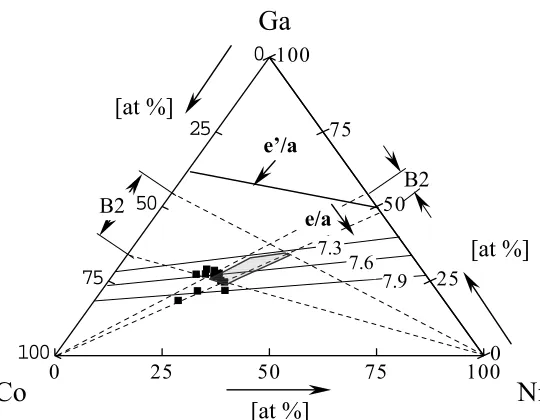
An analysis of the ternary
system for the CoNiGa shape memory
alloys shown in Fig. 1 reflects the
favorable conditions that exist – around
the (Co2NiGa) Heusler-type composition
- for the formation of an ordered solid
solution. Note that the Co-Ni phase
diagram is a significant facilitator because of its large solubility between the components. Of importance is also the
[image:5.612.65.367.394.602.2]extended solubility that can be achieved in quenched state of the other two systems, Ni-Ga and Co-Ga.
Figure 1: Schematic ternary phase diagram showing the favorable conditions for the formation of a B2 phase susceptible (center gray area) of
transforming into martensite. The dotted lines show the extension of the B2 domain for solution treated alloys. Binary phase diagrams constructed after [ ].
50
at%Ni
NiGa CoGa
Ga
The composition of the alloys studied
in this paper and for which a phase
transformation has been observed are presented
in Fig.2 and fall around the compositional range
of the B2 phase of the binary Ni-Ga and Co-Ga
systems of alloys.
The Bethe-Slater curve suggests that
high values of the saturation magnetization can
be obtained for electron / atom (e/a) ratios larger
than 7.3. If we take into consideration both the
metallurgical observations and the electron /
atom lines (Figure 2), it can be observed that the
CoNiGa alloys analyzed in this study fulfill the above-mentioned conditions.
0 25 50 75 100
0
25
50
75
100 0
25 50 75 100
[image:6.612.63.333.98.308.2] [image:6.612.65.428.437.563.2]
e’/a
[at %]
[at %]
7.9
Ga
Ni
Co
Figure 2: Compositional range for the formation of Co2NiGa
FMSMAs (see text for details). The black dots mark the alloys investigated in this study.
[at %]
7.3
e/a
7.6
B2 B2
Figure 3a shows the microstructure of a Co50Ni23.5Ga26.5 alloy. The structure is composed of Co-rich (up to 60
at%) dendrites in a Ga-rich (around 29 at%) matrix. The examination in polarized light of a thermally cycled sample
suggests that the martensite
structure develops in the
Ga-rich phase rather than in the
Co-rich one. A typical shape
memory martensitic structure
has been observed in a
Ga-rich alloy (Fig. 3b), while
further examinations revealed
typical hierarchical variants.
Precipitate
b
a
Matrix
Figure 3: Microstructure of Co2NiGa alloys:
a. Co rich precipitates and Ga-rich matrix with martensite formations in a Co50Ni23.5Ga26.5 alloy;
b. typical martensitic structure in a Co50Ni22.25Ga27.75 alloy
According to the phase diagrams (Figs.1,2) the presence of a Co-rich phase in a Ga-rich matrix is likely to
into martensite, especially in the quenched state. This conclusion is strengthened by neutron diffraction studies that
suggests the presence of a Co phase for the stoechiometric composition.
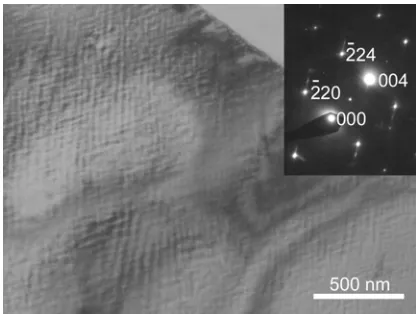
Figure 4 shows a typical TEM images taken from CoNiGa martensites. The analysis of selected area electron
diffraction (SAED) patterns suggests that the parent phase transforms to tetragonal or orthorhombic martensites, in
agreement with the neutron
and X-ray studies.
High-density striations are observed
in the bright field image.
SAED pattern and dark field
image revealed that they are
composed of thin twin plates.
Preliminary neutron scattering
and X-ray diffraction profiles suggest that Heusler-type cubic austenites transform into tetragonal and/or orthorhombic
martensites [18]. The profiles allow an estimation of the lattice constant of the parent phase, 0.575 nm. The tetragonal
and orthorhombic distortion are estimated at c/a ≈ 0.86 and c/b ≈ 0.88.
Figure 4: Internal twins and the corresponding SAED pattern of CoNiGa martensites: (a) Bright field image, (b) SAED pattern taken of (b),
[image:7.612.68.412.191.310.2](c) Dark field image using the circled reflections in (b).
Figure 5 shows a TEM micrograph taken of the
Co50.1Ni20.9Ga29.0 alloy, with the Ms temperature lower than
room temperature. Tweed contrast was frequently observed in
the parent-phase. It is generally known that precursor
phenomenon of martensitic transformation [19], e.g. tweed
contrast in TEM microstructure, lattice softening and diffuse
scattering of X-rays and electrons, can be observed in β-phase
alloys. It is proposed that the broad inflections of the modulus
defect versus T curves were caused by the precursor
phenomenon.
[image:7.612.67.275.445.602.2]The thermoelastic character
of the martensite has been obseved on
heating and cooling the Ga-rich
specimen. The corresponding
elasto-mechanical behavior of a sample
prepared from the same alloy shows a
phase transition detected by both the
internal friction and modulus defect.
The results are associated in fig. 5. It
can be seen that the transition is
typical for shape memory alloys in
that it associates the structural and elastomechanical changes to changes in the temperature, in a reversible manner. A
similar microstructural change has been observed in a sample with Co-rich precipitates but only for the Ga-rich matrix.
The transition temperature was slightly higher than the one observed in the sample without precipitates (with lower Ga
content).
20 40 60 80 100 120 140 160 0.001 0.002 0.003 0.004 0.005 Temperature Da m p in g -0.20 -0.15 -0.10 -0.05 0.00 M odul us D e fe c t RT
75 oC
85 oC
[image:8.612.91.360.96.281.2]110 oC
Figure 5: Elasto-mechanical (damping (■) and modulus defect (○)) and
microstructural changes (inserts taken on heating) observed during the thermal cycling of a Co50Ni22Ga28 FMSMA.
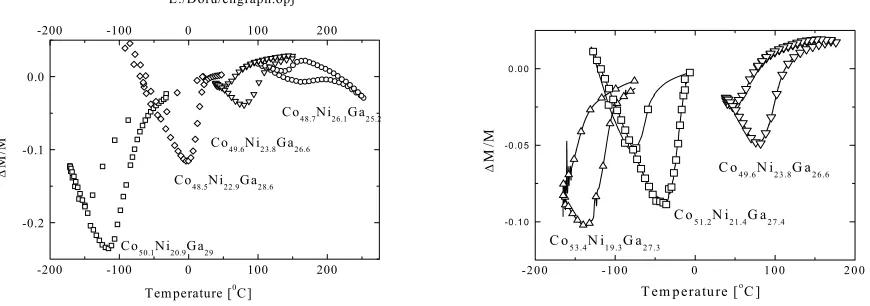
The change in the modulus defect associated with the martensitic transformation in Co2NiGa alloys is shown
in figs. 6a and b. Figure 6a describes the behavior of alloys with a 49.3±0.8 at% Co while fig. 6b describes the behavior
Figure 6: Phase transformations observed in the CoNiGa FMSMA system by changes in the modulus defect as a function of temperature for alloys with: (a) Co= 49.3±0.8 at % and (b) Ga = 27±0.4 at %.
-20 0 -10 0 0 1 0 0 2 0 0
-0 .1 0 -0 .0 5 0 .0 0
C o49 .6N i23 .8G a26 .6
C o51 .2N i21 .4G a27 .4
C o53 .4N i19 .3G a27 .3
∆
M/
M
T em perature [o
C ]
-200 -100 0 100 200 -0.2
-0.1 0.0
-200 -100 0 100 200
E:/Doru/cngraph.opj
Co48.7Ni26.1Ga25.2
Co49.6Ni23.8Ga26.6
Co48.5Ni22.9Ga28.6
Co50.1Ni20.9Ga29
∆
M/
M
[image:8.612.82.517.500.653.2]of alloys with 27±0.4 at% Ga. In both cases it can be seen that the transition temperature and the amplitude of the
transformation are composition-dependent (fig.7).
The microstructural analysis suggests that the cause for the
decrease in the amplitude resides in the presence of the Co-rich
precipitates. The higher the Co/Ga ratio, the more precipitates form and
the less the matrix. The latter one is the one that transforms and causes
the change observed in the modulus defect.
The change in the transition temperature is tentatively attributed
to the Ga content of the matrix. The lower the Ga content is, the higher
the transition temperature. The analysis of the binary Co-Ga and Ni-Ga
phase diagrams suggests that Ga content of the matrix can be reduced by
solution treatment followed by quenching. Accordingly the
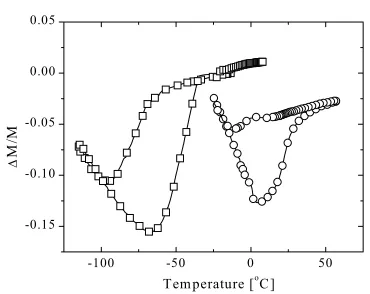
quenched state of a Co-rich two-phase alloy in the CoNiGa
system should show a higher transition temperature
compared to the unquenched one because of the higher
solubility at high temperatures. This assumption is verified
by the experimental data presented in fig. 8 that shows the
phase transitions for a two-phase Co50Ni25Ga25 single crystal
before and after quenching. An increase in the
transformation temperatures has been observed after
water-quenching from 900 oC. Upon further annealing of the
quenched sample, followed by slow cooling, the
transformation reverted toward the low temperatures while a
subsequent solution treatment followed by quenching shifted the transformation toward high temperatures again.
[image:9.612.82.222.157.269.2]0 100 200 300 400 500 48/27 20/30 20/30 50/25 28/22 24/26 20/30 MS [K ] Ni/Ga Co/Ni
Figure 7: Changes in the martensitic start (Ms) temperature as a function
of the component ratio for the investigated CoNiGa alloys.
-100 -50 0 50 -0.15 -0.10 -0.05 0.00 0.05 ∆ M/ M
Tem perature [o
C]
Figure 8: The influence of quenching on the martensitic phase transformation of a Co50Ni25Ga25 single
crystal (before quenching and after annealing followed by slow cooling (□), and after quenching (○)).
A similar shift in the transition temperature range has been observed in quaternary Co-Ni-Ga-Al alloys as a
result of replacing part of Ga or Ni by Al. Figure 9 shows that a slightly higher transition temperature can be reached for
[image:9.612.79.264.367.514.2]Al. However, the amplitude of the transformation
seems to diminish when Ga is replaced by Al. It
can be concluded – for the compositional range
investigated - that while Al can be used to shift t
transformation temperature, it also has nega
effects on the amplitude of the transforma
very likely because it favors the formation of
new precipitates.
he
tive
tion,
Recent studies of the NiMnGa system
[11, 12] showed a relationship between the
electron / atom ratio (e/a) and the transformation
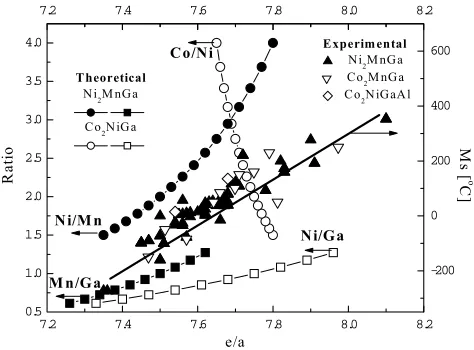
temperatures. The comparative experimental data presented in fig. 10 proves that a similar relationship seems to exist
for the Co-base FMSMAs, and therefore the transformation mechanisms could be the same for both systems. However a
theoretical analysis of the e/a ratio for stoechiometric Ni2MnGa and Co2NiGa alloys shows that while the influence of
the ratio between the last two components for
each alloy family – Mn/Ga and Ni/Ga
respectively – is similar, the influence of the
ratio of the first two components is totally
different. Figure shows that - for NiMnGa –
higher e/a – hence higher transition
temperatures – can be achieved by increasing
the Ni/Mn ratio. The same goal can be
obtained for CoNiGa alloys by reducing the
Co/Ni ratio. This observation is consistent
with the experimental data showed in figs. 6
and 7.
-100 -50 0 50 100 150 200 250
-0.1 0.0
Co50Ni22Ga28
Co50Ni24Ga26
Co50Ni24Ga24Al2 Co50Ni22Ga26Al2
∆
M/
M
Temperature [oC]
Figure 9:The effect of Al addition on the martensitic transformation in Co2NiGa FMSMAs.
7.2 7.4 7.6 7.8 8.0 8.2
0.5 1.0 1.5 2.0 2.5 3.0 3.5 4.0 Ms [ o C] Theoretical
Ni2M nGa Co2NiGa
M n/Ga Ni/M n Ni/Ga Co/Ni Ra ti o e/a
7.2 7.4 7.6 7.8 8.0 8.2
-200 0 200 400 600 Experimental
[image:10.612.91.328.429.604.2]Ni2M nGa Co2M nGa Co2NiGaAl
Figure 10: Theoretical evaluation of the relationship between the components ratio and e/a for stoichiometric Heusler-type FMSMAs associated with experimental data showing the Ms
4. CONCLUSIONS
CoNiGa FMSMA system has been investigated from microstructural and elasto-mechanical perspectives. The
phase transition observed resembles the one known for NiMnGa FMSMAs. It also benefits from the favorable
conditions that exist in the ternary Co-Ni-Ga system for the formation of a solid solution in the vicinity of the
Heusler-type composition. This B2 phase transforms into martensite in a thermoelastic and reversible manner, and
as proved by both structural and elasto-mechanical data.
The microstructural analysis shows that for lower Ga content (xGa<26at%), the formation of Co-rich
precipitates is diminishing the output of the transformation. The martensite seems to develop in areas richer in Ga
than the stoichiometric composition. A solution treatment followed by quenching for an alloy with Co-rich
precipitates increased the transition temperatures by 75 oC, while a subsequent annealing reverted the
transformation toward the initial temperature values. It is therefore suggested that the Co and Ni enriched matrix
are the cause for the increase in the transformation temperatures upon quenching.
The increase in the Ni/Ga ratio has been shown to be effective in increasing the transformation temperatures,
while the increase in the Co/Ni ratio is in indirect relationship with the transformation temperature. These
observations have been confirmed by both theoretical and calculated values of the e/a vs. ratio dependence and
experimental data of the Ms vs. e/a and Ms vs. composition respectively.
ACKNOWLEDGEMENTS
The work was supported by the National Science Foundation, grant DMR0095166, and the Office of Naval
Research, contracts No. MURI N000140110761, N000149910837 and N000140010849.
REFERENCES
1 C.M. Wayman, Scripta Met., 5 (1971) 489. 2 R. Oshima , Scripta Met. 1981;15:829.
3 P.J.Webster , K.R.A. Ziebeck , S.L. Town , M.S. Peak , Phil. Mag. 1984; 49B:295.
4 I.K. Zasimchuk, V.V. Kokorin, V.V. Martynov, A.V. Tkachenko and V.A. Chernenko, Fiz. Met. Metalloved. 6, 110
5 A. Sato, E. Chrishima, K. sana and T. Mori, Acta Metall., 30 (1982), 1177. 6 K. Enami, S. Nenno, Met. Trans. 2 (1971), 1487.
7 V.S. Litinov, L.P. Zelenin, R.S. Schlyar, Fiz. Met. Metall. 31 (1971)138.
8 A. Ayuela, J. Enkovaara, K. Ullakko and R.M. Neeminen, J. Phys.: Condens. Matter. 11 (1999) 2017-2026 9 M. Wuttig , L. Liu , K. Tsuchiya , R.D. James , J. Appl. Phys. 2000;87:4707.
10 K. Oikawa , L. Wulff , T. Iijima , F. Gejima, A. Ohmori, A. Fujita, K. Fukamicji, R. Kainuma, K. Ishida, Appl. Phys.
Letters 2001; 79:3290.
11 V. A. Chernenko, Scripta Mater. 1999:40,5:523.
12 D.L. Schlagel , Y.L. Wu , W. Zhang , T.A. Lograsso , J Alloys and Compounds 2000;312:77. 13 M. Wuttig, J. Li and C. Craciunescu, Scripta Mater. 2001;44:2393
14 C.M. Craciunescu, Y. Kishi and M. Wuttig, submitted to Scripta Mater. 15 C.M. Craciunescu, Y. Kishi and M. Wuttig, submitted to MRS Poceedings
16 L.V. Saraf, C.M. Craciunescu, P. Piccoli, M. Wuttig and R. Ramesh, submitted to Apl. Phys. Lett. 17 Vibran Technologies Inc., www. vibran.com.
18 Y. Kishi, C. Corneliu, D. A. Neumann and M. Wuttig, un-published data. 19 M. Sugiyama, R. Oshima , F.E. Fujita: JIM, vol. 27, No.10, 1986, 719-730.
*[email protected]; **[email protected]; *****[email protected]; phone: 301-405-5212; fax: