O R I G I N A L R E S E A R C H
Body Composition of Filipino Chronic Obstructive
Pulmonary Disease (COPD) Patients in Relation to
Their Lung Function, Exercise Capacity and Quality of
Life
This article was published in the following Dove Press journal: International Journal of Chronic Obstructive Pulmonary Disease
Jamie R Chua 1
Albert B Albay Jr1
Michael L Tee 2
1Division of Pulmonary Medicine,
Department of Medicine, Philippine General Hospital, College of Medicine, University of the Philippines Manila,
Manila, Philippines;2Associate Professor,
Department of Physiology and Division of Rheumatology, Department of Medicine, College of Medicine, University of the Philippines Manila, Manila, Philippines
Background and objectives: The loss of muscle or fat free mass (FFM) as a result of systemic inflammation and poor nutrition in Chronic Obstructive Pulmonary Disease (COPD), is recognized as an important factor that influences symptoms and disease-related outcomes. To date, there are no data on body composition among Filipino COPD patients and how it impacts COPD disease severity. This paper examined the relationship of Fat Free Mass Index (FFMI = FFM/height) and sarcopenia with COPD disease severity variables. Methods: This was a cross-sectional analytic study comparing low and normal FFMI, sarcopenic and nonsarcopenic COPD patients, in terms of lung function, exercise capacity, and quality of life score. Filipino COPD patients older than 40 years were included. Patients performed six minute walking distance (6MWD), handgrip strength (HGS), and quality of life status evaluation using Filipino version of COPD Assessment Test (CAT). Body compo-sition was measured using bioelectrical impedance analysis (BIA).
Results:A total of 41 patients were included. The mean age was 69.22 years. The prevalence of being underweight and having sarcopenia was 32% and 46%, respectively. Point biserial correlation showed that COPD patients with low FFMI had a statistically significant reduction in peak inspiratoryflow (r=−0.5791, P value 0.0002), peak expiratoryflow (r=−0.4475, P value 0.0055), and handgrip strength (r=−0.4560, P value 0.0027); and lower CAT score (r=−0.3422, P value 0.0285). Similarfindings were observed among sarcopenic COPD patients.
Conclusion: The prevalence of being underweight and having sarcopenia was high. Low FFMI results in reduction of lung function and upper limb muscle strength among Filipino COPD patients.
Keywords:chronic obstructive pulmonary disease, nutrition, body composition, sarcopenia, lung function
Introduction
Chronic Obstructive Pulmonary Disease (COPD) remains among the top 10 leading causes of mortality in the Philippines.1 Aside from lung involvement, COPD patients usually have extrapulmonary comorbidities, with cardiovascular, muscu-loskeletal, and psychologic conditions being the most prevalent.2The presence of oxidative stress and altered circulating levels of inflammatory mediators as reflected by acute-phase proteins give rise to a chronic inflammatory state in COPD, which can lead to weight loss, muscle wasting, and tissue depletion.3
Correspondence: Jamie R Chua Division of Pulmonary Medicine, Department of Medicine, Philippine General Hospital, College of Medicine, University of the Philippines Manila 25 Caimito Street, South Caloocan City, Metro Manila 1400, Philippines Tel +63 224164308
Email [email protected]
International Journal of Chronic Obstructive Pulmonary Disease
Dove
press
open access to scientific and medical research Open Access Full Text Article
International Journal of Chronic Obstructive Pulmonary Disease downloaded from https://www.dovepress.com/ by 118.70.13.36 on 22-Aug-2020
In COPD patients over 50 years of age, there is a 1–2% annual reduction of muscle mass, which was correlated to reduced exercise capacity, functional performance, and muscle strength.4 This phenomenon, known as sarcope-nia – a syndrome characterized by progressive skeletal muscle loss, reduced muscle strength and physical perfor-mance, has been shown to be twice as prevalent among COPD patients versus normal elderly population.5 Furthermore, data6have shown that COPD patients with low muscle mass, as measured by Fat Free Mass Index (FFMI = FFM/height m2) have lower quality of life scores,7and higher mortality.8
The body mass in a two-compartment model is divided in fat mass (FM), and fat-free mass (FFM), an indirect measure of muscle mass. Measurement of body weight or BMI does not accurately reflect body composition changes. For this reason, the European Respiratory Society (ERS) created a multidisciplinary task force for nutritional assessment,9 where anthropometry, Dual Energy X-ray Absorptiometry (DEXA), and Bioimpedance analysis (BIA) were recom-mended for body composition evaluations in clinical prac-tice. The widely used cut-off low FFMI values among COPD patients were based on American Thoracic Society (ATS) and ERS guidelines on Pulmonary rehabilitation10at FFMI <16 kg/m2and <15 kg/m2, for males and females, respec-tively. However, a large European COPD cohort study by Vestbo et al8used the lowest 10th percentile of the general population in defining low FFMI instead.
In defining sarcopenia, European Working Group Society on Older People (EWGSOP) recommends the use of normative data derived from the study population, with equal to or below the mean minus two standard deviations.11 A study done by Tee et al,12 where FFMI from healthy young adult Filipinos was measured using BIA, and normality of the distribution of the data was assessed, determined the Philippine normative values for defining sarcopenia among normal elderly at FFMI values <12.50 kg/m2for males and <8.33 kg/m2for females.
Proper nutritional risk assessment and intervention are essential components of pulmonary rehabilitation, the cor-nerstone in the comprehensive management of COPD patients. However, the substantial differences in the current diagnostic cut-off points for low FFMI across populations are not reflective of race and environmental factors, and to date, there are no correlative data on body composition and cut-off values for low FFMI among Filipino COPD patients.
This paper aimed to describe body composition of Filipino COPD patients, compare and determine the appropriate
cut-off values in defining low FFMI among Filipino COPD patients, and examine the relationship of low FFMI, presence or absence of sarcopenia with disease severity variables (lung function severity, exercise capacity, and quality of life score).
Methods
Study Population
Adult Filipino COPD patients older than 40 years attending Philippine General Hospital were included in this study. Diagnosis of COPD was made on the basis of the Global Initiative for Chronic Obstructive Lung Disease (GOLD) criteria:13history of chronic cough, sputum production and dyspnea, significant exposure to risk factors such as tobacco, and post-bronchodilator FEV1/FVC ratio < 0.70 on spirome-try. Patients were recruited if they reported significant expo-sure to smoking or noxious gas (i.e, biofuel); had undergone pulmonary function testing with a spirometer; and had a post-bronchodilator FEV1/FVC ratio < 0.70. Exclusion criteria included: age <40 years, active infectious lung disease, med-ical conditions that can affect lean body mass or physmed-ical performance such as active neoplastic disease, hyperthyroid-ism, lower-leg trauma or severe muscle weakness, and con-ditions that will limit performing dual energy X-ray absorptiometry (DEXA) or conditions that would affect DEXA results such as recent barium intake, metallic instru-mentation, and morbid obesity.
This study was conducted in accordance with the Declaration of Helsinki, and was approved by the Departmental Technical Review Board and Research Ethics Board, Philippine General Hospital, University of the Philippines Manila (Registration number 2018–270). Informed consent forms available in English and Filipino version were obtained from all subjects.
Data Collection Procedure
Participants were interviewed and examined to obtain rele-vant demographic and health information. Measurements for anthropometrics, body composition via BIA, hand grip strength and six-minute walking distance were performed and recorded as follows:
(A) Anthropometric measures
Subjects were weighed after they removed heavy outer gar-ments, shoes, and emptied their pockets. It was recorded to the nearest 0.1 kg. Afterwards, height was recorded using
International Journal of Chronic Obstructive Pulmonary Disease downloaded from https://www.dovepress.com/ by 118.70.13.36 on 22-Aug-2020
a stadiometer to the nearest centimeter. BMI was calculated by dividing weight (Kg) by height (meter2).
(B) Body composition
Fresenius Body Composition Monitor was used to deter-mine lean tissue mass or Fat Free Mass. Standard manu-facturer protocols were followed.
(C) Hang Grip Strength (HGS)
The subjects were asked to stand and hold the dynam-ometer in the hand to be tested, with the arm at right angles and the elbow by the side of the body. When ready, the subjects squeezed the dynamometer with max-imum isometric effort, which was maintained for about five seconds. The assistant recorded the maximum reading in kilograms (kg). The subjects repeated the test three times, with 30 s rest in between. The assistant recorded the highest value to document each subject’s performance.
(D) Six-minute walking distance
Subjects performed six-minute walking test according to international standards. Single personnel duly-trained from the section of Pulmonary Medicine conducted all six-minute walking tests.
(E) Quality of life
Filipino version of COPD assessment tool (CAT) was used to evaluate quality of life. This version of the question-naire has already been validated. Appropriate permission for the use of the questionnaire was obtained. Cut-offs for low quality of life score is a value score <10, a criterion used patient stratification in 2018 GOLD guidelines.13
(F) Pulmonary Function Test
MIR spirolab III diagnostic spirometer was used for pul-monary function test. Personnel duly-trained from the sec-tion of Pulmonary Medicine conducted the tests. However, patients with spirometry results within one year from recruit-ment may not have repeat examination.
Low FFMI and Sarcopenia
Three cutoff values were compared to define low and normal Fat Free Mass Index (FFMI = FFM/height m2):
1. ATS/ERS Criteria10 for low FFMI: <16.0 kg/m2 (M) and <15.0 kg/m2(F);
2. Philippine Normative Value12 for sarcopenia: <12.50 kg/m2(M) and <8.33 kg/m2(F);
3. Extrapolated 10th percentile values based on Population specific cohort:12 <13.8 kg/m2(M) and <10.5 kg/m2(F).
Sarcopenia was defined using EWGSOP definition of low muscle mass and either low muscle strength or low phy-sical performance. Cutoff point specific for Filipinos:12
1. low muscle mass as defined by criteria 2;
2. low muscle strength defined as hand grip strength of <24.54 kg for males and <16.10 kg for females.12
Sample Size, Sampling and Data Analysis
Power analysis for a point biserial correlation was conducted in G*Power to determine a sufficient sample minimum sample size was computed using G*Power. At least 41 study partici-pants are needed for a two-tailed point biserial correlation to achieve a power of 0.80, with a level of significance of 0.05, and a medium to large effect size (ρ = 0.41).14Pulmonary Medicine outpatient clinics were conducted twice per week; convenient sampling was used to achieve sample size.
Statistical analyses were performed using STATA (ver-sion 15.1; StataCorp, College Station, TX, USA). The quan-titative variables age, BMI, post-bronchodilator FEV1, FEV1/FVC, PIF, PEF, 6MWD, and hand grip strength, were expressed as mean ± SD. The categorical variables gender, comorbidities, 2018 GOLD classification,14GOLD stage and CAT, were expressed as count (with proportion).
Point biserial correlation coefficients were computed to determine the relationship between the quantitative vari-ables [pulmonary function (post-bronchodilator FEV1, FEV1/FVC, PIF, PEF); 6MWD; and CAT score] and the dichotomous variables [fat free muscle index (FFMI) low vs. normal; and presence or absence of sarcopenia]. Significant correlation coefficients (r≠0) were determined by evaluating p-values atα= 0.05.
Results
Baseline Characteristics
Forty-three (43) patients were recruited and interviewed for this study, two (2) patients were excluded due to active lung infection, and history of neoplastic disease. The base-line characteristics, demographics, and body composition
International Journal of Chronic Obstructive Pulmonary Disease downloaded from https://www.dovepress.com/ by 118.70.13.36 on 22-Aug-2020
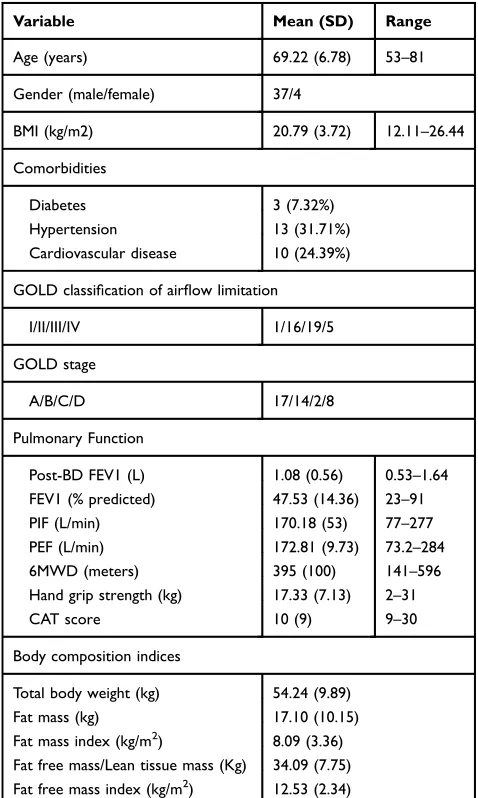
indices of the patients (n=41) are shown in Table 1. Majority of the subjects were elderly with mean age of 69.22 years, male, with GOLD III classification of airflow limitation and GOLD stage A. The prevalence of being underweight (WHO Asia Pacific criteria BMI <18.5 kg/ m2) was 32% (13/41). 25% (7/28) of normal weight COPD patients had hidden muscle depletion (7/28).
Diagnosis of Low FFMI
The characteristics of patients with “low” and “normal” FFMI using three cutoff points are illustrated in Table 2.
The ATS/ERS criteria, extrapolated 10th percentile value and Philippine normative value for sarcopenia diagnosed 97%, 73%, and 48% of all COPD patients with low FFMI, respectively.
Using the Philippine normative value for sarcopenia cutoff point, COPD patients with low FFMI had statisti-cally significant reduction in PIF (r= −0.5791, P value 0.0002), PEF (r= −0.4475, P value 0.0055), and hand grip strength (r= −0.4560, P value 0.0027), however low CAT score (r=−0.3422, P value 0.0285). Significant power was achieved in PIF (99%), PEF (88%), and HGS (89%) (Table 3).
Sarcopenic versus Nonsarcopenic COPD
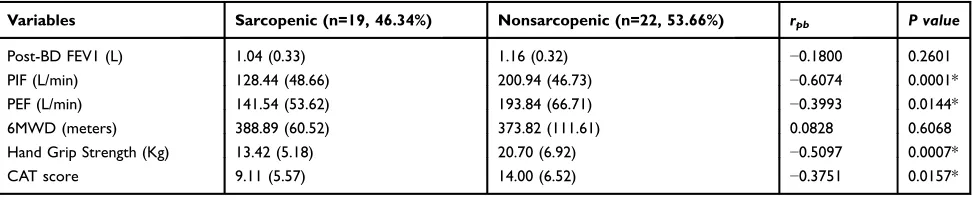
As shown inTable 4, sarcopenic COPD patients had statis-tically significant reduced peak inspiratoryflow (r=−0.6074, P value 0.0001), peak expiratoryflow (r=−0.3993, P value 0.0144), hand grip strength (r=−0.3751, P value 0.0007), and CAT score (r=−0.3751, P value 0.0157) compared to non-sarcopenic patients.
Discussion
Our study shows that sarcopenia negatively affects pulmon-ary function among COPD patients, and, as novelty, is the first attempt to describe body composition of Filipino COPD patients. We examined the relationship between body com-position, lung function and exercise capacity, in individuals with“low”or“normal FFMI”according to standard versus population specific cutoff values using bioelectrical impe-dance analysis–an easy, safe, noninvasive, and convenient method of measuring lean and fat body compartments.
The results of this study showed 32% prevalence of being underweight, which is higher than Latin Americans15 and other Asian populations (6–10%).16,17 The disparities seen might be attributed to ethnic differences in body habitus, and perhaps, economic development of countries. Around 25% of normal weight/BMI COPD patients had nutritional deple-tion as evidenced by low FFMI. Thisfinding is higher com-pared to other studies17where 9–10% of patients normal or high BMI can be associated with FFM depletion. Therefore, BMI can underestimate FFM depletion. Meanwhile, sarco-penia was observed in 35% of our COPD patients, which is again higher compared to another Asian COPD population (vs. 24–25%).18
The ATS/ERS criteria cut-off values over-diagnosed low FFMI, as evidenced by 97% diagnosis. These cut-off values were based on 5th percentile of the normative data of Caucasian population using electromagnetic scanning Table 1 Baseline Characteristics, Demographics, and Body
Composition Indices
Variable Mean (SD) Range
Age (years) 69.22 (6.78) 53–81
Gender (male/female) 37/4
BMI (kg/m2) 20.79 (3.72) 12.11–26.44
Comorbidities
Diabetes 3 (7.32%)
Hypertension 13 (31.71%)
Cardiovascular disease 10 (24.39%)
GOLD classification of airflow limitation
I/II/III/IV 1/16/19/5
GOLD stage
A/B/C/D 17/14/2/8
Pulmonary Function
Post-BD FEV1 (L) 1.08 (0.56) 0.53–1.64
FEV1 (% predicted) 47.53 (14.36) 23–91
PIF (L/min) 170.18 (53) 77–277
PEF (L/min) 172.81 (9.73) 73.2–284
6MWD (meters) 395 (100) 141–596
Hand grip strength (kg) 17.33 (7.13) 2–31
CAT score 10 (9) 9–30
Body composition indices
Total body weight (kg) 54.24 (9.89)
Fat mass (kg) 17.10 (10.15)
Fat mass index (kg/m2) 8.09 (3.36)
Fat free mass/Lean tissue mass (Kg) 34.09 (7.75)
Fat free mass index (kg/m2) 12.53 (2.34)
Abbreviations:BMI, body mass index; GOLD, global initiative for chronic obstructive lung disease; post-BD, post-bronchodilator; FEV1, forced expira-tory volume in 1 second; FVC, forced vital capacity; 6MWD, 6-minute walking distance; PEF, peak expiratoryflow; PIF, peak inspiratoryflow; CAT, COPD assessment test; DEXA, dual energy X-Ray absorptiometry; BIA, bioimpedance analysis.
International Journal of Chronic Obstructive Pulmonary Disease downloaded from https://www.dovepress.com/ by 118.70.13.36 on 22-Aug-2020
instrument,19 whose body habitus are larger and preva-lence of obesity is higher. Therefore, these cutoff values were not applicable to our population. Hence, population specific cutoff values for defining low FFMI12 were com-pared using the−2SD and 10th percentile values resulting in 48% and 78% diagnosis, in which the former has gen-erally at close proximity of prevalence to another Asian COPD population.16 The Philippine normative value cut-off for sarcopenia has proven its strength to show impact on clinically significant COPD related disease severity variables; nonetheless the authors support the use of the less stringent criteria, the extrapolated 10th percentile values, as screening cutoff for COPD patients. These criteria allow clinical interventions before the onset of clinically significant irreversible effects of muscle loss on pulmonary function and muscle strength.
The study showed significant correlation between low FFMI, sarcopenia, and impaired lung function, expressed as PIF and PEF, but not FEV1. Thesefindings showed that fat free mass affects respiratory muscle strength variables, and not airflow obstruction. These results validated a previous study by Engelen et al,20where nutritional depletion was correlated with decreased function of both muscle groups, preferentially peripheral muscles. The clinical utility of PIF and PEF as measures of a patient’s inspiratory and expiratory effort, are useful to assess the patient’s ability to do effective inhalation for inhaler medication21and for monitoring disease stability.22 Interestingly, our study showed that quality of life scores as measured by COPD assessment test (CAT) were lower among the low FFMI and sarcopenic group, which is con-trary to other studies.23,24In the study of Shoup et al,24where St. Georges’Respiratory Questionnaire was utilized as mea-sure of health-related quality of life, influence of nutritional depletion was mediated through increased levels of dyspnea. However, since the study was limited to information of patients’inhaler compliance (pharmacologic intervention to address dyspnea), its potential contribution to disparity of results is likely.
Lastly, our study was limited by its primary design as a relationship study between ordinal (low/normal FFMI) and continuous variables (COPD related disease severity variables), hence we recommend larger sample size for precise correlation between two continuous variables.
Conclusion
The prevalence of having sarcopenia and being under-weight is higher among Filipino COPD patients than shown in other population studies. Low Fat Free Mass
T able 2 Pulmonar y Function T est and COPD Disease Se verity V ariables According to Low versus Normal FFMI Using Thr ee Cutoff P oints A TS/ERS Criteria Extrapolated 10th P er centile Philippine Normativ e V alue for Sar copenia Lo w FFMI (n=40, 97.56%) Normal FFMI (n=1, 2.44%) rpb P value Lo w FFMI (n=30, 73.17%) Normal FFMI (n=11, 26.83%) rpb P value Lo w FFMI (n=20, 48.78%) Normal FFMI (n=21, 51.22%) rpb P value P ost-BD FEV1 (L) 1.11 (0.33) 0.76 ( − ) 0.1648 0.3031 1.12 (0.34) 1.05 (0.32) 0.1039 0.5178 1.04 (0.33) 1.17 (0.33) − 0.2009 0.2080 PIF (L/min) 162.88 (59.55) 228 ( − ) − 0.1793 0.0878 155.31 (63.13) 189.1 (43.19) − 0.2536 0.1356 132.00 (49.76) 201.24 (48.15) − 0.5791 0.0002* PEF (L/min) 168.08 (66.36) 180 ( − ) − 0.0295 0.8622 166.62 (70.56) 173.2 (52.18) − 0.0446 0.7931 139.88 (52.61) 198.50 (65.39) − 0.4475 0.0055* 6MWD (meters) 337.80 (89.88) 501 ( − ) − 0.2093 0.1891 385.27 (65.73) 368.64 (142.25) 0.0811 0.6140 388.70 (58.91) 373.29 (114.34) 0.0848 0.5979 Hand grip str ength (Kg) 17.06 (7.01) 28 ( − ) − 0.2368 0.1361 16.57 (6.83) 19.41 (7.83) − 0.1767 0.2690 14.00 (5.67) 20.50 (7.02) − 0.4560 0.0027* C A T scor e 11.48 (6.38) 22 ( − ) − 0.2495 0.1157 10.43 (6.44) 15.27 (5.50) − 0.3295 0.0354* 9.45 (5.63) 13.90 (6.66) − 0.3422 0.0285* Note: *Indicates statistical signi fi cance. Abbre viations: post-BD , post-br onchodilator ; FEV1, for ced expirator y volume in 1 second; FVC , for ced vital capacity; 6MWD , 6-minute walking distance; PEF , peak e xpirator y fl ow; PIF , peak inspirator y fl ow; C A T , COPD assessment test; rpb , (point biserial coef fi cient).
International Journal of Chronic Obstructive Pulmonary Disease downloaded from https://www.dovepress.com/ by 118.70.13.36 on 22-Aug-2020
Index and sarcopenia were correlated with reduced lung function and upper arm muscle strength. These findings shall serve as a foundation for future studies to establish appropriate rehabilitation and nutritional support to preserve lung function among COPD patients.
Acknowledgements
Partial funding for this project was provided through the Research Unit Fund from previous Department of Science and Technology grant of Dr. Michael Tee. The authors would like to acknowledge the assistance and support given by Dr. Jaime C. Montoya of Philippine Council for Health Research and Development and Research Grant Administration Office of the University of the Philippines Manila. The authors would like to thank Dr. Elizabeth Montemayor, Chair of the Department of Physiology, University of the Philippines- Manila, College of Medicine for lending us the body composition monitor; staff and Fellows of Division of Pulmonary Medicine; Dr. Davidson Pastrana of Nuclear Medicine; Ms. Chen Calma, Mr. Rainer Ramos and Mr. Wilson de Leon, our trained research assis-tants, and Dr. Emilio Villanueva III who helped us with the statistical data analysis.
Author Contributions
Study concept and design: JRC, ABA, MLT; COPD data acquisition: JRC, ABA; sarcopenia data acquisition: MLT; quality control of data and algorithms: JRC, ABA, MLT; data analysis and interpretation: JRC, ABA, MLT; statis-tical analysis: JRC, ABA, MLT; manuscript preparation: JRC, ABA, MLT; manuscript editing, review and final approval: JRC, ABA, MLT. All authors contributed to data analysis, drafting or revising the article, gave final approval of the version to be published, and agree to be accountable for all aspects of the work.
Disclosure
The primary author has no conflict of interest in any form (financial, proprietary, professional) with the study, how-ever the co-author (ABA) has acted as a paid freelance lecturer for Abbott and Nestle Philippines but did not receive funding for research carried out in this work. The authors report no other conflicts of interest in this work.
References
1. Deaths in the Philippines, 2016. Philippine Statistics Authority. [Internet]. February2018. Available from: https://psa.gov.ph/content/
deaths-philippines-2016.
Table 3Power Analysis of Point Biserial Correlation
ATS/ERS Extrapolated 10th Percentile Philippine Normative Value for Sarcopenia
Effect Size Achieved Power Effect Size Achieved Power Effect Size Achieved Power
Post-BD FEV1 (L) 0.1648 18% 0.1039 10% −0.2009 25%
PIF (L/min) −0.1793 21% −0.2536 37% −0.5791 99%*
PEF (L/min) −0.0295 5% −0.0446 6% −0.4475 88%*
6MWD (meters) −0.2093 27% 0.0811 8% 0.0848 8%
Hand grip strength −0.2368 33% −0.1767 20% −0.4560 89%*
CAT score −0.2495 36% −0.3295 59% −0.3422 62%
Note:*Indicates significant power was achieved.
Abbreviations:post-BD, post-bronchodilator; FEV1, forced expiratory volume in 1 second; FVC, forced vital capacity; 6MWD, 6-minute walking distance; PEF, peak expiratoryflow; PIF, peak inspiratoryflow, CAT, COPD assessment test.
Table 4Pulmonary Function Test and COPD Disease Severity Variables According to Presence and Absence of Sarcopenia
Variables Sarcopenic (n=19, 46.34%) Nonsarcopenic (n=22, 53.66%) rpb P value
Post-BD FEV1 (L) 1.04 (0.33) 1.16 (0.32) −0.1800 0.2601
PIF (L/min) 128.44 (48.66) 200.94 (46.73) −0.6074 0.0001*
PEF (L/min) 141.54 (53.62) 193.84 (66.71) −0.3993 0.0144*
6MWD (meters) 388.89 (60.52) 373.82 (111.61) 0.0828 0.6068
Hand Grip Strength (Kg) 13.42 (5.18) 20.70 (6.92) −0.5097 0.0007*
CAT score 9.11 (5.57) 14.00 (6.52) −0.3751 0.0157*
Note:*Indicates statistical significance.
Abbreviations:post-BD, post-bronchodilator; FEV1, forced expiratory volume in 1 second; FVC, forced vital capacity; 6MWD, 6-minute walking distance; PEF, peak expiratoryflow; PIF, peak inspiratoryflow; CAT, COPD assessment test;rpb,(point biserial coefficient).
International Journal of Chronic Obstructive Pulmonary Disease downloaded from https://www.dovepress.com/ by 118.70.13.36 on 22-Aug-2020
2. Patel AR, Hurst JR. Extrapulmonary comorbidities in chronic obstructive pulmonary disease: state of the art.Expert Rev Respir Med.2011;5(5):647–662.
3. Wouters EF, Creutzberg EC, Schols AM. Systemic effects in COPD.
Chest. 2002;121(5Suppl):127S–130S. doi:10.1378/chest.121.5_suppl. 127S
4. Costa TM, Costa FM, Moreira CA, Leda MR. Sarcopenia in COPD: relationship with COPD severity and prognosis.J Bras Pneumol.
2015;41(5). doi:10.1590/S1806-37132015000000040
5. Iwai K, Hayashi H, Nakano Y. Relationship between muscle strength, fat free mass and exercise capacity in patients with chronic obstruc-tive pulmonary disease. Physiotherapy. 2015;101:e661–e662. doi:10.1016/j.physio.2015.03.3499
6. Schols AM, Broekhuizen R, Weling-Scheepers CA, Wouters EF. Body composition and mortality in chronic obstructive pulmonary disease.Am.J Clin Nutr.2005;82(1):53–59. doi:10.1093/ajcn/82.1.53 7. Gologanu D, Ionitab D, Gartonea T, et al. Body composition in patients with chronic obstructive pulmonary disease. J Clin Med.
2014;9(1):201.
8. Vestbo J, Prescott E, Almdal T, et al. Body mass, fat-free body mass, and prognosis in patients with chronic obstructive pulmonary disease from a random population sample.Am J Respir Crit Care Med.
2006;173:79–83.
9. Schols AM, Ferreira IM, Franssen FM, et al. Nutritional assessment and therapy in COPD: a European Respiratory Society statement.Eur Respir J.2014;44(6):1504–1520. doi:10.1183/09031936.00070914 10. Nici L, Donner C, Woulters E, et al. American thoracic society/
European respiratory society statement on pulmonary rehabilitation.
AJRCCM.2006;173(12):1390–1413.
11. Cruz-Jentoft AJ, Baeyens JP, Bauer JM, et al. Sarcopenia: European consensus on definition and diagnosis: report of the european working group on sarcopenia in older people.Age Ageing.2010;39:412e23. doi:10.1093/ageing/afq034
12. Tee ML, Tee CA, Montemayor EB. Determination of normative reference for the definition of sarcopenia among Filipinos.
Osteoporos Sarcopenia.2016;2(3):186–190. doi:10.1016/j.afos.2016. 07.004
13. Global Initiative for Chronic Obstructive Lung Disease, GOLD. Global strategy for the diagnosis, management, and prevention of chronic obstructive pulmonary disease. [Internet]; 2018. Available from:
https://goldcopd.org/wp-content/uploads/2017/11/GOLD-2018-v6.0-FINAL-revised-20-Nov_WMS.pdf.
14. Faul F, Erdfelder E, Buchner A, Lang A-G. G*Power Version 3.1.7 [computer software]. Germany:Uiversität Kiel;2013. Available from:
http://www.psycho.uni-duesseldorf.de/abteilungen/aap/gpower3/
download-and-register.
15. Montes de Oca M, Tálamo C, Perez-Padilla R, et al. PLATINO team. Chronic obstructive pulmonary disease and body mass index infive Latin America cities: the PLATINO study. Respir Med. 2008;102 (5):642–650. doi:10.1016/j.rmed.2007.12.025
16. Luo Y, Zhou L, Li Y, et al. Fat-free mass index for evaluating the nutritional status and disease severity in COPD.Respir Care.2016;61 (5):680–688. doi:10.4187/respcare.04358
17. Wu Z, Yang D, Ge Z, Yan M, Wu N, Liu Y. Body mass index of patients with chronic obstructive pulmonary disease is associated with pulmonary function and exacerbations: a retrospective real-world research.J Thorac Dis.2018;10:5086.
18. Limpawattana P, Inthasuwan P, Putraveephong S, et al. Sarcopenia in chronic obstructive pulmonary disease: a study of prevalence and associated factors in the Southeast Asian population.Chron Respir Dis.2018;15:250–257. doi:10.1177/1479972317743759
19. VanItallie TB, Yang MU, Heymsfield SB, Funk RC, Boileau RA. Height-normalized indices of the body’s fat-free mass and fat mass: potentially useful indicators of nutritional status.Am J Clin Nutr.
1990;52(6):953–959. doi:10.1093/ajcn/52.6.953
20. Engelen MPKJ, Schols AMWJ, Baken WC, Wesseling GK, Wouters EFM. Nutritional depletion in relation to respiratory and peripheral skeletal muscle function in out-patients with COPD.Eur Respir J.1994;7:1793–1797. doi:10.1183/09031936.94.07101793 21. Sharma G, Mahler DA, Mayorga VM, Deering KL, Harshaw Q,
Ganapathy V. Prevalence of low peak inspiratoryflow rate at dis-charge in patients hospitalized for COPD exacerbation. Chronic Obstr Pulm Dis.2017;4(3):217–224.
22. So JY, Lastra AC, Zhao H, Marchetti N, Criner GJ. Daily peak expiratory flow rate and disease instability in chronic obstructive pulmonary disease.Chronic Obstr Pulm Dis.2016;3(1):398–405.
23. Mostert R, Goris A, Weling-Scheepers C, Wouters EFM,
Schols AMWJ. Tissue depletion and health related quality of life in patients with chronic obstructive pulmonary disease. Respir Med.
2000;94:859±867. doi:10.1053/rmed.2000.0829
24. Shoup R, Dalsky G, Warner S, et al. Body composition and health-related quality of life in patients with obstructive airways disease.Eur Res J. 1997;10:1576–1580. doi:10.1183/09031936.97. 10071576
International Journal of Chronic Obstructive Pulmonary Disease
Dove
press
Publish your work in this journal
The International Journal of COPD is an international, peer-reviewed journal of therapeutics and pharmacology focusing on concise rapid reporting of clinical studies and reviews in COPD. Special focus is given to the pathophysiological processes underlying the disease, inter-vention programs, patient focused education, and self management
protocols. This journal is indexed on PubMed Central, MedLine and CAS. The manuscript management system is completely online and includes a very quick and fair peer-review system, which is all easy to use. Visit http://www.dovepress.com/testimonials.php to read real quotes from published authors.
Submit your manuscript here:https://www.dovepress.com/international-journal-of-chronic-obstructive-pulmonary-disease-journal
International Journal of Chronic Obstructive Pulmonary Disease downloaded from https://www.dovepress.com/ by 118.70.13.36 on 22-Aug-2020