A Review on Effect of LASER Cutting Process
Parameters on Cut Quality
R. A. Kavare
1, B. R. Shevade
2 1PG Student,
2Assistance Professor, Department of Mechanical Engineering,
Walchand College of Engineering, Sangli, (India)
ABSTRACT
In today’s rapidly changing scenario in manufacturing industries, the metal cutting processes are essential for a
manufacturing unit to respond effectively to severe competitiveness and increasing demand for the quality product in the market. Cutting of sheet metal is considered as an imperative process because of its importance in regular daily existence, for example, ships, aircrafts, cars, furniture and so forth. Among different sheet cutting processes, laser beam cutting is a standout, the most proficient sheet cutting process to make complex geometries with stringent plan necessities in hard-to-cut sheet materials.Optimization methods in laser cutting process considered to be a vital tool for continual improvement of output quality in products and processes. This can be achieved through modeling of input-output and in process parameters to determine optimal cutting conditions. This paper reviews the experimental analysis of laser cutting process parameters, carried out to measurethe impact of laser cutting process parameters on the nature of the cut.
Keywords: Heat Affected Zone, Kerf geometry, laser cutting, Optimization, surface roughness
I. INTRODUCTION
The name LASER is an acronym for "Light Amplification by the Stimulated Emission of Radiation".There are
two main types that have been used in most of all applications are the carbon dioxide (CO2) laser and the
Neodymium-doped Yttrium Aluminium Garnet (Nd-YAG) laser. Laser cutting, in general, is an effective way to
reduce production and manufacturing costs. This is due to the advantage of high production rates as well as the
fact that lasers can be mechanized, computer controlled and integrated into assembly lines. Many industries
have been revolutionized by the application of laser equipment in their production lines. This is because of the
high-quality and low distortion characteristics of the cutting action which can be achieved. Most materials can
be cut by this process including metals, wood, plastics, rubber, and composites etc. except some highly
reflective and conductive materials such as aluminium, gold, copper, and silver are difficult to cut using lasers
and also some of the materials, such as polycarbonate, may produce dangerous exhaust gases[1-2].
1. 1 Mechanisms
There are five distinct mechanisms: inert gas melt shearing; active gas melt shearing; vaporization; chemical
degradation; and scribing.
Active Gas Melt Shearing by replacing the inert assist gas with a reactive gas such as oxygen or air, additional
process energy may be generated through an exothermic chemical reaction. Cutting speeds can thus be increased
in comparison with inert gas melt shearing. The mechanism again relies on the formation of a penetrating cavity,
and so the beam must be focused to produce the required power density. Ferrous alloys and some thermoset
polymers are cut by active gas melt shearing.
Vaporization mechanism normally used with pulsed lasers, and for continuous wave (CW) cutting of materials
that are not easily melted. A high power density is used, material is heated rapidly to the vaporization
temperature before extensive melting though thermal conduction occurs. Material is removed by vaporization
and the ejection of liquid by an inert gas jet.
Chemical Degradation relies on the action of the laser beam to break chemical bonds and form new compounds,
and is an important mechanism in the cutting of wood, thermoset polymers, elastomers and some composites.
Cutting rates are generally lower than melt shearing, and cut edges are of relatively high quality, although
residue may require cleaning.
Scribing the objective of scribing is to create a groove or a series of blind holes at the workpiece surface. Low
energy, high power density pulses cause vaporization with a restricted heat affected zone (HAZ). The notches
serve to raise stress locally such that the material can be fractured along a defined line under subsequent
bending. The mechanism is used for some ceramics, notably alumina, as well as some glasses and composites
[1].
1.2 Principle
Laser cutting is a thermal, non-contact and highly automated process well suited for various manufacturing
industries to produce components in large numbers with high dimensional accuracy and surface finish. It is also
stated that high power density beam when focused in a spot melts and evaporates material in a fraction of
second and the evaporated molten material is removed by a coaxial jet of assisted gas from the affected zone as
shown in fig.1.
Laser cutting is a thermal separation process. Herein, a focused beam of high energy photons is bombarded on
the material to be cut. This beam simply melts the material, and high-pressure gas is used to blow off the
molten material out of the kerf.
2. Process Parameters and Response variables in laser cutting
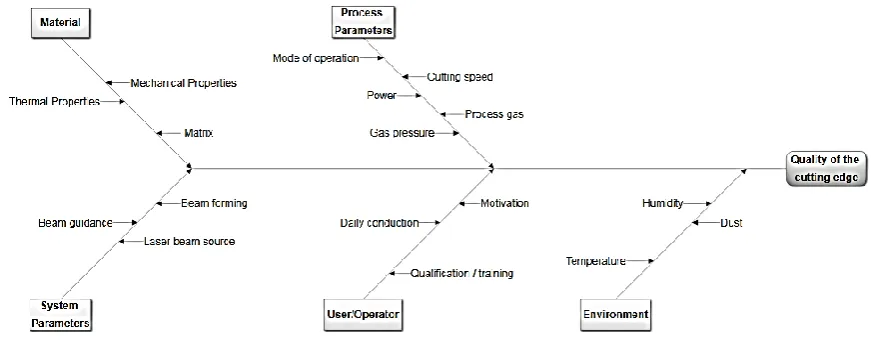
Laser cutting process has always been a major research area for getting the exceptionally good quality of cut.
The laser cutting parameters are dependent on the composition of the material to be cut, its thickness, the beam
characteristics, the cutting rate required, and the desired edge quality that is reduced surface roughness, kerf
width and heat affected zone (HAZ). As shown in fig. 2
Figure 2. Cause and effect diagram of laser beam cutting.
2.1 Process Parameters
2.2.1 Continuous wave (CW) or pulsed laser operations
The highest cutting speeds can be obtained at high power levels in CW-mode operation. Continuous wave
means that the laser power output is constant, without interruption over time.
2.2.2 Laser power and intensity
Laser power is the total energy emitted in the form of laser light per second. The intensity of a laser beam is
equal to its power divided by the area over which the power is concentrated. The high intensity causes the
material to heat up rapidly so that little time is available for heat to dissipate into the surrounding material. This
produces high cutting rates and an excellent quality of cut.
2.2.3 Cutting Speed or Feed Rate
In the laser cutting process, the cutting speed or feed rate is also an important parameter which decides the heat
input in the cutting front and interaction time of laser beam and workpiece.
2.2.4 Focal length of the lens
The focal length of the lens defines the shape of the focused laser beam. A lens with a short focal length
produces a small spot size and a short depth of focus, generally resulting in high speed and good cutting quality
When thicker materials are cut, the depth of focus must be adapted to the material’s thickness by selecting a
longer focal length. As the longer focal length also results in greater focal spot power, it must be increased in
order to maintain intensity and cutting speed.
2.2.5 Wavelength of the laser beam
The absorption in the material being cut is dependent upon the wavelength of the laser beam.
2.2.6 Laser beam mode
A laser beam’s mode refers to the distribution of energy through its cross section. The mode affects the cutting
process, because it affects the size of the focused spot and the intensity of the focused beam and also it affects
intensity distribution in the beam and focus and, as a result, cut quality a good mode is therefore essential in
laser cutting.
2.2.7 Nozzle size and standoff distance
Gas assistance is essential in laser cutting. Therefore, nozzle geometry and standoff distance are important.
Nozzle design and flow dynamics through the nozzle differ substantially from other thermal cutting processes.
This is mainly due to the compactness and diameter of the nozzle, which is always larger than the kerf produced
below it. As a result, only a portion of the gas jet formed by the nozzle penetrates the kerf. Nozzle standoff
distances depend on the design of the nozzle.
2.2.8 Gas type and gas pressure
The cutting gas used is crucial to the cutting result. Oxygen generally yields good cutting performance in carbon
steels and low alloyed steels. However, oxygen reacts with the base metal, and the cut edge is covered with an
oxide layer. These are the reasons why high-alloy steels are being cut with nitrogen more and more often
whenever sufficient laser power is available.
2.2 Response variables
2.2.1 Surface roughness
Surface roughness is an effective parameter representing the quality of a machined surface.
2.2.2 Kerf width
Kerf is a groove or a slit or a notch usually the lower and upper part of the cut is usually not parallel, it will be
narrow at the bottom than the top. Kerf width is measured along the whole cut line of the width. It is the
difference of starting width of the top profile to the ending width of the top profile. This same applies to the
bottom surface.
2.2.3 Heat Affected Zone (HAZ)
The thermal heat of laser cutting produces a heat affected zone (HAZ) next to the cut edge. The heat affected
zone is the part of the material whose metallurgical structure is affected by heat but is not melted.
III. LITERATURE REVIEW
Wandera et al. [3] investigated on inert gas-assisted laser cutting of 10 mm stainless steel plate and 4 mm
position, and assist gas pressure on the cutting performance and cut quality were investigated. Clean cut surfaces
without or with minimal dross were achieved with some combinations of process parameters.
Ghany and Newishy [5] presented experimental results containing the effect of different pulsed and CW laser
operation parameters on the cutting quality of 1.2 mm thick austenitic stainless steel and discussed the relation
of each parameter to the optimum cutting quality. It was shown that the laser cutting quality depends mainly on
the cutting speed, cutting mode, laser power, and pulse frequency and focus position. The cutting parameters
provided dross-free and sharp cut surface during pulsed laser mode.
Adelmann and Hellmann [6] have used a fast algorithm to optimize the laser parameters (FALCOA) to get a
burr-free laser cut. The algorithm includes the design of experiments and one-factor-at-a-time methods. The
algorithm describes the whole optimization from the first to the optimum cut.
Gadallah and Abdu [7] studied and optimized the process parameters of laser beam cutting process for stainless
steel (316L) considering the effect of input parameters such as power, oxygen pressure, frequency, and cutting
speed over process responses such as average kerf taper, surface roughness, and heat affected zones. The
experiments were conducted on a 200 W pulsed Nd: YAG laser beam machining system with CNC work table.
Power and assist gas pressure significantly affect the kerf quality in the operating range of process parameters.
Stelzer et al. [8] investigated cutting capabilities of a fiber and a CO2 laser beam with similar Rayleigh length
and compared as a function of material thickness with respect to achievable maximum cutting speed, cut edge
surface roughness and cut kerf geometry. The most interesting finding achieved so far concerns the observation
that the cut kerfs are nearly identical in size but differ qualitatively in shape for both laser types. Fiber and CO2
laser cutting results in AISI 304 stainless steel were compared. In this study, they found out that a sudden
increase in surface roughness is present at a particular sheet thickness. In defined experimental conditions, this
transition occurs between 4 and 6 mm in case of fiber laser cuts and between 8 and 10 mm for CO2 laser cutting
trials. Furthermore, they observed cut kerf shapes were nearly identical in size but they differed qualitatively in
shapes, for both laser types.
Pocorni et al. [9] in their work investigated the morphology of the laser cut front generated by fiber lasers by
observation of the ‘frozen’ cut front. In addition, high speed imaging (HSI) was employed to study the fluid
dynamics on the cut front while cutting. During laser cutting, the morphology and flow properties of the melt
film on the cut front affect cut quality parameters such as cut edge roughness and dross. The results presented in
this paper suggest that the cut front produced when cutting stainless steel with a fiber laser and a nitrogen assist
gas is covered in slow-moving humps which themselves are covered by a thin layer off aster moving liquid. The
results here indicate that the decrease in cut edge quality, when processing thicker section steel with fiber lasers,
could be a consequence of sporadic hump generation (as opposed to smooth flow) in addition to multiple
reflections of the laser beam inside the cut kerf.
Löschner et al. [10] studied the effect of cutting speed on HAZ and surface roughness in laser cutting of
AISI316L stainless steel. Test samples of 10 mm thickness were cut with varying cutting speeds, while other
increases. An optimized cutting speed (16.5 mm/s) produces cut surfaces with good roughness and negligible
HAZ.
IV. CONCLUSION
The work presented here is a glance of research work carried out in laser cutting process. From the above
discussions, it can be concluded that:
i. Laser cutting process is fit for cutting complex profiles in most of the materials with a high level of exactness and precision.
ii. The performance of laser cutting process depends on the attributes such as laser power, cutting speed, and assist gas pressure etc. which ultimately govern the process parameters like surface roughness, HAZ and
kerf width.
iii. This paper just presents an overview of the recent experimental investigations in laser cutting of various engineering materials concerned with cut quality like surface roughness, HAZ and kerf width and identifies
the most common process parameters and cut quality characteristics.
REFERENCES
[1] J. C. Ion, Laser Processing of Engineering Materials (Elsevier Butterworth-Heinemann, 2005).
[2] V. Senthilkumar, Laser cutting process – A Review, International Journal of Darshan Institute on
Engineering Research and Emerging Technology,3, 2014, pp. 44-48.
[3] C. Wandera, A. Salminen and V. Kujanpaa, Inert gas cutting of thick-section stainless steel and
medium-section aluminum using a high power fiber laser, Journal of Laser Applications 21, 2009, pp. 154-161.
[4] A. Cekic, D. Begic-Hajdarevic, M. Kulenovic and A. Omerspahic, CO2 Laser Cutting of Alloy Steels
using N2 Assist Gas, 24th DAAAM International Symposium on Intelligent Manufacturing and
Automation, 2013, pp. 310 – 315.
[5] K. Abdel Ghany and M. Newishy, Cutting of 1.2mm thick austenitic stainless steel sheet using pulsed
and CW Nd: YAG laser, Journal of Materials Processing Technology, 168, 2005, pp. 438–447.
[6] B. Adelmann and R. Hellmann, Fast Laser Cutting Optimization Algorithm, Physics Procedia, 12, 2011,
pp. 591–598.
[7] M. Gadallah and H. Abdu, Modeling and optimization of laser cutting operations, EDP Sciences, 2,
2015, pp. 20-31.
[8] S. Stelzer, A. Mahrle, A. Wetzig and E. Beyer, Experimental investigations on fusion cutting stainless
steel with fiber and CO2 laser beams, Physics Procedia, 41, 2013, pp. 399 – 404.
[9] J. Pocorni, J. Powell, E. Deichsel, J. Frostevarg and A. Kaplan, Fibre laser cutting stainless steel: Fluid
dynamics and cut front morphology, Optics & Laser Technology, 87, 2017, pp. 87–93.
[10] K. Jarosz, P. Löschner and P. Niesłony, Effect of cutting speed on surface quality and heat-affected zone
![Figure 1. Schematic diagram of laser beam cutting [1].](https://thumb-us.123doks.com/thumbv2/123dok_us/7779980.1284608/2.595.193.382.537.713/figure-schematic-diagram-laser-beam-cutting.webp)