Title:Open source high-temperature RepRap for 3-D printing heat-sterilizable PPE and other applications
Authors: Noah G. Skrzypczak1, Nagendra G. Tanikella2, and Joshua M. Pearce2,3,4,5*
Affiliations:
1. Mechanical Engineering - Engineering Mechanics, Michigan Technological University, USA
2. Department of Materials Science & Engineering, Michigan Technological University, USA
3. Department of Electrical & Computer Engineering, Michigan Technological University, USA
4. Équipe de Recherche sur les Processus Innovatifs (ERPI), Université de Lorraine, France 5. School of Electrical Engineering, Aalto University, Finland
Contact email: [email protected]
Abstract:
Thermal sterilization is generally avoided for 3-D printed components because of the relatively low deformation temperatures for common thermoplastics used for material extrusion-based additive manufacturing. 3-D printing materials required for high-temperature heat sterilizable components for COVID-19 and other applications demands 3-D printers with heated beds, hot ends that can reach higher temperatures than polytetrafluoroethylene (PTFE) hot ends and heated chambers to avoid part warping and delamination. There are several high temperature printers on the market, but their high costs make them inaccessible for full home-based distributed
manufacturing required during pandemic lockdowns. To allow for all these requirements to be met for under $1,000, the Cerberus – an open source three-headed self-replicating rapid
prototyper (RepRap) was designed and tested with the following capabilities: i) 200oC-capable heated bed, ii) 500oC-capabel hot end, iii) isolated heated chamber with 1kW space heater core and iv) mains voltage chamber and bed heating for rapid start. The Cereberus successfully prints polyetherketoneketone (PEKK) and polyetherimide (PEI, ULTEM) with tensile strengths of 77.5 and 80.5 MPa, respectively. As a case study, open source face masks were 3-D printed in PEKK and shown not to warp upon widely home-accessible oven-based sterilization.
Keywords: open source; open hardware; COVID-19; medical hardware; RepRap; 3-D printing; open source medical hardware; high temperature 3-D printing; additive manufacturing; ULTEM; polycarbonate
Specifications table
Hardware name Cerberus - Open Source High Temperature 3-D Printer
Subject area • Engineering and Material Science
Hardware type • Additive manufacturing
Open Source License GNU General Public License (GPL) v3.0 and CERN Open Hardware License (OHL) v1.2
Cost of Hardware Under $1000
Source File Repository Registration: https://osf.io/46njf Repository: https://osf.io/gbjvf/
1. Hardware in context
Coronavirus disease 2019 (COVID-19) caused by the SARS-CoV-2 virus has overwhelmed medical infrastructure at the regional level in many areas throughout the world [1-4]. The rapid spread of COVID-19 created temporary shortages of medical equipment like ventilators [5-7] and personal protective equipment (PPE) [8-12]. There has been an explosion of distributed manufacturing [13] (where products are made at the local level in small companies [14], makerspaces and fab labs [15,16] and even at the personal level [17-21]) to overcome these shortages of medical supplies [22-25]. Distributed manufacturing with 3-D printing has been used to effectively manufacture custom parts for breathing apparatuses [26] and perhaps most importantly for PPE to help reduce the spread of the disease [27-31]. Levingston, Desai and Berkwits [32] report that although there have been numerous suggestions to sterilize PPE including ethylene oxide, hydrogen peroxide and UV [33] or gamma irradiation, ozone, and alcohol prior, previous work from other viral epidemics provides some guidance [34], but overall there is uncertainty. Rubio-Romero et al., report that the best methods for sterilizing normally-disposable face masks is methods are those that use hydrogen peroxide vapor, ultraviolet
radiation, moist heat, dry heat and ozone gas [35]. 3-D printing helps extend supply of one-time-use PPE, and reusable face-masks that need only a fraction of the filter material of an N95 mask have the potential to greatly expand supply [36]. This method, however is challenging to
implement because of the wide variation in 3-D printer/user capability and thus resultant part quality but also because of the porous nature of material extrusion-based 3-D printing (which can even be influenced by the color of the filament [37]) make some of these techniques questionable [38]. For some PPE like widely 3-D printed face shields [39,40] chemical methods may be adequate, but that for masks reasonably straight-forward methods like soapy water, alcohol, bleach immersion, ethylene oxide, and ionizing radiation are not fully recommended [35].
Instead for face masks even if virus particles made their way inside porous media, using hot air is considered the most effective method for home disinfection [35].
Sterilization using high temperatures presents an issue for common methods of 3-D printing, which are generally material extrusion fused filament fabrication (FFF)/fused deposition
$25,000 to $110,000 with most costing over $50,000 [54]). High-costs of such high-temperature printers exists because of the challenges of printing above 250oC [55]. Previous attempts to reduce the costs of high-temperature 3-D printer have used retrofits of existing systems. NASA has augmented a commercial open source Lulzbot Taz (itself a RepRap) [56] and Zawaski and Williams have shown promising designs for an inverted delta-style high temperature 3-D printer [57]. To build on that previous work, in this study a Cartesian-style high-temperature 3-D printer to print PPE and other components for the COVID-19 pandemic is designed, prototyped, and validated.
2. Hardware description.
3-D printing high temperature materials required for high-temperature heat sterilizable
components and products for COVID-19 and other applications demands a 3-D printer with hot ends and heated beds that can go up to higher temperatures than the normal PTFE or even all metal hot ends on typical desktop FFF-based 3-D printers. In addition to the more thermally capable parts on the machine, the chamber in which the parts print also needs to be heated in some way to keep the parts from warping, delamination and removing themselves from the print surface. To allow for all these requirements to be met while staying under $1,000, the Cerberus – a three-head RepRap was designed and released under open source licenses with the following capabilities:
• E3D high temperature heated bed (up to 200oC) and V6 hot end (up to 500oC) were used to allow for management of high temperature materials.
• All devices that require a relatively low operating temperature (below 70oC) such as motors and electronics are removed from the heated print chamber to keep them from overheating.
• 1000 W space heater core is used to help the heated bed heat the chamber.
• Mains voltage is used for the chamber heater and heated bed to keep current draw low while also allowing for rapid heating times.
3. Design files
Table 1. Design Files Summary
Design file name Image File type Open source
license Location of the file
E3D_Thermocouple_Board STEP/STL GNU General
Public License (GPL) v3.0 and CERN Open Hardware License (OHL) v1.2
https://osf.io/gbjvf/
SiliconeLockRing STEP/STL GNU General
Public License (GPL) v3.0 and CERN Open Hardware
License (OHL) v1.2
PCB_Case STEP/STL GNU General
Public License (GPL) v3.0 and CERN Open Hardware License (OHL) v1.2
https://osf.io/gbjvf/
LargeFunnel_R STEP/STL GNU General
Public License (GPL) v3.0 and CERN Open Hardware License (OHL) v1.2
https://osf.io/gbjvf/
LargeFunnel_L STEP/STL GNU General
Public License (GPL) v3.0 and CERN Open Hardware License (OHL) v1.2
https://osf.io/gbjvf/
DoorLatch_Pin STEP/STL GNU General
Public License (GPL) v3.0 and CERN Open Hardware License (OHL) v1.2
https://osf.io/gbjvf/
DoorLatch STEP/STL GNU General
Public License (GPL) v3.0 and CERN Open Hardware License (OHL) v1.2
https://osf.io/gbjvf/
SwitchCover2 STEP/STL GNU General
Public License (GPL) v3.0 and CERN Open Hardware License (OHL) v1.2
Switch_Cover STEP/STL GNU General Public License (GPL) v3.0 and CERN Open Hardware License (OHL) v1.2
https://osf.io/gbjvf/
CableClamp STEP/STL GNU General
Public License (GPL) v3.0 and CERN Open Hardware License (OHL) v1.2
https://osf.io/gbjvf/
CableClamp2 STEP/STL GNU General
Public License (GPL) v3.0 and CERN Open Hardware License (OHL) v1.2
https://osf.io/gbjvf/
Extruder_Base STEP/STL GNU General
Public License (GPL) v3.0 and CERN Open Hardware License (OHL) v1.2
https://osf.io/gbjvf/
Extruder_Arm STEP/STL GNU General
Public License (GPL) v3.0 and CERN Open Hardware License (OHL) v1.2
https://osf.io/gbjvf/
TopBearingArm STEP/STL GNU General
Public License (GPL) v3.0 and CERN Open Hardware License (OHL) v1.2
https://osf.io/gbjvf/
PelletFeeder_Mount STEP/STL GNU General
Public License (GPL) v3.0 and CERN Open Hardware License (OHL) v1.2
Z_Motor_Mount_Plate STEP/STL GNU General Public License (GPL) v3.0 and CERN Open Hardware License (OHL) v1.2
https://osf.io/gbjvf/
LCD_Cover STEP/STL GNU General
Public License (GPL) v3.0 and CERN Open Hardware License (OHL) v1.2
https://osf.io/gbjvf/
DoorSwitchSensorTrigger STEP/STL GNU General
Public License (GPL) v3.0 and CERN Open Hardware License (OHL) v1.2
https://osf.io/gbjvf/
DoorSwitchSensorMount STEP/STL GNU General
Public License (GPL) v3.0 and CERN Open Hardware License (OHL) v1.2
https://osf.io/gbjvf/
DoorHinge2 STEP/STL GNU General
Public License (GPL) v3.0 and CERN Open Hardware License (OHL) v1.2
https://osf.io/gbjvf/
DoorHinge1 STEP/STL GNU General
Public License (GPL) v3.0 and CERN Open Hardware License (OHL) v1.2
https://osf.io/gbjvf/
FanMount_MIR STEP/STL GNU General
Public License (GPL) v3.0 and CERN Open Hardware License (OHL) v1.2
FanMount STEP/STL GNU General Public License (GPL) v3.0 and CERN Open Hardware License (OHL) v1.2
https://osf.io/gbjvf/
Fan_Inlet_Shroud STEP/STL GNU General
Public License (GPL) v3.0 and CERN Open Hardware License (OHL) v1.2
https://osf.io/gbjvf/
FanShroudTube STEP/STL GNU General
Public License (GPL) v3.0 and CERN Open Hardware License (OHL) v1.2
https://osf.io/gbjvf/
FanShroud STEP/STL GNU General
Public License (GPL) v3.0 and CERN Open Hardware License (OHL) v1.2
https://osf.io/gbjvf/
PulleyCleat2 STEP/STL GNU General
Public License (GPL) v3.0 and CERN Open Hardware License (OHL) v1.2
https://osf.io/gbjvf/
BearingSupport STEP/STL GNU General
Public License (GPL) v3.0 and CERN Open Hardware License (OHL) v1.2
https://osf.io/gbjvf/
TurntableMountV2 STEP/STL GNU General
Public License (GPL) v3.0 and CERN Open Hardware License (OHL) v1.2
TurntableLockRing STEP/STL GNU General Public License (GPL) v3.0 and CERN Open Hardware License (OHL) v1.2
https://osf.io/gbjvf/
GT2_TurntablePulley STEP/STL GNU General
Public License (GPL) v3.0 and CERN Open Hardware License (OHL) v1.2
https://osf.io/gbjvf/
ToolBlank STEP/STL GNU General
Public License (GPL) v3.0 and CERN Open Hardware License (OHL) v1.2
https://osf.io/gbjvf/
E3D_Clamp STEP/STL GNU General
Public License (GPL) v3.0 and CERN Open Hardware License (OHL) v1.2
https://osf.io/gbjvf/
FanPelletMount-Copy STEP/STL GNU General
Public License (GPL) v3.0 and CERN Open Hardware License (OHL) v1.2
https://osf.io/gbjvf/
Pellet_LockRing STEP/STL GNU General
Public License (GPL) v3.0 and CERN Open Hardware License (OHL) v1.2
https://osf.io/gbjvf/
FanPelletMount STEP/STL GNU General
Public License (GPL) v3.0 and CERN Open Hardware License (OHL) v1.2
Tool_Probe STEP/STL GNU General Public License (GPL) v3.0 and CERN Open Hardware License (OHL) v1.2
https://osf.io/gbjvf/
FanShroud_Pellet STEP/STL GNU General
Public License (GPL) v3.0 and CERN Open Hardware License (OHL) v1.2
https://osf.io/gbjvf/
Tool_Middle STEP/STL GNU General
Public License (GPL) v3.0 and CERN Open Hardware License (OHL) v1.2
https://osf.io/gbjvf/
HeatsinkFanShroud STEP/STL GNU General
Public License (GPL) v3.0 and CERN Open Hardware License (OHL) v1.2
https://osf.io/gbjvf/
PelletFunnel STEP/STL GNU General
Public License (GPL) v3.0 and CERN Open Hardware License (OHL) v1.2
https://osf.io/gbjvf/
HeaterFanShroud STEP/STL GNU General
Public License (GPL) v3.0 and CERN Open Hardware License (OHL) v1.2
SpoolHolder STEP/STL GNU General Public License (GPL) v3.0 and CERN Open Hardware License (OHL) v1.2
https://osf.io/gbjvf/
Rear_Panel STEP/STL GNU General
Public License (GPL) v3.0 and CERN Open Hardware License (OHL) v1.2
https://osf.io/gbjvf/
ElectronicsPanel STEP/STL GNU General
Public License (GPL) v3.0 and CERN Open Hardware License (OHL) v1.2
https://osf.io/gbjvf/
BottomPanel STEP/STL GNU General
Public License (GPL) v3.0 and CERN Open Hardware License (OHL) v1.2
https://osf.io/gbjvf/
Left_Side_Panel STEP/STL GNU General
Public License (GPL) v3.0 and CERN Open Hardware License (OHL) v1.2
FrontPanel STEP/STL GNU General Public License (GPL) v3.0 and CERN Open Hardware License (OHL) v1.2
https://osf.io/gbjvf/
DoorTrim STEP/STL GNU General
Public License (GPL) v3.0 and CERN Open Hardware License (OHL) v1.2
https://osf.io/gbjvf/
SideDoorTrim STEP/STL GNU General
Public License (GPL) v3.0 and CERN Open Hardware License (OHL) v1.2
https://osf.io/gbjvf/
Firewall_Panel STEP/STL GNU General
Public License (GPL) v3.0 and CERN Open Hardware License (OHL) v1.2
https://osf.io/gbjvf/
HotendInsulationPlate STEP/STL GNU General
Public License (GPL) v3.0 and CERN Open Hardware License (OHL) v1.2
https://osf.io/gbjvf/
Rotary_Encoder_wheel STEP/STL GNU General
Public License (GPL) v3.0 and CERN Open Hardware License (OHL) v1.2
Sensor_Base STEP/STL GNU General Public License (GPL) v3.0 and CERN Open Hardware License (OHL) v1.2
https://osf.io/gbjvf/
SensorMount STEP/STL GNU General
Public License (GPL) v3.0 and CERN Open Hardware License (OHL) v1.2
https://osf.io/gbjvf/
MotorMount STEP/STL GNU General
Public License (GPL) v3.0 and CERN Open Hardware License (OHL) v1.2
https://osf.io/gbjvf/
BedBeltMount STEP/STL GNU General
Public License (GPL) v3.0 and CERN Open Hardware License (OHL) v1.2
https://osf.io/gbjvf/
Z_SidePlates STEP/STL GNU General
Public License (GPL) v3.0 and CERN Open Hardware License (OHL) v1.2
https://osf.io/gbjvf/
Z_Axis_Mid_Plate STEP/STL GNU General
Public License (GPL) v3.0 and CERN Open Hardware License (OHL) v1.2
https://osf.io/gbjvf/
x_Angle_Iron STEP/STL GNU General
Public License (GPL) v3.0 and CERN Open Hardware License (OHL) v1.2
Middle_Panel_Pulley STEP/STL GNU General Public License (GPL) v3.0 and CERN Open Hardware License (OHL) v1.2
https://osf.io/gbjvf/
BeltTransferPlate STEP/STL GNU General
Public License (GPL) v3.0 and CERN Open Hardware License (OHL) v1.2
https://osf.io/gbjvf/
20mm_Angle_Iron STEP/STL GNU General
Public License (GPL) v3.0 and CERN Open Hardware License (OHL) v1.2
https://osf.io/gbjvf/
X_Axis_EndPlate STEP/STL GNU General
Public License (GPL) v3.0 and CERN Open Hardware License (OHL) v1.2
https://osf.io/gbjvf/
AluminumPrintBedSupport STEP/STL GNU General
Public License (GPL) v3.0 and CERN Open Hardware License (OHL) v1.2
Bed_X_EndCap STEP/STL GNU General Public License (GPL) v3.0 and CERN Open Hardware License (OHL) v1.2
https://osf.io/gbjvf/
BearingAngleIron STEP/STL GNU General
Public License (GPL) v3.0 and CERN Open Hardware License (OHL) v1.2
https://osf.io/gbjvf/
Z_Motor_Mount STEP/STL GNU General
Public License (GPL) v3.0 and CERN Open Hardware License (OHL) v1.2
https://osf.io/gbjvf/
E3d_Mount STEP/STL GNU General
Public License (GPL) v3.0 and CERN Open Hardware License (OHL) v1.2 https://osf.io/gbjvf/
Repetier-Firmware_Chamber Firmware for two hotends, heated bed, and heated chamber. Repetier.ino GNU General Public License (GPL) v3.0 and CERN Open Hardware License (OHL) v1.2
https://osf.io/gbjvf/
Slicer Settings Full Slicer profiles for materials and print settings. In
HighTemp\Documentation\Software. The best profiles are for Cura in Repetier Host.
.rcp GNU General
Public License (GPL) v3.0 and CERN Open Hardware License (OHL) v1.2
https://osf.io/gbjvf/
STEP files are included for editing and STL for printing. The Repetier.ino firmware file is for two hotends, a heated bed and a heated chamber. In addition, the Cura engine slicer
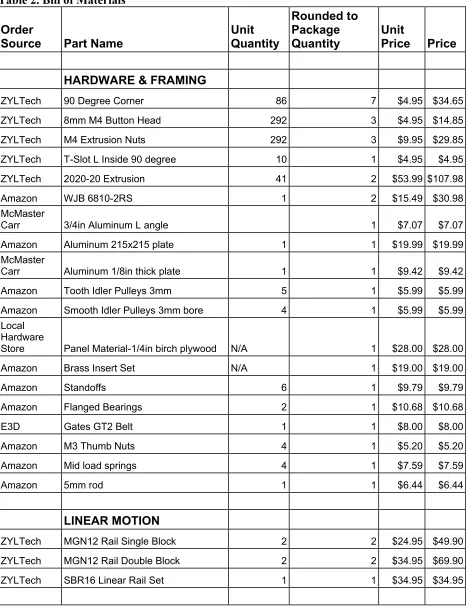
4. Bill of Materials Table 2. Bill of Materials
Order
Source Part Name Unit Quantity
Rounded to Package
Quantity Unit Price Price
HARDWARE & FRAMING
ZYLTech 90 Degree Corner 86 7 $4.95 $34.65
ZYLTech 8mm M4 Button Head 292 3 $4.95 $14.85
ZYLTech M4 Extrusion Nuts 292 3 $9.95 $29.85
ZYLTech T-Slot L Inside 90 degree 10 1 $4.95 $4.95
ZYLTech 2020-20 Extrusion 41 2 $53.99 $107.98
Amazon WJB 6810-2RS 1 2 $15.49 $30.98
McMaster
Carr 3/4in Aluminum L angle 1 $7.07 $7.07
Amazon Aluminum 215x215 plate 1 1 $19.99 $19.99
McMaster
Carr Aluminum 1/8in thick plate 1 1 $9.42 $9.42
Amazon Tooth Idler Pulleys 3mm 5 1 $5.99 $5.99
Amazon Smooth Idler Pulleys 3mm bore 4 1 $5.99 $5.99
Local Hardware
Store Panel Material-1/4in birch plywood N/A 1 $28.00 $28.00
Amazon Brass Insert Set N/A 1 $19.00 $19.00
Amazon Standoffs 6 1 $9.79 $9.79
Amazon Flanged Bearings 2 1 $10.68 $10.68
E3D Gates GT2 Belt 1 1 $8.00 $8.00
Amazon M3 Thumb Nuts 4 1 $5.20 $5.20
Amazon Mid load springs 4 1 $7.59 $7.59
Amazon 5mm rod 1 1 $6.44 $6.44
LINEAR MOTION
ZYLTech MGN12 Rail Single Block 2 2 $24.95 $49.90
ZYLTech MGN12 Rail Double Block 2 2 $34.95 $69.90
ELECTRONICS
E3D
Nema 17 Stepper Motor Unipolar L=48mm w/ Gear Ratio 14:1
Planetary Gearbox 1 1 $29.99 $29.99
E3D Nema17 High Torque Motor (E3D) 3 3 $12.60 $37.80
E3D Nema 17 External 48mm Stack 0.4A Lead 2mm/0.07874" Length 330mm 1 1 $33.99 $33.99
E3D High Temperature Heated Bed (E3D) 1 1 $107.25 $107.25
Amazon Solid State Relays 1 1 $9.56 $9.56
Amazon Borosilicate Glass (E3D) 1 1 $11.44 $11.44
E3D Swiss Clips (E3D) 4 4 $0.47 $1.88
Amazon RAMPS 1.4 w/ full graphics disp 1 1 $35.99 $35.99
Amazon Power Supply 12V 1 1 $25 $25
Amazon Brushless Radial Fan 1 1 $17.58 $17.58
Amazon PTC Ceramic Air Heater 110V/220V 1000W 1 1 $28.79 $28.79
Amazon Microswitch 4 1 $7 $7
Blue Sea Systems A-Series Toggle
Single Pole Circuit Breakers 1 1 $15 $15
E3D V6 High Temp Hotend
E3D E3D V6 1 1 $55.62 $55.62
E3D Thermocouple Kit 1 1 $28 $28
E3D High Temperature Heater Cartridge 1 1 $62.09 $62.09
E3D Stepper Motor 1 1 $12 $12
Amazon Extruder Gear 1 1 $3 $3
Amazon Bowden tube and fittings 1 1 $8 $8
Table 3. 3-D printed components
3D Printed Parts Quantity Material
E3D_Thermocouple_Board 1 PETG
SiliconeLockRing 1 PETG
PCB_Case 1 PETG
LargeFunnel_R 1 PETG
LargeFunnel_L 1 PETG
SwitchCover2 1 PETG
Switch_Cover 1 PETG
CableClamp 1 PETG
CableClamp2 1 PETG
Extruder_Base 2 PETG
Extruder_Arm 2 PETG
TopBearingArm 1 PETG
PelletFeeder_Mount 1 PETG
Z_Motor_Mount_Plate 1 PETG
LCD_Cover 1 PETG
DoorSwitchSensorTrigger 1 PETG
DoorSwitchSensorMount 1 PETG
DoorHinge1 2 PETG
DoorHinge2 2 PETG
FanMount_MIR 1 PETG
FanMount 1 PETG
Fan_Inlet_Shroud 1 PETG
FanShroudTube 1 PETG
FanShroud 1 PETG
PulleyCleat2 1 PETG
BearingSupport 1 PETG
TurntableMountV2 1 PETG
TurntableLockRing 1 PETG
GT2_TurntablePulley 1 PETG
ToolBlank 1 PETG
E3D_Clamp 1 PETG
FanPelletMount 1 PETG
Pellet_LockRing 1 PETG
FanPelletMount 1 PETG
Tool_Probe 1 PETG
FanShroud_Pellet 1 PETG
Tool_Middle 1 PETG
PelletFunnel 1 PETG
HeaterFanShroud 1 PEKK
SpoolHolder 1 PETG
Rotary_Encoder_wheel 1 PETG
Sensor_Base 1 PETG
SensorMount 1 PETG
Z_Motor_Mount_Plate 1 PETG
E3d_Mount 1 PETG
The 3-D printed parts are printed in PETG on any RepRap-class FFF 3-D printer [41-43].
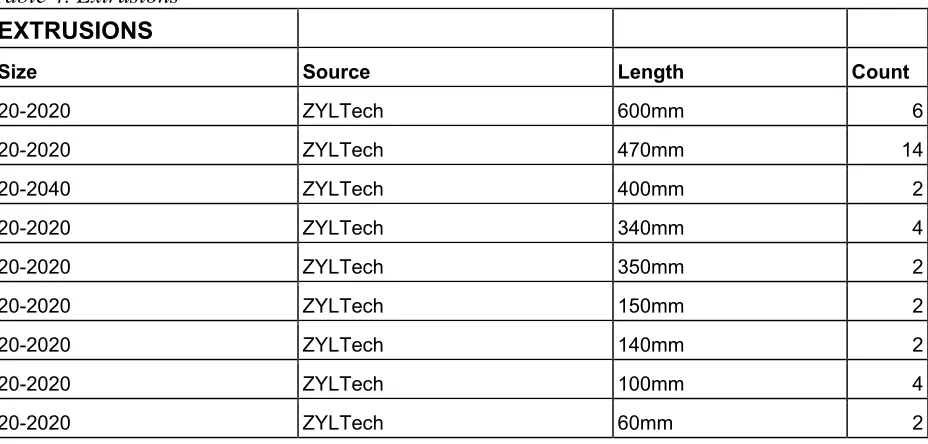
Table 4. Extrusions
EXTRUSIONS
Size Source Length Count
20-2020 ZYLTech 600mm 6
20-2020 ZYLTech 470mm 14
20-2040 ZYLTech 400mm 2
20-2020 ZYLTech 340mm 4
20-2020 ZYLTech 350mm 2
20-2020 ZYLTech 150mm 2
20-2020 ZYLTech 140mm 2
20-2020 ZYLTech 100mm 4
20-2020 ZYLTech 60mm 2
5. Build Instructions 5.1 Printer Frame
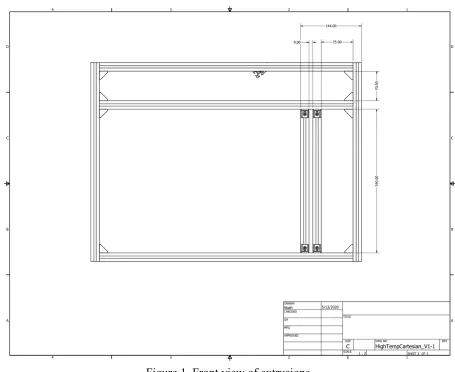
Figure 1. Front view of extrusions
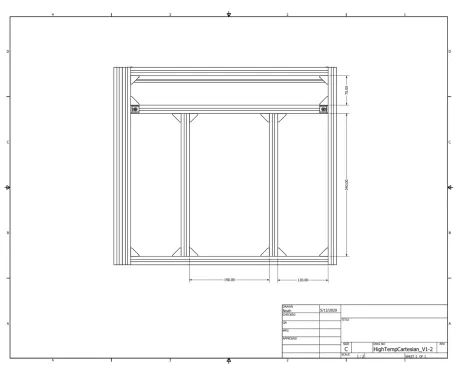
Figure 3: Top view of extrusions.
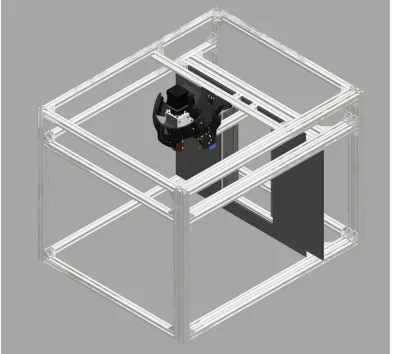
The complete frame in Figure 4 consists of the main frame and a hinged front door. The frame is the first overall step in the assembly process. The design of the frame is intended to be easy to modify and allow for an enclosed chamber that can be heated without
overheating the electrical or 3-D printed components inside the printer. All extrusions can be cut using a hacksaw and the miter box included in the stl files for the rest of the
Figure 4. Printer Frame
5.2 Motion Platform
Figure 5. X and Z axis view
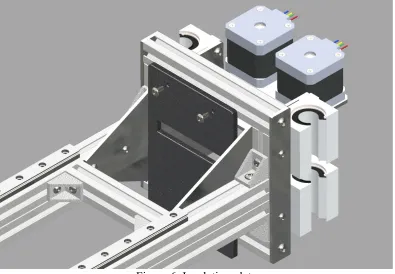
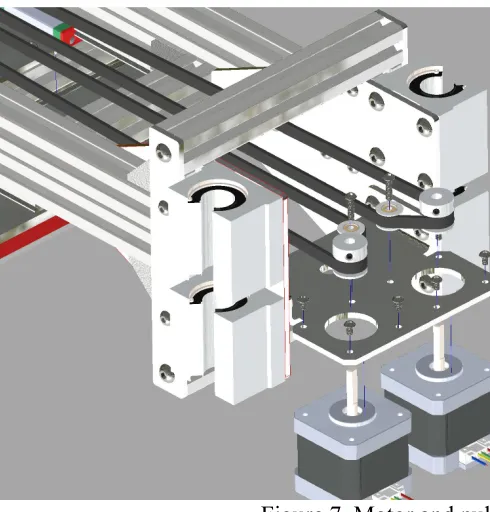
The two motors that control the x and y axes movements are each attached using three screws that hold the motor on and one for holding the belt idler pulley tight. To keep the tensioners tight, a longer bolt is used that tightens into the thread limit inside the motors (about 7mm into the motor). It is recommended that the motor wires be turned outwards for easy access during the wiring steps. It is also possible to add motor noise isolators by using a M3 nut to act as a jam nut for the idler pulleys. Figure 7 shows this assembly.
Figure 7. Motor and pulley mounts
Figure 8. X to Y belt transmission side 1
Next, the y axis is added to the system. As with the x axis, the y axis must be aligned by keeping the bolts on the rail loose and then slide the other sliders back and forth to ensure that it does not bind before tightening down the bolts. The belt should be mounted before the bed support plate is mounted. This is shown in Figure 10. Once this is
complete the heated bed can be mounted to the support plate. This is done using 25mm-30mm M3 screws and bed spring with a thumb screw below the plate to allow for manual bed leveling of the system. Figure 11 shows the heated bed being mounted.
Figure 11. Heated bed mounting.
Figure 12. Completed motion platform assembly
5.3 Rotary Tool head
Figure 13. Rotary tool head assembly V1
Figure 14. Rotary Tool with E3D V6 and probe
5.4 Printer Assembly
(B)
Figure 17. (A) Z gantry installed and installation test without firewall (B)
Figure 18: Z motor installation.
After these steps, the paneling can be attached. In this case, the panels were laser cut out of 5mm thick birch plywood and painted black. The inside of the paneling was covered with a thin insulation film that was glued to the panels using spray adhesive. The most complicated panel to install is the top tool head insulation plate. This plate is bolted to the frame in the same manner that the firewall was. It goes underneath the secondary frame extrusions. This is shown in Figure 19. The front extrusions also need hinges before the next steps, so those are installed next as shown in Figure 20 using eight 8mm M4 bolts and T-slot nuts. The positions of the hinges are determined by the rear
Figure 20. Hinge attachment
(C)
Figure 21. (A) Panel installation, (B) inside sealed with aluminum tape in and (C) with test print on bed.
Figure 22: Screen assembly
Figure 23. Filament sensor
Figure 24. Filament sensor installed on machine
is a 608Z bearing or skateboard bearing, and the extruder gear is a 12mm extruder gear. This assembly is shown in Figure 25. The mounting plate is shown in Figure 26.
Figure 25. Extruder Assembly
To control the rotary tool head, a larger NEMA 17 stepper is used and it is attached as shown in Figure 27. The GT2 belt is looped through the slots under the center tool head position and the teeth on the belt should engage with itself after it is wrapped around the path given on the pulley.
(A)
(B)
Extra cooling fans for the center tool head and part cooling fans with corresponding can shrouds are the next set of parts to be installed. Fan shrouds are attached using bots from below. The small 50mm radial blower fans are the part cooling fans and the large
120mm fan is to test better cooling on the hot ends. The large 120mm fan is not necessary for regular high temperature printing, the 40mm fan on the V6 is enough.
Figure 28. Cooling fans and extra fan
Figure 29. Door latch
Figure 30. Daughterboard stack
Figure 31. Power delivery parts
Figure 32. Electronics compartment
(B)
(C)
6 Electronics
The main electrical components consist of an Arduino Mega 2560 and a RAMPS 1.4 board that runs on a 12v power supply. The more powerful heaters in the system such as the main space heater and the powerful heated bed all run on mains voltage and are controlled using solid state relays. Table 5 explains the wiring for the pins for the RAMPS board.
Table 5. RAMPS pins.
RAMPS 1.4 Additional Controls
Daughterboard RAMPS 1.4 Pin Notes
E3D PT100 board primary hot end 5V 5V
GND GND
D57 Signal Pin
E3D PT100 board second hot end 5V 5V
GND GND
D58 Signal Pin
Turntable Stepper Driver +12V +12V
GND (-12V) GND
+5V +5V
GND (-5V) GND
D4 Direction
D5 Step
D6 Enable
PWM Fan Controllers Any of the
following: D44 D45 D46
Only PWM pins will work to control the fans. +12V and GND pins are the only fan input.
Optional Relays to control extra fans
or GND Relay breaks the +12V
lights 5V wire to switch fans/lights
Any other digital
pin available. on and off.
7. Operation Instructions
Firmware for the pinout listed in the electronics section of the assembly section is given with the CAD files. The firmware (Repetier-Firmware_Chamber) can be opened in and compiled in Arduino and uploaded to the controller. The rotary tool head must be started in the central position before the printer powers up. The configuration can be uploaded to the Repetier Firmware Configuration Tool to make changes if needed.
Start GCode:
G204 P1 S1 ; Select motor 1 G28 X ; Home X
G28 Y ; Home Y
G201 P1 X-58 ; Move extra motor to the probe position G28 Z ; Home Z
G201 P1 X58 ; Move extra motor to the furthest tool head position (Center is X0) G1 Z5 F5000 ; lift nozzle
Bed adhesion is commonly an issue with printing high temperature materials. This problem is partially counteracted by the heated chamber and high temperature heated bed, but it is not completely eliminated. To help printed parts adhere to the build surface, either nano polymer adhesive from Vision Miner or regular Elmer’s glue stick is used on the glass build surface to keep the printed part stuck to the print surface. An important thing to note about printing high temperature materials is that the parts warp with great force, and if a part is left to sit on the print bed as it cools, it could potentially break the glass. It is important to remove the printed part when the bed is still up to temp. It is also important to remember that the heated parts of this machine, even though they look like regular 3-D printer components, they are much hotter. The heated bed alone when printing polyetherimide (PEI or tradename ULTEM) is almost to the temperature that regular PLA melts at (up to 200oC) and the hot end is much higher than that (up to a potential 500oC). The best way to remove the printed parts is to have the machine
automatically move the printer bed to a position that it is easy to remove printed parts from it (called “Go to Park Position after Job/Kill). To do this through Repetier host, turn on the setting that tells the machine to go to a park position once a print is done. The park position that is the easiest to remove parts from is X 100, Y 200 and Z180. This puts the bed all the way down and towards the door of the printer, so the part is readily accessible. It is also recommended that when the print is finished it makes a noise or sends a text message to the user, so the bed does not cool down too fast. This can all be done through Repetier host in preferences. Another option is to leave the bed at temp when the print is done as well. Turn off the setting in printer settings that says, “Disable Heated Bed after Job/Kill” and the heated bed will stay on through the host.
7. Validation and Characterization
7.1 Mechanical testing of high temperature 3-D printed parts 7.1.1 Method
Tensile tests were performed on printed specimens of polyetherketoneketone (PEKK) and
PEI/ULTEM materials provided by 3DXTech (Grand Rapids, MI) using the 3-D printing settings shown in Table 6. The specimens were printed according to ASTM 638 type IV standard, which has previously been shown to be adequate for 3-D printing samples [59]. Instron 4206 testing machine was used along with a 300lb Futek load cell (MODEL LCF455). The extension data was captured by the testing machine based on the crosshead position. Five specimens were tested each for PEKK and PEI/ULTEM samples.
Table 6. 3-D printing settings tested on the Cerberus.
Basic Printer Settings
Material Nozzle
Temperature [oC] Bed Temperature [oC] Layer Height [mm] Part Cooling Fan
PEKK 390 180 0.3 OFF
PEI/ULTEM 380 170 0.3 OFF
Polycarbonate 280 130 0.3 ON or OFF
7.1.2 Results
The PEKK sample had an average peak stress of 77.54MPa with a standard deviation of 2.75MPa. The PEI/ULTEM sample had an average peak stress of 80.54MPa with a standard deviation of 0.81MPa. The average modulus for the PEKK is 928.78 MPa and for the ULTEM, it is 805.40 MPa. The cross-sectional area for the specimens is 27.1 mm2 average with a standard deviation of 0.121 on the width and 0 on the thickness. The peak loads on the PEKK specimens averaged out at 2159.289N and the PEI/ULTEM averaged out at 2285.478N.
These properties were closely aligned with values that are expected from these materials. The expected values for the peak strength of PEKK and PEI/ULTEM are 70 N/mm² and 92 N/mm², respectively [60,61]. Previous work on 3-D printing PEI/ULTEM has shown that strengths were expected to be 46 to 85% of the strengths obtainable by injection molding when printed on a proprietary printer [62]. The results here were slightly better than proprietary printers with more constrained printing parameters, which is similar to results previously observed for acrylonitrile butadiene styrene (ABS) printed with RepRap printers by random makers throughout the world [63]. PEKK is a relatively newer 3-D printing material and material extrusion values appear not to have been published, however, laser sintering-based 3-D printing PEKK provides ultimate tensile strengths ranging from 75-90 MPA [64]. The PEKK values were closer to expected than the PEI/ULTEM. This can be caused by variability in the dryness of the material and
commercial filaments available for conventional FFF-based desktop 3-D printers [65-67]. The PEI and PEKK even have tensile strengths substantially higher than polycarbonate (PC), which is generally the strongest material available for FFF and fused particle fabrication (FPF)/ fused granular fabrication (FGF)-based standard printers [65,68,69].
7.2 Thermal Testing of COVID-19 Maker Mask
To demonstrate a potential COVID-19 use case for this machine, a reusable face mask was printed on the machine out of PEKK as shown in Figure 35. The mask was then put into an oven at 120°C for 30 minutes. The results of the test are shown in Figure 36.
Figure 36: Sterilization Test Results
8. Machine Capabilities, Future Work and Conclusions
The Cerberus showed promising results for 3-D printing PEI/ULTEM and PEKK. The heated chamber, high temperature components, and isolated electronics all allowed the machine to print these materials and others similar should perform similarly.
Capabilities of the Cerberus open source high-temperature 3-D printer are:
1. High temperature 3-D printing (up to 500oC nozzle temperature, 200oC bed temperature)
2. Scalable tool heads where weight and size does not affect print quality 3. External electronics to save costs on cooling components and improve
reliability and functionality
4. Potential for dual extrusion of high temperature materials or soluble supports for high temperature thermoplastics.
5. Auto bed leveling and manual bed leveling through probe integration 6. Freedom to add more functionality to the tool heads.
Drawbacks of the design:
1. Tools are difficult to remove or change currently.
2. A shorter extrusion path is needed to print some materials such as carbon fiber filled materials.
3. Dual drive extruder gears will help in printing with carbon fiber materials. 4. Uses FFF instead of FPF/FGF, the latter of which can make use of far
less-costly feedstocks such as pellets [71-76] and is more easily adapted for recycled 3-D printing [77-81].
These drawbacks can be overcome in future revisions of this open source 3-D printer. Design files for a test quick release tool system is also included in the design files posted along with a direct Bowden combination drive system for the V6 hot end. Additional functionalities for this Cerberus printer can be a pellet extruder, an automatic nozzle cleaner, and a method to print continuous fibers at high temperatures. In addition, a pellet extruder will allow for recyclability of either high temperature plastics or others like PETG or PLA plastic. A nozzle cleaner will allow the printer to clean the nozzle before the print will start. The high print temperatures cause the nozzle to ooze plastic when the print head is not in use and can sometimes peel the first layer off the print bed when a print begins. The last future functionality that will expand the
capabilities of the machine is continuous carbon fiber. In combination with high temperature thermoplastics, continuous fiber can greatly improve the strength of the printed parts.
9. Acknowledgements: This work was supported by the Witte endowment.
10. Declaration of interest: none.
11. References:
1. World Health Organization, 2020. Critical preparedness, readiness and response
actions for COVID-19: interim guidance, 7 March 2020 (No.
WHO/COVID-19/Community_Actions/2020.1). World Health Organization.
2. Kampf G, Scheithauer S, Lemmen S, Saliou P, Suchomel M. COVID-19-associated shortage of alcohol-based hand rubs, face masks, medical gloves and gowns–proposal for a risk-adapted approach to ensure patient and healthcare worker safety. Journal of
Hospital Infection. 2020 Apr 30. https://doi.org/10.1016/j.jhin.2020.04.041 3. Silv, M., COVID-19: too little, too late?. 2020. The Lancet
https://doi.org/10.1016/S0140-6736(20)30522-5
4. Fisher, D. and Heymann, D., 2020. Q&A: The novel coronavirus outbreak causing COVID-19. BMC medicine, 18(1), pp.1-3.
5. Rubinson, L., Vaughn, F., Nelson, S., Giordano, S., Kallstrom, T., Buckley, T., Burney, T., Hupert, N., Mutter, R., Handrigan, M. and Yeskey, K., 2010. Mechanical ventilators in US acute care hospitals. Disaster medicine and public health preparedness, 4(3), pp.199-206.
6. Miller, J. Germany, Italy rush to buy life-saving ventilators as manufacturers warn of shortages. Reuters. 2020. https://www.reuters.com/article/us-health-coronavirus-draegerwerk-ventil-idUSKBN210362
7. Neighmond, P. As The Pandemic Spreads, Will There Be Enough Ventilators?,” 2020. NPR.
https://www.npr.org/sections/health-shots/2020/03/14/815675678/as-the-pandemic-spreads-will-there-be-enough-ventilators
8. Cook, T.M., 2020. Personal protective equipment during the COVID‐19 pandemic–a narrative review. Anaesthesia.
9. Livingston, E., Desai, A. and Berkwits, M., 2020. Sourcing personal protective equipment during the COVID-19 pandemic. JAMA.
10. Ranney, M.L., Griffeth, V., Jha, A.K., 2020. Critical Supply Shortages — The Need for Ventilators and Personal Protective Equipment during the Covid-19 Pandemic. New England Journal of Medicine 0, null. https://doi.org/10.1056/NEJMp2006141
11. WHO. Shortage of personal protective equipment endangering health workers worldwide [WWW Document], 2020. URL https://www.who.int/news-room/detail/03-03-2020-shortage-of-personal-protective-equipment-endangering-health-workers-worldwide
(accessed 4.22.20).
12.Jacobs, A., Richtel, M., Baker, M., 2020. ‘At War With No Ammo’: Doctors Say Shortage of Protective Gear Is Dire. The New York Times.
14. Laplume, A., Anzalone, G.C. and Pearce, J.M., 2016. Open-source, self-replicating 3-D printer factory for small-business manufacturing. The International Journal of Advanced Manufacturing Technology, 85(1-4), pp.633-642.
15. Stacey, M., 2014. The FAB LAB network: A global platform for digital invention, education and entrepreneurship. Innovations: Technology, Governance, Globalization, 9(1-2), pp.221-238.
16. Byard, D.J., Woern, A.L., Oakley, R.B., Fiedler, M.J., Snabes, S.L. and Pearce, J.M., 2019. Green fab lab applications of large-area waste polymer-based additive
manufacturing. Additive Manufacturing, 27, pp.515-525.
17. DeVor, R.E., Kapoor, S.G., Cao, J. and Ehmann, K.F., 2012. Transforming the landscape of manufacturing: distributed manufacturing based on desktop manufacturing (DM) 2. Journal of manufacturing science and engineering, 134(4). 18.Wittbrodt, B.T., Glover, A.G., Laureto, J., Anzalone, G.C., Oppliger, D., Irwin, J.L.
and Pearce, J.M., 2013. Life-cycle economic analysis of distributed manufacturing with open-source 3-D printers. Mechatronics, 23(6), pp.713-726.
19. Gwamuri, J., Wittbrodt, B.T., Anzalone, N.C. and Pearce, J.M., 2014. Reversing the trend of large scale and centralization in manufacturing: The case of
distributed manufacturing of customizable 3-D-printable self-adjustable glasses. Challenges in Sustainability, 2(1), pp.30-40.
20. Woern, A.L. and Pearce, J.M., 2017. Distributed manufacturing of flexible products: Technical feasibility and economic viability. Technologies, 5(4), p.71. 21. Petersen, E.E. and Pearce, J., 2017. Emergence of home manufacturing in the
developed world: Return on investment for open-source 3-D printers. Technologies, 5(1), p.7.
22. Shokrani A, Loukaides EG, Elias E, Lunt AJ. Exploration of alternative supply chains and distributed manufacturing in response to COVID-19; a case study of medical face shields. Materials & Design. 2020 Apr 25:108749.
23. Pearce, J. Distributed Manufacturing of Open-Source Medical Hardware for Pandemics. Preprints2020, 2020040054 (doi: 10.20944/preprints202004.0054.v1).
24. Molina A, Vyas P, Khlystov N, Kumar S, Kothari A, Deriso D, Liu Z, Banavar S, Flaum E, Prakash M. Project 1000 x 1000: Centrifugal melt spinning for distributed
manufacturing of N95 filtering facepiece respirators. arXiv preprint arXiv:2004.13494. 2020 Apr 26.
25. Pearce, J.M. 2020. A review of open source ventilators for COVID-19 and future
pandemics. F1000Research 2020, 9:218 https://doi.org/10.12688/f1000research.22942.2
26. Cavallo L, Marcianò A, Cicciù M, Oteri G. 3D Printing beyond Dentistry during COVID 19 Epidemic: A Technical Note for Producing Connectors to Breathing Devices.
Prosthesis. 2020 Jun;2(2):46-52.
27. Tino R, Moore R, Antoline S, Ravi P, Wake N, Ionita CN, Morris JM, Decker SJ, Sheikh A, Rybicki FJ, Chepelev LL. COVID-19 and the role of 3D printing in medicine.
https://threedmedprint.biomedcentral.com/track/pdf/10.1186/s41205-020-00064-7 28. Ishack S, Lipner SR. Applications of 3D Printing Technology to Address COVID-19
29. McCue TJ. Calling All Makers With 3D Printers: Join Critical Mission To Make Face Masks And Shields For 2020 Healthcare Workers [Internet]. Forbes. [cited 2020 May 17]. Available from: https://www.forbes.com/sites/tjmccue/2020/03/24/calling-all- makers-with-3d-printers-join-critical-mission-to-make-face-masks-and-shields-for-2020-healthcare-workers/
30. Erickson MM, Richardson ES, Hernandez NM, Bobbert II DW, Gall K, Fearis P. Helmet Modification to PPE with 3D Printing During the COVID-19 Pandemic at Duke
University Medical Center: A Novel Technique. The Journal of Arthroplasty. 2020 Apr 18.
31. Rowan NJ, Laffey JG. Challenges and solutions for addressing critical shortage of supply chain for personal and protective equipment (PPE) arising from Coronavirus disease (COVID19) pandemic–Case study from the Republic of Ireland. Science of the Total Environment. 2020 Apr 6:138532.
32. Livingston E, Desai A, Berkwits M. Sourcing personal protective equipment during the COVID-19 pandemic. JAMA. 2020 Mar 28. doi:10.1001/jama.2020.5317
33. Rowan NJ, Laffey JG. Challenges and solutions for addressing critical shortage of supply chain for personal and protective equipment (PPE) arising from Coronavirus disease (COVID19) pandemic–Case study from the Republic of Ireland. Science of the Total Environment. 2020 Apr 6:138532.
34. Medicine I of. Reusability of Facemasks During an Influenza Pandemic: Facing the Flu [Internet]. 2006 [cited 2020 May 17]. Available from:
https://www.nap.edu/catalog/11637/reusability-of-facemasks-during-an-influenza-pandemic-facing-the-flu
35. Rubio-Romero JC, del Carmen Pardo-Ferreira M, García JA, Calero-Castro S. Disposable masks: Disinfection and sterilization for reuse, and non-certified
manufacturing, in the face of shortages during the COVID-19 pandemic. Safety Science. 2020 May 13:104830.
36. Williams D. A doctor is 3D printing face masks to help meet the desperate need for protective gear [Internet]. CNN. [cited 2020 May 17]. Available from:
https://www.cnn.com/2020/03/23/us/coronavirus-3d-printed-medical-supplies-trnd/index.html
37. Wittbrodt B, Pearce JM. The effects of PLA color on material properties of 3-D printed components. Additive Manufacturing. 2015 Oct 1;8:110-6.
38. Health C for D and R. FAQs on 3D Printing of Medical Devices, Accessories,
Components, and Parts During the COVID-19 Pandemic. FDA [Internet]. 2020 Apr 5 [cited 2020 May 17]; Available from: https://www.fda.gov/medical-devices/3d-printing- medical-devices/faqs-3d-printing-medical-devices-accessories-components-and-parts-during-covid-19-pandemic
39. Flanagan ST, Ballard DH. 3D Printed Face Shields: A Community Response to the COVID-19 Global Pandemic. Academic Radiology. 2020 Apr 17.
https://doi.org/10.1016/j.acra.2020.04.020
40. Amin D, Nguyen N, Roser SM, Abramowicz S. 3D PRINTING OF FACE SHIELDS DURING COVID-19 PANDEMIC: A TECHNICAL NOTE. Journal of Oral and Maxillofacial Surgery. 2020 May 1. https://doi.org/10.1016/j.joms.2020.04.040
42. Sells, E., Bailard, S., Smith, Z., Bowyer, A. and Olliver, V., 2010. RepRap: the replicating rapid prototyper: maximizing customizability by breeding the means of production. In Handbook of
Research in Mass Customization and Personalization: (In 2 Volumes) (pp. 568-580).
43. Bowyer, A., 2014. 3D printing and humanity's first imperfect replicator. 3D printing and additive manufacturing, 1(1), pp.4-5.
44. Oberloier, S. and Pearce, J.M., 2018. General design procedure for free and open-source hardware for scientific equipment. Designs, 2(1), p.2.
45. Ventola, C.L., 2014. Medical applications for 3D printing: current and projected uses. Pharmacy and Therapeutics, 39(10), p.704.
46. Niezen, G., Eslambolchilar, P. and Thimbleby, H., 2016. Open-source hardware for medical devices. BMJ innovations, 2(2), pp.78-83.
47. Michaels, R.E. and Pearce, J.M., 2017. 3-D printing open-source click-MUAC bands for identification of malnutrition. Public health nutrition, 20(11), pp.2063-2066.
48. Pearce, J.M., 2017. Maximizing Returns for Public Funding of Medical Research with Opensource Hardware. Health Policy and Technology, 6(4), pp.381-382.
49. Tatham, P., Loy, J. and Peretti, U., 2015. Three dimensional printing–a key tool for the humanitarian logistician?. Journal of Humanitarian Logistics and Supply Chain Management.
50. Saripalle, S., Maker, H., Bush, A. and Lundman, N., 2016, October. 3D printing for disaster preparedness: Making life-saving supplies on-site, on-demand, on-time. In 2016 IEEE Global
Humanitarian Technology Conference (GHTC) (pp. 205-208). IEEE.
51. James, E. and James, L., 2016. 3D printing humanitarian supplies in the field. Humanit. Exch, 66, pp.43-45.
52. Savonen, B.L., Mahan, T.J., Curtis, M.W., Schreier, J.W., Gershenson, J.K. and Pearce, J.M., 2018. Development of a resilient 3-D printer for humanitarian crisis response. Technologies, 6(1), p.30.
53. Kats, D., Spicher, L., Savonen, B. and Gershenson, J., 2018, October. Paper 3D Printing to Supplement Rural Healthcare Supplies—What Do Healthcare Facilities Want?. In 2018 IEEE
Global Humanitarian Technology Conference (GHTC) (pp. 1-8). IEEE.
54. PEEK 3D printer 2020: guide and top tier selection [Internet]. Aniwaa. [cited 2020 May 17]. Available from: https://www.aniwaa.com/buyers-guide/3d-printers/best-peek-3d-printer-pei-ultem/
55. Das A, Chatham CA, Fallon JJ, Zawaski CE, Gilmer EL, Williams CB, Bortner MJ. Current understanding and challenges in high temperature additive manufacturing of engineering thermoplastic polymers. Additive Manufacturing. 2020 May 5:101218. 56. Gardner JM, Stelter CJ, Yashin EA, Siochi EJ. High Temperature Thermoplastic
Additive Manufacturing Using Low-Cost, Open-Source Hardware. NASA/TM—2016– 219344. https://ntrs.nasa.gov/archive/nasa/casi.ntrs.nasa.gov/20170000214.pdf
57. Zawaski C, Williams C. Design of a low-cost, high-temperature inverted build
environment to enable desktop-scale additive manufacturing of performance polymers. Additive Manufacturing. 2020 May 1;33:101111.
58. CoreXY | Cartesian Motion Platform [Internet]. [cited 2020 May 17]. Available from:
https://corexy.com/
59. Repetier-Firmware configuration tool for version 1.0.3 [cited 2020 May 17]. Available from: https://www.repetier.com/firmware/v100/index.php
60 Polymer Database | Thermo-Physical Properties of Unfilled Polyetherketoneketone (PEKK) [cited 2020 May 17]. Available from:
http://polymerdatabase.com/Commercial%20Polymers/PEKK.html
61 Dielectric Manufacturing | ULTEM (Polyetherimide, PEI) Characteristics. [cited 2020 May 17]. Available from: https://dielectricmfg.com/knowledge-base/ultem/
62 Zaldivar RJ, Witkin DB, McLouth T, Patel DN, Schmitt K, Nokes JP. Influence of pro-cessing and orientation print effects on the mechanical and thermal behavior of 3D-Printed ULTEM 9085 Material. Additive Manufacturing. 2017 Jan 1;13:71–80. 63 Tymrak BM, Kreiger M, Pearce JM. Mechanical properties of components fabricated
with open-source 3-D printers under realistic environmental conditions. Materials & De-sign. 2014 Jun 1;58:242–6.
64 Benedettia L, Bruléb B, Decraemerb N, Daviesa R, Evansa K, Ghitaa O. MECHANICAL PERFORMANCE OF LASER SINTERED POLY (ETHER KETONE
KE-TONE)(PEKK). Solid Freeform Fabrication 2019: Proceedings of the 30th Annual Inter-national. Solid Freeform Fabrication Symposium – An Additive Manufacturing Conferen
http://utw10945.utweb.utexas.edu/sites/default/files/2019/062%20Mechanical%20Perfor-mance%20of%20Laser%20Sintered%20Poly%28Ethe.pdf
65 Tanikella NG, Wittbrodt B, Pearce JM. Tensile strength of commercial polymer materi-als for fused filament fabrication 3D printing. Additive Manufacturing. 2017 May 1;15:40–7.
66 Popescu D, Zapciu A, Amza C, Baciu F, Marinescu R. FDM process parameters influ-ence over the mechanical properties of polymer specimens: A review. Polymer Testing. 2018 Aug 1;69:157-66.
67 Wang X, Jiang M, Zhou Z, Gou J, Hui D. 3D printing of polymer matrix composites: A review and prospective. Composites Part B: Engineering. 2017 Feb 1;110:442-58. 68 Cantrell JT, Rohde S, Damiani D, Gurnani R, DiSandro L, Anton J, Young A, Jerez A,
Steinbach D, Kroese C, Ifju PG. Experimental characterization of the mechanical proper-ties of 3D-printed ABS and polycarbonate parts. Rapid Prototyping Journal. 2017 Jun 20. 69 Reich MJ, Woern AL, Tanikella NG, Pearce JM. Mechanical properties and applications
of recycled polycarbonate particle material extrusion-based additive manufacturing. Ma-terials. 2019 Jan;12(10):1642.
70 Maker Mask | 3D Printable Respirator [Internet]. [cited 2020 May 17]. Available from:
https://www.makermask.com/
71 Whyman S, Arif KM, Potgieter J. Design and development of an extrusion system for 3D printing biopolymer pellets. The International Journal of Advanced Manufacturing Tech-nology. 2018 Jun 1;96(9-12):3417-28.
72 Nieto DM, López VC, Molina SI. Large-format polymeric pellet-based additive manufac-turing for the naval industry. Additive Manufacmanufac-turing. 2018 Oct 1;23:79-85.
73 Volpato N, Kretschek D, Foggiatto J, et al. Experimental analysis of an extrusion system for additive manufacturing based on polymer pellets. Int J Adv Manuf Technol
2015;81:1519–1531.
74 Liu X, Chi B, Jiao Z, et al. A large-scale double-stage-screw 3D printer for fused deposi-tion of plastic pellets. J Appl Polym Sci 2017;134:45147
76 Wang Z, Liu R, Sparks T, Liou F. Large-scale deposition system by an industrial robot (I): design of fused pellet modeling system and extrusion process analysis. 3D printing and additive manufacturing. 2016 Mar 1;3(1):39-47.
77 Woern AL, Byard DJ, Oakley RB, Fiedler MJ, Snabes SL, Pearce JM. Fused particle fab-rication 3-D printing: Recycled materials’ optimization and mechanical properties. Mate-rials. 2018 Aug;11(8):1413.
78 Byard DJ, Woern AL, Oakley RB, Fiedler MJ, Snabes SL, Pearce JM. Green fab lab ap-plications of large-area waste polymer-based additive manufacturing. Additive Manufac-turing. 2019 May 1;27:515-25.
79 Dertinger SC, Gallup N, Tanikella NG, Grasso M, Vahid S, Foot PJ, Pearce JM. Tech-nical pathways for distributed recycling of polymer composites for distributed manufac-turing: Windshield wiper blades. Resources, Conservation and Recycling. 2020 Jun 1;157:104810.