DIGITIZATION: ITS IMPACT ON ECONOMIC DEVELOPMENT &
TRADE “WITH SPECIAL REFERENCE TO SERVICES AND MSME
SECTOR OF INDIA”
Moinak Maiti
1Parthajit Kayal
2+1
Research Scholar Department of Banking Technology (UGC innovative programme) School of Management Pondicherry University Pondicherry, India
2
Research Scholar Institute for Financial Management and Research (IFMR), Kothari Road, Nungambakkam, Chennai, Tamil Nadu, India
(+ Corresponding author)
ABSTRACT
Article History
Received: 8 February 2017 Revised: 27 February 2017 Accepted: 7 March 2017 Published: 16 March 2017Keyword
s
Crowd funding Digitisation E-commerce FDI MSME finance Services Trade.
This study discusses the impact of digitisation on India’s two most vibrant and high
potential segments for future growth: services sector and MSME segments. We find that
there is a significant rise in growth rate for the India’s services sector and MSME
segment since 2000. This was majorly due to digitisation. Digitisation automates the
product and process as a result of which both quality and production increases. Despite
having a high potential for future growth, India’s MSMEs segment has suffered due to
less ‘access to finance’. Digitisation improves the performances of MSMEs and helps in
reducing financial obstacles by providing alternative financing options to MSME.
Increasing access to alternative finance has resulted in the significant rise in MSMEs
operating performance, profitability and productivity. The high performance of the
India’s services sector and MSME segment contribute significantly to the overall trade
growth. This paper finds that there is a high impact of digitisation on the inclusive
growth of the overall Indian economy and trade.
Contribution/ Originality:
The paper's primary contribution is finding that the significant rise in the recent
growth rate of the service sector and MSME segment was majorly due to digitization. Digitalization resulted in the
high performance of these sectors which contributed significantly to the inclusive growth of the overall Indian
economy and trade.
1. INTRODUCTION
Information Technology (IT) and IT-enabled services (ITES) have a huge impact on manufacturing and services
sector for both developed and developing nations. Due to ITES development, several non-tradable services become
tradable nowadays. For the past few decades among the emerging nations, India’s contribution to IT and ITES is
exceptional. Rapid development in IT and ITES promotes the economic growth of a country. Digitization has a
direct benefit on the performance of the services and Micro Small and Medium Enterprises (MSME) sector of India.
Digitization directly impacts on total trade volume of an economy as it helps in increasing the efficiency of any
business. When comes to trade India’s service and MSME sectors have a high potential. IT and ITES makes a huge
Asian Economic and Financial Review
ISSN(e):
2222-6737 ISSN(p):
2305-2147
DOI: 10.18488/journal.aefr.2017.76.541.549 Vol. 7, No. 6, 541-549.
impact especially to service sector and MSME sector, and these two sectors are known to be the avenues for growth
for any economies. India’s service sector contributes a major share to India’s trade volume and gross domestic
product (GDP). Due to the development of information and communications technology (ICT), the service sector has
flourished since 2000 onwards. During 2014-15 service sector alone contributed to around 52 percent of India’s total
GDP. The market share of Indian services sector in world trade is significantly large and also increasing year on
year. In 2014-15, India’s service sector amounted to the US $783 billion with a compound annual growth rate of 9
percent, which is much higher than India’s GDP growth rate. India’s service sector has grown at a compound annual
growth rate of 11.7 percent during 2011-12 to 2014-15
1. During the same period, India’s service sector have
contributed significantly to the export and employment and also attracted a large amount of FDI inflow.
Despite having a huge opportunity, ‘access to finance’ is the major reason behind the low growth of India’s
MSME sector as reported by McKinsey and International Finance Corporation (IFC). Due to recent progress in IT
and ITES, the bottlenecks for Small and medium enterprises (SME) banking have reduced significantly over the
years. These, in turn, have accelerated the overall banking performance and growth performance in most of the Asian
countries. The McKinsey and IFC reports also mentioned India and China as the red hot destination for the BRIC
2countries’ SME finance business. It is widely known that IT and ITES promote the different services (financial and
non-financial) and thereby greatly responsible for the advancement of India’s service and MSME sectors.
This study highlights the impact of digitization on India’s services and MSME sectors’ development and growth.
The paper is structured as follows: Section 2 discusses the review of the literature. Section 3 gives the overview of
the impact of digitization on India’s services sector and section 4 presents the impact of digitization on India’s
MSMEs sector. Section 5 concludes.
2. LITERATURE REVIEW
Digitization and other technological development have significant positive impact on the overall production
process of any sector. Studies by
Kaldor (1967) and
Kuznets (1966) reveal that the advancement in the
manufacturing sector leads to the growth of IT and ITES advancement. Further Studies by
Dasgupta and Singh
(2005);
Goldar and Mitra (2008) and
Joshi (2007) also attempt to understand whether there exist any such
relationship between the growth of manufacturing sector and ITES.
Chanda (2002)
finds that technological
development leads to more demand for manpower and in turns growth of ITES in India.
Lal (2007) examines five
developing countries and finds that information communication technology (ICT) infrastructure; communicat ions are
the driver for growth.
Joshi (2009b) suggests that due to ICT development many non-tradable services become
tradable nowadays. Johannes (2015) UNCTAD
3presentation supports that technology development, servicification
of manufacturing and global values; and demand for service with rising income are the drivers for the global trade in
services.
Myers and Majluf (1984) find evidence of lack of credit information for SMEs in developing countries. They
argued that SMEs borrowers/SMEs clients have more information than the lenders/banks and this information
asymmetry makes SME financing difficult. Due to information asymmetry in the lending business and high
monitoring cost, banks do not extend finances just on the basis of interest rate criteria. Information transparency is
one of the important factors for banks to extend SME credit
(Morris
et al.
, 2001; Das, 2007). Lack of information
transparency is the major reason for banks to deny SME loan to Indian SMEs. Further study by
Petersen and Rajan
(2002);
Berger
et al.
(2005a);
Frame
et al.
(2001) and
Frame and Woosley (2004) confirm that information
transparency and credit scoring enhances the SME financing by banks.
Bhattacharya
et al.
(2000) argued that low
1All the statistics taken from India’s Union budget 2014-15
2 Brazil, Russia, India, China
profitability, low capitalization, assets deficiency and high-risk are also the reasons for banks not extending finance to
MSME. Bank size is also a key factor in financial loan extension due to operational differences among small and
large banks. Big banks have access to highly advanced technologies and several other facilities. Berger
et al.
(2005b)
find that big banks have comparative advantages in transactional lending whereas small size banks have comparative
advantages in relationship lending. Big banks need informational transparency in business whereas small banks may
consider soft information for lending. Thampy (2010) highlights that the banks that operate in India face the problem
of credit appraisal, credit scoring and unsecured loans to extend MSME credit facilities to the various MSME clients.
Recent advancement in IT and ITES have contributed in easing transactions, reducing information asymmetry
and increasing efficiency. It is acceptable that IT and ITES have a direct impact on the performance of the services
sector and growth in trade growth. MSMEs are the vehicle for sustainable development for any economy. As
mentioned earlier Indian MSMEs are facing major difficulties with ‘access to finance’. Advancement in IT and ITES
are helping in reducing the financial barriers for MSME and thereby increasing the performance of the MSME
sectors. High-performance of MSME sector contributes significantly to the growth of trade.
3. IMPACT OF DIGITALIZATION ON INDIA’S SERVICES SECTOR
3.1. Service Sector GDP
The overall contribution of the Indian service sector towards the India’s GDP has increased over the years. This
has happened mostly due to rise in IT and ITES. In 2013-14, the share of the service sector to the India’s GDP was
56 percent. If one compares the overall growth rate of GDP over the services sector GDP it is observed that the later
had grown at 20 percent higher rate than the former. This was due to the 12.9 percent growth rate alone in the
financial, insurance, real estate and business service sub-sectors. Figure 1 shows a comparison of the weight of the
service subsectors in 2000-01 and 2012-13.
Community, social and personal services (14 percent) was the dominating sub-sector followed by trade (hotel
and restaurants) and financial services
4(13 percent each) during 2000-01 periods. The scenario has changed
completely by 2012-13 as financial services start to take over other sectors. The contributions of all the other
sub-sectors are also shown in figure 1. The reason for such a leap in the financial services is due to the significant
development of the IT infrastructure in the financial institutions that automate the overall operation process and
provides quick services to the customers. It has also contributed to the financial sector (11.8 percent) and other
sectors like the real estate, ownership of dwelling, and business services (10 percent) which observed highest growth
rate during 2013-14 in terms of its share in total service GDP.
3.2. FDI Inflow in Services Sector
The development of services sector resulted in a large inflow of foreign direct investment (FDI) in India. Among
the service sectors alone, top five services sub-sectors attracts about 45 percent in total of the FDI inflow during the
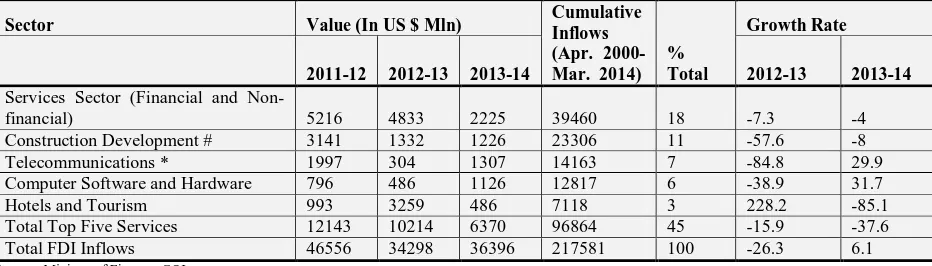
period April 2000 to March 2014 in India. Table 1 shows the sector wise detail of FDI inflows.
Table-1. FDI inflows in services sector 2011-14
Sector Value (In US $ Mln) Cumulative Inflows
(Apr. 2000-Mar. 2014)
% Total
Growth Rate
2011-12 2012-13 2013-14 2012-13 2013-14
Services Sector (Financial and
Non-financial) 5216 4833 2225 39460 18 -7.3 -4
Construction Development # 3141 1332 1226 23306 11 -57.6 -8
Telecommunications * 1997 304 1307 14163 7 -84.8 29.9
Computer Software and Hardware 796 486 1126 12817 6 -38.9 31.7
Hotels and Tourism 993 3259 486 7118 3 228.2 -85.1
Total Top Five Services 12143 10214 6370 96864 45 -15.9 -37.6
Total FDI Inflows 46556 34298 36396 217581 100 -26.3 6.1
Source: Ministry of Finance, GOI
Notes: # indicates township, housing, built-up infrastructure and * indicates radio paging, cellular mobile, basic telephone services.
The financial and non-financial sub-sector attracts the highest cumulative FDI inflow of US$ 39.46 billion
followed by the other sub-sectors like construction development (US$ 23.3 billion), telecommunications (US$ 14.2
billion), and computer software and hardware (US$ 12.8 billion) during the period April 2000 to March 2014 (see
Table 1). The contribution of other developing services are trading (2.4 percent), IT and broadcasting (1.7 percent),
medical services (1.1 percent), ports (0.8 percent), agricultural services (0.8 percent), education (0.4 percent), aviation
(0.2 percent) and retails (0.1 percent). The cumulative FDI inflow increases to 54.7 % for the same period. In
2013-14, the overall growth rate of FDI inflows in the top five service sub-sectors fell sharply by 37.6 percent whereas
overall FDI inflows increased by 6.1 percent during the same period.
3.3. Services Export
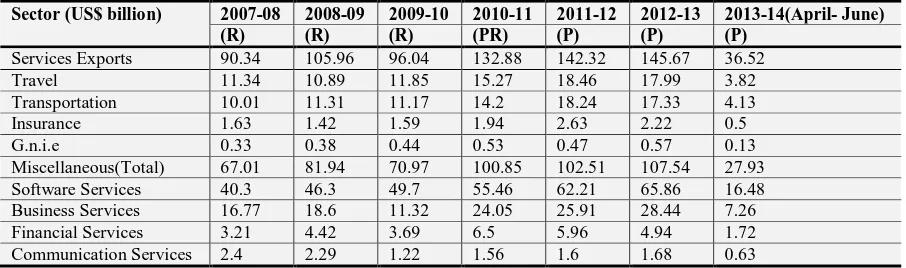
Table 2 shows export of India’s services during 2007-14. Transportation sector witnessed 73.13 percent growth,
Government Goods and Services Not Included Elsewhere (G.N.I.E) rose by 72.73 percent while business services
increased by 69.59 percent between the period 2007-08 and 2012-13. The ITES subsector shows continuous growth
between 2007 and 2013.
Table-2. India’s services export (2007-14)
Sector (US$ billion) 2007-08 2008-09 2009-10 2010-11 2011-12 2012-13 2013-14(April- June)
(R) (R) (R) (PR) (P) (P) (P)
Services Exports 90.34 105.96 96.04 132.88 142.32 145.67 36.52
Travel 11.34 10.89 11.85 15.27 18.46 17.99 3.82
Transportation 10.01 11.31 11.17 14.2 18.24 17.33 4.13
Insurance 1.63 1.42 1.59 1.94 2.63 2.22 0.5
G.n.i.e 0.33 0.38 0.44 0.53 0.47 0.57 0.13
Miscellaneous(Total) 67.01 81.94 70.97 100.85 102.51 107.54 27.93
Software Services 40.3 46.3 49.7 55.46 62.21 65.86 16.48
Business Services 16.77 18.6 11.32 24.05 25.91 28.44 7.26
Financial Services 3.21 4.42 3.69 6.5 5.96 4.94 1.72
Communication Services 2.4 2.29 1.22 1.56 1.6 1.68 0.63
(P) –provisional PR- partially revised R– revised
Source: RBI balance of payment release on 30.09.2013
3.4. Services Employment
Table 3 shows the sub-sector wise employment in services. Financial service, real estate and business services
subsectors are the highest employment providers during 1993-2012. Transport, storage, communication, financial
services, real estate and business services subsectors show the highest employment elasticity
5of 0.5 between 1993-94
and 1999-00. In between 1999 and 2005 India has seen overall GDP growth due to increases in production and
employment in almost every sector. Thereafter great recession and subsequent effect have impacted the entire sector
badly and caused higher unemployment.
Table 3. Sector-wise employment trends
Absolute Number (Million) Employment elasticity
(Share in Percentage Given in Parentheses)
1993-94 1999-00 2004-05 2009-10 2011-12 1993-94 to 1999-00 1999-00 to 2004-05 2004-05 to 2009-10 2009-10 to 2011-12
Agriculture 204.3 214.7 226.8 220.5 204.4 0.3 0.7 -0.2 -0.5
(61.1) (58.5) (54.5) (51.6) (47.1)
Industry 53.5 61.7 81.0 93.1 106.1 0.4 0.9 0.3 0.9
(16.0) (16.8) (19.5) (21.8) (24.4)
Services 76.6 90.6 108.0 113.7 123.9 0.3 0.5 0.1 0.5
(22.9) (24.7) (26.0) (26.6) (28.5)
Trade, hotels, and restaurants 26.8 34.1 46.5 48.4 50.5 0.4 0.8 0.1 0.3
(8.0) (9.3) (11.2) (11.3) (11.6)
Transport, storage, and
communication
11.0 15.0 18.7 19.9 22.8
0.5 0.4 0.1 0.6
(3.3) (4.1) (4.5) (4.6) (5.2)
Financial, insurance, real estate and Business services
3.7 4.8 7.5 9.4 10.7
0.5 1.6 0.4 0.6
(1.1) (1.3) (1.8) (2.2) (2.5)
Community, social, and personal services
35.1 36.7 35.3 36.1 39.9
0.1 -0.2 0.1 1.1
(10.5) (10.0) (8.5) (8.4) (9.2)
Total 334.4 367.0 415.7 427.4 434.4 0.2 0.4 0.1 0.1
(100.0) (100.0) (100.0) (100.0) (100.0)
Note: Employment elasticity is calculated by CAGR method, Employment elasticity = (CAGR employment) / (CAGR GDP at FC constant 2004 -05 prices) for the respective period. UPS- usual principal status
Source: Ministry of Finance, Govt. of India
3.5. International Comparison of Performance of India’s Services Sector
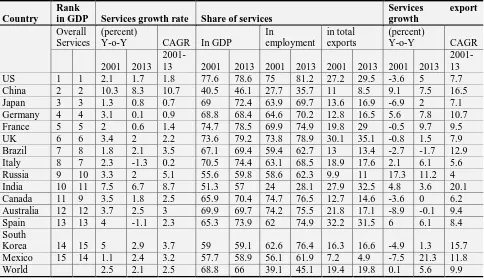
In table 3, we present the performance of the service sector of the 14 other countries along with India. China and
India witnessed a very high compound annual growth rate during these years. China is the only country to have 50
percent share of services in its GDP. Among all the countries considered in this study, Spain, India and China show a
higher share of service GDP. Significant increase in the share of global employment in services observed during the
period 2001 and 2013 while the share of global income from services decreases for the same period.
Between 2001 and 2013 there is an overall increase in the services trade around the world. India and China both
have large contributions in the world commercial services export. The USA witnessed a growth in the world
commercial export during 2013 whereas both India and China have the reserve trends. China is the highest recipient
of the FDI followed by the India. Both China and India receives increasing FDI inflow in the services sector.
India’s position in trade in services for the year 2014 is shown in table 4:
Table-4. India’s position in trade in services in 2014
Group of countries % GDP
Rank
SAARC
1
Asian
20
commonwealth
14
G20
5
World
62
Source: World Bank
Table-5. International Comparison of performance in services
Country
Rank
in GDP
Services growth rate
Share of services
Services
export
growth
Overall
Services
(percent)
Y-o-Y
CAGR In GDP
In
employment
in total
exports
(percent)
Y-o-Y
CAGR
2001 2013
2001-13
2001
2013 2001 2013 2001 2013 2001 2013
2001-13
US
1
1
2.1
1.7
1.8
77.6
78.6
75
81.2
27.2
29.5
-3.6
5
7.7
China
2
2
10.3
8.3
10.7
40.5
46.1
27.7
35.7
11
8.5
9.1
7.5
16.5
Japan
3
3
1.3
0.8
0.7
69
72.4
63.9
69.7
13.6
16.9
-6.9
2
7.1
Germany
4
4
3.1
0.1
0.9
68.8
68.4
64.6
70.2
12.8
16.5
5.6
7.8
10.7
France
5
5
2
0.6
1.4
74.7
78.5
69.9
74.9
19.8
29
-0.5
9.7
9.5
UK
6
6
3.4
2
2.2
73.6
79.2
73.8
78.9
30.1
35.1
-0.8
1.5
7.9
Brazil
7
8
1.8
2.1
3.5
67.1
69.4
59.4
62.7
13
13.4
-2.7
-1.7
12.9
Italy
8
7
2.3
-1.3
0.2
70.5
74.4
63.1
68.5
18.9
17.6
2.1
6.1
5.6
Russia
9
10
3.3
2
5.1
55.6
59.8
58.6
62.3
9.9
11
17.3
11.2
4
India
10
11
7.5
6.7
8.7
51.3
57
24
28.1
27.9
32.5
4.8
3.6
20.1
Canada
11
9
3.5
1.8
2.5
65.9
70.4
74.7
76.5
12.7
14.6
-3.6
0
6.2
Australia
12
12
3.7
2.5
3
69.9
69.7
74.2
75.5
21.8
17.1
-8.9
-0.1
9.4
Spain
13
13
4
-1.1
2.3
65.3
73.9
62
74.9
32.2
31.5
6
6.1
8.4
South
Korea
14
15
5
2.9
3.7
59
59.1
62.6
76.4
16.3
16.6
-4.9
1.3
15.7
Mexico
15
14
1.1
2.4
3.2
57.7
58.9
56.1
61.9
7.2
4.9
-7.5
21.3
11.8
World
2.5
2.1
2.5
68.8
66
39.1
45.1
19.4
19.8
0.1
5.6
9.9
Source: Ministry of Finance, Government of India
4. IMPACT OF DIGITALIZATION ON INDIA’S MSMES SECTOR
4.1. MSMEs Overall Performances
Figure-2. GDP, MSME production and industrial growth rate of India (1999-2014)
Data Source: MSME and Planning commission of India, Government of India
4.2. Alternative Avenues for MSME Financing
Access to finance is one of the major problem faces by MSMEs in the emerging Asian countries. Development in
IT and ITES open doors to counterfeit it by the following way.
4.2.1. E-Commerce
E-commerce platform provides a marketing avenue to the SMEs to increase their sells. This platform could be
used for different purposes at very cost efficient way like targeting customers, engaging with customers, analysing
their preferences etc. Most of the e-commerce sites have detail information about the seller like product details, the
demand of the product, sales report, product review etc. This information could be used by the banks to identify
potential SMEs loan customers. Therefore, e-commerce platform can be useful for SMEs and also for SME
financing.
4.2.2. Crowd Funding
Figure-3. Categories of crowd funding
Source: International Organization of Securities Commissions (IOSCO) staff working paper
“Crowd sourced funding is a means of raising money for a creative project (for instance, music, film, book
publication), a benevolent or public-interest cause (for instance, a community-based social or co-operative initiative)
contributions are sought through an online crowd-funding platform while the offer may also be promoted through
social media”-SEBI
6Report
.
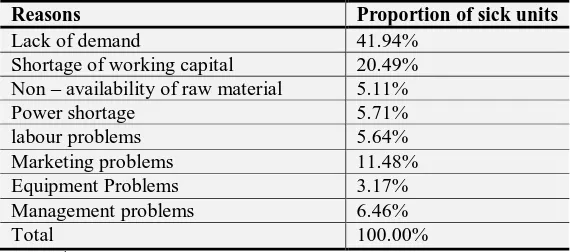
Table No.6 shows the various reasons for MSMEs sickness in India as per fourth all-India census of MSMEs.
Shortage of working capital contributes around 20 percent which can be mitigated by the crowd-funding.
Table-6. Major reasons for sickness/incipient sickness
Reasons
Proportion of sick units
Lack of demand
41.94%
Shortage of working capital
20.49%
Non – availability of raw material
5.11%
Power shortage
5.71%
labour problems
5.64%
Marketing problems
11.48%
Equipment Problems
3.17%
Management problems
6.46%
Total
100.00%
Source: 4th All India Census of MSME, Ministry of Micro, Small and Medium Enterprises,
Government of India
The above discussion justifies that MSMEs development is important for the sustainable development of any
country. It can be achieved by preventing the major bottlenecks in MSME sector by adopting latest technology and
‘access to finance’.
5. CONCLUSION
The study discusses the effect of digitization on India’s services and MSME sector. The performance of the
services sector improved significantly since 2000 onwards. Development in IT and ITES digitize and automated the
overall business process. This resulted in overall improvement in both manufacturing and services sectors.
Development in the manufacturing sector contributed to growth in several service sub-sectors due to ancillary
requirement. Advancement in digitization transformed several non-tradable services into tradable. The overall
performance of service sector increases during 2000 to 2014 due to digitization. The share of service sectors and
contribution of MSME have increased towards GDP, FDI inflow, trade and employment. MSME sector is very
important for an economy to achieve a sustainable growth. India’s MSME sector is one of the most vibrant sectors.
The major issue with MSME is ‘access to finance’ which is affecting the overall performance of this sector. Despite
several obstacles, India’s MSME sector is performing well due to the development of IT and ITES which contributed
towards reducing several hurdles to MSME credits. Further advancement in IT and ITES can definitely help in
developing a strong MSME sector for India by removing further difficulties and providing an alternative platform for
MSME financings like crowd funding and E-commerce. In a nutshell, India’s service sector and MSME segment
have the high potential for future growth with digitization. The inclusive growth of both India’s services sector and
MSME segment can give a boost to the volume of trade and India’s share with the help of digitization.
Funding: This study received no specific financial support.
Competing Interests: The authors declare that they have no competing interests.
Contributors/Acknowledgement: All authors contributed equally to the conception and design of the study.
REFERENCES
Berger, A., S. Frame and N. Miller, 2005a. Credit scoring and the availability, price, and risk of small business credit. Journal of
Money, Credit & Banking, 37(2): 191-222.View at Google Scholar | View at Publisher
Berger, A., N. Miller, H. Nathan, M.A. Peterson, R.G. Rajan and J.C. Stein, 2005b. Does function follow organizational form?
Evidence from the lending practices of large and small banks. Journal of Financial Economics, 76(2): 237-269.View at
Google Scholar | View at Publisher
Bhattacharya, D., N. Faiz and S. Zohir, 2000. Policy for employment generation in the informal sector of Bangladesh e A study
prepared for the international labour office. Dhaka: Centre for Policy Dialogue.
Chanda, R., 2002. Globalization of services: India’s opportunities and constraints. New Delhi: Oxford University Press.
Das, K., 2007. SMEs in India: Issues and possibilities in times of globalisation. In Hank Lim (Ed.), ASEAN SMEs and
globalization. Tokyo: ERIA.
Dasgupta, S. and A. Singh, 2005. Will services be the new engine of economic growth in India? Working Paper No. 310. Centre
for Business Research, University of Cambridge, September.
Frame, W.S., A. Srinivasan and L. Woosley, 2001. The effect of credit scoring on small business lending. Journal of Money Credit
and Banking, 33(3): 813-825.View at Google Scholar | View at Publisher
Frame, W.S. and L. Woosley, 2004. Credit scoring and the availability of small business credit in low and moderate income areas.
Financial Review, 39(1): 35-54.View at Google Scholar | View at Publisher
Goldar, B.N. and A. Mitra, 2008. Productivity increase and changing sectoral composition: Contribution to economic growth in
India. Working Series No. E/291/2008. Institute of Economic Growth.
Johannes, 2015. Available from unctad.org/meetings/en/Presentation/ditc_tncd_2015_d23_Schwarzer.pdf [Accessed 25th July
2016].
Joshi, S., 2007. The main drivers of services growth in India in post globalisation period. In Conference Volume Part-II, 90th
Annual Conference of IEA Hazratbal, Srinagar: University of Kashmir. pp: pp. 943–951.
Joshi, S., 2009b. IT and ITES as an engine of growth: An exploration into the Indian experience. Working Paper Series No.
E/294/2009. Institute of Economic Growth.
Kaldor, 1967. Strategic factors in economic development. Ithaca: Cornell University Press.
Kuznets, S., 1966. Modern economic growth, rate, structure and spread. New Haven: Yale University Press.
Lal, K., 2007. Information and communication technologies in the context of globalization: Evidence from developing countries.
New York: Palgrave Macmillan.
Morris, S., R. Basant, K. Das, K. Ramachandran and A. Koshy, 2001. The growth and transformation of small firms in India. New
Delhi: Oxford University Press.
Myers, S. and N. Majluf, 1984. Corporate financing and investment decisions when firms have information investors do not have.
Journal of Financial Economics, 13(2): 187-221.View at Google Scholar | View at Publisher
Petersen, M.A. and R.G. Rajan, 2002. Does distance still matter? The information revolution in small business lending. Journal of
Finance, 57(6): 2533-2570.View at Google Scholar | View at Publisher
Thampy, A., 2010. Financing of SME firms in India: Interview with Ranjana Kumar, Former CMD, Indian Bank; Vigilance
Commissioner, Central Vigilance Commission. IIMB Management Review, 22(3): 93-101.View at Google Scholar
BIBLIOGRAPHY
Joshi, S., 2009a. The main drivers of services growth in India in post-globalisation period. Growth Theory and Globalisation of
India. pp: 275.