Strongly interacting matter from holographic QCD model
Yidian Chen1, , Danning Li2, , and Mei Huang1,3,
1Institute of High Energy Physics, Chinese Academy of Sciences, Beijing 100049, China
2Physics Department, Jinan University, Guangzhou 510632, China
3Theoretical Physics Center for Science Facilities, Chinese Academy of Sciences, Beijing 100049, China
Abstract.We introduce the 5-dimension dynamical holographic QCD model, which is constructed in the graviton-dilaton-scalar framework with the dilaton background fieldΦ and the scalar fieldXresponsible for the gluodynamics and chiral dynamics, respectively. We review our results on the hadron spectra including the glueball and light meson spec-tra, QCD phase transitions and transport properties in the framework of the dynamical holographic QCD model.
1 Introduction
Quantum chromodynamics (QCD) is the fundamental theory of strong interaction. In the infrared (IR) regime, it remains as an outstanding challenge of solving nonperturbative QCD physics, e.g. the chiral symmetry breaking and color confinement. The anti-de Sitter/conformal field theory (AdS/CFT) cor-respondence or gauge/gravity duality [1–3] provides a novel method to tackle the problem of strongly coupled gauge theories, and has been widely used in investigating hadron physics, strongly coupled quark gluon plasma and condensed matter physics. In general, holography maps a D-dimensional quantum field theory (QFT) to a quantum gravity in (D+1)-dimensions, and the gravitational de-scription becomes classical when the QFT is strongly-coupled. The extra dimension can be regarded as an energy scale or renormalization group (RG) flow in the QFT [4].
In this talk, I give a brief review on the dynamical holographic QCD (DhQCD) model recently developed in our group. The DhQCD model is constructed in the graviton-dilaton-scalar framework, and it resembles the renormalization group from ultraviolet (UV) to infrared (IR). The dilaton back-ground fieldΦ(z) and the scalar fieldX(z) are dual to the gluon operator and the quark operator at the UV boundary, and in the IR region, the dilaton background field and scalar field are responsi-ble for nonperturbative gluodynamics and chiral dynamics, respectively. The metric structure at IR is automatically deformed by the nonperturbative gluon condensation and chiral condensation in the vacuum. I also give a summary of our results on hadron spectra, QCD phase transitions, equation of state and transport properties in the framework of DhQCD model.
e-mail: [email protected] e-mail: [email protected] e-mail: [email protected]
2 The glueball spectra and meson spectra
The detailed description of DhQCD model can be found in Ref.[5]. The pure gluon part of QCD is modelled by the 5D graviton-dilaton coupled action:
SG=
1 16πG5
d5x√gse−2Φ
Rs+4∂MΦ∂MΦ−VGs(Φ)
, (1)
withG5 the 5D Newton constant, gs, Φ andVGs the 5D metric, and the dilaton field and dilaton
potential in the string frame, respectively. The metric takes the following form
gs
MN=b
2
s(z)(dz2+ημνdxμdxν), bs(z)≡eAs(z), (2)
and is automatically deformed by the dilaton backgroundΦ(z)=μG2z2as in [6].
The glueball spectra are excitations from the pure gluon background, i.e. the deformed AdS5
background solved from the graviton-dilaton coupled system. In order to distinguish even and odd parity, we introduce the positive and negative coupling between the dilaton field and glueballs, re-spectively. With this setup, we have the 5D actions for the scalar, vector and tensor glueballsG(x,z) taking the following form:
SG = −12
d5x√gse−pΦ(∂MG∂MG+MG2,5(z)G
2) (3)
SV = −
1 2
d5x√gse−pΦ(
1 2F
MNF
MN+MV2,5(z)V
2), (4)
ST = −
1 2
d5x√gse−pΦ(∇LhMN∇LhMN−2∇LhLM∇NhN M
+2∇MhMN∇Nh− ∇Mh∇Mh+Mh2,5(z)(hMNhMN−h
2)), (5)
whereM2
5(z)=M52e−2Φ/3,p=1 for even parity andp=−1 for odd parity. The equation of motion for
any glueballA can be brought into Schroedinger-like equation
−An+VAAn=m2A,nAn, (6)
with the 5D effective Schroedinger potential
VA =cA
s−pΦ
2 +
(cAs−pΦ
)2 4 +e
2As−23ΦM2
A,5, (7)
wherec=1 for 1-form andc=3 for 0-form and 2-form, andM2
A,5the 5-dimension mass.
The final results for two-gluon and three-gluon glueball spectra in the DhQCD model is shown in Fig. 1(a). With the only one parameterμG=1GeV, which is fixed by the Regge slope of the scalar glueball spectra, we can produce almost all glueballs spectra agree well with lattice data [7], except three trigluon glueball states 0−−, 0+−and 2+−, whose masses are 1.5 GeV lighter than lattice results. We add light flavors in terms of meson fields on the gluodynamical background. The total 5D action for the graviton-dilaton-scalar system takes the form of
S =SG+
Nf
NcSKKS S
, (8)
SG=
1 16πG5
d5x√gse−2ΦR+4∂MΦ∂MΦ−VG(Φ), (9)
SKKS S = −
d5x√gse−ΦT r(|DX|2+VX(X+X,Φ)+
1 4g2
5
(FL2+F2R)). (10)
The meson spectra produced from this model is summarized in Fig. 1(b). It is observed that in the graviton-dilaton-scalar system, the generated meson spectra agree well with experimental data.
2 4 6 8 n
2 0 2 4 6
m2nGeV2
( a ) ( b )
Figure 1.The glueball spectra (a) and light meson spectra (b) in the DhQCD model.
3 Thermodynamical and transport properties
In order to study strongly interacting matter at finite temperature, we introduce a black hole in the 5D gravity side and study the black hole thermodynamics. The metric ansatz at finite temperature in string frame takes the form of
ds2S=e2As
−f(z)dt2+dz
2
f(z)+dx
idxi
. (11)
With this metric ansatz, from the Einstein equations we derive the equations of motion:
−As +A
2
s +
2 3Φ
−4
3A
sΦ
= 0, (12)
f(z)+3As(z)−2Φ(z)
f(z) = 0, (13)
8 3∂z
e3As(z)−2Φ
f(z)∂zΦ
−e5As(z)−103Φ∂
withVE
G=e4Φ/3VGs. The temperature of the solution is identified with the Hawking temperature
T = e
−3As(zh)+2Φ(zh)
4π zh
0 e−
3As(z)+2Φ(z)dz
. (15)
For the pure gluon system, when the dilaton profile takes the form ofΦ =μGz2, we can get the analytic solution of the metric prefactor
As(z)=log(L
z)−log(0F1(5/4, μ4
Gz
4
9 ))+ 2 3μ
2
Gz2, (16)
whereLis the AdS radius.
We obtain the equation of state of the hot gluonic matter, and compare the trace anomaly−3p with the pure SU(3) lattice data [8] in Fig.2 (a). It is observed that the thermodynamical quantities in the quenched dynamical holographic QCD model can describe the pure gluon system quite well, especially, the nearTcsharp peak of the trace anomaly shows that we have encoded the correct IR
physics in the 5D model.
We also investigated the transport properties of the gluonic matter, e.g. the jet quenching parame-ter, the shear viscosity and bulk viscosity in the DhQCD model.
Jet quenching measures the energy loss rate of an energetic parton passing thorough the created hot dense medium, and the jet quenching parameter is related to the adjoint light like Wilson loop by the following AdS/CFT dictionary [10]
WAd j[C]≈exp(− 1 4√2qLˆ
−L2). (17)
The expectation value of Wilson loop is dual to the on-shell value of the string Nambu-Goto action with proper string configuration, and the ˆqcan be obtained [9]
ˆ q=
√
2√λ
πz3
h
1
0 dν
e−4As(νzh) z4
h
1−f(νzh)
2 f(νzh)
. (18)
In pure AdS background, ˆq/T3is a constant for all temperatures. In Fig.2 (b), we show ˆq/T3as a
function of the temperature in the DhQCD model. It is seen that there is a peak with the height around 40 at aroundT =1.1Tc, which coincides with the peak of the trace anomaly. This indicates that the
DhQCD model has encoded novel property of the deconfinement phase transition.
For a conformal system withAdS5background, the shear viscosity over entropy density is 1/4πan
the bulk viscosity is zero. However, for a system with phase transitions, it has been observed that the shear viscosity over entropy density ratioη/shas a minimum in the phase transition region in systems of water, helium, nitrogen [11]. It is expected that the same feature also shows up for nonconformal QCD system. The lattice QCD shows that the temperature dependence of bulk viscosity over entropy density [12] exhibits a peak around the phase transition. We derive the shear/bulk viscosity in the DhQCD model, and the details can be found in [13].
The bulk viscosity can be extracted from the Kubo formula
ζ=1 9ωlim→0
1
ωImTxx(ω)Txx(0) , (19)
withTxx is the x−xcomponent of the stress tensor. We have obtained the bulk viscosity from the
ΜG0.75 GeV
ΜG0.60 GeV
ΜG0.50 GeV ΜG0.43 GeV
+ + + Pure AdS
1 2 3 4
T
Tc
20 25 30 35 40
q
T3
( a ) ( b )
1.5 2.0 2.5 3.0
T
Tc
0.02 0.04 0.06 0.08 0.10 0.12
Ζ
s
1.0 1.5 2.0 2.5 3.0 3.5 4.0 4.5
T
Tc
0.0710 0.0715 0.0720 0.0725 0.0730 Ηs
( c ) ( d )
Figure 2.(a) The trace anomaly −3T4p as a function ofTcscaled temperatureT/Tcin the DhQCD model (Solid black line) comparing with the pure SU(3) lattice data [8]; (b) The jet quenching parameterq/ˆT3as a function of temperatureT; (c) Bulk viscosity over entropy density and (d) shear viscosity over entropy density as functions of the temperature.
density shows a sharp peak near the transition temperature, and this feature is in agreement with lattice results in [12].
derivative corrections of the following form [14]
S =16π1 G5
d5x√−gR−4 3∂μΦ∂
μΦ−
V(Φ)+βe
√
2/3γΦRμνλρRμνλρ.
The shear viscosity can be extracted through the Kubo formula
η=lim ω→0
1
ωImTxy(ω)Txy(0) . (20)
Up to the order ofO(β), the shear viscosity over entropy density ratio results read
η/s=4π1
1− β c0e
√
2/3Φh(1−2/3γz
hΦ
(zh))
, (21)
withc0=−z5h∂z
(1−z2/z2
h)2e2A/(8f(z)z2)
|z=zh. Fig.2(d) shows the numerical result ofη/s when
β=0.01,γ=−√8/3, it is observed that there is a valley at aroundT =1.1Tc, which is almost the same location of the peak position of ˆq/T3andζ/s.
4 Chiral phase transition
For QCD phase transitions, most studies focus on confinement/deconfinement phase transition. How-ever, it is difficult to realize the chiral phase transition of QCD in the framework of AdS/CFT from both top-down and bottom-up approaches. We show how to correctly realize chiral symmetry break-ing in the vacuum and restoration at finite temperature in the soft-wall holographic QCD models [15, 16].
In this part, we focus on chiral symmetry breaking and restoration, therefore, we only take the scalar part of theS U(Nf)L×S U(Nf)R5D action, which takes the form of
S =−
d5x√−ge−ΦT r(DmX+DmX+VX(|X|). (22)
WhereΦis the dilaton field, and the 5D mass of the complex scalar field X can be determined as M2
5=−3 from the AdS/CFT dictionary. For simplicity, we do not consider the back-reaction of the
dilaton field and scalar field to the background geometry, andgis the AdS5metric background.
If the scalar fieldXgets a non-vanishing vacuum expectation valueX0, thenS U(Nf)L×S U(Nf)R
is spontaneously broken. We consider the 2-flavor case withmu=mdand 3-flavor case with mu=
md=ms, so we expect that the symmetry is broken toS U(Nf) andX0= √χ(z)
2NfINf. Here INf is the
Nf×Nf identity matrix andχ(z) is only dependent on the fifth coordinatez. Inserting the expectation
value ofX, we obtain the the effective action in terms ofχof the following form
Sχ=−
d5x√−ge−Φ(1 2g
zzχ2+V(χ)), (23)
with
V(χ)≡T r(VX(|X|))=−
3 2χ
2+v
3χ3+v4χ4. (24)
The leading term ofV(χ) is the mass term and it is fixed to be−32χ2, the quartic termv4χ4keeps
χ↔ −χsymmetry, and the cubic termv3χ3is for the three-flavor mixing term and vanishes for the
two-flavor case. The equation of motion forχcan be derived as
χ+(3As−Φ+ f
f )χ
−e2As
In addition, we take the following form for the dilaton field
Φ(z)=−μ1z2+(μ1+μ0)z2tanh(μ2z2), (26)
which is negative in the UV and positive at IR.
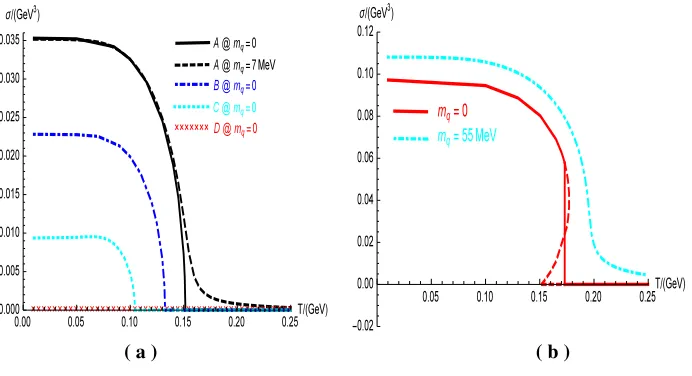
The chiral phase transition is shown in Fig. 3 (a) and (b) for 2-flavor and 3-flavor cases, respec-tively. We have realized the spontaneous chiral symmetry breaking in the vacuum and its restoration at finite temperature in the holographic QCD framework. The results are in good agreement with lattice result: In the chiral limit, the phase transition is of second order for two-flavor case and of 1st-order for three-flavor case, and in the case of finite current quark mass, the phase transition turns to crossover in both two-flavor and three-flavor cases.
( a ) ( b )
Figure 3.The chiral condensateσas a function of the temperatureT in 2-flavor case (a) and 3-flavor case (b), respectively.
5 Discussion and summary
In summary, we report our DhQCD model which is constructed in the graviton-dilaton-scalar frame-work, where the dilaton background field and scalar field are responsible for the gluodynamics and chiral dynamics, respectively. The dynamical holographic model can resemble the renormalization group from ultraviolet (UV) to infrared (IR), and the metric structure at IR is automatically deformed by the nonperturbative gluon condensation and chiral condensation in the vacuum.
We review our results on hadron spectra, and the produced glueball spectra and the light-flavor meson spectra in the DhQCD model agree well with lattice data and experimental data. We also show that for pure gluonic matter, the equation of state is in agreement with lattice result, and the transport properties show temperature dependent behavior. Especially, we observe that the transport properties can reflect the phase transition information, e.g. the ratio of the jet quenching parameter over cubic temperature ˆq/T3 and the bulk viscosity over entropy density show a peak around the
critical temperature Tc, and the shear viscosity over entropy density shows a valley around phase
We also show that chiral phase transition can be successfully realized in the holographic QCD framework. In summary, our dynamical holographic QCD model can describe hadron physics, QCD phase transition, thermodynamical properties and transport properties quite successfully.
Acknowledgements
This work is supported by the NSFC under Grant Nos. 11275213, 11261130311(CRC 110 by DFG and NSFC), CAS key project KJCX2-EW-N01, and Youth Innovation Promotion Association of CAS.
References
[1] Maldacena J. M., Adv. Theor. Math. Phys.2, 231 (1998).
[2] Gubser S. S., Klebanov I. R. and Polyakov A. M., Phys. Lett. B428, 105 (1998). [3] Witten E., Adv. Theor. Math. Phys.2, 253 (1998).
[4] Adams A., Carr L. D., Schaefer T., Steinberg P. and Thomas J. E., New J. Phys.14, 115009 (2012).
[5] Li D. N., Huang M. and Yan Q. -S. , Eur.Phys.J.C(2013) 73:2615; D. Li and M. Huang, JHEP
1311, 088 (2013).
[6] A. Karch, E. Katz, D. T. Son and M. A. Stephanov, Phys. Rev. D74(2006) 015005.
[7] Meyer H. B., hep-lat/0508002; Lucini B. and Teper M. , JHEP0106(2001) 050; Morningstar C. J. and Peardon M. J., Phys. Rev. D60(1999) 034509; Chen Y., Alexandru A., Dong S. J., Draper T., et al., Phys. Rev. D73(2006) 014516.
[8] G. Boyd, J. Engels, F. Karsch, E. Laermann, C. Legeland, M. Lutgemeier and B. Petersson, Nucl. Phys. B469, 419 (1996).
[9] D. Li, J. Liao and M. Huang, arXiv:1401.2035 [hep-ph].
[10] H. Liu, K. Rajagopal and U. A. Wiedemann, Phys. Rev. Lett. 97, 182301 (2006) [hep-ph/0605178].
[11] L. P. Csernai, J. I. Kapusta and L. D. McLerran, Phys. Rev. Lett.97, 152303 (2006).
[12] D. Kharzeev and K. Tuchin, arXiv:0705.4280 [hep-ph]. F. Karsch, D. Kharzeev and K. Tuchin, Phys. Lett. B663, 217 (2008). H. B. Meyer, Phys. Rev. Lett.100, 162001 (2008).
[13] D. Li, S. He and M. Huang, JHEP 1506, 046 (2015) doi:10.1007/JHEP06(2015)046
[arXiv:1411.5332 [hep-ph]].
[14] S. Cremonini, U. Gursoy and P. Szepietowski, JHEP1208(2012) 167 [arXiv:1206.3581 [hep-th]].
[15] K. Chelabi, Z. Fang, M. Huang, D. Li and Y. L. Wu, Phys. Rev. D93, no. 10, 101901 (2016) doi:10.1103/PhysRevD.93.101901 [arXiv:1511.02721 [hep-ph]].
![Fig. 1(a). With the only one parameterThe final results for two-gluon and three-gluon glueball spectra in the DhQCD model is shown in μG = 1GeV, which is fixed by the Regge slope of the scalarglueball spectra, we can produce almost all glueballs spectra agree well with lattice data [7], except](https://thumb-us.123doks.com/thumbv2/123dok_us/8153118.1359760/2.482.69.367.308.397/parameterthe-results-glueball-spectra-scalarglueball-spectra-produce-glueballs.webp)

![Figure 2. (a) The trace anomalytemperature ϵ−3pT 4as a function of Tc scaled temperature T/Tc in the DhQCD model (Solidblack line) comparing with the pure SU(3) lattice data [8]; (b) The jet quenching parameterq/ˆT 3 as a function of T; (c) Bulk viscosity over entropy density and (d) shear viscosity over entropy density as functionsof the temperature.](https://thumb-us.123doks.com/thumbv2/123dok_us/8153118.1359760/5.482.52.431.77.480/anomalytemperature-temperature-solidblack-quenching-parameterq-viscosity-functionsof-temperature.webp)