International Journal of COPD 2018:13 3243–3254
International Journal of COPD
Dove
press
submit your manuscript | www.dovepress.com 3243
O r I g I n a l r e s e a r C h
open access to scientific and medical research
Open access Full Text article
Whole-body vibration training – better care
for COPD patients: a systematic review and
meta-analysis
Jian Zhou1,2,*
long Pang2,*
nan Chen1,2
Zihuai Wang1,2
Chengdi Wang3
Yang hai1,2
Mengyuan lyu2,4
hongjin lai2
Feng lin1,5
1Department of Thoracic surgery,
West China hospital, sichuan University, Chengdu, People’s republic of China; 2West China school
of Medicine, sichuan University, Chengdu, People’s republic of China;
3Department of respiratory Medicine,
sichuan University, Chengdu, People’s republic of China; 4Department of
laboratory Medicine, West China hospital, sichuan University, Chengdu, People’s republic of China; 5Western
China Collaborative Innovation Center for early Diagnosis and Multidisciplinary Therapy of lung Cancer, sichuan University, Chengdu, People’s republic of China
*These authors contributed equally to this work
Purpose: Whole-body vibrating training (WBVT) is a modality aiming to improve neuromuscular performance of patients with COPD. However, a consensus on the effects of WBVT has not been reached. We aimed to clarify the effects of WBVT on functional exercise capacity, pulmonary function, and quality of life in COPD patients.
Patients and methods: PubMed, Web of Science, and EMBASE were searched through April 5, 2018. We calculated the pooled weight mean difference (WMD) using a random-effects model. Quality assessment and publication bias analyses were also performed.
Results: We included eight randomized control trials involving 365 patients. Compared with control group, WBVT increased 6-minute walking distance (6-MWD) (WMD: 62.14 m; 95% CI: 48.12–76.16; P,0.001), the change of 6-MWD (Δ6-MWD) (WMD: 42.33 m; 95% CI: 15.21–69.45; P=0.002), the change of the time to finish five repeated sit-to-stand tests (WMD: -2.07 seconds; 95% CI: -4.00 to -0.05; P=0.04), and decreased the change of St George’s Respiratory Questionnaire score (WMD: -6.65 points; 95% CI: -10.52 to -2.78; P,0.001). However, no significant difference was found between the two groups regarding forced expired volume in 1 second (FEV1) (% predicated), change of FEV1 (% predicated), sit-to-stand test, 6-MWD (% predicated), change of 6-MWD (% predicated), St George’s Respiratory Questionnaire score, COPD Assessment Test score, and change of COPD Assess-ment Test score.
Conclusion: WBVT has beneficial effects on functional exercise capacity for COPD patients. Keywords: COPD, whole-body vibration training, functional capacity, pulmonary rehabilitation
Introduction
Vibration is a mechanical stimulus, and the biomechanical variables that determine its intensity are the frequency and amplitude. Vibration training is the deliberate exposure to the body of varying frequencies using certain joint angles for any limited time. Vibration training is quite a new technology in sports science. Athletes and fitness and rehabilitation centers are widely using vibration training in their programs. Whole-body vibration training (WBVT) is one of the therapeutic pulmonary rehabilitation modali-ties aiming to improve neuromuscular performance of patients with neuromuscular dysfunction, which is applied through a vibration surface that generates sinusoidal vibrations.1 During WBVT, muscle contraction is elicited, and selected muscles can
thereby be stimulated and strengthened.2
WBVT devices deliver vibrations across a range of frequencies (15–60 Hz) and displacements from ,1 to 10 mm. Numerous combinations of amplitudes and Correspondence: Feng lin
Department of Thoracic surgery, West China hospital, sichuan University, no 37, guoxue alley, Chengdu, sichuan 610041, People’s republic of China Tel +86 28 8542 2494
Fax +86 28 8542 2494 email [email protected]
Journal name: International Journal of COPD Article Designation: Original Research Year: 2018
Volume: 13
Running head verso: Zhou et al
Running head recto: WBVT for COPD patients DOI: 176229
International Journal of Chronic Obstructive Pulmonary Disease downloaded from https://www.dovepress.com/ by 118.70.13.36 on 22-Aug-2020
For personal use only.
Dovepress Zhou et al
frequencies with current technology make it possible for a wide variety of WBVT protocols to be used on humans. Vibrating platforms fall into different, distinct categories. The type of platform used is a moderator of the effect and result of the training or therapy performed. It can be pivotal (vibrating from side to side) or lineal (vibrating up and down). When applied in patients with COPD, it usually employs low-amplitude, low-frequency mechanical stimulation.
Roelants et al3 reported that after a 24-week WBVT, the
muscle strength and performance of elderly women increased to a similar extent as regular resistance training. Evidence suggested that WBVT is a promising training modality for patients with COPD.4 However, a more convincing
conclu-sion is urgently needed.
Our study aimed to identify the effects of WBVT on improving functional exercise capacity, pulmonary function, and quality of life in COPD patients.
Methods
eligibility criteria
For inclusion, the studies needed to 1) focus on patients with COPD; 2) compare the effects difference between WBVT and conventional training; 3) be randomized controlled trials (RCTs); and 4) be written in English. The studies were excluded if they met one of the following criteria: 1) were reviews, letters, conference abstracts, book chapters, animal experiments, and case reports; 2) essential information was incomplete; and 3) WBVT was not conducted for the purpose of improving patient’s condition. Two independent reviewers determined study eligibility.
search strategy
Two authors (JZ and LP) independently searched literatures in MEDLINE, EMBASE, and Web of Science through April 5, 2018 with the following search items: “COPD” chronic obstructive pulmonary disease “emphysema” or “chronic bronchitis” and “whole body vibration training” “vibration training” or “vibration.” Then, manual searching of the reference lists of eligible studies was done to find potential relevant publications.
study selection
Two independent reviewers (JZ and LP) screened the titles and abstracts of identified articles. The obtained full-text of potential articles were screened for further check.
Data collection
Data extraction was performed by two independent researchers (JZ and LP), including publication information
(the first author, country, publication year), patient characteristics (sample size, age, gender, disease, the grade of COPD), WBVT training regime (the intensity, the frequency, the duration), and compared outcomes (6-minute walking distance [6-MWD], forced expira-tory volume in 1 second [FEV1], sit-to-stand test [SST], St George’s Respiratory Questionnaire [SGRQ], COPD Assessment Test [CAT], Chronic Respiratory Question-naire, Berg scale, and adverse events).
risk of bias in individual studies
We assessed the risk of bias of included studies according the Risk of Bias Tool found in the Cochrane Handbook
for Systemic Reviews of Interventions,5 with the following
aspects: sequence generation and concealment of alloca-tion (selecalloca-tion bias), blinding of participants and personnel (performance bias), blinding of outcome assessors (detection bias), incomplete outcome data addressed (attrition bias), free of selective reporting (reporting bias), and other bias. If any disagreements appeared, a third reviewer (FL) made a final decision.
sensitivity analyses and subgroup analyses
We conducted sensitivity analyses to explore the potential reasons for the heterogeneity, by removing one included study each time and identifying the robustness of the results. Subgroups analyses were performed to find poten-tial heterogeneity, including age ($70 or ,70 years), ethnicity (European or American), the status of COPD (stable or severe), vibration type (side-alternating vibra-tion or vertical vibravibra-tion), and exercise duravibra-tion ($1 or ,1 month).synthesis of results
The pooled outcomes were expressed as weighted mean difference (WMD) with P-value and 95% CIs. The results were regarded statistically significant when P,0.05. Heterogeneity across studies was tested by using the I² statistic, which is a quantitative measure of inconsistency across studies. Studies were considered to have low het-erogeneity when I² statistic was 25%–50%, and those with an I² statistic .75% were considered to have high heterogeneity. A random-effects model was used if the
I² statistic .50%, otherwise the fixed-effect model was used. All statistical analyses were performed using Review Manager V.5.3 (The Cochrane Collaboration, Software Update, Oxford, UK).
International Journal of Chronic Obstructive Pulmonary Disease downloaded from https://www.dovepress.com/ by 118.70.13.36 on 22-Aug-2020
Dovepress WBVT for COPD patients
Results
study characteristics
A total of 1,012 studies were identified by the initial database search. Only eight RCTs6–13 with 365 patients were included
in our study after full evaluation (Figure 1). The included studies were published between 2012 and 2017. The analyzed patients were mainly the elderly with an average age varying from 58 to 75 years, community dwelling, and functionally independent. People with exacerbated COPD were studied in one trial.9 Other trials studied individuals with stable
COPD. Generally, no special intervention was performed in a control group, but three trials performed physiotherapy,9
calisthenics training,12 and conventional resistance training,11
respectively. The primary outcomes included 6-MWD, FEV1, SST, SGRQ, CAT, CRQ, Berg scale, and the changes in these scores. Table 1 shows the study characteristics.
Methodological quality of included
studies
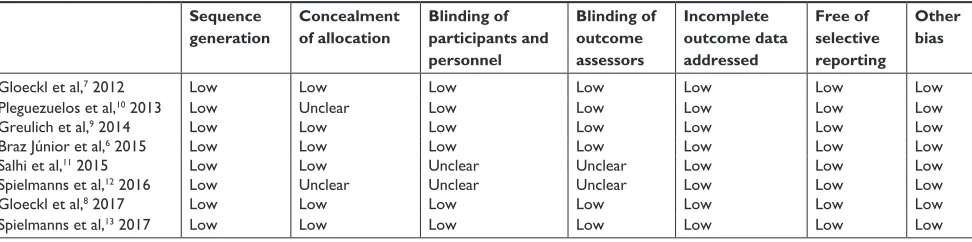
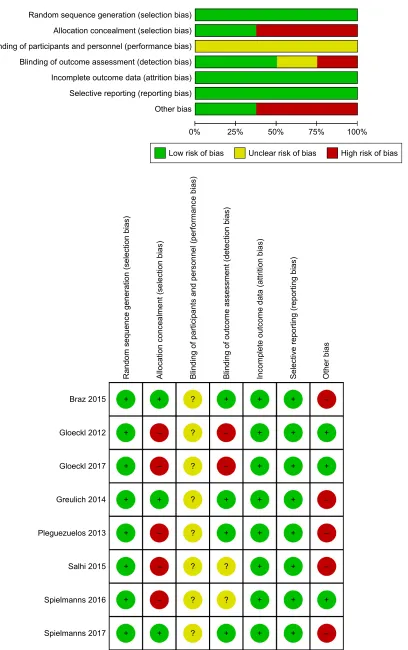
The risk of the included studies was found to be acceptable. Three studies7,10,12 did not report the concealment of
alloca-tion. Due to the intervention (WBVT), it is not possible to blind patients or study personnel to the group allocation. All included studies did not report on any specific group being blinded in the articles, typically participants, personnel, and outcome assessors (Table 2 and Figure 2).
,GHQWLILFDWLRQ
6FUHHQLQJ
(OLJLELOLW\
,QFOXGHG
5HFRUGVLGHQWLILHGWKURXJK HOHFWURQLFGDWDEDVHV
Q
$GGLWLRQDOUHFRUGVLGHQWLILHG WKURXJKUHIHUHQFHV
Q
5HFRUGVDIWHUGXSOLFDWHVUHPRYHG Q
5HFRUGVVFUHHQHG Q
5HFRUGVH[FOXGHGQ &DVHUHSRUWV
5HYLHZV
([SHULPHQWDOVWXGLHV &RQIHUHQFHDEVWUDFWV /HWWHUVRURWKHUV
)XOOWH[WDUWLFOHVH[FOXGHGZLWK UHDVRQVQ
1RWUHODWHGWR:%97 1RW&23'SDWLHQWV 1RQ(QJOLVKOLWHUDWXUHV )XOOWH[WDUWLFOHVDVVHVVHG
IRUHOLJLELOLW\ Q
6WXGLHVLQFOXGHGLQ TXDOLWDWLYHV\QWKHVLV
Q
6WXGLHVLQFOXGHGLQ TXDQWLWDWLYHV\QWKHVLV
PHWDDQDO\VLV Q
Figure 1 The PRISMA flow diagram of literature retrieval.
Note: reproduced from Moher D, liberati a, Tetzlaff J, altman Dg; The PrIsMa group (2009). Preferred reporting Items for systematic reviews and Meta-analyses: The
PrIsMa statement. PLoS Med 6(7):e1000097. doi:10.1371/journal.pmed1000097.36
Abbreviation: WBVT, whole-body vibration training.
International Journal of Chronic Obstructive Pulmonary Disease downloaded from https://www.dovepress.com/ by 118.70.13.36 on 22-Aug-2020
Dovepress Zhou et al
Table 1
Characteristics of the included
r
CTs
Study
WBVT group
Control group
Inclusion criteria
WBVT application WBVT mode and settings
WBVT- related adverse events
WBVT exercise training regime
Findings
g
loeckl
et al,
7 2012
36 age: 64
± 11 Fe V1 (% pred): 39 ± 11
36 age: 65
± 7 Fe V1 (% pred): 38 ± 12 1) a
ssured diagnosis of COPD
stage III or IV according to gO
lD, 2) given written
informed consent
9 sessions (3 sessions/ week for 3 weeks) side-alternating WBVT platform, 24–26
h
z,
6 mm peak-to-peak displacement
n
one
reported
WBVT group: 3
×
3 minutes of
self-paced dynamic squatting exercise during WBVT Control group: 3
×
3 minutes of
self-paced dynamic squatting exercise on the floor without WBVT
WBVT seems to be a promising new exercise modality for patients with COPD and may enhance the effects of a multidisciplinary rehabilitation program
Pleguezuelos et al,
10 2013
26 age: 68.4
± 8.9 Fe V1 (% pred): 37.11 ± 11.9
25 age: 71.3
± 8 Fe V1 (% pred): 32.0 ± 6.8
1) Severe COPD defined as FeV
1 /FVC , 0.7/F eV1 , 50%
predicted, 2) stable disease, 3) hospital admission or change in treatment in the previous 3 months 18 sessions (3 sessions/ week for 6 weeks) side-alternating WBVT platform, 35
h
z,
2 mm peak-to-peak displacement
n
one
reported
WBVT group: six series, of four 30 seconds repetitions with 60 seconds of rest between each series Control group: 30 minutes of moderate intensity daily walking
WBVT significantly improved the functional capacity of severe COPD patients
g
reulich
et al,
9 2014
20 age: 66.4
± 9.93 Fe V1 (% pred): 32.71 ± 13.18
20 age: 70.4
± 10.1 Fe V1 (% pred): 38.4 ± 17.82 1) h
ospitalized due to
severe COPD exacerbations, 2) pneumonia was ruled out by chest X-ray
r
elated to
hospitalized days
n
ot mentioned
n
one
reported
WBVT group: supervised manner 3×2 min/d on the vibrating platform with physiotherapy program Control group: physiotherapy program (5 minutes mobilization, 5 minutes passive movement, and 10 minutes respiratory exercises) WBVT is safe, feasible, and may exhibit positive effects on clinical parameters in COPD patients hospitalized due to an exacerbation of their underlying disease
Braz Júnior et al,
6 2015
11 age: 62.9
± 8.82 Fe V1 (% pred): 14.63 ± 11.14
1) Diagnosis of COPD according to
g O lD, 2) F eV1 , 30% predicted,
3) stable disease, 4) smoking history, environmental or occupational exposure to pollutants, former smoker for at least 1 year, 5) a sedentary lifestyle and preserved cognitive functioning 36 sessions (3 sessions/ 12 week)
side-alternating WBVT platform, 35
h
z, 2 mm
(low intensity)/4 mm (high-intensity) peak- to-peak displacement
n
one
reported
WBVT group: 30 seconds of semi- squatting training interspersed with 60 seconds of standing rest. 60 seconds of semi-squatting training interspersed with 30 seconds of standing rest Control group: no intervention WBVT may potentially be a safe and feasible way to improve functional capacity in the 6-MWT of patients with COPD undergoing a training program on the vibrating platform as well as in all domains of the
sgr
Q
quality of life
salhi et al,
11
2011
26 age: 58
± 4.5 Fe V1 (% pred): 38 ± 4.25
25 age: 63
± 2.75 Fe V1 (% pred): 39 ± 4 1)
either the F
eV
1
,
50%
pred or diffusion capacity (Dl,CO)
,
50% pred, 2)
Wmax
,
90 Watt, a 6-MWD
,
70%
pred a Qo
l
,
100 points on
the C
r
DQ or
,
20 points
on the domain dyspnea of the C
r
DQ, 3) a QF
,
70%
pred or respiratory muscle force
,
70% pred
36 sessions (3 sessions/ week for 12 weeks) side-alternating WBVT platform, 27
h
z,
2 mm peak-to-peak displacement Comparable to previous studies.
WBVT group: 30–60 seconds lower-body exercises and upper- body exercises on WBVT on top of 15 minutes endurance training rT group: muscle training on multigym equipment with endurance training WBVT after 15 minutes aerobic training enhances 6-MWD,
Wmax
, and Qo
l in
COPD patients
International Journal of Chronic Obstructive Pulmonary Disease downloaded from https://www.dovepress.com/ by 118.70.13.36 on 22-Aug-2020
Dovepress WBVT for COPD patients
spielmanns et al,
12 2017
14 age: 69
± 1.925 Fe V1 (% pred): 63 ± 7.925
13 age: 70
± 3 Fe V1 (% pred): 52 ± 7.5 1) s ta bl e C O PD in s ta ge I– III ac co rd in g to th e g O lD
classification, 2) written informed consent, 3) age
$
65
years 4) no involvement in any kind
o f r eg ul ar e xe rc ise tr ai ni ng (a t l ea st o nc e pe r w ee k) w ith in
the last 3 months before study
26 sessions (2 sessions/ week during 3 months) side-alternating WBVT platform, 6–10
h z (1–4 weeks)/12–18 h z (5–8 weeks)/21–24 h z
(9–12 weeks), 2–6 mm peak-to-peak displacement
n
one
reported
WBVT group: 10 minutes warm-up +15 minutes WBVT
+
5 minutes
cool-down, training was performed for 3
×
2 minutes
Calisthenics group: 30 minutes of relaxation and breathing retraining in combination with calisthenics exercises
a
low-volume WBVT
program resulted in significantly and clinically relevant larger improvements in exercise capacity compared with calisthenics exercises in subjects with mild-to- severe COPD
g
loeckl
et al,
8 2017
36 age: 65
± 8 Fe V1 (% pred): 25.2 ± 5.2
36 age: 63
± 9 Fe V1 (% pred): 36.6 ± 11.7
Patients aged 50–80 years with COPD stage III or IV according to g
O
lD
9 sessions (3 sessions/ week for 3 weeks) side-alternating WBVT platform, 24–26
h
z,
5 mm peak-to-peak displacement
n
one
reported
WBVT group: squat exercise on WBVT with endurance training and strength training Control group: squat exercise without WBVT with endurance training and strength training WBVT may be highly beneficial when incorporated into P
r
programs for COPD patients, especially in those with impaired balance performance and low exercise capacity
spielmanns et al,
13 2017
12 age: 62.4
± 20.3 Fe V1 (% pred): 48.4 ± 20.9
16 age: 68.0
± 9.1 Fe V1 (% pred): 51.2 ± 17.3
1) Patients with COPD at stages II–IV according to gO
lD guideline, 2) they
had to participate in pre- and postassessments at the outpatient center 13 sessions (1 session/ week for 3 months) side-alternating WBVT platform, 24–26
h
z,
3 mm peak-to-peak displacement During or after the training WBVT group: 90 minutes squat exercises on WBVT Control group: 90 minutes squat exercises without WBVT WBVT was feasible and safe in patients with COPD during an outpatient low- frequency exercise program
Abbreviations: 6-MWD, 6-minute walking distance; WBVT, whole-body vibration training; g O lD, g lobal Initiative for Chronic Obstructive lung Disease; Pr , pulmonary rehabilitation; Fe V1 , forced expiratory volume in 1 seconds;
FVC, forced vital capacity;
sgr Q, st g eorge’s r espiratory Questionnaire; Wmax
, maximal workload; Qo
l, quality of life; C
r
DQ, Chronic
r
espiratory Disease Questionna
ire; QF, quadriceps force;
r
T, resistance training.
International Journal of Chronic Obstructive Pulmonary Disease downloaded from https://www.dovepress.com/ by 118.70.13.36 on 22-Aug-2020
Dovepress Zhou et al
Table 2 risk of bias assessment Sequence generation
Concealment of allocation
Blinding of participants and personnel
Blinding of outcome assessors
Incomplete outcome data addressed
Free of selective reporting
Other bias
gloeckl et al,7 2012 low low low low low low low
Pleguezuelos et al,10 2013 low Unclear low low low low low
greulich et al,9 2014 low low low low low low low
Braz Júnior et al,6 2015 low low low low low low low
salhi et al,11 2015 low low Unclear Unclear low low low
spielmanns et al,12 2016 low Unclear Unclear Unclear low low low
gloeckl et al,8 2017 low low low low low low low
spielmanns et al,13 2017 low low low low low low low
sensitivity analysis and publication bias
We did not find any outcomes that were outside of the estimated range from derived forest plots. No significant outcomes were found in sensitivity analyses. No significant publication biases were identified by Begg’s test and visual inspection of the funnel plot.assessment of functional exercise
capacity
6-MWD and the change of 6-MWD
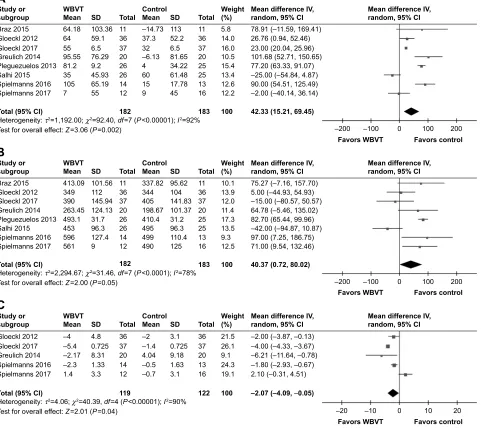
6-MWD and its variation- change of 6-MWD were reported in all eight trials, as shown in Figure 3. The results showed a significantly increased 6-MWD result (WMD: 62.14, 95% CI: 48.12–76.16, P,0.001) and the change of 6-MWD (WMD: 42.33, 95% CI: 15.21–69.45, P=0.002) in WBVT group compared with control group, which indicated that WBVT led to significant improvements in functional exercise capacity. We found no significant discoveries in subgroup analyses. Side-alternating vibration was applied in five trials,7–9,12,13 in which 6-MWD did not show
signifi-cant differences between two groups (WMD: 38.91, 95% CI: -1.11 to 78.92, P=0.11), but the change of 6-MWD (WMD: 43.73, 95% CI: 14.84–72.62, P=0.003) increased above the minimal clinically important difference (MCID) of 35 m.15 Vertical vibration was applied in the
remain-ing three trials,6,10,11 but patients enrolled in these trials
did not show any improvement in their 6-MWD (WMD: 38.66, 95% CI: -47.22 to 125.54, P=0.38) and change of 6-MWD (WMD: 40.51, 95% CI: -40.49 to 121.52, P=0.33) significantly.
6-MWD (% predicated) and change of 6-MWD (% predicated)
Three studies7,11,12 focused on 6-MWD (% predicated) to
assess the functional exercise capacity. Compared with control group, WBVT group did not show a significantly increased 6-MWD (% predicated) (WMD: 4.21, 95% CI: -8.42
to 16.84, P=0.51) and the change of 6-MWD (% predi-cated) (WMD: 4.87, 95% CI: -5.19 to 14.93, P=0.34).
ssT and change of ssT
A total of five studies7–9,12,13 reported SST and the change
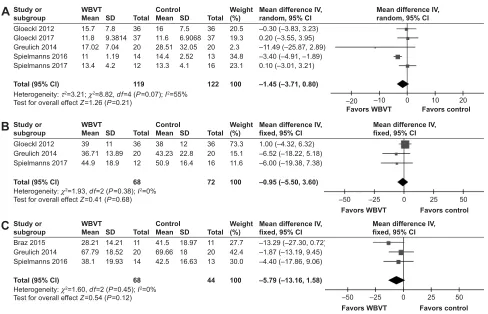
of SST. The analysis of SST and the change of SST are presented in Figures 3 and 4. WBVT group decreased the change of SST significantly compared with control group (WMD: -2.07 seconds, 95% CI: -4.09 to -0.05, P=0.04). However, no significant outcome was found between the two groups regarding the SST (WMD: -1.45 seconds, 95% CI: -3.71 to 0.80, P=0.21). Side-alternating vibration was applied in all the five trials, and it decreased the change of SST above the MCID of 1.7 seconds.16
assessment of pulmonary function
FeV1 (% predicated) and change of FeV1 (% predicated)
With analysis from three included studies,7,9,13 no significant
difference was found between the two groups concerning FEV1 (% predicated) (WMD: -0.95, 95% CI: -5.50 to 3.60, P=0.68), which can be seen in Figure 4, and the change of FEV1 (% predicated) (WMD: -1.83, 95% CI: -4.53 to 0.87, P=0.18).
assessment of quality of life
sgrQ and change of sgrQ
The change of SGRQ and SGRQ scores were reported in three trials.6,9,12 Compared with control group, WBVT
decreased the change of SGRQ score (WMD: -6.65 points, 95% CI: -10.52 to -2.78, P,0.001). However, as is shown in Figure 4, no significant difference was found between the two groups regarding SGRQ score (WMD: -5.79 points, 95% CI: -13.16 to 1.58, P=0.12).
CaT and change of CaT
With analysis from three included trials,9,12,13 no significant
difference was found between the two groups regarding
International Journal of Chronic Obstructive Pulmonary Disease downloaded from https://www.dovepress.com/ by 118.70.13.36 on 22-Aug-2020
Dovepress WBVT for COPD patients
5DQGRPVHTXHQFHJHQHUDWLRQVHOHFWLRQELDV $OORFDWLRQFRQFHDOPHQWVHOHFWLRQELDV %OLQGLQJRISDUWLFLSDQWVDQGSHUVRQQHOSHUIRUPDQFHELDV %OLQGLQJRIRXWFRPHDVVHVVPHQWGHWHFWLRQELDV ,QFRPSOHWHRXWFRPHGDWDDWWULWLRQELDV 6HOHFWLYHUHSRUWLQJUHSRUWLQJELDV 2WKHUELDV
/RZULVNRIELDV 8QFOHDUULVNRIELDV +LJKULVNRIELDV
5DQGRPVHTXHQFHJHQHUDWLRQVHOHFWLRQELDV $OORFDWLRQFRQFHDOPHQWVHOHFWLRQELDV %OLQGLQJRISDUWLFLSDQWVDQGSHUVRQQHOSHUIRUPDQFHELDV %OLQGLQJRIRXWFRPHDVVHVVPHQWGHWHFWLRQELDV ,QFRPSOHWHRXWFRPHGDWDDWWULWLRQELDV 6HOHFWLYHUHSRUWLQJUHSRUWLQJELDV 2WKHUELDV
%UD]
*ORHFNO
*ORHFNO
*UHXOLFK
3OHJXH]XHORV
6DOKL
6SLHOPDQQV
6SLHOPDQQV
"
"
"
"
"
"
"
"
"
"
±
±
±
±
±
± ±
±
± ±
±
±
$
%
Figure 2 assessment of risk of bias.
Notes: (A) graph of the risk of bias for the included studies, (B) graph of the risk of bias summary for the included studies.
International Journal of Chronic Obstructive Pulmonary Disease downloaded from https://www.dovepress.com/ by 118.70.13.36 on 22-Aug-2020
Dovepress Zhou et al
± ±
7HVWIRURYHUDOOHIIHFW= 3
+HWHURJHQHLW\τ χ GI 3,
*ORHFNO *ORHFNO *UHXOLFK 6SLHOPDQQV 6SLHOPDQQV 7RWDO&, 6WXG\RU VXEJURXS ± ± ± ± 0HDQ 6' :%97 7RWDO ± ± ± ± 0HDQ &RQWURO 6' 7RWDO :HLJKW ±±± ±±± ±±± ±±± ± ±±± 0HDQGLIIHUHQFH,9
UDQGRP&, 0HDQGLIIHUHQFH,9UDQGRP&,
)DYRUV:%97 )DYRUVFRQWURO
&
± ±
7HVWIRURYHUDOOHIIHFW= 3
+HWHURJHQHLW\τ χ GI 3,
:%97 &RQWURO 0HDQGLIIHUHQFH,9
UDQGRP&, *ORHFNO %UD] *ORHFNO *UHXOLFK 3OHJXH]XHORV 6DOKL 6SLHOPDQQV 6SLHOPDQQV 7RWDO&, 6WXG\RU VXEJURXS 0HDQ 6' 7RWDO 0HDQ 6' 7RWDO :HLJKW ± ± ±± ± ±± 0HDQGLIIHUHQFH,9 UDQGRP&, )DYRUV:%97 )DYRUVFRQWURO
%
7HVWIRURYHUDOOHIIHFW= 3
+HWHURJHQHLW\τ χ GI 3,
:%97 &RQWURO 0HDQGLIIHUHQFH,9 UDQGRP&, *ORHFNO %UD] *ORHFNO *UHXOLFK 3OHJXH]XHORV 6DOKL 6SLHOPDQQV 6SLHOPDQQV 7RWDO&, 6WXG\RU VXEJURXS 0HDQ 6' 7RWDO ± ± 0HDQ 6' 7RWDO :HLJKW ± ±± ±± 0HDQGLIIHUHQFH,9 UDQGRP&, ± ± )DYRUV:%97 )DYRUVFRQWURO
$
Figure 3 Meta-analysis of the effect of WBVT or control group on (A) change of 6-MWD; (B) 6-MWD; (C) change of ssT. Abbreviations: 6-MWD, 6-minute walking distance; ssT, sit-to-stand test; WBVT, whole-body vibration training.
the CAT score (WMD: 1.35 points, 95% CI: -1.56 to 4.27,
P=0.36) and the change of CAT score (WMD: -0.29 points, 95% CI: -3.27 to 2.69, P=0.85).
CrQ and change of CrQ
Change of CRQ and CRQ were reported in two trials;7,11
however, no significant difference was found between the two groups regarding the CRQ (WMD: 0.95, 95% CI: -0.64 to 2.54, P=0.24) and the change of CRQ (WMD: 0.27 points, 95% CI: -1.41 to 1.96, P=0.75).
Change of Berg scale and Berg scale
Based on the analysis of the two included studies,10,12 we
found no significant difference between WBVT group and
control group regarding the Berg scale (WMD: 0.27 points, 95% CI: -1.37 to 1.92, P=0.74) and the change of Berg scale (WMD: 1.49 points, 95% CI: -3.10 to 6.09, P=0.52).
Discussion
Our study included eight RCTs to assess the efficacy and safety of WBVT in improving functional exercise capacity, pulmonary function, and quality of life in COPD patients. The present systematic review showed that WBVT had beneficial effects on functional exercise capacity, which was mainly measured by 6-MWD and change of 6-MWD. However, limited evidence suggested that WBVT might enhance pulmo-nary function and quality of life in COPD patients regarding the change of FEV1 (% predicated) and SGRQ score.
International Journal of Chronic Obstructive Pulmonary Disease downloaded from https://www.dovepress.com/ by 118.70.13.36 on 22-Aug-2020
Dovepress WBVT for COPD patients ± ± )DYRUVFRQWURO )DYRUV:%97 ± ± )DYRUVFRQWURO )DYRUV:%97 ± ± )DYRUVFRQWURO )DYRUV:%97
:%97 &RQWURO 0HDQGLIIHUHQFH,9
UDQGRP&,
:%97 &RQWURO 0HDQGLIIHUHQFH,9
IL[HG&,
:%97 &RQWURO 0HDQGLIIHUHQFH,9
IL[HG&,
+HWHURJHQHLW\τ χ GI 3 ,
7HVWIRURYHUDOOHIIHFW= 3
+HWHURJHQHLW\χ GI 3 ,
7HVWIRURYHUDOOHIIHFW= 3
+HWHURJHQHLW\χ GI 3 ,
7HVWIRURYHUDOOHIIHFW= 3
0HDQ 0HDQ 0HDQ *ORHFNO 6WXG\RU VXEJURXS 6WXG\RU VXEJURXS 7RWDO&, 6SLHOPDQQV %UD] 6WXG\RU VXEJURXS 7RWDO&, *UHXOLFK 6SLHOPDQQV *ORHFNO *UHXOLFK 6SLHOPDQQV *ORHFNO *UHXOLFK 7RWDO&, 6SLHOPDQQV 6' 6' 6' 7RWDO 7RWDO 7RWDO 0HDQ 0HDQ 0HDQ 6' 6' 6' 7RWDO 7RWDO 7RWDO :HLJKW :HLJKW :HLJKW ±± ±± ±± 0HDQGLIIHUHQFH,9 UDQGRP&, 0HDQGLIIHUHQFH,9 IL[HG&, 0HDQGLIIHUHQFH,9 IL[HG&, ± ±± ± ± ±± ±± ±± ±± ±± ±± ±±±
$
%
&
Figure 4 Meta-analysis of the effect of WBVT or control on (A) ssT; (B) FeV1 (% predicated); (C) sgrQ.
Abbreviations: FeV1, forced expiratory volume in the first second; SGRQ, St George’s Respiratory Questionnaire; SST, sit-to-stand test; WBVT, whole-body vibration
training.
Some previous systematic reviews17–19 focused on the
question of whether WBVT was better than conventional training in pulmonary function and exercise capacity. Gloeckl et al17 performed a systematic review in 2015 which
included six studies.6,7,9,10,20,21 However, we found that two of
six included studies20,21 might not be RCTs. Yang et al18 and
Cardim et al19 performed similar systematic reviews in 2016.
The two systematic reviews performed by them included the same four RCTs.6,9,10,22 They both drew the conclusion that
WBVT may improve functional exercise capacity of patients with COPD.
Compared with the previous systematic reviews, our present systematic review has some advantages. First, we included eight RCTs based on strict inclusion criteria, with a total of 365 patients enrolled. Second, we analyzed more outcomes, such as the change of 6-MWD, to measure the dif-ferences. Last but not the least, we performed more subgroup analyses, leading to new significant findings such as the fact that the type of WBVT influences the effects of training. These are the main advantages of this meta-analysis.
To clarify the effects of WBVT on functional exercise capacity, we used 6-MWD, the change of 6-MWD, 6-MWD
(% predicated), the change of 6-MWD (% predicated), and SST and the change of SST. 6-MWD and the change of 6-MWD were the most important outcomes showing sig-nificant differences. Patients enrolled in this meta-analysis increased their 6-MWD above the MCID of 35 m.15 Similar
results were observed for the SST and SGRQ; the time needed for SST decreased above the MCID of 1.7 seconds.16 FEV
1
(% predicated) and the change of FEV1 (% predicated) were used to measure the pulmonary function of COPD patients. Our results showed that no significant difference was found between the two groups, which indicated that WBVT pro-vided limited benefits to pulmonary function. The change of SGRQ, SGRQ; the change of CAT, CAT; the change of CRQ, CRQ; and the change of Berg scale, Berg scale were used to measure the quality of life in COPD patients. Only the change of SGRQ decreased above the MCID of 4.23
Considering a reduction in quality of evidence due to the risk of bias, the inaccuracy and inconsistency, it is hard to draw the conclusion that WBVT has benefits on the quality of life in COPD patients.
The underlying mechanisms by which WBVT improves muscle function are incompletely clarified. During WBVT,
International Journal of Chronic Obstructive Pulmonary Disease downloaded from https://www.dovepress.com/ by 118.70.13.36 on 22-Aug-2020
Dovepress Zhou et al
the vibrations are transmitted to the muscle group through the limbs, which motivates the activation of the active muscle and improves the biological activity of the high threshold motion unit, leading to the participation of the muscle group in the sports unit.24 The effects of WBVT therapy
can be divided into two types: direct biological effect and indirect biological effect. Direct effects derive from the mechanical vibration waves to the muscle group. Indirect effects are connected to the reflex and regulation of nerve and body fluids caused by mechanical vibration waves. The mechanism by which WBVT can improve functional exercise capacity of people with CODP might be closely related to the following factors.
First, WBVT led to improvements in neuromuscular activation. The most common mechanism to explain WBVT-induced reflex muscular activity is the tonic vibration reflex.25
Different from the voluntary muscle control in traditional resistance training, the muscle contractions during WBVT are stimulated by stretch reflexes.26 The length of the muscle
spindle generally increases and afferents from Golgi tendon organs become more sensitive to vibration,25 which is seen as
an effective measurement of tendon elongation and a surrogate of force.27 People feel an experience of movement during the
tonic vibration reflex,28 in which the discharge from Golgi
ten-don organs increases, which means better muscle force.25
Fur-thermore, specific increases in ATP turnover and a generation of excess heat follow vibrations to fiber preparations,24 which
is complied with increased skin and muscle perfusion.29–31
Second, WBVT improves blood circulation in people with COPD. At present, the relevant literature shows that after WBVT, the peripheral blood circulation of the body increases by nearly 14%.32 WBVT can increase the amount
of vascular endothelial growth factor and endothelia in blood, thus accelerating blood vessel formation.33 WBVT can also
effectively improve the dilatation capacity of arterioles,34 the
speed of the blood flow, the flexibility and coordination of the muscle and also reduce the threshold of the excitability of the muscle spindle at the same time,35 which shows important
physiological significance to indirectly improve the exercise capacity of people with COPD.
Furthermore, the effects of WBVT on the respiratory sys-tem are mostly focused on alleviating the clinical symptoms of lung diseases. WBVT can effectively improve the clinical symptoms of patients with COPD, which is mainly related to the strengthened contraction force of the respiratory muscles, which further stimulates the respiratory function, improves the ratio of ventilation, blood flow, and the respiratory function.7,10 Taking all related factors together, WBVT can
effectively improve the muscle performance.
Our results showed heterogeneity across included studies. We concluded the possible reasons of heterogeneity as follows. First, the severity of participants’ state of COPD ranged from stable to severe, so different stages of COPD could result in the heterogeneity. Second, the various assess-ments of effects of WBVT could contribute to the hetero-geneity. Furthermore, inhomogeneous study protocols and settings (study period, WBVT device, WBVT parameters, exercises performed on the WBVT platform, age of patients) made the heterogeneity inevitable.
To clarify the origin of heterogeneity, we tried to perform subgroup analyses. The type of vibration was an important factor related to the effects of WBVT. Side-alternating vibration increased the change of 6-MWD and decreased the change of SST above the MCID, but vertical vibration did not lead to any significant difference. Subgroup analyses showed that side-alternating vibration may be better than vertical vibration. Also, WBVT had different effects on patients at dif-ferent age, but not those of difdif-ferent ethnicity. Besides, people with stable COPD benefited more than people with severe COPD. However, the limited sample made it hard to decide whether longer training period would have greater effects.
The first potential limitation of this present systematic review was the different training protocols and inconsistent control group interventions used among studies, which contributed mostly to the heterogeneity of the outcomes. Another limitation is that due to limited intention-to-treat data reported, our primary analysis was not according to intention-to-treat analyses, which may bias our results.
Conclusion
In conclusion, the current evidence indicates that WBVT is a safe modality that has beneficial effects on functional exercise capacity but limited effects on pulmonary function and quality of life of COPD patients. More high-quality RCTs are needed to confirm this.
Acknowledgment
We give sincere thanks to Hong Xie for her advice with respect to the English language editing of this manuscript.
Author contributions
FL, JZ, and LP conceived and designed the study. FL pro-vided administrative support. Provision of study materials or patients was due to JZ. JZ and LP helped in the collection and assembly of data. JZ, LP, NC, ZW, CW, YH, ML, and HL were involved with data analysis. FL, JZ, LP, NC, ZW, CW, YH, ML, and HL were involved in manuscript writ-ing and final approval of the paper. All authors contributed
International Journal of Chronic Obstructive Pulmonary Disease downloaded from https://www.dovepress.com/ by 118.70.13.36 on 22-Aug-2020
Dovepress WBVT for COPD patients
toward data analysis, drafting and critically revising the paper and agree to be accountable for all aspects of the work.
Disclosure
The authors report no conflicts of interest in this work.
References
1. Rauch F, Sievanen H, International Society of Musculoskeletal and Neuronal Interactions. Reporting whole-body vibration intervention studies: recommendations of the International Society of Musculosk-eletal and Neuronal Interactions. J Musculoskelet Neuronal Interact. 2010;10(3):193–198.
2. Gloeckl R, Marinov B, Pitta F. Practical recommendations for exer-cise training in patients with COPD. Eur Respir Rev. 2013;22(128): 178–186.
3. Roelants M, Delecluse C, Verschueren SM. Whole-body-vibration training increases knee-extension strength and speed of movement in older women. J Am Geriatr Soc. 2004;52(6):901–908.
4. Spruit MA, Singh SJ, Garvey C, et al. An official American Thoracic Society/European Respiratory Society statement: key concepts and advances in pulmonary rehabilitation. [Erratum appears in Am J Respir
Crit Care Med. 2014;189(12):1570]. Am J Respir Crit Care Med.
2013;188(8):15.
5. Armijo-Olivo S, Stiles CR, Hagen NA, Biondo PD, Cummings GG. Assessment of study quality for systematic reviews: a comparison of the Cochrane Collaboration Risk of Bias Tool and the Effective Public Health Practice Project Quality Assessment Tool: methodological research. J Eval Clin Pract. 2012;18(1):12–18.
6. Braz Júnior DS, Dornelas de Andrade A, Teixeira AS, Cavalcanti CA, Morais AB, Marinho PE. Whole-body vibration improves functional capacity and quality of life in patients with severe chronic obstructive pulmonary disease (COPD): a pilot study. Int J Chron Obstruct Pulmon
Dis. 2015;10:125–132.
7. Gloeckl R, Heinzelmann I, Baeuerle S, et al. Effects of whole body vibration in patients with chronic obstructive pulmonary disease – a randomized controlled trial. Respir Med. 2012;106(1):75–83. 8. Gloeckl R, Jarosch I, Bengsch U, et al. What’s the secret behind the
benefits of whole-body vibration training in patients with COPD? A randomized, controlled trial. Respir Med. 2017;126:17–24. 9. Greulich T, Nell C, Koepke J, et al. Benefits of whole body vibration
training in patients hospitalised for COPD exacerbations – a randomized clinical trial. BMC Pulm Med. 2014;14:60.
10. Pleguezuelos E, Pérez ME, Guirao L, et al. Effects of whole body vibration training in patients with severe chronic obstructive pulmo-nary disease. Respirology. 2013;18(6):1028–1034.
11. Salhi B, Malfait TJ, van Maele G, Joos G, van Meerbeeck JP, Derom E. Effects of whole body vibration in patients with COPD. COPD. 2015; 12(5):525–532.
12. Spielmanns M, Boeselt T, Gloeckl R, et al. Low-volume whole-body vibration training improves exercise capacity in subjects with mild to severe COPD. Respir Care. 2017;62(3):315–323.
13. Spielmanns M, Gloeckl R, Gropp JM, et al. Whole-body vibration training during a low frequency outpatient exercise training program in chronic obstructive pulmonary disease patients: a randomized, con-trolled trial. J Clin Med Res. 2017;9(5):396–402.
14. Salhi B, van Meerbeeck J, Joos GF, Derom E. Effects of whole body vibration in patients with COPD: a randomized study. Am J Respir Crit
Care Med. 2011;2011:183.
15. Regueiro EM, Burtin C, Baten P, et al. The minimal important differ-ence of the pulmonary functional status and dyspnea questionnaire in patients with severe chronic obstructive pulmonary disease. Respir Res. 2013;14:58.
16. Jones SE, Kon SS, Canavan JL, et al. The five-repetition sit-to-stand test as a functional outcome measure in COPD. Thorax. 2013;68(11): 1015–1020.
17. Gloeckl R, Heinzelmann I, Kenn K. Whole body vibration training in patients with COPD: A systematic review. Chron Respir Dis. 2015; 12(3):212–221.
18. Yang X, Zhou Y, Wang P, He C, He H. Effects of whole body vibration on pulmonary function, functional exercise capacity and quality of life in people with chronic obstructive pulmonary disease: a systematic review. Clin Rehabil. 2016;30(5):419–431.
19. Cardim AB, Marinho PE, Nascimento JF, Fuzari HK, Dornelas de Andrade A. Does whole-body vibration improve the functional exer-cise capacity of subjects with COPD? A Meta-Analysis. Respir Care. 2016;61(11):1552–1559.
20. Furness T, Joseph C, Welsh L, Naughton G, Lorenzen C. Whole-body vibration as a mode of dyspnoea free physical activity: a community-based proof-of-concept trial. BMC Res Notes. 2013;6(1):452. 21. Furness T, Joseph C, Naughton G, Welsh L, Lorenzen C. Benefits
of whole-body vibration to people with COPD: a community-based efficacy trial. BMC Pulm Med. 2014;14:38.
22. Gloeckl R, Halle M, Kenn K. Interval versus continuous training in lung transplant candidates: a randomized trial. J Heart Lung Transplant. 2012;31(9):934–941.
23. Welling JB, Hartman JE, Ten Hacken NH, Klooster K, Slebos DJ. The minimal important difference for the St George’s Respiratory Questionnaire in patients with severe COPD. Eur Respir J. 2015;46(6): 1598–1604.
24. Robinson JM, Wang Y, Kerrick WG, Kawai R, Cheung HC. Activation of striated muscle: nearest-neighbor regulatory-unit and cross-bridge influ-ence on myofilament kinetics. J Mol Biol. 2002;322(5):1065–1088. 25. Burke D, Schiller HH. Discharge pattern of single motor units in the
tonic vibration reflex of human triceps surae. J Neurol Neurosurg
Psychiatry. 1976;39(8):729–741.
26. Cardinale M, Lim J. Electromyography activity of vastus lateralis mus-cle during whole-body vibrations of different frequencies. J Strength
Cond Res. 2003;17(3):621–624.
27. Treloar AE, Boynton RE, Behn BG, Brown BW. Variation of the human menstrual cycle through reproductive life. Int J Fertil. 1967;12(1 Pt 2): 77–126.
28. Goodwin P. Personal involvement. Nurs Times. 1972;68(52):1660. 29. Lohman EB, Sackiriyas KS, Bains GS, et al. A comparison of whole
body vibration and moist heat on lower extremity skin temperature and skin blood flow in healthy older individuals. Med Sci Monit. 2012; 18(7):CR415–CR424.
30. Maloney-Hinds C, Petrofsky JS, Zimmerman G. The effect of 30 Hz vs. 50 Hz passive vibration and duration of vibration on skin blood flow in the arm. Med Sci Monit. 2008;14(3):Cr112–Cr116.
31. Rittweger J, Rauch F. What is new in musculo-skeletal interactions.
J Musculoskelet Neuronal Interact. 2000;1(2):171–176.
32. Button C, Anderson N, Bradford C, Cotter JD, Ainslie PN. The effect of multidirectional mechanical vibration on peripheral circulation of humans. Clin Physiol Funct Imaging. 2007;27(4):211–216.
33. Suhr F, Brixius K, de Marées M, et al. Effects of short-term vibration and hypoxia during high-intensity cycling exercise on circulating levels of angiogenic regulators in humans. J Appl Physiol. 2007;103(2): 474–483.
34. Rosenberger A, Liphardt AM, Bargmann A, et al. EMG and heart rate responses decline within 5 days of daily whole-body vibration training with squatting. PLoS One. 2014;9(6):e99060.
35. Kerschan-Schindl K, Grampp S, Henk C, et al. Whole-body vibration exercise leads to alterations in muscle blood volume. Clin Physiol. 2001; 21(3):377–382.
36. Moher D, Liberati A, Tetzlaff J, Altman DG; The PRISMA Group. Preferred Reporting Items for Systematic Reviews and Meta-Analyses: The PRISMA Statement. PLoS Med. 2009;6(7):e1000097.
International Journal of Chronic Obstructive Pulmonary Disease downloaded from https://www.dovepress.com/ by 118.70.13.36 on 22-Aug-2020
International Journal of COPD
Publish your work in this journal
Submit your manuscript here: http://www.dovepress.com/international-journal-of-chronic-obstructive-pulmonary-disease-journal The International Journal of COPD is an international, peer-reviewed
journal of therapeutics and pharmacology focusing on concise rapid reporting of clinical studies and reviews in COPD. Special focus is given to the pathophysiological processes underlying the disease, intervention programs, patient focused education, and self management protocols.
This journal is indexed on PubMed Central, MedLine and CAS. The manuscript management system is completely online and includes a very quick and fair peer-review system, which is all easy to use. Visit http://www.dovepress.com/testimonials.php to read real quotes from published authors.
Dovepress
Dove
press
Zhou et al
International Journal of Chronic Obstructive Pulmonary Disease downloaded from https://www.dovepress.com/ by 118.70.13.36 on 22-Aug-2020