PARAMETER OPTIMIZATION SIMULATION OF HIGH POWER YTTERBIUM DOPED DOUBLE-CLAD FIBER LASER
KHAIROL BARIYAH BINTI MAAMUR
A thesis submitted in fulfillment of the requirement for the award of the degree of
Master of Science (Physics)
Faculty of Science Universiti Teknologi Malaysia
iii
This thesis is specially dedicated to:
My beloved parents,
Maamur Othman, Zaharah Mohamad
My dear husband, Mohd Shahrom
My supportive sibling, Mohd Redwan, Nur Shahida
My dedicated lecturers,
and all my friends.
iv
ACKNOWLEDGEMENT
First of all, I am greatly thankful to Allah for His blessing to allow me to complete this works on the time.
Along with the completing of this thesis, there are many people involved that contributed towards my understanding and thought. In particular, I wish to express my sincere appreciation to my supervisor, Assoc. Prof. Dr. Yusof Bin Munajat, for his encouragement, guidance and criticism during the course of this research. Without his time and patience much of this work could not have been accomplished. Not forgotten, million thanks to Dr Saktioto and Profesor Dr. Rosly Bin Abd. Rahman, and all my friends who always gave me cooperation and assistance in doing this research.
I also would like to express my gratitude to Ministry of Science Technology and Innovation (MOSTI) for supporting scholarship for two year semesters Master MyBrain and Ministry of Higher Education (MOHE) Malaysia for the financial support given under the Fundamental Research Grant Scheme (FRGS), Vot 78455.
v
ABSTRACT
vi
ABSTRAK
vii
TABLE OF CONTENTS
CHAPTER TITLE PAGE
DECLARATION ii
DEDICATION iii
ACKNOWLEDGEMENTS iv
ABSTRACT v
ABSTRAK vi
TABLE OF CONTENTS vii LIST OF TABLE x LIST OF FIGURES xi
LIST OF ABBREVIATIONS xii
LIST OF SYMBOLS xiv
1 INTRODUCTION
1.1 Background of Study 1
1.2 Statement of Problem 2
1.3 Objective of the Study 3
1.4 Scope of the Study 3
1.5 Significance of the Study 4
viii
2 LITERATURE REVIEW
2.1 Introduction 6
2.2 Optical Fiber 8
2.3 Principle of Laser 11
2.3.1 Stimulated Emission 11 2.3.2 Optical Amplification 12
2.3.3 Optical feedback 14
2.4 Brief introduction of fiber laser 15
2.5 Double clad fiber 18
2.6 Double clad fiber designs 20
2.7 Ytterbium doped fiber laser 22
2.8 Fiber Bragg Grating 25
2.9 Simplified analytic solution 27
2.10 Rate Equation of Yb-doped fiber laser 32
2.11 Simulation Software 34
3 RESEARCH METHODOLOGY
3.1 Introduction 35
3.2 Liekki Application Designer (LAD) software 35
3.3 Numerical experimental setup 38
3.3.1 Multimode Ytterbium doped fiber- double Cladding
41
3.3.2 Pump Power 41
3.3.3 Splice 42
3.3.4 Multimode pump coupler (MPC) 43
3.3.5 Grating 44
3.4 Simulation system 46
3.4.1 System with difference pumping configuration
ix
3.5 Simulation Design 48
4 RESULT AND DISCUSSION
4.1 Introduction 50
4.2 Effective Pump Wavelength 51
4.3 Output power at different pumping scheme 52 4.4 Optimum value for length in difference
pumping configuration
54
4.5 Optimum fiber length as a function of dopant configuration
56
4.6 Optimum fiber length as a function of pump power
58
4.7 Optimum fiber length as a function of output reflectivity, R2
59
5 CONCLUSION AND FUTURE WORK
5.1 Introduction 61
5.2 Conclusion 61
5.3 Future Work 65
REFERENCES 66
x
LIST OF TABLES
TABLE NO. TITLE PAGE
3.1 Specification of Yb-DCF 40
3.2 Typical device specification for multimode ytterbium doped double clad fiber
41
xi
LIST OF FIGURES
FIGURE NO TITLE PAGE
2.1 Ray bouncing inside an optical fiber 8
2.2 Fiber Layer 9
2.3 Two level laser 13
2.4 A three level laser 13
2.5 Schematic of laser cavity 15
2.6 Schematic of fiber resonator for cw fiber laser: 17 2.7 Double clad concept for high power fiber laser 18
2.8 Various designs of double-clad fibers 20
2.9 Model calculation for the absorbtion of difference cladding-pumped structure in dependence of fiber length
21
2.10 Absorption and emission cross sections of ytterbium in fused silica
23
2.11 Energy levels of Yb3+ ions in Yb:YAG 24
2.12 Principle of FBG 25
2.13 Schematic diagram of the double-clad fiber laser with forward pumping configuration
28
2.14 Schematic diagram of the double-clad fiber laser with backward pumping configuration.
30
3.1 Flow chart of simulation procedure 38
3.2 Ytterbium doped double clad fiber laser system. 39
3.3 Pump Power 42
3.4 Splice 43
xii
3.6 Grating 46
3.7 Schematic representation of FBG as a mirror 46 3.8 Experimental setup for Ytterbium doped fiber
amplifier in difference pumping scheme. (a) forward (b) backward
47
3.9 Flow chart of simulation design 49
4.1 Output power as a function of pump power in difference pump wavelength
51
4.2 Output power as a function of pump power 51
4.3 Output power versus fiber length 55
4.4 Output power profile for difference dopant concentration
56
4.5 Output power for difference pump power. 59
xiii
LIST OF ABBREVIATIONS
DCF - Double Clad Fiber
DFL - Doped Fiber Laser
EDFL - Erbium doped fiber Laser
ASE - Amplified Spontaneous Emission
FBG - Fiber Bragg Grating
WDM - Wavelength division multiplexing
xiv
LIST OF SYMBOLS
Yb - Ytterbium
Er - Erbium
Nd - Neodynium
N - Dopant concentration
λB - Bragg wavelength
Pp - Pump Power
P+(z) - Forward Signal Power P-(z) - Backward Signal Power αa - Absorption Coefficient αs - Scattering Loss Coefficient
λp - Pump Wavelength
λs - Signal Wavelength
τf - Spontaneous Lifetime
σs - Stimulated Emission Cross-Section Af - Saturation Signal Output Power
ms - Millisecond
m - Meter
dB - Decibel
nm - Nanometer
CHAPTER 1
INTRODUCTION
1.1 Background of the Study
High-power fiber laser have many advantages over other types of high power lasers including high conversion efficiency, immunity from thermal lensing effect due to large ratio of surface area to volume, no need of beam steering, simplicity of optical construction and excellent beam quality. Most work on Yb-doped fiber laser focuses on the inclusion of fiber Bragg grating (FBG) into the cavity and also the use of Yb-doped fiber with double clad structure [1]. Yb+3 ion have special properties among different kinds of ion such as simple energy levels, long life time at high level, high quantum efficiency and wide absorption spectrum which make it possible to develop a high-power Yb+3 doped fiber laser.
2
reflector coefficient is accessible to survey and simulate in fiber laser output by solving the rate equation.
Understanding the role of thermally induces stress and others thermo-optics effect in power scaling studies requires much attentions because the standard fiber design will eventually lead to a high core temperature can no longer be justified as the thermal effect is negligible in practice. Interestingly, the recent modeling of thermal effect of glass fiber laser has been revealed where a careful management of these effects can remarkably reduced the handling of these lasers as performing scaling up effort.
1.2 Statement of Problem
There has been recent interest in the development of ytterbium-doped fiber laser system that has been used for high power laser. Moreover, strongly pumped fiber amplifiers are often been used to generate high power output by magnifying continuous wave in many applications. Ytterbium doped fiber can offer high gain, good efficiency, excellent beam quality and broad gain bandwidth.
3
Recently, rare-earth doped double clad fiber laser have made considerable progress experimentally. Double-clad fiber lasers (DCFLs) were widely applied in many fields, such as medicine, military, industry and modern telecommunications. It is due to their inherent advantages over solid state lasers, such as high output power, high conversion efficiency, lower cost and excellent beam quality [3].
In this research, the simulation are conducted to analyze and optimize the amplification performance of ytterbium doped double clad fiber and determine the optimal parameter such as fiber length, dopant concentration, pump power and reflectivity.
1.3 Objective of the Study
The objectives of this study are:
i. To design and simulate of Ytterbium doped double-clad fiber laser system. ii. To investigate the Yb-doped DCF laser parameter such as pump power, fiber
length, dopant concentration and reflectivity that can lead to optimum output laser.
1.4 Scope of the Study
4
parameter such as dopant concentration of Yb, fiber length, pump power, and reflectivity for practical application.
1.5 Significance of the study
Among several laser which is doped with rare-earth elements, Ytterbium-doped double clad fiber (DCF) laser will be focused in this research and the effect of some parameter to the output power of Yb-doped DCF will be determined. This result will proved that the Yb-doped DCF laser can offer high output power compared to the other rare-earth element and it is highly dependent on the fiber laser parameter such as fiber length, dopant concentration, pump power, pumping scheme, and reflectivity. Thus, this research is done to investigate the Yb-doped DCF laser parameter that can lead to optimum output laser. Besides, this research can briefly review on the rate equation fiber laser system. This is very important in order to understand the basic principle of Yb-doped DCF laser system.
1.6 Thesis plan
5
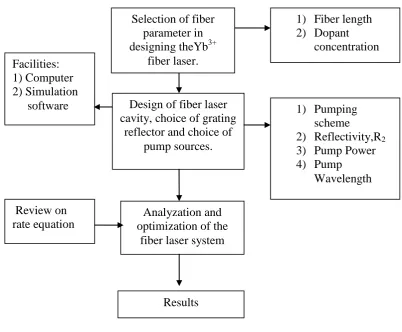
is research methodology will explains all the simulation procedure by using Liekki Application Designer (LAD) software including the numerical setup. The simulation results and discussion on this research will be analyzed and explains in details in Chapter 4. Finally, Chapter 5 summarizes all the simulation findings and concludes all the results and some suggestions for future studies related to this research. The flow chart of the research activities is shown in Figure 1.1.
Figure 1.1: Flow chart of research activities.
1) Fiber length 2) Dopant
concentration
Design of fiber laser cavity, choice of grating
reflector and choice of pump sources.
Analyzation and optimization of the
fiber laser system
Results
1) Pumping scheme
2) Reflectivity,R2 3) Pump Power 4) Pump
Wavelength Facilities: 1) Computer 2) Simulation software Review on rate equation
Selection of fiber parameter in designing theYb3+
66
REFERENCES
1. Harun, S.W., Paul, M.C., Moghaddam, M.R.A. and Das, S. Efficient diode pumped ytterbium doped fiber laser. Electronis Letters. 2010. 46.
2. Jeong, Y., Sahu, J.K., Baek, S., Alegria, C. and Codemard, C. Optic.
Communication. 2004. 234. 315.
3. Jeong, Y., Sahu, J.K., Payne, D.N., and Nilsson, J. Ytterbium doped large core fiber laser with 1.36 kW continous wave output power. Electronic
Letter. 2004. 40. 6088-6092.
4. Gaponstev, D. 6 kW CW single mode Yb fiber laser in all fiber format. Laser
Focus World. 2005. 41. 9.
5. Kelson, I., and Hardy, A.A. Strongly pumped fiber lasers. IEEE J. Quantum
Electron. 1998. 34. 1570-1577.
6. Limin, X., Ping, Y., Mali, G., Wenlou, W., and Pan, O. An approximate analytic solution of strongly pumped Yb-doped double-clad fiber lasers without neglecting the scattering loss. Optic Communication. 2004. 230. 401.
7. Reichel, V., Unger, S., Hageman, V., et.al. 8W highly efficient Yb-doped fiber laser. Proceeding of SPIE. 2000. 3889. 160-169.
8. Ammar, H., Thierry, C., Cafer, O., and Francois, S. Dynamic and stabilization of a high power side-pumped Yb-doped double-clad fiber laser.
Optic Communication. 2000. 186. 311-317.
67
10. Ray, T. Optoelectronics and fiber optic technology. Planta A Tree. 15-23. 2003.
11. Alan, J.R,. Understanding optical fiber communication. Artech fiber house. 59-60. 2001.
12. Bagad, V.S. Optical Fiber Communication. Technical Publication Pune. 1St Edition. 2009.
13. Wilson, J., and Hawkes, J. Optoelectronics An Introduction. 2nd Edition. Prentice Hall. 155-164. 1989.
14. Leigh, M.A. High power pulsed fiber laser sources and their use in Terahertz
generation. Ph.D. Thesis. The University of Arizona. 39-44. 2008.
15. Peter, W.M., Josept, H.E., Laser Physics. Wiley. 153-155. 2009.
16. Seungin, B., Daniel, B,. Soh. S., Yoonchan, J., Jayanta, Sahu, K., et al. A Cladding-Pumped Fiber Laser with Pump-Reflecting Inner-Cladding Bragg Grating .IEEE. 2004. 407-409.
17. Budz, A.J., Waisman, J.H., Tiedje, F., and Hauge, H.K. Short-Pulse Dual-Wavelength System Based on Mode-Locked Diode Lasers With a Single Polarization-Maintaining Yb:Fiber Amplifier. Journal of Light Wave Technology. 2009. 3416-3424.
18. Jin, J., Jiao, Q., Chang, Y., Zhang, Y., and Lu, F.Y.Experimental research of double-clad fiber laser. Proceeding of SPIE. 2004. 47-51.
68
20. Wang, G., Wang, J., Duanmu, Q. et.al. Numerical analysis and experimental research of output performance for Yb3+-doped DCF lasers. Proceeding of SPIE. 2005. 5627. 406-409.
21. Shalibeik, H. Rare-earth doped fiber lasers and amplifiers. Cuvillier Verlag Gottingen. 13-15. 2007.
22. Zhang, F., Wang, C., Ning, T. A global design of high power Nd3+-Yb3+ co-doped fiber lasers.Elsevier. Optic Communication. 2008. 281. 4442-4448.
23. Hajialamdari, M., Alkadry, A.M., Strickland, D. Modeling of a two-color, two stage, ultrafast Yb-doped fiber amplifiers. Optic Communications. 2011. 284. 2843-2848.
24. Jeong, Y., Sahu, J.K., Williams, R.B., Richardson, D.J. et.al. Ytterbium-doped large core fiber laser with 272 W output power. Electronics Letters. 2003. 39. 977-978.
25. Hanna, D.C., Percival, R.M., Perry, I.R., Smart, R.G., and Suni, P.J. Continous-wave oscillation of a monomode ytterbium doped fiber laser.
Electronic Letter. 1988. 24. 1-4.
26. Wang, B.S., and Andrejco, M.J. Advanced Topics on Erbium Doped Fibers for High Performance Amplifiers. SPIE. 2005. 1-9.
27. McCumber, D.E. Einstein relation connecting broadband emission and absorption spectra.Physical Review. 1964. 136. 954-957.
69
29. Xiao, W.P., Ling, D.K., and Dongsheng, L. Optical fiber sensor layer embedded in smart composite material and structure. Smart Mater. Struct. 2006. 15. 1231-1234.
30. Ota, J., Shikawa, A., Ueda, K.I. High power Yb-doped double-clad fiber laser directly operating at 1178 nm. Jpn.J.Applied Physics. 2006. 45. 117-119.
31. Manfred, K. Strain measurement with fiber Bragg grating sensor. HBM. 1-11.
32. Hang, Y.L., Kin, T.L., Cheng, L. and Wei, J. Viability of using an embedded FBG sensor in a composite for dynamic strain measurement. Elsevier. 2006. 39. 328-334.
33. Zhengqian, L., Chenchun, Y., Guoyong, S., Zhiping, C., Miaoling, S., and Qibo, L. Simplified analytic solutions and a novel fast algorithm for Yb3+-doped double-clad fiber lasers. Optic Communication. 2007. 277. 118–124.
34. Hardy A.A & Oron R. J. Amplified spontaneous emission and Rayleigh backscattering in strongly pumped fiber amplifiers. Lightwave Technology. 1998. 16. 1865-1873.
35. Barnard, C., Myslinski, P., Chrostowski, J., and Kavehrad, M. Analytical model for rare-earth doped fiber amplifiers and lasers. IEEE Journal of
Quantum Electronics. 1994. 30. 1817-1829.
36. Cheng, X.P., Shuma, P., Tang, M., and Wub, R. Analysis and characterization of fiber Bragg grating-based Q-switched ytterbium-doped double-clad fiber lasers. Optics and Lasers in Engineering. 2009. 47. 148–155.
37. Yong, W., and Hong, P. Dynamics characteristic of double clad fiber amplifiers for high power pulse amplification. Journal of Light Wave
70
38. Cheng, X.P., Shum, P., and Tang, M. Numerical analysis and characterization of fiber Bragg grating based Q-switched Ytterbium-doped DCF lasers.
Elsevier. Optics and Laser in Engineering. 2009. 47. 148-155.
39. Guohua, L., and Deming, L. Optimization of pumping mode for double clad fiber lasers. Elsevier. 2008. 40. 256-260.
40. Limin, X., Ping, Y., Mali, G., and Wenlou, W. An approximate analytic solution of strongly pumped Yb-doped double clad fiber lasers without neglecting the scattering loss. Elsevier. Optic communications. 2004. 230. 401-410.
41. Yong, W. Optimization of pulse amplification in Ytterbium-doped double clad fiber amplifiers. Journal of light wave technology. 2003. 23. 2139-2147.
42. Rebolledo, M.A., and Jarabo, S. Analysis of a technique to determine absolute values of the stimulated emission cross section in erbium doped silica fiber from gain measurement, Pure Appl. Opt. 1997. 6. 425-433.
43. nLight Corporation website. High power semiconductor lasers and fibers.
44. Sahu, J.K., Kalita, M.P., Alam, S., Ibsen, M., et al. 12W Ytterbium doped all fiber laser at 1179 nm. IEEE. 2009
45. Paschotta, R., Nilsson, J., Tropper, A.C., Hanna, D.C. Ytterbium doped fiber amplifiers. IEEE. J.Quantum Electron. 1997. 33. 1049-1056.
46. Duan, Z., Zhang, L., and Chen, J. Analytical characterization of an end pumped rare-earth doped double clad fiber laser. Optical Fiber Technology. 2007. 13. 143-148.
71
48. Khare, R.P. Fiber Optics and Optoelectronics. Oxford. 96-100. 2004.
49. Vivek, A. Optical network design and implementation. Cisco press. 94-100. 2004.
50. Thevenaz, L. Advanced fiber optics concept and technology. CRC Press. 190-191. 2011.
51. Yang, D., Jiang, P., Wang, Y., Wu, B. Dual wavelength high power Yb-doped double clad fiber laser based on few mode Fiber Bragg Grating. Optic
and laser Technology. 2010. 42. 575-579.
52. Yong, W. Optimization of pulse amplification in Yb-doped double clad fiber Amplifiers. Journal Of Lightwave Technology. 2005. 23. 2139-2147.
53. Kasap, S.O. Optoelectronics and photonics principle and practices. Pearson Education Internasional. 2001.
54. Peterman, K. Constraint for fundamental mode spot size for broadband dispersion compensated single mode fibers. Electronic Letter. 1983. 19. 712-714.
55. Jinglin, L., Chujun, Z. The optimum length of linear cavity Yb3+-doped double clad fiber laser. Elsevier. 2010. 283. 1449-1453.
56. Ghatak, A.K., and Thyagarajan, K. Introduction to Fiber Optic, First South Asian adn, Cambridge University Press, Cambridge. 1999.
57. Abdullah, F., Bouzid, B., Mahdi, M.A., Cheah, C.L. Characterization of a dual wavelength fibre laser based-on dumbbell conguration.Optics and Laser
72
58. Zainal, A., Naji, M.S., Mansoori, A.W., and Adikan, F.R.M. Optimizations of remotely-pumped Edfa location for unrepeated transmission systems.
Electronic Engineering. 2007. 89. 349-352.
59. Claude, R. Femtosecond Laser Pulses. Springer: Universite Bordeaux. 309-330. 2003.
60. Susan, L. and Dexheimer. Terahertz Spectroscopy. Taylor & Francis. 269-275. 2007.
61. Gong Y.D. Terahertz Spectroscopy Technology Trend Using 1550nm Ultrafast Fiber Laser. Microwave and Optical Technology Letters. 2006. 49. 439.
62. Preu, S. Tunable, Continuous wave Terahertz Photomixer Sources and
Applications. 2011.