20th International Conference on Structural Mechanics in Reactor Technology (SMiRT 20) Espoo, Finland, August 9-14, 2009 SMiRT 20-Division 6, Paper 2560
Analysis of the Stress-Strain State of Containment Depending on Temperature
Fluctuations in the Environment
Alexander S. Kiselev
a, Alexey S. Kiselev
a, Victor N. Medvedev
a,
Valery F. Strizhov
a, and lexey N. Ulianov
aa
Nuclear Safety Institute of the Russian Academy of Sciences (IBRAE RAS), Moscow, Russia, e-mail: [email protected]
Keywords: Containment,
heat-insulation, finite element, temperature field
1
ABSTRACT
The running experience of NPP containments collected over a protracted period of time has demonstrated that environmental effects (mostly seasonal and daily temperature fluctuations) are the key factors influencing their stress-strain state. Taking account of the fact that environmental-temperature fluctuations may have rather large increments over short periods of time, the temperature-stress values could be also significant and would lead to degradation of strength properties of containment materials. There is analyzed the effect of environmental seasonal and daily temperature fluctuations on stresses distribution of containment of VVER-1000 reactor of Kalinin NPP Unit 1. It is proposed using of heat-insulation on the outer surface of cylinder and dome part of containment to reduce the influence of temperature fluctuations on reinforced concrete. Using detailed 3D model of containment it is obtained quantitative assessment of the decreasing of temperature gradients, of stresses values, and geometry changes due to heat insulation implementation.
2
INTRODUCTION
At the present time the design life of containments at several Russian Nuclear Power Plants (NPPs) is nearing completion that requires both analysis of the capability to prolong their operation and development of measures to extend service life of their structures. New NPP units under construction also face these problems due to the need for both reducing damageability of reinforced-concrete structures during operation and extending their service life.
The running experience of NPP containments collected over a protracted period of time has demonstrated that environmental effects (mostly seasonal and daily temperature fluctuations) are the key factors influencing their stress-strain state.
Taking account of the fact that environmental-temperature fluctuations may have rather large increments over short periods of time, the temperature-stress values could be also significant and would lead to degradation of strength properties of containment materials and, as a consequence, to loss in their operational functionality.
The paper focuses on a calculated analysis of changes in the strain-stress state of NPP containments with VVER-1000 depending on seasonal and daily environmental-temperature fluctuations. Two specific cases are considered: 1 – real condition of containment without thermal insulation at the outer wall surface; and 2 – assumed coating of the outer containment surface with a foam-concrete layer (heat insulation).
3
FEATURES OF THE CONTAINMENT CALCULATION MODEL
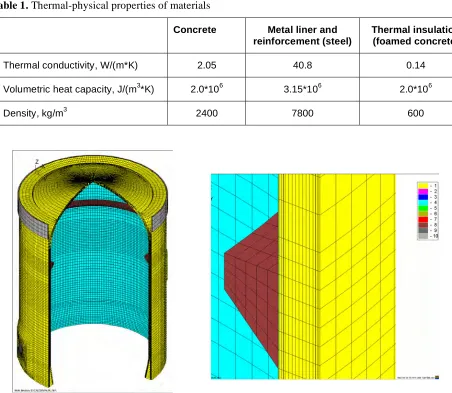
In the calculations performed the real data of Unit 1 containment at Kalinin NPP were used.
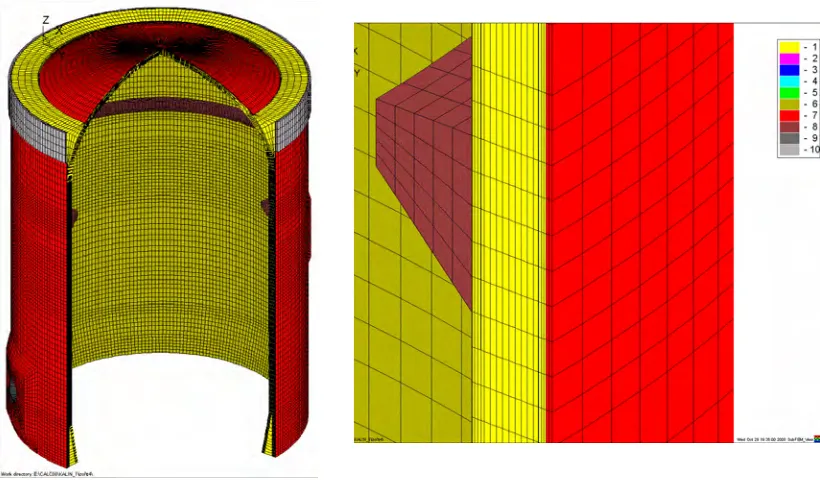
containment surface on temperature distributions and stress-state parameters, another finite-element model of the containment was developed (Fig. 2), which possessed 2 finite-element layers at the outer surface of both the cylindrical and the domical parts (material No 7: each layer of 50-mm thick and total heat insulation of 100-mm thick). Altogether 19 finite-element layers were introduced across the wall thickness in Model #1 (without heat insulation) and 21 finite-element layers in Model #2 (with heat insulation). Model #1 contained 518046 linear 8-node finite elements and 554820 nodes, whereas Model #2 consisted of 567594 finite elements and 604494 nods.
Boundary conditions of the third type were assigned in the temperature calculations at the inner and the outer surfaces of the containment model, i.e. the convective heat-exchange conditions with medium temperatures inside and outside the containment and specific heat-transfer coefficient.
In the temperature-field calculations with consideration for both seasonal and daily temperature fluctuations for normal operating conditions the medium temperature inside the containment was taken equal to 40 C during winter, spring and autumn months and to 50 C in summer months. The heat-transfer coefficient of 8.75 W/m2/K was used. The temperature outside the containment was assigned as a piecewise-linear dependence in accordance with the results of in-situ measurements performed every three hours in the course of the time frame under consideration (30-50 days). The heat-transfer coefficient of 23.3 W/m2/K was taken for the containment outside.
The thermal-physical properties of materials used in the calculations are in the table 1.
Table 1. Thermal-physical properties of materials
Concrete Metal liner and reinforcement (steel)
Thermal insulation (foamed concrete)
Thermal conductivity, W/(m*K) 2.05 40.8 0.14
Volumetric heat capacity, J/(m3*K) 2.0*106 3.15*106 2.0*106
Density, kg/m3 2400 7800 600
Figure 2. Finite-element containment model used for temperature field calculations (case with thermal insulation at the outer surface of the cylinder and the dome)
4
DETERMINING TEMPERATURE DISTRIBUTION WITHIN THE CONTAINMENT
The effects of environmental temperature fluctuations on containment functioning are due to the combination of the following impacts:
- seasonal temperature fluctuations in the environment; - daily temperature fluctuations in the environment; and
- temperature variations within the containment due to seasonal temperature fluctuations in the environment.
4.1 Effects of seasonal temperature fluctuations in the environment
The results of air-temperature measurements in the vicinity of Kalinin NPP (the Tver region) give an idea of seasonal environmental-temperature fluctuations at this location. Throughout the period of meteorological observations at the Kalinin NPP site the absolute maximum air temperature reached +35 C; the calculated maximal temperatures of 1%, 0.1% and 0.01% probability (i.e. the occurrence once every 100, 1000 and 10000 years) made up 35 C, 37 C and 40 C, respectively. The absolute minimum air temperature recorded in the Kalinin NPP area made up -48 C, and the calculated minimal temperatures of 1%, 0.1% and 0.01% probability (i.e. the occurrence once every 100, 1000 and 10000 years) equaled minus 48 C, minus 53 C and minus 58 C.
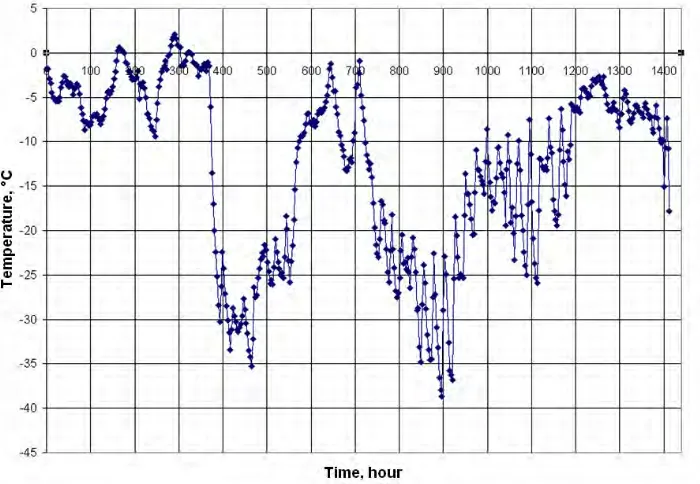
Over the last three years a minimum air temperature of minus 38.7 C was recorded in the Kalinin NPP area (Fig. 3). According to the results of air temperature measurements close to the Kalinin NPP site from 01.10.2006 till 30.09.2008, maximum mean daily temperatures during summer months equal about 30 C, whereas minimum temperatures in winter months go down to minus 30 C (Fig. 4).
4.2 Effects of daily air-temperature fluctuations in the environment
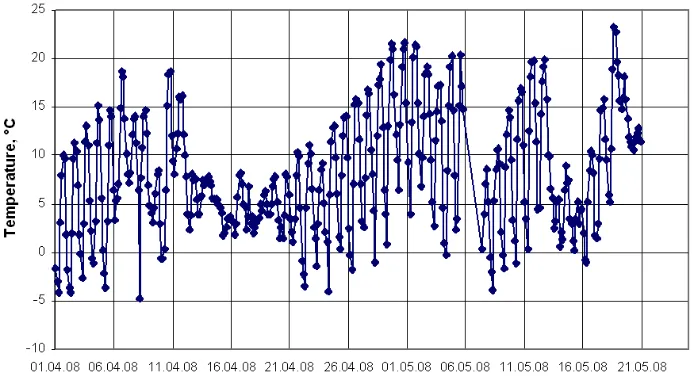
In spring, substantial daily air-temperature fluctuations (up to 20 C and more) are typical for the Kalinin NPP area (Fig. 5), and in the nighttime air temperatures can even drop down to -5 C. Such large daily temperature fluctuations may lead to strength degradation in concrete due to destructive processes caused by freezing-thawing strains.
Figure 3. Air-temperature variations in wintertime in the vicinity of Kalinin NPP (22.12.2005 through 21.02.2006)
Figure 4. Annual air-Temperature variations in the vicinity of Kalinin NPP (01.10.2006 through 30.09.2008)
Though in autumn daily air-temperature fluctuations are not large, they quite often fluctuate around zero, and frequent air-temperature variations from close-to-zero to sub-zero values may also result in strength degradation in concrete due to freezing-thawing strains.
In winter, daily air-temperature fluctuations can be rather significant. Under conditions of large temperature variations in the outer environment on the one hand and an increase in inside temperatures during the power unit operation at power on the other hand, tensile stresses in concrete by the outer wall surface of the containment are expected. Simultaneously, compression stresses by the inner wall surface would considerably increase.
4.3 Dependence of temperature variations inside the containment on seasonal temperature fluctuations in the environment
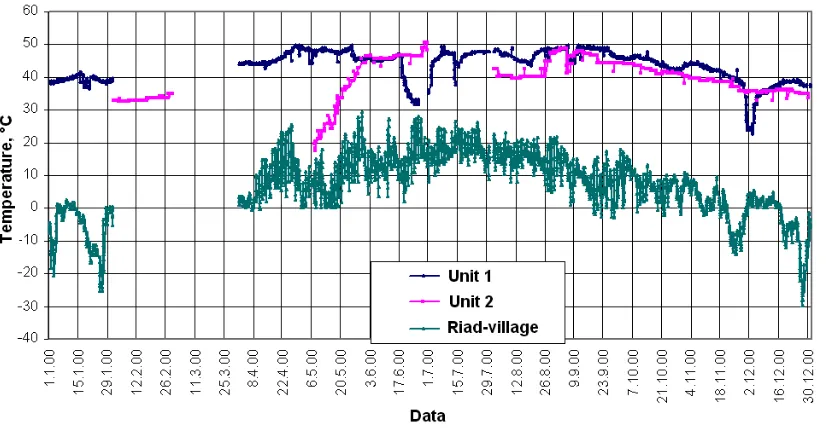
Seasonal temperature fluctuations in the environment exert effects on temperature variations inside the containment. Let us consider their parameters by comparison of air temperatures measured in the vicinity of Kalinin NPP (Riad-village) and in-containment temperatures at Units 1 and 2 of Kalinin NPP from 01.01.2000 through 31.12.2000 (Fig. 6). As indicated in Fig.6, in-containment temperatures vary within 32-40 C in wintertime, during spring and autumn they fluctuate around 32-40 C, whereas in summer these temperatures may attain 50 C.
Figure 6. Variations of environmental temperatures in the vicinity of Kalinin NPP (Riad-village) and in-containment temperatures at Units 1 and 2 of Kalinin NPP from 01.01.2000 through 31.12.2000
5
RESULTS OF CALCULATION OF THE CONTAINMENT STRESS-STRAIN STATE
During the study the stress-strain state of the Unit 1 containment (Kalinin NPP) was calculated taking account of both seasonal and daily fluctuations of environmental temperatures.
The calculations were conducted in the following order. At first, temperature distributions across section of the containment wall depending on fluctuations of both seasonal and daily temperatures were calculated. Two specific cases were considered: 1 – without heat-insulating layer; and 2 – with heat insulation of 10-cm thick (foamed concrete of γ=600 kg/m3 density) at the outer surface of both the containment cylinder and dome.
In calculations on determining temperature distributions across section of the containment wall (Kalinin NPP Unit 1) depending on fluctuations of seasonal and daily temperatures during wintertime the data of Fig. 7 were used. The temperature of the medium within the containment was taken invariable and equaling 40° .
Figure 7. Variations of environmental temperatures in the vicinity of the containment of Kalinin NPP Unit 1 in wintertime (January 1 through February 28, 2006)
The calculation of temperature fields allowed achieving temperature distributions within the containment wall for 2900 time instants with 0.5-hour time step. The calculation results for a section in the middle of the containment cylinder are demonstrated in Fig. 8. It may be seen that qualitatively the temperature fluctuations at the outer containment surface follow those of the environment.
The results of calculations for the case with heat insulation (Fig. 9) demonstrate that the temperature fluctuations at the surface of concrete under heat insulation are considerably lesser compared to those recorded at the surface of the heat-insulation layer, these temperature fluctuations following – with minor deviations – the environmental-temperature curve.
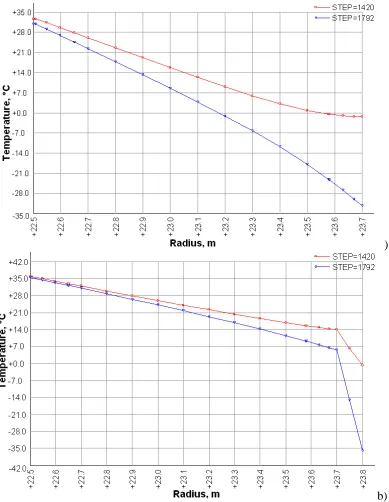
Temperature profiles across wall section in the containment cylindrical part corresponding to the maximal and the minimal temperature differences at the inner and the outer containment surfaces for the time period under consideration are demonstrated in Figs. 10 (a) and (b).
The curve breakpoint (Fig. 10 (b)) corresponds to the heat insulation - concrete wall boundary. A comparison of the containment-calculation results for the cases with and without heat insulation shows that at a minimal temperature difference between the inner and the outer containment surfaces the outer-surface temperature has increased from minus 2° up to 14° , and at a maximum temperature difference from minus 32° up to 6° . Thus when heat insulation is used, a decrease in temperature stresses within the containment wall may be expected.
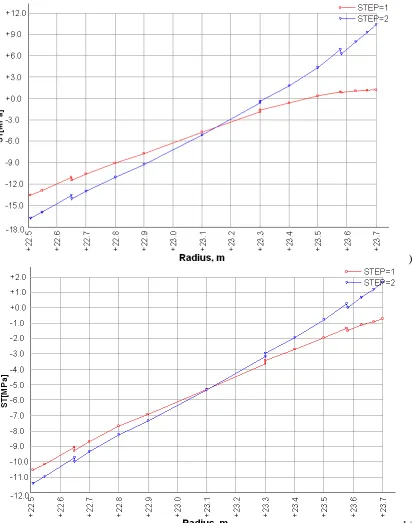
The distribution of hoop and meridian operational stresses in concrete across the containment wall thickness in wintertime for the cases of maximal and minimal temperature differences is demonstrated in Fig. 11. Hoop compressive stresses at the inner containment surface make up about -17 MPa, whereas tensile stresses at the outer surface equal about 10.5 MPa (Fig. 12 (a)).
Thus the calculations with heat insulation at the outer surfaces of cylindrical and domical parts of the containment within zero-moment zones in wintertime have established a considerable decrease in tensile stresses that would exert a favorable effect on both the containment stress-strain state and endurance.
Figure 8. Temperature variations in wall of the containment cylinder (Kalinin NPP Unit 1) in wintertime without heat insulation depending on time in hours (240800 – point at the inner wall surface of the containment, 240811 – point close to the inner layer of reinforcement, 240821 – point in the middle of wall, 240833 – point close to the outer layer of reinforcement, 240839 – point at the outer containment surface)
In the calculations without heat insulation the containment diameter has varied by 11.5 mm and the crane track length by 36 mm, both being due to seasonal temperature fluctuations. However in case of a considerable temperature decrease inside the containment in wintertime, e.g. from 42° down to 22° (the real situation of December 2000 at Kalinin NPP Unit 1 – Fig. 7), the containment diameter would diminish further by 3÷4 mm with concurrent variations in the crane track length up to 50 mm.
For the case with heat insulation the effects of seasonal temperature fluctuations would appear in variations of the containment diameter by 7.2 mm, i.e. by 4.3 mm (38%) less than in the case without heat insulation.
Hence, the use of heat insulation would have a favorable effect on the technical condition of the crane track.
)
b)
)
b)
Figure 11.
Distributions of hoop operational stresses in concrete across the containment wall
thickness in wintertime (STEP=1 – at a minimal temperature difference, STEP=2 – at a maximal
temperature difference): ( ) – no heat insulation; (b) – with heat insulation
6
CONCLUSION
The actual states of both the containment pre-stress system and its concrete are the key factors determining the operational capability of NPP containments and the capability of prolongation of their serviceability beyond the design life. It is worthy of note that the pre-stress system is restorable up to the required parameters without much difficulty via replacement of tendons; however, this is not the case of containment concrete exposed to environmental impacts.
crack formation within surface concrete layers and corrosion of reinforcement. The performed calculations enabled estimation of the effects of these factors on the containment stress-strain state and development of recommendations on diminishing the dependence of containment endurance on environmental effects via the use of heat insulation.
The calculations of Kalinin NPP Unit 1 containment have demonstrated that in the case without heat insulation in wintertime (i.e. at maximal temperature differences) hoop compressive stresses at the inner containment surface equal about -17 MPa, whereas tensile stresses t the outer containment surface about 10.5 MPa. In the case with heat insulation for maximal temperature differences hoop compressions at the inner containment surface have diminished from –17 MPa to -11.5 MPA, hoop tensile stresses near the outer surface have decreased from 10.5 MPa to 1.5 MPa, and compressive stresses in the liner from –170 MPa to – 112 MPa.
Due to seasonal environmental-temperature fluctuations the containment diameter could vary by about 15.5 mm that causes changes in the crane-track length up to 50 mm. When running crane equipment, such a phenomenon should be taken under consideration. When heat insulation is used, the containment-diameter variations diminish (down to 38% from the above-indicated value for containment without heat insulation).
To minimize environmental effects on the outer containment surface, its coating with a heat-insulating layer is recommended that will allow not only decreasing the costs of NPP servicing and repairs but also extending the containment service life.
The following beneficial effects might be expected as the result of coating the outer surfaces of containments with heat insulation:
- diminution of negative environmental impacts (temperature fluctuations, humidity effects, frequent changes of freezing by thawing, impacts of deleterious substances etc.) on reinforced concrete would allow extending service life of NPP containments;
- decrease in variations of geometric containment parameters within the crane track area due to diminution of the temperature gradient inside and outside the containment;
- decrease in financial and manpower resources for NPP maintenance and repair thanks to reduction of the scope of crane-track-adjustment works;
- decrease in creep strain of concrete and consequently a diminution of losses in tendon efforts from creep strains of concrete; and