AND PARTICLE SYSTEM
AHMED ZUHAIR QASIM
A dissertation submitted in partial fulfillment of the requirements for the award of the degree of
Master of Science (Computer Science)
Faculty of Computer Science and Information Systems Universiti Teknologi Malaysia
ACKNOWLEDGEMENT
“In the Name of Allah, Most Gracious, Most Merciful”
First and foremost, Alhamdulillah, it is with the assistance and grace of Allah Almighty that I was able to finish this dissertation.
I would like to express my sincere appreciation to my supervisor Dr.Ahmad Hoirul Basorifor his great advice and generous help during the period of my study and also, who had the patience and wisdom to guide me in order to overcome all the academic obstacles that I faced during my study. My overwhelming gratitude to my evaluators, I am also grateful for their helpful suggestions.
A special thanks to my parents and my siblings for their unlimited moral support, to everyone in my extended family, and for their lessons on how to be patient and strong. I thank them very much for always being there for me and I ask Allah the almighty to grant them Paradise.
TABLE OF CONTENT
CHAPTER TITLE PAGE
DECLARATION ii
DEDICATION iii
ACKNOWLEDGMENT iv
ABSTRACT v
ABSTRAK vi
TABLE OF CONTENTS vii
LIST OF TABLES Xi
LIST OF FIGURES xii
LIST OF ALGORITHMS xiii
LIST OF ABBREVIATIONS xv
1 INTRODUCTION
1.1 Introduction 1
1.2 Problem Background 3
1.3 Problem Statement 9
1.4 Aim of the Study 10
1.5 Objectives of the Study 10
1.6 Scope of the Study 11
1.7 Significance of the Study 11
3 RESEARCH METHODOLOGY
3.1 Introduction 30
3.2 Research Methodology 31
3.3 Facial Animation 33
3.3.1 Facial Action Coding System
(FACs) 33
3.3.2 Action Units (AU) 35
3.4 Facial features of Extreme Expression 36
3.4.1 Fluid Generator 37
3.4.1.1 Simple particle system 37 3.4.1.2 Particle-Particle
Interactions 38
3.4.1.3 Navier-Stokes Equations for
Incompressible Flow 38
3.4.2 Texture Based 41
2 LITERATURE REVIEW
2.1 Introduction 14
2.2 Facial Animation 15
2.2.1 Traditional Polygonal Mesh 16
2.2.2 Splines Based Models 17
2.2.3 Pose Animation 18
2.2.4 Facial Action Coding System 19
2.3 Emotion Expression 20
2.3.1 Facial Gesture Generation 21
2.3.2 Extreme Expression 24
2.4 Sweat simulation 24
2.4.1 Fluid simulation 25
2.4.2 Texture based simulation 27
3.5 Extreme Expression Generator 41
3.6 Testing and Evaluation 42
3.7 Summary 42
4 IMPLEMENTATION
4.1 Introduction 43
4.2 Facial Action Coding System (FACS) and
Action Units 44
4.3 Extreme Expression 46
4.3.1 Fluid Generation 47
4.3.2 Texture Based Generator 49
4.4 Sweating Simulation 51
4.4.1 Generating Sweats Using Particle
Based System 51
4.4.2 Generating Sweats Using Texture
Based 56
4.5 Testing and Evaluation 60
4.5.1 Avatar Realism 60
4.5.1.1 Visual Realism 61
4.5.1.2 Behavioral Realism 62
4.5.2 Testing and Evaluating the System for Generating Sweat
Based on Particle System 63
4.5.2.1 Evaluation the System for Generating Sweat Based on Particle
System Simulation 63
4.5.2.2 Evaluation the System for Character in Neutral Mode before Generating
Sweat 64
4.5.2.3 Evaluation of System for Generating Fluid Sweat with 500
4.5.2.4 Evaluating the System for Generating Fluid Sweat with 1000
Particles 69
4.5.2.5 Frame Rate
Measurement with Different Features
Enable and Disable 72
4.5.2.6 General Frame Rate Performance Based on Particle System Fluid
Simulation 74
4.5.3 Testing and Evaluating the System for Generating Sweat
Based on Textured Simulation 76
4.6 Summary 78
5 CONCLUSION AND FUTURE WORK
5.1 Introduction 79
5.2 Conclusion 80
5.3 Contribution 81
4.4 Future Work 83
REFERENCES 85
LIST OF TABLES
TABLE NO. TITLE PAGE
1.0 Review Facial Animation researches. 7
3.1 Representation for the signal sample action units 36
3.2 The basic expressions based on AUs combination 37
4.1 The fame rate with Min, Max and Avg FPS that are shown
in Figure 4.18 and Figure 4.19 66
4.2 The fame rate with Min, Max and Avg FPS that are shown in Figure 4.20 and Figure 4.21, when the particle system
generates 500 particles. 69
4.3 The fame rate with Min, Max and Avg FPS that are shown
in Figure4.18 and Figure 4.19. 72
4.4 Shows the results of the comparison between the natural
LIST OF FIGURES
FIGURE NO. TITLE PAGE
1.1 Representation of the four static expressions that were used
in the game Oblivion: Elder Scrolls IV. 5
1.2 The four expressions for the face in the character of Fallout
3game. 5
2.1 A simple arm model exhibiting bone animation. The bones have a weighted influence on the vertices. Notice that the
elbow vertices are affected by both bones. 18 2.2 Pose Blend Animation. The first face on the left is the
neutral pose. The second and third faces express anger and sadness. The face on the right is a combination of sadness
and anger. 19
2.3 Shows an overview diagram of the HMM-based on
framework of head motion synthesis. 24
2.4 Fear expression using sweating and sadness expression
using tears. 29
3.1 Research Methodology 33
4.1 Natural Human Face represented by some Action Units that controls the changing appearance for eyebrows, eye cover
fold, forehead, lower and upper eye lids 45
4.2 Fear expressions implementation depending on FACS 46
4.3 Generating fluids based on particle system 47
4.4 Several frames of generating fluids after giving the alpha
transparency for some particles. 48
4.5 Four selected frames of a running cycle for sweat 50 4.6 Generating random sweat in vertex 2 between (330,460)
FIGURE NO. TITLE PAGE
4.7 Four selected frames of real-time sweating synthesis in the
side areas of the forehead 52
3.8 Pseudo Code for creating real-time sweating for the first
kind of particle system sweating generator 53 4.9 Real-time synthesis for the second type sweating generators
based on particle system 53
4.10 Pseudo Code to create real-time sweating simulation for
second type of sweating generator 54
4.11 simulation of fear using sweat in real-time base on the
particle system 55
4.12 Pseudo Code for implementing the third kind of sweating phenomenon in a virtual avatar based on a particle system
generator. 55
4.13 The combination between the facial animation and sweats
based on texture 57
4.14 pseudo code for generating random sweat and updating it on
the forehead zone 57
4.15 Pseudo code representing the speed of falling sweat in virtual
avatar 58
4.16 An example of a sweat simulation based on texture
generator 59
4.17 Four frames taken from a sweat animation 59
4.18 Avatar characteristics taxonomy 61
4.19 Virtual Avatar neutral mode based on facial action coding
system 64
4.20 This bar graph shows the frame per second when the character in the neutral mode. The X-axis represent the time
per second and the Y-axis represent the FPS 65 4.21 Graph represent the frame time for scared state when the
virtual human sweating, the X-axis represent the frame rate
and the Y-axis represent time in (ms) 66
4.22 Bar chart graph shows the frame per second rate in the scared state when the sweats falling down the face surface, the X-axis represent the time per second and the Y-axis
FIGURE NO. TITLE PAGE
4.23 Graph represent the frame time for scared state when virtual character sweating, the X-axis represent the frame and the
Y-axis represent time in (ms) 68
4.24 Bar chart graph shows the frame per second’s rate in the sweating mode using 1000 particles, the X-axis represent
the time per second and the Y-axis represent the FPS 70 4.25 Graph represent the frame time for scared state when the
virtual human sweating and the particle system generate 1000 particles, the X-axis represent the frame rate and the Y-axis represent time in (ms)
71
4.26 Graph shows the difference in frame rate between 1000 and 500 particles while disabling and/or enabling several parts of sweat simulation. The X-axis represents the system in
different features and the Y-axis represents the fps 73 4.27 An example of a sweating face for sweat simulation based
on particle system 75
4.28 Several frames taken from a sweating animation based on
particle system generator 75
4.29 Fear Emotion Keyframes for Alice Face 76
4.30 Results for the expression of fear using textured sweats in
INTRODUCTION
1.1 Introduction
Virtual human, has been developed in various forms of computer applications(Yee et al., 2007). Currently, an avatar is able to interact naturally depending on the considerable progress in artificial intelligence, diverse sensing technology and advanced computer graphics(Lee et al., 2010).
Facial animation is one of the complex and effective communication tools in the field of creative animation that produces truthful virtual avatars or social agents. It is considered as a very challenging work at a high level because it needs animations on a high level at each event and the component of the face, like facial bones, and muscles of the face and lips synchronization during speech. Construction face of human at a high level accuracy requires great effort and time and skills at animation industry. On the other hand, it is very important because the expressions in the face include a lot of important information therefore, it is possible to observe the feelings of the people and their mental states. As the supervisor in Blur Studio's animated, Jeff Wilson said, “Generating credible facial animation is very vital because the face is essential to understand the emotions”(Liu, 2009; Wilson and Mike, 2005).
One of the most important purposes in the use of virtual characters in a 3D environment is the attempt to create an efficient communication to attract the user. To build this exciting type of contact between the user and virtual character, it is needed to provide a very important side in building this relationship which is the expression of emotions. It is possible to display a wide variety of emotions in virtual characters realistically, either by using diverse styles of motions in body(Egges and thalmann, 2005; Tol and Egges, 2009) or by different facial expressions(Gachery and Thalmann, 2001; Tol and Egges, 2009).
In Physiological Arousal, actually, emotions have a correlation with changes in the extreme light of physiological processes that occur inside the human body. In addition to the many changes that occur within the body that have been listed only, these processes are likely to be included in the variations that occur in the activity of sweat glands and salivary, the changes that occur in the levels of some neurotransmitters inside the brain, changes in metabolism, result of changes in muscle strain and finally, changes that will occur on the digestive system as a result of the revised digestion. There are other species of physiological processes that could lead to a change in the color of the face, piloerection, facial expressions and as well as other signs that represent emotion (Ettinger, 2008).
Finally, motions also contain behavioral responses. Emotions always motivate the human to express his feelings or act out. These expressions perhaps range from screaming or crying, as well as verbal expression, which represents laugh or smile. There are common signs of emotions which include tone of voice as well as the position and other types of physical language (Ettinger, 2008). Not all kinds of fear lead to a process of sweating in humans, the kind of fear which leads to sweating depends on the ratio of fear.
1.2 Problem Background
In fact, the process of generating realistic synthetic faces in three-dimensional characters and trying to make it desirable has become something very important which attracted the attention of many researchers and it became a very big challenge for researchers in recent times to achieve. During the past few years and with the progress in the establishment and providing a variety of algorithms and techniques developed in Facial animation, currently, it is possible to create the geometry of the human face in detail through the ability to use 3D photometric techniques and scanners. A result of technological progress in the areas of modeling of the human faces the researchers have become less tolerant to ignore the imperfections in the animation and models that have been happening in the past(Ypsilos and Ypsilos, 2004).
Figure 1.1: Representation of the four static expressions that were used in the game
Oblivion: Elder Scrolls IV(The elder scrolls iv:Oblivion, 2009)
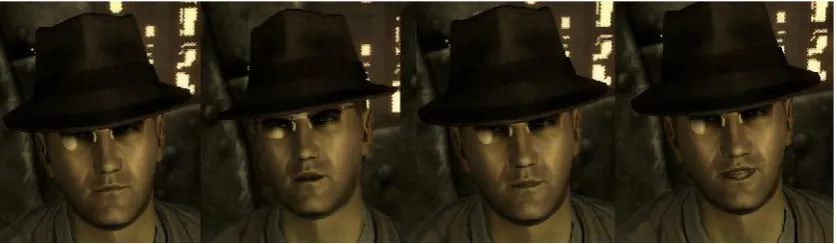
However immersion is increasing because the impact by the user(Tol and Egges, 2009).In the most recent games, like (Fallout3, 2009) or (Grand theft auto iv, 2009), although these characters display a variety and different levels of emotions, but it seems that these emotions have difficulty to be influenced by the actions of the user. For example, the character that seems friendly always stays friendly, whereas characters that are not friendly always seem to represent a form of anger. Figure 1.2 views the character of Fallout 3 game, Where the difference between the facial expressions is very little, but these expressions in fact are not depending at all on the users’input (Tol and Egges, 2009).
Figure 1.2: The four expressions for the face in the character of Fallout 3
They are closer to be realistic and the differences between the facial expressions are very little but it seems that these emotions have difficulties to be influenced by the actions of the user. In the examples that have been mentioned above, Emotions that have been viewed are through geometric animation for the face only. Therefore, many emotions in some of the virtual characters in this computer game are still quite limited. These characters need to support the displays of expressions such as loudly laughing, crying, sweating with scare in the best manner, on the contrary, in movies, when using this type of regular expressions in order to work to attract the viewer.
Weaknesses to display these affective emotions lead to displaying less realistic experience in terms of emotions.The process of generating these distinct expressions in real-time 3D is often more like a complex task. It needs the process of skin deformation and precise modeling for the muscles representation of facial animation in many applications through the method of geometric deformation, often through combination with a standard facial animation approach like the MPEG-4 facial animation standard. This standard uses a limited set of parameters to recreate and describe actual expression for the animator (Tol and Egges, 2009).
Another system, named FACS, works to describe the units of facial action effectively on the muscles of the human face. It was developed initially for the purposes of psychology, to perform the task of description and recognition of expressions and a process to link them with emotions. Examples of this type of procedures done by this standard are "Brow lowerer" or "Lip Tightener”.after that,It was adapted to be suitable for use in the movies, to generate realistic expressions.
The construction and animation in a realistic manner in the real three-dimensional human faces are still significant problems in the field of computer graphics (ILIE et al., 2011). In the field of facial animation synthesis, the existing technologies are still not able to build facial expressions, in an effective and more realistic manner and including the underlying emotional content(Zhang et al., 2008).
Sweating, fear, anger, wrinkles, blushing and tears are a set of expressions in face that were used as the emotions to express the physiological emotions in human aspects (de Melo and Gratch, 2009). Whereas ,the simulation of sweat during the occurrence of fear is not representative of the expressive manner of reality compared with their representation during the 3D movie, which are represented in a very similar style to the reality.
Table 1.0 : Review Facial Animation researches.
Author Title Year Their work Future work
Gladilin, E., Zachow, S., Deuflhard, P. and Hege, H
Anatomy-and physics-based facial animation for craniofacial surgery simulations
2003 A modeling approach for the realistic simulation of facialexpressions of emotion in craniofacial surgery planning
Ypsilos, I. A. and Ypsilos
Capture and Modelling of 3D Face Dynamics
2004 This thesis addresses the problem of capturing, modelling and analysing 3D facial dynamics and provides a framework for the realistic synthesis of face sequences.
Author Title Year Their work Future work Zhang, Y., Ji,
Q., Zhu, Z. and Yi, B
Dynamic Facial Expression Analysis and Synthesis With MPEG-4 Facial Animation Parameters
2008 Explores the use of a coupled Bayesian network to unify the facial expression analysis and synthesis into one coherent structure to synthesize dynamic facial expressions
A more quantitative performance evaluation of our method is
needed. This requires to establish a
quantitative measure to quantify the quality of the reconstructed FAPs and their temporal development Deng, Zhigang Neumann, Ulrich Data-Driven Expressive Speech Animation Synthesis and Editing
2008 A data-driven system (eFASE) for an expressive facial animation synthesis and editing system is presented
Optimizing the facial motion database could improve the overall efficiency of this system, such as reducing
the size of the facial motion database through clustering methods
Tol, W. and Egges, A.
Real-time 3D crying
simulation
2009 A real-time crying simulation framework, by using an extended SPH approach, optimised for crying fluid simulation
Author Title Year Their work Future work de Melo, C.
and Gratch, J.
Expression of Emotions using Wrinkles, Blushing, Sweating and Tears
2009 A real-time model for the expression of emotions in virtual
humans using wrinkles, blushing, sweating and tears
developing computational cognitive models for blushing,
sweating and tears
Lee, S., Carlson, G., Jones, S., Johnson, A., Leigh, J. and Renambot, L.
Designing an Expressive Avatar of a Real Person
2010 Development process for the Lifelike Responsive Avatar Framework (LRAF) and a prototype application for modeling a specific individual to analyze the effectiveness of expressive avatars.
Further investigation of how human can recognizes emotions within a context accompanying
temporal changes over time and/or spoken information factors affect on avatar emotion is necessary in the future.
Zhang, Shen Wu, Zhiyong Meng, Helen M. Cai, Lianhong Facial Expression Synthesis Based on Emotion Dimensions for Affective Talking Avatar 2010 Introduces synthesizing emotional facial expression on expressive talking avatar in emotional text to audio visual speech system
Author Title Year Their work Future work Mihai Daniel
ILIE, Cristian NEGRESCU, Dumitru Stanomir
Circular Interpolation for Morphing 3D Facial Animations
2011 presented a novel shape interpolation method that gives very good results for mesh morphing 3D facial
animations
The method could also be adjusted for other kinds of animations by
dividing the mesh in a few parts and then applying the algorithm on each such part
in particular
1.3 Problem Statement
There are many extreme expressions that should be considered in facial animation such as, scared until sweating, sadness with cry, anger, shame, and pride in addition to combinations between some of expressions which happen together in some situations. According to previous studies that have been presented and through intensive observation this research reveals that the extreme expression is not researched well. Therefore it is required to generate some extreme expression to enhance the realism of virtual human.
The main questions of this study can be described as follows:
These are some research questions that can be derived from main research question:
Why the existing facial expression in virtual avatar still need for some extreme expression?
What are the elements that are needed to express the extreme emotion?
How to simulation sweat during the extreme expression?
How to explain the sweat properties?
What are the requirements to build this system?
1.4 Aim of the Study
The aim of this thesis is to create real time sweating simulation of extreme expression on virtual human using texture based and particle based approch.
1.5 Objectives of the Study
The objectives of this study are explained below:
1- To study and analyze various techniques of computer facial animation techniques.
2- To design and implement a proposed system capable of integrating
FACS with texture based or particle system.
1.6 Scope of the Study
The scopes of this study are explained below:
1- The FACS proposed method is employed to express the emotions in facial
animation.
2- This thesis focuses on expressing the sweating effect according to
emotion state.
3- The FACS and particle system with texture based will be designed and
applied using Microsoft visual C# 2010 as a programing language.
1.7 Significance of the Study
1.8 Thesis Structure
This thesis consists of five chapters which are organized into the chapters as the following:
Chapter 1 includes the introduction, problem background, problem
statement, aim of the study, objectives, scope and significance of the research.
Chapter 2 details out the literature review of the research. This chapter
provides an introduction of facial animation. Facial animation techniques are divided into, traditional polygonal mesh, pose animation, and end with facial action coding system which is used to model the face and expressions in this research. Also this chapter describes the emotion expression followed by description of facial gesture generation and extreme expression. The sweat simulation is very important to be solved and simulated. It is divided into fluid simulation which uses the particle system to generate the sweat on the forehead area and texture based simulation which uses the texture to create textured sweating on the forehead area. The chapter ends with a discussion.
Chapter 3 describes the research methodology that plays an important role as
The next stage is designing a system capable to combine the facial animation technique with sweat generators techniques to get the extreme expression was also conducted. The final stage consists of testing and evaluation which is used to measure the techniques and evaluates the system.
Chapter 4 details out the implementation for facial animation techniques and
sweat simulation techniques in order to achieve the second objective. This stage refers to the research methodology as a guideline. Firstly, the chapter discusses how to implement facial action coding system (FACS) and Action Units. Next, an explanation of extreme expression is involved in this chapter. Then, this chapter explores the implementation of fluid generation followed by the implementation of texture based generator. After that, the integration of facial animation technique with one of the two sweat generators techniques have been implemented and explained in details. The final stage in this chapter is to implement the testing and evaluation process for the facial animation technique and sweat generators techniques to get a better idea about extreme expressions future.
Chapter 5 is the last chapter of this thesis. The chapter provides the
REFERENCES
Balci, K., Not, E., Zancanaro, M. and Pianesi, F. (2007). Xface open source project and smil-agent scripting language for creating and animating embodied conversational agents. Paper presented at the Proceedings of the 15th international conference on Multimedia, Augsburg, Germany.
Bickel, B., Botsch, M., Angst, R., Matusik, W., Otaduy, M., Pfister, H., et al. (2007). Multi-scale capture of facial geometry and motion. Paper presented at the ACM SIGGRAPH 2007 papers, San Diego, California.
Blinn, J. F. (1978). Simulation of wrinkled surfaces Proceedings of SIGGRAPH’78 (pp. 286–292).
Bregler, E. C. a. C. (2002). Performance driven facial animation using blendshape interpolation.
Bridson, R., M, M., #252 and ller-Fischer. (2007). Fluid simulation: SIGGRAPH 2007 course notes<h3>Video files associated with this course are available from the citation page</h3>. Paper presented at the ACM SIGGRAPH 2007 courses, San Diego, California.
Carlos, B., Zhigang, D., Michael, G., Ulrich, N. and Shrikanth, N. (2007). Rigid Head Motion in Expressive Speech Animation: Analysis and Synthesis. Audio, Speech, and Language Processing, IEEE Transactions on, 15(3), 1075-1086. doi: 10.1109/tasl.2006.885910
Cheng, A. J. L. a. F. F. (2012). MODELING THREE DIMENSIONAL ANIMATED, DETAILED, AND EMOTIONAL FACIAL EXPRESSIONS (Department of Computer Science, University of Kentucky, Lexington, KY 40506, USA).
ACM SIGGRAPH/Eurographics Symposium on Computer Animation, Madrid, Spain.
Chopra-Khullar, S. and Badler, N. I. (1999). Where to look? Automating attending behaviors of virtual human characters. Paper presented at the Proceedings of the third annual conference on Autonomous Agents, Seattle, Washington, United States.
de Melo, C. and Gratch, J. (2009). Expression of Emotions Using Wrinkles, Blushing, Sweating and Tears. In Z. Ruttkay, M. Kipp, A. Nijholt & H. Vilhjálmsson (Eds.), Intelligent Virtual Agents (Vol. 5773, pp. 188-200): Springer Berlin Heidelberg.
Deng, Z., Lewis, J. P. and Neumann, U. (2003). Practical eye movement model using texture synthesis. Paper presented at the ACM SIGGRAPH 2003 Sketches & Applications, San Diego, California.
Deng, Z., Narayanan, S., Busso, C. and Neumann, U. (2004). Audio-based head motion synthesis for Avatar-based telepresence systems. Paper presented at the Proceedings of the 2004 ACM SIGMM workshop on Effective telepresence, New York, NY, USA.
Deng, Z. and Neumann, U. (2008). Data-Driven Expressive Speech Animation Synthesis and Editing
Data-Driven 3D Facial Animation. In Z. Deng & U. Neumann (Eds.), (pp. 60-78): Springer London.
Deng, Z. and Noh, J. (2007). Computer Facial Animation: A Survey
Data-Driven 3D Facial Animation. In Z. Deng & U. Neumann (Eds.), (pp. 1-28): Springer London.
Description of the facial action coding system. (2009) Retrieved June 2009, from http://face-andemotion.com/dataface/facs/description.jsp
Egges, A. and thalmann, N. M. (2005). Emotional communicative body animation for multiple characters. Proceedings of the 2005 In Proceedings of the First International Workshop on Crowd Simulation. 2005. 31-40.
Enright, D., Marschner, S. and Fedkiw, R. (2002). Animation and rendering of complex water surfaces. ACM Trans. Graph., 21(3), 736-744. doi: 10.1145/566654.566645
Ettinger, R. H. (2008). Emotion and Stress. In D. M. Parker (Ed.), Understanding Psychology (2 ed., pp. 325-361): Horizon Textbook Publishing
F. Pighin, a. J. P. L. (2006). Performance-driven facial animation Performance-driven facial animation.
Fallout3. (2009).http://fallout.bethsoft.com/, Accessed June 2009
Fiume, J. S. a. E. (1995). Depicting fire and other gaseous phenomena using diffusion processes. Paper presented at the Computer Graphics,29(Annual Conference Series).
Forstmann, S., Ohya, J., Krohn-Grimberghe, A. and McDougall, R. (2007). Deformation styles for spline-based skeletal animation. Paper presented at the Proceedings of the 2007 ACM SIGGRAPH/Eurographics symposium on Computer animation, San Diego, California.
Friesen, P. E. a. W. V. (1978). Manual for the Facial Action Coding System. Consulting Psychologists Press, Inc.
Gachery, S. and Thalmann, M. (2001). {Designing MPEG-4 facial animation tables for web applications}. MIRALab, University of Geneva. doi: citeulike-article-id:6056721
Girod, M. H. a. G. F. a. B. (1994). Modeling and animation of facial expressions based on b-splines. The Visual Computer, 11, 87-95.
Graf, H. P., Cosatto, E., Strom, V. and Fu Jie, H. (2002). Visual prosody: facial movements accompanying speech. Proceedings of the 2002 Automatic Face and Gesture Recognition, 2002. Proceedings. Fifth IEEE International Conference on. 21-21 May 2002. 396-401.
Grand theft auto iv. (2009).http://www.rockstargames.com/IV/, Accessed June 2009 Gratch, C. M. d. M. a. J. (2009). Expression of Emotions using Wrinkles, Blushing,
Sweating and Tears. In Proceedings of the Intelligent Virtual Agents 2009, 188-200.
Guente, B. (1992). [A system for simulating human facial expression].
Haber, J. and Terzopoulos, D. (2004). Facial modeling and animation. Paper presented at the ACM SIGGRAPH 2004 Course Notes, Los Angeles, CA.
ILIE, M. D., NEGRESCU, C. and STANOMIR, D. (2011). Circular Interpolation for Morphing 3D Facial Animations. ROMANIAN JOURNAL OF INFORMATION SCIENCE AND TECHNOLOGY, 14(2), 131–148.
J. Andreas Bærentzen , K. E. H. a. K. E. (2007). Boneless pose editing and animation. Paper presented at the Proceedings of the 15th Scandinavian conference on Image analysis, Aalborg, Denmark.
Jung, Y., Kn\, C., \#246 and pfle. (2006). Dynamic aspects of real-time face-rendering. Paper presented at the Proceedings of the ACM symposium on Virtual reality software and technology, Limassol, Cyprus.
Kang, S.-H. and Watt, J. H. (2012). The impact of avatar realism and anonymity on effective communication via mobile devices. Computers in Human Behavior, (0). doi: http://dx.doi.org/10.1016/j.chb.2012.10.010
L. Boissieux, G. K., N. Magnenat-Thalmann, and P. Kalra. (2000). Simulation of skin aging and wrinkles with cosmetics insight Proceedings Eurographics Workshop on Computer Animation and Simulation (pp. 15-27).
Lee, S., Carlson, G., Jones, S., Johnson, A., Leigh, J. and Renambot, L. (2010). Designing an Expressive Avatar of a Real Person
Lee, S. P., Badler, J. B. and Badler, N. I. (2002). Eyes alive. ACM Trans. Graph., 21(3), 637-644. doi: 10.1145/566654.566629
Liu, C. (2009). An analysis of the current and future state of 3D facial animation techniques and systems. Master of Science, SIMON FRASER UNIVERSITY. Magnenat-Thalmann, N., Kalra, P., Leveque, J. L., Bazin, R., Batisse, D. and Querleux,
B. (2002). A computational skin model: fold and wrinkle formation. Trans. Info. Tech. Biomed., 6(4), 317-323. doi: 10.1109/titb.2002.806097
Mandler, G. (1980). The generation of emotion: A psychological theory, in Emotion Theory, Research, and Experience. Theories of Emotion, Academic Press, 1. Matthias Müller, D. C. a. M. G. (2003). Particle-based fluid simulation for interactive
applications. Paper presented at the Proceedings of the 2003 ACM SIGGRAPH/Eurographics symposium on Computer animation, San Diego, California.
Member, Q. Z. a. Z. L. a. S. M. a. B. G. a. S. M. a. D. T. a. H.-y. S. a. S. (2006). Geometry-driven photorealistic facial expression synthesis. IEEE Transactions on Visualization and Computer Graphics, 11(1), 48 - 60
N. Magnenat-Thalmann, H. M., M. Angelis, and D. Thalmann. (1989). Design, transformation and animation of human faces Visual Computer (pp. 32-39). Narayanan, C. B. a. Z. D. a. U. N. a. S. (2005). Natural Head Motion Synthesis Driven
by Acoustic Computer Animation and Virtual Worlds (pp. 3-4).
Nixon, D. and Lobb, R. (2002). A fluid-based soft-object model. Computer Graphics and Applications, IEEE, 22(4), 68-75. doi: 10.1109/mcg.2002.1016700
Noh, Z. D. a. J. (2007 ). Computer Facial Animation: A Survey Data-Driven 3D Facial Animation (pp. pp 1-28): Springer London.
Oat, C. (2007). Animated wrinkle maps, Advanced Real-Time Rendering in 3D Graphics and Games.
Ohya, S. F. a. J. (2007). Skeletal animation by spline aligned deformation on the gpu. Image engineering, 106(608), 47-52.
Parke, F. I. (1989). Parameterized models for facial animation revisited ACM SIGGRAPH Facial Animation Tutorial Notes , 53-56.
Pfaff, T., Thuerey, N., Cohen, J., Tariq, S. and Gross, M. (2010). Scalable fluid simulation using anisotropic turbulence particles. Paper presented at the ACM SIGGRAPH Asia 2010 papers, Seoul, South Korea.
Picard, R. W. (1995). Affective Computing. Picard95affectivecomputing.
Prem Kalra, A. M., Nadia Magnenat Thalmann,Daniel Thalmann. (1992). Simulation of Facial Muscle Actions Based on Rational Free From Deformations Computer Graphics Forum (Vol. 11(3), pp. 59-69).
Sifakis, E., Neverov, I. and Fedkiw, R. (2005). Automatic determination of facial muscle activations from sparse motion capture marker data. ACM Trans. Graph., 24(3), 417-425. doi: 10.1145/1073204.1073208
SMITH, A. P. (2006). MUSCLE-BASED FACIAL ANIMATION USING BLENDSHAPES IN SUPERPOSITION. ASTER OF SCIENCE.
Stam, J. (1999). Stable Fluids. Paper presented at the In Proceedings of the 26th annual conference on Computer graphics and interactive techniques.
Stam, J. (2003). Real-Time Fluid Dynamics for Games. Paper presented at the In Proceedings of the Game Developers Conference.
Suresh Lodha, R. R. (2005). A kinematic-variational model for animating skin with wrinkles Computers & Graphics (Vol. 9(5), pp. 756-770).
The elder scrolls iv:Oblivion. (2009).
http://www.elderscrolls.com/games/oblivion/overview.htm, Accessed June 2009
Tiberiu Popa, Q. Z., Derek Bradley, Vladislav Kraevoy, Hongbo Fu, Alla Sheffer, Wolfgang Heidrich. (2009). Wrinkling captured garments using space-time data-driven deformation. Computer Graphics Forum (Proc. Eurographics), 28(2), 427-435.
Turk, M. C. a. P. J. M. a. R. B. V. H. I. a. G. (2002). Melting and flowing. Paper presented at the In Proceedings of the ACM SIGGRAPH symposium on Computer animation.
Veer, R. V. a. G. v. d. (2000). Effects of Gaze on Multiparty Mediated Communication In Proceedings of Graphics Interface (pp. 95-102): Morgan Kaufmann.
Vertegaal, R., Slagter, R., Veer, G. v. d. and Nijholt, A. (2001). Eye gaze patterns in conversations: there is more to conversational agents than meets the eyes. Paper presented at the Proceedings of the SIGCHI Conference on Human Factors in Computing Systems, Seattle, Washington, United States.
Vinayagamoortht, V., Gillies , Marco , steed, A., Tanguy,E.,Pan, X.,Loscos, C.and Slater,M. (2006). Building expression into virtual characters. In STAR report, Proc.of Eurographics 2006.
Wang, H., Mucha, P. J. and Turk, G. (2005). Water drops on surfaces. ACM Trans. Graph., 24(3), 921-929. doi: 10.1145/1073204.1073284
Williams, L. (1990). Performance-driven facial animation Proc. of ACM SIGGRAPH, 24 (pp. 235-243).
Wilson and Mike, H. (2005). Face Robot facial animation technology pioneers new approach to believable, emotional digital acting.
Wu, Y., Kalra, P. and Thalmann, N. M. (1996). Simulation of Static and Dynamic Wrinkles of Skin. Paper presented at the Proceedings of the Computer Animation.
Y. Bando, T. K., and T. Nishita. (2002). A simple method for modeling wrinkles on human skin Proceedings of the 10 th Pacific Conference on Computer Graphics and Application (pp. 166-175).
Yahi, M.-L. V. a. H. (1992). Facial animation with wrinkles. EG Workshop on Animation and Simulation.
Ypsilos, I. A. and Ypsilos, C. I. A. (2004). Capture and Modelling of 3D Face Dynamics. University of Surrey, Guildford, Surrey GU2 7XH,U.K.
Zhang, S., Wu, Z., Meng, H. M. and Cai, L. (2010). Facial Expression Synthesis Based on Emotion Dimensions for Affective Talking Avatar
Modeling Machine Emotions for Realizing Intelligence. In T. Nishida, L. C. Jain & C. Faucher (Eds.), (Vol. 1, pp. 109-132): Springer Berlin Heidelberg.
Zhang, Y., Ji, Q., Zhu, Z. and Yi, B. (2008). Dynamic Facial Expression Analysis and Synthesis With MPEG-4 Facial Animation Parameters. IEEE Trans. Circuits Syst. Video Techn., 18(10), 1383-1396.