Impact of Information Technologies (IT) Implementation on Over\all
TSC Performance
Gengeswari, Krishanpillai
Faculty of Business and Finance,
Universiti Tunku Abdul Rahman, Jalan Universiti, Bandar Barat, 31900 Kampar, Perak, Malaysia. E-mail: [email protected]
Abu Bakar, Abdul Hamid
Faculty of Management and Human Resource Development, Universiti Teknologi Malaysia, Skudai, 81310 Johor, Malaysia. E-mail: [email protected]
Siti Zaleha, Abdul Rashid
International Business School, UTM International Campus, Level 15, Yayasan Selangor Building, Jalan Raja Muda Abdul Aziz, 50300, Kampung Baru, Kuala Lumpur ,
E-mail: Malaysia. [email protected].
Gengeswari, Krishanpillai (Corresponding Author)
Faculty of Business and Finance, Universiti Tunku Abdul Rahman, Jalan Universiti, Bandar Barat, 31900 Kampar, Perak, Malaysia. E-mail: [email protected].
ABSTRACT
Tourism sector is known for its sophistication and interdependency where performance of one player would greatly influence the business operations of others in the sector. Hence, practices of supply chain management (SCM) have become a must for firms within this sector to coordinate their business operations. Despite the growing importance of SCM practices within tourism sector, only few empirical researches have been done in the area of tourism supply chains (TSC). Accordingly, this study attempts to empirically explore supply chain practices within Malaysian tourism firms with the focus on the impact of information technologies (IT) implementation towards overall TSC performance. About 331 questionnaires were electronically mailed to tour operators and agents where the response rate was about 36%. Findings indicate that IT implementation significantly influences the overall TSC performance where firms with advanced IT implementation level tend to enjoy a better growth in the overall TSC performance.
Keywords: Supply chain management, tourism supply chains, information technologies, performance measures.
1.0 INTRODUCTION
Tourism sector is claimed to be the world’s most important industrial sectors with two times growth for the last 30 years (Walker, 2009). Despite the increasing security concerns due to terrorism attacks and slow economy recovery, it is claimed that the long term prospects for tourism appear to be good (Walker, 2009) where it is expected that international arrivals will reach more than 1.56 billion by the year 2020 (WTO, 2010).
et al. 2008; Zhang et al. 2009; Simon and Roy, 2009; Pibbonrungroj and Disney, 2009; Rusko et al. 2009). Due to the scarce of tourism SCM researches, Pibbonrungroj and Disney (2009) have done a systematic literature search and it was found that there were only 44 TSCM studies and most of TSCM literatures (about 66%) have been published in 2008 and 2009. It was also discovered that there are two stages of TSCM researches. The first stage is the era before 2007 where there is only conceptual-framework papers meanwhile in second stage of TSCM research, more empirical studies are published than conceptual framework papers. Pibbonrungroj and Disney (2009) found that half of empirical studies were found in Europe whereas only about one-third of empirical studies were found in Asia specifically in China which is known as world-renowned tourist destinations (Pibbonrungroj and Disney, 2009). It implies that there are little similar studies in Asia and none in South East Asia.
Inherently, tourism is not a single unified sector but selectively cuts across and impacts many traditional and emerging sectors. It consists of numerous suppliers who provide services and goods namely accommodation, foods and beverages, inbound and outbound transportation as well as excursions (Tapper and Font, 2004). In addition to this, this sector involves number of intermediaries whom play a significant part in the marketing and distribution of tourism goods and services to the final customers or in this case tourist. The complex nature of tourism business, motivates tourism firms to emphasize on the both vertical and horizontal integration of their goods and services with and among the channel members i.e. suppliers and intermediaries (Yamaguchi, 2004; Mitchell and Phuc, 2007). The complexity of tourism sector is said to be greater with respect to international tourism activities due to the involvement of different cultures and industry systems. In such a closely interlinked supply system, any behavior of any party can evoke chain reactions that will directly influence the performance of individual organization (Murphy and Smith, 2009). Hence, the adoption of effective supply chain management (SCM) has become vital for tourism firms to enhance their competitiveness (Chen, 2009; Zhang and Murphy, 2009).
Information Technologies (IT) is claimed to be a backbone of SCM practices where integration in SC business processes is difficult to attain without presence of IT (Wagner et al. 2003; Gunasekaran and Ngai, 2004; Jaharkharia and Shankar, 2005). On the other hand, Wagner et al. (2003) discovered that with IT implementation in supply chain practices by merely 23% of companies, the whole industry would enjoy enormous benefits. Furthermore, complex nature of tourism sector has further necessitated the usage of IT infrastructures in TSC practices (Ma et al. 2003; Buhalis and Law, 2008; Page, 2009). Business transactions and interactions are difficult to be manually done in tourism sector (Buhalis and Law, 2008) with key players and customers scattered worldwide. Therefore, integration of TSC business process can be easily achieved provided chain members utilize advanced IT infrastructures which ultimately result into an enhanced overall TSC performance.
However, review on existing literatures highlight that there is no or very limited studies which examine the impact of IT on entire supply chain management practices within tourism sector (e.g. Wyne and Berthon, 2001; Zhang et al. 2009; Pibbonrungroj and Disney, 2009). This scenario is completely different in manufacturing sector where there are currently numerous studies that have examined the impact of IT in supply chain management practices within that sector (e.g. Johnston and Mak, 2000; Hoek, 2001; Grieger, 2003; Lancaster et al. 2006). Accordingly, this study intends to examine the impact of IT implementation on the overall TSC performance by focusing on Malaysian tourism firms.
2.0 CONSTRUCTION OF RESEARCH VARIABLES
2.1 Implementation Information Technologies in Tourism Supply Chain
intermediaries as well as the customers are located nationwide or worldwide. Such fragmentation necessitates integration within and across chain members where an integrated information system has become the main mechanism for business operators to pursue the concept of SCM in their operations (Gunasekaran and Ngai, 2004).
Review of existing indicates that there is abundance of studies on IT implementation in SCM-related area where it was highlighted that majority of the studies concentrated less on the context of integrated business operations (Gunasekaran and Ngai, 2004; Auramo et al. 2005). Current studies centers either on selective business processes in SCM, i.e. procurement and customer relationship management (Kioses et al. 2007; Fasanghari, 2008), relationship between two parties, i.e. suppliers and intermediaries (e.g. Cameron and Botha, 2002; Pramatari, 2007), specific technologies i.e. RFID – radio frequency identification and EDI – electronic data interchange (e.g. Zaremba et al. 2003; Tavassoli et al. 2009) or issues and strategies involved (e.g. Wagner et al. 2003; Jaharkharia and Shankar, 2005) in implementing SCM. The absence of a comprehensive study examining the IT utilization in the entire supply chain management practices has become a key agenda for both scholars and practitioners. This is because, it was discovered with utilization of information technologies by only 23% company, the whole industry would achieve enormous benefits as SCM is an interrelated chain operation (Wagner et al. 2003).
In many existing researches, business models using IT have been referred as an “electronic commerce” and “electronic business” where electronic commerce or e-commerce relates typically to web-based sales e.g. online purchasing or online orders. On the other hand, electronic business or e-business relates to a more holistic use of IT e.g. exchanging of business documents within organization and across organizations and online promotional activities. As such, in many instances, both scholars and practitioners consider e-business practices equally to the utilization of IT (Auramo et al. 2005). The common objectives of IT implementation in SCM are provision of information availability and visibility; facilitation of single point of contact for data; and enabling collaboration with supply chain partners (Wagner et al. 2003; Gunasekaran and Ngai, 2004; Pramatari, 2007).
Implementation level of IT within tourism supply chain can be assessed based on its functions focusing either within the organizations, between organizations or with customers (Buhalis, 2000). IT enhances a number of intra-organizational processes by facilitating a certain level of integration between various internal business operations. At this level, organizations implement IT is mainly to increase its efficiency and productivity in addition to develop its strategic and operational management capabilities (Egziabher, 2001). At inter-organizational level, IT is implemented to support the communications and interactions between individual tourism organizations (Pease and Rowe, 2005) e.g. hotel operators and tour operators or airlines operators and tour operators.
As for this study, implementation of IT is assessed in general context instead of focusing to some specific technologies. This study adopts typology of e-Business Market Watch (2003) in determining IT infrastructures used by tourism firms. Usage of computers, Internet (WWW and electronic mails), Intranet, Extranet, LAN, WAN, EDI and remote accesses are the IT infrastructures proposed by e-Business Market Watch. As for this study, IT implementation level is classified into two namely basic and advanced considering the usage of key IT infrastructures. Basic IT implementation level is achieved when the tourism firms are using merely computers and Internet in their SC business processes meanwhile advanced IT implementation level is achieved when firms are using Intranet, Extranet, LAN, WAN and remote access to practice their TSC business processes.
2.2 Performance Measurement in Tourism Supply Chains
Traditionally, firm performance is always viewed and measured in accounting or financial terms (Conant et al.1990 IN Avci et al. 2010). Dimensions such as profit, costs and market share are the common measurements used to assess the financial performance (FP) of the company (Kaplan and Norton, 2001). Nevertheless, both practitioners and academicians claim that firm performance should be not assessed solely based on the financial dimensions (Kaplan and Norton, 2001; Reichel and Haber, 2004). Hence, consideration on the non-financial performance (NFP) metrics is also equally important in measuring the performance of supply chain practitioners and it is very crucial particularly for service supply chain practitioners (Kaplan and Norton, 2001; Sengupta et al. 2006; Avci et al. 2010). This is because NFP metrics center on the long-term success of company by concentrating on customer satisfaction, internal business process efficiency, innovation and employee satisfaction (Kaplan and Norton, 2001; Laitinen, 2002; Avci et al. 2010). Moreover, due to nature of services sector especially intangibility, labor-intensive and customer centric, NFP metric is said to play significant role in assessing the performance of service supply chains (Avci et al. 2010). Besides that, it is also very challenging to collect financial information from companies due to confidentiality concern unless they are public listed companies. Nevertheless, it is highly suggested that combining of both financial and non-financial metrics in assessing firm performance is actually a wise move for supply chain practitioners where it facilitates an efficient strategic decision making process (Laitinen, 2002).
Yilmaz and Bititci (2006) found there is a wide gap in examining the performance of tourism firms resulted from their supply chain practices. Accordingly, they suggested that firm performance can be measured in three levels. At the first level, the performance of entire supply chain processes is measured in accordance with internal (examples of attributes are profits and cost) and customers (examples of attributes are value for money and responsiveness) perspective. At the second level, the performance of each tourism supply chain process is measured in accordance with the attributes defined at the first level. A the third level, due to the challenging nature of delivery stage, performance of key supply chain players is measured based on the attributes set in second level. Considering the lack of tourism supply chain researches focusing on firm performance, Yilmaz and Bititci (2006) had highly recommend future researches examining the tourism firm performance should begin by examining the performance of entire supply chain or the first level, before moving into higher levels or the individual supply chain processes or players. Besides Yilmaz and Bititci (2006), researches done by Reichel and Haber (2004), Sengupta et al. (2006), Avci et al. (2010) and Fantazy et al. (2010) are some of notable works contributed towards the field of firm performance in services supply chains particularly for tourism sector.
In a study examining supply chain practices in both manufacturing and services sector, Sengupta et al. (2006) defined the firm performance through operational and financial results based on the perception of respondents. In their study, three main aspects of operational process namely speed, delivery and quality, were used to measure the companies’ operational performance. Meanwhile, the company’s operational cost and net profit were used to measure FP of the companies. Next, Fantazy et al. (2010), in their study on supply chain practices and performance in hospitality industry, evaluated both financial and non-financial performance of hotel operators. They measured FP in terms of net profit while NFP in terms of customer satisfaction.
Avci et al. (2010) also employed both financial and non-financial performance metrics for assessing the firm performance from the perspective of company. They used hotel room’s occupancy rate, firm’s market share, operational cost and net profits as the key metrics in measuring the FP. On the other hand, customer satisfaction, customer loyalty, employee satisfaction, employee turnover and company image were used in measuring NFP of surveyed tourism firms.
Fantazy et al. used both financial and non-financial performance to measure the overall firm performance resulting from supply chain practices. Meanwhile, Avci et al. (2010) employed subjective method to measure the firm performance in which the assessment was done based on the perspective firms. As such, this study is intended to assess the perceived overall TSC performance (both financial and non-financial).
3.0 RESEARCH METHODOLOGY
This study employs quantitative method with cross-sectional design which involves one time collection of information from the respondents. Target population of this study consists of tour operators and travel agencies (amounting to 2358 operators). Information about respondents was obtained from the directory of Malaysian Association of Tour Operators and Travel Agents (MATTA). Simple random sampling technique was used to select the respondents where Table Isaac used to determine the sample size. According to Isaac et al. (1981), population size (n) that contains 2358 tour operators and travel agencies (approximate to 2400), needs 331 companies as a sample size (s) in order to acquire 95% level of confidence. This study administers questionnaire to the chosen respondents via electronic mails (e-mail). After several rounds of follow-up, only 120 tour operators & travel agents have returned the completed questionnaire. MANOVA (multivariate analysis of variance) technique was employed to examine relationship between IT implementation level and overall TSC performance. MANOVA is used as there is one independent variable (i.e. IT implementation level) with more than two levels and two dependent variables (financial and non-financial performance measures) which are measured on interval scale (Aaker et al., 2007; Malhotra, 2010). Accordingly, construct reliability for both IT implementation level and performance measures of TSC was assessed by computing Cronbach’s alpha where the analysis showed that these measures have an adequate level of reliability with their alphas amounting to 0.8773 and 0.8121, respectively.
4.0 ANALYSIS AND DISCUSSIONS
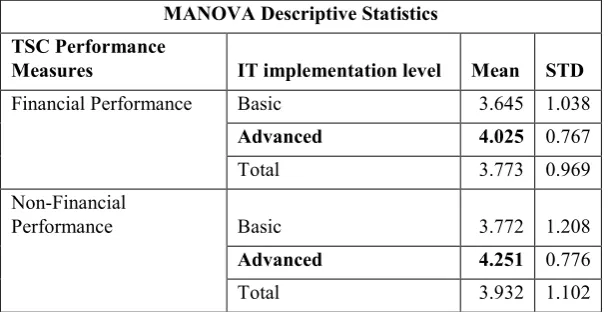
As in Table 1, it can be seen that many respondents experience a higher growth in non-financial aspect (mean value=3.897) of business operation resulted from TSC practices compared to growth in financial aspect (mean value=3.644). Financial aspects include employee turnover, operational costs, net profits and market share while non-financial aspects consisting of number of satisfied customers, loyal customers and company’s image. Besides, Table 2 indicates that firms that have advanced IT implementation level significantly enjoy positive growth in both financial and non-financial aspects. This is vice versa for firms with basic level of IT implementation. Basic IT implementation level includes usage of computers and Internet in their TSC business processes meanwhile advanced IT implementation level includes usage of Intranet, Extranet, LAN, WAN and remote access to practice their TSC business processes. This is justifiable as with usage of advanced technologies, firms are indirectly at higher level of TSC integration which enables them to enjoy enormous benefits in all business areas (Buhalis, 2000; Wagner et al. 2003).
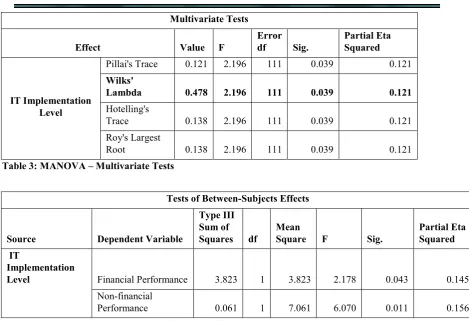
MANOVA test was conducted to ascertain the differences in overall TSC performance based on the implementation level of information technologies (refer to Table 3). Low Wilks Lambda value (0.4783) with significant value of 0.039 indicates that there is a significant difference in TSC performance based on the level of IT implementation. However, as indicated by partial squared value, the effect of level of IT implementation is relatively small on the TSC performances which account only 12.1%. It means that though there is a significance influence of IT implementation on TSC performance measures but its concentration is very minimal which would discourage firms to further implement advanced technologies to facilitate their TSC practices.
these firms able to improve their relationship with customers resulting into increased number of loyal and satisfied customer (Kaplan and Norton, 2001; Laitinen, 2002). Besides, the increases in the number of loyal and satisfied customers in addition to effective SC practices would enhance firm’s image (Laitinen, 2002; Avci et al. 2010). All these factors contribute to the enhance of overall TSC performance particularly relating to non-financial aspects of business operations.
5.0 CONCLUSIONS AND RECOMMENDATIONS
As this study merely examines the responses of tour agents, whom act as an intermediary within TSC network, the findings of this study should be carefully extended to the entire tourism sector. This is because an examination on only one group of TSC players does not resemble the entire sector. As such, it is recommended to examine all primary suppliers of tourism products together with the intermediaries in order to explore a comprehensive supply chain practices among tourism firms. Besides, lower response rate (120/331) of 36% has also aroused concern on the generalization of findings from this study.
Besides, this study also only focuses on the relationship between IT implementation and TSC performance, it leaves a scope for future researches to investigate the impact of TSC integration level on this relationship. Besides, the future researches also could do a comparison studies between TSC suppliers and TSC intermediaries on the IT implementation in TSC practices. In addition to this, future researchers shall empirically explore other areas of TSC practices namely TSC processes, its sustainability, its implications and others in order to further understand the complete scenario of supply chain practices within tourism sector.
REFERENCES
Aaker, D.A., Kumar, V., Day, G.S., Lawley, M. and Stewart, D. (2007). Marketing Research. The Second Pacific Rim Edition. Australia: John Wiley & Sons, Inc.
Auramo, J., Kauremaa, J. and Tanskanen, K. (2005). Benefits of IT in Supply Chain Management: An Explorative Study of Progressive Companies. International Journal of Physical Distribution & Logistics Management. 35(2): 82-100.
Avci, U., Madanoglu, M. and Okumus, F. (2010). Strategic Orientation and Performance of Tourism Firms: Evidence from a Developing Country. Tourism Management. Xxx: 1– 11.
Buhalis, L. and Law, R. (2008). Progress in Tourism Management Progress in Information Technology and Tourism Management: 20 years on and 10 years after the Internet— The State of eTourism Research. Tourism Management. 29. Pg: 609–623.
Buhalis, D. (2000). Relationships in the distribution channel of tourism: conflicts between hoteliers and tour operators in the Mediterranean region. International Journal of Hospitality and Tourism Administrative. 1 (1): 113–139..
Cameron, H. and Botha, R. (2002). Towards a Framework for the e-Enabling of an Automotive Supply Chain. SAICSIT Post-graduate Research Symposium.
Chen, D. (2009). Innovation of Tourism Supply Chain Management. International Conference on Management of e-Commerce and e-Government, 310-313.
Egziabher, M. (2001). Information Technology: Its Uses in Tourism Industry. Catering and Tourism Training Institute: Ethiopia.
Fantazy, K. A., Kumar, A. and Kumar, V. (2010). Supply Management Practices and Performance in the Canadian Hospitality Industry. International Journal of Hospitality Management. xxx–xxx: 1-9.
Fasanghari, M. (2008). Assessing the Impact of Information Technology on Supply Chain Management. International Symposium on Electronic Commerce and Security. 726-730.
Grieger, M. (2003). Electronic Marketplaces: A Literature Review and a Call for Supply Chain Management Research. European Journal of Operational Research. 144: 280– 294.
Gunasekaran, A. and Ngai, E.W.T. (2004). Information Systems in Supply Chain Integration and Management. European Journal of Operational Research. 159: 269–295.
Hoek, R. (2001). E-Supply Chains Virtually Non-Existing. Supply Chain Management: An International Journal. 6(1); 21-28.
Isaac, S., William and Michael,B. (1981). Handbook in Research and Evaluation: A Collection of Principles, Methods and Strategies Useful in the Planning, Design and Evaluation of Studies in Education and the Behavioral Science. 2nd Edition. San Diego, USA.
Jharkharia, S. and Shankar, R. (2005). IT-Enablement of Supply Chains: Understanding the Barriers. The Journal of Enterprise Information Management. 18 (1): 11-27. Johnston, R.B. and Mak, H.C. (2000). “An Emerging Vision of Internet-Enabled Supply
Chain Electronic Commerce.” International Journal of Electronic Commerce 4(4):10-16.
Kaplan, R. S. and Norton, D. P. (2001). Transforming the Balanced Scorecard from Performance Measurement to Strategic Management. Part-1. Accounting Horizon.
15(1): 87–104.
Kioses, E., Pramatari, K. and Doukidis, G. (2007). Measuring the Business Value of Electronic Supply Chain Collaboration: The Case of Electronic Invoicing. 20th Bled eConference eMergence: Merging and Emerging Technologies, Processes, and Institutions. Bled, Slovenia: June 4 - 6, 2007.
Kozak, N., Uysal, M. and Birkan, I. (2008). An Analysis of Cities Based on Tourism Supply and Climatic Conditions in Turkey. Tourism Geographies.10 (1): 81-97.
Laitinen, E. (2002). A Dynamic Performance Measurement System: Evidence from Small Finnish Technology Companies. Scandinavian Journal of Management. 18(1): 65–99. Lancaster, S., Yen, D.C. and Yuan Ku,C. (2006). E-Supply Chain Management: An
Evaluation of Current Web Initiatives. Information Management & Computer Security.
14 (2): 16-21.
Ma, J.X., Buhalis, D. and Song, H. (2003). ICTs and Internet Adoption in China’s Tourism Industry. International Journal of Information Management. 23: 451–467.
Mitchell,J. and Phuc, L.C. (2007). Final Report on Participatory Tourism Value Chain Analysis in Da Nang, Central Vietnam. Vietnam Private Sector Support Programme. Muchina, S. and Popovici, V. (2008). Logistics and Supply Chain Management in Tourism.
Amfiteatru Economic. 122-132.
Murphy, J. and Smith, S. (2009). Chefs and Suppliers: An Exploratory Look at Supply Chain Issues in an Upscale Restaurant Alliance. International Journal of Hospitality Management. 28: 212–220.
Page, S. (2009). Tourism Management. 3rd Edition. London: Elsevier.
Pease, W. and Rowe, M. (2005). An Overview of Information Technology in the Tourism Industry.
Phaik Loke, S., Murali, S. and Downe, A.G. (2009). Strategic Alliances Outcomes in Supply Chain Environments: Malaysian Case Studies. European Journal of Social Sciences.
9(3): 71-386.
Piboonrungroj, P. and Disney, S.M. (2009). Tourism Supply Chains: A Conceptual Framework. PhD Networking Conference- Exploring Tourism III: Issues in PhD Research, 1-11.
Pramatari, K. (2007). Collaborative Supply Chain Practices and Evolving Technological Approaches. Supply Chain Management: An International Journal. 12 (3): 210-220. Reichel, A. and Haber, S. (2004). A Three-Sector Comparison of the Business Performance
of Small Tourism Enterprises: An Exploratory Study. Tourism Management. 26: 681– 690.
Rusko, R. T., Kylanen, M. and Saari, R. (2009). Supply Chain in Tourism Destinations. The Case of Levi Resort in Finnish Lapland. International Journal of Tourism Research.
11: 71-87.
Simon, V. and Roy, J. (2009). Global Service Supply Chains: An Empirical Study of Current Practices and Challenges of a Cruise Line Corporation. Tourism Management. 30: 128–139.
Tapper, R. and Font, X. (2004). Tourism Supply Chains. Environment Business & Development Group. Leeds Metropolitan University.
Tavassoli, S., Sardashti, M. and Naghme Khajeh, N. T. (2009). Supply Chain Management and Information Technology Support. IEEE Explorer. 289-293.
Wagner, B.A. and Johansson, U. (2003). E-Business and E-Supply in Small and Medium Sized Business. Supply Chain Management: An International Journal. 8 (4): 343-354. Walker, J.R. (2009). Introduction to Hospitality. 5th Edition. Pearson Education Inc.: New
Jersey, Upper Saddle River.
World Tourism Organization (WTO). Millennium Tourism Boom in 2000. Available from: http://www.world-tourism.org. Viewed January 2010.
Wyne, C. and Berthon, P. (2001). The Impact of Internet on Distribution Value Chain: the Case of South African Tourism Industry. International Marketing Review. 18(4): 420-431.
Yamaguchi,S. (2004). Strengthening Of Partnerships Between Tour Operators and Travel Agents. JATA World Tourism Congress 2004. September 23, 2004.
Yilmaz, Y. and Bititci, U. (2005). Performance Measurement in the Value Chain: Manufacturing vs. Tourism. International Journal of Productivity and Performance Management. 55 (5): 371-389.
Zaremba, M., Zaleski,S., Wall, B. and Brownie, J. (2003). Internet Enabled Supply Chain Integration for SMEs. SMARTISAN (IST-2000-26267) and Moment (GRD1-2001-40488).
Zhang, X., Song, H. and Huang, G.Q. (2009). Tourism Supply Chain Management: A New Research Agenda. Tourism Management. 30(3): 278-287.
Zhang, Y. and Murphy, P. (2009). Supply-chain Considerations in Marketing Underdeveloped Regional Destinations: A Case Study of Chinese to Goldfields Regions of Victoria. Tourism Management. 30 (2): 278 – 287.
TABLES
Performance Measures Mean
Std. Deviation
Financial Performance 3.644 .892 Non-financial Performance 3.897 .795
Table 1: Descriptive Statistics - Performance Measures
MANOVA Descriptive Statistics TSC Performance
Measures IT implementation level Mean STD
Financial Performance Basic 3.645 1.038
Advanced 4.025 0.767
Total 3.773 0.969
Non-Financial
Performance Basic 3.772 1.208
Advanced 4.251 0.776
Total 3.932 1.102
Multivariate Tests
Effect Value F
Error
df Sig.
Partial Eta Squared
IT Implementation Level
Pillai's Trace 0.121 2.196 111 0.039 0.121
Wilks'
Lambda 0.478 2.196 111 0.039 0.121
Hotelling's
Trace 0.138 2.196 111 0.039 0.121
Roy's Largest
Root 0.138 2.196 111 0.039 0.121
Table 3: MANOVA – Multivariate Tests
Tests of Between-Subjects Effects
Source Dependent Variable
Type III Sum of Squares df
Mean
Square F Sig.
Partial Eta Squared IT
Implementation
Level Financial Performance 3.823 1 3.823 2.178 0.043 0.145
Non-financial
Performance 0.061 1 7.061 6.070 0.011 0.156