FIRST-PRINCIPLES STUDY OF STRUCTURAL, ELECTRONIC AND PTICAL PROPERTIES OF AlN, GaN, InN AND BN COMPOUNDS
MOWAFAQ MOHAMMAD KETHYAN AL-SARDIA
PROPERTIES OF AlN, GaN, InN AND BN COMPOUNDS
MOWAFAQ MOHAMMAD KETHYAN AL-SARDIA
A thesis submitted in fulfilment of the requirements for the award of the degree of
Master of Science (Physics)
Faculty of Science Universiti Teknologi Malaysia
Specially dedicated to my beloved parents for setting me on the path towards intellectual pursuit. My sisters and brothers for their continuing support
ACKNOWLEDGEMENT
First of all, in humble way I wish to give all the Praise to Allah, the Almighty God for with His mercy has given me the strength, keredhaanNya and time to complete this work.
I would like to express my sincere gratitude and appreciation to my supervisor, Dr. M. Alam Saeed and Dr. Ahmad Radzi Mat Isa for their supervision, ideas, guidance and enjoyable discussion throughout this study. I am also grateful to Mr. Bakhtiar Ul Haq for his valuable advices, opinion and suggestions. I wish also to thank Mr. Masood Yousaf , Mr. Hanafi Ithin and Mr. Mohammad Zarshenas. I hope all this valuable time and experience will keep in continue.
ABSTRACT
ABSTRAK
TABLE OF CONTENTS
CHAPTER TITLE PAGE
DECLARATION ii
DEDICATION iii
ACKNOWLEDGEMENTS iv
ABSTRACT v
ABSTRAK vi
TABLE OF CONTENTS vii
LIST OF TABLES x
LIST OF FIGURES xii
LIST OF ABBREVIATIONS xviii
LIST OF SYMBOLS xix
1 INTRODUCTION 1
1.1 Background of Research 1
1.2 Properties and Applications 2
1.3 Research Objectives 4
2.2 Density Functional Theory 7
2.3 The Hohenberg-Kohn Theorems 8
2.4 The Kohn-Sham Equations 11
2.5 Local Density Approximation (LDA) 12 2.6 Generalized Gradient Approximation (GGA) 13 2.7 Modified Becke-Johnson Method (mBJ) 14 2.8 Augmented Plane Wave Method (APW): 16 2.9 Linearized Augmented Plane Wave Method (LAPW) 17 2.10 Augmented Plane Wave Plus Local Orbital (APW+lo) 18 2.11 The Full Potential Linearized Augmented-Plane Wave
Technique
19
2.12 The WIEN2k Code 20
3 COMPUTATIONAL METHOD 21
3.1 Introduction 21
3.2 Computational Details 22
4 Results and Discussion 26
4.1 Structural Properties 26
4.2 Electronic Properties 32
4.2.1 Zinc blende Structure (ZB) 34 4.2.2 Wurtzite Structure (WZ) 45
4.3 Optical Properties 56
4.3.1 Zinc blende Structure (ZB) 59 4.3.2 Wurtzite Structure (WZ) 70
5 SUMMARY AND CONCLUSION 78
5.1 Summary and Conclusion 78
5.2.1 Enhancement of The Band Gap Value 80 5.2.2 Enhancement of The Computation Time 81
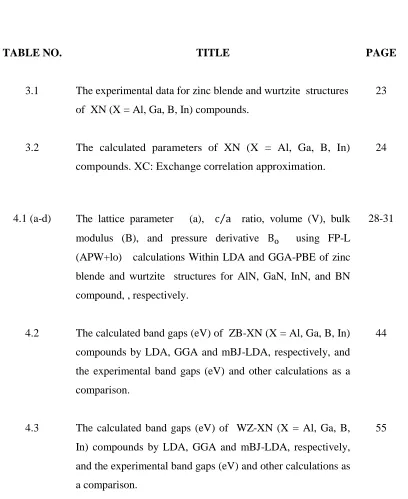
LIST OF TABLES
TABLE NO. TITLE PAGE
3.1 The experimental data for zinc blende and wurtzite structures of XN (X = Al, Ga, B, In)compounds.
23
3.2 The calculated parameters of XN (X = Al, Ga, B, In) compounds. XC: Exchange correlation approximation.
24
4.1 (a-d) The lattice parameter (a), ratio, volume (V), bulk modulus (B), and pressure derivative using FP-L (APW+lo) calculations Within LDA and GGA-PBE of zinc blende and wurtzite structures for AlN, GaN, InN, and BN compound, , respectively.
28-31
4.2 The calculated band gaps (eV) of ZB-XN (X = Al, Ga, B, In) compounds by LDA, GGA and mBJ-LDA, respectively, and the experimental band gaps (eV) and other calculations as a comparison.
44
4.3 The calculated band gaps (eV) of WZ-XN (X = Al, Ga, B, In) compounds by LDA, GGA and mBJ-LDA, respectively, and the experimental band gaps (eV) and other calculations as a comparison.
4.4 Calculated (ZB) static dielectric constant , static refractive index and magnitude of the coefficient of reflectivity at zero frequency .
64
4.5 Calculated (WZ) static dielectric constant , static refractive index and magnitude of the coefficient of reflectivity at zero frequency .
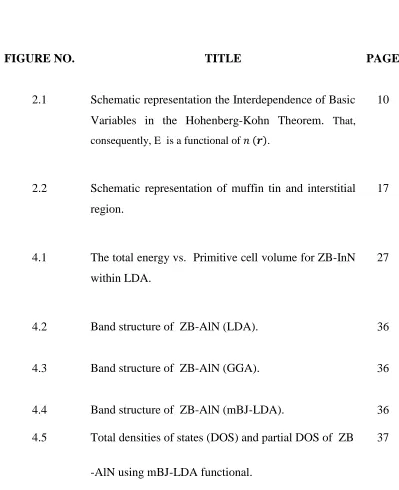
LIST OF FIGURES
FIGURE NO. TITLE PAGE
2.1 Schematic representation the Interdependence of Basic Variables in the Hohenberg-Kohn Theorem. That, consequently, E is a functional of .
10
2.2 Schematic representation of muffin tin and interstitial region.
17
4.1 The total energy vs. Primitive cell volume for ZB-InN within LDA.
27
4.2 Band structure of ZB-AlN (LDA). 36
4.3 Band structure of ZB-AlN (GGA). 36
4.4 Band structure of ZB-AlN (mBJ-LDA). 36
4.5 Total densities of states (DOS) and partial DOS of ZB -AlN using mBJ-LDA functional.
4.6 Band structure of ZB-GaN (LDA). 38
4.7 Band structure of ZB-GaN (GGA). 38
4.8 Band structure of ZB-GaN (mBJ-LDA). 38
4.9 Total densities of states (DOS) and partial DOS of ZB -GaN using mBJ-LDA functional.
39
4.10 Band structure of ZB-BN (LDA). 40
4.11 Band structure of ZB-BN (GGA). 40
4.12 Band structure of ZB-BN (mBJ-LDA). 40
4.13 Total densities of states (DOS) and partial DOS of ZB -BN using mBJ-LDA functional.
41
4.14 Band structure of ZB-InN (LDA). 42
4.15 Band structure of ZB-InN (GGA). 42
4.16 Band structure of ZB-InN (mBJ-LDA). 42
4.17 Total densities of states (DOS) and partial DOS of ZB -InN using mBJ-LDA functional.
43
-AlN using mBJ-LDA functional.
4.22 Band structure of WZ-GaN (LDA). 49
4.23 Band structure of WZ-GaN (GGA). 49
4.24 Band structure of WZ-GaN (mBJ-LDA). 49
4.25 Total densities of states (DOS) and partial DOS of WZ -GaN using mBJ-LDA functional.
50
4.26 Band structure of WZ-BN (LDA). 51
4.27 Band structure of WZ-BN (GGA). 51
4.28 Band structure of WZ-BN (mBJ-LDA). 51
4.29 Total densities of states (DOS) and partial DOS of WZ -BN using mBJ-LDA functional.
52
4.30 Band structure of WZ-InN (LDA). 53
4.31 Band structure of WZ-InN (GGA). 53
4.33 Total densities of states (DOS) and partial DOS of WZ -InN using mBJ-LDA functional.
54
4.34 The optical properties (real and imaginary parts of the dielectric function, refractive index , extinction coefficient , absorption coefficient
, reflectivity , optical conductivity
absorption coefficient and loss function ) of ZB-AlN calculated by the LDA/GGA and mBJ-LDA, respectively.
66
4.35 The optical properties (real and imaginary parts of the dielectric function, refractive index , extinction coefficient , absorption coefficient
, reflectivity , optical conductivity
absorption coefficient and loss function ) of ZB-GaN calculated by the LDA/GGA and mBJ-LDA, respectively.
67
4.36 The optical properties (real and imaginary parts of the dielectric function, refractive index , extinction coefficient , absorption coefficient
, reflectivity , optical conductivity
absorption coefficient and loss function ) of ZB-BN calculated by the LDA/GGA and mBJ-LDA, respectively.
68
of ZB-InN calculated by the LDA/GGA and mBJ-LDA, respectively.
4.38 The optical properties (real and imaginary parts of the dielectric function, refractive index , extinction coefficient , absorption coefficient
, reflectivity , optical conductivity
absorption coefficient and loss function ) of WZ-AlN calculated by the LDA/GGA and mBJ-LDA, respectively.
74
4.39 The optical properties (real and imaginary parts of the dielectric function, refractive index , extinction coefficient , absorption coefficient
, reflectivity , optical conductivity
absorption coefficient and loss function ) of WZ-GaN calculated by the LDA/GGA and mBJ-LDA, respectively.
75
4.40 The optical properties (real and imaginary parts of the dielectric function, refractive index , extinction coefficient , absorption coefficient
, reflectivity , optical conductivity
absorption coefficient and loss function ) of WZ-BN calculated by the LDA/GGA and
LDA, respectively.
4.41 The optical properties (real and imaginary
parts of the dielectric function, refractive
index , extinction coefficient , absorption
coefficient , reflectivity , optical
conductivity absorption coefficient and
loss function ) of WZ-InN calculated by the LDA/GGA and mBJ-LDA, respectively.
LIST OF ABBREVIATION
APW - Augmented Plane Wave BO - Born Oppenheimer
DFT - Density Functional Theory DOS - Density of states
FP-LAPW - Full Potential Linearized Augmented Plane Wave LAPW - Linearized Augmented Plane Wave
GGA-EV - Engel-Vosko Generalized gradient approximations GGA-PBE - Perdew et al. Generalized gradient approximations LDA - Local Density Approximations
mBJ - Modified Becke-Johnson HF - Hartree Fock theorem HK - Hohenberg-Kohn KS - Kohn-Sham theorem PBE - Perdew-Burke-Ernzernhof PP - Pseudopotential
LIST OF SYMBOLS
E - Energy
EF - Fermi Energy
Eg - Energy gap / band gap
EXC - Exchange-correlation energy
G - Reciprocal lattice vector
ψ - Wave function H - Hamiltonian operator
k - Wavenumber
N - Number of electrons
n(r) - Electron density r - Position vector
V - Volume
Ψ - Wavefunction
ε - Energy
Vext - External potential - Laplacian operator
- The classical electron – electron (e-e) interaction energy - Exchange-Correlation energy
V - The volume of the unit cell
- The wave vector in the irreducible Brillion zone - The spherical harmonics function.
ZB - Zinc blende structure
lmax - The maximum quantum number - The bulk modulus
WZ - Wurtzite structures VBM - Valence band maximum CBM - Conduction band minimum
- Complex dielectric function - Complex refractive index - The real refractive index
- The extinction coefficient - Static dielectric constant
- Static refractive index - Absorption coefficient
CHAPTER 1
INTRODUCTION
1.1 Background of Research
III–V compound semiconductors have fascinated significantly due to their very inimitable physical properties and applications. Properties of semiconductors belonging to III–V group are under extensive studied due to their use in electronic and optoelectronic devices [1, 2]. Due to a wide range of exceptional physical properties, its different compounds have been under experimental and theoretical studies for a long time [3-5]. To comprehend the physical properties of such compounds a lot of research has been carried out but there are yet many characteristics needs clarity, like electronic band gap disagreement among different studies [6-10]. Detailed computational/theoretically study of structural, electronic and optical properties are very vital.
density approximation (LDA) [13] or generalized gradient approximation (GGA-PBE)” [14]. Most of the theoretical studies were carried out using pseudo-potential [15] or FP-LAPW (one of the most accurate calculation approach for the investigate of crystalline solids) methods. To study the structural properties of solids, LDA and GGA approximation works very well but not suitable for band gap calculations as these underestimate the band gap energy values. To overcome this short coming a new method/approach known as modified Becke-Johnson (mBJ) was introduced by Tran and Blaha [16] that explains the electronic properties of different solids successfully will be applied.
The main interest of this research is to carry out theoretical investigations of III-nitrides compounds such as AlN, GaN, InN, and BN with mBJ method for the electronic and optical properties that will provide very useful information for practical application of said materials in electronic and microelectronics industry.
1.2 Properties and Applications
semiconductors family are under extensive investigation for a long time[1, 2] due to their exceptional physical properties such as very short bond lengths, low compressibility, low dielectric constant, large bulk moduli, wide band gaps, high ionicity, high value of thermal conductivity (which make them suitable material for high powered devices) [17] and melting point, etc., [1, 2, 18-21] and the extreme hardness of cubic phase of BN [21].
These properties largely stem from their large electronegativity difference between group III and V elements, leading to very strong chemical bonds [19] ( which impart structural stability under relatively high mechanical stress), making them ideal building blocks for many applications in optoelectronic devices specifically in a wavelength range from blue to ultraviolet such as blue light emitting diodes (LEDs), laser diodes, solar blind photo detectors [7, 22], as well as for high-power, high-temperature, and high-frequency devices [20, 23, 24].
doping), it has recently become possible using the most rapidly flourishing (epitaxial) techniques to crystallize them in a stable form with cubic symmetry. Yang et al. [26] successfully applied this approach to grow cubic GaN on the GaAs (001) surface and obtained better optical properties compare to the wurtzite structures. During the last two decades, most of the advancements in technological application of semiconductors have been achieved owing to advances in epitaxial techniques. Nevertheless, the experimental techniques are usually costly and provide insufficient theoretical insight to build better materials for novel device applications.
Therefore, for inexpensive and rapid development, theoretical studies are highly successful in predicting/investigation new material for useful practical application. Although studies related to III-V nitrides started in early seventies of last century [1, 2], considerable attention of researchers was caught in 1990s with the introduction of blue light emitting diodes. Moreover, due to their incomparable physical properties, is also viewed promising candidate in the future optoelectronic device applications like “high-density data devices and undersea optical communication systems” [27].
1.3 Research Objectives
1. Study of structural properties of XN (X = Al, Ga, In and B) compounds.
2. Study of electronic properties of XN (X = Al, Ga, In and B) compounds.
3. Study of optical properties of XN (X = Al, Ga, In and B) compounds.
1.4 Scope of Study
The scope of this research is as the following:
Density functional theory is used to compute and simulate the electronic and structural properties of above-said compounds within Zinc blende and wurtzite structures by the following techniques:
1. The local density approximation (LDA) and the generalized gradient approximation (GGA-PBE) are used to calculate ground-state energies, the lattice parameters, the bulk modulus and its derivatives, the band structures and optical properties.
REFERENCES
1. Pankove, J. I. J. Lumin, 1973. 7: p. 114.
2. Kesamanly, F.P., Sov. Phys. Semicond, 1974. 8: p. 147.
3. Madsen, G.K.H., et al., Phys. Rev B, 2001. 64: p. 195134.
4. Singh, D.J. and Phys. Rev B, 1991. 43: p. 6388.
5. Sjöstedt, E., L. Nordström, and D.J. Singh, Solid State Comm, 2000. 114(15).
6. Amrani, B., R. Ahmed, and F.E.H. Hassan, Comput. Mater. 2006: p. 11.001.
7. Morkoc, H., Nitride Semiconductors and Devices. Vol. 32. 1999, Springer, Berlin: Springer Series in Material Science.
8. Rushton, P.P., S.J. Clark, and D.J. Tozer, Phys. Rev B, 2001. 63: p. 115206.
9. Zhu-feng, H., et al., Phys. Chem. Comm, 2003. 12(6): p. 47.
10. Ahmed, R., Unpublished Thesis PhD. 2010 & referance there in, Lahore: Punjab Uni.
13. Perdew, J.P. and Y. Wang, Phys. Rev. B, 1992. 45: p. 13244.
14. Perdew, J.P., K. Burke, and M. Emzerhof, Phys. Rev. Lett, 1996. 77: p. 3865.
15. Pickett, W.E., Comput.Phys. Rep, 1989. 9: p. 117.
16. Tran, F. and P. Blaha, Accurate Band Gaps of Semiconductors and Insulators with a Semilocal Exchange-Correlation Potential. Physical Review Letters, 2009. 102(22): p. 226401.
17. Monemar, B., III-V nitrides—important future electronic materials. Journal of Materials Science: Materials in Electronics, 1999. 10(4): p. 227-254.
18. Wu, J., When group-III nitrides go infrared: New properties and perspectives. Journal of Applied Physics, 2009. 106(1): p. 011101.
19. Sharma2, U.S., P.S. Bisht1, and U.P. Verma1, Electronic and structural properties of group III nitrides and phosphides using density functional theory. J. Phys.: Condens. Matter 2009. 21 ( 025501 (5pp)).
20. Ahmed, R., H. Akbarzadeh, and A. Fazal e, A first principle study of band structure of III-nitride compounds. Physica B: Condensed Matter, 2005. 370(1–4): p. 52-60.
21. Ahmed, R., et al., First principles study of structural and electronic properties of different phases of boron nitride. Physica B: Condensed Matter, 2007. 400(1–2): p. 297-306.
23. Daoudi, B., et al., FP-LAPW calculations of ground state properties for AlN, GaN and InN compounds. Int. J. Nanoelectronics and Materials, 2008(1): p. 65-79.
24. Lawniczak-Jablonska, K., et al., Electronic states in valence and conduction bands of group-III nitrides: Experiment and theory. Physical Review B - Condensed Matter and Materials Physics, 2000. 61(24): p. 16623-16632.
25. Karch, K. and F. Bechstedt, Ab initio lattice dynamics of BN and AlN: Covalent versus ionic forces. Physical Review B, 1997. 56(12): p. 7404.
26. Yang, H., et al., Evaluation of the surface stoichiometry during molecular beam epitaxy of cubic GaN on (001) GaAs. Applied Physics Letters, 1996. 68(2): p. 244-246.
27. Usman, Z., et al., J. Phys. Chem. A, 2011. 115: p. 6622.
28. M.Martin, R.c., Electronic structure: basic theory and practical methods. First paperback edition with correction 2008 ed. 2004, New York: Cambridge University.
29. Hessler, P., N. T.Maitra, and K.Burke, Journal of Chemical Physics, 2002. 117: p. 72-81.
30. Karlheinz, S., DFT calculations of solids with LAPW and WIEN2k. Journal of Solid State Chemistry, 2003. 176(2): p. 319-328.
31. Thomas, L.H., The calculation of atomic fields. Vol. 23. 1927: Proc. Cambrigde Philos.
34. W.Kohn and L.S. Sham, Phys. Rev. A, 1965. 140: p. 1133.
35. Perdew, J.P. and Y. Wang, Phys. Rev. B, 1992. 45: p. 13244.
36. Koch, W. and M.C. Holthausen, A Chemist’s Guide to Density Functional Theory. Second ed.
37. Perdew, J.P., K. Burke, and M. Ernzerhof, Phys. Rev. Lett, 1996. 72: p. 3865.
38. Singh, D., Physical Review B, 2010. 82.
39. Guo, S.-D. and B.-G. Liu, EPL (Europhysics Letters), 2011. 93: p. 47006.
40. Koller, D., F. Tran, and P. Blaha, Merits and limits of the modified Becke-Johnson exchange potential. Physical Review B, 2011. 83(19).
41. Yousaf, M., et al., An Improved Study of Electronic Band Structure and Optical Parameters of X-Phosphides (X= B, Al, Ga, In) by Modified Becke— Johnson Potential. Communications in Theoretical Physics, 2012. 58(5): p. 777.
42. Yousaf, M., et al., Electronic Band Structure and Optical Parameters of Spinel SnMg2O4 by Modified Becke—Johnson Potential. Chinese Physics Letters, 2012. 29(10): p. 107401.
44. Anderson, P., et al., Magnetic and optical properties of the InCrN system. Journal of applied physics, 2005. 98(4): p. 043903-043903-5.
45. Sjöstedt, E., L. Nordström, and D. Singh, An alternative way of linearizing the augmented plane-wave method. Solid state communications, 2000. 114(1): p. 15-20.
46. Madsen, G.K.H., et al., Efficient linearization of the augmented plane-wave method. Physical Review B, 2001. 64(19): p. 195134.
47. Petersen, M., et al., Computer Physics communications, 2000. 126: p. 294-309.
48. schwarz, K., P. Blaha, and S.B. Trickey, Molecular Physics, 2010. 108: p. 3147.
49. Blaha, P., et al., WIEN2K: An Augmented Plane Wave and Local Orbital Program for Calculating Crystal Properties. 2001, Universitate Wien: Austria: Techn.
50. K. S. P. Blaha, G.K.H.M., D. Kvasnicka, J. Luitz, WIEN2k, An Augmented Plane Wave + Local Orbital Program for Calculating Crystal Properties, Karlheinz Schwartz, Techn, Universität Wien, Austria 2001.
51. P.Blaha, Institute for Materials Chemistry, Austria: TU Vienna.
52. Ahmed, R., et al., STRUCTURAL PROPERTIES OF III-NITRIDE BINARY COMPOUNDS: A COMPREHENSIVE STUDY. Modern Physics Letters B, 2009. 23(08): p. 1111-1127.
55. Sherwin, M. and T. Drummond, Journal of applied physics, 1991. 69(12): p. 8423-8425.
56. Fuchs, M., et al., Cohesive properties of group-III nitrides: A comparative study of all-electron and pseudopotential calculations using the generalized gradient approximation. Physical Review B, 2002. 65(24): p. 245212.
57. Wang, S. and H. Ye, A plane-wave pseudopotential study on III–V zinc-blende and wurtzite semiconductors under pressure. Journal of Physics: Condensed Matter, 2002. 14(41): p. 9579.
58. Tütüncü, H., et al., Structural and dynamical properties of zinc-blende GaN, AlN, BN, and their (110) surfaces. Physical Review B, 2005. 71(19): p. 195309.
59. Wyckoff, R., Crystal Structures. 2nd ed. 1986: Krieger, Malabar.
60. Ueno, M., et al., X-ray observation of the structural phase transition of aluminum nitride under high pressure. Physical Review B, 1992. 45(17): p. 10123.
61. Persson, C., et al., First-principle calculations of optical properties of wurtzite AlN and GaN. Journal of crystal growth, 2001. 231(3): p. 407-414.
63. Ueno, M., et al., Stability of the wurtzite-type structure under high pressure: GaN and InN. Physical Review B, 1994. 49(1): p. 14.
64. Sherwin, M. and T. Drummond, Predicted elastic constants and critical layer thicknesses for cubic phase AlN, GaN, and InN on β‐SiC. Journal of applied physics, 1991. 69(12): p. 8423-8425.
65. W. A. Harrison, Electronic Structure and the Properties of Solids. 1989, Dover, New York.
66. Kanoun, M., et al., Prediction study of elastic properties under pressure effect for Zinc blende e BN, AlN, GaN and InN. Solid-State Electronics, 2004. 48(9): p. 1601-1606.
67. Paulus, B., F.H. Shi, and H. Stoll, J. Phys. Condens. Matter, 1997. 9: p. 2745.
68. Carrier, P. and S.-H. Wei, Theoretical study of the band-gap anomaly of InN. Journal of applied physics, 2005. 97(3): p. 033707-033707-5.
69. Moreno‐Armenta, M.G., L. Mancera, and N. Takeuchi, First principles total energy calculations of the structural and electronic properties of ScxGa1–xN. physica status solidi (b), 2003. 238(1): p. 127-135.
70. Wentorf, R.H., Cubic Form of Boron Nitride. J. Chem. Phys, 1957. 26(4): p. 956.
71. Grimsditch, M., E. Zouboulis, and A. Polian, Elastic constants of boron nitride. Journal of applied physics, 1994. 76(2): p. 832-834.
74. Janotti, A., S.-H. Wei, and D. Singh, First-principles study of the stability of BN and C. Physical Review B, 2001. 64(17): p. 174107.
75. Sōma, T., A. Sawaoka, and S. Saito, Characterization of wurtzite type boron nitride synthesized by shock compression. Materials Research Bulletin, 1974. 9(6): p. 755-762.
76. Furthmüller, J., J. Hafner, and G. Kresse, Ab initio calculation of the structural and electronic properties of carbon and boron nitride using ultrasoft pseudopotentials. Physical Review B, 1994. 50(21): p. 15606.
77. Bousahla, Z., et al., Full potential linearized augmented plane wave calculations of positronic and electronic charge densities of zinc-blende AlN, InN and their alloy Al< sub> 0.5</sub> In< sub> 0.5</sub> N. Journal of Solid State Chemistry, 2005. 178(6): p. 2117-2127.
78. Furthmüller, J., et al., Band structures and optical spectra of InN polymorphs: Influence of quasiparticle and excitonic effects. Physical Review B, 2005. 72(20): p. 205106.
79. Kim, K., W.R.L. Lambrecht, and B. Segall, Elastic constants and related properties of tetrahedrally bonded BN, AlN, GaN, and InN. Physical Review B, 1996. 53(24): p. 16310 and references therein.
80. Dridi, Z., B. Bouhafs, and P. Ruterana, Phys. Stat. Sol. C, 2002. 0: p. 315.
82. Fiorentini, V., M. Methfessel, and M. Scheffler, Electronic and structural properties of GaN by the full-potential linear muffin-tin orbitals method: The role of the d electrons. Physical Review B, 1993. 47(20): p. 13353-13362.
83. Adachi, S., Properties of Group-IV, III–V and II–VI semiconductors. 2005, England: Wiley.
84. Litimein, F., et al., The electronic structure of wurtzite and Zinc blende e AlN: an ab initio comparative study. New Journal of Physics, 2002. 4(1): p. 64.
85. Jonnard, P., et al., Electronic structure of wurtzite and zinc-blende AlN. The European Physical Journal B-Condensed Matter and Complex Systems, 2004. 42(3): p. 351-359.
86. Persson, C., et al., Effective electronic masses in wurtzite and zinc-blende GaN and AlN. Journal of Crystal Growth, 2001. 231(3): p. 397-406.
87. Armenta, M.G.M., A. Reyes-Serrato, and M.A. Borja, Ab initio determination of the electronic structure of beryllium-, aluminum-, and magnesium-nitrides: A comparative study. Physical Review B, 2000. 62(8): p. 4890.
88. Wei, S.H., et al., Breakdown of the band-gap-common-cation rule: The origin of the small band gap of InN. Physical Review B, 2003. 67(16): p. 165209.
89. Fomichev, V.A. and M.A. Rumsh, J. Chem. Phys, 1968. 48: p. 555.
92. Zaoui, A. and F.E.H. Hassan, Full potential linearized augmented plane wave calculations of structural and electronic properties of BN, BP, BAs and BSb. Journal of Physics: Condensed Matter, 2000. 13(2): p. 253.
93. Carrier, P. and S.H. Wei, Theoretical study of the band-gap anomaly of InN. Journal of Applied Physics, 2005. 97(3): p. 033707.
94. Stampfl, C. and C.G. Van de Walle, Density-functional calculations for III-V nitrides using the local-density approximation and the generalized gradient approximation. Physical Review B, 1999. 59(8): p. 5521-5535.
95. Wei, S.-H., et al., Breakdown of the band-gap-common-cation rule: The origin of the small band gap of InN. Physical Review B, 2003. 67(16): p. 165209.
96. Wu, J., et al., Unusual properties of the fundamental band gap of InN. Applied Physics Letters, 2002. 80(21): p. 3967-3969.
97. G. Harbake: , Optical Properties of Solids,. 1972, F. Abeles Amsterdam, North- Holland. p. 21.
98. Penn, D.R., Wave-number-dependent dielectric function of semiconductors. Physical Review, 1962. 128(5): p. 2093.
100. Shwetha, G. and V. Kanchana, Optical isotropy in structurally anisotropic halide scintillators: Ab initio study. Physical Review B, 2012. 86(11): p. 115209.
101. Akasaki, I. and M. Hashimoto, Infrared lattice vibration of vapour-grown AlN. Solid State Communications, 1967. 5(11): p. 851-853.
102. Berrah, S., A. Boukortt, and H. Abid, Electronic and optical properties of Zinc blende e AlN, GaN and InN compounds under pressure. Physica Scripta, 2007. 75(4): p. 414.
103. Gavrilenko, V. and R. Wu, Linear and nonlinear optical properties of group-III nitrides. Physical Review B, 2000. 61(4): p. 2632.
104. Moss, T., A relationship between the refractive index and the infra-red threshold of sensitivity for photoconductors. Proceedings of the Physical Society. Section B, 1950. 63(3): p. 167.
105. Chin, V., T. Tansley, and T. Osotchan, Electron mobilities in gallium, indium, and aluminum nitrides. Journal of Applied Physics, 1994. 75(11): p. 7365-7372.
106. Jiao, Z.-Y., S.-H. Ma, and J.-F. Yang, A comparison of the electronic and optical properties of zinc-blende, rocksalt and wurtzite AlN: A DFT study. Solid State Sciences, 2011. 13(2): p. 331-336.
107. Christensen, N. and I. Gorczyca, Optical and structural properties of III-V nitrides under pressure. Physical Review B, 1994. 50(7): p. 4397.
110. Riane, R., et al., Pressure dependence of electronic and optical properties of Zinc-blende GaN, BN and their B< sub> 0.25</sub> Ga< sub> 0.75</sub> N alloy. Physica B: Condensed Matter, 2010. 405(3): p. 985-989.
111. Usman, Z., et al., First-principle electronic, elastic, and optical study of cubic gallium nitride. J Phys Chem A, 2011. 115(24): p. 6622-8.
112. O. Madelung, Semiconductor Basic Data. 1996, Berlin: Springer.
113. Fatmi, M., et al., First-principles study of structural, elastic, electronic, lattice dynamic and optical properties of XN (X= Ga, Al and B) compounds under pressure. Physica Scripta, 2011. 83(6): p. 065702.
114. Cappellini, G., et al., Optical properties of BN in cubic and layered hexagonal phases. Physical Review B, 2001. 64(3): p. 035104.
115. Xu, Y.-N. and W. Ching, Calculation of ground-state and optical properties of boron nitrides in the hexagonal, cubic, and wurtzite structures. Physical Review B, 1991. 44(15): p. 7787.
116. Misek, J. and F. Srobar, Electrotech. Cas., 1979. 30: p. 690.
117. Xu, Y.-N. and W. Ching, Electronic, optical, and structural properties of some wurtzite crystals. Physical Review B, 1993. 48(7): p. 4335.
118. Ejder, E., Refractive index of GaN. physica status solidi (a), 1971. 6(2): p. 445-448.