ABSTRACT
XIAO, XUSHENG. Cooperative Testing and Analysis via Informed Decision Making. (Under the direction of Tao Xie and Laurie Williams.)
Software is pervasive in all aspects of our life, and thus it is critical to ensure high qual-ity of software. Software qualqual-ity includes both functional qualqual-ity and non-functional qualqual-ity. Functional quality refers to functional correctness of software, and non-functional quality sup-ports the delivery of functional requirements, such as security. Failing to ensure high quality of software can result in serious consequences, such as causing software to behave incorrectly and compromising users’ security and privacy. To improve software quality, software testing/analy-sis tools can be used to automate certain activities in software development and maintenance, reducing manual efforts of quality assurance.
Although tool automation is important in software testing and analysis for reducing manual efforts, tools face various problems when dealing with complex software, and such problems would be still difficult for the tools to tackle in the foreseeable future. For example, my ICSE 2011 work shows that even a state-of-the-art test-generation tool may achieve not more than 65% code coverage due to problems in dealing with method calls to external libraries. For some of these problems, tool users (e.g., developers and testers) may help the tools tackle these problems, such as providing mock objects to simulate the behaviors of the external libraries. With the provided mock objects, the test-generation tools can be reapplied to generate more test inputs, achieving new coverage and carrying out software testing more effectively. In suchcooperation, the advances on test-generation tools free the users from labor-intensive and tedious tasks (e.g., manually producing test inputs for coverage) and the tools try their best in automating the tasks, while the users focus their efforts in addressing only the problems faced by the tools (e.g., providing mock objects). Note that the efforts in addressing the problems are typically less than the efforts in asking the users to finish all the remaining work for the tasks (e.g., generating test inputs for all the not-covered code). For example, with the provided mock objects, the tools can be reapplied to explore the not-covered code and generate more test inputs for covering the newly explored code. In this way, the users do not need to generate test inputs for all the newly explored code. If more problems are encountered in exploring the newly explored code, the users can provide their help again.
To support such new types of cooperation enabled by the advances on software testing /analysis tools, there is a strong need to provide a user-tool interface1 that communicates
suf-1
ficient and precise information to the users (e.g., reporting the problems faced by the tools), allowing the users to help the tools address the problems. However, many software testing/-analysis tools still do not communicate sufficient or precise information to the users, and little research has been done on such interfaces for these new types of cooperation. For example, most test-generation tools often report only the achieved coverage, but not the problems faced by the tools; for a few tools that report the problems, many reported problems are false warnings. Such situations pose difficulties for the users to help the tools address the problems.
To maximize the value of software testing and analysis for improving software quality, this dissertation proposes a framework ofcooperative testing and analysis, which provides interfaces that enable the users to make informed decisions in cooperation with software testing/analysis tools. With the advances on software testing/analysis tools, many new types of cooperation emerge for various software engineering (SE) tasks. In these types of cooperation, the tools free the users from tedious and mechanic subtasks, and the users’ subtasks have been shifted to the subtasks that are dependent on the users’ domain knowledge and expectations. To better support such new types of cooperation, there is a strong need to provide the interfaces for communicating sufficient and precise information to the users.
In this dissertation, our framework focuses on providing interfaces to support two types of cooperation with software testing/analysis tools for SE tasks:
• Problem-Diagnosis Interface: For certain SE tasks where automated tools drive the tasks towards a goal of testing and analysis, users can help the tools address the encoun-tered problems since the complicated characteristics of the code under test are beyond the capability of the tools. For such SE tasks, our framework providesproblem-diagnosis in-terfaces to support a type of cooperation, calledproblem-diagnosis cooperation, as follows. Users first set up and apply a tool to conduct initial testing and analysis on a program. The provided interface then shows the feedback to the users, including the effectiveness of the tool and the problems faced by the tool; these problems are precisely identified and the benefits of solving these programs are accurately estimated using analyses of the program and the tool. By looking at the problems, the users provide guidance to the tool based on the feedback, helping the tool address the problems. Such process forms a feedback loop and can be repeated until the effectiveness is satisfied or the users run out of patience.
interfaces to support a type of cooperation, called behavior-diagnosis cooperation, as fol-lows. Users first set up and apply a tool to conduct initial testing and analysis on a program. The provided interface then shows a list of behaviors related to the goal for the users to inspect, and the users make decisions on whether these behaviors are expected. Furthermore, the interface also provides explanations for the behaviors. Based on whether the behaviors are in the form of either concrete instances or abstract models, these expla-nations can be in the form of (1)extension: a larger scope of information to collect more concrete instances or extend the models of the behaviors, (2)instantiation: instantiations of the behaviors’ abstract models, or (3) abstraction: inferred models from the concrete instances of the behaviors. Such explanations help the users make informed decisions on the behaviors to be inspected.
The key difference between problem-diagnosis cooperation and behavior-diagnosis coop-eration is that problem-diagnosis coopcoop-eration typically engages the users to diagnose some intermediate results used for producing the final results, while behavior-diagnosis cooperation typically engages the users to diagnose the final results directly. For example, after a test-generation tool generates test inputs for a program, problem-diagnosis cooperation engages the users to diagnose the reported problems and address the problem for helping the tool in achieving higher coverage. If the tool generates an input that causes the program to throw uncaught exceptions, behavior-diagnosis cooperation engages the users to diagnose the excep-tions and confirm whether such excepexcep-tions indicate real faults. Also, the information of how the exception-throwing states are reached in the failing executions is shown to the users (i.e., a larger scope of information is used to explain the exceptions), helping the users make informed decisions in diagnosing exceptions.
We propose a number of approaches under cooperative testing and analysis, where each approach provides the interface to support cooperation between tools and their users for a specific SE task, improving either functional or non-functional quality of software.
First, we propose approaches to better support cooperation for automated test generation, ensuring functional correctness of software. The goal of automated test generation is generating test inputs for achieving high code coverage. However, even the state-of-the-art test-generation tools have difficulties in achieving high coverage for complex software. To improve the effec-tiveness of the test-generation tools, our approaches provide a problem-diagnosis interface that precisely reports the problems faced by the test-generation tools, and shows the ordering of the problems based on their estimated benefits. Such interface enables the problem-diagnosis cooperation for test-generation tools. In this cooperation, the tools automatically generate test inputs for achieving coverage of a program and report problems faced by the tools for not-covered code. Based on the users’ domain knowledge of the program under test, the users provide their guidance to address the problems. To identify major types of problems that pre-vent test-generation tools from achieving high coverage for complex software, we first conduct empirical studies on popular open-source projects. Based on the study results, we then propose an approach to precisely identify these problems. To allow prioritization of the problems, we further propose an economic-analysis approach to accurately estimate the benefit of solving a problem, i.e., how much coverage improvement can be obtained by solving the problem.
infor-mation flows are expected for the mobile applications, and make decisions on granting accesses for the permissions.
The goal of security policy extraction is controlling resource accesses for a software system. In practice, security policies are commonly written in Natural Language (NL) and are supposed to be written in security requirements. However, often ACPs are buried in NL documents such as requirement documents, and these NL software documents could be large in size, making it tedious and error-prone to manually inspect these NL documents for extracting security poli-cies. To improve security policy extraction, our approach provides a behavior-diagnosis interface that shows the security policies automatically extracted from the sentences in requirements doc-uments, and the users make decisions on whether the security policies are expected based on their domain knowledge about the software system’s functionality and security requirements. Also, scenario-based functional requirements (such as use cases) contain sequences of action steps that describe actors (principals) who access different resources for achieving some func-tionalities and help developers determine what system functionality to implement. Validating these action steps against the extracted policies explains what action steps violating the poli-cies. Thus, our behavior-diagnosis interface further shows the requirements documents where the security policies are extracted as policy-witness scenarios, and the inconsistencies between action steps and the extracted policies as policy-violation scenarios. Such policy-witness and policy-violation scenarios use the instantiations of the extracted security policies as explana-tions for the security policies, enabling the behavior-diagnosis cooperation for security policy extraction. In this cooperation, the tools extract security policies for the users to inspect and explain the security policies by showing the policy-witness and policy-violation scenarios. Based on the users’ domain knowledge about the software system’s functionality and security require-ments, the users inspect the policy-witness and policy-violation scenarios (instantiations of the security policies) to determine whether these scenarios are expected for the software system, and make decisions on the extracted security policies.
of the executed methods, our approach provides a behavior-diagnosis interface that shows the complexity models of methods. Our approach infers complexity models of workload-dependent loops from multiple executions of the program on multiple workloads. Such complexity models inferred from the concrete executions explain how the costs of certain methods grow in larger workloads, enabling the behavior-diagnosis cooperation for performance analysis. In this coop-eration, the tools compute the costs of the executed methods for the users to inspect and explain the cost growth of the methods by showing the inferred complexity models. Based on the users’ domain knowledge about the functionality and performance requirements of the program under analysis, the users inspect the complexity models of the methods to determine whether the cost growths represented by the models are expected for the methods, and make decisions on whether the methods are performance faults.
©Copyright 2014 by Xusheng Xiao
Cooperative Testing and Analysis via Informed Decision Making
by Xusheng Xiao
A dissertation submitted to the Graduate Faculty of North Carolina State University
in partial fulfillment of the requirements for the Degree of
Doctor of Philosophy
Computer Science
Raleigh, North Carolina 2014
APPROVED BY:
Emerson Murphy-Hill Douglas Reeves
Tao Xie
Co-chair of Advisory Committee
Laurie Williams
DEDICATION
BIOGRAPHY
ACKNOWLEDGMENTS
I would like to start by giving my deepest thanks to my advisor, Tao Xie, who supports me with freedom and guidance throughout my Ph.D. studies. During the past five years, with the largest possible freedom offered by Tao, I was able to pursue my own research interests, collaborate with other groups, and do internships in industry research labs, etc. Tao has also provided me valuable technical and professional advice, which improves my research skills, technical writing, and effective presentation, and will continue to benefit me in my future career. His dedicated mentorship made my five-year Ph.D. studies a fruitful and fulfilling experience. I want to thank my co-advisor Laurie Williams for her support of my dissertation research. I also would like to thank Emerson Murphy-Hill and Douglas Reeves for serving on my dissertation committee and providing valuable feedback on my dissertation research. Portions of this dissertation were previously published at ICSE 11 [205] (Chapter 4), ASE 13 [200] (Chapter 4), ASE 12 [203] (Chapter 6), FSE 12 [201] (Chapter 7), ISSTA 13 [199] (Chapter 8). The material included in this dissertation has been updated and extended.
I thank my internship mentors and collaborators in Microsoft Research and IBM Research, who have immensely helped me with the work described in this dissertation. Nikolai Tillmann and Jonathan de Halleux (Microsoft Research, USA) provided support for the Pex tool and offered their insightful feedback for my research on automated test generation. Nikolai Tillmann, Jonathan de Halleux, Manuel Fahndrich, and Michal Moskal (Microsoft Research, USA) helped me in integrating my approach into the TouchDevelop platform and provided the TouchDevelop programs for my evaluation. Amit Paradkar (IBM Research, USA) provided support for the natural language processing (NLP) parser for my research on extraction of ACP rules from use cases, and Suresh Thummalapenta (Microsoft, USA; formerly IBM Research, India) provided his help for my evaluations. Shi Han and Dongmei Zhang (Microsoft Research, China) provided support for the performance profiling tool and guidance for my research on performance analysis. I thank Gogul Balakrishnan, Franjo Ivanˇci´c, and Aarti Gupta (NEC Laboratories America) for their guidance and help during my 2012 summer internship in NEC Laboratories America, and thank Mark Marron and Sumit Gulwani (Microsoft Research, USA) for their mentoring and help during my 2013 summer internship in Microsoft Research. Thanks also go to other students I met during my internships for their technical discussions. Working with such great researchers and students has helped expand my research to a broader scope.
Kiran Shakya, Mithun Acharya, Linghao Zhang, Yuan Yao, Yu Xiao, Sihan Li, Wei Yang, and Blake Bassett. My research was supported by NSF grants CNS-0716579, 0725190, CCF-0845272, CCF-0915400, CNS-0958235, CNS-1318419, an NCSU CACC grant, Army Research Office (ARO) grants W911NF-08-1-0443 and W911NF-08-1-0105 managed by NCSU SOSI, and a Microsoft Research Software Engineering Innovation Foundation Award. Gratitude to the De-partment of Computer Science at NC State University for Teaching Assistantship opportunities and financial support during my Ph.D studies.
I would like to thank Tao Xie, Zhendong Su, Sumit Gulwani, and Nikolai Tillmann, who wrote recommendation letters for me and helped me throughout my job search process. I also would like to thank Mark Marron, who invited me to present my research and visit Microsoft Research for a week during my job search. I thank Milos Gligoric, William Enck, and Mohsen Vakilian for their feedback on my research statement and presentation. I also want to thank the people from different schools who helped my job search.
TABLE OF CONTENTS
LIST OF TABLES . . . ix
LIST OF FIGURES . . . x
Chapter 1 Introduction . . . 1
1.1 Motivation . . . 1
1.2 Tasks and Challenges . . . 3
1.3 Summary . . . 5
1.4 Scope . . . 11
1.5 Outline . . . 11
Chapter 2 Background and Related Work . . . 13
2.1 Cooperative Testing and Analysis . . . 13
2.1.1 Problem-Diagnosis Cooperation . . . 14
2.1.2 Behavior-Diagnosis Cooperation . . . 14
2.2 Automated Test Generation . . . 15
2.2.1 Developer Testing . . . 15
2.2.2 Structural Test Generation . . . 17
2.2.3 Empirical Studies of Problems Faced by Structural Test Generation . . . 18
2.2.4 Problem Identification for Structural Test Generation . . . 19
2.2.5 Economical Analysis . . . 19
2.3 Security Analysis . . . 21
2.3.1 Mobile Privacy Control . . . 21
2.3.2 Extraction of Access Control Policies . . . 23
2.4 Performance Analysis . . . 24
2.5 Summary . . . 26
Chapter 3 Cooperative Testing and Analysis . . . 28
3.1 Introduction . . . 28
3.2 Problem-Diagnosis Cooperation . . . 29
3.3 Behavior-Diagnosis Cooperation . . . 31
3.4 Summary . . . 33
Chapter 4 Problem-Diagnosis Cooperation for Identifying Problems Faced by Structural Test Generation . . . 34
4.1 Introduction . . . 34
4.2 Preliminary Study for Problems Faced by Structural Test Generation . . . 36
4.3 Precise Problem Identification for Structural Test Generation . . . 38
4.3.1 Example . . . 39
4.3.2 Approach . . . 42
4.3.3 Evaluations . . . 48
4.3.4 Discussion . . . 53
Chapter 5 Problem-Diagnosis Cooperation for Prioritizing Problems Faced
by Structural Test Generation . . . 57
5.1 Introduction . . . 57
5.2 Examples . . . 59
5.3 Approach . . . 61
5.3.1 Estimation of Problem Benefit . . . 62
5.4 Evaluations . . . 66
5.4.1 Subjects and Evaluation Setup . . . 66
5.4.2 RQ5.1: Effectiveness of Estimating Problem Benefit . . . 67
5.5 Discussion . . . 70
5.6 Summary . . . 71
Chapter 6 Behavior-Diagnosis Cooperation for Mobile Privacy Control . . . . 72
6.1 Introduction . . . 72
6.2 TouchDevelop Language . . . 75
6.2.1 Classified Information Flow . . . 76
6.3 Capability Identification . . . 77
6.4 Information Flow Analysis . . . 78
6.4.1 Overview . . . 79
6.4.2 Simplified Language . . . 80
6.4.3 Summaries of Basic Blocks and Actions . . . 81
6.4.4 Classified Information Propagation . . . 83
6.5 Tampered Information . . . 86
6.6 User-Aware Privacy Control . . . 87
6.7 Evaluation . . . 88
6.7.1 Subjects and Evaluation Setup . . . 88
6.7.2 Information Flow Evaluations . . . 89
6.8 Discussion . . . 93
6.9 Summary . . . 94
Chapter 7 Behavior-Diagnosis Cooperation for Security Policy Extraction . . 95
7.1 Introduction . . . 95
7.2 ACP and Action-Step Models . . . 97
7.2.1 ACP Model and XACML . . . 98
7.2.2 Action-Step Model . . . 99
7.3 Challenges and Examples . . . 100
7.3.1 Technical Challenges . . . 100
7.3.2 Example of ACP Extraction . . . 101
7.3.3 Example of Action-Step Extraction . . . 102
7.4 Approach . . . 103
7.4.1 Linguistic Analysis . . . 103
7.4.2 Model-Instance Construction . . . 106
7.4.3 Transformation . . . 109
7.5 Evaluations . . . 110
7.5.2 RQ7.1: ACP-Sentence Identification . . . 112
7.5.3 RQ7.2: Accuracy of ACP Extraction . . . 113
7.5.4 RQ7.3: Accuracy of Action-Step Extraction . . . 114
7.5.5 Detected Inconsistency . . . 115
7.6 Discussion . . . 115
7.7 Summary . . . 117
Chapter 8 Behavior-Diagnosis Cooperation for Performance Analysis . . . . .118
8.1 Introduction . . . 118
8.2 Problem Formulation . . . 121
8.3 Examples . . . 123
8.4 Approach Overview . . . 124
8.5 Temporal Inference . . . 124
8.5.1 Workload Generation and Execution . . . 125
8.5.2 Least-Squares Regression . . . 126
8.5.3 Model Validation . . . 126
8.5.4 Model Inference and Refinement . . . 128
8.6 Spatial Inference . . . 129
8.6.1 Abstraction of Model . . . 130
8.6.2 Inference of Complexity Transitions . . . 131
8.6.3 Cost Prediction of Complexity Transitions . . . 131
8.7 Evaluations . . . 131
8.7.1 Subjects and Evaluation Setup . . . 132
8.7.2 RQ8.1: WDPB Identification . . . 134
8.7.3 RQ8.2: Model Inference and Refinement . . . 136
8.7.4 RQ8.3: Context-Sensitive Analysis . . . 138
8.8 Discussion . . . 139
8.9 Summary . . . 140
Chapter 9 Future Work . . . .142
9.1 Tool Automation for Assisting Cooperation in Test Generation . . . 142
9.2 Detecting Inconsistency between User Expectations and Mobile Application Be-haviors . . . 144
9.3 Identifying Complexity Changes Across Program Versions . . . 146
9.4 Cooperative Testing and Analysis . . . 148
9.5 Improving Quality of Various Types of Software . . . 148
Chapter 10Assessment and Conclusion . . . .150
10.1 Conclusion . . . 150
10.2 Risk Analysis . . . 152
10.3 Lessons Learned . . . 153
LIST OF TABLES
Table 4.1 Main problems for not-covered branches in 10 files from core libraries of four
open source projects . . . 37
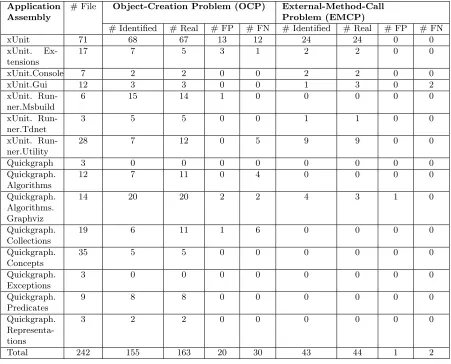
Table 4.2 Evaluation results showing the effectiveness of Covana in identifying EMCP and OCP . . . 49
Table 4.3 Evaluation results showing the effectiveness of Covana in reducing irrelevant problem candidates . . . 53
Table 5.1 Subjects and their characteristics . . . 66
Table 5.2 Results on the number of problems being (in)accurately estimated . . . 67
Table 5.3 Avg. precision and recall of our estimation . . . 68
Table 6.1 Capabilities provided by the TouchDevelop APIs . . . 78
Table 6.2 Information flow summary of 546 published scripts . . . 90
Table 6.3 Information flow vs. source-sink pairs . . . 91
Table 6.4 Safe/Unsafe flow summary of 78 flow scripts . . . 92
Table 6.5 Categorization of sources . . . 92
Table 7.1 Identified subject, action, and resource elements in sentences matched with semantic patterns for ACP sentences. . . 103
Table 7.2 Metrics for addressing research questions. . . 110
Table 7.3 Evaluation results of RQ7.1 . . . 111
Table 7.4 Evaluation results of RQ7.2 . . . 113
Table 7.5 Evaluation results of RQ7.3 . . . 114
Table 8.1 Scenarios for the evaluations . . . 133
Table 8.2 Results of model inference and refinement . . . 136
Table 8.3 Results of cost prediction . . . 137
LIST OF FIGURES
Figure 2.1 Overview of Developer Testing . . . 15
Figure 2.2 Example JUnit test case for theQueue . . . 16
Figure 4.1 Three simplified methods from xUnit [208]. . . 40
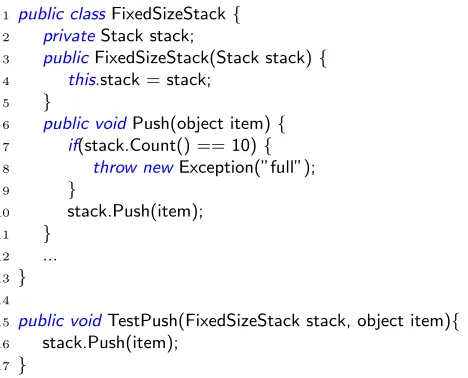
Figure 4.2 FixedSizeStack implemented using Stack . . . 41
Figure 4.3 Overview of Covana . . . 43
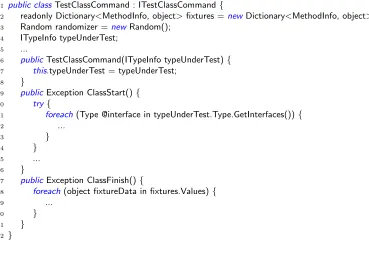
Figure 4.4 TestClassCommand class of xUnit . . . 51
Figure 4.5 Two methods that have EMCPs in xUnit . . . 52
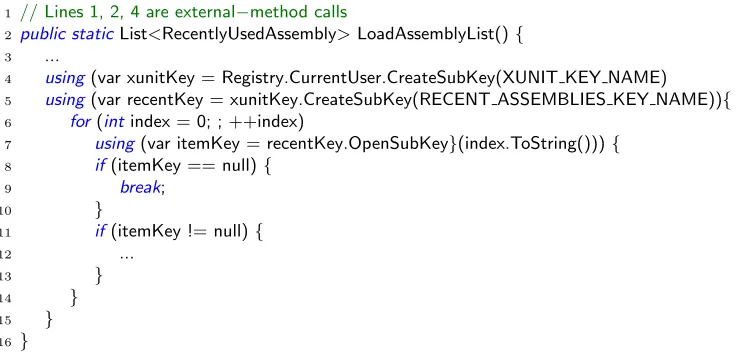
Figure 4.6 The method LoadAssemblyList in the classRecentlyUsedAssemblyList of xUnit . . . 54
Figure 5.1 An example program that contains both OCPs and EMCPs . . . 59
Figure 5.2 An angelic program transformed from the example in Figure 5.1 . . . 60
Figure 5.3 Overview of EcoCov . . . 62
Figure 5.4 Instrumentation templates used by EcoCov . . . 64
Figure 5.5 A simplified example of over-approximation . . . 69
Figure 6.1 Information flow view of a sample script . . . 73
Figure 6.2 Grant access to private information . . . 74
Figure 6.3 Example of classified information flow . . . 76
Figure 6.4 Implicit and reference-type information flow . . . 77
Figure 6.5 Sizes of 546 published scripts in TouchDevelop . . . 89
Figure 7.1 Example ACP sentences written in NL. . . 98
Figure 7.2 An example use case. . . 99
Figure 7.3 Generated XACML ACP for ACP-2 in Figure 7.2 . . . 101
Figure 7.4 An example action step . . . 102
Figure 7.5 Overview of our approach. . . 104
Figure 8.1 Two WDPBs found in the 7-Zip file manager [3] . . . 123
Figure 8.2 Overview of ∆Infer . . . 125
CHAPTER
1
Introduction
1.1
Motivation
Software is pervasive in all aspects of our life, and thus it is critical to ensure high quality of software. Software quality includes both functional quality and non-functional quality. Func-tional quality refers to funcFunc-tional correctness of software, and non-funcFunc-tional quality supports the delivery of functional requirements, such as security. Failing to ensure high quality of soft-ware would result in serious consequences. Softsoft-ware with poor functional quality has many functional faults, causing the software to behave incorrectly. Recently, a functional fault causes Knight Capital’s computers to execute a series of automatic orders that were supposed to be spread out over a period of days, costing Knight Capital about 440 million dollars [23]. A re-port by National Institute of Standards and Technology found that software faults cost the U.S. economy about$60 billion each year [151]. Software with poor non-functional quality may com-promise users’ security and privacy. For example, posting your kid’s photo using applications with geo-tagging may expose your kid’s exact location to strangers [19].
be still difficult for the tools to tackle in the foreseeable future. For example, my ICSE 2011 work shows that even a state-of-the-art test-generation tool may achieve not more than 65% code coverage due to problems in dealing with method calls to external libraries [205], and static-analysis tools cannot prove certain properties in complex software [66]. For some of these problems, tool users (e.g., developers and testers) may help the tools tackle these problems, such as providing mock objects to simulate the behaviors of the external libraries. With the provided mock objects, test-generation tools can be reapplied to generate more test inputs, achieving new coverage and carrying out software testing more effectively. In suchcooperation, the advances on test-generation tools free the users from labor-intensive and tedious tasks (e.g., manually producing test inputs for coverage) and the tools try their best in automating the tasks, while the users focus their efforts in addressing only the problems faced by the tools (e.g., providing mock objects). Note that the efforts in addressing the problems are typically less than the efforts in asking the users to finish all the remaining work for the tasks (e.g., generating test inputs for all the not-covered code). For example, with the provided mock objects, the tools can be reapplied to explore the not-covered code and generate more test inputs for covering the newly explored code. In this way, the users do not need to generate test inputs for all the newly explored code. If more problems are encountered in exploring the newly explored code, the users can provide their help again.
To support such new types of cooperation enabled by the advances on software testing/anal-ysis tools, there is a strong need to provide a user-tool interface that communicates sufficient and precise information to the users (e.g., reporting the problems faced by the tools), allowing the users to help the tools address the problems. These user-tool interfaces are the places where the users interact with the tools. Unlike user interfaces in Human-Computer Interface (HCI) research [109], we do not focus on the representation of information and the ways for the users to manipulate the information in these interfaces, but focus on the contents being displayed or manipulated.
However, many software testing/analysis tools still do not communicate sufficient or precise information to the users, and little research has been done on such interfaces for these new types of cooperation. For example, most test-generation tools often report only the achieved coverage, but not the problems faced by the tools; for a few tools that report the problems, many of the reported problems are false warnings. Such situations pose difficulties for the users to help the tools address the problems.
the users from tedious and mechanic subtasks, and the users’ subtasks have been shifted to the subtasks that are dependent on the users’ domain knowledge and expectations. To better support such new types of cooperation, there is a strong need to provide the interfaces for communicating sufficient and precise information to the users.
1.2
Tasks and Challenges
Under cooperative testing and analysis, we propose a number of approaches that provide inter-faces to support cooperation for three important SE tasks: automated test generation, security analysis, and performance analysis. These tasks are major SE tasks that improve both func-tional quality and non-funcfunc-tional quality of software, with the focus on assuring three major attributes in software quality: functional correctness, security, and performance. The tasks and challenges are described below.
• The increasing popularity of smartphones has made them a target for mobile threats of malware and potentially unwanted applications [76]. To address such security issues, the predominant smartphone platforms (Apple, Google, and Windows Phone) rely on either employees to manually validate applications, or end users to make decisions on grant-ing permissions to access privacy-sensitive information. The manual validation process is costly and delays publishing of applications. It is also incomplete, since it cannot ex-amine every execution path to detect violations of privacy policies [91]. Access-control granting by users provides information about what private information these applica-tions may access, rather thanhow these applications use private information, causing the users to make uninformed decisions on how to control their privacy. These privacy con-trol mechanisms lead to a situation where the users simply install applications without questioning the requested permissions, even if the applications may silently leak private information [80, 189, 72].
• Access control is one of the most fundamental and widely used privacy and security mech-anisms. Access control is often governed by an Access Control Policy (ACP) [165] that includes a set of rules specifying which principals (such as users or processes) have access to which resources. It is important to ensure correct specification of ACPs and correct enforcement of ACP specifications; otherwise, there could be serious consequences such as allowing an unauthorized user to access protected resources. In practice, ACPs are commonly written in Natural Language (NL) and are supposed to be written in security requirements, a type of non-functional requirements. However, often ACPs are buried in NL documents such as requirement documents, and these NL software documents could be large in size, often consisting of hundreds or even thousands of sentences (iTrust, an open source healthcare project consists of 37 use cases [113] with 448 use-case sentences), where a portion of the sentences describing ACPs (117 sentences in iTrust) are buried among other sentences [201]. Also, in software development, there exists an inherent gap between ACPs specified using domain concepts used in requirements and the actual sys-tem implementation developed using programming concepts. This gap poses problems for ensuring the consistency between requirements and manually-constructed policies based on system implementations. Manually inspecting large requirements documents to extract ACPs is labor-intensive and tedious. For example, a proprietary IBM enterprise applica-tion (that we used in our evaluaapplica-tions) includes 659 use cases with 8,817 sentences. Thus, it is very tedious and error-prone to manually inspect these NL documents for identifying and extracting ACPs for policy modeling and specification.
devel-opers identify performance faults that cause severe scalability reductions and even finan-cial losses [31, 96, 32]. As a type of widespread performance problems, workload-dependent performance bottlenecks (WDPBs) in responsive actions, which are expected to return instantly, cause software hangs (i.e., unresponsiveness of software applications) [172]. Tra-ditional performance testing that mainly relies on black-box random testing or manual input design often misses WDPBs since WDPBs may not surface on small or even rela-tively large workloads [143]. In addition, many existing performance analysis approaches reportwhat are the expensive methods for users to inspect without explaininghow these methods become expensive, posing challenges for the users to identify WDPBs.
1.3
Summary
To address these preceding problems and thereby maximize the value of software testing and analysis for improving software quality, in this dissertation, we propose a framework of coopera-tive testing and analysis, which provides interfaces that enable users to make informed decisions in cooperation with software testing/analysis tools. Our framework focuses on providing inter-faces to support two types of cooperation with software testing/analysis tools for various SE tasks:
• Problem-Diagnosis Interface: For certain SE tasks where automated tools drive the tasks towards a goal of testing and analysis, the users can help the tools address the en-countered problems since the complicated characteristics of the code under test are beyond the capability of the tools. For such SE tasks, our framework provides problem-diagnosis interfaces to support a type of cooperation, called problem-diagnosis cooperation, as fol-lows. Users first set up and apply a tool to conduct initial testing and analysis on a program. The provided interface then shows the feedback to the users, including the ef-fectiveness of the tool and the problems faced by the tool; these problems are precisely identified and the benefits of solving these programs are accurately estimated using anal-yses of the program and the tool. By looking at the problems, the users provide guidance to the tool based on the feedback, helping the tool address the problems. Such process forms a feedback loop and can be repeated until the effectiveness is satisfied or the users run out of patience.
interfaces to support a type of cooperation, called behavior-diagnosis cooperation, as fol-lows. Users first set up and apply a tool to conduct initial testing and analysis on a program. The provided interface then shows a list of behaviors related to the goal for the users to inspect, and the users make decisions on whether these behaviors are expected. Furthermore, the interface also provides explanations for the behaviors. Based on whether the behaviors are in the form of either concrete instances or abstract models, these expla-nations can be in the form of (1)extension: a larger scope of information to collect more concrete instances or extend the models of the behaviors, (2)instantiation: instantiations of the behaviors’ abstract models, or (3) abstraction: inferred models from the concrete instances of the behaviors. Such explanations help the users make informed decisions on the behaviors to be inspected.
The key difference between problem-diagnosis cooperation and behavior-diagnosis coop-eration is that problem-diagnosis coopcoop-eration typically engages the users to diagnose some intermediate results used for producing the final results, while behavior-diagnosis cooperation typically engages the users to diagnose the final results directly. For example, after a test-generation tool generates test inputs for a program, problem-diagnosis cooperation engages the users to diagnose the reported problems and address the problem for helping the tool in achieving higher coverage. If the tool generates an input that causes the program to throw uncaught exceptions, behavior-diagnosis cooperation engages the users to diagnose the excep-tions and confirm whether such excepexcep-tions indicate real faults. Also, the information of how the exception-throwing states are reached in the failing executions is shown to the users (i.e., a larger scope of information is used to explain the exceptions), helping the users make informed decisions in diagnosing exceptions.
We propose a number of approaches under cooperative testing and analysis, where each approach provides the interface to support cooperation between users and tools for a specific SE task, improving either functional or non-functional quality. In summary, this dissertation makes the following major contributions:
• Problem-Diagnosis Cooperation for Identifying Problems Faced by Structural Test Generation.To understand what types of problems prevent test-generation tools from achieving high structural coverage of complex object-oriented programs, we conduct empirical studies on open-source projects [204, 200]. Our studies on open-source projects leverage Pex [184], a state-of-the-art test-generation tool based on Dynamic Symbolic Execution (DSE) [167, 92, 125], to generate test inputs for the open-source projects, and we manually study the not-covered branches to identify the problems faced by Pex. We observe that most of the not-covered branches are due to two major types of problems: OCPs and EMCPs.
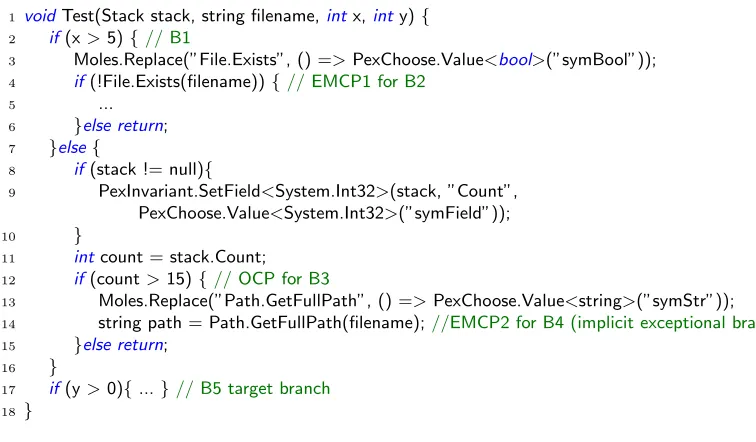
The goal of automated test generation is generating test inputs for achieving high code coverage. Based on the study results, test-generation tools have difficulties in achieving high code coverage due to two major types of problems: OCPs and EMCPs. To improve the effectiveness of the test-generation tools, we propose an approach, Covana [204, 198], that precisely identifies the causes of the observed symptoms primarily by determining whether not-covered branches have data dependencies on problem candidates. Based on Covana, we provide a problem-diagnosis interface that shows the problems faced by struc-tural test-generation tools, enabling the problem-diagnosis cooperation for test-generation tools. In this cooperation, tools automatically generate test inputs for achieving coverage of a program and report problems faced the tools for not-covered code. Based on the users’ domain knowledge of the program under test, the users provide factory methods for addressing OCPs, and provide mock objects for addressing EMCPs.
Our evaluations on two open-source projects (xUnit and QuickGraph) show that Covana effectively identifies 43 EMCPs out of 1610 EMCP candidates with only 1 false positive and 2 false negatives, and 155 OCPs out of 451 OCP candidates with 20 false positives and 30 false negatives.
structural coverage, the developers could first address problems that bring high coverage improvement.
To enable such economical cooperation of developers and tools, we propose an economic-analysis framework, called EcoCov, that accurately estimates the benefit of addressing a cause and the cost of eliminating a symptom. Based onEcoCov, our approach provides the problem-diagnosis interface to show the ordering of the causes based on their estimated benefits, extending the problem-diagnosis interface of precisely reporting problems faced by structural test-generation tools.
We name the main idea of ourEcoCov framework asangelic diagnosis1 because it uses an angelically nondeterministic operator to generate desired values to bypass the problems. In this framework, we concretize addressing a cause as solving a problem, either an OCP or an EMCP, and eliminating a symptom as covering a not-covered branch. We evaluate EcoCov on three open-source C# projects and the evaluation results show that EcoCov achieves averagely 91.1% precision and 96.6% recall in estimating the problem benefit.
• Behavior-Diagnosis Cooperation for Mobile Privacy Control. Existing privacy-control approaches employed by mobile platforms show limited success, partly because these approaches report only what permissions are used by mobile applications, rather than how these permissions are used by the applications, making the users make unin-formed decisions on controlling their privacy.
flows are expected for the mobile applications, and make decisions on granting accesses for the permissions.
We built our approach into TouchDevelop [186], and evaluated our approach by studying 546 applications published by 194 users. Since our approach requires the users to make decisions for each permission in a given mobile application, it is very important to reduce the decisions that the users have to make. The results show that among the 546 appli-cations, our approach reduces the need to make access granting decisions to only 10.1% (54) of all applications.
policy-violation scenarios (instantiations of the security policies) to determine whether these scenarios are expected for the software system, and make decisions to include or reject the security policies.
We conducted three evaluations on the collected ACP sentences from publicly available sources along with use cases from both open source and proprietary projects. Our results show thatText2Policyeffectively identifies ACP sentences with the precision of 88.7% and the recall of 89.4%, extracts ACP rules with the accuracy of 86.3%, and extracts action steps with the accuracy of 81.9%. These action steps can be used to validate against the ACP rules directly, identifying the inconsistencies as policy-violation scenarios.
• Behavior-Diagnosis Cooperation for Identifying Workload-Dependent Perfor-mance Bottlenecks. To identify WDPBs that cause software hangs, traditional per-formance testing that mainly relies on black-box random testing or manual input design often misses WDPBs since WDPBs may not surface on small or even relatively large workloads [118, 143, 89]. In addition, many performance analysis approaches reportwhat are the expensive methods for users to inspect without explaining how these methods become expensive.
The goal of performance analysis is detecting performance faults that unexpectedly com-promise the performance of a program, and our focus is to detect WDPBs. We propose an approach, ∆Infer [199], which infers complexity models of workload-dependent loops from executions on different workloads. For example, a complexity model of some loop can be linear, a·n+b, in terms of the input size n. Based on ∆Infer, our approach pro-vides a behavior-diagnosis interface that shows the complexity models of methods besides the costs of the executed methods. Our approach infers complexity models of workload-dependent loops from multiple executions of the software on multiple workloads. Such complexity models inferred from the concrete executions explain how the costs of cer-tain methods grow in larger workloads, enabling the behavior-diagnosis cooperation for performance analysis. In this cooperation, the tools compute the costs of the executed methods for the users to inspect and explain the cost growth of the methods by showing the inferred complexity models. Based on the users’ domain knowledge about the func-tionality and performance requirements of the program under analysis, the users inspect the complexity models of the methods to determine whether the cost growth represented by the models are expected for the methods, and make decisions on whether the methods are performance faults.
Our evaluations on two open-source projects (7Zip [3] and Notepad++ [6]) show that
10 performance faults (8 of them are new faults) without the need of executing the projects on large workloads.
1.4
Scope
The approaches presented in this dissertation focus on automated test generation, security anal-ysis, and performance analysis. Our approaches for improving automated test generation focus on structural test generation that generates test inputs for a program unit (such as a class) written in modern object-oriented languages (such as C# and Java). The goal of structural test generation focuses on achieving high structural coverage [30]. Our approaches for security analysis focus on computing information flows from mobile applications and extracting ACP policies from requirements documents [113] written in NL. Our analysis for mobile applications focuses on TouchDevelop [186] applications, but can be extended to other mobile applications in Android and iOS with additional techniques described in Chapter 9. Our approach of extracting ACP policies focuses on requirements documents, such as scenario-based requirements (e.g., use cases [113]) that specify sequences of action steps to describe user interactions with the soft-ware system under development. Our approach for performance analysis focuses on identifying WDPBs in GUI applications that employ a single UI thread to update GUI. UI updates are allowed in only the UI thread, and thus operations in the UI thread are expected to return instantly [15]. Such GUI applications are widely seen in daily applications, such as Windows Form applications [12] and Java AWT [2]/Swing [11].
The approaches presented in this dissertation focus on sequential programs but not concur-rent programs. Although a majority of our approaches focus on open-source projects available on the Internet, our approaches are general and can be applied on proprietary software artifacts as well, as shown in the evaluation results of our Text2Policy approach [201]. Our approaches focus on analyzing both structured software artifacts, such as source code and traces, and un-structured software artifacts, such as NL requirements documents. Finally, our approaches focus on both testing functional correctness or program robustness and analyzing other quality at-tributes such as performance and security. However, there exist various other quality atat-tributes such as energy efficiency and maintainability. Chapter 9 discusses our new approaches that target at quality attributes beyond functional correctness, performance, and security.
1.5
Outline
CHAPTER
2
Background and Related Work
This chapter presents background information and discusses how our research relates to other research in cooperative testing and analysis, automated test generation, security analysis, and performance analysis. Section 2.1 describes existing research on cooperative testing and analysis and how our research is different from the existing research. Section 2.2 presents the background of structural test generation and discusses other research that relates to our research on improv-ing structural test generation. Section 2.3 presents the background of mobile privacy control and access control policies, and discusses their related work. Section 2.4 describes existing research on performance analysis and how our research is different from the existing research.
2.1
Cooperative Testing and Analysis
focuses on cooperation for SE tasks, our research focuses on the cooperation between users and tools for SE tasks, rather than the cooperation between users.
Our framework focuses on providing interfaces to support two types of cooperation: problem-diagnosis cooperationandbehavior-diagnosis cooperation. We next present related work on these two types of cooperation.
2.1.1 Problem-Diagnosis Cooperation
Our framework of cooperative testing and analysis supports problem-diagnosis cooperation that users cooperate with software testing/analysis tools by addressing the problems faced by the tools. There exists some related work on leveraging user help to improve testing and analysis goals.
St-Amour et al. [177] propose an approach to report optimizations that the compiler could perform if the compiler has additional information, enabling users to provide further help for the compiler optimization in the source program. Dillig et al. [67] propose an approach to compute small and relevant queries that capture the facts that an analysis is missing when automated static analysis fails to verify a program. These queries are presented to users who decide whether the answers to queries are yes or no, and the answers are then used to either verify the program or prove the existence of a real faults. These approaches report additional information that causes the tools to perform poorly, similar to our problem-diagnosis cooperation. However, our problem-diagnosis cooperation further emphasizes the feedback loop between users and tools, where the process of problem fixing and problem identification is repeated until the effectiveness of the tools is satisfied or the users lose patience. Moreover, our EcoCov estimates the benefits and costs of addressing problems faced by test-generation tools, allowing users to focus on more important problems.
In this dissertation, we propose approaches that provide problem-diagnosis interfaces to support the problem-diagnosis cooperation for test-generation tools. We present the background information of automated test generation and related work in Section 2.2.
2.1.2 Behavior-Diagnosis Cooperation
Our framework of cooperative testing and analysis supports behavior-diagnosis cooperation that software testing/analysis tools cooperate with users by revealing and explaining software behaviors for the users to inspect.
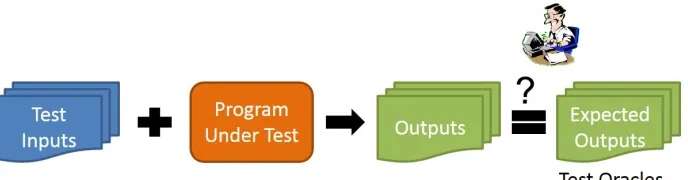
Figure 2.1: Overview of Developer Testing
software faults using visualization and record/replay techniques [128, 126, 127]. Unlike their explanations based on visualization and record/replay techniques, our research focuses on ex-plaining software behaviors using extensions, instantiations, and abstractions based on whether the behaviors are represented as instances or models. There exists research that provides exten-sions for the models of software behaviors (such as using data flows to extend the permisexten-sions in iOS [71]), infers abstractions from the instances of software behaviors (such as inferring com-plexity models from executions [95, 213, 56]), and provides instances of the models of software behaviors (such as testing security policies [138, 111]). Such research typically asks the users to inspect the analysis results, while our behavior-diagnosis cooperation uses such analysis to explain the behaviors that the users are inspecting.
In this dissertation, we propose approaches that provide behavior-diagnosis interfaces to support the behavior-diagnosis cooperation for security analysis and performance analysis. We present the background information of security analysis and performance analysis and related work in Sections 2.3 and 2.4.
2.2
Automated Test Generation
In this section, we first introduce the background of software testing, and then describe the background of automated test generation.
2.2.1 Developer Testing
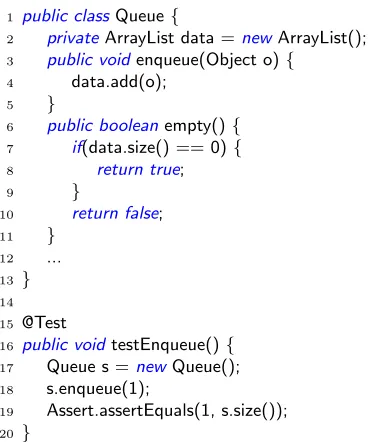
1 public classQueue{
2 privateArrayList data =newArrayList(); 3 public voidenqueue(Object o){
4 data.add(o);
5 }
6 public booleanempty(){ 7 if(data.size() == 0){ 8 return true;
9 }
10 return false; 11 }
12 ... 13 } 14 15 @Test
16 public voidtestEnqueue(){ 17 Queue s =newQueue(); 18 s.enqueue(1);
19 Assert.assertEquals(1, s.size()); 20 }
Figure 2.2: Example JUnit test case for the Queue
write and run unit tests for individual units of code (e.g., a class or a method) to ensure that the code behaves as expected. These unit tests are typically independent to each other, although recent work shows that some tests may have dependencies to global variables [216]. These unit tests help the developers to gain high confidence of the program unit under test and reduce the cost of fixing faults by detecting the faults early in the software development life cycle. Recent focus on test-driven development (TDD) [41], where tests are written before the program unit, further signifies the importance of developer testing. The popularity and benefits of developer testing have been well witnessed in industry.
testing framework helps automatically execute testEnqueue and verify that the return value of s.size()is the same as the expected value1(shown in Line 19).
Although these frameworks assist in reducing effort for the third and fourth tasks, devel-opers still need to perform the first two tasks manually. Manual developer testing is known to be tedious and labor intensive. In addition, it is difficult for manual testing to exercise com-prehensive behaviors of the program unit under test, and thus may not expose hidden faults of the program unit. For example, developers may miss certain test inputs (such as corner or special test inputs) that can expose faults in the program unit because of program complexity and limited resources allocated for the task.
In this dissertation, we focus on the problem of generating test inputs for achieving high structural coverage [30], i.e., structural test generation. Although achieving full code coverage does not guarantee that the code is fault-free, covering a part of code is necessary for exposing the faults in this part of the code. Without expected outputs, the generated test inputs can help detect robustness-related faults such asnull dereference and division by zero. Although it is infeasible for developers to create expected outputs for the large number of generated test inputs, the developers can use specifications [140] to improve the effectiveness of generating test inputs and checking program behaviors. If specifications are not available (which may be difficult for the developers to write), code coverage criteria [224] such as statement coverage and block coverage can also be used to select a subset of generated test inputs for the developers to manually create the expected outputs. Next we present the background of structural test generation.
2.2.2 Structural Test Generation
Structural test-generation approaches aim to produce test inputs to achieve high structural coverage of the program under test, such as statement or branch coverage [30]. A major reason for achieving high structural coverage is that generating test inputs for covering a line of code is necessary for exposing the faults in this line of code. Next we describe two state-of-the-art structural test-generation approaches.
object-oriented programs. Since random test-generation techniques do not analyze the program, random techniques have relatively low costs and generate test inputs efficiently. However, a com-mon limitation of random techniques is that they often fail to generate inputs for some corner cases.
DSE-based Test Generation. Symbolic execution [125], a case of abstract interpreta-tion [58], analyzes programs by tracking symbolic values instead of actual values. Symbolic execution associates symbolic values with program variables (such as program inputs and local variables), and statically simulates program execution to track these symbolic values. Along the simulated execution, symbolic execution collects constraints on symbolic values obtained from predicates in branch statements to form a Path Condition, which is a symbolic expression that can be used to reason about all program inputs that take the same path through the program. Dynamic Symbolic Execution (DSE) [167, 92, 184] explores the feasible paths of the program under test and generates test inputs to exercise the paths. DSE initially executes the program under test symbolically with arbitrary or default inputs and collects path conditions as the constraints on inputs from the executed branch statements. DSE then systematically negates part of these constraints to form new path conditions, and leverages a constraint solver to solve these path conditions for obtaining new test inputs. These new test inputs steer the future explorations towards different paths of the program, iteratively collecting new constraints and achieving new structural coverage, such as statement and branch coverage [30]. With the advances of research on constraint solvers, e.g., Z3 [61] and CVC3 [40], DSE-based tools, such as Pex [184] and SAGE [93], show promising results in producing high-covering test inputs during unit or security/system testing [47, 48, 167, 184]. Pex has found serious faults in an already-well tested component of the .NET runtime, and SAGE has been continually running on more than 100 machines to detect security vulnerabilities since 2008.
2.2.3 Empirical Studies of Problems Faced by Structural Test Generation This section presents the related work on empirical studies of structural test generation.
of problems faced by test-generation tools and presents an approach to precisely identify the problems.
2.2.4 Problem Identification for Structural Test Generation
This section presents related work (to our approach Covana) on identifying problems faced by software testing and analysis tools.
Explaining Failures of Program Analysis. Dincklage and Diwan [190] propose an anal-ysis language and build a system to produce reasons when program analyses fail to produce desirable results. The objective of their approach is to express arbitrary data flow analyses using their analysis language and compute reasons for the failures. Zhang et al [219] propose an approach to infer documentation for explaining why tests fail and indicating the changes that can cause the tests to pass. Although Covana is remotely related to these approaches in terms of helping explain causes of residual structural coverage in the form of problems,Covana focuses on a quite different problem and includes significantly different techniques needed for addressing unique challenges in identifying problems that prevent test-generation tools from achieving high structural coverage.
Coverage Analysis. Pavlopoulou and Young [156] developed a residual coverage monitor-ing tool (for Java), which provides rich feedback from actual use of deployed software. Since their approach aims to reduce the performance overhead for gathering structural coverage from deployed software, their approach does not provide a way to analyze the coverage, while our approach analyzes the residual structural coverage gathered from DSE to filter out irrelevant problem candidates.
Problem Identification for Symbolic Execution. Anand et al. [33] propose type-dependence analysis, which performs a context- and field-sensitive interprocedural static anal-ysis to identify the parts of the program under test that may be unsuitable for symbolic ex-ecution, such as third-party libraries. Their approach identifies external-method calls that are problematic in symbolic execution by carrying out static analysis to determine whether an external-method call receives symbolic values as arguments. To identify EMCPs, Covana con-siders not only data dependencies of arguments of external-method calls on program inputs, but also data dependencies of partially-covered branch statements on external-method calls for their return values.
2.2.5 Economical Analysis
Angelic Analysis. Angelic nondeterminism was first proposed by Floyd [84] to concisely express backtracking algorithms back in 1967. Recently, angelic nondeterminism has been suc-cessfully used in programming and debugging. Barman et al. [39] propose a programming methodology based on the refinement of angelic programs. They use the choose operator to represent the code that has not been implemented yet, and thus allow the execution of incom-plete programs. Since the incomincom-plete program is executable, programmers can run the program to better figure out how to make the program behave as expected. Chandra et al. [49] propose angelic debugging where they replace the value of a suspicious faulty expression with an angelic value that rescues the failing tests. If such angelic value exists and changing the expression may not break passing tests, then the expression is presented to developers as a repair candidate.
EcoCovis related to angelic programming and debugging in that we all replace the value of a code element with an angelic value. To compute angelic values, we all use constraint solvers to solve the collected constraints. However, the main difference is that the angelic values in angelic programming and debugging are values that correct the program executions (e.g., rescue the failing tests), while the angelic values in our diagnosis are values that make the problems encountered by the test-generation tools disappear. Hence, the constraints that we collect are different.
Economical Analysis.Horwitz [107] proposes an approach that aims to provide developers with the cost-benefit analysis of executing a not-covered component. Her approach computes the value for the must-execute-set metric by employing a control-dependence graph to compute the number of the not-covered parts (of the program under test) that will be executed if a predicate takes a value v. Unfortunately, such static-analysis approach ignores the capabilities of test-generation tools in generating various values for the not-covered code part that is dependent on
B, producing imprecise estimation of the benefits. Moreover, such approach does not consider implicit branches introduced in object-oriented programs. For example, a member function call may throw an exception if the receiver object is a null object. Such extra control flows introduced by exceptions change the computation of the must-execute-set significantly.
2.3
Security Analysis
Security is one of the most important quality attributes of software. In this dissertation, our research focuses on mobile privacy control and extracting access control policies.
In recent years, the rapid growth of smartphones and mobile applications spur the occur-rences of mobile threats of malware and potentially unwanted application (PUA) on the Android platform. Over the year of 2012, Android’s mobile threat share has risen from 66.7% in 2011 to 79.0% in 2012 [76]. Thus, addressing the issues of mobile threats is very critical. Access con-trol is one of the most fundamental and widely used privacy and security mechanisms. Access control is often governed by an Access Control Policy (ACP) [165] that includes a set of rules specifying which principals (such as users or processes) have access to which resources. Failing to correctly specify ACPs can result in serious consequences such as allowing an unauthorized user to access protected resources, and thus it is critical to ensure the correct specification of ACPs. Next we describe related work on both mobile privacy control and access control policies.
2.3.1 Mobile Privacy Control
This section presents the related work on mobile privacy control and information flow analysis. User-Aware Application Capabilities. Mobile-device platforms such as Android and social-network platforms such as Facebook use manifests to show application capabilities and request permissions at install time. Other mobile-device platforms such as iOS and research ap-proaches such as TaintDroid [72] report application capabilities the first time the applications try to access a resource. The capabilities shown in the manifests are either claimed by develop-ers [164] or present only part of the requested application capabilities. Felt et al. [79] propose an approach that uses static analysis to map API calls used by applications to permissions. However, they adapt automated testing methodology to test the applications and identify APIs that require permissions, while our approach annotates the APIs with permissions and uses static checking.
Information Flow Analysis. Xie and Aiken [206] present an approach that statically computes summaries of blocks and procedures of PHP and detects security vulnerabilities at the block level, intraprocedural level, and interprocedural level. Their approach does not handle reference-type flows caused by references of containers and objects, and would lose track of flows after built-in procedure calls (e.g., senses->take camera picture) that cannot be analyzed by their approach. To address these problems, our approach uses mutable locations to simplify analysis of reference-type flows and tracks untampered- and tampered-classified information for classifying safe and unsafe flows.
flow paths from sources to sinks to determine whether there exists a user prompt along that path. PiOS emits warnings if such a flow is found without a user prompt. For the purposes of safe-guarding TouchDevelop users, the PiOS approach is insufficient because: (1) the PiOS analysis is not conservative; it misses flows that are too long or use indirect flow, (2) the prompts the PiOS identifies may be unrelated, show nothing of the leaked information, or show tampered information. PiOS also does not use the static information to control user prompting and privacy settings as our approach does.
Language-based information flow [163] allows developers to annotate variables with security attributes. These attributes can be used by compilers to enforce information flow controls. For example, Slam [37] shows that information flow labels can be applied to a simple language with reference types and Jif [145, 144] extends the Java language with statically-checked information flow annotation. Laminar [162] allows developers to specify security regions and provide infor-mation flow controls on both language and JVM/OS levels. Although these language-extending approaches are effective in guaranteeing information flow controls, they impose additional bur-dens on developers when writing applications; such burbur-dens are undesirable for writing scripts on mobile devices in the context of TouchDevelop, especially for beginners.
Dynamic taint analysis [72, 223] has been applied to track information flows on both mobile platforms such as Android and desktop platform such as Windows. These approaches track tainted data during runtime, providing accurate runtime information about leaks. However, to reduce runtime overhead, these approaches usually ignore implicit flows raised by control struc-tures. Moreover, it is impractical to dynamically execute all execution paths of these applications to detect potential information leaks. Such limitations make these approaches inappropriate for computing information flows for all submitted applications.
Access Granting. Mobile-device platforms such as Android and social-network platforms such as Facebook use manifests to request permissions at install time. Once permissions are given by users, the permissions cannot be changed. iOS and Windows User Account Con-trol [142] prompt a dialog to request permissions from users when the applications try to access a resource or make security or privacy-related system-level changes. Instead of presenting only information about the access to resources, our approach presents information flows to describe what applications may do with private user information. Our access granting also provides a way for users to try out applications before using private information, and these settings can be changed at will.
on-device use. Our anonymized/real/abort setting is inspired by their approach, but we use static information flow analysis extended with tampered information to classify flows as safe/unsafe flows and provide default access settings, rather than runtime information.
Automated Security Validation of Mobile Applications. Gilbert et al. present a vi-sion of making mobile applications more secure via automated validation [91]. They propose using commodity cloud infrastructure to emulate smartphones and run the submitted applica-tions to dynamically track information flows and acapplica-tions. Based on the information flow and action tracking, they propose to automatically detect malicious behavior and misuse of sensitive data via further analysis of dependency graphs [82] or natural language processing. Such an approach is akin to automated testing and suffers from the same problems, namely coverage. It is difficult to drive applications automatically into exercising all data and control paths. Thus, in the end, such an approach gives only a partial view of the behavior and does not safe-guard users.
2.3.2 Extraction of Access Control Policies This section presents related work on extraction of ACPs.
Manual Extraction of ACPs from NL Documents. He and Anton [105] propose a manual approach, called Requirements-based Access Control Analysis and Policy Specification (ReCAPS), to extract ACPs from various NL documents, including requirements documents, design documents and database design, and security and privacy requirements. During the extraction, their approach also clarifies ambiguities in requirements documents and identifies inconsistencies among requirements documents and database design. Their objective is to derive a comprehensive set of ACP rules, similar to our approach. However, Text2Policy adapts NLP techniques and provides new analysis techniques to automate the process of ACP extraction, while their approach is manual.
Template Matching. Etzioni et al. [75] propose an approach to extract lists of named entities found on the web using a set of patterns. Their approach is related to the ACP extraction of our approach, since both use patterns to extract information. However, their patterns are based on the low-level POS tags (such as NP and NPList), while our semantic patterns are based on grammatical functions of phases (such as subject, main verb group, and object).Text2Policy employs semantic patterns that are more general and provide high precision in identifying ACP sentences as shown in our evaluations.
ma-chine learning, and infers automata for resources from action-resource pairs and class/interface hierarchies. Both of these approaches focus on parsing API documents, and use the specific char-acteristics of API documents to improve the NLP analysis. For example, different parts of API documents can be mapped to different parts of code structures, such as class/method names, return values, and parameter names. However, the contents of requirements documents usually cannot be mapped directly to code structures, thus making their approaches inappropriate on analyzing requirements documents.
NLP to Assist Privacy-Policy Authoring.The SPARCLE Policy Workbench [120, 121, 45, 46] employs the shallow-parsing technique [147] to parse privacy rules and extract the el-ements of privacy rules based on a pre-defined syntax. These elel-ements are then used to form policies in a structured form, so that policy authors can review it and then produce policies in a machine-readable form, such as EPAL [34] and XACML [9, 150] with a privacy-policy profile. Michael et al. [141] propose an approach to map NL policy statements to an equivalent compu-tational format suitable for further processing by a policy workbench. However, neither of these approaches can identify sentences describing a policy rule. These approaches parse all the input statements for policy extraction by assuming that the input statements are policy statements, while our approach identifies ACP sentences from requirements documents using semantic pat-terns. Both of these approaches provide simple templates to extract elements for constructing policy rules, while our approach provides more general semantic patterns. Additionally, their approaches cannot infer negative meaning of sentences.
Use-Case Analysis. Sinha et al. [170, 169] adapt NLP techniques to parse and represent use-case contents in use-case models. The extraction of use-case contents to formal models is similar to the action-step extraction in our approach. However, our approach focuses on extracting access requests for validation against the specified and extracted ACPs. Moreover, we provide corresponding analysis techniques to infer human actors from previous sentences.
2.4
Performance Analysis
Performance problems exist widely in released software [118, 89]. As a type of widespread performance problems, software hangs cause unresponsiveness of software applications [194, 172]. A recent study of hang problems [172] shows that 27.04% of the 233 studied hang faults are caused by time-consuming operations in responsive actions1, such as expensive computations in
the UI thread for GUI applications. Among the expensive operations that cause hang problems, some of these operations are constantly expensive (such as server initializations), whereas some of them depend on the input workloads. These problems are referred to as workload-dependent performance bottlenecks (WDPBs). WDPBs are usually caused by workload-dependent loops
1

![Figure 4.1:Three simplified methods from xUnit [208].](https://thumb-us.123doks.com/thumbv2/123dok_us/1308520.1163471/57.612.127.440.73.294/figure-three-simplied-methods-from-xunit.webp)