HYSTERESIS BEHAVIOUR OF SENSITIVITY IN CH4 DETECTION IN AIR 55 Jurnal Teknologi, 36(C) Jun. 2002: 55–60
© Universiti Teknologi Malaysia
HYSTERESIS BEHAVIOUR OF SENSITIVITY IN CH4
DETECTION IN AIR USING Sno2 WITH Pd AS SENSITIZING
ADDITIVE
JOHN OJUR DENNIS1, MOHD MUSTAMAM. ABD. KARIM2, ZUHAIRI
IBRAHIM3 & MOHD KHAIRI SAIDIN4
Abstract. The sensitivity of SnO2 with Pd as an additive showed a hysteresis behaviour when measurement was carried out as the operating temperature is increasing compared to measurement with decreasing temperature. The sensitivities of the samples that were calculated at the various operating temperatures from 200°C to 430°C were found to be higher when measuring with decrea-sing temperature. This observed hysteresis in sensitivity is discussed in terms of the type of oxygen species adsorbed on the SnO2 surface.
Keywords: hysteresis, sensitivity, sensitizing additive, conductance, methane
Abstrak. Kepekaan SnO2 dengan Pd sebagai bahan tambah menunjukkan sifat histerisis apabila
pengukuran dilakukan pada suhu operasi menaik berbanding dengan pengukuran yang dilakukan pada suhu menyusut. Kepekaan sampel-sampel dikira bagi beberapa suhu operasi dari 200°C sehingga 430°C dan didapati kepekaan meningkat apabila pengukuran yang dilakukan pada suhu menurun. Histerisis yang diamati dalam kepekaan ini dibincangkan dalam konteks jenis spesies oksigen yang terjerap di atas permukaan SnO2.
Kata Kunci: histerisis, kepekaan, bahan tambah pemekaan, konduktans, metana
1.0 INTRODUCTION
Tin (IV) oxide (SnO2) is non-stoichiometric in that it is deficient in oxygen atoms. Charge neutrality is maintained by the presence of some tin (II) ions (Sn2+) in place of some tin (IV) ions (Sn4+) and these act as electron donors so that the material is predominantly an n-type semiconductor [1]. Due to this sudden interruption in the periodicity of the crystalline lattice, the atoms or ions on the semiconductor surface have incomplete coordination (incomplete number of nearest neighbours) which give them quite different properties from atoms or ions in the bulk. The disturbance of lattice periodicity at the surface creates “intrinsic” localized electronic states. The at-oms on the surface, therefore, show increased reactivity towards the components of their fluid surroundings [2]. Pd is an effective oxidation catalyst for CH4. The addition
1,3&4
Materials Science Unit, Department of Physics, Faculty of Science, Universiti Teknologi Malaysia, 81310, Skudai, Johor, Malaysia
2
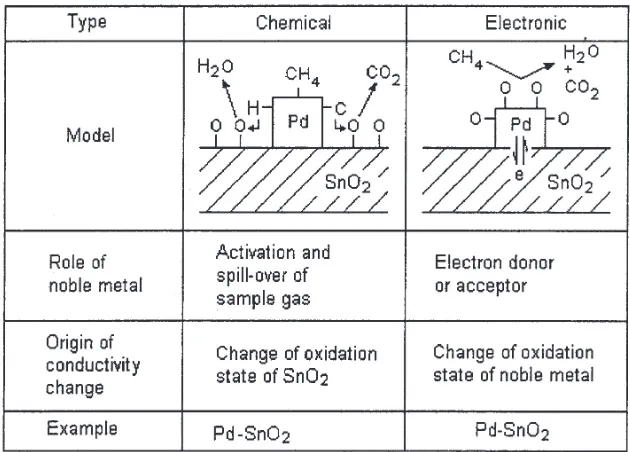
of Pd to SnO2, therefore, significantly enhances its sensitivity in CH4 detection [3]. If Pd particles are present on surface of SnO2 crystallites, there are several ways in which the catalyst can affect the intergranular contact region of the crystallites and thus the sensor conductance as shown in Figure 1. One of them is Fermi energy pinning by the metal, while another is spillover of species from the metal to the semiconductor [4].
If a pressed pellet of SnO2 is exposed to air, a higher Shottky energy barrier would develop between adjacent SnO2 crystallites. This increase in the barrier energy is due to adsorption of oxygen on the surface of SnO2 [4]. The surface of SnO2 becomes negatively charged by the adsorption of oxygen molecules or atoms that are ionized at the expense of electrons removed from the bulk of the crystallites. According to Vancu et. al [2] there are three species of oxygen (O–2 , O2–, and O–) that can be adsorbed on the surface of SnO2 when it is heated to operating temperatures in the range of 200°C to 600°C [2]. The former two are adsorbed at lower temperatures and are less reactive than O–, which is adsorbed at higher temperatures. When such a charged SnO2 sur-face is exposed to CH4, a chemical reaction occurs between the CH4 molecules and the adsorbed oxygen ions ultimately forming H2O and CO2 that are then desorbed. The reaction to form H2O and CO2 results in the release of electrons to the solid, thus lowering the potential barrier and increasing the conductance of the sample [5].
HYSTERESIS BEHAVIOUR OF SENSITIVITY IN CH4 DETECTION IN AIR 57 2.0 EXPERIMENTAL PROCEDURE
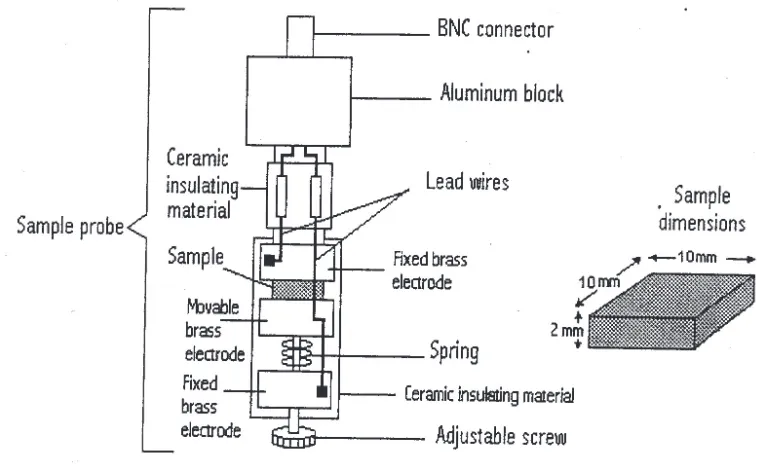
SnO2 powder (Fluka) and Pd powder (ESPI) were mechanically mixed in the re-quired proportions of (100-x)SnO2 × Pd (x = 10 and 15 wt%). The mixed powders were then compressed in a 40 mm die at a pressure of 40 MPa for five minutes. The disc-shaped samples were then sintered in an electric furnace at 900°C for one hour with heating and cooling rates of 20°C per minute. Ten grams batch mixture of SnO2 and noble metal (Pd) produced a pellet of 40 mm diameter and 2 mm thickness. The pellets were then mechanically cut into 10 × 10 × 2 mm3 of dimension regular shapes. The sample was next inserted into a sample holder with electrodes that were pressed against the samples by tightening a screw as shown in Figure 2. The sample holder was attached to a probe and then was inserted into the reaction unit of a gas sensor test chamber which was described elsewhere [6].
The electrical circuit used to measure the output signal is a simple sensor circuit consisting of a sensing element of resistance Rs, in series with a load resistor RL as shown in Figure 3 [3]. A dc voltage is applied to the combination to provide the current Is, which drops voltages, Vs and VL across the sensor and the load , respec-tively. The output signal was taken as the load voltage, VL, across the load resistor,
RL. The sensitivity, S, is then calculated from the relation
S = [(G−G0)/G0] × 100% (1) where G is the conductance in test gas and G0 is the conductance in synthetic air (<10 ppm moisture).
Commercial gas mixtures of 5000 ppm CH4 in air and synthetic air were used in the experiments. In addition, other concentrations of CH4 in synthetic air were achieved by using a flow controller and a gas injection port in a simple gas mixing system.
3.0 RESULTS AND DISCUSSION
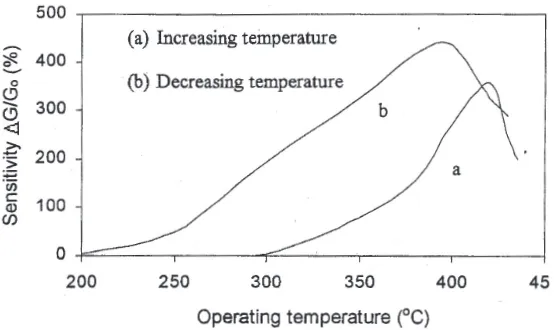
Figure 4 and 5 show the sensitivity of SnO2 samples with 10 and 15 wt% Pd, respec-tively, sintered at 900°C for 1 hour as a function of operating temperature from 200°C
Figure 3 Sensor circuit used for measuring the output signal
Figure 4 Sensitivity to CH4 in air vs. operating temperature for SnO2 with 10 wt% Pd sintered at
HYSTERESIS BEHAVIOUR OF SENSITIVITY IN CH4 DETECTION IN AIR 59
to 430°C for measurements taken with increasing and decreasing temperature. As can be observed in all instances, the sensitivities calculated at the various operating tem-peratures are higher for measurement with temperature decreasing as compared to measurement with temperature increasing. This hysteresis is explained in terms of the type of oxygen ion adsorbed on SnO2 surface when it is heated to operating tempera-tures in the range of 200°C to 600°C. These adsorbed oxygen ions are either molecu-lar (O–2 ) or atomic (O2– and O–) [2]. The former two (O–2 and O2–) are adsorbed at lower temperatures and are less reactive than the later (O–), which is adsorbed at higher temperatures. Consequently, when measurement is done while temperature is being increased in steps, the less reactive oxygen ions are encountered at each step and gradually the more reactive oxygen ions appear at higher temperatures. Con-versely, when the measurement process is reversed to measurement at decreasing temperatures in steps the more reactive oxygen ions (O–) remain adsorbed as the temperature is lowered from a higher to a lower level thus resulting in the higher sensitivities observed when measurement is done with decreasing temperature.
4.0 CONCLUSION
The mechanism underlying the hysteresis in the detection of CH4 in air using SnO2 with Pd as sensitizing additive was discussed in the light of the experimental results observed in this study. The higher sensitivities observed when measurement was carried out with decreasing temperature as compared to measurement with
increas-Figure 5 Sensitivity to CH4 in air vs. operating temperature for SnO2 with 15 wt% Pd sintered at
ing temperature is attributed to the reaction of CH4 with the more reactive O– ions that remain adsorbed on the metal oxide surface as the operating temperature is decreased.
5.0 ACKNOWLEDGEMENT
The authors would like to express their thanks and gratitude to Universiti Teknologi Malaysia for providing the research funds and facilities, Mr. John Ojur Dennis will also like to extend his thanks and appreciation to the University of Juba, Sudan, for offering him scholarship to study in UTM.
REFERENCES
[1] Watson, J. 1984. The Tin Oxide Gas Sensor and its Applications. Sensors and Actuators, 5 29-42.
[2] Vancu, A., R. Ionescu, and N. Barsan. 1992. Chemoresistive Gas Sensors. In Ciureanu, P. and Middelhoek, S. (eds.). Thin Film Resistive Sensors. Bristo: Hilger. 437-491.
[3]. Ihokura, K., and J. Watson. 1994. The Stannic Oxide Gas Sensor: Princi ples and Applications. Florida:CRC Press Inc.
[4] Morrison, S. R. 1987. Selectivity in Semiconductor Gas Sensors. Sensors and Actuators. 12. 425-440. [5] Ionescu, R., and A. Vancu. 1996. Factors Influencing the Electrical Conductance of SnO2 Gas Sensors.
International Semiconductor Conference. Rumania: IEEE. 489-495.
[6] Dennis, J. O. 2001. The effect of Pd on Electrical Properties of SnO2 in CH4 detection. PhD. Thesis: Universiti