APPROPRIATE URBAN PUBLIC OPEN SPACE
WAN MOHD ZAKRI WAN ABDULLAH
A thesis submitted in fulfilment of the requirements for the award of the degree of
Doctor of Philosophy (Architecture)
Faculty of Built Environment Universiti Teknologi Malaysia
iii
ACKNOW LEDGEMENTS
This endeavor would not have succeeded without the contributions of various individuals and institutions. First of all I would like to thank my supervisor Associate Professor Dr. Shuhana Shamsuddin who has given me guidance and encouragement throughout the completion of the thesis. I also wish to thank Professor Dr. Georgia Butina-Watson and (Emeritus) Professor Dr. Brian Goodey for guiding me in the early stage of this research. My appreciation is also due to Professor Dr. Mike Jenks for his willingness to read the thesis, give advices and supports although most of the time via e-mail. I would like to express my gratitude to the Dean of Faculty of Built Environment, Professor Dr. Supian Ahmad, Head of Department of Architecture, FAB, UTM, Associate Professor Dr. Syed Ahmad Iskandar Syed Ariffin, and all staff of the faculty for their assistance and encouragement. My appreciation is also extended to all my friends and whose names are not possible here for me to mention. To Associate Professor Dr. Ahmad Bashri Sulaiman, thank you so much.
iv
ABSTRACT
v
vi
ABSTRAK
vii
viii
TABLE OF CONTENTS
CHAPTER TITLE PAGE
THESIS TITLE i
DECLARATION ii
ACKNOW LEDGEMENTS iii
ABSTRACT iv
ABSTRAK v
TABLE OF CONTENTS viii
LIST OF TABLES xiii
LIST OF FIGURES xvii
LIST OF APPENDICES xxiii
LIST OF TERM INOLOGIES AND ABBREVIATIONS xxiv
1 INTRODUCTION TO TH E RESEARCH
1.0 Introduction 1
1. 1 Background to the Problem 2
1.1.1 Global Concerns 2
1. 1. 1. 1 Place-ness in Urban Environment 2 1. 1. 1.2 Public Open Space and Town Users 6
1.1.2 Local Issues 8
1.1.2.1 Place-ness in Urban Environment 8 1.1.2.2 Public Open Space and Town Users 11
1.1.3 Summary 16
1.2 Research Agenda 17
xiii
1.2.2 Assumption 18
1.2.3 Research Aim 18
1.2.4 Research Questions 18
1.2.5 Research Objectives 19
1.3 Definition of Key Terms 19
1.4 Research Methodology 20
1.5 The Case Study 23
1.6 Limitation of the Research 24
1.7 Structure of the Thesis 25
2 DEFINITION OF TH E CONCEPT OF 'APPROPRIATE
URBAN PUBLIC OPEN SPACE'
2.0 Introduction 28
2.1 Review of Relevant Concepts to this Study 29
2.1.1 The Concept of Place 29
2.1.1.1 Town Center as a Place 32
2.1.1.2 Urban Public Open Spaces 36
2.1.2 The Concepts of Urban Development 40
2.1.2.1 Public Participation 43
2.1.2.2 Town Users 50
2.1.2.3 Urban Vitality and Viability 52
2.1.2.4 User Satisfaction 57
2.1.3 The Concept of Appropriateness 58
2.1.3.1 Appropriate Technology 59
2.1.3.2 Appropriate Design 62
2.2 The Concept of Appropriate Urban Public Open Space 63
2.3 Conclusion 67
3 COMPONENTS OF URBAN PUBLIC OPEN SPACE
3.0 Introduction 69
3.1 Square Typologies 70
xiv
Square
3.1.2 Summary 75
3.2 Components of Square 76
3.2.1 Physical Elements 79
3.2.1.1 Sense of Enclosure 80
3.2.1.2 Dimensional Properties of Square 81 3.2.1.3 Landscaping and Public Amenity 84
3.2.1.4 Physical Viability 87
3.2.1.5 Summary 88
3.2.2 Functional Elements 89
3.2.2.1 Activities 91
3.2.2.2 Accessibility 92
3.2.2.3 Functional Vitality 93
3.2.2.4 Summary 94
3.2.3 The Psychological Properties of Square 95
3.3 Conclusion 97
4 RESEARCH DESIGN AND M ETHODOLOGY
4.0 Introduction 99
4.1 Scope of the Research 99
4.2 Choice of Methodology 101
4.2.1 Review of Previous Methodology 101
4.2.2 Main Focus of the Problem 103
4.3 Methodology Adopted for this Research 105
4.3.1 The Needed Data 108
4.3.1.1 To Determine the Characteristics of the 108 Elements
4.3.1.2 To Establish Users' Satisfaction levels 108 with the Elements
4.3.1.3 To Establish 'Appropriate' Quality of 109 Urban Public Open Space
4.4 Research Techniques 109
xv
4. 4. 1. 1 Questionnaire Survey 110
4.4.2 Qualitative Technique 111
4.4.2.1 Visual Observation 112
4.4.2.2 Photographic Documentation 112
4.4.2.3 In-depth Interview 113
4.4.2.4 Archival Search 114
4.5 Data Collection Procedures 115
4.5.1 Questionnaire Survey Procedures 115
4.5.1.1 Questionnaire Design 115
4.5.1.2 Pilot Survey 118
4.5.1.3 The Questionnaire Survey 119
4.5.2 Field Observation Procedures 124
4.5.2.1 Observation Form Design 125
4.5.2.2 Observation of Users' Activities 126 4.5.2.3 Photographic Documentation 126
4.5.3 In-depth Interview Procedures 127
4.5.3.1 Semi-structured Interview 127 4.5.3.2 Sampling of the Respondents 128
4.6 Measuring Instrument 129
4.7 Data Processing Procedures 130
4.7.1 Questionnaire Survey Data 131
4.7.2 Observation Data 131
4.7.3 Interview Data 132
4.8 Case Study 132
4.9 Conclusion 136
5 M ORPHOLOGICAL DEVELOPMENT OF KOTA
BHARU TOWN CENTER
5.0 Introduction 137
5.1 Urban Morphology 137
5.2.1 Early Development Period (1777-1909) 140 5.2.2 British Occupation Period (1909-1941 and 1945- 150
1957)
5.2.3 Post Independent Period (1957 - present) 152
5.2.4 Summary 154
5.3 The Study Area of Kota Bharu Town Center 156
5.4 Public Open Spaces of the Town Center 158
5.4.1 Padang Merdeka 159
5.4.2 Dataran Quran 160
5.4.3 Bulatan Jam Besar 161
5.4.4 Padang Bas 163
5.4.5 Other Notable Public Open Spaces 165 5.4.6 Favorite Open Space of the Town Center 169
5.4.7 Summary 169
5.5 Conclusion 170
6 ASSESSMENT OF PHYSICAL ELEM ENTS' VIABILITY
6.0 Introduction 171
6.1 Background Data to the Analysis 171
6.1.1 Profiles of the Participating Respondents 172 6.1.2 Users' Familiarity Levels with the Town Center 176 6.1.3 Favorite Public Open Space of the Town Users 177
6.1.4 Summary 181
6.2 Preliminary Analysis of the Physical Elements 182 6.2.1 Variation of Satisfaction Levels According to 182
Selected User Groups
6.2.2 Overall Satisfaction Level of the Physical 186 Element Categories
6.2.3 Summary 192
6.3 Quantitative Viability Assessment Procedures 193
6.4 Buildings 196
6.4.1 Commercial Blocks - Shop-houses/offices 199
6.4.2 Office Towers 202
xvii
6.4.3 Markets 206
6.4.4 Hotels 208
6.4.5 Mosques 210
6.4.6 Other Buildings 212
6.4.7 Small Structures 216
6.4.8 Summary 222
6.5 Public Amenities 223
6 . 5 . 1 W a t e r Elements 224
6.5.2 Seating 225
6.5.3 Waste Receptacle 227
6.5.4 Public Telephone Booths 229
6.5.5 Public Toilets 230
6.5.6 Streetlights 231
6.5.7 Signboards 234
6.5.8 Summary 236
6.6 Vegetation 238
6.7 Conclusion 242
7 ASSESSMENT OF FUNCTIONAL ELEM ENTS'
VITALITY
7.0 Introduction 244
7.1 Relevant Aspects to the Analysis of Functional Elements 244
7.1.1 Use of the Public Open Spaces 245
7.1.2 Modes of Transportation to the Town Center 248
7.1.3 Summary 250
7.2 Qualitative Vitality Assessment Procedures 251 7.3 Assessment of the Functional Elements' Vitality 253
7.3.1 Commercial Elements 254
7.3.1.1 Summary 257
7.3.2 Parking Spaces 259
xviii
7.3.3 Public Transportation 263
7.3.3.1 Summary 266
7.3.4 Pedestrian Spaces 267
7.3.4.1 Summary 272
7.3.5 Entertainment and Recreational 274
7.3.5.1 Summary 278
7.4 Conclusion 279
8 CONCLUSION
8.0 Introduction 281
8.1 Research Agenda 281
8.2 Main Research Findings 284
8.2.1 Sampling Technique of the Research 285 8.2.2 Characteristics of Physical Elements that 287
Contribute to Their Viability Quality
8.2.3 Characteristics of Functional Elements that 291 Contribute to Their Vitality Quality
8.2.4 Qualities of Appropriate Urban Public Open 293 Space
8.3 Urban Design Implications 294
8.3.1 Spatial-physical Planning and Design 294
8.3.2 Functional Planning 295
8.3.3 Conservation 296
8.3.4 An Important Role of the Town Users 297
8.4 Contributions of the Research 297
8.5 Suggestions for Further Research 299
8.6 General Conclusion 300
LIST OF REFERENCES 302
xiii
TABLE NO.
2.1
2.1a
2.1b
2.1c
3.1
3.2
3.2a
LIST OF TABLES
TITLE
The essence of Moughtin's urban sustainability and Bentley's responsive environment
Analytical scale of participation: Composite of the scales of Arnstein's ladder of participation (1&2), classification of political systems based on Pateman's definition of democracy (3), hierarchy of spatial units based on simplified version of Doxiadis' Ekistic scale (4) and mode of planning (5).
This table shows how assessment stage (area indicated by dotted line) completes and compliments the analytical scale of participation of Table 2.1a (represented by simplified area outlined by heavy line).
The main components of the well-known theories in urban study, all of which fall under the idea of sustainability. *Action of DoE's idea of viability and vitality represents the implementation aspect
Comparative classification of typologies, determinants and physical attributes of urban public square by the selected established theories.
The components' categories of square and their characteristics and/or qualities as extracted from the stated scholars
The feeling of enclosure in relation to the distance of the observer to the boundary building
PAGE
42
45
48
57
74
77
81
4.1b 5.4 6.1a 6.1b 6.1c 6.2a 6.2b 6.2c 6.2d 6.3a 6.4a 6.4b 4.1a 6.4c
Sample size required for various sampling errors at 95% confidence level (simple random sampling)
Required sample sizes depending on population homogeneity and desired accuracy
Padang Bas was the most preferred open space by the majority of the town users whilst Bulatan Jam Besar was the least.
Frequency of visit to Kota Bharu town center by the respondents
Distribution of the respondents who recognized the shape of their favorite open place
Dominant pattern of users/non-users' group of the concerned public open spaces of Kota Bharu town center Dominant satisfaction level of the focus users' groups with the concerned elements of the public open spaces
Overall distribution of satisfaction levels of the respondents with the physical elements of the three public open spaces
Overall distribution of satisfaction levels of the respondents with the physical elements of the three public open spaces
Distribution of responses as derived from the interviewees toward the elements of the public open spaces of Kota Bharu town center
Quantitative measure of viability of 'Buildings' of Padang Bas that was based on the most dominant response of the buildings' attributes
Satisfaction levels of building category of the three public open spaces of Kota Bharu town center
Physical qualities of the building typology as indicated by three different data
Physical viability of the office towers as indicated by three different data
xv 6.4d 6.4e 6.4f 6.5a 6.5b 6.5c 6.6a 6.6b 6.6c 6.6d 7.1a 7.1b
Physical viability of the Central Market as indicated by three different data
Summary of the physical viability of several building typologies
General characteristics and/or qualities that were found to be associated with building category of the public open spaces of Kota Bharu town center as compared with the well-established theories
Viability level of the selected elements of public amenities as based on the questionnaire survey data
Summary of elements of public amenity typology and their physical quality of viability
General characteristics/qualities that were found to be associated with the existing public amenity category of the public open spaces of Kota Bharu town center as compared with the well-established theories
Viability level of vegetation and its attributes of all three open spaces as based on the survey of the town users
Viability level of the vegetation and its attributes of Padang Merdeka as based on the survey data
Summary of elements of vegetation and their physical quality of viability
General characteristics/qualities that were found to be associated with the existing vegetation of the public open spaces of Kota Bharu town center as compared with the well-established theories
Distribution of respondents' purpose of use at the studied public open spaces
Transportation modes of the respondents to the town center 203 217 218 220 232 233 234 235 236 237 241 243
7.2a The essences of the selected well-established theories in 247 urban design and their inter-relationship as highlighted by
xvi
7.3a Overall satisfaction levels with commercial elements of 250 public open spaces of Kota Bharu town center
7.3b Majority of the town users were satisfied with the eating 252 places of the public open spaces within the town center
7.3c General characteristics and/or qualities that were found to 254 be associated with commercial elements as compared with
the well-established theories that contributed to their level of vitality
7.3d Overall satisfaction levels of the parking facility of Kota 255 Bharu's public open spaces
7.3e General characteristics and/or qualities that were found to 258 be associated with parking spaces as compared with the
well-established theories that contributed to their level of vitality
7.3f Overall satisfaction levels with the public transportation 259 and its modes
7.3g Overall characteristics and/or qualities that were found to 262 be associated with public transportations as compared
with the well-established theories that contributed to their level of vitality
7.3h Overall satisfaction levels with the concerned three 263 'Pedestrian Spaces'
7.3i Overall characteristics/qualities that were found to be 268 associated with pedestrian spaces of the studied places as
compared with the well-established theories that contributed to their level of vitality
7.3j Overall satisfaction levels with 'Entertainment' and 269 'Recreational' elements
7.3k Overall characteristics/qualities that were found to be 273 associated with entertainment & recreational as compared
xvii FIGURE NO. 1.1 2.1a 2.1b 2.1c 2.2 3.2a 3.2b 3.2c 3.2d 3.2e 5.1
LIST OF FIGURES
TITLE
Structure of the Thesis Integrated design process
Design process at urban design stage with the added 'assessment stage' that continues the cyclical pattern of the design process and should also be a part of the other design facets of Figure 2.1a. The assessment at urban design stage, as argued by Moughtin (1992), should be the general users.
A healthy town center balances a number of qualities. 'Appropriateness' of urban public open space, in this research context, primarily depends on the quality of 'physical viability' and 'functional vitality', and are both satisfied by its users.
The basic square elements as explained by Zucker Examples of the shapes of square
Physical viability of a square depends on disposition and combination of various physical element categories and must be satisfied by the users.
The space becomes livelier as the activities around the edge grow
Functional vitality of a square depends on the willing utilization by the users and must be satisfied by them. A sketched map of Malaysia shows the location of Kota Bharu in relation to several other major towns/cities within the Peninsular
5.2a 5.2b 5.2c 5.2d 5.2e 5.2f 5.3a 5.3b 5.4 5.4a 5.4b 5.4c 5.4d
A Sketched plan shows early development area of Kota Bharu Town, circa 1850s, as derived from the literature review and oral narrations of the locals Istana Balai Besar or Big Audience Hall Palace as viewed from its main gateway
An early postcard of a Malay village shows houses made entirely of thatch (attap) roofing and woven bamboo walls, situated close together below a canopy of coconut trees
A painting by Georgette Chen (1907-93) depicts Terengganu open market scene, which similarly portrays the environment of that of early Kota Bharu town that was also conducted in the open and dominated by Malay female traders.
Typical fa9ade details of Malaysia's urban shophouses that very much influenced by western architectural development
The approximate development of Kota Bharu town during the British Era as derived from the literature review and oral narrations of the locals
The yellow area is the Central Commercial Area of Kota Bharu Town.
The study area of Kota Bharu Central Commercial Area is marked by the dashed lines
A sketched plan of Kota Bharu town center showing the location of the studied open spaces
Padang Merdeka as it is looked from the northeast toward the Kelantan River.
Twin gateways of Dataran Islam as viewed from the northeast corner of the space toward Padang Merdeka.
Photo montage of an aerial view of Bulatan Jam Besar
An aerial view of Padang Bas which is used as a
xix 5.4e 5.4f 5.4g 6.1a 6.1b 6.4a 6.4b 6.4c 6.4d 6.4e 6.4f 6.4g
parking place during the day. The white roof structure on the lower left hand corner is a temporary structure that is constructed on the Dataran MPKB during the fasting month of Ramadan when this picture is taken.
A sketched plan of Padang Bas
The linear Taman Hijau as viewed from its southern entrance. Notice the LHDN building to the right. The main space or 'Dataran’ of Plaza MPKB as viewed from the central point of the plaza toward the west. The main public bus station is on the left and the space of Padang Bas is on the right
Summary of profiles of the participating respondents of Kota Bharu town center
Distribution of respondents according to their favorite public open space
The southern two-storey old shop houses as seen from the open space of Padang Bas
Combo pictures show the new commercial blocks that defined the eastern boundaries as seen from the center of the open space
The TELEKOM tower and other high-rise buildings as seen from the open space
Lido Cinema, which was characterized by Art Deco architecture and located on the west bank of Kelantan River immediately to the south of Grand Riverview Hotel, had been demolished in early 2005
TNB corporate office tower as viewed from across the open space of Padang Bas
Fixed concrete louvers were typical element all around the octagonal building
Temenggong Hotel used to be the tallest building of the town center. Area toward the lower part of the picture is the later expansion area of the town center.
6.4h 6.4i 6.4j 6.4k 6.4L 6.4m 6.4n 6.4o 6.4p 6.5a 6.5b
Notice different characteristics of buildings immediately to the left and right of the hotel
Plan of Kota Bharu town center showing the location 207 of the hotels and several other building typologies in
relation to the three concerned public open spaces
The mosque is located within the compound of the 208 Central Market in the background. The under
construction building on the right is a new extension to the market
The main public transportation node of SKMK Bus 210 Terminal that is perpendicularly situated to the south
of Padang Bas
The older TNB building but now is owned by Kota 211 Bharu Municipal Council (MPKB)
One mobile and portable stall is being installed on 214 the tarmac of the open space of Padang Bas using
wooden poles, ropes and steel hooks, which are nailed into the surface to hold and tighten the ropes, to support the extended canopy of the stall
Two of the shelters that have identical form and 215 located to the east of the open space
Four shelter buildings that are located at the south- 215 east corner of the open space. Two shelters on the left
are strictly designated for female users whilst the other two on the right are for male users
The shelter on the south-west corner is built on an 216 elevated platform
Timber shelter-cum-open-theater that was built of 216 cengal wood and unpainted on the east side of the
open space
Bench/seating at the southeast corner of the open 222 space. Picture taken before 8.00am on Friday, which
is a weekend in the state
Picture taken on hot and sunny Saturday at noon of 223 the southeast corner of the open space
6.5c 6.5d 6.5e 6.5f 6.5g 6.5h 6.5i 7.2a 7.3a 7.3b 7.3c 7.3d 7.3e
Sheltered seating is fully utilized by the users during 223 hot sunny afternoon. Notice also other elements for
public utilization
An unpleasant environment of the open space of 224 Padang Bas was caused mainly by litters and
unregulated temporary vendor stalls as well as poorly paved surface
Public phone booths those were provided by Telekom 226 Malaysia outside its building to the southeast corner
of Padang Bas
The toilet building as seen from the northeast corner 227 of the open space. Notice the poorly placed garbage
collection point along the pedestrian sidewalk of Jalan Parit Dalam
One of the articulated streetlights is located low and 228 too close to one of the permanent stalls along the
pedestrianized street
The artificial palm-tree lights of red and yellow 229 colors as seen at night from the open space. Notice
the fluorescent lights of the temporary hawker stalls
A signage for tourism at Dataran Quran that was 231 engraved on a marble-like slab
Qualitative assessment procedures of the functional 248 elements
Open parking space of Dataran Quran 256
A number of trishaws parked at their 'station' next to 260 SKMK Bus Terminal
A footwear repairer totally occupied the width of the 264 narrow arcade way at Padang Bas
The verandah way along the frontage of the newer 265 commercial block on the southeast corner of Padang
Merdeka
xxi
7.3f
7.3g
7.3h
8.2a
8.3a
Merdeka only connects to the State Mosque
A picture of Padang Merdeka shows the lawn area of 266 the open space was used as a soccer play ground by
the youths
The same area of the open space has been paved 267 using interlocking blocks
Users taking a rest on the bench at the foot of the 271 huge pillar at Dataran Quran that was effectively
shaded by a row of trees
Time-Interval Cluster Sampling Technique. The red 282 dotes represent the assigned field assistants who are
allowed to move freely within the designated clusters at varied paces as represented by the arrows but must select a (random) sample after a predetermined intermission.
The idea of quality of physical viability for an 290 appropriate urban public open space. 'Change' and
'adaptability' represent the dynamic nature of viability that should vibrate through the open space and its physical elements. Buildings should embrace the idea of culture, enclosure and orientation as well as being functional, physically and climatically. Amenities and vegetation further enhance and enrich the spatial environment.
xxii
8.3b The idea of vitality that contributes to an appropriate urban public open space
xxiii
APPENDIX
A1
A2
A3
A4
A5
A6
A7 A8 B1
LIST OF APPENDICES
TITLE
Overall users' satisfaction levels with the physical elements of public open space of Kota Bharu town center
Satisfaction levels with the concerned functional elements of Padang Bas
Users' satisfaction levels with functional elements of Padang Merdeka
Users' satisfaction levels with functional elements of Dataran Quran
Overall satisfaction level of the attributes of the physical element categories according to the respective urban public open spaces
Satisfaction level with functional components and characteristics of the favorite public open space of Kota Bharu town center
Semi-structured Interview form Questionnaire Survey Form Visual Observation Form PB1
PAGE
316
317
318
319
320
321
322 323 333
xxiv
LIST OF TERM INOLOGIES AND ABBREVIATIONS
Appropriateness
Physical Viability
Functional Vitality
Town Users
S DS DK N Lo Sc Fo Co Ma
An appropriate quality is attained if both aspects of physical viability and functional vitality qualities are met
Physical viability is defined as having a capacity to adapt and respond to changing circumstances as well as an ability to stimulate improved changes. It is measured primarily based on user satisfaction
It is a measure of functional elements that is defined as having an ability to attract or contribute to human activity of a place, and is also gauged primarily based on user satisfaction
Town users are people who frequent a town and are familiar with the environment regardless whether they are residents or non residents
CH APTER 1
INTRODUCTION TO THE RESEARCH
1.0 Introduction
2
This endeavor was initially inspired by the study of 'Identity of Place' (Shuhana Shamsuddin, 1997). It begins by clarifying urban design issues o f place-ness in urban environment, public open space as 'a place', and the role of town users in evaluating the concept of a place. As the issues are both a global, as well as a local phenomenon, therefore, they need to be understood in an overall global scenario and then reconstituted in the context of this research. The issues form the basis toward the formulation of the assumption, aim, objectives, and research questions. The limitations of this research are then stated. Subsequently, a review into similar study areas is used as the framework in selecting the methodology and approaches for this research. Finally, this chapter presents the overall structure of the thesis.
1.1 Background to the Problem
Similar urban design issues that are viewed at from global as well as local perspectives are used as the framework for this research. Two issues that are related to urban spatial place study are looked into; they are place-ness in urban environment and the relationships between public open space, which is one of the main components that constitutes the built environment, and the town users.
1.1.1 Global Concerns
1.1.1.1 Place-ness in U rban Environm ent
3
greatly improved. Much of the discourses, which is centered on the built environments, seeks to identify and understand factors that have been considered as the main causes to the issues of place identity and placelessness, and suggests ways to correct them (Hough, 1990). Globally, such a problem still persists as reflected by various studies, such as by Short (1996), Chapman (1996), Shuhana Shamsuddin (1997), Sandalack (1998), Crawford (2000), Carter (2002) and PPS (2006b).
Kevin Lynch (1960) was considered as one of the pioneers in the study of urban place-ness through his book 'The Image of the City'. Many similar studies followed suit thereafter. A study by Shuhana Shamsuddin (1997) investigated the attributes that contribute to imageability and the formation of distinctive identity in a Malaysian town center. Similarly, in another study, Sandalack (1998) traced the impetus to the development of Canadian Prairie towns and elucidated the causes of its disappearing distinctive identity and place-ness. Although the studies by Shuhana Shamsuddin and Sandalack were conducted in different regions and places that were different in almost every aspect, their theses were similar in nature as they dealt with urban place crisis faced by the respective town. In retrospective, both of them concluded that the process of modernization and technological advancement were the main reasons that contributed to the situation faced by Canadian Prairie towns (Sandalack, 1998) and Kuantan town center (Shuhana Shamsuddin, 1997). Besides rapid technological change that has taken place since the industrial revolution, according to Muir (in Chapman, 1996: 60), "the emergence of new approaches to planning and architecture has often resulted in urban landscapes and environments of variable and sometimes very poor quality".
4
informality and are over-planned and detailed; economic decline from out-of-town development demands improved central access for at least some vehicles, which can then be restrictively managed; and vehicular movement is often seen as making streets safer.
Short (1996: 414-437), discussed city image from a different perspective where he concluded that competition among cities is at global, not just national or regional levels where appropriate image is of crucial importance in order to improve the relative standing of a city in comparison with others not only in terms of the physical environments but also in the quality of life, services and management, abilities to attract investments and tourists, career opportunities and political stability. However, due to centuries of cultural contact through trades, colonization, education and migration, an authentic local or national culture is almost non-existence (Ellin, 1996). Melvin M. Webber (in Wingo, 1963) also rejected the contention that there is an overriding universal spatial or physical aesthetic of urban form. Hence, in this globalized world, it is important to mediate the impact of globalization with elements peculiar to each place in order not only to determine what contributes to the identity of a place but more importantly to place-ness, and find ways in developing it. Trancik (1986: 114) acknowledged that most city developments, new towns, and suburbs are environments that have failed to create a concept of place that responds to local, social, cultural, or physical environment. Perhaps, the issue of a place should be evaluated from a different perspective since urban place-ness is multidisciplinary that cut across all social groups (Clay, 1987). The situation may require a shift of lateral thinking in order to interpret what is happening in the present multi-functional and pluralistic cities (Chapman, 1996: 82). Perhaps, a combination of universal qualities of good places and the qualities peculiar to a region or place could be valuable in providing guidance for development of a place that can be considered 'appropriate'.
5
especially in Western Europe and the New World. The issue regained momentum after the World War Two notably through the works of Kevin Lynch (1960), Christoper Alexander (1966), and Jane Jacobs (1961), in response to widespread standardation of modern cities in terms of planning, building character, and materials used regardless of place, climate, people, and their culture. The issue, although arises during different eras and in different regions, generally is due to the same reason that technological development in various fields has caused mobility of people and goods, productions and consumptions of almost every material aspect of human life to significantly increase, improve and probably become more efficient. Nowadays, in the ever advancing technological, electronic and cyber world, the lack of attachment to a place can be more evident as people are more mobile, have more choices and can do almost anything at convenience. Richard Sennett (in Lennard, 1997: 5) argued that "people travel today at speeds our forebears could not at all conceive. The technologies of motion, from automobiles to continuous, poured concrete highways, made it possible for human settlements to extend beyond tight-packed centers out into peripheral space". Their increased mobility may lead them to be less aware and less attached to their surroundings (Chapman, 1996: 232). In fact, they can also carry out activities such as shopping and see other places without going out from their home and work place; and they can communicate with families and friends face to face via the virtual world of cyber networks. Another risk is that, as professional practice can now spread over the whole of the globe, the distinctive local conditions and circumstances may be ignored in favor of simplistic, transferable international solutions (Chapman, 1996: 232). The danger there is that the essential characteristics of cities, the cradle of civilization may be lost (Bob Cools in Lennard, 1997: 5). Therefore, understanding the forms of places and their evolutionary process, sharing experiences, encouraging local public participation in the design processes and evaluations are essential in developing visions or designs for the future of a place.
6
the common world, gathers us together and yet prevents our falling over each other, so to speak". The quality of place-ness of human built environment associates with meanings that are imparted by people of a place. Meanings are culturally interpreted and affect people's interpretations of imageability, which contributes to the interpretation of the place quality (Harrison and Howard, 1982). Different cultures develop sensitivity to certain elements and as a result the cues become more salient, meaningful and noticeable to the observer from that culture. The noticeable differences are reinforced by the salience and meaning of the elements such as thermal changes, olfactory and acoustic cues that play a major role in the judgment of the quality, status and social identity of places (Rapoport, 1990: 273). The quality of urban place such as public open space as inferred by Carter (2002), therefore, cannot be measured based on international industrial standard of product quality. It is embedded in people's life and has to be evaluated and interpreted from the perspective of the locals.
1.1.1.2 Public Open Space and Town Users
7
Several early studies on the urban public open space typology of squares, or agora (Greek), or piazza (Italian), or platzangst (German) and, or place (French),
8
1.1.2 Local Issues
1.1.2.1 Place-ness in U rban Environm ent
According to Fryer (1979) and inferred by Salleh Buang (2006: 10), since World War II, the Southeast Asian region, particularly in Malaysia and Indonesia, has been undergoing a rapid urbanization process, which has been accompanied by an increase in the urban population. Globally, by the end of the twentieth century, 60% of the world's population lived in urban areas (Ribajournal, Feb. 2001: 12). In Malaysia, with a population of about 22 millions including citizens and non-citizens, the population statistics of 1998 showed that 59.1% of the population lived in urban areas with an
average annual growth rate of 3.8%
(http://www.windowstomalavsia.com.mv/thenation>population>demographv). The increase in Malaysian urban population is largely due to the rural-urban migration, growth of new urban areas and the extension of administrative urban boundaries. The government, on the verge of endorsing a new National Urbanization Policy (NUP), predicted that Malaysian urban population will be 75% by 2020 (Sarban Singh, 2006: 14, 32-33). However, the rapid urbanization process, which has resulted in the growth of urban population and new towns, and expansion of existing ones, was not accompanied by cohesive urban physical and social developments (Sarban Singh, 2006:32) that have led to incoherent urban image and placeless-ness (Shuhana Shamsuddin, 1997: 2-3, Johan Azmir Anis, 2000: 11). Therefore, two of the objectives o f NUP are to develop a planned, progressive and sustainable town; and to create a conducive environment to encourage social development (Sarban Singh, 2006: 32).
9
in conjunction with the celebration of World Town Planning Day in Kuala Lumpur on 17-18 November 2005, the Department of Town and Country Planning and Malaysian Institute of Planners had organized the two-day event centered on the theme of 'Planning Towards A Liveable City' highlighting "a set of implementable urban indicators that were identified in 1999 and categorized as the Malaysian Urban Indicators Network or MURNInet" ( as reported in New Sunday Times, 6 November 2005; p.22). "Indicators that are policies orientated, facilitate states and local authorities to prioritize sectors of development and map out objectives" (Ibid). The six thrusts of the National Urbanization Policy 2006-2020 (Sarban Singh, 2006: 33) also echoed the same sentiments. However, the common planning and urban design practices adopted in Malaysia are seldom based on the observation of the way people behave in public spaces. Poor design of public open space in Malaysian town centers is also due to the lack of public participation and feedbacks in the design process (Ahmad Bashri Sulaiman, 2000). As a result, Malaysian planners and urban designers failed to provide a broader range of activities and a user-friendly environment that is 'appropriate' to the climatic, physical, social, and economic circumstances of Malaysian towns (Dolbani Mijan, 2000).
10
Dar al-Salaam, Samarkhand and Delhi. He made a comparison between Western cities such as London, Liverpool and Manchester in Great Britain as the country was the most advanced industrialized nation during the booming era of Western imperialism and those Islamic cities. He claimed that the main difference between the two was that, on one hand, Western cities prioritized material and economic gains and ignored the welfare of the general public except for the elitist groups. On the other hand, the development of Islamic cities was pillared on knowledge that the understanding of the religion would lead toward a harmonious relationship between people and their built environment, regardless of their social status.
11
1.1.2.2 Public Open Space and Town Users
People's role in the making of Malaysian great cities (Johan Azmir Anis, 2000: 11) is the concern of this research, yet, another thorny issue that has been propagated by the local media is the lack of social harmony and integration among various races in Malaysia (Ashraf Abdullah, 2000: 1) also will be briefly clarified. Through the Dasar Ekonomi Baru, or New Economic Policy, now in the middle of its Ninth Edition, the government tries to bridge the economic and social gaps between the three major races, namely the Malay, the Chinese and the Indians with the aim to promote racial integration. In 2001, Deputy Prime Minister then, Datuk Seri Abdullah Ahmad Badawi, expressed that the nation took national unity into account when it implemented the development plans right from the time of independence until now (The Sun, 2001: 6). He, now the Prime Minister, has reiterated the same agenda when revealing the latest edition of the plan in early 2006. Urban design and planning wise, however, the effort has been ineffective since most new urban developments, especially of public open spaces that have been taking place in Malaysian major towns, merely reflect political and architectural concerns without thorough investigation of users’ behavior and activities (Ahmad Bashri Sulaiman, 2000). Mohd Khalid Harun (2000), Vice President of Real Estate and Housing Developers’ Association of Malaysia, stated that in a multi racial, multi-cultural and multi-religious society like Malaysia, the city must fulfill an important role of maintaining racial harmony and unity. Although he did not refer to specific typological urban generation, he inferred to the importance of urban environment that prioritizes public open space development, which is capable of stimulating and mustering social interaction.
12
opinions held at twenty dormitories in California, your situation in Salt Lake City or Toronto may be different, so borrow carefully from our findings". Sommer, as was then echoed by Rapoport, implied that the findings of similar research areas might not be applicable to different settings.
Contrary to the expectation of socio-cultural differences and variations, however, the studies on 'Identity of a Place' and 'Responsive Public Open Space', which were conducted respectively by Shuhana Shamsuddin (1997) and Dolbani Mijan (2000) in the context of Malaysian urban environments, concluded that the diversity of Malaysian cultural backgrounds contributes little toward the perception of the public places. The same scenario was also unearthed in a study of a small town of Pasir Mas, Kelantan that the perception of the town users toward the town bared inconsequential differences regardless of their ethnicity (Loh et al, 2006). Perhaps, the unexpected findings were due to the socio-culture of Malaysian urban public life that is based on the spirit of tolerance and accommodation, which has been painstakingly cultivated over the years (Lee, 2001: 3) after the darkest moment in the history of Malaysia when racial riot had broken out on the 13th of May, 1969. An understanding of Malaysian socio-cultural history, which is briefly presented below, may further explain the findings of the aforementioned researches.
13
of Malaysia's communities open their doors to members of other cultures during a religious festival--to tourists as well as neighbors. Such inclusiveness is more than just a way to break down cultural barriers and foster understanding. It is a positive celebration of a tradition of tolerance th at has for millennia formed the basis of M alaysia’s progress. " (http://www.interknowledge.com/malaysia>kaleideculture)
One common aspect that has always been taken into consideration by urban design research conducted in Malaysia such as the works of Noor Sharipah Sultan Sidi (1991), Shuhana Shamsuddin (1997), Dolbani Mijan (2000) and Affendi Ahamad (2004) is the ethnic background of the respondents. The issue of ethnicity has also been conspicuously heightened by local politicians and media throughout the years and would get more intense especially during election times as reflected by a report in the New Sunday Times (7 Mac 2004, p.1 - 4) just before the concluded general election. It is the ultimate aspiration of all Malaysians to live in harmony but insensitive racial related statements by the irresponsible politicians and medias, for whatever vested interests they have, only promote racial polarization and fuel distrust among the races. This research acknowledges that the population composition of Malaysian major towns typically consists of three major races, which are the Malay, the Chinese and the Indian. However, based on the findings of the previous researches that indicated little or no difference in the perception of urban environment by the ethnic groups and the quotation above, the issue is assumed to be more politically motivated than socially embedded thus is rendered to be insignificant in this research. Yet, a preliminary study and analysis will still be carried to ascertain the scenario.
14
in Built Form', which concerned with building styles based on professional opinions rather than elements and qualities o f a place that town users associated with. He only took opinions of a selected group of professionals that did not reflect the general population of a place, thus, his study contributed little to the image development and 'appropriateness' of the place. Nonetheless, at the end of his study, Mahbob Salim did acknowledge that in a pluralistic country such as Malaysia, an investigation was needed to establish the relationships between urban image and the groups of different social, demographic and cultural characteristics of the society. The shortcomings of Mahbob Salim's study and the weakness of Malaysian urban design practice in general were further reiterated by Ahmad Bashri Sulaiman (2000) when he concluded that the practice in Malaysia rarely took public opinions and feedback into considerations in the implementation and re-evaluation of urban developments of public realms.
Shuhana Shamsuddin (1997) examined identity of a place through perception and recognition by the residents of familiar elements within their urban neighborhood. She investigated the concept of distinctive character in terms of built form, usage and public activities. She found out that one of the components, which strongly constituted perceptual identity of a place by the residents, is public open space. The study, however, only considered the town center residents, and did not investigate the qualitative aspects of the public open spaces in relation to the general town users as a whole. As a place of public significance, a town and its public space should not be associated only with the residents but also to those who commute to and use it in a regular basis.
15
symposium, which was organized to find the answers to the growing problems of Kota Kinabalu City, actually reflects the sustaining general problems faced by the towns in Malaysia. It is unfortunate that in trying to resolve the problems, the relevant authorities dealing with Malaysian urban planning and development have failed to recognize the core component of urbanism which is the town users that give life to the urban environment.
16
1.1.3 Summary
17
1.2 Research Agenda
1.2.1 Scenario
Generally, there are two major categories of public open space in an urban environment, which are the streets and the squares (Krier, 1979, Moughtin, 1996). The focus of this research is on the square typology because of its significances as clarified in the following Chapter 2. However, as was elucidated by Ahmad Bashri Sulaiman (2000), creating such public open space in a town center is not a norm in the practice of planning, urban design and architecture in Malaysia. A lot of ideas put forward are borrowed, unfortunately, without thorough investigation and understanding of the local needs, and the significance of such spatial places to the environment. The lack of understanding of the implications of urban public open space development is evident in the newly launched National Urbanization Policy (NUP) 2006-2020, in which one of its six tenets is "to create a conducive urban living environment with a distinct identity" (Sarban Singh, 2006: 33). In its clarification, the emphasis on public open space is only implicit in creating "public amenities of recreational areas" (Ibid). Such spatial entity is not only recreational but also economic, social, political and cultural. More importantly, it has to have a sense of place. The policy, therefore, is only successful in revealing the lack of understanding among the policy makers.
18
attempting to be more users oriented in its qualitative investigation. Thus, the following assumption, research aim, questions and objectives are established.
1.2.2 Assumption
An assumption of this research is that the idea of ' appropriate urban public open space' depends on the simultaneous fulfillment of the qualities of physical viability and functional vitality.
1.2.3 Research Aim
The aim of this research is to search for the qualities that contribute to the idea of 'appropriate urban public open place'.
1.2.4 Research Questions
The key research question is 'what are the qualities that contribute to the appropriateness of urban public open space in Malaysian town center?'
The subsidiary questions this research will deal with are;
i. What are the qualities of the physical elements of urban public open space that contribute to their viability?
ii. What are the qualities of the functional elements of urban public open space that contribute to their vitality?
19
1.2.5 Research Objectives
The objectives of research are as follows:
i. To evaluate the quality of viability of the physical elements of urban public open space that is based primarily on town users' satisfaction levels
ii. To evaluate the quality of vitality of the functional elements of urban public open space that is based primarily on town users' satisfaction levels
iii. To establish the appropriateness of urban public open space based on the qualities of physical viability and functional vitality
1.3 Definition of Key Terms
There are four key terms that are related to each other in this research. They are 'appropriateness', 'physical viability', 'functional vitality' and 'town user'. A discussion and clarification of their derived definitions and relationships are carried out in Chapter Two. Nonetheless, they are briefly defined as below;
i. Physical Viability:
Physical viability is defined as having a capacity to adapt and respond to changing circumstances as well as an ability to stimulate improved changes. It is measured primarily based on user satisfaction.
ii. Functional Vitality:
It is a measure of functional elements that is defined as having an ability to attract or contribute to human activity of a place, and is also gauged primarily based on user satisfaction.
iii. Appropriateness:
20
iv. Town Users:
Town users are people who frequent a town and are familiar with the environment regardless whether they are residents or non residents.
1.4 Research Methodology
This research investigates the qualities of physical and functional aspects of urban public open space in the context of Malaysia's town centers based on town users' satisfaction with the components as contributing toward the spatial appropriateness (see Chapter 2, section 2.2). Generally, there are two approaches to studying urban public open space. The first type of research is a qualitative method in which the collected data are analyzed qualitatively such as through descriptive analysis. This method is widely employed in urban design research such as those by Lynch (1960), Rapoport (1977) and Moughtin (1992), and recommended by Berg (2004). The second type of urban design research is a quantitative method, in which the data are statistically analyzed, that was adopted in urban spatial analysis such as those by Plummer and Shewan (1992), and Hillier and Hanson (1984). Although the two approaches have different techniques of data analysis, both share several similar techniques in collecting the data, such as through field survey, interview, field observation and archival search.
21
layers of social, physical and functional developments, and establish the relationships between them over time. Since Malaysia's urban developments, in general, have not been well documented, therefore, the first effort of this research is to morphologically analyze the historical and physical evolution of the town.
According to Sandalack (1998), morphological approach could be a very effective tool in understanding environmental evolution of a town. Her study seeks to understand urban historical development of a Canadian Prairie town in the physical terms by recognizing the town genesis, and follow its subsequent changes. However, as argued by Moudon (1997), urban morphologists tend to focus only on the tangible results of social and economic forces. This is seen as a shortcoming of the approach as admitted by Sandalack in the conclusion of her thesis. Therefore, in the analysis of this research that is based on town users evaluation of the urban spatial environment, morphological study alone is insufficient. Initially, the morphological study is useful as it provides the basis of understanding the urban historical development; subsequently, other techniques such as field observations of the spatial components and environment as well as of public activities, and users' perception of a place are necessary to achieve the objectives of this research.
22
components of urban public open space. Lo, Yiu and Lo (2003) Friedmann (1978) and Babbie (2001) suggested that since the components are influenced and related to other aspects of urban environment, field observation is the best way to record them in their natural setting.
Moughtin (1992), Chapman (1996) and Lo, Yiu and Lo (2003) argued that environmental design in general involved an interactive and continuous process in which individuals designed and influenced their physical environment and, in turn, the environment influenced their behavior. The complex interplay between a person and the environment generates two discrete but interacting variables, which are the person variables and the environmental variables. The complexity and vastness of the person- environment interface, which involves many different disciplines such as sociology, psychology, law and landscape design, requires the study to acquire information from various different sources such as observation, interview and users' survey. At this early stage of its development, at least in Malaysian architectural context, theoretical or conceptual definition of the urban spatial environment is almost non-existent. As such, in order to initiate an understanding of the intricate relation between a person and his designed environment, according to Pomeranz (in Krasner, 1980), any attempt to define and conceptualize the subject matter should be explorative and descriptive in nature.
23
qualitative are considered relevant for this research. However, as the nature of this study is to better understand an urban phenomenon of public significance based on town users' perception, it means that this research will be primarily explorative and descriptive since it analyzes an existing urban environment and explains its process of development, and also prescriptive because it will provide justification and direction for the design and development of the environment. The quantitative method plays a subsidiary role especially to quantify supporting data of the qualitative work and to provide basis for sampling and comparative groups of an intensive case study of this research. A more detailed explanation of the research methodology is provided in Chapter 4.
1.5 The Case Study
24
1.6 Limitations of the Research
This research acknowledges that the issues of urban public open space were multi-dimensional wherein cultural, economic, political, climatic, architectural and behavioral as well as many other aspects were inter-related to each other. However, this study was only limited to the study of the physical and functional elements of square typology (in a selected Malaysian urban environment) because, as were highlighted by PPS (2006c), Lang (2005) and exuded by Chapman (1996: 137), they were the two tangible variables most likely to affect the quality of the urban spatial places. It was necessary for this research to scope down the discussion to be better focused. However, this might contribute to the limitation of its findings.
This research also acknowledges that religious beliefs, ethnic backgrounds and other socio-cultural associations of the town users might influence their perception and satisfaction levels with the urban spatial environment and its elements. However, those aspects were not fully explored on their own for the justified reason that there were insignificant differences among Malaysian urban population toward their built environment (see Section 1.1.2b). A preliminary investigation would still be carried out to ascertain the situation. In certain circumstances though, their influences were unavoidable and still accounted for in the reasoning of why the users felt satisfied or dissatisfied with the concerned elements. In other words, their influences were only considered to be peripheral. This delimitation was considered necessary due to the immense scope of work involved if all the aspects were to be explored in greater depth. This was seen as a limitation to the findings of this endeavor.
25
that was defined as a town center by the local planning authority rather than the whole town itself or the central topographical areas of the town, the justification in the selection o f the case study town, which was Kota Bharu town center, was still governed by the criteria o f a town center as a place. Since a case study approach was adopted, the findings might not be applicable to other places and towns.
1.7 Structure of the Thesis
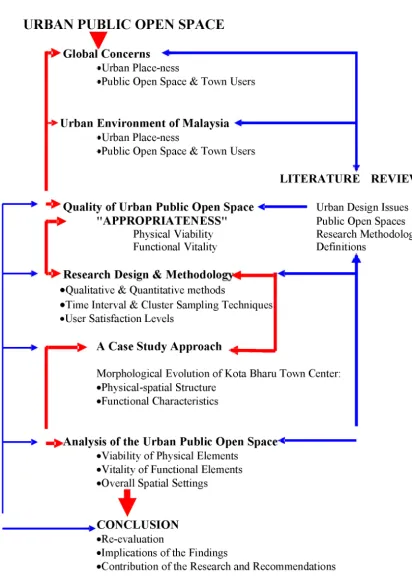
C hapter 1 presents the overall structure of this research. It states the research problem, outlines the main issues such as the study of concept of place and its relation to place-ness in urban environment, and the relationships between urban public open space and town users. It also states the aim, objectives, and discusses the relevant research approaches and introduces the methodology for the research. Finally, this chapter highlights the limitations of the research.
26
instrument are also presented in order to substantiate the validity and reliability of the research findings.
A case study approach initiated through an urban morphological study is adopted in this research because it allows an in-depth understanding of the origin and development of a particular urban form. However, after lengthy archival search, it was found out that there has been no extensive study done, neither a complete documentation of the case study town available. Therefore, the first analytical investigation of this research is to reconstruct the historical and physical evolution of the town, which is presented in C hapter 5. The following two chapters present further analyses of the case study town. There are two main components of the spatial environment that are subjected to the investigation; they are the physical and functional components. C hapter 6 examines the town users' satisfaction level with the physical elements of the urban public open space, whilst, in C hapter 7, the functional elements of the spatial place are analyzed.
27
URBAN PUBLIC OPEN SPACE
▼
Global Concerns •Urban Place-ness
•Public Open Space & Town Users
U rban Environm ent of Malaysia •Urban Place-ness
•Public Open Space & Town Users
LITERATURE REVIEW Quality of U rban Public Open S p a c e d
► "APPROPRIATENESS" Physical Viability Functional Vitality
Urban Design Issues Public Open Spaces Research Methodologies Definitions
Research Design & Methodolog; •Qualitative & Quantitative methods
•Time Interval & Cluster Sampling Techniques •User Satisfaction Levels
A Case Study Approach
Morphological Evolution of Kota Bharu Town Center: •Physical-spatial Structure
•Functional Characteristics
■> Analysis of the U rban Public Open Space* •Viability of Physical Elements
•Vitality of Functional Elements •Overall Spatial Settings
i
_____ CONCLUSION
•Re-evaluation
•Implications of the Findings
302
LIST OF REFERENCES
Abdul Razak Mahmud (2002). Ikhtisar Sejarah Negeri Kelantan (Tanah Serendah Sekebun Bunga). Kota Bharu: Pustaka Aman Press Sdn. Bhd.
Abel, C. (1985). Built Sources of Malaysian Identity. Majalah Arkitek, September, p.32- 40.
Affendi Ahamad (2004). Kajian Bagi Mengenalpasti Karektor Fizikal dan Sosio- Budaya Bandar: Kajian Kes Melaka Bandar ay a Bersejarah. Master Thesis. Universiti Teknologi Malaysia, Skudai.
Ahmad Bashri Sulaiman (1988). A Man-Environment Approach towards the Design o f Public Squares in Islamic Cities. Master Thesis. University of Nottingham, U.K.
Ahmad Bashri Sulaiman (2000). Urban Design Method - Theory and Practice: A Case Study in Malaysia. Ph.D Thesis. University of Nottingham, U.K.
Ahmad Bashri Sulaiman, Shuhana Shamsuddin and Wan Mohd Zakri Wan Abdullah (2004). The Study o f Physical and Functional Characteristics o f Urban Public Open Space: A Case Study o f Kota Bharu Town Center, Kelantan. Unpublished
Short-term Researh. Universiti Teknologi Malaysia, Skudai.
Akin, J. E. (2005). Finite Element Analysis with Error Estimators: An Introduction to the FEM and Adaptive Error Analysis fo r Engineering Student - Mathematical Preliminaries. New York: Elsevier Ltd.
303
Alexander, C. (1977). A Pattern Language; Town, Buildings, Construction. New York: Oxford University Press.
Al-Kodmany, K. (2001). Bridging the Gap Between Technical and Local Knowledge: Tools for Promoting Community-Based Planning and Design. Journal o f Architectural and Planning Research. Vol. 18 (2), p. 110-126.
Allaby, M. and Bunyard, P. (1980). The Politics o f Self-Sufficiency. Oxford: Oxford University Press.
American Society of Civil Engineers, (1986). Urban Planning Guide: ASCE Manuals and Reports on Engineering Practice. New York: Task Committee of ASCE.
Arefi, M. (1999). Non-place and Placelessness as Narratives of Loss: Rethinking the Notion of Place. Journal o f Urban Design. Vol. 4 (2), p.179-191.
Armstrong, D. E. and Jacobson, S. H. (2008). An Analysis of Neighborhood Functions on Generic Solution Spaces. European Journal o f Operational Research. Vol.186 (2), p.529-541.
Arnstein, S.R. (1969). A Ladder of Citizen Participation. Journal o f the American Institute o f Planners. Vol. 35 (4), p.216-224.
Ash Amin (2000). Squares. In Pile, S and Thrift, N (ed.). City A - Z ( p.232-234). London: Routledge..
Ashihara, Y. (1983). The Aesthetic Townscape. Massachusetts: The MIT Press.
Ashraf Abdullah (2000, Dec. 18). It’s Time for Healing-Unity is far too valuable to be forsaken, says Abdullah. New Straits Times, p.1.
Associate Press (2006, Mac 5). Trishaws Thrive in New York. New Sunday Times, p.34. Babbie, E (2001). The Practice o f Social Research. Singapore: Wadsworth Thompson
Learning.
304
Banerjee, T. and Southworth, M. (1990). City Sense and City Design - Writings and Projects of Kevin Lynch. Massachusetts: The MIT Press.
Banz (1970). Elements o f Urban Form. London: Mcgraw Hill Book Company. Barnett, J. (1982). An Introduction to Urban Design. New York: Harper & Row.
Barton, H., Grant, M. and Guise, R. (2003). Shaping Neighbourhoods. London: Spon Press.
Bechtel, R. et al (1987). Methods in Environmental and Behavioral Research. New York: Van Nostrand Reinhold Company.
Beer, Anne R. (2003). The Art of Making Places - Liveable Public Space. The Steel Valley Project. U.K: Map21 Ltd.
Bendikat, E. (2002). The Public Urban Space in the Modern Age: Technical Functionality and Regulation -The Impact of Economic Activities and Technology on the Urban Space. Deutsches Institut fu r Urbanistik. Vol. 41 (1), p.3-17.
Bentley, I. et al. (1985). Responsive Environments: A Manual fo r Designers. Oxford: Architectural Press.
Berg, B.L (2004). Qualitative Research Methods - For the Social Science. Singapore: Pearson.
Bernick, M. and Cervero, R (1996). Transit Villages in the 21st. Century. New York: McGraw-Hill.
Bianchini, F. and Landry, C (1994). The Creative City. England: Franco Bianchini, Charles Landry & Comedia.
Bird, James (1977). Centrality and Cities. London: Routledge Early Editions.
Bridge, G. and Watson, S. (2001). Retexturing the City (p. 350-359), City. Vol.5 (3), p.350-359.
305
Carr, F. and Rivlin, S. (1992). Environmental and Behavioral Series: Public Space. U.K: Cambridge University Press.
Carter, Paul (2002). Repressed Spaces; The Poetics o f Agoraphobia. London: Reaktion Books.
Cartwright, R.M (1980). The Design o f Urban Space: A GLC Manual. London: The Architectural Press Ltd.
Chapman, David (ed.) (1996). Creating Neighbourhoods and Places in the Built Environment. London: E & FN Spon.
Chelvi, K.T (2004, Sept. 5). 'If you stand up for your rights, you are a trouble-maker'. Focus - News Sunday Times, p. 6.
Chongdon, R.C (ed.) (1977). Introduction to Appropriate Technology: Toward a Simple Life-style. Pennsylvania: Rodale Press, Inc.
Chua, B. H. and Edwards, N. (Ed.) (1992). Public Space - Design, Use and Management. Singapore: Singapore University Press.
Clay, G. (1987). Right Before Your Eyes-Penetrating the Urban Environment. Washington D.C: Planners Press.
Cohen, L. and Manion, L. (1989). Research Methods in Education. New York: Routledge.
Collins, G.R. and Collins C.C (1986). Camillo Sitte: The Birth o f Modern City Planning. New York: Rizzoli.
Colquhoun, I. (1995). Urban Regeneration. London: B.T. Batsford Ltd. Crawford, J.H. (2000). Carfree Cities. Utrecht: International Books.
Creswell, J.W (2002). Research Design: Qualitative and Quantitative Approaches. U.K: Sage Publications.
Cullen, G (1971). The Concise Townscape. The Architectural Press.