An Assessment of the Computing Component of Civil Engineering Education
Osama Abudayyeh, P.E., Member, Hubo Cai, Student Member, Steven J. Fenves, Honorary Member, Kincho Law, Member, Robert O’Neill, P.E., Member, and William Rasdorf, P.E.,
Fellow
Keywords
Civil Engineering Education Computing in Civil Engineering Computing Education
Table Captions
Table 1: Responses by Sub-discipline
Table 2: Responses by Job Title (Practitioners)
Table 3. Survey of Frequency of Use (Practitioners)
Table 4. Survey of Importance Results Table 5. Survey of Competence Results
Table 6. Academic Coverage of Skill Results (Educators) Table 7. Multiple Comparisons
Table 8. Composite Ranking and Overall Perceived Importance of Skills
An Assessment of the Computing Component of Civil Engineering Education
Osama Abudayyeh, P.E.,1Member, Hubo Cai2, Student Member, Steven J. Fenves,3 Honorary Member, Kincho Law,4 Member, Robert O’Neill, P.E.,5 Member, and William Rasdorf,6 P.E.,
Fellow
Abstract
This paper presents the results of two surveys conducted by the American Society of Civil Engineers’ (ASCE) Task Committee on Computing Education of the Technical Council on Computing and Information Technology (TCCIT) to assess the current computing component of the curriculum in civil engineering. Previous surveys completed in 1989 and 1995 have addressed the question of what should be taught to civil engineering students regarding computing. The surveys reported in this paper are a follow-up study to the two earlier surveys. Key findings of the study include: 1) the relative importance of the top four skills (spreadsheets, word processors, CAD, electronic communication) has remained unchanged, 2) programming competence is ranked very low by practitioners, 3) the importance and use of GIS and specialized engineering software have increased over the past decade, 4) the importance and use of expert systems have significantly decreased over the past decade, and 5) the importance and use of equation solvers and databases have declined over the past decade.
Background
The rapid advances in computer software and hardware have provided engineers with powerful means of processing, storing, retrieving, sharing and displaying data (Fenves 2001; Law 1990a and b). These advances have made computing a growing and essential part of nearly every engineering discipline. The effective use of computing in engineering is recognized by many as the key to increased individual, corporate, and national productivity. Applications of computing technologies are giving engineers means of rapid access to a wide variety of information and ways to model complex engineering systems. Computing technologies in areas such as data management, artificial intelligence, concurrent processing, networking, communications, and interactive computer graphics have also become prominent in engineering. The ASCE Journal of
1
Ph.D., Associate Professor, Department of Civil and Construction Engineering, Western Michigan University, Kalamazoo, MI 49008-5316. E-mail: [email protected].
2
Ph.D. Candidate, Department of Civil and Environmental Engineering, North Caroline State University, Raleigh, NC 27695-7908.
3
Ph.D., Guest Researcher, National Institute for Standards and Technology (NIST), 100 Bureau Dr., Building 304, Stop 8262, Gaithersburg, MD 20899-8262; University Professor Emeritus, Department of Civil and Environmental Engineering, Carnegie Mellon University. Email: [email protected].
4
Ph.D., Professor, Department of Civil and Environmental Engineering, Stanford University, Stanford, CA 94305-4020. Email: [email protected].
5
Ph.D., Professor, School of Engineering, Computing and Construction Management, Rogers Williams University, Bristol, RI 02809-2921. Email: [email protected].
6
Computing in Civil Engineering (JCCE) has become one of the premier venues in reporting innovative computing research results in civil engineering.
Unlike the majority of papers in JCEE, this paper does not present new computing research results. Rather, it presents an assessment of the base knowledge of computing that future civil engineers, both those that will produce research and those that will make use of it, can be expected to possess.
In order to prepare graduates to operate effectively in the emerging and changing computing environment, adequate computing resources, expertise in the teaching of computing, and an appropriate computing component in the curriculum are needed. To a large extent, the first two concerns have been ameliorated over time. The third concern, however, still presents a challenge to civil engineering education. To better understand these concerns and the steps to be taken to address them, the Technical Council on Computing and Information Technology (TCCIT) of the American Society of Civil Engineers (ASCE) undertook a series of computing surveys in 1986, 1989, and 1995. The surveys reported here are the fourth in this series.
In 1986 the Education Committee of the TCCIT, then called Technical Council on Computing Practices (TCCP), conducted a survey to the attitude of faculty and practitioners towards computing in civil engineering education. The survey identified that civil engineering students needed to be exposed to the following areas :
1) the technology of computers;
2) computers as problem solving tools; and
3) computers as engineering simulators to assist in design.
With the needs identified, TCCIT formed a task committee in 1987 to conduct a second survey to assess the status of computing in the civil engineering curriculum. The survey identified a need to strengthen computing education in civil engineering. It suggested three different scenarios for incorporating problem solving computing tools and concepts into the civil engineering curriculum and enumerated lists of pros and cons for each scenario. The results of the 1987 survey were published in (Law 1990a and b), and were widely distributed to engineering faculty. Today they serve as a benchmark from which we can measure progress, reassess needs, and plan for the continued future roles that ASCE can play in advancing the use of computing in civil engineering education.
Survey Objectives
The purpose of the previous surveys was to determine the computing component of the undergraduate civil engineering curriculum as perceived by academics and professionals. The analyses of these surveys led to recommendations. The present (2002) surveys have the same purpose. They are thus a new benchmark from which to measure and assess changes in civil engineering computing education.
The 2002 Survey Results
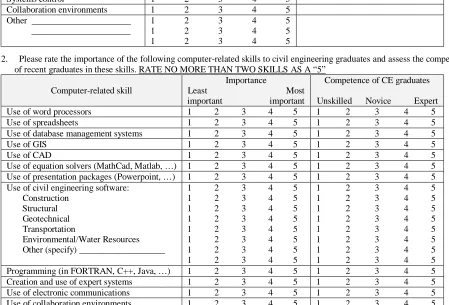
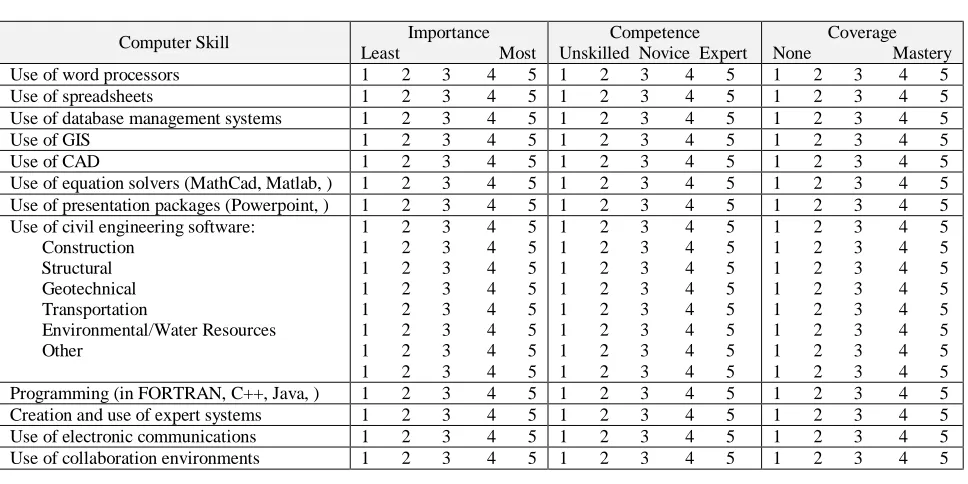
Two new survey questionnaires were designed to collect data on the computing component of the curriculum: a Practitioners’ Survey and an Educators’ Survey. (Refer to Figures 1 and 2 for the two survey instruments.) This section represents the summarized results of these two surveys.
Responses to each specific question were examined and counted and percentages were computed. The overall rating for each computing skill or application within a specific question (questions 1 and 2 in the Practitioners’ Survey and question 1 in the Educators’ Survey) was determined as a weighted average of the percentages. The weights range from 1 to 5 as specified in the survey questionnaires. In addition, a higher rating indicates more important, more competent, or more coverage. Thus, the computing skills can be ranked regarding their importance, the graduates’ competence, or the extent of educational coverage.
The Practitioners’ Survey
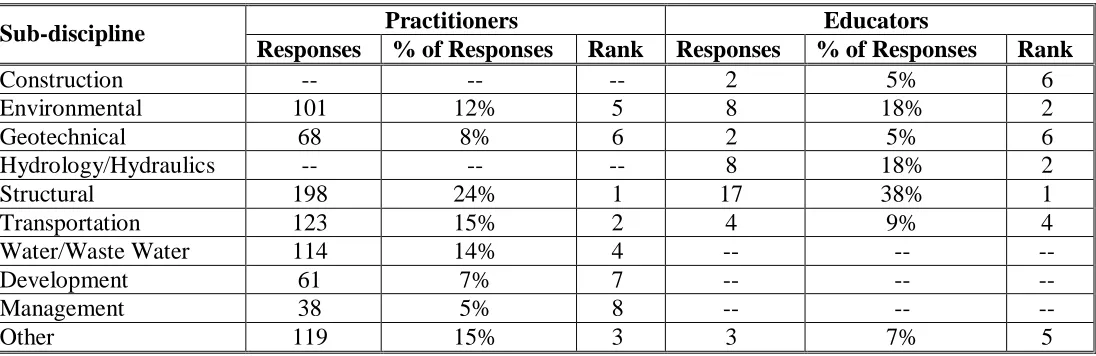
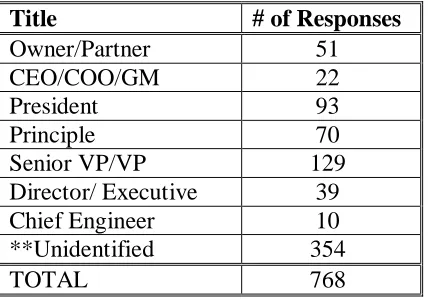
The Practitioners’ Survey allowed respondents sufficient room to elaborate on their responses – especially concerning questions 3-6. The survey email was sent to civil engineering professionals. A total of 768 civil engineers participated in this survey. All major sub-disciplines were represented in the respondent population (Table 1). More than 50% of the respondents identified themselves as very senior members of their organizations (Table 2). 78% of all respondents identified themselves as software users, 17% as managers of hardware/software and 5% as software developers.
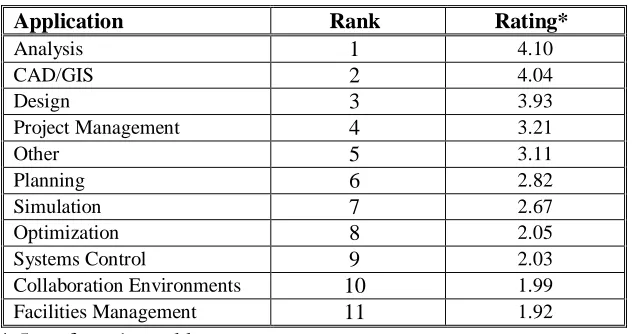
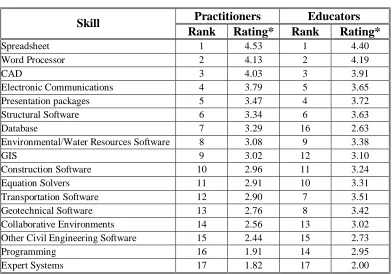
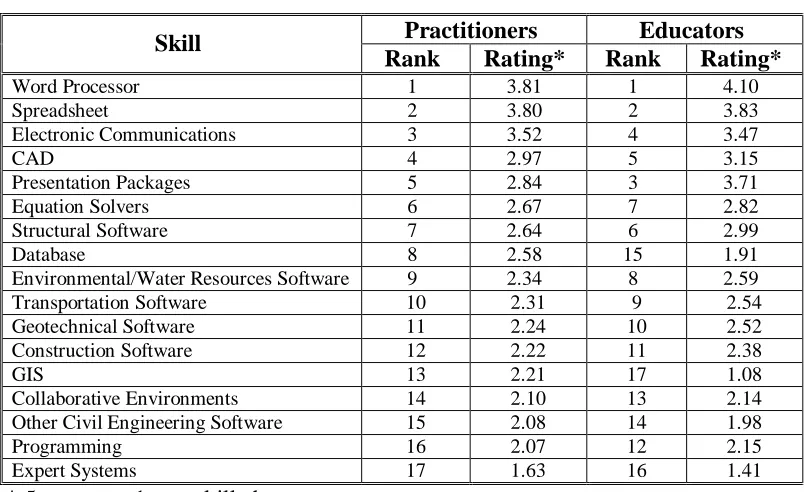
Table 3 presents the responses from the practitioners after being summarized, rated, and ranked regarding the frequency of use for the listed types of computer applications. Respondents rate analysis, CAD/GIS, and design as the three most frequently used applications. Table 4 lists the various computing skills in their order of importance from the practitioners’ perspective. Table 5 shows how the practitioners rated the competence of recent graduates in various computer-related skills. Practitioners considered the recent graduates to be about halfway between novice and expert in the use of word processors, spreadsheets and electronic communications, and around the novice level in the use of CAD and presentation packages.
In question 3, practitioners were asked if learning a programming language was important to a civil engineering undergraduate education. The response was 48% yes and 52% no.
purposes. Of particular concern was that many recent hires had little or no experience with CAD. Practitioners felt that recent hires were very competent computer users for most non-engineering uses, that they were comfortable using computers and, for the most part, had an attitude for learning engineering - specific software.
In question 5, practitioners were asked what could be done to avoid the “blackbox” experience by recent civil engineering graduates. Two major themes developed from the responses. The first was that practitioners wanted students to be taught the theory, that they be well grounded in fundamentals and that they be able do the work by hand without the use of the computer. The second was that students needed to have practical, real world, hands on experiences prior to graduation. Many of the practitioners suggested that internships and Co-ops should be a required element of the undergraduate program.
The Educators’ Survey
The Educators’ Survey allowed respondents sufficient room to elaborate on their responses – especially concerning questions 2-8. An attempt was made to identify the most important skills required by civil engineering undergraduates, as seen by educators, by limiting the number of times that the highest rating could be used on all questions.
The survey email was sent to all Civil Engineering Chairs or Department Heads. 44 responses were received. Responses were mostly from medium to large universities. Within these institutions, respondents ranged from Instructor to Professor or Chair. 45% of the responses were from Professors and 39% were from Chairs or Heads. All major sub-disciplines were represented in the respondent population (Table 1).
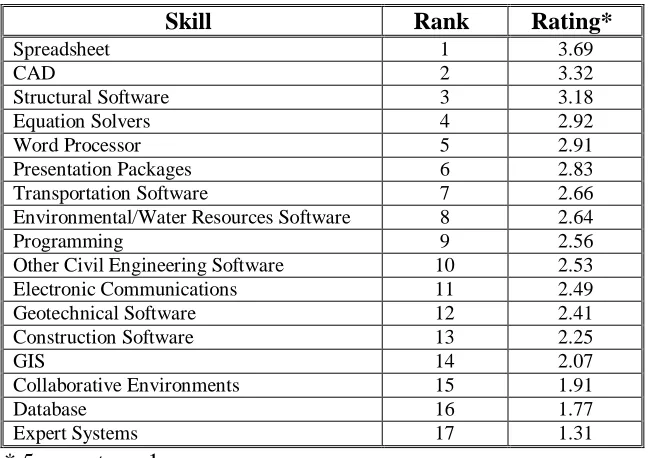
Table 4 shows how the educators rated the importance of various computer-related skills. Table 5 shows how the educators rated the competence of undergraduates in these skills. Educators considered the students to be about halfway between novice and expert in the use of word processors, spreadsheets and electronic communications and around the novice level in the use of CAD, presentation packages and equation solvers. Table 6 is a listing of skills in the order of the extent of academic coverage within the curriculum, where mastery means extensive coverage of the skill.
In question 2, educators were asked whether it was important to a civil engineer to learn a programming language. The response was 73% yes and 27% no.
number of educators felt that students needed more CAD, more exposure to discipline-specific software, programming and the use of GIS.
In question 6, educators were asked to comment on the overall competence of their civil engineering undergraduates in the use of computers for engineering purposes. In general, educators felt comfortable with the computing competence of their students. Educators felt that many students effectively learn some very specific engineering software and that students are prepared to learn new software as their jobs require.
In question 7, educators were asked what could be done to avoid the “blackbox” experience by recent civil engineering graduates. Comments on this topic ranged from “make sure you teach the fundamentals” and “insure students can solve similar type problems manually” to “provide case studies that demonstrate garbage-in-garbage-out.”
Analysis of the 2002 Surveys
This section details the analysis of the survey results and the observations obtained.
Analysis Methodology
The focus of analyzing the survey results is on the questions regarding IMPORTANCE, COMPETENCE in both surveys, COVERAGE in the Educators’ Survey, and FREQUENCY IN USE in the Practitioners’ Survey. Survey results of these questions help to determine the importance of individual computing skills, the competence of undergraduates and graduates in each skill, how frequently a skill is used in practices, and the level to which each computing skill is covered in the academic curriculum. In addition to the comparisons, the written comments on each specific survey question were examined individually.
Analysis Comparison and Observations
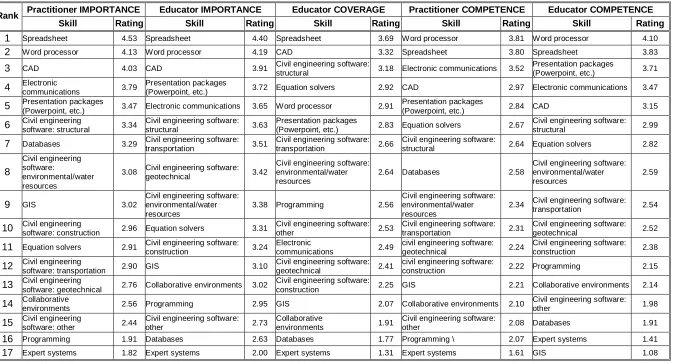
Table 7 shows all the rating and ranking information for the computing skills covered in the 2002 survey regarding their importance and competence from both practitioners’ and educators’ perspectives, and their coverage from the educators’ perspective.
A comparison of the importance ranking from the educators’ and practitioners’ surveys reveals significant consistency. Educators and practitioners both rank the application of word processors and spreadsheets as the top two skills, CAD as the third, and programming and expert systems as the least important ones. One exception is databases, which is ranked 7 from the practitioners’ perspective but 16 from the educators’ perspective.
A comparison of the competence rankings from the educators’ and practitioners’ surveys reveals that educators and practitioners have similar perceptions about the students’ computing skills. Both report that the students have high competence in the use of word processors and spreadsheets, followed by presentation packages, CAD, and electronic communication. Practitioners rated the students’ competence in GIS and databases higher than educators.
covered by the current curriculum. For example, the use of spreadsheets is ranked 1 in both the importance and coverage listings. Expert systems and database are ranked as the least important and the least covered skills. It is interesting to note that word processing ranks higher on importance than on coverage, while programming and equation solvers rank lower on importance than on coverage. The first observation can be explained by the fact that students are using word processors so frequently for homework and project reports that they gain the necessary expertise without formal coverage. On the other hand, the inconsistency of programming and equation solver in these two rankings reveals that the current curriculum may provide more coverage of these two skills than they warrant.
A comparison of the importance ranking from the practitioners’ survey with the coverage ranking from educators’ survey reveals the extent to which the current curriculum covers the computing skills believed to be important in practice. It seems that the curriculum should cover databases and GIS more thoroughly while putting less emphasis on programming and equation solvers.
A comparison of the importance and coverage rankings from the educators’ survey and the competence ranking from the practitioners’ survey shows that there is reasonable consistency between skills taught and the skills that graduates possess. The only notable exception is the use of databases, which is rated as not important and is being covered very little, yet graduates are perceived to have some competence. This disparity indicates that students might gain this knowledge and skills via independent study and practice.
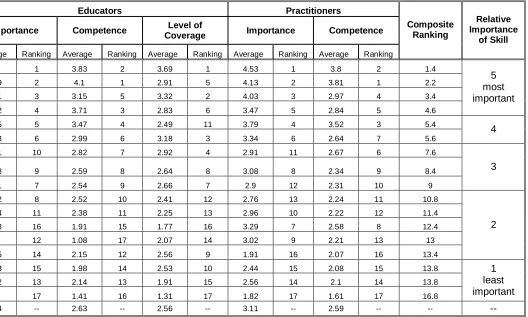
In summary, there is reasonable consistency between importance, competence and coverage among the major computing skills. As an alternate comparison and summary, Table 8 presents the same five ratings and rankings as those in Table 7, ordered by the composite rating of each skill across the five categories, and a final measure of the relative importance of each topic, expressed on the scale from most important (5) to least important (1). The consistency among the rankings commented on previously is made even more apparent. Overall, nearly 60% of the individual rankings conform to the overall importance category; for the top and bottom categories, the conformance is nearly 70%.
Examination of Written Comments
Educators and practitioners appear to be in agreement on both the competency question and the “blackbox” issue. Recent graduates are very competent in the use of generic computers tools such as spreadsheets, word processors, and presentation software. They are also capable of learning engineering specific software. The bigger issue is that of knowing what the programs are doing and interpreting the results, the “blackbox” phenomenon. The recommended solution by both educators and practitioners is more focus on engineering fundamentals, and on requiring manual solutions concurrently with using a computer software.
Comparisons of the 2002 Survey with the 1989 and 1995 Surveys
unavailable in the 1989 survey and that both the 1989 and 1995 surveys contain skills which were not included in the 2002 surveys.
Table 9 compares the ranking of importance for each computing skill of the 2002 survey from the practitioners’ perspective with their corresponding rankings in the 1995 and 1989 surveys. The top four skills remainunchanged in the two most recent surveys. The biggest changes noted are the decreased emphasis on databases, and a new emphasis on the use of discipline-specific engineering software (structural and environmental/water resources software) and GIS.
Table 10 compares the ranking of importance for each computing skill of the 2002 survey from the educators’ perspective with their corresponding rankings in the 1995 and 1989 surveys. Since the applications of specialized civil engineering software are ranked closely to each other, they are grouped into one category, specialized engineering software. The rating of this category was determined by taking the average rating of all applications of civil engineering software. The top four skills remain unchanged in the two most recent surveys. The biggest changes are the increased emphasis on the use of presentation packages and a new emphasis on the use of discipline-specific, specialized engineering software. Also noteworthy is the continued decline of the importance of programming and the use of equation solvers.
Closure
Conclusions
For over a decade, the relative importance of the top four skills (spreadsheets, word processors, CAD, electronic communication) has remained unchanged, indicating some stability in these computing skills in civil engineering.
Programming competence is ranked very low by practitioners. One explanation for this may be the fact that programming is introduced early in the curriculum, but seldom, if ever, used again. Thus, by the time they graduate, graduates have lost much of their competence in programming.
The importance and use of GIS and specialized engineering software have increased over the past decade. This trend is expected to continue in the coming years.
The importance and use of expert systems have significantly decreased over the past decade due to the fact that they did not live up to their expectations. It is expected that coverage of expert systems will disappear in the near future.
The importance and use of equation solvers and databases have declined over the past decade. One potential explanation for this is the fact that many specialized engineering software already incorporates these components. It is expected that equation solvers and databases will continue to play a role in future civil engineering computing applications.
Recommendations
presented in this paper to examine their curricula for outcome assessment of their graduates’ computing competence and to formulate strategies for appropriate curriculum changes.
Educators are encouraged to either integrate programming throughout the curriculum to address the competency challenge discussed earlier, or to eliminate programming from the curriculum.
Based on the survey findings, educators are encouraged to ensure that CAD and GIS are integrated throughout the curriculum.
Suggestions for Future Surveys
The following two suggestions are offered for the improvement of future surveys:
• The present surveys used the single term “skill” to refer to a wide range of curricular topics; future surveys should more clearly differentiate between the various kinds of concepts, topics, subjects, skills, and attitudes comprising “computing”;
• Future task committees charged with repeating the present surveys should include one or more members with survey research experience to improve the surveys, their distribution and their summarization and reporting.
Acknowledgements
The authors express their thanks to all who participated in this survey for their cooperation and objectivity. Additionally, the authors thank ASCE for funding this study, for providing meeting facilities, and for developing and administering the electronic version of the survey. The opinions expressed in this paper are theauthors’ and do not necessarily reflect the views of ASCE or the institutions with which the authors are affiliated. The authors also thank the Executive Committee of the Technical Council on Computing and Information Technology which has had the foresight to support all three of this committee's survey efforts.
References
Baker, Nelson and Glenn Rix, (1991). “The Status of Computing in Civil Engineering Curricula and Practice,” Proceedings of ASCE 7th Conference on Computing in Civil Engineering, American Society of Civil Engineers, Washington, DC. 910-919.
Fenves, S. and Rasdorf, W. (2001). “Role of ASCE in the Advancement of Computing in Civil Engineering,” Journal of Computing in Civil Engineering, American Society of Civil Engineers, Volume 15, Number 4, 239-247, October.
Fontane, D.G., (1985). Written correspondence - Civil Engineering Education Computer Resources Survey - fall 1986. Colorado State University, Fort Collins, CO, January.
Henry, R.M., (1992). "Civil Engineering Curriculum Computer Integration 1992." Proceedings of the ASCE 8th Conference on Computing in Civil Engineering, American Society of Civil Engineers.
American Society of Civil Engineers, Volume 116, Number 2, 128-141, April.
Law, K. H., Rasdorf, W. J., Karamouz, M. and Abudayyeh, 0. Y., (1990b). “The Role of Computing in Civil Engineering Education,” Proceedings of the Sixth Conference on Computing in Civil Engineering, American Society of Civil Engineers, Atlanta, GA, 442-450, September.
O'NeiII, R. J., Henry, R. M. and Lenox, T. A., (1996a). “Role of Computing: Practitioners' Perspective,” Proceedings Third Congress on Computing in Civil Engineering, American Society of Civil Engineers, Anaheim, CA, 670-676, June.
O'Neill, R. J., Henry, R. M. and Lenox, T. A., (1996b). “Role of Computing: Educators' Perspective,” Proceedings of the ASEE Annual Conference, American Society for Engineering Education, Washington D.C., Session 3215, June.
Rasdorf, William, (1985). “Computer Programming in the Civil Engineering Curriculum”,
Figure 1. Practitioners’ Survey
Name (optional): CE Specialization:
(Struct, Geotech, Hydro, …)
Company (optional): Position (optional):
Identify your role with respect to computing:
(software user, software developer, manager of hardware/software)
1. Please rate the frequency of use of the following types of computer applications by your company?
Application Frequency of Use
Seldom Often
Software used in your company (if applicable)
Planning 1 2 3 4 5
Project management 1 2 3 4 5
Analysis 1 2 3 4 5
Design 1 2 3 4 5
Simulation 1 2 3 4 5
CAD/GIS 1 2 3 4 5
Facilities management 1 2 3 4 5
Optimization 1 2 3 4 5
Systems control 1 2 3 4 5
Collaboration environments 1 2 3 4 5
Other ______________________ ______________________ 1 2 3 4 5
1 2 3 4 5
1 2 3 4 5
2. Please rate the importance of the following computer-related skills to civil engineering graduates and assess the competence of recent graduates in these skills. RATE NO MORE THAN TWO SKILLS AS A “5” Computer-related skill Importance Least Most important important Competence of CE graduates Unskilled Novice Expert Use of word processors 1 2 3 4 5 1 2 3 4 5
Use of spreadsheets 1 2 3 4 5 1 2 3 4 5
Use of database management systems 1 2 3 4 5 1 2 3 4 5
Use of GIS 1 2 3 4 5 1 2 3 4 5
Use of CAD 1 2 3 4 5 1 2 3 4 5
Use of equation solvers (MathCad, Matlab, …) 1 2 3 4 5 1 2 3 4 5
Use of presentation packages (Powerpoint, …) 1 2 3 4 5 1 2 3 4 5
Use of civil engineering software: Construction Structural Geotechnical Transportation Environmental/Water Resources Other (specify) ___________________ 1 2 3 4 5
1 2 3 4 5
1 2 3 4 5
1 2 3 4 5
1 2 3 4 5
1 2 3 4 5
1 2 3 4 5
1 2 3 4 5
1 2 3 4 5
1 2 3 4 5
1 2 3 4 5
1 2 3 4 5
1 2 3 4 5
1 2 3 4 5
1 2 3 4 5
1 2 3 4 5
Programming (in FORTRAN, C++, Java, …) 1 2 3 4 5 1 2 3 4 5
Creation and use of expert systems 1 2 3 4 5 1 2 3 4 5
Use of electronic communications 1 2 3 4 5 1 2 3 4 5
Use of collaboration environments 1 2 3 4 5 1 2 3 4 5
3. Do you think learning a programming language is important to civil engineering undergraduate education? YES NO Comment:
4. Comment on the overall competence of the undergraduate civil engineers that you hire in the use of computers for engineering purposes.
5. What do you think can be done to avoid the “blackbox” experience by recent civil engineering graduates?
Figure 2. Educators’ Survey
Name (optional): CE Specialization:
(Struct, Geotech, Hydro, …)
University (optional): Title (optional):
(Prof, Assoc, Assist, …)
1. Please rate the importance of the following computer-related skills to CE undergraduates; the competence of your undergraduates in these skills; and the level of coverage of these skills in your civil engineering curriculum. RATE NO MORE THAN TWO SKILLS AS A “5”
Computer Skill Importance
Least Most
Competence Unskilled Novice Expert
Coverage None Mastery Use of word processors 1 2 3 4 5 1 2 3 4 5 1 2 3 4 5 Use of spreadsheets 1 2 3 4 5 1 2 3 4 5 1 2 3 4 5 Use of database management systems 1 2 3 4 5 1 2 3 4 5 1 2 3 4 5 Use of GIS 1 2 3 4 5 1 2 3 4 5 1 2 3 4 5 Use of CAD 1 2 3 4 5 1 2 3 4 5 1 2 3 4 5 Use of equation solvers (MathCad, Matlab, ) 1 2 3 4 5 1 2 3 4 5 1 2 3 4 5 Use of presentation packages (Powerpoint, ) 1 2 3 4 5 1 2 3 4 5 1 2 3 4 5 Use of civil engineering software:
Construction Structural Geotechnical Transportation Environmental/Water Resources Other
1 2 3 4 5 1 2 3 4 5 1 2 3 4 5 1 2 3 4 5 1 2 3 4 5 1 2 3 4 5 1 2 3 4 5 1 2 3 4 5
1 2 3 4 5 1 2 3 4 5 1 2 3 4 5 1 2 3 4 5 1 2 3 4 5 1 2 3 4 5 1 2 3 4 5 1 2 3 4 5
1 2 3 4 5 1 2 3 4 5 1 2 3 4 5 1 2 3 4 5 1 2 3 4 5 1 2 3 4 5 1 2 3 4 5 1 2 3 4 5 Programming (in FORTRAN, C++, Java, ) 1 2 3 4 5 1 2 3 4 5 1 2 3 4 5 Creation and use of expert systems 1 2 3 4 5 1 2 3 4 5 1 2 3 4 5 Use of electronic communications 1 2 3 4 5 1 2 3 4 5 1 2 3 4 5 Use of collaboration environments 1 2 3 4 5 1 2 3 4 5 1 2 3 4 5
2. Do you think learning a programming language is important to civil engineering undergraduate education? YES NO Comment:
3. Do you think computing and information technology are well integrated into your civil engineering undergraduate program? YES NO
4. Areas of strengths:
5. Areas to be improved:
6. Comment on the overall competence of your civil engineering undergraduates in the use of computers for engineering purposes.
7. What do you think can be done to avoid the “blackbox” experience by recent civil engineering graduates?
Table 1: Responses by Sub-discipline
Practitioners Educators
Sub-discipline
Responses % of Responses Rank Responses % of Responses Rank
Construction -- -- -- 2 5% 6
Environmental 101 12% 5 8 18% 2
Geotechnical 68 8% 6 2 5% 6
Hydrology/Hydraulics -- -- -- 8 18% 2
Structural 198 24% 1 17 38% 1
Transportation 123 15% 2 4 9% 4
Water/Waste Water 114 14% 4 -- -- --
Development 61 7% 7 -- -- --
Management 38 5% 8 -- -- --
Table 2: Responses by Job Title (Practitioners)
Title # of Responses
Owner/Partner 51
CEO/COO/GM 22
President 93
Principle 70
Senior VP/VP 129
Director/ Executive 39
Chief Engineer 10
**Unidentified 354
Table 3. Survey of Frequency of Use (Practitioners)
Application Rank Rating*
Analysis 1 4.10
CAD/GIS 2 4.04
Design 3 3.93
Project Management 4 3.21
Other 5 3.11
Planning 6 2.82
Simulation 7 2.67
Optimization 8 2.05
Systems Control 9 2.03
Collaboration Environments 10 1.99
Facilities Management 11 1.92
Table 4. Survey of Importance Results
Practitioners Educators
Skill
Rank Rating* Rank Rating*
Spreadsheet 1 4.53 1 4.40
Word Processor 2 4.13 2 4.19
CAD 3 4.03 3 3.91
Electronic Communications 4 3.79 5 3.65
Presentation packages 5 3.47 4 3.72
Structural Software 6 3.34 6 3.63
Database 7 3.29 16 2.63
Environmental/Water Resources Software 8 3.08 9 3.38
GIS 9 3.02 12 3.10
Construction Software 10 2.96 11 3.24
Equation Solvers 11 2.91 10 3.31
Transportation Software 12 2.90 7 3.51
Geotechnical Software 13 2.76 8 3.42
Collaborative Environments 14 2.56 13 3.02
Other Civil Engineering Software 15 2.44 15 2.73
Programming 16 1.91 14 2.95
Expert Systems 17 1.82 17 2.00
Table 5. Survey of Competence Results
Practitioners Educators
Skill
Rank Rating* Rank Rating*
Word Processor 1 3.81 1 4.10
Spreadsheet 2 3.80 2 3.83
Electronic Communications 3 3.52 4 3.47
CAD 4 2.97 5 3.15
Presentation Packages 5 2.84 3 3.71
Equation Solvers 6 2.67 7 2.82
Structural Software 7 2.64 6 2.99
Database 8 2.58 15 1.91
Environmental/Water Resources Software 9 2.34 8 2.59
Transportation Software 10 2.31 9 2.54
Geotechnical Software 11 2.24 10 2.52
Construction Software 12 2.22 11 2.38
GIS 13 2.21 17 1.08
Collaborative Environments 14 2.10 13 2.14
Other Civil Engineering Software 15 2.08 14 1.98
Programming 16 2.07 12 2.15
Expert Systems 17 1.63 16 1.41
Table 6. Academic Coverage of Skill Results (Educators)
Skill Rank Rating*
Spreadsheet 1 3.69
CAD 2 3.32
Structural Software 3 3.18
Equation Solvers 4 2.92
Word Processor 5 2.91
Presentation Packages 6 2.83
Transportation Software 7 2.66
Environmental/Water Resources Software 8 2.64
Programming 9 2.56
Other Civil Engineering Software 10 2.53
Electronic Communications 11 2.49
Geotechnical Software 12 2.41
Construction Software 13 2.25
GIS 14 2.07
Collaborative Environments 15 1.91
Database 16 1.77
Expert Systems 17 1.31
Table 7. Multiple Comparisons
Practitioner IMPORTANCE Educator IMPORTANCE Educator COVERAGE Practitioner COMPETENCE Educator COMPETENCE
Rank
Skill Rating Skill Rating Skill Rating Skill Rating Skill Rating
1 Spreadsheet 4.53 Spreadsheet 4.40 Spreadsheet 3.69 Word processor 3.81 Word processor 4.10
2 Word processor 4.13 Word processor 4.19 CAD 3.32 Spreadsheet 3.80 Spreadsheet 3.83
3 CAD 4.03 CAD 3.91 Civil engineering software:
structural 3.18 Electronic communications 3.52
Presentation packages
(Powerpoint, etc.) 3.71
4 Electronic communications 3.79 Presentation packages
(Powerpoint, etc.) 3.72 Equation solvers 2.92 CAD 2.97 Electronic communications 3.47
5 Presentation packages (Powerpoint, etc.) 3.47 Electronic communications 3.65 Word processor 2.91 Presentation packages
(Powerpoint, etc.) 2.84 CAD 3.15
6 Civil engineering software: structural 3.34 Civil engineering software:
structural 3.63
Presentation packages
(Powerpoint, etc.) 2.83 Equation solvers 2.67
Civil engineering software:
structural 2.99
7 Databases 3.29 Civil engineering software:
transportation 3.51
Civil engineering software:
transportation 2.66
Civil engineering software:
structural 2.64 Equation solvers 2.82
8
Civil engineering software:
environmental/water resources
3.08 Civil engineering software:
geotechnical 3.42
Civil engineering software: environmental/water resources
2.64 Databases 2.58
Civil engineering software: environmental/water resources
2.59
9 GIS 3.02
Civil engineering software: environmental/water resources
3.38 Programming 2.56
Civil engineering software: environmental/water resources
2.34 Civil engineering software:
transportation 2.54
10 Civil engineering software: construction 2.96 Equation solvers 3.31 Civil engineering software:
other 2.53
Civil engineering software:
transportation 2.31
Civil engineering software:
geotechnical 2.52
11 Equation solvers 2.91 Civil engineering software:
construction 3.24
Electronic
communications 2.49
civil engineering software:
geotechnical 2.24
Civil engineering software:
construction 2.38
12 Civil engineering software: transportation 2.90 GIS 3.10 Civil engineering software:
geotechnical 2.41
civil engineering software:
construction 2.22 Programming 2.15
13 Civil engineering software: geotechnical 2.76 Collaborative environments 3.02 Civil engineering software:
construction 2.25 GIS 2.21 Collaborative environments 2.14
14 Collaborative environments 2.56 Programming 2.95 GIS 2.07 Collaborative environments 2.10 Civil engineering software: other 1.98
15 Civil engineering software: other 2.44 Civil engineering software:
other 2.73
Collaborative
environments 1.91
Civil engineering software:
other 2.08 Databases 1.91
16 Programming 1.91 Databases 2.63 Databases 1.77 Programming \ 2.07 Expert systems 1.41
Table 8. Composite Ranking and Overall Perceived Importance of Skills
Educators Practitioners
Importance Competence Coverage Level of Importance Competence
Skill
Average Ranking Average Ranking Average Ranking Average Ranking Average Ranking
Composite Ranking
Relative Importance
of Skill
Spreadsheet 4.4 1 3.83 2 3.69 1 4.53 1 3.8 2 1.4
Word processor 4.19 2 4.1 1 2.91 5 4.13 2 3.81 1 2.2
CAD 3.91 3 3.15 5 3.32 2 4.03 3 2.97 4 3.4
Presentation packages (Powerpoint, etc.) 3.72 4 3.71 3 2.83 6 3.47 5 2.84 5 4.6
5 most important
Electronic communications 3.65 5 3.47 4 2.49 11 3.79 4 3.52 3 5.4
Civil engineering software: structural 3.63 6 2.99 6 3.18 3 3.34 6 2.64 7 5.6
4
Equation solvers 3.31 10 2.82 7 2.92 4 2.91 11 2.67 6 7.6
Civil engineering software:
environmental/water resources 3.38 9 2.59 8 2.64 8 3.08 8 2.34 9 8.4
Civil engineering software: transportation 3.51 7 2.54 9 2.66 7 2.9 12 2.31 10 9
3
Civil engineering software: geotechnical 3.42 8 2.52 10 2.41 12 2.76 13 2.24 11 10.8
Civil engineering software: construction 3.24 11 2.38 11 2.25 13 2.96 10 2.22 12 11.4
Databases 2.63 16 1.91 15 1.77 16 3.29 7 2.58 8 12.4
GIS 3.1 12 1.08 17 2.07 14 3.02 9 2.21 13 13
Programming 2.95 14 2.15 12 2.56 9 1.91 16 2.07 16 13.4
2
Civil engineering software: other 2.73 15 1.98 14 2.53 10 2.44 15 2.08 15 13.8
Collaborative environments 3.02 13 2.14 13 1.91 15 2.56 14 2.1 14 13.8
Expert systems 2 17 1.41 16 1.31 17 1.82 17 1.61 17 16.8
1 least important
Table 9. Comparison of Importance of Skills with 1995 and 1989 Surveys (Practitioners)
2002 Survey 1995 Survey 1989 Survey
Skill
Rank Rating Rank Rating Rank Rating
Spreadsheet 1 4.50 1 4.29 2 *
Word Processor 2 4.13 2 4.13 6 *
CAD 3 4.03 3 3.76 1 *
Electronic Communications 4 3.79 4 3.2 -- *
Presentation Packages 5 3.47 7 2.66 7 *
Structural Software 6 3.34 -- * -- *
Database 7 3.29 5 3.07 3 *
Environmental/Water Resources
Software 8 3.08 -- * -- *
GIS 9 3.02 -- * -- *
Table 10. Comparison of Importance of Skills with 1995 and 1989 Surveys (Educators)
2002 Survey 1995 Survey 1989 Survey
Skill
Rank Rating Rank Rating Rank Rating
Spreadsheets 1 40 1 * 1 *
Word Processing 2 39 2 * 6 *
CAD 3 32 3 * 2 *
Electronic Communications 4 30 4 * -- *
Presentation Packages 5 29 7 * -- *
Specialized Engineering Software 6 21 -- * -- *
Equation Solvers 7 19 5 * -- *
Programming 8 15 6 * 3 *
Collaborative Environments 9 14 -- * -- *