(Under the direction of Dr. Lori Foster Thompson).
by
Kyle Edward Morgan
A thesis submitted to the Graduate Faculty of North Carolina State University
in partial fulfillment of the requirements for the degree of
Master of Science
Psychology
Raleigh, North Carolina 2012
APPROVED BY:
_________________________ _________________________ Dr. Rupert W. Nacoste Dr. Samuel B. Pond
BIOGRAPHY
TABLE OF CONTENTS
LIST OF TABLES ... iv
LIST OF FIGURES ... v
Attributions in Mobile Computer-Mediated Communication ... 1
CMC’s Fundamental Attribution Problem ... 1
Mobile CMC ... 6
Signaling Situational Constraints During Mobile CMC ... 7
Experience with Mobile Technologies ... 8
Attributions in CMC ... 9
Method ... 10
Participants ... 10
Design ... 10
Procedure ... 11
Measured Variables ... 13
Results ... 15
Data Cleaning... 15
Manipulation Checks ... 16
Tests of Hypotheses and Research Questions ... 17
Discussion ... 19
Limitations and Future Research ... 22
Practical Implications... 23
References ... 25
APPENDICES ... 38
LIST OF TABLES
Table 1. Manipulation Checks ... 30 Table 2. Effect of Previous Experience on Perceptions of Constraints ... 31 Table 3. Descriptive Statistics by Tagline and Spelling Error Conditions ... 32 Table 4. ANOVAs Examining the Interaction of Spelling Errors and the Presence of a
LIST OF FIGURES
Attributions in Mobile Computer-Mediated Communication
Computer-mediated communication (CMC) is one of the prominent contributions of the digital age. It impacts the way in which people stay in touch with friends and family and has changed the way that business is run. CMC refers to any method of communicating online, such as instant messaging and email (Baron, 2008). This method of communication has been around for decades, with the advent of email occurring in 1971 (Baron, 2008). Its use is rapidly evolving alongside the technologies which facilitate it, so much so that some individuals attribute the degradation of the English language to the technologies through which we communicate (Baron, 2008; Stephens, Houser, & Cowan, 2009).
One notable trend in computer-assisted business is the use of mobile technologies such as smartphones for CMC. Constraints inherent in these technologies have the potential to influence communication styles, with implications for how mobile CMC users are
perceived and the relationships they develop with coworkers. The present study considers this practical problem from a theory-driven perspective. The purpose of this study is to investigate whether situational cues conveying the use of a smartphone mitigate negative dispositional attributions that may otherwise result when using mobile technologies during CMC.
CMC’s Fundamental Attribution Problem
pressure to make a decision immediately, a benefit one does not have in a face-to-face interaction. These and other advantages make CMC a crucial component of today’s work world.
Despite its benefits, there are potential drawbacks that accompany the use of CMC. Challenges stem from a lack of visual and auditory cues that can impede mutual knowledge known to be important for effective collaboration (Cramton, 2001). Mutual knowledge refers to knowledge that two communicating partners share, and know they share, in common (Cramton, 2001). It increases comprehension between partners fostered in part by direct knowledge. Firsthand experience creates direct knowledge with an individual, allowing for predictions about behavior based on knowledge of his or her environment and habits. During face-to-face collaboration, a great deal of information about a collaborator’s environment and habits can be acquired through nonverbal signals and other visual and auditory cues. Such cues are often absent during CMC. Virtual collaborators who are geographically dispersed, for example, may implicitly assume a common environment (e.g., computer equipment, office dynamics, scheduling constraints) across sites, even when such an assumption is not warranted. In reality, different work sites often face unique constraints, which may not be immediately visible or detectable to people relying on CMC. In short, auditory and visual cue deprivation puts virtual collaborators at risk for the “mutual knowledge problem,” which has been associated with misunderstandings and conflict during collaboration (Cramton, 2001).
due to the communicator’s disposition (e.g., rudeness, carelessness), but they could also be the result of situational constraints, such as time restrictions and distractions, physical disabilities, or suboptimal equipment – for instance, an unfamiliar keyboard or very small screen upon which to view and edit email.
People are likely to seek explanations when faced with unusual or suboptimal CMC exchanges, such as those marked by misspellings and interpersonal blunders. The
explanations they form are affected by the amount of direct knowledge they have about collaboration partners and their environments (Cramton, 2001). Accordingly, the mutual knowledge problem and communication missteps noted above are not isolated issues. They interrelate and operate in tandem. Their effects on interpersonal perceptions and
collaboration dynamics can be informed by theory predating the age of virtual collaboration. In particular, attribution theory is relevant.
According to attribution theory, individuals try to understand the causes and
implications of the events they witness (Ross, 1977). When these events are the behaviors of others, attributions are typically categorized as situational or dispositional. A situational attribution is one in which an individual sees the actions of another as based on
environmental constraints or facilitators. Conversely, individuals make dispositional attributions when they assume that another’s actions are based on his or her nature, personality, or disposition.
information present in face-to-face communication because they cannot see facial
expressions, hear inflections in their partners’ voices, or perceive other potentially relevant cues. Even voice-only communication such as a telephone call can impart certain inflections that convey unspoken meaning which does not get transmitted during text-based CMC. Conversational cues can be anything from nuances of meaning and frame of mind to details that people might infer from their counterpart’s demeanor or expression (Kiesler, Siegel, & McGuire, 1984). These cues can also include non-conversational information such as being able to see screaming children in the background or clues suggesting that one’s conversation partner is from a different culture. Because of this lack of situational information,
individuals are especially likely to attribute CMC counterparts’ behaviors to their personality characteristics or disposition (Amichai-Hamburger, 2008; Connell, 2000) rather than taking the environment into consideration. This challenge is compounded by the fact that people are already prone to making dispositional attributions, a phenomenon known as the
fundamental attribution error (Ross, 1977). The fundamental attribution error refers to the propensity to underestimate situational factors in favor of dispositional explanations for others’ behaviors – explanations that could very well be incorrect. These incorrect attributions can lead to adverse outcomes, ranging from miscommunications to misconceptions during CMC.
In support of the preceding arguments, the literature has documented the inclination to explain misspelled and exceedingly brief communications in dispositional terms.
Green, Costello, & McClin, 2002; Figueredo & Varnhagen, 2005). Grammatical and typographical errors have also been shown to reduce recipients’ views of a sender’s
rationality (Wilson, 2005), competency (Jessmer & Anderson, 2001) and intelligence (Lea & Spears, 1992). If errors are found consistently during communication, then the sender could also be seen as careless (Lea & Spears, 1992) or lacking in conscientiousness (Vignovic & Thompson, 2010).
The tone and brevity of an email has also been shown to trigger dispositional
attributions. Previous studies have shown that individuals who spend more time composing and editing their electronic communication are seen as having greater social orientation (Walther, 2007). Authors of polite messages are also viewed as more likeable (Jessmer & Anderson, 2001). Some individuals only impart the necessary information in a message, without any regard for pleasantries (Carmel, 1999). However, this may be construed as rude (Taylor & Martin, 2004). Individuals who are rude are typically thought to be low in agreeableness (McCrae & Costa, 1987), a construct often associated with warmth and friendliness (Graziano & Eisenberg, 1997). Past research has shown that people who send brief email messages are indeed perceived as low in agreeableness as well as extraversion, which is a disposition characterized as sociable, fun-loving, and talkative (McCrae & Costa, 1987; Vignovic & Thompson, 2010).
Mobile CMC
Smartphones, or mobile phones that have email and other internet capabilities, are becoming increasingly popular. An early example is the Blackberry™, which was later outsold by the iPhone™ and Android™ systems (“Android surges,” 2010). One survey reported that 42% of US respondents owned a smartphone (“Android surges,” 2010) with that percentage being about 12% worldwide (“Smartphone Statistics,” n.d.). Some estimates, however, place the percentage of Americans owning smartphones at about 17% (Gahran, 2010). Of the reported 12% of individuals worldwide who use smartphones, 48% reportedly use them to aid in their business activities (“Smartphone Statistics,” n.d.).
Mobile technologies such as smartphones provide a relatively new medium for CMC. While freeing users from some limitations, smartphones introduce new constraints,
presenting unique challenges in addition to those encountered when traditional CMC occurs through a full-sized computer. For example, smartphones typically include a standard QWERTY keyboard either on a small touchscreen or a tactile keyboard that places very small buttons below the screen. As such, they can be more difficult to use than desktop and laptop computers. Not only do smartphones have smaller keyboards, which can make input difficult, they also have smaller screens, which may cause email senders to overlook
typographical errors and brevity that may in turn adversely affect how email communicators are perceived.
Signaling Situational Constraints During Mobile CMC
In short, smartphones impose constraints that are likely to result in communication missteps that people blame on the user rather than the technology. Past research, however, has shown that email recipients will excuse blunders such as typographical errors when their communication partner’s situational constraints are explicitly conveyed (Vignovic &
Thompson, 2010). A cue signaling the use of a smartphone could thus reduce the fundamental attribution error during CMC. This premise is depicted in Figure 1, which shows the conceptual model driving the current research study.
One possible way to help email recipients realize the situational constraint imposed on mobile CMC users’ communication styles is to include a relevant “tagline” along with email messages sent from a smartphone. Indeed, smartphone software typically comes equipped with a default tagline – a “signature” of sorts included at the bottom of each email. This tagline informs email recipients that a smartphone was used to send the message. For example, at the time of this writing, “Sent from my iPhone” is the default tagline included on messages sent from an Apple® iPhone ™.
Such default taglines can be easily deleted or turned off so that they no longer appear. When present, they may serve as a situational cue allowing the recipient to infer the
of the major constraints imposed by using a smartphone is the difficulty of typing on a scaled-down keyboard, either physical or on a touchscreen. The smartphone tagline is expected to signal this constraint to email recipients.
H1: A smartphone cue will reduce email recipients’ perceptions of the sender’s ease of input.
Presumably, individuals who use mobile devices to send email typically do so when they do not have immediate access to a full-sized computer, meaning they are away from their everyday workstation. This increases the likelihood that mobile CMC occurs in the midst of other activities rather than occurring during fully dedicated “computer time.” Such multitasking could impose cognitive or attentional constraints in addition to the physical (keyboard, input) constraints indicated above. For example, the mobile CMC sender may be pressed for time, sending a quick email while waiting in line at an airport or coffee shop. Events in his or her environment could also distract the sender. For instance, a parent waiting with a sick child in doctor’s office may use a smartphone to keep up with work demands while away from the office.
By indicating the use of a mobile technology, the smartphone tagline is expected to signal attention constraints. This proposition will be tested.
H2: A smartphone tagline will heighten perceptions of demands on an email sender's attention.
Experience with Mobile Technologies
perceiver, has knowledge of the difficulty associated with using a mobile device to send emails. Experience may influence this knowledge. Individuals who have little or no experience using a smartphone may underestimate or overestimate the difficulty of input as well as the attention constraints surrounding mobile CMC. Perhaps people with experience using mobile devices better appreciate the nontrivial challenges imposed by the technology. Alternatively, practiced users may consider it quite easy to type on a smartphone or may otherwise hold unique perceptions of the attentional demands occurring during mobile CMC. This area warrants exploration.
RQ1-RQ2: Will an email recipient’s prior experience with smartphones influence the degree to which a smartphone cue affects perceptions of the sender’s ease of input (RQ1), and demands on his/her attention (RQ2)?
Attributions in CMC
As noted earlier, spelling errors in CMC have been shown to reduce perceptions of intelligence and conscientiousness, whereas brevity reduces perceptions of agreeableness and extraversion. However, the negative effect of these communication styles could be attenuated when a contextual cue is added to the message. In a study by Vignovic and Thompson (2010), participants excused typographical errors (though not brevity) when given a cue indicating that the email sender was from a foreign culture. In the case of mobile
is, email recipients are expected to be less prone to making dispositional attributions than they would without the cue.
H3-H4: There will be an interaction between situational information and spelling errors such that a smartphone cue will reduce the negative effects of spelling errors on recipients’ perceptions of an email sender’s intelligence (H3) and conscientiousness (H4).
H5-H6: There will be an interaction between situational information and brevity such that a smartphone cue will reduce the negative effects of brevity on recipients’
perceptions of an email sender’s agreeableness (H5) and extraversion (H6). Method
Participants
Participants (N = 239) for this study were recruited through Amazon’s Mechanical Turk Service. This service gives researchers access to a large number of participants around the world through an online survey system. For the purpose of this study, respondents were limited to those who live in the US and speak English as their first language. Participants in the current study were 65.5% female, and 53.4% had an associate’s degree or higher. The average age of participants was 34.1 (SD = 12.6). Participants were paid $0.15 for their participation in this study.
Design
not present, where no such cue is given. The spelling error manipulation also had two levels corresponding to: (a) an email that contained no spelling errors and (b) an email that
contained spelling errors. Finally, the brevity condition’s two levels were: (a) a very brief email that was short and to the point and (b) a lengthier email that included non-substantive conversational verbiage. In addition to the three manipulated independent variables described above, this study included a subject variable, prior experience, which refers to the
participants’ experience with a smartphone. The six dependent variables included in this study were perceptions of the email sender’s: ease of input, demands on attention,
intelligence, conscientiousness, agreeableness, and extraversion. The first two dependent variables pertained to perceptions of the email author’s situation, and the last four correspond to perceptions of his disposition.
Procedure
Participants were informed that the purpose of this study was to examine individuals’ perceptions of coworkers they meet through email. After providing informed consent,
participants were randomly assigned to one of eight websites corresponding to the eight study conditions. Participants read an email exchange between two people who work for the same organization but have never met. The first employee, Luis Hagan, sent an email
The first email message was identical across conditions. The manipulations were contained in the target’s reply. Participants saw the reply corresponding to the condition to which they were randomly assigned. The brief reply contained 7 words, compared to the 37 words included in the lengthier (i.e., non-brief) reply. The additional text in the lengthier email was not substantive; that is, it did not introduce information that would influence participants’ perceptions beyond that of the manipulation. For instance, whereas “Let’s meet in your office” appeared in the lengthier email, in the brief email it was shortened to “Your office.”
Half of the brief replies contained one misspelling and half were error-free. Half of the standard (non-brief) replies contained five misspellings and half were error free.
Misspellings used in the emails were typographical, not grammatical, in nature. For instance, omitted letters or incorrect capitalizations were used, whereas homophones were not. Half of all replies included the following tagline: “Sent from my iPhone.”
Participants were allowed to spend as much time as they wished reading the email exchange. They were informed that they were going to be asked to rate their perceptions of David (i.e., the target individual who replied to the initial email) once they finished reading the correspondence. When they finished reading the correspondence, participants were asked to click “next,” after which they no longer had access to the email exchange. They then rated the target on the six dependent variables of interest. Afterwards, they responded to
demographic items, including those that asked about their own experience with smartphones. Three items with only one obviously correct answer were also included to ensure that
David refused to meet with Luis”). Finally, participants were thanked, debriefed, and dismissed.
Prior to commencing the main study, a pilot study was conducted to determine whether the experimental manipulations would be noticed. Participants (N = 215) were recruited through Mechanical Turk. Participants were 57.7% female and were on average 33.7 years old (SD = 12.9). They were randomly assigned to review one of the sets of email exchanges described above. That is, the stimulus materials used in the pilot study were identical to those used in the subsequent experiment. Results of the pilot study demonstrated that individuals who were presented with the smartphone tagline used in this experiment were more likely than those who were not shown the tagline to report that the sender was using a smartphone, t(64) = 2.46, p = .02. Those who were presented with an email
containing spelling errors were also more likely to report that the email contained errors than those who did not receive an email containing spelling errors, t(210) = 5.41, p < .001.
Measured Variables
Participants were asked to respond to a variety of items pertaining to the email sender’s situation and disposition. A 1 (very inaccurate) to 5 (very accurate) response scale was used to assess conscientiousness, agreeableness, and extraversion. All other items used a 1 (strongly disagree) to 5 (strongly agree) Likert-type rating scale. Responses to any
negatively worded statements were reflected prior to aggregating the items comprising each scale.
is: “David probably had difficulty typing the email message he sent to Luis” (reverse scored). Higher scores on this scale represented heightened perceptions of the ease with which the target email sender composed his message.
Perceived demands on attention (6 items, α = .92). Six items were created to assess participants’ perceptions of the target’s available attention. A sample item is: “David
probably was distracted while typing his reply to Luis.” Higher scores indicated increased perceptions of demands on the target’s attention while he composed his message.
Perceived intelligence (7 items, α = .92). Seven items were created for the purpose of this study to assess participants’ perceptions of the target’s intelligence. A sample item is: “David probably is good at solving problems.”
Perceived conscientiousness (10 items, α = .93). Ten items from Goldberg’s (1999) International Personality Item Pool (IPIP) were modified to assess participants’ perceptions of the target’s conscientiousness, rather than participants’ own conscientiousness as in the original scale. A sample item is: “David probably pays attention to detail.”
Perceived agreeableness (10 items, α = .92). Ten items from the IPIP were modified to assess participants’ perceptions of the target’s agreeableness. A sample item is: “David probably makes people feel at ease.”
Prior experience (7 items, α = .94). Seven items were created to assess participants’ experience using smartphones. A sample item is: “I use a smartphone as part of my daily routine.”
Manipulation checks (6 items). Participants responded to 6 items which were designed to assess detection of the experimental manipulations – smartphone cue (2 items), brevity (2 items), and spelling errors (2 items). Examples include: “David used an iPhone to reply to Luis,” “David’s reply was very brief,” and “David’s reply contained spelling errors.” These items were included at the end of the survey to prevent influencing participant
responses on the other response scales.
Results Data Cleaning
As mentioned, attention check items were embedded in the study to detect random or careless responding, which has been shown to be a problem in psychological research (Meade & Craig, in press). Participants who answered the attention check items incorrectly were removed from the dataset. Data collection was terminated after 239 usable cases were obtained. A power analysis (G*Power 3; Faul, Erdfelder, Lang, & Bucner, 2007) indicated that this produced adequate statistical power of .97 at α = .05 to detect a medium effect size of .25.
and no tagline conditions (N = 112; 47%). All analyses had individual cell sizes higher than 32, which was the minimum sample size per condition deemed necessary by an a priori power analysis (G*Power 3; Faul et al., 2007) in order to achieve adequate statistical power of .8 at α = .05 to detect a medium effect size of .25.
Prior to conducting hypothesis tests, measured variables were assessed for violations of normality assumptions. All measures were within the acceptable range for skewness and kurtosis. In addition, all between-group comparisons were preceded by a test of the
homogeneity of variance assumption. The degrees of freedom were adjusted downward and a separate variances test was employed when the conditions being compared failed to
demonstrate homogeneity of variance.
Manipulation Checks
In order to test the success of the experimental manipulations (inclusion or exclusion of the tagline, presence or absence of spelling errors, and a brief or longer email), three independent-samples t-tests were conducted. The results shown in Table 1 demonstrated that respondents who received the tagline were significantly more likely than those who did not to agree with the tagline manipulation check items, which stated that the email was sent from a smartphone. Those who read an email containing spelling errors were particularly likely to answer affirmatively to the spelling errors manipulation check items, which stated that the message contained spelling errors. Finally, those who read an email which was brief were significantly more likely than those who read an email that was not brief to endorse
those individuals who received a tagline, spelling errors, or a brief email perceived these manipulations.
Tests of Hypotheses and Research Questions
The first two hypotheses were tested by examining the main effect of a smartphone cue on perceptions of the target’s ease of input (H1) and perceptions of the demands on the target’s attention (H2). An independent samples t-test indicated significant differences between the no tagline (M = 3.38, SD = .78) and tagline (M = 3.16, SD = .77) conditions on perceptions of the sender’s ease of input (H1), t(237) = 2.26, p = .01; thus, hypothesis 1 was supported. There were no significant differences between the no tagline (M = 3.31, SD = .92) and tagline (M = 3.26, SD = .76) conditions on perceptions of demands on the sender’s attention, t(237) = .52, p = .60; thus, hypotheses 2 was not supported.
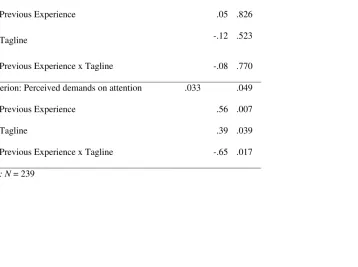
Two multiple regression analyses were conducted to answer this study’s research questions. Prior experience with smartphones served as a continuous predictor variable, and smartphone cue was dummy-coded for the purpose of these analyses. The criterion of interest varied by research question. To investigate RQ1, perceived ease of input was regressed onto (a) prior experience with smartphones, (b) the presence of a smartphone cue, and (c) the interaction between these two predictors. Results of this analysis, shown in Table 2, indicated that the interaction between experience and the presence of a tagline was not a significant predictor of perceived ease of input. Furthermore, although experience did not significantly predict ease of input in this analysis, its inclusion in the analysis did reduce the
The multiple regression analysis conducted to test RQ2 included the same predictors indicated above but a different criterion - perceptions of the demands on the target’s
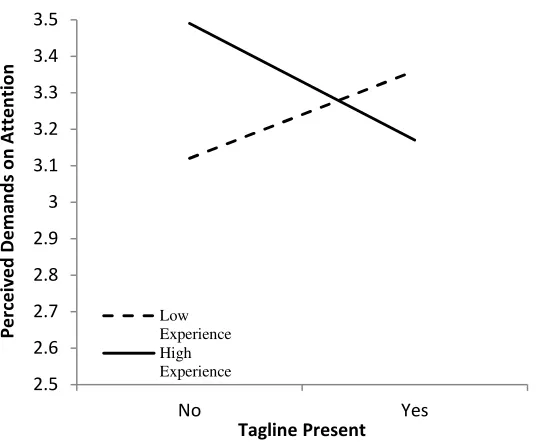
attention. The regression to test RQ2 showed that the interaction between experience and tagline was a significant predictor of perceived demands on attention, as seen in Table 2. To explore the nature of this interaction, participants were divided into high and low
experience groups based on whether their experience score fell above or below the median. As shown in Figure 2, relatively inexperienced individuals were more likely to perceive demands on attention in the tagline condition than the no tagline condition, while those who are high in smartphone experience were more likely to perceive demands on attention in the no tagline condition than in the tagline condition.
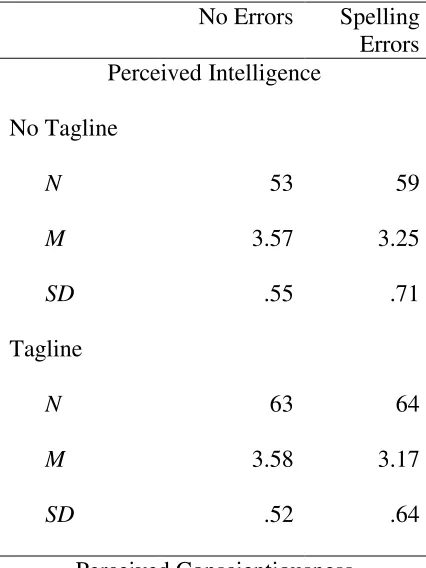
Next, the manipulations’ effects on attributions about the email sender’s disposition were examined. Table 3 provides descriptive statistics which show how the email sender with and without spelling errors was perceived. As indicated by the two-way ANOVAs shown in Table 4, the data revealed main effects such that spelling errors adversely affected perceptions of the email sender’s intelligence and conscientiousness. The tests of hypotheses 3 and 4 entailed an examination of the interaction between a smartphone cue and spelling errors on perceptions of the target’s intelligence (H3) and conscientiousness (H4). As shown in Table 4, there was no significant interaction between tagline and spelling errors on the dependent variables. Thus, hypotheses 3 and 4 were not supported.
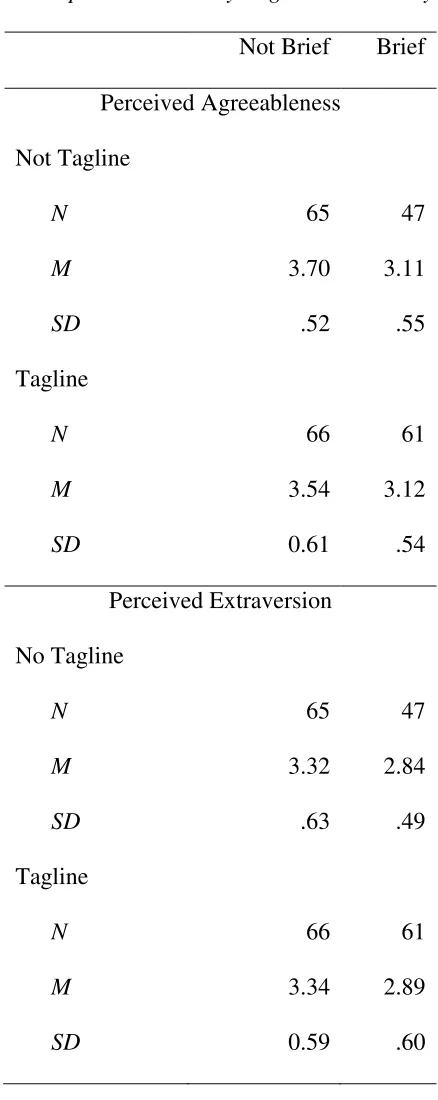
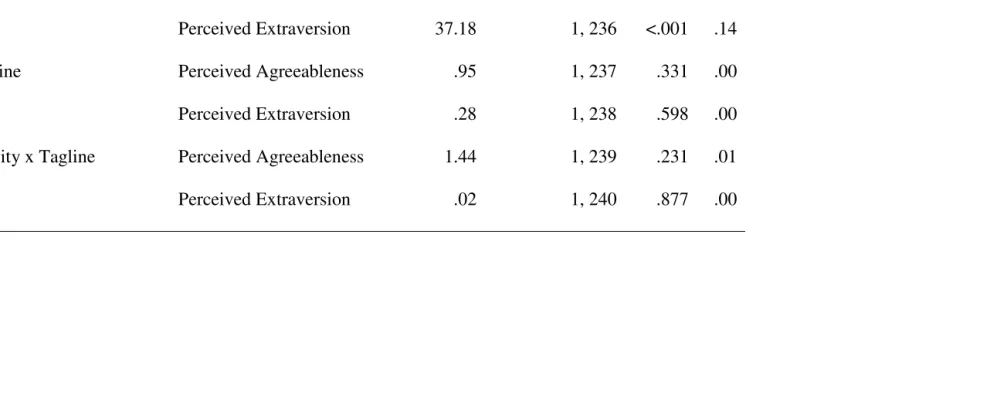
email sender’s agreeableness and extraversion. The tests of hypotheses 5 and 6 entailed an examination of the interaction between a smartphone cue and brevity on perceptions of the target’s agreeableness (H5) and extraversion (H6). As shown in Table 6, there was no significant interaction between tagline and brevity on the dependent variables. Thus, hypotheses 5 and 6 were not supported.
Discussion
The use of mobile phone technologies has increased in recent years (IDC, 2012), with 27% of these mobile devices qualifying as smartphones (comScore, 2011). This issue
becomes even more pertinent when one considers that 25% of internet users in the US only access the web with a smartphone. This number increases to as high as 70% in developing countries (mobiThinking, 2012). Based on these factors, increased research on
communication via smartphone is essential. Though there has been research on the topic of attributions made during CMC (Cramton, 2001; Vignovic & Thompson, 2010), no prior work has focused on attributions linked to users of emerging mobile technologies. This study highlights one of the potential pitfalls of mobile CMC use that could put smartphone users at a disadvantage.
The current study sought to determine the effect that experience with smartphones has on individuals' perceptions about the situational constraints confronted by those using
smartphones to communicate. Individuals seem to note the physical constraint that typing on a smartphone keyboard imposes. Contrary to expectation, smartphone usage did not
depends on the “eyes of the beholder,” so to speak – that is, the degree to which the email recipient him or herself possesses experience with a smartphone. Individuals with relatively little smartphone experience appear to be especially likely to view email senders as having other demands on their attention when they know that a smartphone is being used.
Contrariwise, individuals with relatively high experience with smartphones are less likely to perceive such demands when they know that a smartphone is being used; if anything, they appear to associate lower demands on attention with smartphone usage (see Figure 2). Though it is apparent that aspects of the recipient affect perceptions of the email sender, more research is needed to explain this interaction. Perhaps it has something to do with different usage habits among those with low and high mobile computing experience.
Consistent with previous research (Cramton, 2001; Vignovic & Thompson, 2010), this study showed that emails that were brief or contained spelling errors prompted negative attributions about the sender. Specifically, individuals who wrote a brief email were
perceived to be less agreeable and extraverted than individuals who wrote a longer email. Also, individuals who sent an email that contained spelling errors were perceived to be less conscientious and intelligent than those who composed an email that did not contain spelling errors.
as being pro-Castro, even knowing that the writers were assigned to take this position in the essay (Jones & Harris, 1967). Jones and Harris’s (1967) study demonstrated that individuals made attributions based on the most salient, or prominent, information available (in this instance, the essay), and ignored the context in which it was presented. Smith and Miller (1979) also found that the salience of situational information affected attributions, especially after a delay period. In the current context, a smartphone tagline though perceptible, may not be a salient enough cue to outweigh or alter the effects of spelling errors and brevity.
Whereas situational information did not significantly attenuate the negative effects of spelling errors in the current study, Vignovic and Thompson (2010) found that a cue
“background”), whereas the current study’s spelling errors consisted of unambiguous typos – that is, words that were misspelled in any context (e.g., “yuo" instead of “you”).
Limitations and Future Research
One potential limitation of the current study is the imbalance in the gender of participants, with almost twice as many women responding as men. This seems to be
consistent with the general demographic trends of Mechanical Turk users, which is likely due to the number of females who are unemployed, underemployed, or stay-at-home parents (Ipeirotis, 2010). There were, however, no differences in measured variables between men and women in this study.
Another limitation of the study is the generalizability of the findings to all CMC contexts. The study uses the context of two individuals who have never previously
corresponded and thus are relying on the text of the email to convey first impressions. The results may not generalize to correspondence between two individuals who have experience with each other from previous occasions.
Future research should focus on determining whether further manipulations of the smartphone tagline would affect the attributions being made. For the purpose of this study, the tagline “sent from my iPhone” was used, which gives an indication that the email was being sent from a mobile device. However, it may be too implicit of a cue. A tagline similar to “This message was sent using a portable device. Please excuse any brevity or typos” could potentially be used as an explicit cue to make the context more salient to the recipient, which may affect the attributions made. Taglines similar to this are becoming prevalent, and sometimes even recommended (Bradley-Banta, n.d.; Dial, 2009; Standss, 2010) by web log (blog) users.
Future research could also focus on attributions made using other forms of
communication technologies, such as speech-to-text programs. These are used for hands-free communication while driving, as well as for simplified dictation. It would be interesting to determine whether the same effects found in this study would be found when these other sorts of technology are used. Additional research could also look at attributions made about emails sent from other forms of mobile devices, such as tablet computers. A tagline on an email sent from a tablet may convey a much different message than one sent using a
smartphone. For example, email recipients may not view these technologies as being quite as limiting as smartphones because their screens and keyboards are much larger.
Practical Implications
the available information, and if an email is very brief or contains spelling errors, then the sender of the email may be judged negatively. Even with the addition of a contextual cue conveying a situational constraint, email recipients may still make these negative attributions.
Because the use of mobile devices to conduct business will likely increase in the near future, individuals should be aware that the taglines included in emails sent from these devices do not necessarily mitigate the effects of spelling errors or brevity on the attributions that may be made based on the content and form of their emails. While previous research has demonstrated that a contextual cue can sometimes allow forgiveness of these mistakes
References
Android surges among handset purchasers. (2010, January 13). Retrieved from eMarketer:
http://www.emarketer.com/Article.aspx?R=1007462
Amichai-Hamburger, Y. (2008). Potential and promise of online volunteering. Computers in Human Behavior, 24, 544-562. doi:10.1016/j.chb.2007.02.004
Baron, N. S. (2008). Always on: Language in an online and mobile world. New York, NY: Oxford University Press.
Bradley-Banta, T. (n.d.). What’s Does Your Smartphone Signature Say? [Web log
comment]. Retrieved from http://bigfishtopdogs.com/2010/12/what%E2%80%99s-does-your-smartphone-signature-say/
Carmel, E. (1999). Global software teams. Upper Saddle River, NJ: Prentice Hall PTR. Cohen, J. (1992). A power primer. Psychological Bulletin, 112(1). 155-159.
comScore (February, 2011). comScore Releases Inaugural Report, “The 2010 Mobile Year in Review.” Retrieved from
http://www.comscore.com/Press_Events/Press_Releases/2011/2/comScore_Releases_ Inaugural_Report_The_2010_Mobile_Year_in_Review
Connell, J. B. (2000). Influencing and perceiving others: How communication media affect impression management and person perception. (Doctoral dissertation). Available
from Dissertations & Theses database. (UMI No. 9979594).
Cramton, C. D. (2001). The mutual knowledge problem and its consequences for dispersed collaboration. Organization Science, 12(3), 346-371.
Dial, M. (2009, November 14). What’s the Best Automatic Smartphone Signature? [Web log comment]. Retrieved from http://themyndset.com/2009/11/whats-the-best-automatic-signature
Faul, F., Erdfelder, E., Buchner, A., & Lang, A.G. (2009). Statistical power analyses using G*Power 3.1: Tests for correlation and regression analyses. Behavior Research Methods, 41, 1149-1160.
Figueredo, L., & Varnhagen, C. K. (2005). Didn't you run the spell checker? Effects of type of spelling error and use of a spell checker on perceptions of the author. Reading Psychology, 26(4-5), 441-458. doi:10.1080/02702710500400495
Gahran, A. (2010, September 30). Most Americans still don't have smartphones. Retrieved from CNN.com:
http://edition.cnn.com/2010/TECH/mobile/09/30/gahran.smartphone.ownership/ Goldberg, L. (1999). A broad bandwidth, public domain, personality inventory measuring the
lower-level facets of several five-factor models. In I. Merviedle, I. Deary, F. Fruyt, & F. Osetendorf, Personality Pychology in Europe (Vol. 7, pp. 7-28). Tilburg, The Netherlands: Tilburg University Press.
Graziano, W. G., & Eisenberg, N. (1997). Agreeableness: A dimension of personality. In R. Hogan, S. Briggs, & J. Johnson, (1997). Handbook of Personality Psychology. San Diego, CA: Academic Press. doi:10.1016/B978-012134645-4/50031-7
IDC (February, 2012). Worldwide Mobile Phone Market Maintains Its Growth Trajectory in the Fourth Quarter Despite Soft Demand for Feature Phones [Press release].
Ipeirotis, P. G. (2010) Demographics of Mechanical Turk (CeDER-10-01)[Data File and Report]. Retrieved from http://hdl.handle.net/2451/29585
Jessmer, S. L., & Anderson, D. (2001). The effect of politeness and grammar on user
perceptions of electronic mail. North American Journal of Psychology, 3(2), 331-346. Jones, E. E., & Harris, V. A. (1967). The Attribution of Attitudes. Journal Of Experimental
Social Psychology, 3(1), 1-24. doi:10.1016/0022-1031(67)90034-0
Jünemann, E., & Lloyd, B. (2003). Consulting for virtual excellence: Virtual teamwork as a task for consultants. Team Performance Managment: An International Journal, 9(7/8), 182-189.
Kiesler, S., Siegel, J., & McGuire, T. W. (1984). Social psychological aspects of computer-mediated communication. American Psychologist, 39(10), 1123-1134.
doi:10.1037/0003-066X.39.10.1123
Kreiner, D. S., Schnakenberg, S. D., Green, A. G., Costello, M. J., & McClin, A. F. (2002). Effects of spelling errors on the perception of writers. The Journal of General Psychology, 129(1), 5-17. doi:10.1080/00221300209602029
Lea, M., & Spears, R. (1992). Paralanguage and social perception in computer-mediated communication. Journal of Organizational Computing and Electronic Commerce, 2(3), 321-341. doi:10.1080/10919399209540190
Meade, A. W., & Craig, S. B. (In press). Identifying careless responses in survey data. Psychological Methods.
mobiThinking (February, 2012). Global mobile statistics 2012: all quality mobile marketing research, mobile Web stats, subscribers, ad revenue, usage, trends…Retrieved from
http://mobithinking.com/mobile-marketing-tools/latest-mobile-stats
Ross, L. (1977). The intuitive psychologist and his shortcomings: Distortions in the attribution process. In L. Berkowitz, Advances in Experimental Social Psychology (Vol. 10, pp. 173-220). New York, New York: Academic Press, Inc.
doi:10.1016/S0065-2601(08)60357-3
Smartphone Statistics. (n.d.). Retrieved from Shut Up and Google It:
http://www.shutupandgoogleit.com/component/content/article/3-smartphone-articles/58
Smith, E. R., & Miller, F. D. (1979). Salience and the cognitive mediation of attribution. Journal Of Personality And Social Psychology, 37(12), 2240-2252.
doi:10.1037/0022-3514.37.12.2240
Standss (2010, July 12). Signatures on emails sent from Smartphones (IPhones/BlackBerries etc). [Web log comment]. Retrieved from
http://www.standss.com/blog/index.php/signatures-emails-smartphones-iphonesblackberries/
Taylor, S. E., & Martin, J. (2004). The academic marathon: Controlling one's career. In J. M. Darley, M. P. Zanna, & H. L. Roedigger, The Compleat Academic: A Career Guide (2 ed., pp. 363-392). Washington, DC: American Psychological Association.
Vignovic, J. A., & Thompson, L. F. (2010). Computer-mediated cross-cultural collaboration: Attributing communication errors to the person versus the situation. Journal of Applied Psychology, 95(2), 265-276. doi:10.1037/a0018628
Walther, J. B. (2007). Selective self-presentation in computer-mediated communication: Hyperpersonal dimensions of technology, language, and cognition. Computers in Human Behavior, 23(5), 2538-2557. doi:10.1016/j.chb.2006.05.002
Wilson, E. V. (2005). Persuasive effects of system features in computer-mediated
Table 1
Manipulation Checks
Tagline Spelling Errors Brevity
No Tagline Tagline t(df=231) No Errors Errors t(df=237) Not Brief Brief t(df=237)
Perceived Tagline M 3.10 4.10 -10.06*
SD .66 .88
Perceived Spelling Errors M 2.67 4.39
-15.13*
SD .81 .94
Perceived Brevity M 4.01 4.64
-7.60*
SD .71 .54
Table 2
Effect of Previous Experience on Perceptions of Constraints
R2 β p
Criterion: Perceived ease of input .030 .069
Previous Experience .05 .826
Tagline -.12 .523
Previous Experience x Tagline -.08 .770
Criterion: Perceived demands on attention .033 .049
Previous Experience .56 .007
Tagline .39 .039
Previous Experience x Tagline -.65 .017
Table 3
Descriptive Statistics Tagline and Spelling Error Conditions
No Errors Spelling
Errors Perceived Intelligence
No Tagline
N 53 59
M 3.57 3.25
SD .55 .71
Tagline
N 63 64
M 3.58 3.17
SD .52 .64
Perceived Conscientiousness No Tagline
N 53 59
M 3.63 3.16
SD .53 .81
Tagline
N 63 64
M 3.58 3.05
Table 4
ANOVAs Examining the Interaction of Spelling Errors and the Presence of a Smartphone Tagline on Perceptions of an Email Sender
Independent Variable Dependent Variable F df (b/w, w/in) p η2p
Spelling Errors Perceived Intelligence 21.49 1, 235 <.001 .08
Perceived Conscientiousness 31.20 1, 236 <.001 .12
Tagline Perceived Intelligence .20 1, 237 .653 .00
Perceived Conscientiousness .78 1, 238 .378 .00
Spelling Errors x Tagline Perceived Intelligence .28 1, 239 .596 .00
Table 5
Descriptive Statistics by Tagline and Brevity Conditions
Not Brief Brief
Perceived Agreeableness Not Tagline
N 65 47
M 3.70 3.11
SD .52 .55
Tagline
N 66 61
M 3.54 3.12
SD 0.61 .54
Perceived Extraversion No Tagline
N 65 47
M 3.32 2.84
SD .63 .49
Tagline
N 66 61
M 3.34 2.89
Table 6
ANOVAs Examining the Interaction of Brevity and the Presence of a Smartphone Tagline on Perceptions of an Email Sender
Independent Variable Dependent Variable F df (b/w, w/in) p η2p
Brevity Perceived Agreeableness 48.34 1, 235 <.001 .17
Perceived Extraversion 37.18 1, 236 <.001 .14
Tagline Perceived Agreeableness .95 1, 237 .331 .00
Perceived Extraversion .28 1, 238 .598 .00
Brevity x Tagline Perceived Agreeableness 1.44 1, 239 .231 .01
Figure 1. Factors influencing attributions formed during CMC Situational
Cue
Perceived Constraints
Email Misstep
Appendix A
Thesis Proposal Manuscript
Attributions in Mobile Computer Mediated Communication
by
Kyle Edward Morgan
A proposal submitted to the Graduate Faculty of North Carolina State University
in partial fulfillment of the requirements for the degree of
Master of Science Psychology
Raleigh, North Carolina 2011
APPROVED BY:
_________________________ _________________________ Dr. Rupert W. Nacoste Dr. Samuel B. Pond
Table of Contents
List of Figures
Attributions in Mobile Computer Mediated Communication
Computer Mediated Communication (CMC) is one of the prominent contributions of the digital age. It impacts the way in which people stay in touch with friends and family and has even changed the way that business is run. CMC refers to any method of communicating online, such as instant messaging and email (Baron, 2008). Though this method of
communication has been around for decades, with the advent of email occurring in 1971 (Baron, 2008), its use is rapidly evolving alongside the technologies which facilitate it, so much so that some individuals attribute the degradation of the English language to the technologies through which we communicate (Baron, 2008; Stephens, Houser, & Cowan, 2009).
One notable trend in computer-assisted business is the use of mobile technologies such as smartphones for CMC. Constraints inherent in these technologies have the potential to influence communication styles, with implications for how mobile CMC users are
perceived and the relationships they develop with coworkers. The present study considers this practical problem from a theory-driven perspective. The purpose of this study is to investigate how to mitigate negative dispositional attributions which may otherwise result when using mobile technologies during CMC.
CMC’s Fundamental Attribution Problem
reducing the pressure to make a decision immediately, which they may experience during face-to-face interaction. These and other advantages make CMC a crucial component of today’s work world.
Despite its benefits, there are potential drawbacks that accompany the use of CMC. Challenges stem from a lack of visual and auditory cues which can impede mutual
knowledge known to be important for effective collaboration. Mutual knowledge refers to knowledge that two communicating partners share, and know they share, in common (Cramton, 2001). It increases comprehension between partners and is fostered in part by direct knowledge. Direct knowledge is created through firsthand experience with an individual, allowing for predictions about behavior based on knowledge of his or her
environment and habits. During face-to-face collaboration, a great deal of information about a collaborator’s environment and habits can be acquired through nonverbal signals and other visual and auditory cues. Such cues are often absent during CMC. Virtual collaborators who are geographically dispersed, for example, may implicitly assume a common environment (e.g., computer equipment, office dynamics, scheduling constraints) across sites, even when such an assumption is not warranted. In reality, different work sites often face unique constraints, which may not be immediately visible or detectable to people relying on CMC. In short, auditory and visual cue deprivation puts virtual collaborators at risk for the “mutual knowledge problem,” which has been associated with misunderstandings and conflict during collaboration (Cramton, 2001).
word choices, a seemingly abrasive tone, or a failure to reply. These issues can be due to the communicator’s disposition (e.g., rudeness, carelessness), but they could also be the result of situational constraints, such as time restrictions and distractions, physical disabilities, or suboptimal equipment – for instance, a foreign keyboard or very small screen upon which to view and edit email.
People are likely to seek explanations when faced with unusual or suboptimal CMC exchanges, such as those marked by misspellings and interpersonal blunders. The
explanations they form are affected by the amount of direct knowledge they have about collaboration partners and their environments (Cramton, 2001). Accordingly, the mutual knowledge problem and communication missteps noted above are not isolated issues. They interrelate and operate in tandem. Their effects on interpersonal perceptions and
collaboration dynamics can be informed by theory predating the age of virtual collaboration. In particular, attribution theory is relevant.
According to attribution theory, individuals try to understand the causes and
implications of the events they witness (Ross, 1977). When these events are the behaviors of others, attributions are typically categorized as situational or dispositional. A situational attribution is one in which an individual sees the actions of another as based on
environmental constraints or facilitators. Conversely, a dispositional attribution is made when an individual assumes that another’s actions are based on the other’s nature, personality, or disposition.
nonverbal or implicit (Carmel, 1999). Individuals using CMC do not have the situational information present in face-to-face communication because they cannot see facial
expressions, hear inflections in their partners’ voices, or perceive other potentially relevant cues. Even voice-only communication such as a telephone call can impart certain inflections that convey unspoken meaning which does not get transmitted during text-based CMC. Conversational cues can be anything from nuances of meaning and frame of mind to details that people might infer from their counterpart’s demeanor or expression (Kiesler, Siegel, & McGuire, 1984). These cues can also include non-conversational information such as being able to see screaming children in the background or clues suggesting that one’s conversation partner is from a different culture. Because of this lack of situational information,
individuals are especially likely to attribute CMC counterparts’ behaviors to their personality characteristics or disposition (Amichai-Hamburger, 2008; Connell, 2001) rather than taking the environment into consideration. This challenge is compounded by the fact that people are already prone to making dispositional attributions, a phenomenon known as the
fundamental attribution error (Ross, 1977). The fundamental attribution error refers to the propensity to underestimate situational factors in favor of dispositional explanations for others’ behaviors – explanations which could very well be incorrect. These incorrect attributions can lead to adverse outcomes, ranging from miscommunications to misconceptions during CMC.
In support of the preceding arguments, the literature has documented the inclination to explain misspelled and exceedingly brief communications in dispositional terms.
attributions about the intellectual ability of the message’s composer (Kreiner, Schnakenberg, Green, Costello, & McClin, 2002; Figueredo & Varnhagen, 2005). Grammatical and
typographical errors have also been shown to reduce recipients’ views of a sender’s
rationality (Wilson, 2005), competency (Jessmer & Anderson, 2001) and intelligence (Lea & Spears, 1992). If errors are found consistently during communication, then the sender could also be seen as careless (Lea & Spears, 1992) or lacking in conscientiousness (Vignovic & Thompson, 2010).
The tone and brevity of an email has also been shown to trigger dispositional
attributions. Previous studies have shown that individuals who spend more time composing and editing their electronic communication are seen as having greater social orientation (Walther, 2007). Authors of polite messages are also viewed as more likeable (Jessmer & Anderson, 2001). Some individuals only impart the necessary information in a message, without any regard for pleasantries (Carmel, 1999). However, this may be construed as rude (Taylor & Martin, 2004). Individuals who are rude are typically thought to be low in agreeableness (McCrae & Costa, 1987), a construct often associated with warmth and friendliness (Graziano & Eisenberg, 1997). Past research has shown that people who send brief email messages are indeed perceived as low in agreeableness as well as extraversion, which is a disposition characterized as sociable, fun-loving, and talkative (McCrae & Costa, 1987; Vignovic & Thompson, 2010).
environmental constraints they cannot see. It is in this context that the smartphone – a notable trend in modern day CMC – takes place.
Mobile CMC
Smartphones, or mobile phones that have email and other internet capabilities, are becoming increasingly popular. An early example is the Blackberry™, which was only recently outsold by the iPhone™ and Android™ systems (“Android surges,” 2010). One survey reported that 42% of US respondents owned a smartphone (“Android surges,” 2010) with that percentage being about 12% worldwide (“Smartphone Statistics,” n.d.). Some estimates, however, place the percentage of Americans owning smartphones at about 17% (Gahran, 2010). Of the reported 12% of individuals worldwide who use smartphones, 48% use them to aid in their business activities (“Smartphone Statistics,” n.d.).
Mobile technologies such as smartphones provide a relatively new medium for CMC. While freeing users from some limitations, smartphones introduce new constraints,
presenting unique challenges in addition to those encountered when traditional CMC occurs through a full-sized computer. For example, smartphones typically include a standard QWERTY keyboard either on a small touchscreen or a tactile keyboard which places very small buttons below the screen. As such, they can be more difficult to use than desktop and laptop computers. Not only do smartphones have smaller keyboards, which can make input difficult, they also have smaller screens, which may cause typographical errors to be
the midst of other activities. The presence of distractions, combined with the difficulty of using a small keyboard and screen, can contribute to typographical errors and brevity which may in turn adversely affect how email communicators are perceived.
Signaling Situational Constraints During Mobile CMC
In short, smartphones impose constraints which are likely to result in communication missteps that get blamed on the user rather than the technology. It should be noted, however, that past research has shown that email recipients will excuse blunders such as typographical errors when their communication partner’s situational constraints are explicitly conveyed (Vignovic & Thompson, 2010). A cue signaling the use of a smartphone should thus reduce the fundamental attribution error during CMC. This premise is depicted in Figure 1, which shows the conceptual model driving the current research study.
One possible way to help email recipients realize the power of situational constraints on mobile CMC users’ communication styles is to include a relevant “tagline” along with email messages sent from a smartphone. Indeed, smartphone software typically comes equipped with a default tagline – a “signature” of sorts included at the bottom of each email. This tagline informs email recipients that a smartphone was used to send the message. For example, at the time of this writing, “Sent from my iPhone” is the default tagline included on messages sent from an Apple® iPhone ™.
Such default taglines can be easily deleted or turned off so that they no longer appear. When present, they may serve as a situational cue allowing the recipient to infer the
perceived to be more difficult than typing on a full-sized keyboard (Baron, 2008). Thus, one of the major constraints imposed by using a smartphone is the difficulty of typing on a scaled down keyboard, either physical or on a touchscreen. The smartphone tagline is expected to signal this constraint to email recipients.
H1: A smartphone cue will reduce email recipients’ perceptions of the sender’s ease of input.
Presumably, individuals who use mobile devices to send email typically do so when they do not have immediate access to a full-sized computer, meaning they are away from their everyday workstation. This increases the likelihood that mobile CMC occurs in the midst of other activities rather than occurring during fully dedicated “computer time.” Such multitasking could impose cognitive or attentional constraints in addition to the physical (keyboard, input) constraints indicated above. For example, the mobile CMC sender may be pressed for time, sending a quick email while waiting in line at an airport or coffee shop. The sender could also be distracted by things in his or her environment. Perhaps a parent who is waiting with a sick child in the doctor’s office wishes to keep up with work demands and so is sending emails from his or her phone.
By indicating the use of a mobile technology, the smartphone tagline is expected to signal time and attention constraints. These propositions will be tested.
H2: A smartphone cue will increase email recipients’ perceptions of a sender’s time constraints.
As noted earlier, spelling errors in CMC have been shown to reduce perceptions of intelligence and conscientiousness, whereas brevity reduces perceptions of agreeableness and extraversion. However, congruent with attribution theory, the negative effect of these
communication styles can be attenuated when a contextual cue is added to the message. In a study by Vignovic and Thompson (2010), participants excused typographical errors (though not brevity) when given a cue indicating that the email sender was from a foreign culture. In the case of mobile technologies, a smartphone cue is expected to similarly act as a situational cue indicating the constraints placed on the sender. By offering this situational cue, it is expected that the effect of communication errors on assumptions about the sender’s disposition should be reduced. That is, email recipients will make fewer dispositional attributions than they would without the cue.
H4-H5: There will be an interaction between situational information and spelling errors such that a smartphone cue will reduce the negative effects of spelling errors on recipients’ perceptions of an email sender’s (H4) intelligence and (H5)
conscientiousness.
H6-H7: There will be an interaction between situational information and brevity such that a smartphone cue will reduce the negative effects of brevity on recipients’
perceptions of an email sender’s (H6) agreeableness and (H7) extraversion.
Experience with Mobile Technologies
a mobile device to send emails. Individuals who have no experience using a mobile phone may underestimate or overestimate the difficulty of input as well as the time and attention constraints surrounding mobile CMC. Perhaps people with experience using mobile devices better appreciate the nontrivial challenges imposed by the technology. Alternatively,
practiced users may consider it quite easy to type on a smartphone or may otherwise hold unique perceptions of the time and attentional demands occurring during mobile CMC. This is an area which needs exploration.
RQ1-RQ3: Will an email recipient’s prior experience with smartphones influence the degree to which a smartphone cue affects perceptions of the sender’s (RQ1) ease of input, (RQ2) time constraints, and (RQ3) demands on his/her attention?
reduced effect on the dispositional attributions formed by experienced users. This possibility will be explored.
RQ 4-RQ5: Is there a three-way interaction between experience with smartphones, the presence of a smartphone cue, and spelling errors on (RQ4) perceived intelligence and (RQ5) perceived conscientiousness?
RQ 6-RQ7: Is there a three-way interaction between experience with smartphones, the presence of a smartphone cue, and brevity on (RQ6) perceived agreeableness and (RQ7) perceived extraversion?
Method Participants
Participants for this study were recruited through Amazon’s Mechanical Turk Service. This service gives researchers access to a large number of participants around the world through an online survey system. For the purpose of this study, respondents will be limited to those who live in the US and speak English as their first language. Participants in the current study were ##% male, and ##% had a bachelor’s degree or higher. Overall, ##% were Caucasian, ##% were African-American, ##% were Asian, and ##% were of another ethnicity. The average age of participants was ## (SD = #.##). Participants were paid $.05 for their participation in this study.
Design
not present, where no such cue is given. The spelling error variable also has two levels corresponding to: (a) an email which contained no spelling errors and (b) an email which contained spelling errors. Finally, the brevity condition’s two levels were: (a) a very brief email which was short and to the point and (b) a lengthier email which included non-substantive conversational verbiage. In addition to the three manipulated independent variables described above, this study includes a subject variable, prior experience, which refers to the participants’ experience with a smartphone. The seven dependent variables included in this study are perceptions of the email sender’s: ease of input, time constraints, demands on attention, intelligence, conscientiousness, agreeableness, and extraversion. Procedure
Participants were informed that the purpose of this study is to examine individuals’ perceptions of coworkers they meet through email. After providing informed consent (See Appendix A), participants were randomly assigned to one of eight websites corresponding to the eight study conditions. Participants read an email exchange between two people who work for the same organization but have never met. The first employee, Luis Hagan, sent an email message to the second, David Hanson, referred to later as the “target,” who replies. The context was one in which Luis contacts David to set up a meeting for a project the two were to be working on together. The initial email, from Luis, contained 161 words with no typographical errors. See Appendix B.
The first email message, from Luis, was identical across conditions. The
each study condition are shown in Appendix B. The brief reply contained 7 words, compared to the 40 words included in the standard (i.e., non-brief) reply. The additional text in the lengthier email was not substantive, that is, did not add additional information which may influence participants’ perceptions beyond that of the manipulation. For instance, whereas “Let’s meet in your office” appeared in the lengthier email, in the brief email it was
shortened to “Your office.”
Half of the brief replies contained 2 misspellings and half were error-free. Half of the standard (non-brief) replies contained 6 misspellings and half were error free. Misspellings used in the emails were typographical, not grammatical, in nature. For instance, omitted letters or incorrect capitalizations were used, whereas homophones were not. Half of all replies included the following tagline: “Sent from my iPhone.”
Participants were allowed to spend as much time as they wished reading the email exchange. They were informed that they were going to be asked to rate their perceptions of David (i.e., the target individual who replied to the initial email) once they finished reading the correspondence. When they finished reading the correspondence, participants were asked to click “next,” after which they will no longer had access to the email exchange. They then rated the target on the seven dependent variables of interest. Afterwards, they were asked to respond to items that gather information about their demographics and their experience with smartphones. Finally, participants were thanked, debriefed, and dismissed.
appropriately test the hypotheses, a sample size of 128 would have an adequate statistical power of .8 for α = .05 to detect a medium effect size of .25 (see Cohen, 1998).
Measured Variables
Manipulation checks (6 items, Appendix C). Participants responded to 6
manipulation check items which were designed to assess detection of the stimulus conditions – cue (2 items), brevity (2 items), and spelling errors (2 items). Examples include: “David used an iPhone to reply to Luis,” “David’s reply was very brief,” and “David’s reply contained spelling errors.”
Perceived ease of input (8 items, α = .##, Appendix D). Eight items were created for the purpose of this study to assess participants’ perceptions of the target’s ease of input. A sample item is, “David probably had difficulty typing the email message he sent to Luis” (reverse scored). Higher scores on this scale represented heightened perceptions of the ease with which the target email sender composed his message.
Perceived time constraints (6 items, α = .##, Appendix E). Six items were created for the purpose of this study to assess participants’ perceptions of the target’s time
constraints. A sample item is, “David probably took his time when writing the email” (reverse scored). Higher scores indicated increased perceptions of time constraints imposed on the target email sender while he composed his message.
Perceived demands on attention (6 items, α = .##, Appendix F). Six items were created for the purpose of this study to assess participants’ perceptions of the target’s
to Luis.” Higher scores indicated increased perceptions of demands on the target’s attention while he composed his message.
Perceived intelligence (7 items, α = .##, Appendix G). Seven items were created for the purpose of this study to assess participants’ perceptions of the target’s intelligence. A sample item is, “David probably is good at solving problems.”
Perceived conscientiousness (10 items, α = .##, Appendix H). Ten items from Goldberg’s International Personality Item Pool (IPIP; 1999) were used to assess participants’ perceptions of the target’s conscientiousness. Items were rated on a 1 (Very Inaccurate) to 5 (Very Accurate) scale. A sample item is, “David probably pays attention to detail.”
Perceived agreeableness (10 items, α = .##, Appendix H). Ten items from
Goldberg’s International Personality Item Pool (IPIP; 1999) were used to assess participants’ perceptions of the target’s agreeableness. Items were rated on a 1 (Very Inaccurate) to 5 (Very Accurate) scale. A sample item is, “David probably makes people feel at ease.”
Perceived extraversion (10 items, α = .##, Appendix H). Ten items from Goldberg’s International Personality Item Pool (IPIP; 1999) were used to assess participants’ perceptions of the target’s extraversion. Items were rated on a 1 (Very Inaccurate) to 5 (Very Accurate) scale. A sample item is, “David probably knows how to captivate people.”
Prior experience (6 items, α = .##, Appendix I). Six items were created for the purpose of this study to assess participants’ experience using smartphones. A sample item is, “I have experience using a smartphone.”
(strongly agree) Likert-type rating scale. Responses to any negatively worded statements were reflected prior to aggregating the items comprising each scale.
Proposed Analyses
A 2 x 2 x 2 MANOVA with follow-up univariate analyses was conducted to test hypotheses 1-7. The three independent variables were presence of cue, spelling errors, and brevity. The seven dependent variables were: ease of input, time constraints, demands on attention, intelligence, conscientiousness, agreeableness, and extraversion. The first three hypotheses were tested by examining the main effect of a smartphone cue on (H1) perceptions of the target’s ease of input, (H2) perceptions of the demands on the target’s attention, and (H3) perceptions of the demands on the target’s attention. The tests of
hypotheses 4 and 5 entailed an examination of the interaction between a smartphone cue and spelling errors on perceptions of the target’s (H4) intelligence and (H5) conscientiousness. The tests of hypotheses 6 and 7 entailed an examination of the interaction between a smartphone cue and brevity on perceptions of the target’s (H6) agreeableness and (H7) extraversion.