i
TRUSTED CLOUD COMPUTING FRAMEWORK IN CRITICAL INDUSTRIAL APPLICATION
MERVAT ADIB BAMIAH
TRUSTED CLOUD COMPUTING FRAMEWORK IN CRITICAL INDUSTRIAL APPLICATION
MERVAT ADIB BAMIAH
A thesis submitted in fulfilment of the requirements for the award of the degree of
Doctor of Software Engineering
Advanced Informatics School Universiti Teknologi Malaysia
iii
ACKNOWLEDGEMENT
v
ABSTRACT
Cloud computing facilitates instant online unlimited access to data and computing resources, ubiquitously and pervasively through its various service delivery and deployment models. Despite the significant advantages of cloud computing, still there are concerns regarding Security, Privacy and Trust (SPT) that resulted from consumers’ loss of control over their confidential data since they outsource it to cloud
ABSTRAK
vii
TABLE OF CONTENTS
CHAPTER TITLE PAGE
DECLARATION ii
DEDEICATION iii
ACKNOWLEDGEMENT iv
ABSTRACT v
ABSTRAK vi
TABLE OF CONTENTS vii
LIST OF TABLES xii
LIST OF FIGURES xiii
LIST OF ABBREVIATIONS xv
LIST OF APPENDICES xix
1 INTRODUCTION 1
1.1 Overview 1
1.2 Problem Background 2
1.3 Problem Statement 3
1.4 Research Aims and Objectives 3
1.5 Scope of Research 4
1.6 Significance of Research 5
1.7 Research Contributions 6
1.8 Thesis Organization 8
2 LITERATURE REVIEW 10
2.1 Introduction 10
2.2 Cloud Computing Definition 11
2.3 Cloud Computing Service Deployment Models 12
2.3.1 Private Cloud 12
2.3.2 Public Cloud 13
2.3.3 Hybrid Cloud 13
2.3.4 Community Cloud 13
2.4 Cloud Computing Service Delivery Models 14
2.4.1 Software as a Service 14
2.4.2 Platform as a Service 15
2.4.3 Infrastructure as a Service 15
2.5 Cloud Computing Concerns 15
2.5.1 Security 16
2.5.2 Privacy 17
2.5.3 Trust 17
2.5.4 Compliance 17
2.6 Cloud Computing SPT Standards 18
2.7 Cloud Computing Trust Aspects 19
2.7.1 Security 22
2.7.2 Privacy 27
2.7.3 Availability 27
2.7.4 Accountability and Auditability 28 2.7.5 Incidents Preparedness and Response 28
2.8 Trusted Computing Group 29
2.8.1 Trusted Platform Module 29
2.8.2 Trusted Software Stack 35
2.8.3 Trusted Network Connect 36
2.8.4 Trusted Storage 36
2.8.5 Virtual Trusted Platform Module 38
2.9 Identity and Access Management 39
2.10 Cloud Service Level Agreement 41
2.11 Cloud SLA Status in Healthcare 42
ix
2.13 Health Insurance Portability and Accountability Act 44 2.14 Healthcare Cloud Computing Trust Requirements 45 2.15 Healthcare Security and Privacy Requirements 46
2.16 Cloud Computing Related Work 48
2.16.1 Security on Demand Framework 49 2.16.2 Trusted Cloud Computing Infrastructure 51 2.16.3 A Framework for Secure Clouds 52 2.16.4 ABE Framework for Secure Sharing PHRs 54 2.16.5 Secure Electronic Healthcare in Cloud 55 2.17 Gap Analysis of Current Cloud Implementations 57
2.18 Research Roadmap 60
2.19 Summary 61
3 RESEARCH METHODOLOGY 62
3.1 Introduction 62
3.2 Cloud Computing and Software Engineering 63
3.3 Research Activities and Outcomes 64
3.4 Research Methodology 66
3.4.1 Literature Review 67
3.4.2 Analysis 68
3.4.3 Design 76
3.4.4 Development 77
3.4.5 Evaluation 77
3.5 Documentation 77
3.6 Research Limitations 77
3.7 Research Planning and Schedule 78
3.7.1 Phase 1 78
3.7.2 Phase 2 78
3.7.3 Phase 3 79
4 TRUSTED CLOUD COMPUTING FRAMEWORK DESIGN 80
4.1 Introduction 80
4.2 Research Design Assumptions 81
4.3 TCCF-Trust Definition 83
4.4 TCG Technologies 84
4.5 Customized Cloud SLA for Healthcare 85
4.6 Compliance with HIPAA Requirements 88
4.7 TCCF-Multi-Factor Authentication 88
4.8 TCCF-Data Security 88
4.8.1 Data Creation Security 89
4.8.2 Data Transfer (in Transmit) Security 90
4.8.3 Data in Use Security 91
4.8.4 Data Sharing Security 92
4.8.5 Data Storage Security 92
4.8.6 Data Backup Security 92
4.8.7 Data Archive Security 93
4.8.8 Data Destruction Security 93
4.9 Trusted Cloud Computing Framework (TCCF) 94
4.9.1 Physical Layer Security 97
4.9.2 Virtualization Layer Security 100
4.9.3 Application Layer Security 107
4.9.4 Middleware Security 109
4.10 TCCF-Password Policy 109
4.11 HTCCF-MFA-SSO-RBAC System Architecture 110 4.12 HTCCF-MFA-SSO-RBAC Prototype Use Case Diagrams 121 4.13 Summary
126
5 PROTOTYPE DEVELOPMENT 126
5.1 Introduction 126
5.2 Research Development Assumptions 127
5.3 HTCCF-MFA-SSO-RBAC System Development Process 127 5.3.1 Prototype, Screenshots and Code Snippets 129
xi
6 EVALUATING TRUSTED CLOUD COMPUTING
FRAMEWORK 146
6.1 Introduction 146
6.2 Compliance with ONC Security Requirements 147
6.3 Compliance with HIPAA 149
6.4 Cloud Computing Threats Mitigations 151 6.5 Comparison with Related Work Evaluation 154
6.6 Trust Evaluation 158
6.7 TCCF - Survey Evaluation 160
6.8 Summary
168
7 CONCLUSION AND FUTURE WORK 169
7.1 Introduction 169
7.2 Contributions and Significance 171
7.3 Limitations and Future Direction of Research 172
7.3.1 Implementation 172
7.3.2 Inter Cloud 172
7.3.3 Performance 172
7.3.4 SLA 173
7.3.5 Security Controls 173
7.4 Summary
174
REFERENCES 175
LIST OF TABLES
TABLE NO. TITLE PAGE
2.1 Gap Analysis of Current Cloud Implementations 57
3.1 Research Activities and Outcomes 64
3.2 LinkedIn Use Examples 70
3.3 Survey Distribution 72
3.4 Respondents Locations 75
3.5 Respondents Specializations 76
3.6 Thesis Timeline Planning 79
4.1 SLA Security Controls 87
4.2 Hypervisors Comparison 106
6.1 Compliance with ONC Security Guidelines 147
6.2 Compliance with HIPAA requirements 149
6.3 CSA Threats Mitigations 152
6.4 TCCF - Comparison with Related Work Evaluation 157
6.5 TCCF - Trust Evaluation 159
6.6 Survey Security Statistics 165
6.7 Data Scaling Physical Layer 166
6.8 Data Scaling Virtualization Layer 166
6.9 Data Scaling Application Layer 167
xiii
LIST OF FIGURES
FIGURE NO. TITLE PAGE
1.1 Top Cloud Computing Concerns 2
2.1 Cloud Computing Deployment Models 12
2.2 Cloud Service Delivery Models 14
2.3 TPM Components 31
2.4 Chain of Trust 34
2.5 vTPM Building Blocks Architecture 39
2.6 Security on Demand Framework 49
2.7 Cloud Computing Security Model 52
2.8 Cloud Computing Security Model 53
2.9 Patient-centric Framework 54
2.10 Privacy Domains in E-Health 56
2.11 Research Road Map 60
3.1 Research Methodology Phases 66
3.2 Survey Monkey Expert Feedback 71
3.3 Kwiksurvey Expert Feedback 72
3.4 Survey Expert 1 Feedback 73
3.5 Survey Expert 2 Feedback 74
4.1 TCCF-Cloud Data life Cycle 89
4.2 TCCF-layered Architecture 96
4.3 TCCF-Physical Layer 97
4.4 TCCF-Virtualization Layer 101
4.5 TCCF-Application Layer 107
4.6 Prototype Authentication Processes 112
4.8 CSA Authentication Activity Diagram 115
4.9 HSP Authentication Activity Diagram 117
4.10 Patient/User Authentication Activity Diagram 119
4.11 CSA Authentication Use Case Diagram 122
4,12 Healthcare Authentication Use Case Diagram 123 4.13 Patient /User Authentication Use Case Diagram 124
5.1 Prototype Home Page 128
5.2 Registration Page 129
5.3 CSA Registration Form 132
5.4 Healthcare Professional Registration Form 134
5.5 Patient/User Registration Form 136
5.6 Sign-in Main Menu 137
5.7 Biometric Authentication Process 138
5.8 Access Denied Message 138
5.9 Smart Card login Process 140
5.10 Username and Email Verification 140
5.11 Password Verification 143
5.12 Invalid Password Verification 143
5.13 Secret Question Challenge 144
5.14 Image Based Authentication 144
5.15 OTP Verification 145
6.1 TCCF - Physical Layer Evaluation 161
6.2 TCCF - Virtualization Layer Evaluation 162
6.3 TCCF- Application Layer Respondents Number 163
6.4 TCCF - Overall Evaluation Results 164
xv
LIST OF ABBREVIATIONS
AAs - Attribute Authorities ABE - Attribute Based Encryption AES - Advanced Encryption Standard AIK - Attestation Identity Key
API - Application Programming Interface BIOS - Basic Input Output System
BYOD - Bring Your Own Device CA - Certificate Authority
CASE - Cloud Aided Software Engineering CRTM - Core Root of Trust for Measurement
CSA - Cloud Service Administrator, Cloud Security Alliance CSCC - Cloud Standards Customer Council
CSP - Cloud Service Provider CSU - Cloud Service User
DDOS - Distributed Denial of Service DLC - Data Life Cycle
DOS - Denial of Service
EAL4+ - Evaluation Assurance Level 4+ E-Health - Electronic Health
EHRs - Electronic Health Records EK - Endorsement Key
EMRs - Electronic Medical Records
FISMA - Federal Information Security and Management Act HHS - Health and Human Services
HITECH - Health Information Technology for Economic and Clinical Health HSP - Healthcare Service Provider
HTCCF - Healthcare Trusted Cloud Computing Framework HTTPS - Hypertext Transfer Protocol Secure
IaaS - Infrastructure as a Service
IAM - Identity and Access Management
IDPS - Intrusion Detection and Prevention Systems IDS - Intrusion Detection systems
IEC - International Electro-technical Commission IF-MAP - Interface for Metadata Access Points IOT - Internet of Things
IPS - Intrusion Prevention Systems IPSec - Internet Protocol Security
ISO - International Organization for Standardization IT - Information Technology
ITSG-33 - Information Technology Security Guidance KVM - Kernel-based Virtual Machines
MA-ABE - Multi Authority Attribute Based Encryption MFA - Multi-Factor Authentication
ML - Measurement List NAC - Network Access Control NGFW - Next Generation Firewalls
NIST - National Institute of Standards and Technology OCR - Office for Civil Rights
ONC - Office of National Coordinator OS - Operating System
OTP - One-Time PIN
P1-MFA - Policy (1) Multi-Factor Authentication PaaS - Platform as a Service
PCI - Payment Card Industry
PCM - Platform Configuration Measurements PCRs - Platform Configuration Registers PDA - Personal Digital Assistant
xvii
PHRs - Personal Health Records PKI - Public Key Infrastructure PVI - Private Virtual Infrastructure QoS - Quality of Service
RBAC - Role Base Access Control RFID - Radio Frequency Identification RNG - Random Number Generator RSA - Rivest, Shamir, and Adelman RTM - Root of Trust for Measurement RTR - Root of Trust for Reporting RTS - Root of Trust for Storage SaaS - Software as a Service
SAML - Security Assertion Markup Language SDLC - Software Development Life Cycle SED - Self-Encrypting Drives
SFTP - Secure File Transfer Protocol SHA - Secure Hash Algorithm SLA - Service Level Agreement SLR - Systematic Literature Review SML - Stored Measurement Log SOA - Service Oriented Architecture SoD - Security on Demand
SPT - Security, Privacy and Trust SRK - Storage Root Key
SSH - Secure Shell SSO - Single Sign On SSL - Secure Sockets Layer
TC - Trusted Computing/Trusted Coordinator TCB - Trusted Computing Base
TCCF - Trusted Cloud Computing Framework TCCP - Trusted Cloud Computing Platform TCCI - Trusted Cloud Computing Infrastructure TCG - Trusted Computing Group
TEE - Trusted Execution Environment TLS - Transport Layer Security
TNC - Trusted Network Connect TOS - Trusted Operating System TP - Trusted Platform
TPM - Trusted Platform Module TM - Trust Monitor
TSS - Trusted Software Stack
TVCCE - Trusted Virtual Cloud Computing Environment TVD - Trusted Virtual Domain
TVDc - Trusted Virtual Data Center
TVEM - Trusted Virtual Environment Module TVMM - Trusted Virtual Machine Monitor US - United States
USD - United States Dollar UTE - User Trusted Entity VDc - Virtual Data Center VF - Virtual Firewall
VLAN - Virtual Local Area Network VM - Virtual Machine
VMM - Virtual Machine Monitor VPN - Virtual Private Network VTN - Virtual Trust Network
xix
LIST OF APPENDICES
APPENDIX TITLE PAGE
A Publications during author’s candidature 204
B Certificates during author’s candidature 207
C TCCF-Evaluation survey 208
1
CHAPTER 1
INTRODUCTION
1.1 Overview
2
1.2 Problem Background
Despite the numerous benefits of cloud computing in terms of scalability, resilience, adaptability, connectivity, virtualization and high performance, still there are several Security, Privacy and Trust (SPT) concerns that made critical information industries reluctant to deploy cloud computing for best business practices (Thilakanathan et al., 2013; Hsing, 2012; Servos, 2012; Shini et al., 2012; Khatua et al., 2011; Pearson and Benameur, 2010; Takabi et al., 2010). These SPT concerns
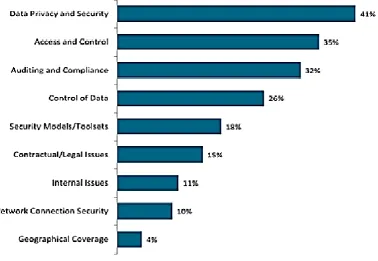
resulted from the loss of’ consumers direct control on their confidential data and computing resources when they outsource them to a remote third Cloud Service Provider (CSP) who facilitates the IT infrastructure, applications and management as services per demands. Since consumers’ data are at cloud storage, they do not know who is managing or accessing their data and where their storage locations are, which may cause a threat of data breach or misuse (Taeho et al., 2013; Ermakova and Fabian, 2013). Figure 1.1 demonstrates that data privacy and security are consumers’ top concerns with 41% which necessitate a trusted cloud solution that overcomes these concerns over deploying cloud computing.
1.3 Problem Statement
Consumers need to be assured that their privacy is preserved and their data are secured besides complying with rules and regulations. The problem statement that needs to be addressed is as follows
How to design a TCCF that maintains the security and privacy of consumers’
confidential data as well as complies with rules and regulations in order to be trusted
and deployed in critical information industries such as healthcare sector?
Designing a trusted cloud solution and solving the research problem statement will be achieved by answering the following research questions:
i. What are the current cloud computing security and privacy concerns that prevent critical information industries from trusting and adopting cloud computing?
ii. How to design a cloud computing framework that can fulfill the security and privacy concerns as well as assist in increasing the trust on cloud computing to be adopted in critical information industries?
iii. How to evaluate and ensure that the designed cloud computing framework will assist in overcoming the security and privacy concerns as well as increases the trust on cloud computing to be adopted critical information industries?
1.4 Research Aims and Objectives
According to Trusted Computing Group (TCG) (Donovan and Visnyak 2011), “There is no comprehensive framework exists to describe the business/mission needs and validate compliance of the entire solution set in compliance with open standards”.
4
business practices. In order to achieve the research aim, the following objectives should be accomplished.
i. To identify and critically analyze the current cloud computing security and privacy concerns that prevent critical information industries from trusting and adopting cloud computing.
ii. To design a cloud computing framework that can fulfill the security and privacy concerns as well as assist in increasing the trust on cloud computing to be adopted in critical information industries.
iii. To evaluate and ensure that the designed cloud computing framework will assist in overcoming the security and privacy concerns as well as increases the trust on cloud computing to be adopted critical information industries.
1.5 Scope of Research
1.6 Significance of Research
This research contributes to software engineering, public and scientific fields as well as to the body of knowledge as follows:
i. In software engineering field, this research contributes in understanding the cloud computing critical industries requirements. The TCCF contributes in overcoming the SPT concerns and providing trusted cloud services based on secure by design hardware and software execution environment as per experts expectations. Taking into consideration the trust aspects (security, privacy, accountability, and availability) (Muppala et al., 2012). Furthermore, by using cloud computing platform, software developers and programmers will be provided with the latest IT tools as a service on-demand that will accelerate the innovation of next generation smart devices, beside facilitating software development and delivery which enables software engineering researchers to study distributed multilateral software development (Østerlie, 2009).
ii. In public field, this research proposes a TCCF that overcomes the SPT concerns to be deployed in critical information industries specifically healthcare sector by providing secure cloud services on demand just-in-time in a cost effective manner that will enhance the QoSs provided to public.
iii. This research adds to science and technology fields as it is based on the usage of the software engineering methodology in gathering user requirements, designing, developing, implementing and testing the systems beside documentation (Bourque and Fairley, 2014). Moreover, providing an agile way of sharing the information in secure and trusted manner ubiquitously and pervasively through the use of cloud computing. In addition, also to addressing the challenge in designing a secure and trusted cloud computing framework for critical information industries including healthcare sector.
6
1.7 Research Contributions
Cloud computing facilitates consumers, users and software engineers the use of computing, storage and other resources over the network. It accelerates real time communication in software development projects that are scattered across the globe in cost effective manner (Munch, 2013). Cloud computing dynamic virtualized multi-tenant nature has raised enormous challenges for software engineers to design and develop trusted cloud applications, platforms, and infrastructures that provide secure services to critical information industries focusing on healthcare sector. In the domain of software engineering, a new term has emerged specifically to cloud computing which is named Cloud Aided Software Engineering (CASE 2.0) that applies the Software Development Life Cycle (SDLC) according to cloud specification’s starting with requirements gathering and analysis until development and deployment phases (Zingham and Saqib, 2013).
The Healthcare Trusted Cloud Computing Framework Multi Factor Authentication Single Sign on Role Base Access Control (HTCCF-MFA-SSO-RBAC) prototype is conducted based on the CASE 2.0. software engineering development process Therefore, this research contributes in the field of software engineering by providing a TCCF which secure the overall cloud infrastructure, data, communication and access, bounded by a customized SLA and complies with standards. This research has several contributions to overcome the SPT concerns in order to optimize the trust of consumers to adopt cloud computing as follows:
Contribution 2: TCCF proposes the integration of TCG technologies for enhanced security, privacy and interoperability. TCG’s Trusted Computing Platform (TCP) will be used to perform authentication, also to ensure confidentiality and integrity in cloud computing environment.
Contribution 3: TCCF proposes an additional context to be added to SLA according to healthcare requirements as a critical information industry which has its own requirements, rules and regulations that need to be guaranteed in the SLA.
Contribution 4: TCCF proposes the compliance with HIPAA data security and privacy rules and regulations.
Contribution 5: TCCF enforces data encryption in SLA at rest, while in the process and in transmit with the latest efficient encryption mechanisms in order to provide optimized level of data confidentiality besides complying with rules and regulations. Furthermore, TCCF also includes data backup in SLA and in the design as a separate phase for securing data availability and disaster recovery.
Contribution 6: TCCF proposes a robust password policy for usage and storage.
8
1.8 Thesis Organization
This thesis focuses on maintaining SPT in the TCCF to be used in healthcare sector. Complete research is organized into six chapters as follows:
Chapter 1 Introduction: This chapter explores the background of the problem which is about consumers’ lack of trust in cloud computing. Research questions, aims, and objectives were formulated as a guide for further studies in the following chapters in order to design and evaluate TCCF. The scope of the research has been identified as to conduct the research within the resources and time frame available. The rest of the chapter discusses the significance and contributions of the study.
Chapter 2 Literature Review: This chapter discusses cloud computing definition and concerns as well as the cloud current standards which the research will be based on. It provides an overview literature review of the research topic in relation to the existing cloud implementations in healthcare sector as a case study with more justification on the problems related to these projects. In addition to discussing cloud computing and TCG technologies that are going to be implemented in the research framework, beside the identification of the cloud SLA current status, in order to customize it regarding healthcare specifications. Moreover, HIPAA will also be discussed for designing the framework compliance requirements.
Chapter 3 Research Methodology: This chapter discusses the research activities and outcomes, research methodology guidelines, study population sampling methods, data collection methods, research limitation as well as planning and schedule.
Chapter 4 Trusted Cloud Computing Framework Design: This chapter introduces the components and designing stages of TCCF for critical information industries. The multi-layered security by design TCCF integrates TCG technologies and other security controls for overcoming the SPT concerns of cloud computing. Cloud Data Life Cycle security is also discussed in this chapter.
Chapter 5 Development of the Multi-Factor Authentication SSO Role Based Access Control Prototype: This chapter discusses the development process of the TCCF evaluation MFA prototype based on the CASE 2.0 approach.
Chapter 6 Evaluation of Trusted Cloud Computing Framework: This chapter introduces the evaluation methods of TCCF that include literature review comparison, a questionnaire survey based on experts’ feedbacks, and the compliance with HIPAA and CSA standards. The rest of the chapter presents a critical analysis of the survey and other evaluation methods results.
Chapter 7 Conclusion and Future Work: This chapter summarizes the whole study based on data analysis and interpretation. It discusses detailed research contributions, limitations, and future work directions.
1.9 Summary
175
REFERENCES
Abbadi, I., Deng, M., Nalin, M., Martin, A., Petkovic, A. and Baroni, I. (2011). Trustworthy Middleware Services in the Cloud. In Proceedings of the 2011 third international workshop on Cloud data management (CloudDB '11). ACM, 33-40.
DOI: 10.1145/2064085.2064094.
Abbadi, I. (2011a). Middleware Services at Cloud Application Layer. Proceedings of the 2011 Second International Workshop on Trust Management in P2P
Systems (IWTMP2PS ’11). Lecture Notes in Computer Science. Springer-Verlag,
Berlin, 557-571. DOI: 10.1007/978-3-642-22726-4_58.
Achemlal, M., Gharout S., and Gaber, C. (2011). Trusted Platform Module as an Enabler for Security in Cloud Computing. Proceedings of the 2011 Network and Information Systems Security (SAR-SSI). 18-21 May 2011. La Rochelle: IEEE, 1–6.
DOI: 10.1109/SAR-SSI.2011.5931361.
Adebiyi, A., Arreymbi, J. and Imafidon, C. (2012). Security Assessment of Software Design using Neural Network, International Journal of Advanced Research in Artificial Intelligence, 1 (4: 1-7. SAI Publications.
Ahmad, B. and Mohamed, S. (2011). Implementation of Trusted Computing Technologies in Cloud Computing. International Journal of Research and Reviews in Information Sciences (IJRIS). 1(1):1-3. Science Academy Publisher.
Alley, D., Ahmed, T., Androvich, J., Archibald, S., Andrew S., Fultz, N., Heusser, S., Keahey, R., Krogue, K., Menon, R., Morgenthal, J., Rice, A., Roberts, D., Ryan, C., Ulmer, S., Wheeler, H. and Wilson, K. (2012). The Cloud Computing Guide for Healthcare. Focus Research. Microsoft, 1-22.
Almorsy, M., Grundy, J. and Ibrahim, S. (2011). Collaboration-Based Cloud Computing Security Management Framework. Proceedings of the 2011 Cloud Computing (CLOUD). 4-9 July 2011. Washington, DC. IEEE, 364-371. DOI:
10.1109/CLOUD.2011.9.
Almutairi, A., Sarfraz, M., Basalamah, S., Aref, W. and Ghafoor, A. (2012). A Distributed Access Control Architecture for Cloud Computing. Proceedings of the 2012 Software. 20 February 2012. IEEE Computer Society. 29(2): 36 – 44. DOI: 10.1109/MS.2011.153.
Alshehri, S., Radziszowski, S. and Raj, R. (2012). Secure Access for Healthcare Data in the Cloud Using Ciphertext-Policy Attribute-Based Encryption. Proceedings of the 2012 Data Engineering Workshops (ICDEW), 2012 IEEE 28th International
Conference on. 1-5 April 2012. Arlington, VA. IEEE, 143-146. DOI:
10.1109/ICDEW.2012.68.
AlZain, M., Pardede, E., Soh, B. and Thom, J. (2012). Cloud Computing Security: From Single to Multi-clouds. Proceedings of the 2012 45th Hawaii International Conference on. System Science (HICSS). 4-7 January. 2012. Maui, HI. IEEE, 5490–
5499. DOI: 10.1109/HICSS.2012.153.
Anderson, J. (2011). The Top 10 Strategic Considerations to Address in a Government Solicitation for Cloud Computing Services. Retrieved on January 13, 2014, from http://safegov.org/2011/12/12/the-top-10-strategic-considerations-to-address-in-a-government-solicitation-for-cloud-computing-services
Angelov, S., Trienekens, J. and Kusters, R. (2014). A survey on design and usage of Software Reference Architectures. Retrieved October 23, 2014, from http://purl.tue.nl/24821036841001.pdf
Arora, P., Wadhawan, R. and Ahuja, S. (2012). Cloud Computing Security Issues in Infrastructure as a Service. International Journal of Advanced Research in Computer Science and Software Engineering (IJARCSSE). 2 (1), January 2012.
177
Ashford (2011). Self-encrypting drives: SED the best-kept secret in hard drive encryption security. Computer Weekly Retrieved on November 18, 2013, from http://www.computerweekly.com/feature/Self-encrypting-drives-SED-the-best-kept-secret-in-hard-drive-encryption-security
Ayad, M., Rodriguez, H. and Squire, J. (2012). Addressing HIPAA Security and Privacy Requirements in the Microsoft Cloud. Retrieved on December 23, 2013, fromhttp://smb.blob.core.windows.net/smbstaging/Content/Microsoft_Cloud_Heal thcare_HIPAA_Security_Privacy.pdf
Baaskar, R. and Gomathi, A. (2012). A Framework for Security Based Cloud by using Trusted Computing. International Journal of Advanced Research in Computer Science and Software Engineering (IJARCSSE). 2:36-40. December – 2012. ISSN:
2277 128X.
Badger, L., Grance, T., Patt-Corner, R. and Voas, J. (2012). Cloud Computing Synopsis and Recommendations. National Institute of Standards and Technology (NIST). Special Publication 800-146, Computer Security Division, 1-81.
Bamiah, M., Brohi, S., Chuprat, S. and Ab Manan, J. (2013). Trusted Cloud Computing Framework for Healthcare Sector. Journal of Computer Science. 10 (2):240-250. DOI: 10.3844/jcssp.2014.240.250. Science Publications.
Bamiah, M. (2013a) Evaluating Trusted Cloud Computing Framework for Healthcare.
LinkedIn. Retrieved on October 8, 2014, from
https://www.linkedin.com/nhome/updates?topic=5810666560951848960.
Bamiah, M., Brohi, S., Chuprat, S., and Brohi, M. (2012). Cloud Implementation Security Challenges. Proceedings of the 2012 Cloud Computing Technologies, Applications and Management (ICCCTAM). 8-10 December. 2012. Dubai. IEEE,
174–178. DOI:10.1109/ICCCTAM.2012.6488093.
Bamiah, M., Brohi, S., Chuprat, S. and Ab Manan, J. (2012a). A Study on Significance of Adopting Cloud Computing Paradigm in Healthcare Sector. Proceedings of the 2012 Cloud Computing Technologies, Applications and Management (ICCCTAM).
8-10 December, 2012. Dubai. IEEE, 65–68.
Bamiah, M., Brohi, S. and Chuprat, S. (2012b). Using Virtual Machine Monitors To Overcome The Challenges Of Monitoring And Managing Virtualized Cloud Infrastructures. Proc. SPIE 8349, Proceedings of the 2012 Fourth International Conference on Machine Vision (ICMV 2011). Machine Vision; Image Processing,
and Pattern Analysis, 83491M. 11 January, 2012. DOI:10.1117/12.920880.
Bamiah, M. and Brohi, S. (2011a). Exploring the Cloud Deployment and Service Delivery Models. International Journal of Research and Reviews in Information Sciences (IJRRIS). 1 (3):77- 80. September 2011, Science Academy Publisher.
ISSN: 2046-6439.
Banirostam, H., Hedayati, A., Zadeh, A. and Shamsinezhad, E. (2013). A Trust Based Approach for Increasing Security in Cloud Computing Infrastructure. Proceedings of the 2013 Computer Modelling and Simulation (UKSim). 10-12 April 2013.
Cambridge. IEEE, 717 – 721. DOI:10.1109/UKSim.2013.39.
Barua, M., Liang, X., Lu, R. and Shen, X. (2011). ESPAC: Enabling Security and Patient-centric Access Control for e-Health in Cloud Computing. International Journal of Security and Networks (IJSN). 6 (2/3):67–76. Inderscience Publishers.
Basit, A. (2009). Guide To Trusted, Computing. Approaches for Attesting Virtualized Environments. Master Thesis. Royal Institute of Technology, Sweden.
Batchu, S., Chaitanya, J., Sagar. N. and Patnala, E. (2013). A study on Security Issues Associated with Public Clouds in Cloud Computing. International Journal of Advanced Computer Technology (IJACT). 2(2):28-38. ISSN: 2319-7900.
Baudoin, C., Flynn, J., McDonald, J., Meegan, J., Salsburg, M. and Woodward, S. (2013). Public Cloud Service Agreements: What to Expect and What to Negotiate. Cloud Standards Customer Council.
Begum, R., Kumar, R. and Kishore, V. (2012). Data Confidentiality Scalability and Accountability (DCSA). International Journal of Advanced Research in Computer Science and Software Engineering (IJARCSSE).2(11):200-206, November 2012.
ISSN: 2277 128X.
Behl, k. and Behl, A. (2012). An Analysis of Cloud Computing Security Issues. Proceedings of the 2012 Information and Communication Technologies (WICT),
2012 World Congress on. October. 30 2012-November. 2 2012. Trivandrum. IEEE,
179
Benkhelifa, E. and Dayan, F. (2014). On a Real World Implementation of Advanced Authentication Mechanism in a Multi-Tenant Cloud Service Delivery Platform. Proceeding of the 2014 5th International Conference on Information and
Communication Systems (ICICS). 1-3 April 2014. Irbid. IEEE, 1-6.
DOI:10.1109/IACS.2014.6841944.
Berger, S., C´aceres, R., Goldman, K., Perez, R., Sailer, R. and Doorn, L. (2006). VTPM: Virtualizing The Trusted Platform Module. In Proceedings of the 15th conference on USENIX Security Symposium (USENIX-SS'06), 15(21):187- 196.
USENIX Association, ACM.
Botero, D. (2013). Pwnetizer: Improving Availability in Cloud Computing through Fast Cloning and I/O Randomization. Master Thesis. Princeton University.
Bourque, P. and Fairley, R.E (2014). Guide to the Software Engineering Body of Knowledge, Version 3.0, IEEE Computer Society, 2014; www.swebok.org.
Bowman, D. (2013). Cloud adoption slower in healthcare than in other industries. Health Information Technology Fierce Health IT. Retrieved on December 2, 2013, from http://www.fiercehealthit.com/story/cloud-adoption-slower-healthcare-other-industries/2013-02-15
Brink, D. (2012). End Point Security. Hardware Root of Trust. Aberdeen Group, Inc.
Retrieved on November 15, 2013, from
http://www.trustedcomputinggroup.org/files/static_page_files/E8B61748-1A4B-B294-D0BD6A4ACA7E04FC/0331-7080-RB-HWRoT-DB-02-NSP.pdf
Brohi, S., Bamiah, A., Chuprat, S. and Ab Manan, J. (2013), Design And Implementation of Privacy Preserved Off-Premises Cloud Storage. Journal of Computer Science. 10 (2): 210-223. DOI: 10.3844/jcssp.2014.210.223.
Brohi, S.; Bamiah, M.; Brohi, M. and Kamran, R. (2012). Identifying and Analysing Security Threats to Virtualized Cloud Computing Infrastructures. Proceedings of the 2012 Cloud Computing Technologies, Applications and Management (ICCCTAM).
8-10 December. 2012. Dubai. IEEE, 151–155.
DOI:10.1109/ICCCTAM.2012.6488089.
Brohi, S. Bamiah, M.; Chuprat, S. and Ab Manan, J. (2012a). Towards an Efficient and Secure Educational Platform on Cloud Infrastructure. Proceedings of the 2012 Cloud Computing Technologies, Applications and Management (ICCCTAM). 8-10
Brohi, S. and Bamiah, M. (2011). Challenges and Benefits for Adopting the Paradigm of Cloud Computing. International Journal of Advanced Engineering Sciences and Technologies (IJAEST’11). 8 (2): 286 – 290. 2011. ISSN: 2230-7818.
Bromium (2013). Understanding Bromium® Micro-virtualization for Security Architects. Retrieved on November 30, 2013, from http://www.bromium.com/sites/default/files/Bromium%20Microvirtualization%20 for%20the%20Security%20Architect_0.pdf
Buecker, A., Costa, F., Davidson, R., Matteotti, E., North, G., Sherwood, D. and Zaccak, S. (2013). Managing Security and Compliance in Cloud or Virtualized Data Centers Using IBM PowerSC. International Technical Support Organization. IBM.
Red Books. (January 2013), 1-319.
Butler, B. (2012). Nine security controls to look for in cloud contracts. Network World.
Retrieved on November 17, 2013, from
http://www.networkworld.com/news/2012/111412-gartner-cloud-contracts-264270.html?page=1
Butler, J. (2010). Adding Enterprise Access Management to Identity Management. SANS Institute. Retrieved on November 17, 2013, from http://www.sans.org/reading-room/whitepapers/analyst/adding-enterprise-access-management-identity-management-35075
Celesti, A., Salici, A., Villar, M. and Puliafito, A. (2011). A Remote Attestation Approach for a Secure Virtual Machine Migration in Federated Cloud Environments. Proceedings of the 2011 Network Cloud Computing and Applications (NCCA), 2011 First International Symposium on. 21-23 November.
2011. Toulouse. IEEE, 99–106. DOI: 10.1109/NCCA.2011.23.
Chen, D. and Zhao, H. (2012). Data Security and Privacy Protection Issues in Cloud Computing. Proceedings of the 2012 International Conference on Computer Science and Electronics Engineering (CSEE). 23-25 March 2012. Hangzhou. IEEE,
647-651. DOI:10.1109/ICCSEE.2012.193.
Chen, L. and Hoang, D. (2011). Novel Data Protection Model in Healthcare Cloud. Proceedings of the 2011 High Performance Computing and Communications
(HPCC), 2011 IEEE 13th International Conference on. 2-4 September 2011. Banff,
181
Chen, L. and Hoang, D. (2011a). Towards Scalable, Fine-Grained, Intrusion-Tolerant Data Protection Models for Healthcare Cloud. Proceedings of the 2011 Trust, Security and Privacy in Computing and Communications (TrustCom). 16-18
November. 2011. Changsha. IEEE, 126–133. DOI: 10.1109/TrustCom.2011.19. Chen, L., Franklin, J. and Regenscheid, A. (2012). Guidelines on Hardware-Rooted
Security in Mobile Devices: Recommendations of the National Institute of Standards and Technology (NIST). NIST Special Publication 800-164 (Draft), 26.
Chi, Y., Moon, H. and Hacigümüş, H. (2011). ICBS: Incremental Cost-Based
Scheduling under Piecewise Linear SLAs. Journal Proceedings of the VLDB Endowment. In VLDB Endowment Homepage archive. ACM. 4 (9):563-574.
Choudhury, A., Kumar, P., Sain, M., Lim, H. and Jae-Lee, H. (2011). A Strong User Authentication Framework for Cloud Computing. Proceedings of the 2011 Services Computing Conference (APSCC), 2011 IEEE Asia-Pacific on. 12-15 Dec. 2011. Jeju
Island. IEEE, 110–115. DOI:10.1109/APSCC.2011.14.
CIO.gov (2012). Creating Effective Cloud Computing Contracts for the Federal Government. Best Practices for Acquiring IT as a Service. A joint publication of the Chief Acquisition Officers Council and Federal Cloud Compliance Committee. CMS (2007). HIPAA Security Series. Security Standards: Technical Safeguards.
Department of Health and Human Services USA. Centers for Medicare and
Medicaid Services (CMS). 2(4):1-17.
Cohen, L., Manion, L. and Morrison, K. (2011). Research Methods in Education. Routledge, 7th Ed. Routledge 2011 -762.
Cooper, D., Polk, W., Regenscheid, A. and Souppaya, M. (2011). BIOS Protection Guidelines. NIST Special Publication 800-147. Retrieved on November 15, 2013,
from-http://csrc.nist.gov/publications/nistpubs/800-147/NIST-SP800-147-April2011.pdf
Creative Research Systems (2012). The Survey System. Retrieved on October, 2014, from http://www.surveysystem.com/sscalc.htm#one
CSA (2013). The Notorious Nine Cloud Computing Top Threats in 2013. Cloud
Security Alliance (CSA). Retrieved on November 28, 2013, from
https://downloads.cloudsecurityalliance.org/initiatives/top_threats/The_Notorious_ Nine_Cloud_Computing_Top_Threats_in_2013.pdf
CSA (2012). Top Ten Big Data Security and Privacy Challenges. Cloud Security
Alliance (CSA) Retrieved on May 28, 2013, from
https://cloudsecurityalliance.org/download/top-ten-big-data-security-and-privacy-challenges/
CSA (2011). Security Guidance For Critical Areas Of Focus In Cloud Computing V3.0.
Cloud Security Alliance. Retrieved on May 28, 2013, from
https://downloads.cloudsecurityalliance.org/initiatives/guidance/csaguide.v3.0.pdf CSA (2010). Domain 12: Guidance for Identity and Access Management V2.1. 2010
Cloud Security Alliance (CSA). Retrieved on November 15, 2013, from https://cloudsecurityalliance.org/guidance/csaguide-dom12-v2.10.pdf
Danev, B., Masti, R., Karame, G. and Capkun, S. (2011). Enabling Secure VM-vTPM Migration in private clouds. Proceedings of the 2011 Annual computer Security
Applications conference (ACSAC). New York, USA. ACM,
187-196.DOI:10.1145/2076732.2076759.
Decat, M., Lagaisse, B. and Joosen, W. (2012). Federated Authorization for SaaS Applications. In International Symposium on Engineering Secure Software and Systems, 2012 ESSoS Doctoral Symposium 2012. First Doctoral Symposium on
Engineering Secure Software and Systems. ESSoS-DS’12, 53-59.
Demirkan, H. (2013). A Smart Healthcare Systems Framework. Proceedings of the 2013 IT Professional. 10 October 2013. IEEE Computer Society. 15(5): 38-45. DOI:
10.1109/MITP.2013.35.
183
Diaz, A. (2012). Cloud SLAs: What You Don’t Know Can Hurt You. IBM. Thoughts.
IBM_THOUGHTSONCLOUD. Retrieved on November 17, 2013, from http://www.wired.com/insights/2012/05/cloud-slas/
Dinh, T. and Ryan, M. (2006). Trusted Computing: TCG proposals. Trusted Computing
Group (TCG) Retrieved on November 15, 2013, from
http://www.cs.bham.ac.uk/~mdr/teaching/modules/security/lectures/TrustedCompu tingTCG.html
Doddavula, S. and Saxena, V. (2011). Implementation of a Secure Genome Sequence Search Platform on Public Cloud: Leveraging Open Source Solutions. Proceedings of the 2011 Cloud Computing Technology and Science (CloudCom). July 2012.
Springer-Verlag, 205–212. DOI:10.1109/CloudCom.2011.36.
Donovan, M. and Visnyak, E. (2011). The Case for a Reference Framework for Trusted Multi-Tenant Infrastructure Retrieved on April 30, 2013, from https://www.ncsi.com/nsatc11/presentations/tuesday/research/donovan_visnyak.pd f
Doyle, K. (2013). KVM Security in The Cloud: A Choice That Matters. Retrieved on
January 30, 2014, from
http://www.globalknowledge.co.uk/content/files/documents/640774/640819/kvm-security
Du, Z., Li, X. and Shen, K. (2011). Ensemble of Trusted Firmware Services based on TPM. International Journal of Digital Content Technology and its Applications (JDCTA). 5(3): 175-184.
El Emam, K., Moreau, K. and Jonker, E. (2011). How strong are passwords used to protect personal health information in clinical trials? Multimedia Appendix 1: Background. Journal Med Internet Res 2011; 13 (1):e18 DOI: doi:10.2196/jmir.1335. http://www.jmir.org/2011/1/e18/
Ermakova, T. and Fabian, B. (2013). Secret Sharing for Health Data in Multi Provider Clouds. Proceedings of the Business Informatics (CBI), 2013 IEEE 15th Conference on. 2013 IEEE International Conference on Business Informatics. 15-18 July 2013.
European CIO Association (2012). Users Recommendations From The European CIO Association For The Success Of The Cloud Computing In Europe. Retrieved on
January 13, 2014, from
http://ec.europa.eu/information_society/activities/cloudcomputing/docs/consolidat ed_list_of_recommendations_users_%20perspective.pdf%5B1%5D.pdf
Fan, W., Yang, S., Pei, J. and Luo, H. (2012). Building trust into cloud. International Journal of Cloud Computing and Services Science (IJ-CLOSER). 1(3):115-122.
DOI: 10.11591/closer.v1i3.742.
Fan, Y. and Wu, J. (2012). Middleware Software for Embedded Systems. Proceedings of the 2012 26th Advanced Information Networking and Applications Workshops
(WAINA). 26-29 March 2012. Fukuoka. IEEE, 61-65. DOI:
10.1109/WAINA.2012.88.
Ffoulkes, P. (2014). Securing the cloud: What are the top concerns? 451 Research LLC. Retrieved on July 30, 2014, from https://451research.com/biography?eid=581 FIDIS (2009). Chain of Trust. FIDIS Deliverables: Privacy and legal-social content.
D14.3: Study on the Suitability of Trusted Computing to support Privacy in Business
Processes. Retrieved on November 17, 2013, from
http://www.fidis.net/resources/deliverables/privacy-and-legal-social-content/d143- study-on-the-suitability-of-trusted-computing-to-support-privacy-in-business-processes/doc/19/
FireEye, Inc, 2013. FireEye Advanced Threat Report. Retrieved September 25 , 2014, from http://www2.fireeye.com/rs/fireye/images/fireeye-advanced-threat-report-2013.pdf
Forrester (2012). IT Purchasing Goes Social. Forrester Consulting and Research Now.
Retrieved October 23, 2013, from
http://www.iab.net/media/file/IT_Purchasing_Goes_Social Best_Practices_Final.pdf
Friedman, E. and Savio, C. (2013). Influencing the Mass Affluent: Building Relationship on Social Media. LinkedIn Corporation. Retrieved October 23, 2013, from
185
Galav, D. and Ghosh, S. (2014). An Identification of Framework for Secure Cloud Computing. International Journal of Science and Research (IJSR). 3(5): 269-272 ISSN (Online): 2319-7064. Impact Factor (2012): 3.358.
Gartner (2013). Identity and Access Management (IAM). Retrieved on November 17, 2013, from http://www.gartner.com/it-glossary/identity-and-access-management-iam/
Ghatage, S. and Rewadkar, D. (2013). Secure Cloud Storage System Incorporating Privacy-Preserving Third Party Audit. International Journal of Advanced Research in Computer Science and Software Engineering (IJARCSSE). 3(11):126-129.
November 2013. ISSN: 2277 128X.
Gilmer, E. (2013). Privacy And Security Of Patient Data In The Cloud. IBM. Developer
Works Retrieved on January 9, 2014, from
http://www.ibm.com/developerworks/library/cl-hipaa/
Gonzalez, N., Miers, C., Redígolo, F., Carvalho, T., Simplicio, M., Näslund, M. and Pourzandi, M. (2011). A quantitative analysis of current security concerns and solutions for cloud computing. Proceedings of the 2011 Cloud Computing Technology and Science (CloudCom). November.29-December.1 2011. Athens.
IEEE, 231-238. DOI: 10.1109/CloudCom.2011.39.
Govpub (2013). Healthcare 2030: The road to wellness – Draft. Western Cape
Government. Retrieved on January 2, 2014, from
http://www.westerncape.gov.za/text/2013/October/health-care-2030-9-oct-2013.pdf
Grozev, N. and Buyya, R. (2012). Inter-Cloud Architectures and Application Brokering: Taxonomy and Survey. Software Practice And Experience. Wiley InterScience, 1-22. DOI: 10.1002/spe.
Guilloteau, S. and Mauree, V. (2012). Privacy in Cloud Computing. ITU-T Technology
Watch Report March 2012. Retrieved on January 8, 2014, from
http://www.itu.int/dms_pub/itu-t/oth/23/01/T23010000160001PDFE.pdf
Hall, J., Rapanotti, L. and Jackson, M. (2007). Problem Oriented Software Engineering: A design-theoretic framework for software engineering. Proceedings of Fifth IEEE International Conference on Software Engineering and Formal Methods. 10-14
Hall, M. and Nachbar, R. (2010). Cloud Security Alliance Announces Collaboration with HITRUST. Proceedings of the 2010 Infosecurity Europe Conference, London, UK 27 April, 2010. London, UK.
Hao, F., Lakshman, T., Mukherjee, S. and Song, H. (2010). Secure cloud computing with a virtualized network infrastructure. Proceedings of the 2010 HotCloud'10 Proceedings of the 2nd USENIX conference on Hot topics in cloud computing
(HotCloud'10). USENIX Association, ACM, 1-7.
Harmana, M., Lakhotiaa, K., Singerb, J., Whiteb, D. and Yooa, S. (2013). Cloud Engineering is Search Based Software Engineering too. Journal of Systems and Software, September 2013, 86(9): 2225-2241. DOI: 10.1016/j.jss.2012.10.027
Harris, J. and Hill, R. (2011). StaticTrust: A Practical Framework for Trusted Networked Devices. Proceedings of the 44th Hawaii International Conference on System Sciences (HICSS). 4-7 January. 2011. Kauai, HI. IEEE, 1-10. DOI:
10.1109/HICSS.2011.384.
Hashizume, K., Rosado, D., Medina, E. and Fernandez, E. (2013). An analysis of security issues for cloud computing. Journal of Internet Services and Applications (JISA).4(1):1-13. DOI: 10.1186/1869-0238-4-5.
HealthIT.gov (2012). Guide to Privacy and Security of Health Information Retrieved on December 28, 2013, from http://www.healthit.gov/sites/default/files/pdf/privacy/privacy-and-security-guide.pdf
HHS.gov (2014). Data breach results in $4.8 million HIPAA settlements. U.S. Department of Health and Human Services. Retrieved on September 23, 2014, from
http://www.hhs.gov/news/press/2014pres/05/20140507b.html
HHS.gov (2013). New rule protects patient privacy, secures health information. U.S. Department of Health and Human Services. Retrieved on November 19, 2013, from
http://www.hhs.gov/news/press/2013pres/01/20130117b.html
HHS.gov (2013a). Cyber Security. Retrieved on December 28, 2013, from http://www.healthit.gov/providers-professionals/cybersecurity
187
Hon, W., Millard, C. and Walden, I. (2012). Negotiating Cloud Contracts: Looking At Clouds From Both Sides Now. Stanford Technology Law Review. 16 (1):80-125. 16 Stan. Tech. L. Rev. 79 (2012).
Honan, B. (2011). Layered Security Protecting Your Data In Today’s Threat Landscape. Tripwire Take Control. IT’ Security And Compliance Automation
Solutions. Retrieved on November 30, 2013, from
http://www.tripwire.com/linkservid/28A1C99D-DCBC-A339-0115D05A9EAB543E/showMeta/2/
Hsing, K. (2012). A Healthcare Cloud Computing Strategic Planning Model. Computer Science and Convergence. Lecture Notes in Electrical Engineering 114:769-775.
DOI: 10.1007/978-94-007-2792-2_76.
Hwang, K. and Li, D. (2010). Trusted Cloud Computing with Secure Resources and Data Colouring. Proceedings of the 2010 Internet Computing. September.-October. 2010. IEEE Computer Society. 14(5): 14–22. DOI: 10.1109/MIC.2010.86.
Indiana University (2013). Secure File Transfer Alternatives. Retrieved on October 14, 2013, from http://protect.iu.edu/cybersecurity/secure-file-transfer-alternatives ISO (2009). ISO/IEC 11889-1:2009 Information technology-Trusted Platform
Module-Part 1: Overview. Retrieved on November 16, 2013, from http://www.iso.org/iso/catalogue_detail.htm?csnumber=50970
Ivanov, V., Yu, P. and Baras, J. (2010). Securing the communication of medical information using local biometric authentication and commercial wireless links. Health Informatics Journal. 16(3):211–223. DOI: 10.1177/1460458210377482.
Jamkhedkar, P., Szefer, J., Botero, D., Zhang, T., Triolo, G. and Lee, R.B. (2013). A Framework for Realizing Security on Demand in Cloud Computing. Proceedings of the 2013 Cloud Computing Technology and Science (CloudCom), 2013 IEEE 5th International Conference on, 2-5 Dec. 2013. Bristol. IEEE. 1: 371-378. DOI:10.1109/CloudCom.2013.55.
Jones, A., DeKeyrel, M., Lobbes, M. and Ling, J. (2012). SmartCloud tip: Build multiple VPNs and VLANs VPN and VLAN features and capabilities in IBM SmartCloud Enterprise 2.0. IBM. DeveloperWorks. Retrieved on December 6, 2013, from http://www.ibm.com/developerworks/cloud/library/cl-multiplevlans/
Khan, M. and Malluhi, Q. (2010). Establishing Trust in Cloud Computing. Proceedings of the 2010 IT Professional. September.-October. 2010. IEEE Computer Society,
12(5):20–27. DOI:10.1109/MITP.2010.128.
Khatua, S., Mukherjee, N. and Chaki, N. (2011). A New Agent Based Security Framework For Collaborative Cloud Environment. In Proceedings of the Seventh Annual Workshop on Cyber Security and Information Intelligence Research
(CSIIRW '11), ACM, 76:1-4. DOI: 10.1145/2179298.2179385.
Kim, M., Ju, H., Kim, Y., Park, J. and Park, Y. (2010). Design And Implementation of Mobile Trusted Module for Trusted Mobile Computing. Proceedings of the 2010 Consumer Electronics. 9-13 January. 2010. Las Vegas, NV. IEEE Consumer
Electronics Society, 56(1):134 -140. DOI: 10.1109/TCE.2010.5439136.
Kim, T., Adeli, H., Fang, W., Villalba, J., Arnett, K. and Khan, M. (2011). Security Technology. Proceedings of the 2011 International Conference, SecTech 2011, Held as Part of the Future Generation Information Technology Conference, FGIT 2011,
in Conjunction with GDC 201. 8-10 Dec. 2011. Jeju Island, Korea. Springer, 11–20.
Kissel, R., Scholl, M., Skolochenko, S. and Li, X. (2012). Guidelines for Media Sanitization Revision 1. National Institute of Standards and Technology (NIST). Retrieved on July 2, 2014, from http://www.disa.mil/Services/DoD-Cloud-Broker/~/media/Files/DISA/Services/Cloud-Broker/sp800_88_r1_draft.pdf
Ko, R., Jagadpramana, P., Mowbray, M., Pearson, S., Kirchberg, M., Liang, Q. and Lee, B. (2011). TrustCloud: A Framework for Accountability and Trust in Cloud Computing. Proceedings of the 2011 Services (SERVICES). 2011 IEEE World Congress on. 4-9 July 2011. Washington, DC. IEEE, 584–588. DOI:
10.1109/SERVICES.2011.91.
Krautheim, F., Phatak, D. and Sherman, A. (2010). Introducing the trusted virtual environment module: a new mechanism for rooting trust in cloud computing. Proceedings of the 3rd international conference on Trust and trustworthy computing
(TRUST'10). Springer-Verlag, Berlin, Heidelberg, 211-227. DOI:
189
Kulkarni, G., Gambhir, J., Patil, T. and Dongare, A. (2012). A security aspects in cloud computing. Proceedings of the 2012 Software Engineering and Service Science (ICSESS), 2012 IEEE 3rd International Conference on. 22-24 June 2012. Beijing,
547 – 550. DOI: 10.1109/ICSESS.2012.6269525.
Le, X., Sankar, R. and Khalid. M. (2010). Public Key Cryptography-Based Security Scheme For Wireless Sensor Networks In Healthcare. Proceedings of the 2010 4th International Conference on Ubiquitous Information Management and
Communication (ICUIMC '10). ACM, 5-7. DOI=10.1145/2108616.2108623.
Lehman, T., and Vajpayee, S. (2011). We’ve Looked at Clouds from Both Sides Now.
Proceedings of the 2011 SRII Global Conference (SRII), 2011 Annual on. March 29
2011-April 2 2011. San Jose, CA. IEEE, 342–348. DOI: 10.1109/SRII.2011.46. Leyva, C. (2013). HIPAA Omnibus Rule. Retrieved on December 25, 2013, from
http://www.hipaasurvivalguide.com/hipaa-omnibus-rule.php
Li, J., Tan, X., Chen, X. and Wong, D. (2013). An Efficient Proof of Retrieve-ability with Public Auditing in Cloud Computing. Proceedings of the 2013 Intelligent Networking and Collaborative Systems (INCoS), 2013 5th International Conference
on. 9-11 September. 2013. Xi'an. IEEE, 93-98. DOI: 10.1109/INCoS.2013.185.
Li, Z, Chang, C., Huang, K. and Lai, F. (2011). A secure electronic medical record sharing mechanism in the cloud computing platform. Proceedings of the 2011 Consumer Electronics (ISCE), 2011 IEEE 15th International Symposium on. 14-17
June 2011. Singapore. IEEE, 98–103. DOI: 10.1109/ISCE.2011.5973792.
Liu, F., Tong, J., Mao, J., Bohn, R., Messina, J., Badger, L. and Leaf, D. (2011). NIST Cloud Computing Reference Architecture. Cloud Computing Program Information Technology Laboratory. National Institute of Standards and Technology (NIST). Gaithersburg, MD 20899-8930. NIST Special Publication 500-292, 1-28.
Lofgren, A. (2013). What's the healthcare industry doing about BYOD? Health
Management Technology. Retrieved on January 2, 2014, from
http://www.healthmgttech.com/online-only/whats-the-healthcare-industry-doing-about-byod.php
Lohr, H., Sadeghi, A. and Winandy, M. (2010). Securing the e-health cloud. In Proceedings of the 2010 1st ACM International Health Informatics Symposium (IHI
Lynn, J. (2013). The HIPAA Final Rule and Staying Compliant in the Cloud. Retrieved on January 4, 2014, from http://www.porticor.com/2013/09/hipaa-compliant-checklist/
Mackey, R. (2012). HIPAA cloud computing advice: Ensuring cloud computing compliance. Retrieved on December 27, 2013, from
http://searchcloudsecurity.techtarget.com/tutorial/HIPAA-cloud-computing-advice-Ensuring-cloud-computing-compliance
Mahmood, Z. and Saeed, S. (2013). Software Engineering Frameworks for the Cloud Computing Paradigm. Computer Communications and Networks. Springer London Heidelberg New York Dordrecht (2013).1-361. DOI: 10.1007/978-1-4471-5031-2 Markets and Markets (2011). World Healthcare IT (Provider and Payor) Market -
Clinical (EMR, PACS, RIS, CPOE, LIS) and Non-Clinical (RCM, Billing, Claims). Retrieved on October 16, 2013, from http://www.marketsandmarkets.com/Market-Reports/healthcare-information-technology-market-136.html
McGee, M. (2013). Medical Device Vulnerability Alert Issued. Homeland Security Warns of Password Problems. Healthcare Info Security. Information Security Media
Group (ISMG) Retrieved on November 24, 2013, from
http://www.databreachtoday.com/medical-device-vulnerability-alert-issued-a-5847 McGee, M. (2013a). HIPAA Omnibus: Impact on Breach Notices. Experts Assess
What the Final Rule Means. Data Breach Today.com. Information Security Media
Group, Corp (ISMG). Retrieved on November 19, 2013, from
http://www.databreachtoday.com/hipaa-omnibus-impact-on-breach-notices-a-5436 McGee, M. (2013b). Patient Information Exposed on Google Business Associate
Blamed for Security Lapse. Healthcare Info Security. Retrieved on December 21, 2013, from http://www.healthcareinfosecurity.com/patient-information-exposed-on-google-a-6303
Mell, P. and Grance, T. (Eds) (2011). The NIST Definition of Cloud Computing. National Institute of Standards and Technology (NIST), Special Publication
800-145. COMPUTER SECURITY. Gaithersburg, MD 20899-8930, 1-3.
Mell, P. and Scarfone, K. (2012). Guide to Intrusion Detection and Prevention Systems (IDPS). Recommendations of the National Institute of Standards and Technology (NIST). Special Publication 800-94 Revision 1 (Draft). COMPUTER SECURITY.
191
Messmer, E. (2013). IBM earns patent for 'encrypted blobs' IBM researchers invented 'fully homomorphic encryption' that allows for processing of encrypted data without having to decrypt it first. Network World. Retrieved on December 31, 2013, from http://www.networkworld.com/news/2013/121913-ibm-patent-277118.html Messmer, E. (2012). Gartner: Network virtualization will lead to security control
changes. Network World. Retrieved on November 30, 2013, from http://www.cio.com/article/708302/Gartner_Network_Virtualization_Will_Lead_t o_Security_Control_Changes?taxonomyId=3112
Metri, P. and Sarote, G. (2011). Privacy Issues and Challenges in Cloud computing. International Journal of Advanced Engineering Sciences and Technologies
(IJAEST). 5(1):1-6. ISSN: 2230-7818.
Mo, Z., Zhou, Y. and Chen, S. (2012). A Dynamic Proof of Irretrievability (PoR) Scheme with O (logn) Complexity. Proceedings of the 2012 Communications (ICC), 2012 IEEE International Conference on. 10-15 June 2012. Ottawa, ON. IEEE, 912
– 916. DOI: 10.1109/ICC.2012.6364056.
Modi, C., Patel, D., Borisaniya, B., Patel, A and Rajarajan, M. (2012). A survey on security issues and solutions at different layers of Cloud computing. The Journal of Supercomputing. Springer US. 63(2):561-592. DOI: 10.1007/s11227-012-0831-5.
Moffa, T. (2012). IT. Security Risk Management: A Lifecycle Approach (ITSG-33) Overview. Communications Security Establishment Canada, Security Control Catalogue ITSG-33 – Annex 3, 1-16.
Mohammed, S., Servos, D. and Fiaidhi, J. (2010). HCX: A Distributed OSGi Based Web Interaction System for Sharing Health Records in the Cloud. Web Intelligence and Intelligent Agent Technology (WI-IAT), 2010 IEEE/WIC/ACM. International
Conference on. August. 31 2010-September. 3 2010. Toronto, ON. IEEE, 3:102– 107. DOI: 10.1109/WI-IAT.2010.26.
Monticello, K. (2012). The $1.7 Million Flash drive Alaska Medicaid Settles HIPAA Violations. Attorneys at Oscislawski llc. Retrieved on November 19, 2013, from
Mu-Hsing, K. (2012). A Healthcare Cloud Computing Strategic Planning Model. Computer Science and Convergence. CSA 2011 and WCC 2011 Proceedings, 2012,
Lecture Notes in Electrical Engineering. 1l4(6):769-775. DOI: 10.1007/978-94-007-2792-2_76.
Munch, J. (2013). Cloud-Based Software Engineering. Proceedings Of The Seminar No. 58312107. Retrieved on October 12, 2014, from https://tuhat.halvi.helsinki.fi/portal/files/28513674/cbse13_proceedings.pdf
Muppala, J., Shukla1, D., Mondal, S. and Patil, P. (2012). Establishing Trust in Public Clouds. Information Technology and Software Engineering. 2(4):1-3. DOI:10.4172/2165-7866.1000e107.
Myerson, J. (2013). Best practices to develop SLAs for cloud computing. Develop a standard way to create service level agreements that multiple partners can use. IBM.
Developer Works. Retrieved on November 17, 2013, from
http://www.ibm.com/developerworks/cloud/library/cl-slastandards/
Narayan, S., Gagné, M. and Naini, R. (2010). Privacy preserving EHR system using attribute-based infrastructure. Proceedings of the 2010 ACM workshop on Cloud
computing security workshop (CCSW '10). ACM, 47-52.
DOI:10.1145/1866835.1866845.
Narayanan, H. and Gunes, M. (2011). Ensuring access control in cloud provisioned healthcare systems. Proceedings of the 2011 Consumer Communications and Networking Conference (CCNC). 9-12 Jan. 2011. Las Vegas, NV. IEEE, 247–251.
DOI:10.1109/CCNC.2011.5766466.
Naruchitparames, J. (2011). Enhancing the Privacy of Data Communications within Information Sensitive Systems. ProQuest LLC1-91. UMI Number: 1494258. Nemati, H. (2011). Pervasive Information Security and Privacy Developments. IGI
Global Snippet, 2011, 1- 428. ISBN: 9781616920012.
Nissany, G. (2013). HIPAA and the Cloud: Securing Patient Data. Retrieved on April 4, 2013, from http://www.thesecurityadvocate.com/2013/09/17/hipaa-and-the-cloud-securing-patient-data/
NIST (2012). Special Publication 800-12: An Introduction To Computer Security: The NIST Handbook Section I: Introduction and Overview. Chapter 1. National Institute of Standards and Technology (NIST). Retrieved on August 3, 2014, from
193
Olden, E. (2011). Architecting a Cloud-Scale Identity Fabric. Proceedings of the 2011 Computer. 17 March 2011. IEEE Computer Society. 44(3):52–59. DOI:
10.1109/MC.2011.60.
Olzak, T. (2011). UEFI and the TPM: Building a foundation for platform trust. InfoSec Institute Resources. Management, Compliance, and Auditing. Chapter 8, 2011.
Østerlie, T. (2009). Cloud computing: Impact on Software Engineering Research and Practice. Norwegian University of Science and Technology (NTNU). Retrieved on August 3, 2014, from http://www.idi.ntnu.no/grupper/su/publ/phd/osterlie-triallecture09.pdf
Ouellette, P. (2013). Reviewing the HIPAA omnibus four data breach risk factors.
Retrieved on January 9, 2014, from
http://healthitsecurity.com/2013/09/05/reviewing-the-hipaa-omnibus-four-data-breach-risk-factors/
Padhy, R., Patra, M. and Satapathy, S. (2011). Cloud Computing: Security Issues and Research Challenges. IRACST - International Journal of Computer Science and Information Technology and Security (IJCSITS). 1(2):136-146. ISSN: 2249-9555.
Palmer, D. (2012). Understanding Trusted Computing From The Ground Up. Electronic Design Magazine. Retrieved on November 25, 2013, from
http://electronicdesign.com/microprocessors/understanding-trusted-computing-ground
Pan, L. (2011). Towards a framework for automated service negotiation in cloud computing. Proceedings of the 2011 Cloud Computing and Intelligence Systems (CCIS), 2011 IEEE International Conference on. 15-17 September. 2011. Beijing.
IEEE, 364–36. DOI: 10.1109/CCIS.2011.6045091.
Parakala, K. and Udhas, P. (2011). The Cloud Changing the Business Ecosystem.
KPMG. Retrieved on December 12, 2013, from
http://www.kpmg.com/IN/en/IssuesAndInsights/ThoughtLeadership/The_Cloud_C hanging_the_Business_Ecosystem.pdf
Patel, A. and Kumar, M. (2013). A Proposed Model for Data Security of Cloud Storage Using Trusted Platform Module. International Journal of Advanced Research in Computer Science and Software Engineering (IJARCSSE). 3(4):862-866. April
Patidar, K., Gupta, R., Singh, G., Jain, M. and Shrivastava, P. (2012). Integrating the Trusted Computing Platform into the Security of Cloud Computing System. International Journal of Advanced Research in Computer Science and Software
Engineering (IJARCSSE). 2(2):1-5. February 2012.
Pearson, S. and Benameur, A. (2010). Privacy, Security and Trust Issues Arising from Cloud Computing. Proceedings of the 2010 2nd IEEE International Conference on Cloud Computing Technology and Science (CloudCom), 2010 IEEE Second
International Conference on. Nov. 30 - Dec. 3 2010. Indianapolis, IN. IEEE, 693 –
702. DOI: 10.1109/CloudCom.2010.66.
Popovic, K. and Hocenski, Z. (2010). Cloud Computing Security Issues And Challenges. In MIPRO, 2010 Proceedings of the 33rd International Convention, 24-28 May 2010. Opatija, Croatia. IEEE. 344 - 349. ISBN: 978-1-4244-7763-0. PR Newswire Association (2014). Retrieved on September 22, 2014, from
http://www.prnewswire.com/news-releases/linkedin-study-cnp-credential-key-to-nonprofit-career-advancement-276385931.html
Proofpoint (2012). Meeting the Challenges of HIPAA Compliance, Phishing Attacks, and Mobile Security. Retrieved on November 19, 2013, from http://healthsystemcio.com/whitepapers/proofpoint-hippa-compliance.pdf
Proofpoint (2013). Experts urge healthcare to be proactive for security and compliance. Retrieved on November 11, 2013, from http://www.proofpoint.com/about- us/security-compliance-and-cloud-news/articles/experts-urge-healthcare-to-be-proactive-for-security-and-compliance-440291
Purcell, J. (2013). Security Control Types and Operational Security. Retrieved on November 29, 2013, from http://www.giac.org/cissp-papers/207.pdf
Radwan, A., Abdel-Hamid, A. and Hanafy, Y. (2012). Cloud-based Service for Secure Electronic Medical Record Exchange. Proceedings of the 2012 Computer Theory and Applications (ICCTA), 2012 22nd International Conference on. 13-15 October.
2012. Alexandria. IEEE, 94-103. DOI: 10.1109/ICCTA.2012.6523553.
Rak, M., Liccardo, L. and Aversa, R. (2011). A SLA-Based Interface for Security Management in Cloud and GRID Integrations. Proceedings of the 2011 Information Assurance and Security (IAS), 2011 7th International Conference on. 5-8 December.