ISSN Online: 1949-5005 ISSN Print: 1949-4998
Development of Psychic Pain in the Context
of Microcephaly and Abortion: Systematic
Review and Meta-Analysis
Uilna Natércia Soares Feitosa1, Danilo Ferreira de Sousa2,
Poliana Moreira de Medeiros Carvalho1,2,3, Raquel Guimarães Kanda4, Joaquim Alves Diniz3, Luis Clescivan Ferreira Nobre3, Dayse Christina Rodrigues Pereira Luz1,2,
Wilma José Santana2,5, Cícera Jaqueline Sobreira Andriola1, Nélio Barreto Vieira4, Antonio Souto Gouveia1, Alberto Olavo Advincula Reis5,
Caio Parente Barbosa1, Modesto Leite Rolim Neto1,3,4
1Programa de Pós-Graduação em Ciências da Saúde, Faculdade de Medicina do ABC-FMABC, Santo André, São Paulo, Brazil 2Faculdade de Juazeiro do Norte, FJN, Juazeiro do Norte, Ceará, Brazil
3Faculdade de Medicina, Estácio/FMJ, Juazeiro do Norte, Ceará, Brazil
4Faculdade de Medicina, Universidade Federal do Cariri-UFCA, Barbalha, Ceará, Brazil
5Programa de Pós-Graduação em Saúde Pública, Universidade de São Paulo-USP, São Paulo, Brazil
Abstract
Background: In the year of 2015, evidence of a relation between Zika virus and the development of microcephaly in pregnant women who acquired the infection started to come up. Thus, it is extremely necessary that the analysis of the affliction affects these women in a biopsychosocial context, in order to discuss and comprehend in a more reliable manner the affection from the perception of the disease, origin, and psychic pain mechanisms. Methods: Systematic review with meta-analysis, using the PRISMA protocol. The study period was 2016 and the keywords included “microcephaly” and “abortion”, one at a time and then combined with the Boolean operator “AND.” The sta-tistical analysis was done using the BioEstat 5.0 program. Calculation was based on an adjustment of Mantel-Haenszel random effect. Results: 41,046 registrations were found. Of this total, 40,992 articles were excluded because they only mentioned the fact or referred to spontaneous abortion, did not analyze abortion on the eyes of microcephaly, only treated with Zika virus, or were repeated. Limitations: Psychic pain and suffering need studies in the mother/son/disease relation, which were not found in the databases. The ar-ticle was based on other sources. Conclusions: The pains vary in different areas of the female life, since internal conflicts, gender violence, stress, fear, insecurity, psychologic torture, grieve, loneliness, among other kinds of psychic suffering. More studies on psycho-emotional themes need to be pro-How to cite this paper: Feitosa, U.N.S., de
Sousa, D.F., de Medeiros Carvalho, P.M., Kanda, R.G., Diniz, J.A., Nobre, L.C.F., Luz, D.C.R.P., Santana, W.J., Andriola, C.J.S., Vieira, N.B., Gouveia, A.S., Reis, A.O.A., Barbosa, C.P. and Neto, M.L.R. (2017) De-velopment of Psychic Pain in the Context of Microcephaly and Abortion: Systematic Review and Meta-Analysis. Health, 9, 376- 391.
https://doi.org/10.4236/health.2017.92026
Received: November 22, 2016 Accepted: February 20, 2017 Published: February 23, 2017
Copyright © 2017 by authors and Scientific Research Publishing Inc. This work is licensed under the Creative Commons Attribution International License (CC BY 4.0).
http://creativecommons.org/licenses/by/4.0/
moted to discuss the female suffering on a wider vision, closer to the reality faced by these women.
Keywords
Abortion, Microcephaly, Psychic Pain
1. Introduction
In the beginning of 2015, an outbreak of Zika virus, which is transmitted through Aedes aegypti mosquito, was identified in Northeastern Brazil, mainly around Pernambuco, where the epidemic was increasing [1]. Hence, based on the 86% amount of children born with microcephaly, especially in the northeas-tern part of the country [2], evidence started to come up about a relation be-tween Zika virus and the development of microcephaly in infected pregnant women. On the one hand, Zika virus is responsible for the increase of microce-phaly cases in Brazil; on the other hand, one of the most conservative political panoramas of the last years stands out, the legal abortion. In the midst of this, there is a public health emergency, in which pregnant women’s physical and mental health is at stake [3]. Therefore, it is extremely necessary that the analysis of the affliction affects these women in a biopsychosocial context in order to discuss and comprehend in a more reliable manner the affection from the per-ception of disease, nature, and psychic pain mechanisms.
In fact, compulsory pregnancy in the context of Zika virus epidemic has opened space for mental health discussions. Firstly, it is due to the fact that women are undergoing psychological torture, and consequently producing po-tential damage to their physical, psychological, and social health. Secondly, due to the lack of social policies aimed at maternity and childhood, so they are sub-mitted to abandonment and violation of their essential rights. This is the cruel face of the outbreak on women, which cannot be forgotten [4].
Thus, at short-term, the virus is becoming a source of concern for the entire planet and now is the focus of attention of the World Health Organization (WHO). In a global panorama, we need to be calm so we do not succumb to fear of the virus [5].
protection instinct reaches its highest level and brings a reaction to the repre-sentation of losing an object through circumstances that develop desire’s dissa-tisfaction, which are surrounded by periods of intense anxiety. Uncertainty of a child’s future inserts the extreme psychic pain state, in which the pregnant woman infected with Zika is destabilized abruptly and painfully.
Besides these factors, there is also the abandonment situation, whether by the partners or by the lack of public policies of support, which makes the woman feel an extreme psychic and social pain. Double abandonment is a woman who does not receive protection from social policies, since there are no health policies nor social assistance aimed at the epidemic effects, besides partner’s abandon-ment; she lives maternity facing an experience of total loneliness and neglect. Abandonment of men reflects an unfair gender regimen to women, and the State’s neglect is a violation of these women’s main rights. Thus, it is a double abandonment” [2].
In this way, the Brazilian scenario has an eminent reality in which the popula-tion is at risk, pregnant women are facing vulnerability, because even in an epi-demic situation, they do not have the right of getting an abortion in the event of microcephaly diagnosis. In this situation, the United Nations (UN) have raised discussions about the guarantee of access to contraceptive methods and abortion for women diagnosed with microcephaly fetuses, mainly in Latin America coun-tries, where most of the cases were registered and where there are very strict laws regarding abortion [8].
Thus, the central panorama in the discussion of abortion in the event of mi-crocephaly is not the possible malformation, but the epidemic. Regardless of the concrete effects the infection might cause in the fetus, the epidemic itself has se-vere effects on women. Making a woman face the outbreak uncertainty is a tor-ture […] These women’s dramatic reality requires immediate actions to guaran-tee their rights [4].
It is not the abortion itself that is being discussed recently, but the rights of women as to decide in continuing or interrupting pregnancy after microcephaly diagnosis [9]. In Brazil, abortion is only allowed in cases of pregnancy from a vi-olation, risk of death for the pregnant woman and fetus anencephaly. In the last case, the Supreme Federal Court opened the possibility in 2012, because such situation is not compatible with life. The thesis that there would not be a life to protect prevailed, therefore obligating a woman to continue the pregnancy, which would result in a death being in the end, is an offense to her dignity and an act of torture [10]. A judge in Brasília, Brazil, has taken the rare step of pub-licly proclaiming that he will allow women to promote legal abortions in cases of microcephaly, by making way for a fight over the issue in parts of the country with a complex legal system [9].
ex-posed to the virus. “There is no justification to defend abortion”-the Church de-clared [12]. Cardinal Oscar Rodriguez Maradiaga from Honduras, one of the main advisors of Pope Francisco, accused the idea of “therapeutic abortion”-due to fetal abnormalities-as a response to birth defects caused by the Zika virus mosquito, which has been raising awareness in the entire Latin America. “There is no such thing as therapeutic abortion,” he said. “Therapeutic means cure, and abortion does not heal anything. Innocent lives are necessary” [13]. “The Guar-dian” declares the need of promoting women’s vision in these countries, who need calmness and help as soon as possible. Since danger is seen in the concep-tion, relief should be located in the access to contraceptives and in the guarantee of reproductive rights. It is not a judgment of principles or religiosity, but the feeling of being the mother of a possible incapable being [9].
Discussion at global level involving the development of psychic pain in preg-nant women associated with the risk of microcephaly in the fetus is still rare, al-though it is commonly carried out. Showing these manifestations is extremely important in the clinical practice, because a significant damage to health, espe-cially mental health, can be caused to women.
2. Methods
This is a systematic review with meta-analysis using the PRISMA protocol (http://www.prisma-statement.org/) to prepare the review and the meta-analysis. During study search, some steps were adopted, such as the research line and eli-gibility of articles, analysis of the findings to establish which articles would be included, and data interpretation based on the study orientation.
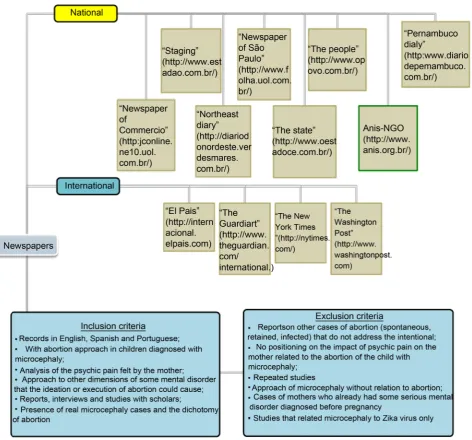
The guiding question followed the PICO acronym, in which P is the pregnant woman; I is the risk of being born with microcephaly; C-newspapers of great distribution; and O are the types of psychic pain. The guiding question was punctuated on the repercussion in newspapers of great distribution internation-ally and nationinternation-ally about psychic pain in pregnant women at risk of the child being born with microcephaly. The newspapers in Figure 1 were used for data research.
Interviews and reports about the subject, related to the year of 2016, were in-cluded, with registrations found in English, Spanish and Portuguese that ap-proached abortion, microcephaly, and/or psychic pain. The study period was chosen because the knowledge production is recent, thus it restricted registration from previous years.
Studies referring to spontaneous abortion that did not show a clear position-ing on abortion and/or psychic pain, repeated registrations or that analyzed the causes of microcephaly only were excluded. “Microcephaly” and “abortion” were the keywords used separately and later combined with the Boolean operator “AND”.
#1. “Microcephaly” and #2. “Abortion”
Figure 1. Newspapers used for the search. Source: Developed by the authors.
The databases used were The People, The State, Newspaper of Commercio, Northeast Journal, Pernambuco Daily, Stating, Newspaper of São Paulo, El País, The New York Times, The Washington Post, The Guardian and Anis. The key-words “microcephaly” and “abortion” were entered with the AND operator in the search box of each source and the period between 01/01/2016 and 07/ 30/2016 was selected. The selection process was the same for all databases.
During the process of study selection, two reviewers worked independently and analyzed the studies that would be included. In case of disagreement, a third reviewer was used for the verdict on the inclusion or non-inclusion of the study.
3. Results
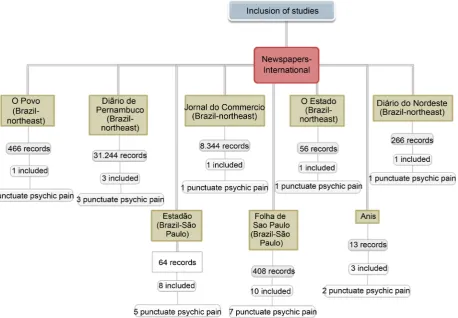
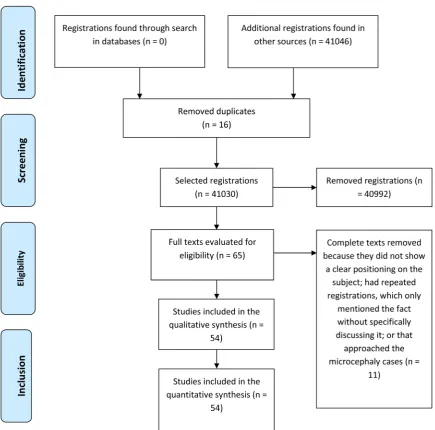
[image:6.595.98.534.280.710.2]A total of 41,046 registrations were found, i.e. 466 were The People; 56, The State; 8344, Jornal do Commercio; 266, Diário do Nordeste; 31,244, Diário de Pernambuco; 64, Estadão; 408, Folha de São Paulo; 45, El País; 40, The New York Times; 50, The Washington Post; 50, The Guardian; 13, Anis. Of this amount, 40,992 articles were excluded because they only mentioned or referred to spontaneous abortion, did not analyze abortion on the vision of microcepha-ly, approached only Zika virus, or were repeated. Figure 2 summarizes the me-thodological process of article selection.
Chart 1 includes a global summary of the findings in the investigated news-papers.
Ideation or need of a possible abortion may create a psychic pain in women, which can be manifested in several ways and negatively affect their mental health. Figure 3 includes the statistical analysis regarding the chances of devel-oping psychic pain; Figure 4 and Figure 5 show the amount of included regis-trations and those punctuating mental health; and Figure 6 shows the main kinds of psychic pain found in international and national newspapers.
A total of 123 cases were analyzed. Mantel-Haenszel test and Odds Ratio measured the association between the possible risk of microcephaly develop-ment associated with abortion ideation and developdevelop-ment of some psychic pain in women. Each group of studies is represented with a line. The square re- presents the effect of studies and the line represents the confidence interval. The size of squares represents the weight of each group of studies for the statistical analysis. The vertical line indicates absence of effect, and the diamond symboliz-es the rsymboliz-esult of the meta-analysis.
A woman with a fetus that is at risk of developing microcephaly and has a perspective of abortion would have, based on the statistical analysis, four more
Chart 1. Main findings [1]-[54].
Newspaper Main approach
The Guardian Approach focused on clandestine abortion.
The New York Times Risk of American women being infected with Zika virus when traveling to tropical countries.
The Washington Post
Analysis of the action mechanism of Zika virus in the central nervous system (CNS), and the issue regarding contraceptive and
abortion in Latin America.
El País
It presents a more humanized vision of the Zika-Microcephaly issue, focusing on the difficulties that the Latin woman faces with
the problem, socioeconomically and religiously.
The peaple It discusses the limitation of knowledge regarding the subject to allow the legalization of abortion.
The state Abortion is not the answer.
Newspaper of Commercio
It associates the abortion issue with a strong influence of eugenic ideas, as well as the fact that legislation does
not support the issue.
Northeast diary It defends prevention against infection through Zika virus, instead of abortion.
Pernambuco diary It emphatically discusses the rights of women in making decisions regarding their bodies.
Newspaper of São Paulo Humanist and social analysis of the Zika virus outbreak in pregnant women.
Staging Legal approach-abortion proposition.
Anis Analysis aimed at women’s humanist perception and approach aimed at legal aspects.
Sample Odds Ratio Lower Confidence Interval Higher Confidence Interval Weight
01 1.000 0.091 11.029 0.667
02 8.000 0.500 127.907 0.500
03 20.000 0.930 429.928 0.408
04 5.000 0.472 52.963 0.690
05 1.000 0.020 50.400 0.250
06 1.000 0.020 50.400 0.250
07 1.000 0.020 50.400 0.250
08 1.000 0.020 50.400 0.250
09 20.000 0.930 429.928 0.408
10 7.000 0.861 56.897 0.875
11 4.167 0.473 36.738 0.811
12 6.000 0.221 162.541 0.353
Combined 4.092 1.883 8.893
[image:8.595.210.540.68.522.2]Source: Developed by the authors.
Figure 3. Meta-analysis-statistical association between microcephaly/abortion and the development of psychic pain in women (Mantel-Haenszel and Odds Ratio) [1]-[54].
chances of developing a significant psychic pain of great relevance in the clinical practice.
4. Discussion
Based on the analysis of the results, we can infer that psychic pain of pregnant women at risk of microcephaly is in the following spheres: socioeconomic, gender, religious, abortion and internal conflicts.
Figure 4. Included registrations and amount of newspapers punctuating mental health-international databases. Source: Developed by the authors.
[image:9.595.80.539.387.705.2]health services are penalized, or are simply not available, efforts to stop this crisis do not show a solution, since they focus on the request that women and girls avoid pregnancy,” as pointed out in “El País” [8]. A dialogue with citizens about the reason this gender equality and sexual and reproductive rights scenario is happening should also begin. Latin America shows particularities regarding these themes. In a context of extreme inequality, where people with a higher so-cioeconomic level are at one side, and an extremely poor population is on the other, differences, sexism, violence and lack of control that women have over their own life projects still prevail, although there is already a legislation safe-guarding these situations. This discussion is based on another domain: the reli-gions [15].
Many times, religions insert principles that, in many cases, restrict the right of female populations of sparing negative feelings, even when facing circumstances that were approved by science. These facts control a woman’s decision power, who subjects herself to the existing principles [16].
Firstly, Latin America, in which most of its population is catholic, faces a de-licate religious conflict. Pregnant women exposed to Zika virus that may be car-rying fetuses with serious brain defects are not allowed to have an abortion, based on the Vatican’s vision. The Catholic Church emphasizes its opposition to abortion under any circumstances, whereas women in Latin America are despe-rately trying to terminate their pregnancies due to fear of giving birth to babies with microcephaly [12]. “Pregnant women all over Brazil are in panic,” said Sil-via Camurça, the director of SOS Corpo, which is a feminist group in Recife, Brazil. Fear of Zika virus provides us a rare opening to defy the religious funda-mentalism that puts the life of thousands of women at risk ever year in Brazil to maintain its laws and behaviors from the Medieval Age [17]. “The New York Times” highlights that it is a difficult subject, because it is new, requires a com-plex debate, and most of the religious influence still exists [17].
Abortion is a polemic issue faced by women and can involve the organism in four different plans: body pain associated with the physiological aspect is caused by an injury, while the psychic impact reflects on the sensitivity related to the af-fectivity for what was lost, an imaginary associated with positive or negative ide-ations regarding pregnancy and symbolism that such event brings to women’s perception. Thus, there could be an unconscious pain, but with great general re-percussions on health.
their nine months of pregnancy. The families have a short period to study the subject, receive the results, process their feelings, and make a decision, as stated by “The New York Times” [6].
5. Conclusions
Strong evidence points out to the risk of microcephaly development and Zika virus in pregnant women. This proof is an important source of anxiety, expecta-tion, and anguish for all women in the fertile age period. In the midst of this ep-idemic situation, psychic pain created in the female imaginary takes a large worldwide proportion, and is emphasized in renowned newspapers of large dis-tribution both in Brazil and abroad. The pains showed in each text vary in dif-ferent ranges of the female life, since internal conflicts, gender violence, stress, fear, insecurity, psychological torture, grieve, loneliness, to other kinds of psych-ic suffering.
The repercussions of psychic pain for these women refer to particular reac-tions to the possibilities of lost. Abortion appears as a defensive and protective reaction. Hence, several reflections are expressed in newspapers with the aim of considering the circumstances that develop desire strength, as an external or in-ternal instance of the disease’s limit of management.
The woman’s pain in this important public health issue should be investigated more carefully. Larger studies on psycho-emotional terms need to be promoted in order to approach the female suffering under a wider vision that is closer to the reality faced by these women. By doing so, it will be possible to provide sup-port to women, not only based on a biological risk, but considering her social, psychological, and emotional plans.
Funding
This research did not receive any specific grant from funding agencies in the public, commercial, or not-for-profit sectors.
References
[1] Diniz, D. (2016) Durante crises políticas é muito fácil se fazer concessões a forças conservadoras (Entrevista). El País.
http://brasil.elpais.com/brasil/2016/03/08/politica/1457400683_667783.html
[2] Diniz, D. (2016) Para pesquisadora, questão central do aborto não é a microcefalia, mas o direito á saúde da mulher (Entrevista). Jornal do Commercio, Pernambuco.
http://m.jc.ne10.uol.com.br/canal/cidades/noticia/2016/02/27/para-pesquisadora-qu estao-central-do-aborto-nao-e-a-microcefalia-mas-o-direito-a-saude-da-mulher-22
3175.php
[3] Oliveira, A. (2016) Las embarazadas brasileñas, entre la expectativa de ser madres y el miedo al vírus del zika. El País, Madrid.
http://internacional.elpais.com/internacional/2016/02/03/america/1454516628_288
998.html
http://brasil.elpais.com/brasil/2016/01/29/politica/1454103307_984282.html?id_exte
rno_rsoc=FB_CM
[5] Diniz, D. (2016) A população de maior risco á epidemia são mulheres pobres e negras do nordeste do país (Entrevista). Fiocruz.
http://www.epsjv.fiocruz.br/noticias/entrevista/a-populacao-de-maior-risco-a-epide
mia-sao-mulheres-pobres-e-negras-do-nordeste
[6] Saint-Louis, C. (2016) Microcephaly, Spotlighted by Zika Virus, Has Long Afflicted and Mystified. The New York Times, New York.
http://www.nytimes.com/2016/02/01/health/microcephaly-spotlighted-by-zika-viru
s-has-long-afflicted-and-mystified.html
[7] Collucci, C. (2016) Grávidas com Zika fazem aborto sem confirmação de microcefalia. Cotidiano, Folha de São Paulo, São Paulo.
http://www1.folha.uol.com.br/cotidiano/2016/01/1735560-gravidas-com-zika-fazem
-aborto-sem-confirmacao-de-microcefalia.shtml
[8] Sahuqullo, M.R. (2016) La ONU insta a garantizar el acesso al aborto en los países afectados por Zika. El País, Madrid.
http://internacional.elpais.com/internacional/2016/02/05/actualidad/1454686710_4
53844.html
[9] McNeil Jr., D.G. (2016) C.D.C. Urges Zika Testing for Some Who Are Pregnant. The New York Times, New York.
http://www.nytimes.com/2016/01/20/health/cdc-urges-zika-testing-for-some-who-a
re-pregnant.html?_r=0
[10] Brum, E. (2016) Sobre el aborto, la discapacidad y los límites. El País, Madrid.
http://internacional.elpais.com/internacional/2016/02/03/actualidad/1454456312_5
98001.html
[11] Lakhani, N. (2016) “Zika-Linked” Miscarriages Pose Jail Risk for Women in El Sal-vador, Activists Say. The Guardian, London.
http://www.theguardian.com/global-development/2016/feb/12/zika-linked-miscarri
ages-pose-jail-risk-women-el-salvador-activists-say
[12] Sherwood, H. (2016) Vatican Says Abortion in “Illegitimate Response” to Zika Vírus. The Guardian, London.
https://www.theguardian.com/world/2016/feb/18/vatican-says-abortion-is-illegitim
ate-response-to-zika-virus
[13] Cha, A.E. (2016) Why Zika Is a Ticking “Time Bomb” for Latin America. The Washington Post, Washington.
https://www.washingtonpost.com/news/to-your-health/wp/2016/02/03/a-zika-time-bomb-with-limited-access-to-birth-control-and-strict-abortion-laws-women-in-lati
n-america-fear-the-future/
[14] Filipovic, J. (2016) Zika Is the Latest Example of How Hard It Is to Be a Woman in Latin America. The Washington Post, Washington.
http://www.washingtonpost.com/posteverything/wp/2016/02/03/zika-is-the-latest-e
xample-of-how-hard-it-is-to-be-a-woman-in-latin-america/
[15] Ayuso, S. (2016) Combatir el Zika tratando solo de erradicar al mosquito no funcionará. El País, Madrid.
http://internacional.elpais.com/internacional/2016/02/03/actualidad/1454456312_5
98001.html
[16] Buarque, C. (2016) Você é a favor do aborto em casos de microcefalia? Cristina Buarque afirma que sim. Diário de Pernambuco, Pernambuco.
-af.shtml
[17] Romero, S. (2016) Surge of Zika Virus Has Brazilians Re-Examining Strict Abortion Laws. The New York Times, New York.
http://www.nytimes.com/2016/02/04/world/americas/zika-virus-brazil-abortion-la
ws.html
[18] Fisher, M., Partlow, J. and Jordan, M. (2016) Zika’s Terrifying Path. The Washing-ton Post, WashingWashing-ton.
https://www.washingtonpost.com/news/world/wp/2016/03/25/kim-conley-zika-viru
s-rio-olympics/
[19] Aguilares, N.L. (2016) El Salvador’s Zika Crisis Compounded by Failings of State, Violence and Machismo. The Guardian, London.
http://www.theguardian.com/global-development/2016/feb/12/el-salvador-zika-cris
is-compounded-by-failings-of-state-violence-and-machismo
[20] Al-Gailani, S. (2016) From Rubella to Zika: Pregnancy, Disability, Abortion and the Spectre of an Epidemic. The Guardian, London.
https://www.theguardian.com/science/the-h-word/2016/jan/29/rubella-zika-pregna
ncy-disability-abortion-epidemic
[21] Associação Jurídico-Espírita do Brasil (2016) Associação espírita é contra aborto em casos de microcefalia. Diário de Pernambuco, Pernambuco.
http://www.diariodepernambuco.com.br/app/noticia/economia/2016/02/21/interna s_economia,628226/associacao-espirita-e-contra-aborto-em-casos-de-microcefalia.s html
[22] Cancian, N. (2016) Avança de casos de microcefalia ‘não justifica defender aborto’, diz CNBB. Cotidiano-Folha de São Paulo, São Paulo.
http://www1.folha.uol.com.br/paywall/adblock.shtml?http://www1.folha.uol.com.br /cotidiano/2016/02/1736949-avanco-de-casos-de-microcefalia-nao-justifica-defende
r-aborto-diz-cnbb.shtml
[23] Casey, N. (2016) Zika Virus in Colombia Presents Complicated Choice about Abor-tion. The New York Times, New York.
http://www.nytimes.com/2016/02/16/world/americas/zika-virus-in-colombia-prese
nts-complicated-choice-about-abortion.html
[24] Collucci, C. (2016) Alta de microcefalia reacende debate sobre o aborto legal. Cotidiano-Folha de São Paulo, São Paulo.
http://www1.folha.uol.com.br/cotidiano/2016/01/1727899-alta-de-microcefalia-reac
ende-debate-sobre-aborto-legal.shtml
[25] Collucci, C. (2016) Pesadelo para as gestantes, vírus da Zika levanta dúvidas, entenda os riscos. Cotidiano, Folha de São Paulo, São Paulo.
http://www1.folha.uol.com.br/saopaulo/2016/05/1766057-pesadelo-para-as-gestante
s-virus-da-zika-levanta-duvidas-entenda-os-riscos.shtml
[26] Felix, P., Castro, F. and Formenti, L. (2016) EUA confirmam vínculo entre infecção por zika e microcefalia. Saúde-Estadão, São Paulo.
http://saude.estadao.com.br/noticias/geral,estados-unidos-confirmam-vinculo-entr
e-zika-e-microcefalia,1855809
[27] Ferraz, L. (2016) Maioria dos brasileiros desaprova aborto mesmo com microcefalia. Cotidiano-Folha de São Paulo, São Paulo.
http://www1.folha.uol.com.br/cotidiano/2016/02/1744476-maioria-dos-brasileiros-desaprova-aborto-mesmo-com-microcefalia.shtml
[28] Ferreira, J. (2016) No Acre, ministro defende opção de aborto para fetos com microcefalia. Diário do Nordeste, Fortaleza.
istro-defende-opcao-de-aborto-para-fetos-com-microcefalia-1.1491777
[29] Formenti, L. (2016) Bebê com microcefalia vai ter prioridade em fila de benefício. Saúde-Estadão, São Paulo.
http://saude.estadao.com.br/noticias/geral,crianca-com-microcefalia-tera-prioridad
e-em-fila-de-beneficio,10000049401
[30] Formenti, L. (2016) Ministério lança plano para apressar teste de microcefalia. Saúde-Estadão, São Paulo.
http://saude.estadao.com.br/noticias/geral,ministerio-da-saude-lanca-plano-para-ap
ressar-teste-de-microcefalia,10000021246
[31] Formenti, L. (2016) Maioria das mães de bebês com microcefalia teve erupções cutâneas no início da gravidez. Saúde-Estadão, São Paulo.
http://saude.estadao.com.br/noticias/geral,maioria-das-maes-com-bebes-com-micr
ocefalia-teve-erupcoes-cutaneas-no-inicio-da-gravidez,10000024920
[32] Garcia, A.G. (2016) Sobre bebês golfinhos e bebês humanos. O Povo on line, Fortaleza-CE.
http://www.opovo.com.br/app/jornaldoleitor/noticiassecundarias/artigos/2016/02/2 9/noticiajornaldoleitorartigos,3581334/sobre-bebes-golfinhos-e-bebes-humanos.sht ml
[33] Garcia, L. (2016) O vírus Zika e o aborto. O Estado, Pernambuco.
http://www.oestadoce.com.br/opiniao/o-virus-zika-e-o-aborto
[34] Garrafa, V. (2016) Especialistas e religiosos debatem aborto em casos de microcefalia. Diário de Pernambuco, Pernambuco.
http://www.diariodepernambuco.com.br/app/noticia/brasil/2016/02/15/interna_bra sil,626966/especialistas-e-religiosos-debatem-aborto-em-casos-de-microcefalia.sht ml
[35] Girard, F. (2016) Vírus Zika: El Zika y los derechos reproductivos. El País, Madrid.
http://elpais.com/elpais/2016/03/15/planeta_futuro/1458059218_007104.html
[36] Goldie, J. (2016) Zika Virus Emergency. The Guardian, London.
http://www.who.int/emergencies/zika-virus/response/en/
[37] Gollp, T.R. (2016) Leitor diz que jornal é conservador sobre aborto, Folha responde. Painel do Leitor-Folha de São Paulo, São Paulo.
http://m.folha.uol.com.br/paineldoleitor/2016/03/1751931-leitor-diz-que-jornal-e-c
onservador-sobre-aborto-folha-responde.shtml
[38] Lee, P.Y. (2016) The Three-Letter Word Missing from the Zika Warnings-Men. The Guardian, London.
http://www.theguardian.com/global-development-professionals-network/2016/feb/
17/three-letter-word-missing-zika-warnings-men
[39] McNeil Jr., D.G., Romero, S. and Tavernise, S. (2016) How a Medical Mystery in Brazil Led Doctors to Zika. The New York Times, New York.
http://www.nytimes.com/2016/02/07/health/zika-virus-brazil-how-it-spread-explai
ned.html
[40] Nunes, K. (2016) Igreja lança canal para ajudar famílias de bebês com microcefalia em PE. Cotidiano-Folha de São Paulo, São Paulo.
http://www1.folha.uol.com.br/cotidiano/2016/03/1749338-igreja-lanca-canal-para-a
judar-familias-de-bebes-com-microcefalia-em-pe.shtml
[41] Nunes, K. (2016) Mãe não merece feto sem vida, diz juiz sobre o aborto em caso de microcefalia. Cotidiano-Folha de São Paulo, São Paulo.
http://www1.folha.uol.com.br/cotidiano/2016/01/1735564-mae-nao-merece-feto-se
m-vida-diz-juiz-sobre-aborto-em-caso-de-microcefalia.shtml
Brasil. El País, Madrid.
http://internacional.elpais.com/internacional/2016/01/29/actualidad/1454103307_9
84282.html
[43] Queiroz, T. and Escobar, H. (2016) No front da microcefalia, cientistas encontram uma “sopa de vírus”. Saúde-Estadão, São Paulo.
http://saude.estadao.com.br/noticias/geral,no-front-da-epidemia--cientistas-encont
ram-uma-sopa-de-virus,10000018444
[44] Resk, F. (2016) Homens abandonam mães de bebês com microcefalia em PE. Saúde-Estadão, São Paulo.
http://saude.estadao.com.br/noticias/geral,homens-abandonam-maes-de-bebes-co
m-microcefalia-em-pe,10000014877
[45] Reuters (2016) Colombia reports more than 2,100 pregnant women have Zika virus. The New York Times, New York, Americas.
http://www.nytimes.com/2016/01/31/world/americas/colombia-reports-more-than-2100-pregnant-women-have-zika-virus.html
[46] Ribeiro, B. (2016) Direitos humanos e microcefalia: um desafio brasileiro. Saúde- Estadão, São Paulo.
http://vida-estilo.estadao.com.br/blogs/era-uma-vez/microcefalia-direitos-humanos/
[47] Sahuqullo, M.R. (2016) El temor al zika amenaza com disparar el aborto clandestino em América. El País, Madrid.
http://internacional.elpais.com/internacional/2016/02/02/actualidad/1454430775_8
75881.html
[48] Salomão, A. (2016) Um ano após 1º caso oficial de microcefalia faz bebê tomar Rivotril. Saúde-Estadão, São Paulo.
http://saude.estadao.com.br/noticias/geral,um-ano-apos-1-caso-oficial-de-zika--mic
rocefalia-faz-bebe-tomar-ate-rivotril,10000026444
[49] Senra, R. (2016) “Aborto já é livre no Brasil; proibir é punir que não tem dinheiro”, diz Drauzio Varella. Cotidiano. Folha de São Paulo, São Paulo.
http://www.bbc.com/portuguese/noticias/2016/02/160201_drauzio_aborto_rs
[50] Senra, R. (2016) Grupo de prepara ação no STF por aborto em casos de micro- cefalia. Cotidiano. Folha de São Paulo, São Paulo.
http://www1.folha.uol.com.br/paywall/adblock.shtml?http://m.folha.uol.com.br/coti diano/2016/01/1734795-grupo-prepara-acao-no-stf-por-aborto-em-casos-de-micro cefalia.shtml
[51] Sun, L.H. (2016) Ultrasounds Missed Her Zika Infection-Until One Showed Serious Harm to Her Fetus. The Washington Post, Washington.
https://www.washingtonpost.com/news/to-your-health/wp/2016/03/30/why-ultraso
unds-may-give-mothers-with-zika-a-false-sense-of-security/
[52] Sun, L.H. and Dennis, B. (2016) Zika Has Pregnant Women in the US Worried, and Doctors Have Few Answers. The Washington Post, Washington.
https://www.washingtonpost.com/national/health-science/zika-has-pregnant-wome n-in-the-us-worried-and-doctors-have-few-answers/2016/03/07/4c370424-e000-11e
5-8d98-4b3d9215ade1_story.html
[53] Valenti, J. (2016) If Women with Zika Risk Shouldn’t Get Pregnant, They Need Abortion Access. The Guardian, London.
http://www.theguardian.com/commentisfree/2016/feb/03/if-women-with-zika-risk-shouldnt-get-pregnant-they-need-abortion-access
[54] Watts, J. (2016) Brazil’s Sprawling Favelas Bear the Brunt of the Zika Epidemic. The Guardian, London.
![Figure 3. Meta-analysis-statistical association between microcephaly/abortion and the development of psychic pain in women (Mantel-Haenszel and Odds Ratio) [1]-[54]](https://thumb-us.123doks.com/thumbv2/123dok_us/7779983.721069/8.595.210.540.68.522/figure-analysis-statistical-association-microcephaly-abortion-development-haenszel.webp)