c
Owned by the authors, published by EDP Sciences, 2017
Latest results on diffraction at HERA
Mariusz Przybycien1,a(on behalf of the H1 and ZEUS Collaborations)
1AGH University of Science and Technology, Faculty of Physics and Applied Computer Science Al. Mickiewicza 30, 30-059 Cracow, Poland
Abstract.Recent results on diffraction from the H1 and ZEUS experiments at HERA are presented. Measurement of open charm production in diffractive DIS has been performed by the H1 experiment using the event topology, given byep→eXY, where the system X, containing at least oneD∗(2010) meson, is separated from a leading low-mass proton
dissociative systemYby a large rapidity gap. The photoproduction of isolated photons is measured using diffractive events recorded by the ZEUS experiment. Cross sections are evaluated in the photon transverse-energy and pseudorapidity ranges 5<Eγ
T <15 GeV
and−0.7< ηγ<0.9, inclusively and with a jet with transverse-energy and pseudorapidity
in the ranges 4<Ejet
T <35 GeV and−1.5< ηjet<1.8. The exclusive deep inelastic
elec-troproduction and photoproduction ofΨ(2S) andJ/Ψ(1S) mesons has been also studied by ZEUS. The cross-section ratioσ(Ψ(2S))/σ(J/Ψ(1S)) has been measured as a func-tion ofQ2,Wandt. The results are compared to several predictions of QCD-inspired
models, providing tests of the models in a region of soft to hard diffraction.
1 Introduction
Diffractive interactions are a distinctive class of hadronic interactions in which the scattering of the
incoming particle is mediated by an exchanged object carrying vacuum quantum numbers, commonly
referred to as the Pomeron [1, 2]. At the HERAepcollider, diffractive processes have been studied
both in photoproduction and in deep inelastic scattering (DIS), photoproduction processes being those
in which the exchanged photon is quasireal. Diffractive processes of this kind are typically
charac-terised by a forward nucleon or nucleonic state that is separated by a gap in rapidity from the hadronic final state produced in the central region of the event. The physical nature of the Pomeron is not fully established within quantum chromodynamics (QCD), and a number of models have been proposed. In an approach originated by Ingelman and Schlein [3], the Pomeron is taken to be a hadron-like ob-ject that contains quarks and gluons. The Pomeron parton density functions (PDFs) can be evaluated
from fits to diffractive DIS (DDIS) data [4]. In an alternative approach [5], the Pomeron is equivalent
to the exchange of two gluons.
The standard DIS kinematics inepcollisions is described in terms of the invariants:
s=(k+P)2, Q2=−q2, y= q·P
k·P, W=(q+P)2, x= Q2
2q·P
)
P
p( Y(PY)
c c
IP z
)
q
*( γ
IP x )
k
e( e(k’)
... D*
)
X
P
X(
t 2 Q
W s
Figure 1. (left) The LO diagram for open charm production in DDIS at HERA in the picture of collinear and proton vertex fac-torisation. Kinematic variables describing the DDIS processes in general as well as particles four-momenta are also indicated. (right) D production in
boson-gluon fusion process with subse-quent decays in the ‘golden chan-nel’ as described in the text.
where the four-vectors are indicated in Fig. 1(left). Heresis the square of the total centre-of-mass
energy of the collision,Q2the photon virtuality,ythe scattered electron inelasticity,W2the
centre-of-mass energy squared of theγpsystem andxthe Bjorken scaling variable. Given the two hadronic
systems X andY, separated by a large rapidity gap, diffractive kinematic variables are defined as
follows:
M2
X=(PX)2, M2Y=(PY)2, t=(P−PY)2, xIP=q·(P−PY)
q·P , zIP=
ˆ
s+Q2
M2
X+Q2
In inclusive DDIS, whereMXandMY are the invariant masses of the systemsXandY, respectively,
t is the squared four-momentum transfer at the proton vertex and xIP the fraction of the proton’s
longitudinal momentum taken by the Pomeron. zIP is the fraction of the Pomeron momentum that
takes part in the hard interaction, and ˆsdenotes the centre-of-mass energy squared of the hard process.
2 Recent measurements at HERA
Measurements of diffractive processes are presented below based on data collected by the H1 and
ZEUS experiments at the HERA Collider, where beams of electrons/positrons of energy 27.5 GeV
were collided with protons of energy 920 GeV. This corresponds to the energy available in the
centre-of-mass system equal to √s=318 GeV.
The H1 Colaboration has performed a measurement ofDproduction in DDIS [6]. The process
is schematically shown in Fig. 1(left). TheD meson originates from the fragmentation of a charm
quark, which is produced at HERA energies mainly via the boson-gluon fusion (γg→cc¯) process.
Hence, the gluon content of the Pomeron can be accessed directly, and allows the collinear
factorisa-tion to be tested. The detecfactorisa-tion ofDmesons is based on the full reconstruction of its decay products
in the ‘golden channel’
D+→D0π+
slow→(K−π+)π+slow (+C.C.)
with subsequent branching ratios as indicated in Fig. 1(right). The cross sections are measured in the
fiducial range defined by DIS phase space 5< Q2 <100 GeV2, 0.02< y < 0.65, D kinematics
pt,D>1.5 GeV, |ηD|<1.5 and diffractive phase spacexIP<0.03, MY >1.6 GeV and|t|<1 GeV2.
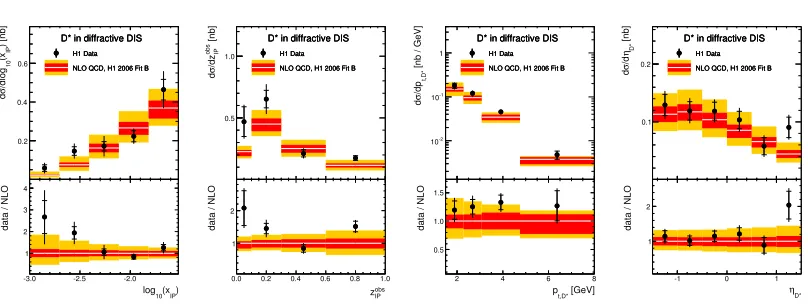
Figure 2(left) shows the differential cross sections as functions of kinematic variables log10(xIP)
andzobs
IP . The shape of dσ/d log10(xIP) is satisfactorily described by the NLO QCD prediction by
HVQDIS [7, 8] given the large relative uncertainties at lowxIPvalues. The shape of dσ/dzobsIP is not
described as well by the prediction, however the experimental uncertainties at lowzobs
)
P
p( Y(PY)
c c IP z ) q *( γ IP x ) k
e( e(k’)
... D* ) X P X( t 2 Q W s
Figure 1. (left) The LO diagram for open charm production in DDIS at HERA in the picture of collinear and proton vertex fac-torisation. Kinematic variables describing the DDIS processes in general as well as particles four-momenta are also indicated. (right) D production in
boson-gluon fusion process with subse-quent decays in the ‘golden chan-nel’ as described in the text.
where the four-vectors are indicated in Fig. 1(left). Heresis the square of the total centre-of-mass
energy of the collision,Q2the photon virtuality,ythe scattered electron inelasticity,W2the
centre-of-mass energy squared of theγpsystem andxthe Bjorken scaling variable. Given the two hadronic
systems X andY, separated by a large rapidity gap, diffractive kinematic variables are defined as
follows:
M2
X =(PX)2, M2Y=(PY)2, t=(P−PY)2, xIP=q·(P−PY)
q·P , zIP=
ˆ
s+Q2
M2
X+Q2
In inclusive DDIS, whereMX andMYare the invariant masses of the systemsXandY, respectively,
t is the squared four-momentum transfer at the proton vertex and xIP the fraction of the proton’s
longitudinal momentum taken by the Pomeron. zIP is the fraction of the Pomeron momentum that
takes part in the hard interaction, and ˆsdenotes the centre-of-mass energy squared of the hard process.
2 Recent measurements at HERA
Measurements of diffractive processes are presented below based on data collected by the H1 and
ZEUS experiments at the HERA Collider, where beams of electrons/positrons of energy 27.5 GeV
were collided with protons of energy 920 GeV. This corresponds to the energy available in the
centre-of-mass system equal to √s=318 GeV.
The H1 Colaboration has performed a measurement ofDproduction in DDIS [6]. The process
is schematically shown in Fig. 1(left). TheDmeson originates from the fragmentation of a charm
quark, which is produced at HERA energies mainly via the boson-gluon fusion (γg→ cc¯) process.
Hence, the gluon content of the Pomeron can be accessed directly, and allows the collinear
factorisa-tion to be tested. The detecfactorisa-tion ofDmesons is based on the full reconstruction of its decay products
in the ‘golden channel’
D+→D0π+
slow→(K−π+)π+slow (+C.C.)
with subsequent branching ratios as indicated in Fig. 1(right). The cross sections are measured in the
fiducial range defined by DIS phase space 5< Q2 < 100 GeV2, 0.02< y < 0.65, D kinematics
pt,D>1.5 GeV, |ηD|<1.5 and diffractive phase spacexIP<0.03, MY >1.6 GeV and|t|<1 GeV2.
Figure 2(left) shows the differential cross sections as functions of kinematic variables log10(xIP)
andzobs
IP . The shape of dσ/d log10(xIP) is satisfactorily described by the NLO QCD prediction by
HVQDIS [7, 8] given the large relative uncertainties at lowxIPvalues. The shape of dσ/dzobsIP is not
described as well by the prediction, however the experimental uncertainties at lowzobs
IP are sizeable.
) [nb] IP (x 10 /dlog σ d 0.2 0.4 0.6
D* in diffractive DIS
H1 Data
NLO QCD, H1 2006 Fit B
D* in diffractive DIS
H1 Data
NLO QCD, H1 2006 Fit B
D* in diffractive DIS
H1 Data
NLO QCD, H1 2006 Fit B
[nb] obs IP /dz σ d 0.5 1.0
D* in diffractive DIS
H1 Data
NLO QCD, H1 2006 Fit B
D* in diffractive DIS
H1 Data
NLO QCD, H1 2006 Fit B
D* in diffractive DIS
H1 Data
NLO QCD, H1 2006 Fit B
) IP (x 10 log
-3.0 -2.5 -2.0
data / NLO
1 2 3 4 obs IP z
0.0 0.2 0.4 0.6 0.8 1.0
data / NLO
1 2
[nb / GeV]
t,D* /dp σ d -2 10 -1 10 1
D* in diffractive DIS
H1 Data
NLO QCD, H1 2006 Fit B
D* in diffractive DIS
H1 Data
NLO QCD, H1 2006 Fit B
D* in diffractive DIS
H1 Data
NLO QCD, H1 2006 Fit B
[nb] D* η /d σ d 0.1 0.2
D* in diffractive DIS
H1 Data
NLO QCD, H1 2006 Fit B
D* in diffractive DIS
H1 Data
NLO QCD, H1 2006 Fit B
D* in diffractive DIS
H1 Data
NLO QCD, H1 2006 Fit B
[GeV] t,D* p
2 4 6 8
data / NLO
0.5 1.0 1.5
D*
η
-1 0 1
data / NLO
1 2
Figure 2.Bin averaged single-differentialDcross sections as a function of the variables log (x
IP),zobsIP,pt,Dand
ηD. Data are shown as dots, where the inner error bars indicate statistical uncertainties and the outer error bars represent the statistical and the full set of systematic uncertainties added in quadrature. The central NLO QCD prediction by HVQDIS is shown as a white line inside the coloured bands. The inner band represents the DPDF and fragmentation uncertainties added in quadrature. The outer band represents DPDF, fragmentation, charm mass, factorisation and renormalisation scale uncertainties added in quadrature.
The differential cross sections as functions ofDtransverse momentum pt,Dand pseudorapidity
ηDare shown in Fig. 2(right). The shapes of dσ/dpt,Dand dσ/dηDare well described by the theory.
ForηD >1, however, the theory predicts a value which underestimates the data by about 50% with
a large uncertainty. There is an indication of a similar effect in the corresponding non-diffractiveD
cross section measurement [9].
The measured diffractive cross sections together with the non-diffractive one published in Ref. [9]
can be used to calculate the diffractive fractionRD=σdiff
D/σDnon−diff. The differential fractionsRD(y),
RD(Q2), RD(pt,D) andRD(ηD) are shown in Fig. 3. Within uncertainties the data do not provide
strong evidence for kinematic dependencies ofRDonQ2 ory, while at the same time they are also
consistent with the kinematic dependencies predicted by theory. The diffractive fraction decreases
y
0.2 0.4 0.6
D
R
0.05 0.10
D* diffractive fraction in DIS H1 Data NLO QCD D* diffractive fraction in DIS
H1 Data NLO QCD D* diffractive fraction in DIS
H1 Data NLO QCD ] 2 [GeV 2 Q
20 40 60 80 100
D
R
0.05 0.10
D* diffractive fraction in DIS H1 Data NLO QCD D* diffractive fraction in DIS
H1 Data NLO QCD D* diffractive fraction in DIS
H1 Data NLO QCD
[GeV] t,D* p
2 4 6 8
D
R
0.05 0.10
D* diffractive fraction in DIS H1 Data NLO QCD D* diffractive fraction in DIS
H1 Data NLO QCD D* diffractive fraction in DIS
H1 Data NLO QCD
D* η -1 0 1
D
R
0.05 0.10 0.15
D* diffractive fraction in DIS H1 Data NLO QCD D* diffractive fraction in DIS
H1 Data NLO QCD D* diffractive fraction in DIS
H1 Data NLO QCD
Figure 3. The diffractive fraction, RD, measured as a ratio of bin averaged diffractive to non-diffractive D
from 8% to 3% withpt,D increasing. The measured dependence of the diffractive fraction on ηD
decreases from 10% to about 5% for the highestηD values. These shapes are well reproduced by
the NLO QCD predictions from HVQDIS within the uncertainties. The shapes can be qualitatively understood as follows. Due to the high energy of the leading proton in diffraction (xIP <0.03) the systemXis produced with low massesMX. Less energy is available from the proton side to produce the hard system containing theD meson as compared to the non-diffractive case. Similarly, the fraction is suppressed for smally, i.e. for small energy of the exchanged virtual photon. The Q2 dependence ofRDcan be explained by the fact that at highQ2(higherx) the diffractive cross section is suppressed due to a limitedxIPrange. Likewise, due to the lack of energy, the events with higher pt,D can be expected to be suppressed in diffraction. The diffractive fraction as a function of ηD
indicates that in diffraction the hard system tends to be produced backwards, due to the kinematics constrained by the presence of a large rapidity gap, or equivalently thexIP<0.03 condition.
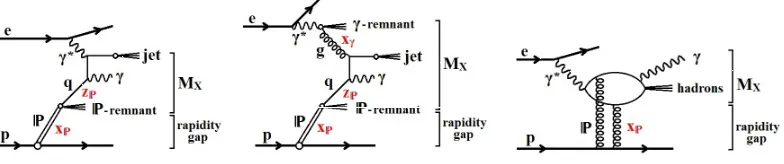
Diffractive photoproduction of isolated photons has been studied by ZEUS in Ref. [10]. The photon–Pomeron interaction can take place through processes in which the photon or Pomeron acts as a source of quarks and gluons, which then take part in the QCD scatter (resolved processes) and processes in which the photon or Pomeron interacts as a whole (direct processes). There are thus in principle four different types of process that may be experimentally studied: a direct or resolved photon interacting with a direct or resolved Pomeron. Examples of these processes are illustrated in Fig. 4. Direct Pomeron processes are not included in the Ingelman–Schlein model [3], but are taken into account in other approaches [11]. Within the Ingelman–Schlein framework, it is normally as-sumed that a Pomeron with a universal set of PDFs is emitted, making allowance for QCD evolution effects. In the H1 DIS analysis [4], the results of which are used here, the Pomeron PDFs are dom-inated by gluons in most regions of parameter space, but a significant quark content is also present. If the factorisation hypothesis holds, the same parton structure would be valid both in direct photo-production processes and in DIS, although in resolved photon processes, absorptive effects may be present [12]. Several studies of diffractive dijet events in photoproduction and DIS have been carried out at HERA. In the present measurement of diffractive events in which a hard isolated “prompt” pho-ton is detected in the central region of the ZEUS detector, it may be accompanied by one or more jets. Such processes, while rare, are interesting for a number of reasons. The prompt photon must originate from a charged parton, and its observation therefore demonstrates the presence either of a quark in the Pomeron or of higher-order processes in which both the Pomeron and the incident photon couple to quarks. This contrasts with diffractive dijet production, which is mainly sensitive to the gluon content of the Pomeron. Hard photons are also produced in fragmentation processes in which a photon is radiated within a jet. Such processes can be suppressed by requiring the observed hard photon to be isolated from other particles in the event.
Figure 4. Examples of diagrams for the diffractive production of a prompt photon and a jet inepscattering
from 8% to 3% with pt,D increasing. The measured dependence of the diffractive fraction on ηD
decreases from 10% to about 5% for the highestηD values. These shapes are well reproduced by
the NLO QCD predictions from HVQDIS within the uncertainties. The shapes can be qualitatively understood as follows. Due to the high energy of the leading proton in diffraction (xIP <0.03) the systemXis produced with low massesMX. Less energy is available from the proton side to produce the hard system containing the D meson as compared to the non-diffractive case. Similarly, the fraction is suppressed for smally, i.e. for small energy of the exchanged virtual photon. The Q2 dependence ofRDcan be explained by the fact that at highQ2(higherx) the diffractive cross section is suppressed due to a limitedxIPrange. Likewise, due to the lack of energy, the events with higher pt,D can be expected to be suppressed in diffraction. The diffractive fraction as a function of ηD
indicates that in diffraction the hard system tends to be produced backwards, due to the kinematics constrained by the presence of a large rapidity gap, or equivalently thexIP<0.03 condition.
Diffractive photoproduction of isolated photons has been studied by ZEUS in Ref. [10]. The photon–Pomeron interaction can take place through processes in which the photon or Pomeron acts as a source of quarks and gluons, which then take part in the QCD scatter (resolved processes) and processes in which the photon or Pomeron interacts as a whole (direct processes). There are thus in principle four different types of process that may be experimentally studied: a direct or resolved photon interacting with a direct or resolved Pomeron. Examples of these processes are illustrated in Fig. 4. Direct Pomeron processes are not included in the Ingelman–Schlein model [3], but are taken into account in other approaches [11]. Within the Ingelman–Schlein framework, it is normally as-sumed that a Pomeron with a universal set of PDFs is emitted, making allowance for QCD evolution effects. In the H1 DIS analysis [4], the results of which are used here, the Pomeron PDFs are dom-inated by gluons in most regions of parameter space, but a significant quark content is also present. If the factorisation hypothesis holds, the same parton structure would be valid both in direct photo-production processes and in DIS, although in resolved photon processes, absorptive effects may be present [12]. Several studies of diffractive dijet events in photoproduction and DIS have been carried out at HERA. In the present measurement of diffractive events in which a hard isolated “prompt” pho-ton is detected in the central region of the ZEUS detector, it may be accompanied by one or more jets. Such processes, while rare, are interesting for a number of reasons. The prompt photon must originate from a charged parton, and its observation therefore demonstrates the presence either of a quark in the Pomeron or of higher-order processes in which both the Pomeron and the incident photon couple to quarks. This contrasts with diffractive dijet production, which is mainly sensitive to the gluon content of the Pomeron. Hard photons are also produced in fragmentation processes in which a photon is radiated within a jet. Such processes can be suppressed by requiring the observed hard photon to be isolated from other particles in the event.
Figure 4. Examples of diagrams for the diffractive production of a prompt photon and a jet inepscattering
from (left) direct and (middle) resolved photons, interacting with a resolved Pomeron. (right) Example of an interaction between a direct photon and a direct Pomeron. The meaning of variables is similar to Fig. 1(left).
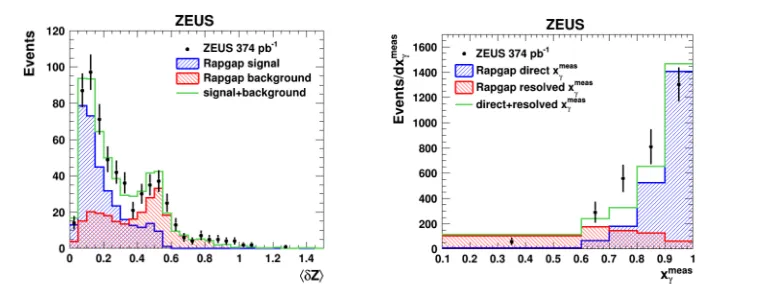
Figure 5.(left) Distribution ofδZfor selected diffractive events with a photon candidate and at least one jet. The
error bars denote the statistical uncertainties on the data, which are compared to the fitted signal and background
components from the MC. The unit of measurement ofδZis the width of one BEMC cell. (right) Events with
a photon and at least one jet as a function ofxmeas
γ , compared to a normalised 70:30 mixture of direct:resolved
photon Rapgap events without reweighting.
The diffractive photoproduction of isolated photons, with and without at least one accompany-ing jet, has been measured in a kinematic region defined in the laboratory frame by: Q2 <1 GeV2, 0.2< y <0.7, −0.7< ηγ <0.9, 5<EγT<15 GeV, 4<EjetT <35 GeV and −1.5< ηjet<1.8. The diffractive requirement wasηmax <2.5 andxIP <0.03. Photon isolation was imposed by requiring that the photon had at least 90% of the energy of the reconstructed jet of which it formed a part. In order to additionaly remove background events in which one or more neutral mesons, such asπ0and η, have decayed to photons, a template fit has been performed of expected from the Rapgap Monte Carlo [13] signal and background distributions as a function of the quantity
δZ= i
Ei|Zi−Zcluster|/(wcell
i Ei)
whereZiis theZ position of the centre of thei-th cell,Zclusteris the energy-weighted centroid of the EFO (Energy Flow Object - a reconstructed object in the ZEUS detector) cluster,wcellis the width of the cell in theZdirection, andEiis the energy recorded in the cell. The sum runs over all BEMC (Barrel Electromagnetic Calorimeter) cells in the EFO cluster. The results of the fit are shown in Fig. 5(left), and are used to statistically subtract the background for each measured cross section.
In direct photon processes, the incoming virtual photon is absorbed by a quark from the target particle, here a Pomeron, while in resolved photon processes, the virtual photon’s hadronic structure provides a quark or gluon that interacts with a quark or gluon from the Pomeron. These two classes of process, which are unambiguously defined only at the leading order (LO) of QCD, may be partially distinguished in events containing a high-ETphoton and a jet by means of the quantity
xmeas
γ =
Eγ+Ejet−pγ Z−pjetZ Eall−pall
Z
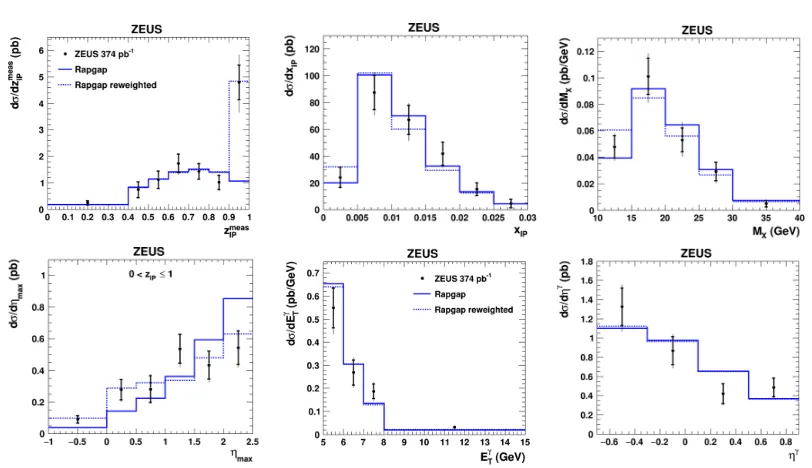
Figure 6. (left column) Differential cross section for isolated photon production accompanied by at least one jet, as a function ofzmeas
IP andηmax. (middle and right) Differential cross sections for inclusive isolated photon
production as functions ofxIP, MX,EγT andηγ. The inner error bars denote statistical uncertainties; the outer denote statistical with systematic uncertainties combined in quadrature. The Rapgap predictions are normalised to the data.
electron are excluded from this analysis. At LO,xmeas
γ =1 for direct photon events, while resolved
photon events can have any value in the range (0,1). Direct photon events at higher order can have xmeas
γ less than unity, but the presence of the LO processes generates a prominent peak in the observed cross section at high values ofxmeas
γ . The distribution of events inxmeasγ after final selection is shown in Fig. 5(right). A 70 : 30 mixture of direct:resolved photon events generated with Rapgap MC gives a reasonable description of the data and was employed in the analysis.
Differential cross sections are presented in terms of the transverse energy and pseudorapidity of the prompt photon and the jet, and of a number of variables that describe the kinematics of the diffractively produced system, in particular the fraction of the Pomeron energy given to the prompt photon and the jet,zIP. Selected measurements are shown in Fig. 6. With the exception ofηmaxand zIP, the distributions in all the variables are well described in shape by the standard Rapgap model over the wholezIPrange and in the rangeszIP<0.9 andzIP>0.9 separately (not shown in the plots). ForzIP >0.9, there is evidence for an excess in the data above the nominal Rapgap prediction. This excess indicates the presence of a direct Pomeron interaction, and is observed predominantly in the direct photon channel.
A measurement of the ratio of the cross sections for the reactions γp → ψ(2S)+ Y and
Figure 6. (left column) Differential cross section for isolated photon production accompanied by at least one jet, as a function ofzmeas
IP andηmax. (middle and right) Differential cross sections for inclusive isolated photon
production as functions ofxIP, MX,EγT andηγ. The inner error bars denote statistical uncertainties; the outer denote statistical with systematic uncertainties combined in quadrature. The Rapgap predictions are normalised to the data.
electron are excluded from this analysis. At LO,xmeas
γ = 1 for direct photon events, while resolved
photon events can have any value in the range (0,1). Direct photon events at higher order can have xmeas
γ less than unity, but the presence of the LO processes generates a prominent peak in the observed cross section at high values ofxmeas
γ . The distribution of events inxmeasγ after final selection is shown in Fig. 5(right). A 70 : 30 mixture of direct:resolved photon events generated with Rapgap MC gives a reasonable description of the data and was employed in the analysis.
Differential cross sections are presented in terms of the transverse energy and pseudorapidity of the prompt photon and the jet, and of a number of variables that describe the kinematics of the diffractively produced system, in particular the fraction of the Pomeron energy given to the prompt photon and the jet,zIP. Selected measurements are shown in Fig. 6. With the exception ofηmaxand zIP, the distributions in all the variables are well described in shape by the standard Rapgap model over the wholezIPrange and in the rangeszIP<0.9 andzIP>0.9 separately (not shown in the plots). ForzIP >0.9, there is evidence for an excess in the data above the nominal Rapgap prediction. This excess indicates the presence of a direct Pomeron interaction, and is observed predominantly in the direct photon channel.
A measurement of the ratio of the cross sections for the reactions γp → ψ(2S) +Y and
γp → J/ψ(1S)+Y, where Y denotes either a proton or a low mass proton dissociative system has been performed by the ZEUS experiment [14]. Theψ(2S) and theJ/ψ(1S) mesons have the same quark content, but different radial distributions of the wave functions, and their mass difference is small compared to the HERA centre-of-mass energy. Therefore this measurement allows QCD pre-dictions of the wave function dependence of thecc¯-proton cross section to be tested. A suppression of theψ(2S) cross section relative to theJ/ψ(1S) is expected, as theψ(2S) wave function has a radial node close to the typical transverse separation of the virtualcc¯pair.
(GeV) µ µ M
2 3 4 5
Entries 10 2 10 3 10 4 10 -1
ZEUS 468 pb Background fit
ZEUS
(1S) ψ J/ (2S)ψ 2 2.5 3 3.5Mµµ (GeV)4
M (GeV)
∆
1 10
-1
ZEUS 468 pb
M (GeV)
∆
0.4 0.45 0.5 0.55 0.6 0.65 0.7
Entries 0 10 20 30 40 50 60 (GeV) π π µ µ M 3.3 3.4 3.5 3.6 3.7 3.8 3.9
Entries 0 5 10 15 20 25 30 35 ZEUS
Figure 7. (left) Two-muon invariant mass distribution for exclusive dimuon events. (right) Selection of events
with exclusive production ofψ(2S) meson decaying intoππµµsystem.
The ratio of the cross sectionsσ(ep→eψ(2S)Y)/σ(ep→eJ/ψ(1S)Y) has been measured in the kinematic range of 5<Q2<80 GeV2, 30<W<210 GeV and|t|<1 GeV2using data corresponding to the luminosity of 468 pb−1. An additional sample of 114 pb−1was used to extend the measurement to the range 2<Q2 <5 GeV2. Events were required to have no activity in the central ZEUS detector in addition to signals from the scattered electron and the decay products of theψ(2S) orJ/ψ(1S). The decay channels used wereJ/ψ(1S) → µ+µ−,ψ(2S) → µ+µ−andψ(2S) → J/ψ(1S)π+π− with the subsequent decayJ/ψ(1S)→µ+µ−.
The µ+µ− mass distribution for the selected events in dimuon decay channels is shown in Fig. 7(left). ClearJ/ψ(1S) andψ(2s) peaks and no other significant peaks are observed. The back-ground was fit by straight line in the side-bands of the signals. Selection ofψ(2S) in the decay channel toπ+π−µ+µ−is based on the scatter plot of∆M = M
µµππ−Mµµ versusMµµshown in Fig. 7(right) together with distributions of the∆MandMµµππfor 3.02 < Mµµ <3.17 GeV. The∆M distribution
)
2
(GeV
2
Q
0 10 20 30 40 50 60 70 80
R 0 0.2 0.4 0.6 0.8 (1S) ψ J/ σσψ(2S)
R =
-1 ZEUS 468 pb
-1 H1 27 pb
-1 p: 6.3 pb
γ H1 HIKT: GBW-BT HIKT: GBW-LOG AR: b-CGC AR: IP-Sat = 0 δ KMW: FFJS KNNPZZ LM = 2 δ KMW: ZEUS W (GeV)
40 60 80 100 120 140 160 180 200
comb R 0 0.05 0.1 0.15 0.2 0.25 0.3 0.35 0.4 -1
ZEUS 468 pb
ZEUS
)
2
|t| (GeV
0 0.1 0.2 0.3 0.4 0.5 0.6 0.7 0.8 0.9 1
comb R 0 0.05 0.1 0.15 0.2 0.25 0.3 0.35 0.4 -1
ZEUS 468 pb
ZEUS
Figure 8.Cross section ratioσψ(2S)/σJ/ψ(1S)for the combinedψ(2S) decay modes as a function ofQ2compared
show a narrow peak at the nominalψ(2S)−J/ψ(1S) mass difference. Simultaneous cuts on∆Mand
Mµµas shown by the dashed lines in the scatter plot were used to select theψ(2S)→µµππevents.
The combined cross section ratio was obtained using the with the statistical uncertainties weighted
average of the cross sections determined for the twoψ(2S) decay channels. The measured ratios are
shown in Fig. 8 as a function ofQ2,W and|t|. The data contain a background of charmonium
pro-duction with diffractive massesMY 4 GeV. Assuming that the cross section ratio does no vary with
MY, the results are not affected by the proton dissociation background. The ratios as a function ofW
and|t|are compatible with a constant. For theQ2dependence, a positive slope is observed. The data
are in good agreement with the H1 measurements as well as with most of theory predictions shown.
3 Summary
Recent results on diffraction from the H1 and ZEUS experiments have been presented. For more
details and in depth discussion of the measurements the reader is referred to the original publications.
References
[1] A. Donnachie, P.V. Landshoff, Total cross-sections, Phys. Lett. B296 (1992) 227,
[hep-ph/9209205].
[2] E. Feinberg, I. Pomeranchuk,High energy inelastic diffraction phenomena, Suppl. Nuovo
Ci-mento 3 (1956) 652.
[3] G. Ingelman and P. Schlein,Jet Structure in High Mass Diffractive Scattering, Phys. Lett.B152
(1985) 256.
[4] H1 Collaboration, A. Aktas et al., Measurement and QCD Analysis of the Diffractive
Deep-Inelastic Scattering Cross Section at HERA, Eur. Phys. J.C48(2006) 715, [hep-ex/0606004].
[5] J. Bartels, H. Lotter, M. Wuesthoff,Quark-Antiquark Jets in DIS Diffractive Dissociation, iPhys.
Lett.B379(1996) 239, [hep-ph/9609239].
[6] H1 Collaboration, et al.,Measurement of D production in diffractive deep inelastic scattering at
HERA, Eur. Phys. J.C77(2017) 340, [hep-ex/1703.09476].
[7] B.W. Harris, J. Smith,Heavy quark correlations in deep inelastic electroproduction, Nucl. Phys.
B452(1995) 109, [hep-ph/9503484].
[8] B.W. Harris, J. Smith,Charm quark and D± cross-sections in deeply inelastic scattering at
HERA, Phys. Rev.D57(1998) 2806, [hep-ph/9706334].
[9] H1 Collaboration, F.D. Aaron et al.,Measurement of D±Meson Production and Determination
of Fcc¯
2 at low Q2in Deep-Inelastic Scattering at HERA, Eur. Phys. J.C71(2011) 1769, Erratum:
Eur. Phys. J.C72(2012) 2252, [hep-ph/1106.1028].
[10] ZEUS Collaboration, H. Abramowicz et al.,Studies of the diffractive photoproduction of isolated
photons at HERA, Phys. Rev.D96(2017) 032006, [hep-ex/1705.10251].
[11] B. Kniehl, H.-G. Kohrs and G. Kramer,Diffractive photoproduction of jets with a direct pomeron
coupling at HERA, Z. Phys.C65(1995) 657, [hep-ph/9408340].
[12] A. Kaidalov, V. Khoze, A. Martin, and M. Ryskin,Probabilities of rapidity gaps in high-energy
interactions, Eur. Phys. J.C21(2001) 521, [hep-ph/0105145].
[13] H. Jung,Hard diffractive scattering in high-energy e p collisions and the Monte Carlo generator
RAPGAP, Comput.Phys.Commun. 86 (1995) 147-161, https://rapgap.hepforge.org/rapgap.pdf.
[14] ZEUS Collaboration, H. Abramowicz et al., Measurement of the cross section ratio
σψ(2S))/σJ/ψ(1S) in deep inelastic ep scattering at HERA, Nucl. Phys.B909 (2016) 934-953,