Finger Vein Image Enhancement Using RPL,
Segmentation with Neural Networks
Arshdeep Kaur#1, Abhinav Mishra#2 #1
M Tech Student, CEC LANDRAN, PTU
2
Assistant Professor
CEC, LANDRAN PUNJAB TECHNICAL UNIVERSITY
Abstract—Biometrics is a validation methodology that depends
upon the automated identification or verification of personage based on their physiological or behavioural attributes. Finger Vein recognition is introduced as a foremost biometric identification technology in the perspective of security and reliability. Finger Vein provides the precise rates (very low FRR, FAR) of user identification among modern biometric technologies, making finger, one of the most consistent security solutions. This paper emphasis on improving and segmenting the reliability and effectiveness of the finger vein networks. The aim of the proposed hybrid approach is to minimize the computation time by enhancing the precision of vein pattern. Simulation results show that by merging these methods i.e. Repeated Line Tracking, Gabor Filter, Segmentation with Neural Networks, more accurate results are obtained than individually.
Keywords- Enhancement, Finger Vein, Neural Networks,
Hybrid
I. INTRODUCTION
Biometrics refers to the metrics related to human characteristics. Biometrics Authentication is used for identification of individuals by providing highest level of security. Biometrics Authentication is used in an array of fields [21] for vital functions including but not limited to:
Criminal Identification
Prison Security
ATMs
Aviation Security
Border Crossing Controls
Database Access
There is two important utilization of biometrics system: first is Authentication or Verification of person’s identity and second is Identification in which a person’s identity is sought using biometrics scene available. Any physiological or behavioural characteristics can be used to make personal identification as long as it satisfies the requirements like universality, uniqueness, performance, collect ability and Permanence. The tremendous growth in the demand for more user friendly and secured biometrics systems has motivated researchers to explore new biometrics features and traits.
In recent years, Finger Vein recognition has become the most innovative and sophisticated hand biometric identification technology. Finger Vein is free from the impact of external contamination and minor injuries and information characteristic is insensitive to the changes in humidity and temperature. Because of these unique characteristics, the vein recognition is widely used in
biometric identification and considered as the most reliable authentication. The vein feature is practically impossible to replicate and has no negative effect on body as it lies in the body [21].
Some of the advantages of Finger Vein include:
Accurate: Finger Vein authentication produces the
accurate rates of user identification among modern biometric technologies, making finger vein authentication the most consistent security solution. Unique vein patterns plus cutting-edge technology means high accuracy rates (very low FTE, FRR and FAR).
Fast: Because of minimal data requirement, fast
vein pattern processing is accomplished within blink of an eye, affording users a speedy hassle free authentication experience.
Secure: This method is secure and impossible to
forge because of its subcutaneous structure. At the same time, dryness and roughness of the skin does not affect the accuracy of the authentication process. Registration and authentication is possible for oily, sweaty or dirty fingers.
Small: Vein Authentication devices are small;
therefore, their applicability is increasing as embedded devices, in multiple applications.
Non-Traceable: Finger Veins are internal to the
body making them invisible and inaccessible to human eye.
User Friendly: The vein pattern is unique for
each finger so a person can register multiple fingers as substitutes for failsafe authentication purposes.
Table 1 shows the characteristic comparison of Biometric [7]
Type Characteristic Defect Security Sensor
Voice Natural/Convenient
Noise Normal Non-contact
Face Remote Controlled Light Normal Non-contact
Fingerprint Widely Application Skin Good Contact
Iris High Precision Glasses Excellent Non-contact
Finger Vein High Security Few Excellent Non-contact
II. LITERATURE SURVEY
A brief survey of the related work in the area of identification and authentication using finger vein is presented in this section. Nowadays, various biometric methods such as iris recognition, face, voice, and fingerprint are used but finger vein pattern is regarded as highly unique method of authentication and offers high degree of privacy because of its subcutaneous structure [21]. Personal identification using finger vein patterns has invited a lot of research interest and there is always need of better and accurate results. An image of a finger captured under infrared light contains not only the vein pattern but also irregular shading produced by the various thicknesses of the finger bones and muscles [17]. We propose a method which not only enhances the clarity of the vein image but also minimize the computational time.
Jinfeng Yang et al. [17] presented a novel scheme for venous region enhancement and finger vein network segmentation. Evaluation focuses on directional filtering, matting based segmentation approach and total time cost was 2.5912 s. Ajay Kumar et al. [14] presented a system that simultaneously acquires finger vein and finger texture images and combine these two evidences using a novel score level strategy.
Du Ge-guo et al. [6] implemented two kinds of different algorithms for feature extraction, one for vital sign detection, other for identification, to prevent the identification spoofing and improve the security capability of vein identification system. David Mulyono et al. [3] introduced a preliminary process to enhance the image quality worsened by light effect and noise produced by camera, then segment the vein pattern by using adaptive threshold method and matched them using improved template matching.
Naoto Miura et al. [1] introduced the method which extracts the finger vein pattern from the unclear image by using repeated line tracking. Experimental results showed that it achieved robust pattern extraction, and the equal error rate was 0.145% in personal identification.
III. SYSTEMMODEL
In the proposed finger vein authentication system, we integrate the following methods:
Repeated Line Tracking
Even Symmetric Gabor Filter (with Morphological Operations )
Segmentation (Automatic Trimap Generation)
Neural Networks
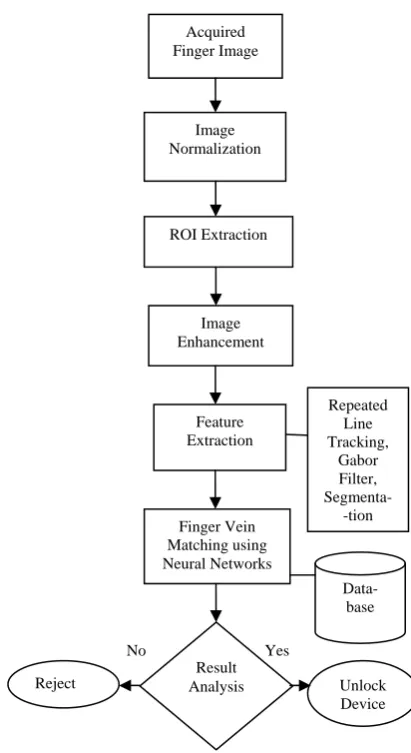
And the integration is called as ‘HYBRID Technique’. The flow chart of the proposed HYBRID Technique is:
No Yes
Figure 1 Flow Chart for finger vein authentication using HYBRID Technique.
As shown in flow chart, the finger vein image is acquired near-Infrared rays. After the acquisition of the finger image, pre-processing is done to enhance the image. Pre-processing involves:
A. Pre-processing:
1) Image Normalization: Normalization is done to change the range of pixel intensity values [16].
Binarization refers to restoring, denoising by converting a greyscale image pixels to binary (black or white) image pixels.
2) ROI Extraction: ROI is an acronym for ‘Region of Interest’. The superfluous regions are separated and the interested area (Region of Interest) is extracted by ROI extractor.
3) Image Enhancement: The image acquired after ROI Extraction still contains dullness, noise, blurriness. Image Enhancement enriches the vividness of the image, its quality and contrast.
Image Normalization
Acquired Finger Image
Feature Extraction
Finger Vein Matching using Neural Networks
Reject Unlock
Device
Data-base ROI Extraction
Image Enhancement
Repeated Line Tracking,
Gabor Filter,
Segmenta--tion
B. Feature Extraction: The enhanced finger vein image needs to be extracted.Extraction means taking out. So, feature extraction is to transform the input data into reduced set of features. The extracted features are expected to contain relevant information from initial data and the desired task can be performed by using this reduced representation. Repeated Line Tracking, Even symmetric Gabor filter and Segmentation comes under feature extraction. These techniques trim down the full size image to extract significant information [21].
1) Repeated Line Tracking:
Repeated Line Tracking method clears the image by removing irregular shading, produced by the thickness of finger bones. Local dark lines are identified and line tracking is executed by moving along the lines, pixel by pixel. When a dark line is not detectable, a new tracking operation starts at another position. All the dark lines in the image can be tracked repeatedly by line tracking operation.
2) Even Symmetric Gabor Filter:
Gabor filter is basically used to detect length and width of the finger vein image. Gabor filters are inspired by multichannel processing and are known to achieve maximum possible joint resolution. Gabor filter consists of two parts: real and imaginary. The real part, usually called even-symmetric Gabor filter is suitable for ridge detection in an image, while the imaginary part, usually called odd-symmetric Gabor filter, is beneficial to edge detection [5].
3) Even Symmetric Gabor Filter with Morphological Operations:
Morphological operations are employed to enhance the extracted vein structure. Basically, these operations further enhance the clarity of vein pattern extracted from Gabor filter. Morphological operations are of low computational complexity.
4) Segmentation:
Segmentation means fragmentation, i.e. dividing the different regions to collect a full enhanced image of the finger vein. In this paper, we used Automatic Trimap, which segments the region into three parts: definite foreground, definite background and blended region. It will exclude the unwanted background and extract the vein pattern from foreground. Blended region enhances the clarity of edges.
5) Vein Pattern Matching using Neural Networks:
A Neural Networks is a connectionist computational systems and similar to biological neural networks. Artificial Neural Networks are generally presented as systems of interconnected neurons which send message to each other and ANN are used to for matching. SURF (Speeded up Robust Feature) technique is used in this. SURF descriptors are used to locate and recognize objects, people or faces to track objects or to extract points of interest. In case of SURF, square-shaped filters are used that filter the image much faster. For vein matching two steps are done:
Extract Features
Match Features
The features extracted from finger vein images are already stored in the database [21]. If the input image is matched
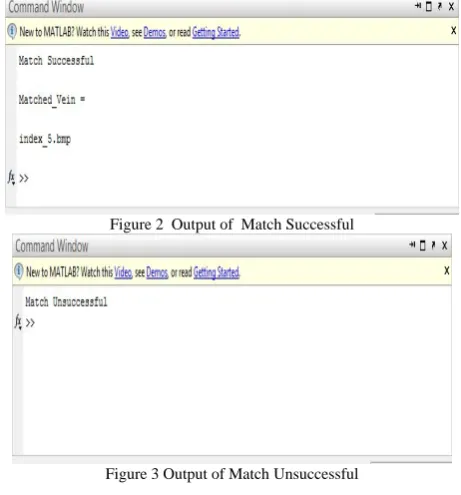
with any one of the extracted veins, the device will be unlocked and if not, then it will show a reject message and in the command window it will be shown as ‘Match Successful’ in case of true identity and ‘Match Unsuccessful’ in case of false identity.
Figure 2 Output of Match Successful
Figure 3 Output of Match Unsuccessful
IV.SIMULATIONRESULTS
The performance of a biometric system depends upon the different parameters such as false rejection rate, false acceptance rate and genuine acceptance rate. Accuracy of an authentication system is measured through error rates. Figure 4 describes the error rates:
FAR (False Acceptance Rate) is given by the number of fake signatures accepted by the system with respect to the total number of comparisons made. Lower the FAR rate, more secure the system is.
GAR (Genuine Acceptance Rate) is an accuracy measurement of a biometric system and leading measurement of precision. Higher the GAR rate, the more accurate the system is.
In figure 4, ROC values of repeated line tracking, Even Gabor, Neural Network and combined method are plotted to show the comparison between them in teams of FAR and GAR.
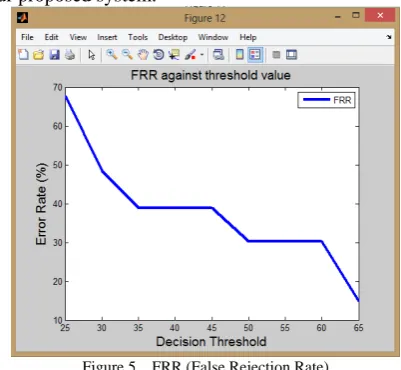
In our proposed framework, FRR (False Rejection Rate) is
the probability that the system fails to detect a match between the input pattern and a matching template in the database. It measures the percentage of valid inputs which are incorrectly rejected. Figure 5 shows the graph of FRR of our proposed system.
Figure 5 FRR (False Rejection Rate)
Figure 6 shows the bar graph, comparison of computational time between our proposed hybrid technique and other individual techniques. Performance of the authentication system increases with fast processing.
Figure 6 Computation Time
Table 2 shows the time taken for matching by our proposed hybrid technique and RPL, EGWS and summation of both.
Table 2 Comparison of Computation Time
Conclusion and future scope
Our finger vein authentication system is implemented successfully. In past, there is work done by Repeated Line Tracking and Gabor filter approach individually but the combination of these two approaches with Neural Network is not done before. In this work, systematically develop a new hybrid approach for the finger vein feature extraction using Repeated Line tracking, Gabor filters and segmentation with Neural Networks. The result comes after the combinations of these three methods are more accurate than the individual method. The result comes for GAR and the FAR after comparing with the individual technique is more accurate. The computational time is minimized by enhancing the performance of the system. In future more techniques can be used to extract the feature of finger vein. Future work will also include combination of some other biometric technique to make identification more accurate and more secure authentication.
REFERENCES
[1] Naoto Miura, Akio Nagasaka, Takafumi Miyatake, “Feature extraction of finger vein patterns based on repeated line tracking and its application to personal identification”, Springer-Verlag, 2004.
[2] Naoto Miura, Akio Nagasaka, Takafumi Miyatake, “Extraction of Finger-Vein Patterns Using Maximum Curvature Points in Image Profiles”, Conference on Machine VIsion Applications , May 2005. [3] David Mulyono, Horng Shi Jinn, “A Study of Finger Vein
Biometric for Personal Identification”, IEEE, 2008.
[4] Behnaz Saropourian, “A New Approach of Finger-Print Recognition based on Neural Network”, IEEE, 2009.
[5] Jinfeng Yang, Jinli Yang, Yihua Shi, “Finger-Vein Segmentation Based on Multi-channel Even-Symmetric Gabor Filters”, IEEE, 2009.
[6] Qin Bin Pan Jian-fei Cao Guag-zhong, Du Ge-guo, “The Anti-spoofing Study of Vein Identification System”, IEEE, 2009. [7] Azadeh Noori Hoshyar, Riza Sulaiman, “Review on Finger Vein
Authentication System by Applying Neural Network”, IEEE, 2010. [8] Fengchun Zhang, Shuxu Guo, Xiaohua Qian, “Segmentation For
Finger Vein Image Based On PDEs Denoising”, International Conference on Biomedical Engineering and Informatics (BMEI), 2010.
[9] Prof G.Ramaswamy, Vuda Sreenivasarao, Dr.P.Ramesh, D.Ravi Kiran, “A Novel Approach for Human Identification through Fingerprints”, International Journal of Computer Applications (IJCA), Volume 4 - No.3, July 2010.
[10] Jingfeng Yang, Xu Li, “Efficient Finger Vein Localization and Recognition”, IEEE, 2010.
[11] Dipali K.Bhole, A.V.Vidhate, Shrikant Velankar, “Offline signature using Cross validation and Graph matching approach”, International Journal of Technology And Engineering System (IJTES),Vol.2,No.1,2011.
[12] Eui Chul Lee, Hyunwoo Jung, Daeyeoul Kim, “New Finger Biometric Method near Infrared Imaging”, Sensors, 2011.
[13] Jinfeng Yang, Junjie Wang, “Finger-vein Image Restoration Considering Skin Layer Structure”, IEEE, 2011.
[14] Ajay Kumar, Yingbo Zhou, “Human Identification Using Finger Images”, IEEE TRANSACTIONS ON IMAGE PROCESSING, VOL.21, NO.4, April 2012.
[15] Alima DAMAK MASMOUDI, Randa BOUKHRIS TRABELIS, Dorra SELLAMI MASMOUDI, “A new biometric human identification based on fusion fingerprints and finger veins using MonoLBP descriptor”, CEM Research laboratory, Vol.78, 2013. [16] Dipantu Bhowmik, “Finger Vein & Texture Recognization Using
Score Level Fusion And 2-D Gabor Filter for Human Identification”, International Journal of Engineering Research and Applications, Vol.3, Issue 2, pp.170-177, ISSN: 2248-9622, 2013.
[18] M.Bhavani, Mrs.Shoba Rani, “Human Identification Using Finger and Iris Images”, International Journal of Computer Trends and Technology (IJCTT), volume 4, Issue 3, ISSN: 2231- 2803, 2013. [19] Megha P.Arakeri, G. Ram Mohana Reddy, “An intelligent
content-based image retrieval system for clinical decision support in brain tumor diagnosis”, Springer, 2013.
[20] Pandillapalli Gowtham, Ch. Sindhu, C. Sudheer Kumar, Ch. Chandra Sekhar, M.s. Abdullah, “IDENTIFICATION OF FINGER
IMAGES USING SCORE- LEVEL FUSION ”, International Journal of Engineering Science Invention (IJESI), Volume 2 Issue 2, February 2013.
![Table 1 shows the characteristic comparison of Biometric [7]](https://thumb-us.123doks.com/thumbv2/123dok_us/7861322.1304005/1.595.299.551.613.729/table-shows-characteristic-comparison-biometric.webp)