Arun Kumar Kuna*, Ganapaty Seru, GadelaVenkata Radha
Gitam Institute of Pharmacy, Gitam University, Gandhi Nagar, Rushikonda, Visakhapatnam – 530 045, Andhra Pradesh, India.
*Corresponding author’s E-mail:[email protected]
Received: 30-11-2016; Revised: 12-01-2017; Accepted: 26-01-2017.
ABSTRACT
A simple, specific and accurate reverse phase high performance liquid chromatographic method was developed for the determination of Imatinib mesylate and its Amine Impurity in pharmaceutical dosage form. The column used was HiQSil C18 (250 x 4.6 mm, 5μm), with mobile phase containing methanol and Acetate Buffer pH 3.5 inthe ratio of 80: 20 v/v, the flow rate was 1.0 mL/ min and eluent was monitored at 273nm. The retention time for Imatinib mesylate was 8.071and for Amine Impurity it is 4.958. The proposed method was validated and successfully applied to the estimation of Imatinib mesylate and Amine Impurity in formulations.
Keywords: Imatinib mesylate, Drug Impurity, HPLC.
INTRODUCTION
matinib mesylate is a small molecule that inhibits the c-Abl protein-tyrosine kinase, a kinase specifically important for proliferation of chronic myelogenous leukemia (CML). A translocation event between chromosomes 9 and 22 generates the Philadelphia chromosome, which then produce the Bcr-Abl fusion protein with aberrant kinase activity that promotes rapid cell proliferation. Imatinib binds up this crucial kinase, halting CML related growth. Imatinib mesylate has further been displayed to inhibit PDGFR and tyrosine kinases associated with c-Kit. The structure of Imatinib mesylate is shown in Figure 1.
Figure 1: Structure of Imatinib mesylate
Imatinib Mesylate is chemically known as 4[(4Methyl1piperazinyl) methyl]N[4methyl3[[4(3pyridinyl) 2 -pyrimidinyl] amino] phenyl] benzamid methane sulfonate and has a chemical formula C29H31N7O•CH3SO3H. A
molecular weight of Imatinib mesylate is 589.7 g/mol. Imatinib mesylate is a white to creamish yellow crystalline powder. It is freely soluble in distilled water, 0.1 N HCl and methanol. Regulatory requirements for the identification, qualification, and control of Impurities in drug substances and their formulated products are now being explicitly defined, particularly through the International Conference on Harmonization (ICH).
1-2Several analytical methods have been reported in the
literature for estimation of Imatinib mesylate and its Impurities in bulk drugs and formulations.3-10The aim of current study was to develop and validate HPLC method
for the simultaneous determination of Imatinib mesylate and its Impurity i.e., Amine Impurity – (N-(5-Amino – 2-methylphenyl)-4-(3-pyridyl)-2-pyrimidine amine).
MATERIALS AND METHODS
Chemicals and Reagents
Imatinib mesylate- pure analytical sample was obtained as a gift sample from Nishka Labs, Hyderabad and its Amine Impurity was procured from Nishka Labs, Hyderabad. All chemicals and reagents used were of AR grade and all the solvents used were of HPLC grade. Methanol HPLC Grade, Acetonitrile HPLC Grade were of Merck Chemicals, Mumbai while Hydrochloric acid and Ammonium Acetate AR Grade was of S.D. Fine Chemical Industries, Mumbai. Double distilled water prepared at laboratory scale using ELGA water purification system, was used throughout the study. GLEEVAC film coated tablets (Novartis) were procured from the local pharmacy labeled to contain Imatinib mesylate equivalent to 100 mg of Imatinib free base.
Instrumentation
HPLC system used was JASCO system equipped with Model PU 2080 Plus pump, Rheodyne
Sample injection port (20 μL), MD 2010 PDA detector and Borwin- PDA software (version 1.5). A chromatographic column HiQSil C18 (250 x 4.6 mm, 5μm) was used for separation. All weighing were done on Shimadzu balance Model AY-120.
Chromatographic Conditions: Isocratic Procedure
Chromatographic separation carried using methanol and acetate buffer pH 3.5 in the ratio of 80:20 v/v as the mobile phase which gave good resolution and acceptable peak parameters. Separation was carried out at flow rate of 1 ml/min and detection at 273 nm. The peak purity was checked with the PDA detector. The mobile phase was
Analytical Method Development and Validation for the Estimation of Imatinib Mesylate and
its Impurity in Pharmaceutical Formulation by RP-HPLC
I
filtered through a 0.45 μ nylon membrane filter prior to use. The sample injection volume was 20 μl.
Preparation of Mobile Phase
Acetate Buffer pH 3.5 was prepared by dissolving 25 gm of ammonium acetate in 25 ml water. Added 38 ml of 7 M HCl adjusted the pH to 3.5 with 2 M HCl or 6 M ammonia and diluted with water to 100 ml. Mobile phase was prepared by mixing methanol and Acetate Buffer pH 3.5 in the ratio of 80: 20 v/v. It was then filtered through 0.45 μm membrane filter paper using filtration assembly and then sonicated on ultrasonic water bath for 15 min.
Preparation of Solution
Standard Solution
A standard stock solution ‘A’ containing 100 μg/ml of Amine Impurity was prepared by dissolving 10 mg of Amine Impurity in methanol in a 100 ml volumetric flask. The stock solution ‘B’ was further prepared by diluting appropriate amount with methanol to get 10 μg/ml solution of Amine Impurity. The Imatinib mesylate standard stock solution ‘C’ containing 1000 μg/ml was prepared using appropriate amount of Imatinib mesylate reference standard dissolved in methanol.
Resolution Solution
Resolution solution ‘D’ was 1 ml of Imatinib mesylate standard stock solution C and 5 ml of Impurity stock solution B, diluted up to 100 ml with methanol. This resolution solution was containing 10 μg/ml of Imatinib mesylate and 0.5 μg/ml of Impurity.
Sample Solution
To determine the content of Imatinib mesylate in conventional tablet, twenty tablets were weighed (each tablet containing Imatinib mesylate equivalent to 100 mg of Imatinib free base); their mean weight was determined and was finely powdered. The weight of the tablet powder equivalent to 100 mg of Imatinib mesylate was transferred into a 100 ml volumetric flask containing 80 ml methanol and sonicated for 5 min. to ensure complete dissolution of drug. The extract was filtered, residue was washed with methanol and volume was made up to the mark by adding washings to the flask. Appropriate volume of above solution was further diluted suitably with methanol to give 20 μg/ml of Imatinib mesylate and 20 μl was injected into HPLC system, under the conditions described above.
System Suitability
System suitability parameters were evaluated to verify that the analytical system is working properly and can give accurate and precise results using 20 μl resolution solutions ‘D’ (10 μg/ml of Imatinib mesylate and 0.5 μg/ml of Impurity). Parameters such as tailing factor, resolution, peak area were evaluated. The % RSD less than 2.0 for six replicate injections and theoretical plates
not less than 2000 was set as acceptance criteria for system suitability of the proposed assay method.
Analytical Method Validation
The method was validated for linearity, range, accuracy, precision, sensitivity, specificity and robustness in accordance with ICH guidelines. 1-2
Linearity and Range
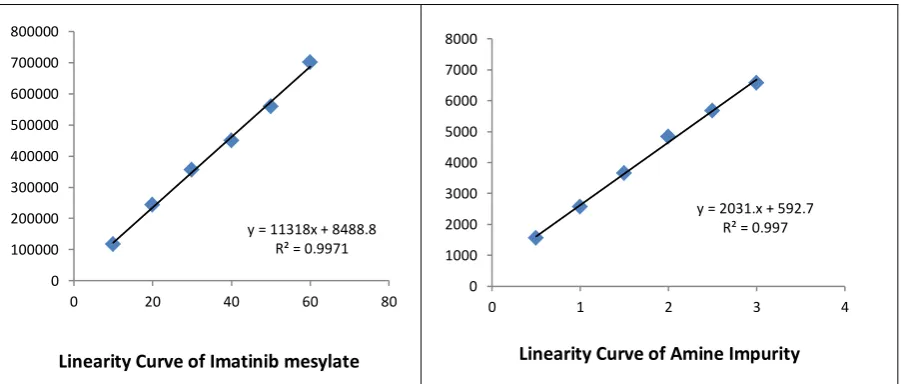
Linearity of Imatinib mesylate was determined over a range of 10-60 μg/ml, while for the Amine Impurity a range of 0.5 μg/ml to 3 μg/ml was selected for linearity study. Calibration curve was drawn by plotting the peak areas of analyte versus their corresponding concentration. Values of coefficient of regression, slope and Y-intercept of the calibration curve were calculated.
Accuracy (recovery study)
To perform recovery studies tablet powder was first mixed with Impurity and appropriately diluted to get sample solution. Recovery studies were performed in triplicate at concentration levels i.e., 50, 100 and 150 % by standard addition method. Sample solutions were spiked with appropriate volume of standard solution of Impurity as well as Imatinib mesylate. The resulting mixtures were analysed by the developed method. Base level amount of Imatinib mesylate and its Impurity used for spiking were 20 μg/ml and 1 μg/ml, respectively. The % RSD and mean recovery was calculated.
Precision
The precision of the method was verified by repeatability (intraday) and intermediate precision studies. Repeatability was assessed by injecting six times 20 μl of standard solution containing Imatinib mesylate (20 μg/ml) spiked with Impurity solution (1 μg/ml) into HPLC system under stabilized chromatographic conditions and value of % RSD was calculated using peak area of Imatinib mesylate and Impurity. Further inter-day variation for the determination of Imatinib mesylate and Amine Impurity was carried out at three different concentration levels (20, 30 and40 μg/ml for Imatinib mesylate and 1, 1.5 and 2 μg/ml for Amine Impurity) on three consecutive days. The % RSD of the obtained assay values at three different concentration levels was calculated.
Method sensitivity (limit of detection and limit of quantitation)
Specificity
Specificity involved demonstration of the ability of the developed method for the separation and resolution of Imatinib mesylate and Amine Impurity. Further peak purity of all the analytes was measured to evaluate the specificity of the method. The sample and standard bands were scanned at three distinct levels, i.e., peak start (S), peak apex (M), and peak end (E) positions. The peak purity was determined by PDA detector.
Robustness
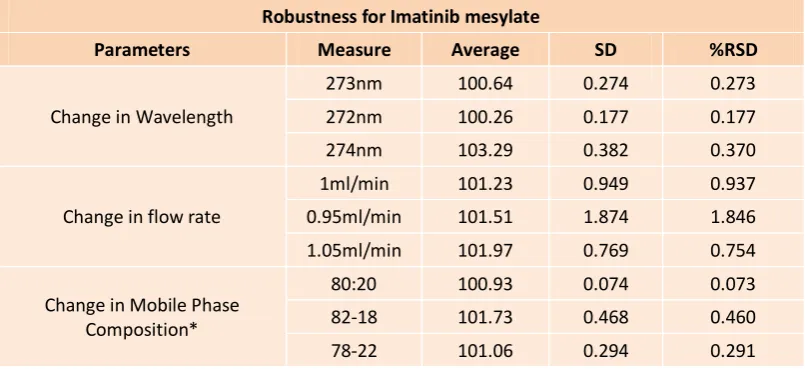
Robustness of the method was checked by carrying out the analysis under conditions during which little variations like changing detection wavelength, flow rate and mobile phase composition was done and the effects on the area were noted. The % RSD for each deliberate change was calculated.
RESULTS AND DISCUSSION
Development and optimization
The HPLC procedure was optimized with a target to achieve separation of Impurity and main component Imatinib mesylate. Based on literature survey and review of physico-chemical properties of analytes, preliminary chromatographic conditions were selected. Chromatographic separation studies were carried out on the resolution solution of Imatinib mesylate (10 μg/ml) and Amine Impurity (0.5 μg/ml). Initially, trials were carried out using methanol, water in various proportions along with buffer of varying pH, to obtain the desired system suitability parameters. After few trials, mixing methanol and Acetate Buffer pH 3.5 in the ratio of 80: 20 v/v was chosen as the mobile phase which gave good resolution and acceptable peak parameters. Wavelength for monitoring the eluent was selected by scanning standard solution of drug and Impurity within 200–400 nm. Separation was carried out at flow rate of 1ml/min and detection at 273 nm. The peak purity was checked with the PDA detector. The mobile phase was filtered through a 0.45 μ nylon membrane filter prior to use. The injection volume was 20 μl.
System Suitability
Chromatographic separation of resolution solution D was successfully achieved with the abovementioned chromatographic conditions. The representative chromatograms shown in Figure 2. Impurity was injected separately as well as by spiking into the Imatinib mesylate to check its interference with the main peak. The Impurities didn’t interfere with Imatinib mesylate peak. The resolution between Imatinib mesylate and Amine Impurity was greater than 3.50. The retention times of the Imatinib mesylate and Amine Impurity were 8.071 and 4.958 respectively. The theoretical plates were above 2000 for both Imatinib mesylate and Amine Impurity. Table 1 contains system suitability parameter details of Imatinib mesylate and Amine Impurity.
Figure 2(A): Chromatogram of Resolution Solution Imatinib mesylate (10 µg/ml) and Amine Impurity (0.5 µg/ml)
Figure 2(B): Mobile Phase Blank
Figure 2(C): Chromatogram of Imatinibmesylate (10 µg/ml).
Table 1: System suitability parameters
Name RT (Min) Mean ± % RSD
Concentration
(μg/ml) Avg. Area
Plates (N)
Tailing
Factor Resolution
Amine
Impurity 4.958 ± 0.124 0.5 1552.130 3965.46 1.136 --
Imatinib
mesylate 8.071 ± 0.547 10 116029.005 4238.78 1.024 3.6*
*with respect to previous peak
Linearity and Range
The method was found to be linear over the range; for Imatinib mesylate it was 10 μg/ml to 60μg/ml and for Amine Impurity 0.5 μg/ml to 3 μg/ml. The data
generated was analysed by linear regression analysis shows the satisfactory result with correlation coefficient greater than 0.997. Linearity Curves of Imatinib mesylate and Amine Impurity are shown in Figure 3.
Linearity Curve of Imatinib mesylate Linearity Curve of Amine Impurity
Figure 3: Linearity Curve of Imatinib mesylate and Amine Impurity.
Accuracy
The % mean recoveries for Imatinib mesylate and Impurity was in the range of 99.88-100.44and 99.49 – 100.96, respectively. The overall % RSD was observed as less than 2%. Accuracy details are given in Table 2.
Precision and Repeatability
The % RSD in precision studies was found to be 0.272 for repeatability and 0.34– 1.98 % Interday for Imatinib mesylate. The % RSD in precision studies was found to be 0.58 for repeatability and 0.38– 0.70 % Inter-day for amine Impurity. This indicates that the method is precise.
Method sensitivity
The LOD concentration was found to be 0.408, 0.062 μg/ml and LOQ concentration was 1.235, 0.188 μg/ml for Imatinib mesylate and Impurity, respectively.
Specificity
The specificity of the method was ascertained by peak purity profiling studies. The peak purity values were found to be more than 991, indicating the no interference of any other peak of degradation product, Impurity or matrix. Details about purity tail and purity front of Imatinib mesylate and Amine Impurity are given in Table 3.
Robustness
Small deliberate alteration in chromatographic conditions did not affect the assay and resolution significantly for the investigated compounds, % RSD was less than 2% indicates that the developed method was robust to minor changes in the experimental conditions. Robustness details are given in Table 4.
y = 11318x + 8488.8 R² = 0.9971
0 100000 200000 300000 400000 500000 600000 700000 800000
0 20 40 60 80
y = 2031.x + 592.7 R² = 0.997
0 1000 2000 3000 4000 5000 6000 7000 8000
Table 2: Accuracy details of Imatinib mesylate and Amine Impurity.
Accuracy Results of Imatinib mesylate
Accuracy Level Recovered (mg) Recovered (%) Average (%) SD
50%
9.984 99.84225
100.44 0.67
10.116 101.1584
10.031 100.3063
100%
20.182 100.9091
100.21 0.63
19.941 99.7028
20.001 100.0063
150%
29.837 99.45667
99.88 1.18
29.689 98.96442
30.362 101.2077
Accuracy Results of Amine Impurity
Accuracy Level Recovered (mg) Recovered (%) Average (%) SD
50%
0.494619 98.924
99.49 0.58
0.497385 99.477
0.500407 100.081
100%
1.010942 101.094
100.96 0.12
1.008668 100.867
1.009190 100.919
150%
1.501363 100.091
100.05 0.41
1.506589 100.439
1.494212 99.614
Table 3: Details of Purity tail and Purity front.
Drug/Impurity Purity tail (s, m) Purity front (m, e)
Imatinib mesylate 995.75 999.26
Amine Impurity 997.50 992.003
Table 4: Robustness details of Imatinib mesylate and Amine Impurity.
Robustness for Imatinib mesylate
Parameters Measure Average SD %RSD
Change in Wavelength
273nm 100.64 0.274 0.273
272nm 100.26 0.177 0.177
274nm 103.29 0.382 0.370
Change in flow rate
1ml/min 101.23 0.949 0.937
0.95ml/min 101.51 1.874 1.846
1.05ml/min 101.97 0.769 0.754
Change in Mobile Phase Composition*
80:20 100.93 0.074 0.073
82-18 101.73 0.468 0.460
Robustness for Amine Impurity
Parameters Measure Average SD %RSD
Change in Wavelength
273nm 99.62 0.581 0.583
272nm 97.66 1.360 1.393
274nm 98.13 0.122 0.125
Change in flow rate
1ml/min 99.45 0.654 0.657
0.95ml/min 98.41 0.348 0.353
1.05ml/min 97.86 0.497 0.508
Change in Mobile Phase Composition*
80:20 100.10 0.520 0.519
82-18 97.48 1.082 1.110
78-22 97.91 0.660 0.674
*Methanol: Buffer
CONCLUSION
The proposed HPLC method for simultaneous estimation of Imatinib mesylate and its Impurity in bulk and Imatinib mesylate tablet was developed and validated as per ICH guidelines. The method was found to be linear in stated range. Statistical analysis proved that the method is specific, accurate, precise and sensitive. The method is suitable for simultaneous quantitative analysis of Imatinib mesylate and its amine Impurity in bulk drugs and formulations without anyinterference from the excipients. Thus, the proposed method can be successfully employed for routine quality control and Impurity profiling of Imatinib mesylate.
Acknowledgement: The authors thank Dr. Jagadeesh Kumar Kuna, RMC Kakinada for his encouragement and support in providing necessary support for this work. We greatly acknowledge the receipt of material and research support from Nishka Labs, Hyderabad.
REFERENCES
1. International conference on harmonization, ICH Q2 (R1)Validation of Analytical Procedures: Text and Methodology, 2005
2. International conference on harmonization, ICH Q3A (R2) Impurities in New DrugSubstances Q3A (R2), 2006. 3. Yadav RR, Rokade MD, Salunke SA, Gangrade DM, Holkar
GS, Daphal VN, Determination of Potential Genotoxic Impurities in Imatinib mesylate by RP-HPLC Method, Biological Forum – An International Journal, 4, 2012, 15-18.
4. Venkataramanna Madireddy, Sudhakar BabuKondra, Narayanareddy P, Stability- Indicative, validated, fast HPLC
method for quantification of two genotoxic Impurities in Imatinib mesylate, Global Journal of Analytical Chemistry, 2, 2011, 198-207.
5. Pratik Shah, Nisha Shah, Rutesh Shah, Method Development and Validation of a stability indicating RP-HPLC method for assay determination of Imatinib in Imatinib mesylate tablets dosage form, International Journal of Pharmaceutical Sciences and Research, 6, 2015, 4453-4468.
6. Fatma Ghrib, Aymen Chtioui, Taieb Saied, NizarBellakhal, Determination of Imatinib and its Genotoxic Impurities in Tablets, Biological Forum – An International Journal, 7, 2015, 1820-1827.
7. Arun Kumar Kuna, Jagadeesh Kumar Kuna, RP-HPLC Method development and validation of Imatinibmesylate in tablet dosage form, International Journal of Pharmacy and Pharmaceutical Sciences, 3, 2011, 162-165.
8. Pratik Shah, Rutesh Shah, A stability- indicating RP-HPLC method development and validation for the related substance determination of Imatinib process Impurities and their degradation products in tablet dosage form, International Journal of PharmTech Research, 8, 2015, 128-146.
9. Sandhya P, Vishnu Priya P, Shyamala, Anjali Devi N, Sharma JVC, Method development and validation of Imatinib mesylate in pharmaceutical dosage form by RP-HPLC, World Journal of Pharmacy and Pharmaceutical Sciences, 3, 2014, 682-688.
10.Shah P, Shah N, Brahmbhatt R, Saptarshi D, Shah R, A rapid reverse phase HPLC dissolution method development and validation of Imatinib in Imatinib mesylate tablets dosage form, International Journal of Pharmaceutical Research and Bio-Science, 3, 2014, 64-82.