www.ijiset.com
Data Analysis of Dust and Foreign Particles
in Fabricator Using Matlab
Manoj kumar.MP
1
P
, S.S. Mahesh ReddyP
2
P
, Dr. G. N. SahadevaP
3
P
1
P
Student, Department of Mechanical Engineering, East Point College of Engineering & Technology, Bangalore, India-560049,
P
2
P
Assistant Professor, Department of Mechanical Engineering, East Point College of Engineering & Technology, Bangalore, India-560049
P
3
P
Professor & Head, Department of Mechanical Engineering, East Point College of Engineering & Technology, Bangalore, India-560049
Abstract
Distinctive alternatives are accessible for division of residue or fine residue particles exhibit in encompassing air like, violent winds, venturi scrubbers, pack channels, electrostatic precipitators, and so on. For gathering little particulate issue electrostatic precipitator, wet scrubber and texture channels are utilized. Among every one of the channels, the most productive is texture channel for fine particles. The general gathering productivity is high for texture channels. Heartbeat stream texture channels depend on the filtration of grimy pipe gas by the outside surface of the sacks, which are then cleaned by a stun wave produced by an air beat entering each pack from the best. As it goes down the length of the pack, the stun wave flexes the texture and unsticks the residue cake.
MATLAB is an dialect utilized for coding. It is an intuitive dialect. The inferred conditions are executed through a MATLAB code to assess the properties of air at different recognized focuses in the rearranged model of the beat stream unit. Correlation of numerical consequences of mass stream rate, weight, temperature at the exit of the repository 1 and 2 is dissected. With advancing time and towards the finish of the beat term, it was watched that the mass stream rate at the exit of the repository 1 is equivalent to the exit of the supply 2.The weight drop with time is progressively when the store 1 is associated with a blow tube or supply 2 having 12 spouts when contrasted with 9 spouts. The temperature in the repository 1 tediously diminishes with time and in store 2 increments forcefully amid the underlying occasions for a little span of the aggregate heartbeat time.
1. INTRODUCTION
1.1 PULSE JET FABRIC FILTERS:
Heartbeat stream texture are broadly utilized in control age, burning, concoction, steel, bond, sustenance, pharmaceutical, metal working, total, and carbon dark industries.With the expanding emanation directions of fine particulates and air poisons, beat fly texture channels have turned into an appealing particulate gathering alternative for air contamination control. Heartbeat fly filtration initially began contamination control in coal let go boilers. Mikropul imagined the primary heartbeat stream dust authority in 1956, for bond businesses. There are around 300 heartbeat fly texture channels introduced over the world in mechanical and coal-let go boilers. Texture channels with heartbeat cleaning have been effectively connected downstream of a wide range of boilers running from pummeled coal-let go, stoker-terminated, foaming and flowing fluidized bed burning boilers. All power plants far and wide have effectively utilized the texture channel with heartbeat stream cleaning utilizing needle felt textures.
1.2 COMPONENTS OF A PULSE-JET BAG FILTER:
The schematic of a heartbeat stream texture channel constructional subtle elements and its working rule can be comprehended utilizing the Figure 1.2.
www.ijiset.com
Residue loaded air-encouraging zone, Filter unit, Dust transfer framework, Fan (air mover) and release stack, Air store, Connecting funnels, Diaphragm valve, Blow pipe, Nozzles, Venturi-spout, Filter pack and enclosure get together, Bag channel lodging, Auxiliary connection, Safety highlights for touchy or inflammable residue.
2. Literature Review:
Wu-Shung Fu and Jia-Shyan Ger [1] have considered the Numerical and exploratory examinations to anticipate properties of gas released from various spouts on a blow tube. One segment of the beat stream pack house channel is the stomach valve. Learning of the stream attributes of the stomach valve is basic in delivering hypothetical forecast of mass stream rate from the air store to blow tube unit. Regarding this, Fu and Ger have dealt with trial and numerical assessment of stream coefficient and stream qualities through the stomach valve. The logical answer for mass rate variety at the exit of the air supply, the temperamental variety of weight in air tank and valve stream coefficient for stomach valve were acquired in conjunction with test information. In continuation with to this, Fu and Ger have endeavored numerical and exploratory work for stream examination through the pass up building an identical model called the two store show. Implying that, the air stockpiling supply is alluded to as repository 1 and store 2 is alluded to as the blow pipe. They inferred the systematic articulation for mass stream rate variety, Mach number, upstream static and stagnation weight at the exit of air store 1 and comparably mass stream rate variety out of repository 2 (i.e. the blow pipe), downstream Mach number, downstream static and stagnation weight. They directed investigation and contrasted and the numerical arrangement results and the outcomes supplement each other. A further expansion to this work by Fu and Ger is that now they consider the blow pipe or repository 2 as the real blow pipe with certain number of spouts as is available in the real heartbeat fly channel set up. They discovered the numerical answer for the insecure weight variety, mass stream variety, Mach number variety at the exit of the store and exit of the every spout situated in the blow pipe. For a similar work they led examinations to look at numerical outcomes.
Alan H. Senior member and Kenneth M. Cushing [3] Survey on the Use of Pulse-Jet Fabric Filters for Coal-Fired Utility and Industrial Boilers, Pulse-fly texture channels depend on the filtration of messy vent gas by the outside surface of the packs, which are then cleaned by a stun wave produced by an air beat entering each sack from the best. As it goes down the length of the pack, the stun wave flexes the texture and unsticks the residue cake. Upgrade of the beat might be accomplished by utilizing a venturi, and cleaning might be on-line or disconnected.
Chuen-Jinn Tsai and Hsin-Chung Lu [4] have completed examination on Numerical and Experimental investigation of cleaning process in Pulse-stream texture filtration framework. The beat fly texture filtration framework or sack house is a standout amongst the most prevalent residue control gadgets. Given different conditions settled. Fruitful activity of a heartbeat stream texture channel depends on the correct decision of filtration speed and legitimate outline of the beat fly cleaning framework. This investigation is an extensive parametric outline investigation of heartbeat stream cleaning framework. Parameters, for example, volume and weight of air tank, blow tube measurement, breadth and number of spouts, length of packs, remove between a spout and the sack opening, and heartbeat term were considered.
X. Li and A.J. Chambers [10] have considered the Model of Dust Collection and Removal from Mechanically Shaken Filter Bags. This model is conceivably helpful for enhancing pack house activity parameters keeping in mind the end goal to accomplish more proficient cleaning with more uniform residue dispersions. Nonetheless, down to earth quantitative expectation can be accomplished simply after a few parameters are estimated through examinations; including the break development parameters and the texture shear and spring firmness under powerful conditions. Moreover, the inner weight drop which makes the sack crumple isn't demonstrated at this stage.
3. MATLAB
www.ijiset.com arranged programming. These components make
MATLAB a superb instrument for educating and research.
3.1 MATLAB session
In the wake of signing into the MATLAB, a base MATLAB session is opened which is appeared in the accompanying Figure 5.1.
The desktop consist of these panels:
•
Current Folder•
Command Window•
Workspace•
Command History3.2 Information Analysis in MATLAB
Each datum investigation has some standard parts:
Preprocessing: Consider anomalies and missing qualities, and smooth information to distinguish conceivable models.
Outlining: Compute fundamental insights to portray the general area, scale, and state of the information.
Demonstrating: Give information patterns more full depictions, reasonable for foreseeing new qualities. Information examination moves among these segments in view of two essential objectives:
(a)Describe the examples in the information with basic models that prompt exact Predictions.
(b)Understand the connections among factors that prompt the model.
Picture investigation includes the change of highlights and questions in picture information into quantitative data about these deliberate highlights and properties. Microscopy pictures in science are regularly perplexing, uproarious, and ancient rarity loaded and subsequently require various picture preparing ventures for the extraction of significant quantitative data.
4.
NUMERICAL RESULTS AND
DISCUSSIONS
The information for the numerical exercise is portrayed at this point. The stream issue comprises of two
stores, the underlying air properties in the repository 1 and supply 2 are accepted at time t =0.0. The underlying weight in repository 1 is 629700 Pascal, temperature of the
air in the supply 1 is 293.7 K, and volume of the store 1 is 0.1065 m3. The underlying weight of air in repository 2 is 101325 Pascal, and introductory temperature is 293.7 K. Two blow tube are picked with the goal that one of the blow tube has9
number of spouts and alternate has 12. The distance across of the spouts is 8 mm and 12 mm separately. The length of the blow tube is 1.75 meters and width 43 mm. Consequently the volume of store 2 (i.e. blow tube with one spout) is 0.00254 m3. The beat length for the numerical exercise is 500 milliseconds (or 0.5 seconds). Note that the commencement of the stomach valve is at 0.43seond as opposed to at 0.0 second. It is required to figure the weight and temperature variety in the repository 1 and 2 with time. Likewise locate the mass stream variety at the exit of the supply 1 and 2. This will be useful to characterize the limit condition when fathoming the beat fly unit in FLUENT.
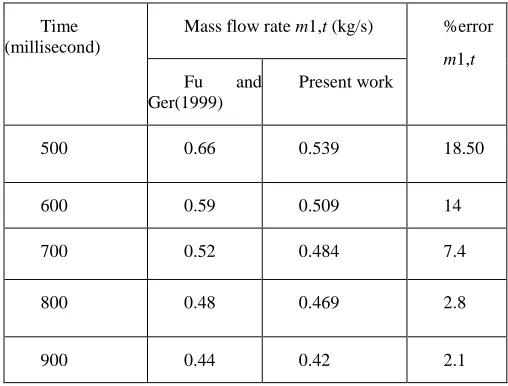
Table 4.1 and 4.2 gives the mass stream at the exit of store 1 at different occasions. It is seen from the table that the mass stream rate at the exit of the supply 1 is diminishing with time. An examination of the outcomes got from the present work with the outcomes detailed in Fu and Ger (1999) is likewise said. The outcomes from the present endeavor are not promising. Note the extensive mistake for mass stream at time 500 milliseconds and 600 milliseconds. Looking at the outcomes for the mass stream varieties, Table 4.1 and Table 4.2 the mass stream at the exit of the supply 1 for blow tube with 12 spouts is higher than mass stream at the exit of the store 1 with 9 spouts.
Table 4.1 Comparisons of mass stream at the exit of the supply 1 at different time for blow tube with 12 spouts.
Time (millisecond)
Mass flow rate m1,t (kg/s) %error
m1,t
Fu and Ger(1999)
Present work
500 0.66 0.539 18.50
600 0.59 0.509 14
700 0.52 0.484 7.4
800 0.48 0.469 2.8
www.ijiset.com
Mass flow riation at exit
Table 4.2 Comparisons of mass stream at the exit of the store 1 at different occasions for blow tube with 9 spouts.
1.0
0.8
0.6
0.4
0.2
0.0 0.45 0.50 0.55 0.60 0.65 0.70 0.75 0.80 0.85 0.90 0.95 1.00 1.05 1.10
Time (second)
Figure 4.1 Mass flow variations in the reservoir 1 for blow tube with 12 nozzles.
1.1
1.0
0.9
0.8
0.7
0.6
0.5
0.4
0.3
0.2
0.45 0.50 0.55 0.60 0.65 0.70 0.75 0.80 0.85 0.90 0.95 1.00 1.05 1.10
Time(sec)
Figure 4.2 Mass flow variations in the reservoir 1 for blow tube with 9 nozzles.
PRESSURE VARIATION WITH TIME IN RESERVOIR 1
In this segment the variety of weight with time in the repository 1 is examined. The outcomes in Tables 5.3 and 5.4 are arranged for the weight at particular time length. Additionally in the table the time subordinate weight acquired from the present endeavor is contrasted and the consequences of Fu and Ger (1999). The weight in the supply is diminishing inside the range of the beat term. The correlation of weight variety in the supply 1 with the Fu and Ger results are in blunder with the mistake scope of 12 to 19%.
Table 4.3 Comparison of weight variety in the supply 1 for blow tube with 9 spouts.
Table 4.4 records the weight variety at different occasions in repository 1 and upstream of the stomach valve (i.e. associating channel). The static weight upstream of stomach valve in the interfacing channel likewise diminishes with time. Examinations of upstream static weight with writing results have a deviation in the scope of 0.3 to 3.75%. So also the weight variety with time in reservoir1
Pr1,t are in great understanding when contrasted with Fu and Ger (1999). From table 5.3 and 5.4 it is watched that weight in the supply 1 in conjunction with blow tube having 9 spouts is higher than the weight in the store 1 associated with a blow tube with 12 spouts.
Time (millisecond)
Mass flow rate m1,t (kg/s)
%error
m1,t
Fu and Ger(1999)
Present work
600 0.32 0.38 9.39
700 0.3042 0.35 11.82
800 0.27 0.34 22.24
900 0.26 0.34 23.08
Time (millisecond)
Pr1,t (bar)
Fu and Ger(1999)
Pr1,t (bar) Present work
%error
Pr1,t
500 5.16 5.94 14.14
600 4.73 5.7 16.31
700 4.3 5.18 19.4
800 4.16 4.9 12.98
900 3.91 4.54 13.58
M
as
s
f
low
r
a
te
(
kg
/s)
Mass flow variation at the
M
as
s
f
low
r
at
e(
k
g/
s
www.ijiset.com Table 4.4 Comparison of weight variety in the supply 1 and
upstream of stomach valve Pu ,t for blow tube with 12 spouts.
PRESSURE VARIATION WITH TIME IN RESERVOIR 2
Table 4.5 Comparison of weight variety in the supply 2 for blow tube with 12 spouts.
Table 4.6 Comparison of weight variety in the supply 2 and upstream of stomach valve Pu ,t for blow tube with 9 spouts.
REFERENCES
[1]. Wu-Shung Fu and Jia- Shyan Ger, “Numerical and Experimental studies to predict properties of gas discharged from a number of nozzles on a blow pipe” Journal of the Chinese institute of engineers vol. 22, No 4, pp 479- 487(1999).
[2]. Nicholas Findanisa and Matthew Southama , “Control and management of particulate emissions using improved reverse pulse-jet cleaning systems”, Procedia Engineering 49 ( 2012 ) 228 – 238.
[3].Alan H. Dean and Kenneth M. Cushing , “Survey on the Use of Pulse-Jet Fabric Filters(for Coal-Fired Utility and Industrial Boilers)”, Southern Research Institute , Birmingham , Alabama, JAPCA, 38:1, 90-96,(1988)
[4].Chuen-Jinn Tsai and Hsin-Chung Lu, “Numerical and experimental study of cleaning process in pulse-jet fabric filtration system” Institute of Environmental Engineering, National Chiao-Tung University, Hsinchu, Taiwan. R.O.C.
[5].T.G. Chuah ,et al, “Prediction and measurements of the pressure and velocity distributions in cylindrical and tapered rigid ceramic filters” Separation and Purification Technology 40 (2004) 47–60.
[6].M.piskovsky et al, “Assessment of venturi nozzle for filter bag cleaning in fabric filters using CFD modelling”
[7]. K. Morris, C J Cursley and R W K Allen, “The role of venturis in pulse jet filters” This paper was presented to the Vth World Filtration Congress, Nice, France, June 1990.
Time
(milli
secon
d)
Pr
1,
t
(bar)
Fu and Ger
(1999)
Pr
1,
t
(bar)
Present
work
%err
or
Pr
1,
t
Pu
,
t
(bar)
Fu and
Ger
(1999)
Pu
,
t
Present
work
%erro
r
Pu
,
t
500 5.8
5.79
0.34 5.7
5.72
0.35
600 5.1
5.4
1.96 5
5.19
2.6
700 4.6
4.73
2.54 4.4
4.68
5
800 4.1
4.4
3.3 4
4.18
3.75
900 3.9
3.84
2.43 3.75
3.78
0.53
Time
(millisecond
)
Pr
2,
t
(bar)
Fu and
Ger(1999b)
Pr
2,
t
(bar)
Present
work
%error
Pr
2,
t
(bar)
500
4.82
4.95
2.6
600
4.31
4.43
2.78
700
3.95
3.97
0.5
800
3.6
3.5
2.7
900
3.28
3.26
0.6
Time
(millisecond)
Pr
2,
t
(bar)
Fu and
Ger(1999b)
Pr
2,
t
(bar)
Present
work
%error
Pr
2,
t
(bar)
500
4.52
5.44
19.95
600
4.19
5.08
20.78
700
3.95
4.9
18.98
800
3.62
4.6
21.56
www.ijiset.com [8].Li-Ming Lo ,et al, “Numerical study of pleated fabric
cartridges during pulse- jet cleaning” Powder Technology xxx (2009) xxx–xxx.
[9].Richard Dennis & Hans A. Klemm , “Modelling Concepts for Pulse Jet Filtration”, GCA/Technology Division , Bedford , Massachusetts , USA , Journal of the Air Pollution Control Association, 30:1, 38-43,(1980)
[10]. X. Li and A.J. Chambers, “Model of Dust Collection and Removal from Mechanically Shaken Filter Bags Callaghan, Newcastle, NSW 2308, Australia.
[11]. Haixia Li R,R et al, “Numerical analysis of flow field in the hot gas filter vessel during the pulse cleaning process”, Department of Mechanical and Electric Engineering, University of Petroleum, Beijing, 100083, PR China, Powder Technology 173 (2007) 82–92.
[12]. Andreas Kavouras, et al, “A model analysis on the reasons for unstable operation of jet-pulsed filters”, Powder Technology 154 (2005) 24 – 32.
[13]. Todd Young and Martin J. Mohlenkamp, “Introduction to Numerical Methods and Matlab Programming for Engineers”, Department of Mathematics, Ohio University, Athens, OH 45701, August 10, 2012.