1(3): 132-140, 2011
SCIENCEDOMAINinternational
www.sciencedomain.org
Effect of
Vitex agnus-castus
on Menopausal
Early Symptoms in Postmenopausal Women:
A Randomized, Double Blind, Placebo –
Controlled Study
Zahra Abbaspoor
1*, Naiiere Azam Hajikhani
2and
Pourandokht Afshari
11
Scientific Board of Nursing & Midwifery School, Ahwaz Jondishapoor University of Medical Sciences, Ahwaz, Iran.
2
Scientific Board of Nursing & Midwifery School, Gorgan Azad University, Gorgan, Iran.
Received 6thJanuary 2011 Accepted 16thJanuary 2011 Online Ready 6thMay 2011
ABSTRACT
Objective: Postmenopausal women usually experience symptoms related to vasomotor instability due to a decline in estradiol levels. Certain plants have been found to have components that are same in structure and function to female estrogen and progesterone. This study conducted to compare the efficacy of Vitex agnus-castus (Vitex) with placebo in postmenopausal women with hot flashes.
Design: Sixty postmenopausal teachers with 45-60 years old participated in a clinical trial conducted in an academic center in Gorgan-Iran. The participants divided in two equal groups randomly and treated with Vitex or placebo, 40 drops per day for 8 weeks. Data collected by using interview, individual characteristics questionnaire and evaluated by Blatt-kapperman’s index at four follow-up visits. Statistical analysis was carried out by using descriptive statistics and multivariable analysis.
Results: The difference in frequency of hot flushes between groups was significant at 2nd, 4th, 6th and 8th weeks of intervention (P=0.015, p=0.000, p=0.000 and p=0.000, respectively) and also the decline in the severity of hot flashes in women who received Vitex was more evident on 2nd, 4th, 6th and 8th weeks (p=0.015, p=0.12, p=0.000 and p=0.000, respectively). Furthermore, comparing both study groups the result showed that the difference in Blatt-Kupperman index was not significant on the 2nd week of treatment (p=0.198); however, it was statistically significant between the two groups on the 4th, 6th, and 8thweek of treatment (p=0.008, p=0.00 and p=0.00, respectively). Some adverse events recoded between groups were statistically significant (p=0.012).
Conclusion:Despite some unimportant adverse events, this study showed that Vitex as a natural therapeutic agent is an effective treatment for the early vasomotor symptoms of postmenopausal women especially in women who have a contraindication to use of female hormones but this recommendation requires to more studies with larger samples.
Keywords: Menopause; early symptoms; placebo; Vitex agnus-castus; hot flush;
1. INTRODUCTION
The menopausal transition is associated with several early and late symptoms because of a decline in estradiol levels (Speroff, 2001). As consequence women experience symptoms related to vasomotor instability, neurocognitive dysfunction accelerated bone loss, urogenital atrophy and cardiovascular diseases (Jones and Judd, 2003).
Most postmenopausal women experience some of the vasomotor instability complaints. Hot flashes are the most common and occur in most postmenopausal women with a prevalence of 67% to 80% (Freedman, 2000). The standard treatment for menopausal syndrome is estrogen+ progesterone therapy (Abnerthy, 1999), (Glazier et al., 2001). Despite the well-known benefits of hormonal therapy (HT),it can be complicated by potential serious adverse effects such as irregular uterine bleeding, mastalgia , nausea, migraine, weight gain , hydric retention (Carpenter, 2001), National Institutes of Health, 2002), venous trombo-embolism (Burkman, 2001) and fear of breast cancer (Collaborative Group on hormonal factors in Breast cancer, 1997).
Thereby, most postmenopausal women look for non-hormonal therapies, such as herbal therapy, to manage their hot flushes symptoms (Ryan et al., 2000). Certain plants (Soy, Black Cohosh and St john's Wort have been found to have molecular components that are identical in structure and function to human hormones and can be used in these preparations. These herbs can provide symptomatic relief of hot flushes, night sweats, irritability, and depression (Wetzel, 2007).
Vitex agnus-castus is a well-known herb that grows in middle-Asia and Mediterranean countries. The fruit of this herb is composed of Volafile essence, fatty oil and flavonoid, which can be used as an alternative to estrogen in women having a contraindication to use of female sex hormones (Samsam, 1996; Liu, 2004; Adams and Josephson, 2005). These components are identical in structure and function to human hormones. Vitex components affect directly on the pituitary gland and make a balance in female hormonal secretions. This medicinal herb also, can be used for a long time without any side effects (Salehi, 1999)
The aim of this trial was to determine the actual efficacy of a standardized extract of Vitex for the treatment of vasomotor symptoms (VMS). We hypothesized that Vitex extract will produce a superior effect in contrast to placebo in the treatment of hot flashes.
2. METHODS
Inclusion criteria were:
(1) being naturally postmenopausal (≥12 mo of amenorrhea); (2) having untreated complaints for at least 2 months; (3) having no cancer or a history of breast cancer;
(4) experiencing hot flashes at least 3 times in a 24 hours period in moderate to severe two weeks follow-up before the study entry;
(5) having no illnesses creating hot flush-like symptoms;
Main Exclusion criteria were:
(1) having undergone treatment with sexual hormones, non-hormonal drugs or any treatment to alleviate postmenopausal symptoms in the last 12 weeks before study entry,
(2) having undergone treatment with chemical or plant-derived medicines or vitamins in the last 12 weeks before study entry,
(3) having undergone bilateral oophorectomy,
(4) having sever diseases(e.g. of the heart, liver, kidney or alimentary system or metabolic diseases) or an abnormal thyroid gland in palpation.
The intervening variables such as age, education, marital status, body mass index and amenorrhea duration matched.
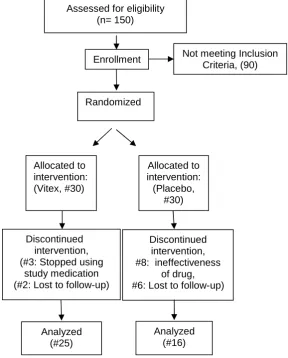
The trial substances, Vitex agnus-castus extract (Poursina Pharmaceutical Mfg. CO, Tehran, Iran) and placebo drops, had identical external properties. There was no difference in color, taste, or smell between treatment and placebo drops. The Vitex bottle contained 30 ml. The placebo consisted of distilled water. A total of 150 women were screened, 90 of whom did not receive the study medication because of exclusion criteria or noncompliance with the inclusion criteria. Therefore, 60 women were included. Participants who met the inclusion criteria were randomly allocated to either the Vitex therapy or placebo at the first visit (baseline) based on admission code number.
Thirty women received Vitex, and thirty women received placebo. All participants were supposed to take the 40 drops every day, 30 minutes after breakfast for 8 weeks. The dose corresponded to the dose recommended in the summary of product characteristics of the tested product. The amount of treatment /placebo used by each woman was checked at each follow-up visit. Clinical examinations and interviews were performed before commencement of treatment and on the 2nd, 4th, 6th and 8th weeks of treatment. Treatment effectiveness was assessed at the 2nd, 4th, 6th and 8th weeks using the Kupperman Index (Blatt, 1953).
2.1 STATISTICAL METHODS
Data analysis was carried out using SPSS, version 13 for Windows. We used Χ2 test, T student test and non-parametric Man-withny test to compare the frequency, and severity of hot flashes within and between groups. A P value was regarded as statistically significant if it was lower than 0.05.
3. RESULTS AND DISCUSSION
3.1 RESULTS
Of the initial 60 women (30 in the treatment group and 30 in the control group), 41 completed the trial (25 in the treatment group and 16 in the control group). Five women in the treatment group did not finish treatment (three stopped using study medication and two were lost to follow-up) and fourteen women in the placebo group discontinued medication (eight of them because of ineffectiveness of the drug and six were lost to follow-up; Fig.1) However, data from 60 women were available for the primary intention-to-treat analysis.
Assessed for eligibility (n= 150)
Not meeting Inclusion Criteria, (90)
Randomized
(60)
Enrollment
Allocated to intervention: (Placebo,
#30) Allocated to
intervention: (Vitex, #30)
Discontinued intervention, (#3: Stopped using
study medication (#2: Lost to follow-up)
Discontinued intervention, #8: ineffectiveness
of drug, #6: Lost to follow-up)
Analyzed (#16) Analyzed
Socio-demographic status was not statistically different between those who finished the study and those who did not. The demographic status (age, amenorrhea duration, body mass index, systolic and diastolic blood pressure, severity, and frequency of hot flashes per 24 h) of both study groups were evaluated at baseline, and there were no statistically significant differences in all baseline parameters between groups (Table1).
Table 1. Demographic of the treatment and placebo groups*
Group characteristics Vitex (n=25)
Placebo (n =16)
P value
Age, yr. 50.80 ± 2.68 50.25 ± 2.11 0.425
BMI 28.63 ± 3.76 28.07 ± 4.02 0.252
Blood pressure 11.76 ± 1.54 12.00 ± 0.89 0.546
Parity (no.children) 3.08 ± 4.81 2.75 ± 5.95 0.132
Frequency of hot flashes (Per 24/h)
6.00 ± 2.58 5.94 ± 2.29 0.107
Duration of hot flashes (Min per 24/h)
3.60 ± 2.29 3.50 ± 1.46 0.297
Kupperman Index 19.32 ± 8.22 20.19 ± 6.04 0.462
*Values are given as mean ± SD.
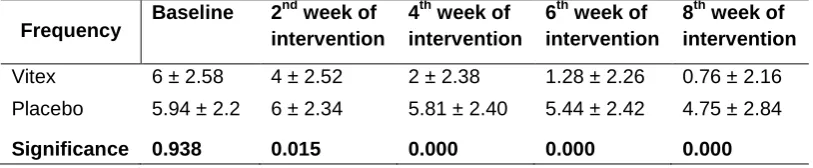
The mean frequency of hot flashes at the baseline visit was somehow similar in both study groups, and there were no significant differences between groups. The fall-off in the frequency of hot flashes per day in women receiving Vitex was evident after 2nd week of intervention. Nevertheless, women showed more improvement in their frequency of flashes during the 2nd month (P < 0.05). During 8 weeks of intervention, women who had used Vitex showed more improvement in their frequency of flashes than the placebo-receiving group did (P < 0.05; Table 2).
Table 2. Mean changes in the number of hot flushes during 24 hours in both groups
Frequency Baseline 2
nd
week of intervention
4thweek of intervention
6thweek of intervention
8thweek of intervention
Vitex 6 ± 2.58 4 ± 2.52 2 ± 2.38 1.28 ± 2.26 0.76 ± 2.16
Placebo 5.94 ± 2.2 6 ± 2.34 5.81 ± 2.40 5.44 ± 2.42 4.75 ± 2.84
Significance 0.938 0.015 0.000 0.000 0.000
*Values are given as mean ± SD.
T test showed that the differences between two groups were statistically significant in frequency on the 2nd, 4th, 6thand 8thweeks of intervention.
Table 3. Mean changes in the hot flush severity score during 24 hours in both groups
Severity
Baseline 2ndweek of intervention
4thweek of intervention
6thweek of intervention
8thweek of intervention
0 1 2 3 0 1 2 3 0 1 2 3 0 1 2 3 0 1 2 3
Vitex 0 20 68 12 0 36 60 4 32 24 40 4 48 32 20 0 80 8 12 0
Placebo 0 18.8 75 6.3 0 18.8 75 6.3 0 18.8 7 6.3 0 18.8 75 6.3 12.5 18.8 62.5 6.3
Significance* 0.815 0.015 0.012 0.000 0.000
*Manwittny test showed that the differences between two groups were statistically significant in severity on the 2nd, 4th, 6th and 8th weeks of intervention. 0= None; 1= Mild; 2= Moderate; 3= Sever;
Table 4. Mean changes in the Blatt-Kuppermam Index during 24 hours in both groups
Blatt- Kuppermam
Index Baseline
2ndweek of intervention
4thweek of intervention
6thweek of intervention
8thweek of intervention
Vitex* 8.22 ± 19.22 8.33 ± 15.84 8.01 ± 11.72 7.02 ± 8.20 5.35 ± 5.16
Placebo* 6.04 ± 20.19 6.55 ± 19.06 6.26 ± 18.31 5.98 ± 16.88 5.32 ± 16.38
Significance* 0.922 0.198 0.008 0.000 0.000
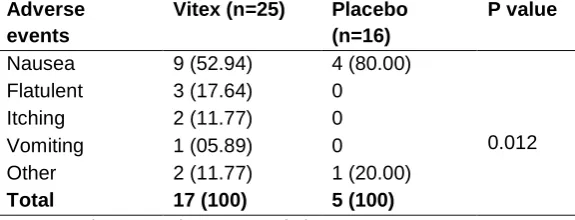
In women who received Vitex, 17 participants and in the placebo group 5 participants reported adverse events in the 8th weeks of treatment. Nausea was the most prevalent reported adverse event. There was a significant difference between the two preparations (Table 4).
T test showed that the differences between two groups were statistically significant in Kuppermam Index on the 4th, 6th and 8th weeks of intervention.
3.2 DISCUSSION
Hot flash is the most bothersome symptom of menopause and affects an estimated 75% of women older than 50 years. Although estrogen therapy and estrogen + progestin therapy remain the treatments of choice for women with VMS, recent HT trials have changed our understanding of the risks and benefits of these therapies (Rossouw et al., 2002). The availability and use of alternatives to HT, including over-the-counter supplements, phyto-estrogens, and homeopathic medicines, have grown dramatically during the past decade. Furthermore, it is believed that dietary changes that include a higher consumption of phyto-estrogens may relieve hot flashes (Keenan et al., 2003; Newton et al., 2002).
The purpose of this study was to evaluate the effect of Vitex extract on menopausal VMS. There were some limitations while conducting this study. The regular and complete use of drugs was out of our control. In addition, this was a self-report study, and we had to rely on the participants' claims.
Atkinson et al., 1997, evaluated the effect of Vitex extract compared with that of placebo on symptoms of menopausal women. They declared that Vitex might be an efficient treatment to improve hot flashes in symptomatic menopausal women. The results of our study were similar to theirs, and we showed that after 8 weeks, the Vitex therapy caused a drop in the frequency and severity of hot flashes. In addition, (Kazemian et al., 2003) evaluated the effect of Vitex extract compared with paci-p on symptoms of menopausal women. They declared that both preparations are efficient treatment to improve hot flashes in symptomatic menopausal women.
Table 5. Adverse events recorded in the two groups during the intervention*
*Values are given as no. (%).
In our study, the influence of both preparations on VMS was more significant in the 2nd month than that in the 1st month of intervention. Therefore, we assumed that if the duration of treatment with Vitex had lasted for more than 2 months, wider changes would have been observed in the frequency and severity of hot flashes. However, long-term safety and side effects ought to be regarded (Rossouw et al., 2008). Whereas we found out a significant
Adverse events
Vitex (n=25) Placebo (n=16)
P value
Nausea 9 (52.94) 4 (80.00)
0.012
Flatulent 3 (17.64) 0
Itching 2 (11.77) 0
Vomiting 1 (05.89) 0
Other 2 (11.77) 1 (20.00)
difference between two groups on adverse event but there was a satisfaction among women in both the Vitex and placebo groups (Table 5).
We suggest that more biochemical studies be performed to realize the exact mechanism of action of this medicinal herb. Furthermore, future trials in different study populations and in larger samples with different daily doses of Vitex extract are needed to make definite decisions on the use of Vitex for improving VMS of menopause.
4. CONCLUSION
We performed this study to evaluate the effect of Vitex extract on menopausal hot flashes. The positive influence of Vitex on hot flashes offers an effective treatment for treatment of early menopausal symptoms in women who cannot tolerate hormonal therapy.
ACKNOWLEDGMENTS
I am indebted to those who commented on early drafts of this article, in particular I am indebted to Dr. Mohammad Hossein Salehi Sormaghy for his full and helpful comments and preparing drug. For preparing placebo and helpful comments, I thank Dr. Mohammad Azadbakhat from scientific board of sari pharmacology faculty and I thank Dr. Abdolrahman Rasekh, Member of scientific board of mathematics faculty for doing statistical analysis.
REFERENCES
Abeliovich, D., Atia, Y., Sarov, B. (1986). Down syndrome in Negev region. Am J Med Abnerthy, K. (1999). Menopause and replacement therapy, 165-170.
Adams, MP. Josephson DL. (2005). Herbal and alternative therapies. Pharmacology for Nursing. Upper Saddle River, NJ, Pearson Prentice Hall, 100-141.
Atkinson, D. (1997). Vitex agnus – castus: a review. Positive health, 23, 33-35.
Blatt, M. Wiesbader H, Kupperman H. (1953). Vitamin E and climacteric syndrome. Arch. Int. Med., 91, 793-799.
Burkman, R.T. (2001). Current perspectives on benefits and risks of hormone replacement therapy. Am. J. Obstet. Gynecol.,185, 13-23.
Carpenter, JS. (2001). The Hot Flash Related Daily Interference Scale: a tool for assessing the impact of hot flashes on quality of life following breast cancer. J. Pain Symp. Manage, 22, 979-989.
Collaborative Group on hormonal factors in Breast cancer. (1997). Breast cancer and hormone replacement therapy. Lancet , 348, 983 - 987.
European Scientific Cooperative on Phytotherapy. (2003). ESCOP Monographs: Cimicifugae Rhizoma-Black Cohosh. New York, NY: Thieme Verlag.
Freedman, RR. (2000). Menopausal hot flashes. In: Lobo R, Kasey J, eds. Menopause Biology and Pathobiology. San Diego, CA: Academic Press, 215-225.
Glazier, M., Gina, MB., Bowman, MA.(2001). A review of the evidence for the use of phytoestrogens as a replacement for traditional estrogen replacement therapy. Arch Intern Med., 161,1161-1172.
Kazemian, A. (2003). Assessment of vitex versus paci-p on hot flushes in menopausal women under Isfahan medical health centers” International congress on Obs&Gyn, Tehran.Iran, 52-54.
Keenan, N.L., Mark, S., Fugh-Berman, A., Browne, D., Kaczmarczyk, J., Hunter C. (2003). Severity of menopausal symptoms and use of both conventional and complementary/alternative therapies. Menopause,10, 507-515.
Liu, J. (2004). Isolation of Linoleic acid as an estrogenic compound from the fruits of Vitex agnus – castusL. Phjytomedicine, 11, 18 – 23.
Mohammadi Nike, F., Abbaspoor, Z., Zand-Moghaddam, A., Saudatee N. (2003). Assessment of soy on hot flushes in menopausal women. AJUMS. 36, 18-26.
National Institutes of Health (2002). Facts about postmenopausal hormone therapy. Washington, DC: US Department of Health and Human Services. Available at: http://www.nhlbi.nih.gov/ health /women/pht_facts.htm. Accessed 2005.
Newton, K.M., Buist, D.S., Keenan, N.L., Anderson, L.A., LaCroix, A.Z. (2002). Use of alternative therapies for menopause symptoms: results of a population-based survey. Obstet Gynecol., 100, 18-25.
Rossouw, J.E., Anderson, G.L., Prentice R.L. (2002). Risks and benefits of estrogen plus progestin in healthy postmenopausal women: principal results from the women's health initiative randomized controlled trial. J. Am. Med. Assoc., 288, 321-333.
Rossouw, R., Brzezinski, A., Hochner-Celnikier, D. (2008). Herbal remedies for menopausal symptoms: are we cautious enough? Eur. J. Contracept. Reprod. Health Care, 13, 133.
Ryan, K.J., Berkwitz, R.S., Barbieri, R.L., Dunif, A. (2000). Berkwitz RS,Barbieri RL Dunif A. Kistner’s Gynecology & women’s health. Seventh edition, 153-155.
Salehi, M.H. (1999). Assessment of pharmacogenezi of women’s herb “Articles abstract of 4th international congress on physiology & pharmacology, 37-38.
Samsam, H. (1996). Herbal and natural drug, Isfahan, publisher Roznahan, 147-150.
Speroff, L. (2001). Clinical gynecologic endocrinology and infertility. Translated by Ghazijahani. B, volume 2, Tehran, Golban Publisher.
Wetzel, W. (2007). Alternative and complementary therapy. In: Lowdermilk DL, Perry SE, eds. Maternity and Women's Health. Philadelphia, PA, Mosby Elsevier, 85.