R E S E A R C H
Open Access
A reliable data transfer protocol based on twin
paths and network coding for underwater
acoustic sensor network
Shaobin Cai
1*, Nianmin Yao
2and Zhenguo Gao
2Abstract
MPNC (multiple path and network coding) is proposed as a reliable transport protocol for UWASN (underwater acoustic sensor network). In MPNC, after three disjoint paths being established, two groups of packets (AandB), coded by network coding, are transmitted over the two side paths respectively, and another group of packets C=A⊕Bare transmitted over the middle path. That is, any two paths can work together as a redundant path for another path, and the reliable transmission of one packet can be guaranteed by 1.5 packets. In order to reduce the number of redundant packets without affecting the transmission reliability, the packets of groupCare coded further at special ratio by network coding as shareable redundant packets according to the link error, and a reliable transport protocol TPNC (twin path and network coding) based on two paths and network coding is proposed in this paper. In TPNC, after two disjoint paths, called twin paths, being established, two groups of packets (AandB), coded by network coding, are transmitted with their own shareable redundant packets over the two paths respectively to guarantee the data packet transmission reliability. The results of simulations show that, compared with MPNC, TPNC can acquire similar data delivery ratio with lower energy consumption.
Keywords:Underwater acoustic sensor network; Transport protocol; Reliability; Twin paths; Network coding
1 Introduction
UWASN (underwater acoustic sensor network) is a special kind of WSN (wireless sensor network), which is consisted of underwater acoustic sensor nodes. The UWASN can be deployed for real-time warship mo-nitoring, oceanographic data collection, environmental monitoring, and disaster prevention, etc. Hence, lots of researches have been done on it [1-3].
The design of a reliable data transfer protocol for UWASN is challenging due to the specific characteris-tics of acoustic channels: high bit error rates, high energy consumption, limited available bandwidth, low transmis-sion speed, and long unstable packet delivery delay.
Traditionally, the data transmission reliability is guaran-teed by acknowledgments and/or FEC (forward error cor-rection). However, the data transmission protocols based on traditional acknowledgments, for example, ARQ, are
not suitable for UWASN [4-6] because their acknowledg-ment packets not only prolong the transmission delay but also waste lots of limited bandwidth. Therefore, to reduce the bandwidth waste and transmission delay, caused by acknowledgment packets, without reducing data transmis-sion reliability, some improved ARQ-based protocols [6-9] use data packets as implicit acknowledgments; some pro-tocols [10-14], such as segmented data reliable transport (SDRT) [12,13], NCRF (network coding [14] in rateless fashion) [15], and NCIA (network coding with implicit acknowledgment) [15], send coded packets in burst, which only needs a acknowledgment packet; some protocols, such as ADELIN (adaptive reliable transport) [16,17], VBF-NC (vector-based forwarding-network coding) [18] and MPNC (multiple path and network coding) [19], guarantee transmission reliability only by sending enough coed packets.
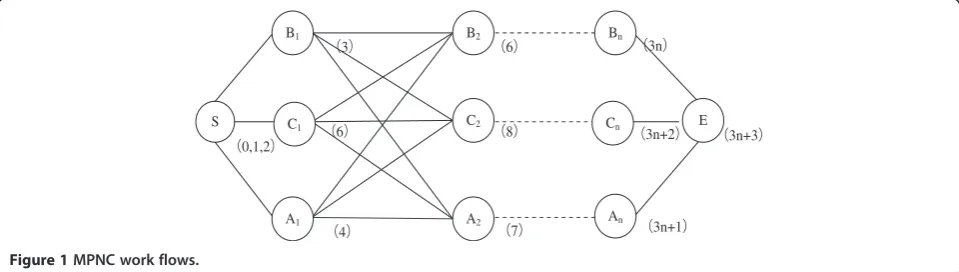
In MPNC, three disjoint paths are established firstly, and then two groups of packets (AandB), coded by net-work coding, are transmitted over the two side paths
in-dividually; another group of coded packets (C=A ⊕B)
* Correspondence:[email protected]
1
Computer Science Department, Harbin Engineering University, Harbin 150001, China
Full list of author information is available at the end of the article
are transmitted over the middle path (Figure 1). So, any two paths can work together as a redundant path for another path. That is, the reliable transmission of one packet can be guaranteed by 1.5 packets in MPNC.
In order to reduce data transmission overhead, the
packets of groupCare coded further at special ratio by
network coding as shareable redundant packet accord-ing to the link error, and TPNC (twin path and network coding) is proposed in this paper. In TPNC, two dis-joint paths are established firstly, and then, one group of packetsA(B), coded by network coding, are transmit-ted with its respective shareable redundant packets on one path.
The rest of the paper is arranged as the following: firstly, TPNC is proposed in chapter 2; secondly, the performances of TPNC are analyzed in chapter 3; finally, a conclusion is drawn in chapter 4.
2 TPNC
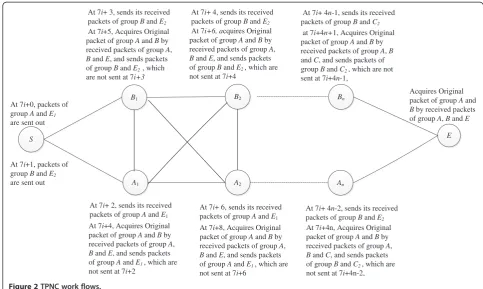
Figure 2 discribes how TPNC works. In Figure 2, the numbers (7i+ 0, 7i+ 1, 7i+ 2,…,7i+ 4n) are the sequence
numbers of time slices, at which the nodes send out their coded packets as following:
(1) OAandOBare two groups ofKoriginal packets.
They are coded by network coding individually to form two coded packet groups (AandB), each of which hasK+K1coded packets.
(2) According to the distance between nodeSandA1
(B1), nodeScalculates the link error ratioea1(eb1);
nodeScoded every⌈1/e⌉(e= max(ea1,eb1) packets
of groupC(C=A⊕B) to form a packet of group Dby network coding.
(3) NodeScodes packets of groupDby network coding to acquire theD(1 +⌊e⌋) packets and forms packet groupE.
(4) At time slice 0, nodeSsends out the packets of groupAwith the packets of groupE1(the first
half of groupE) to guarantee the packet transmission reliability.
(5) At time slice 1, nodeS, it sends out the packets of groupBwith the packets of groupE2(the latter
half of packet groupE) to guarantee the packet transmission reliability.
(6) At time slice 2, nodeA1broadcasts its received
packets of groupAand groupE1to improve the packet transmission reliability.
(7) At time slice 3, nodeB1broadcasts its received
packets of groupBand groupE2to improve the packet transmission reliability.
(8) By their received packets of groupA, groupB, and groupEfrom nodeS, nodeA1, and nodeB1, node
A1and nodeB1can decode these packets to
acquire the original packets of groupOAand
groupOB.
(9) At time slice 4, according to link error ratio, calculated from the distance between nodeA1and
nodeA2, nodeA1forms packet groupEand sends
out the packets of groupAand groupE1, which are not sent out at time slice 2.
(10) At time slice 5, according to link error ratio, calculated from the distance between nodeB1and
nodeB2, nodeB1forms packet groupEand sends
out the packets of groupBand groupE2, which are not sent out at time slice 3.
(11) At time slice 6, nodeA2broadcasts its received
packets of groupAand groupE1to improve transmission reliability.
(12) At time slice 7, nodeB2broadcasts its received
packets of groupBand groupE2to improve transmission reliability.
(13) By their received packets of groupA, groupB, and groupEfrom nodeA1, nodeA2, nodeB1, and nodeB2, nodeA2and nodeB2can acquire the
original packets of groupOAand groupOB.
(14) NodeA2and nodeB2do as nodeA1and nodeB1do.
By the way above, packets of group A, B, and E are
transmitted over the twin path, and node E can
ac-quire the original packets of group OA and group OB
by decoding its received coded packets of group A,B, andEfinally.
From the descriptions above, it can be known that the
packet number of group E is much less than that of
group C. So, the data transmission overhead of TPNC
should be much less than that of MPNC.
3 Performance analysis
In this section, the performance of protocols is analyzed in a 9-hop UWASN. The simulation environment of MATLAB and Aqua-sim [20] is defined according to Zheng's work [18]. In the experiments, the bit error of channel is a direct ratio to the distance between nodes when the optimal frequency f(d) is used for their com-munication [21]. Furthermore, in order to acquire aver-age results, every experiment is done 1000 times.
In the following experiments, the length of data packet
is 50 bytes; the number of redundant packets K′ for a
15-packet group is defined as the following [19]:
(1)K′= 0, whend= <10 km;
(2)K′= 5, when 10 km <d= <30 km; (3)K′= 10, when 30 km <d= <35 km; (4)K′= 15, when 35 km <d= <37.5 km; (5)K′= 18, when 37.5 km <d< 41.5 km.
The successful delivery ratio and the normalized energy consumption are defined in this paper to describe the
performance of protocol. The normalized energy con-sumption is defined as the following:
Τ¼ΣΗi¼1Τi
R ð1Þ
In the above formula,Rpresents the successful delivery ratio;Tipresents the number of average received packets of a node.
3.1 MATLAB analysis
MATLAB is used to analyze the performance of the pro-tocols firstly in this sub-section.
Figure 3 describes the relationship between the success-ful delivery ratio and the node distance. From Figure 3, it can be known that TPNC is as strong as MPNC and is stronger than VBF-NC. That is, the successful deli-very ratios of TPNC, MPNC, and VBF-NC are all high enough to guarantee transmission reliability when the distance between nodes is less than 35 km. However, the delivery ratio of VBF-NC decreases greatly because its redundant packets transmitted on the forwarding set are not enough to guarantee data transmission reli-ability; the delivery ratios of both MPNC and TPNC only vibrate lightly because more redundant packets are used with the increasing of distance between nodes by stages, when the distance between nodes is more than 35 km.
At 7i+4, Acquires Original packet of groupAandBby received packets of groupA,
BandE, and sends packets of groupAandE1, which are not sent at 7i+2
At 7i+5, Acquires Original packet of groupAandBby received packets of groupA,
BandE, and sends packets of groupBandE2, which are not sent at 7i+3
At 7i+6, acquires Original packet of groupAandBby received packets of groupA,
BandE, and sends packets received packets of groupA,B
andC, and sends packets of groupBandC2, which are not sent at 7i+4n-1,
At 7i+ 4n-1, sends its received packets of groupBandC2
Acquires Original packet of groupAand
Bby received packets of groupA,BandE
At 7i+ 3, sends its received packets of groupBandE2
At 7i+ 2, sends its received packets of groupAandE1
At 7i+8, Acquires Original packet of groupAandBby received packets of groupA,
BandE, and sends packets of groupAandE1, which are not sent at 7i+6
At 7i+ 6, sends its received packets of groupAandE1
At 7i+4n, Acquires Original packet of groupAandBby received packets of groupA,
BandC, and sends packets
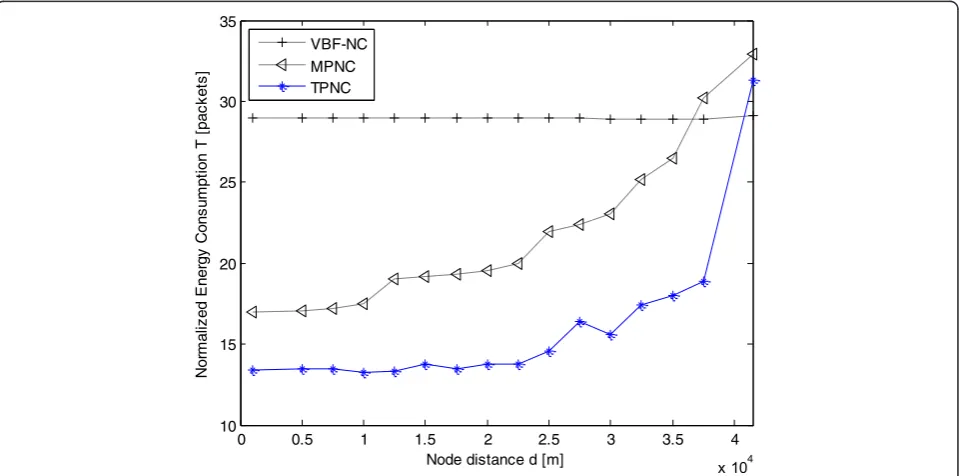
Figure 4 describes the relationship between the nor-malized energy consumption and the node distance. From Figure 4, it can be seen that the normalized en-ergy consumption of TPNC is much lower than those of MPNC and VBF-NC because fewer redundant packets are used by TPNC to guarantee the transmission reli-ability when the distance between nodes is small. With the increasing of the distance between nodes, more and more redundant packets are used by TPNC and MPNC
to maintain their successful delivery ratio. So, the norma-lized energy consumptions of TPNC and MPNC increase with the increasing of the redundant packets. However, compared with MPNC, fewer redundant packets are used by TPNC, and less energy is consumed by TPNC.
From Figures 3 and 4, a conclusion can be drawn that the data delivery ratios of TPNC and MPNC are simi-lar, and the normalized energy consumption of TPNC is much lower than that of MPNC because TPNC can
0 0.5 1 1.5 2 2.5 3 3.5 4 4.5
x 104 0.1
0.2 0.3 0.4 0.5 0.6 0.7 0.8 0.9 1
S
u
c
c
es
s
ful
D
el
iv
er
y
R
at
io R
[
100%
]
Node distance d [m] TPNC
VBF-NC MPNC
Figure 3The relationship between successful delivery ratio and node distance.
0 0.5 1 1.5 2 2.5 3 3.5 4
4
10 15 20 25 30 35
Node distance d [m]
N
o
rm
al
iz
ed E
ner
gy
C
ons
um
pt
ion T
[
pac
k
et
s
]
VBF-NC MPNC TPNC
guarantee its data transmission reliability by less redun-dant packets.
3.2 Analysis by Aqua-sim
In order to approve the analysis results of MATLAB above, the performance of the protocols is analyzed by Aqua-sim [20], which is specially developed for UWASN on the basis of NS-2 by Underwater Wireless Sensor Network Lab of Connecticut University, in this sub-section.
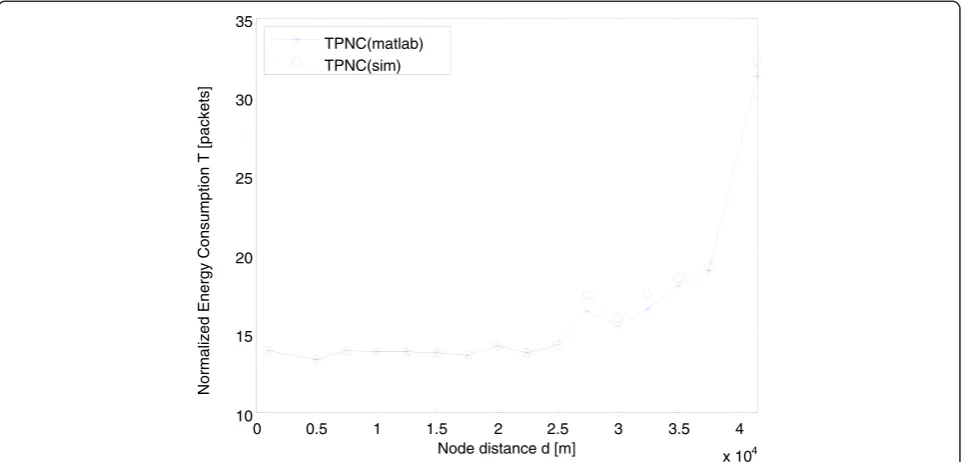
In Figures 5 and 6, the comparison between analysis results of MATLAB and simulation results of Aqua-sim is done. In these figures, 'Matlab' presents the analysis results of MATLAB; 'Sim' presents the simulation results of Aqua-sim. From Figures 5 and 6, it is shown that the successful delivery ratio and normalized energy con-sumption of Matlab and Sim are similar. There are only a few differences, which should be caused by the noise of environment during the simulation of Aqua-sim. So,
0 0.5 1 1.5 2 2.5 3 3.5 4 4.5
x 104 0.8
0.82 0.84 0.86 0.88 0.9 0.92 0.94 0.96 0.98 1
S
uc
c
es
s
ful
D
e
liv
er
y
R
at
io R
[
%
]
Node distance d [m] TPNC(matlab)
TPNC(sim)
Figure 5The relationship between successful delivery ratio and node distance.
0 0.5 1 1.5 2 2.5 3 3.5 4
x 104 10
15 20 25 30 35
Node distance d [m]
Normalized Energy Consumption T [packets]
TPNC(matlab) TPNC(sim)
the simulation results can prove that the Matlab ana-lysis results are right.
4 Conclusion
On the basis of analyzing the existed reliable data trans-fer protocols for UWASN, TPNC is proposed to improve MPNC in this paper. In order to reduce the number of
re-dundant packets, which belong to the groupCin MPNC,
without affecting the transmission reliability, the packets
of the group C are coded further by network coding as
shareable redundant packet according to the link error.
And then, two groups of packets (A and B), coded by
network coding, are transmitted with their respective shareable redundant packets over the two established disjoint paths to transfer the data packet reliably. The simulation results show that the redundant packet num-ber of TPNC is reduced greatly without affecting the strength of TPNC protocol. So, compared with MPNC, TPNC can acquire similar data delivery ratio with lower energy consumption.
Competing interests
The authors declare that they have no competing interests.
Acknowledgments
The paper is supported by National Science foundation of China (41176082, 61073082), supported by Program for New Century Excellent Talents in University (NCET-13-0753), Specialized Research Fund for the Doctoral Program of Higher Education of China (20132304110031), National Science foundation of Heilongjiang Province, China (42400621-1-14076), and Specialized Research Fund for the Innovation talents of science and technology (2014RFQXJ012).
Author details
1Computer Science Department, Harbin Engineering University, Harbin
150001, China.2Computer Science Department, Dalian University of
Technology, Dalian 116024, China.
Received: 3 July 2014 Accepted: 19 January 2015
References
1. IF Akyildiz, D Pompili, T Melodia, Underwater acoustic sensor networks: research challenges[J]. Ad Hoc Netw.3(3), 257–279 (2005)
2. JO'Donnell, D Codiga, C Edwards, D Ullman, D Hebert, J Rice, E Levine, P Steggman, I Babb. Front resolving observational network with telemetry (FRONT) [R]. Connecticut university groton marine science inst. 2002 3. About AOSN II and Adaptive Sampling. http://www.princeton.edu/~dcsl/
aosn/
4. M Gao, W-S Soh, M Tao, A transmission Scheme for continuous ARQ protocols over underwater acoustic channels. ICC'09. 1–5 (2009) 5. J W Lee, J Y Cheon, H-S Cho, A cooperative ARQ scheme in underwater
acoustic sensor networks. OCEANS'10. 1–5 (2010)
6. H-P Tan, WKG Seah, L Doyle, A multi-hop ARQ protocol for underwater acoustic networks. OCEANS'07. 1–6 (2007)
7. Valera A, Pius W, Q. Lee, H-P Tan, H Liang, WKG Seah, Implementation and evaluation of multihop ARQ for reliable communications in underwater acoustic networks. OCEANS '09. 1–6 (2009)
8. J-W Lee, J-P Kim, J-H Lee, J Y Seon, KC Dho, K Son, H-S Cho, An improved ARQ scheme in underwater acoustic sensor networks. OCEANS'08. 414–432 (2008)
9. H Zhuang, H Tan, V Alvin, Z Bai, Opportunistic ARQ with bidirectional overhearing for reliable multihop underwater networking, Oceans'10. 1–6 (2010)
10. R Cao, L Yang, Reliable transport and storage protocol with fountain codes for underwater acoustic sensor networks. WUWNet '10. 18–21 (2010) 11. G Lv, Z Guo, H Qu, Z Che, Study of RFEC-based transport protocol in
underwater acoustic sensor networks. WiCOM '08. 1–4 (2008) 12. X Peng, C JunHong, An fec-based reliable data transport protocol for
underwater sensor networks. Comput. Commun. Netw. 747–753 (2007) 13. P Xie, Z Zhou, Z Peng, J-H Cui, Z Shi, SDRT: a reliable data transport protocol
for underwater sensor networks. Ad Hoc Netw.8(7), 708–722 (2010) 14. DE Lucani, M Médard, M Stojanovic, Network coding protocols for
underwater networks: the benefits of implicit acknowledgement. WuWNet '07. 25–32 (2007)
15. A Rudolf, C Ning, L ShuoYen, Y Raymond, Wai-Ho, Network information flow. IEEE Trans. Inf. Theory46(4), 1204–1216 (2000)
16. B Liu, F Garcin, F Ren, C Lin, A study of forward error correction protocols for reliable transport in underwater sensor networks. SECON'08. 197–205 (2008)
17. L Bin, C Hongyang, L Xianfu, R Fengyuan, S Kaoru, Internode distance-based redundancy reliable transport in underwater sensor networks. EURASIP J. Wirel. Commun. Netw. 1–16 (2010)
18. Z Guo, B Wang, P Xie, W Zeng, JH Cui, Efficient error recovery with network coding in underwater sensor networks. Ad Hoc Netw.7(4), 791–802 (2009) 19. C Shaobin, G Zhenguo, Y Nianmin, A network coding based protocol for
reliable data transfer in underwater acoustic sensor. Ad Hoc Netw.
11(5), 1603–1609 (2011)
20. Aqua-Sim, An NS2 based Underwater Sensor Network Simulator, Underwater Sensor Network (UWSN) Lab, University of Connecticut, URL: http://uwsn.engr.uconn.edu/ aquasim.tar.gz
21. B Liu, H Wen, F Ren, C Lin, Performance analysis of reliable transport protocols joint with the optimal frequency and optimal packet length in underwater sensor networks. WoWMoM '07. 1-5 (2008)
Submit your manuscript to a
journal and benefi t from:
7 Convenient online submission
7 Rigorous peer review
7 Immediate publication on acceptance
7 Open access: articles freely available online
7 High visibility within the fi eld
7 Retaining the copyright to your article