Morphological encoding beyond slots and
fillers: An ERP study of comparative formation
in English
Harald Clahsen1, Silke Paulmann2*, Mary-Jane Budd3, Christopher Barry2
1 Potsdam Research Institute for Multilingualism (PRIM), University of Potsdam, Potsdam, Germany, 2 Department of Psychology & Centre for Brain Science, University of Essex, Colchester, United Kingdom, 3 School of Psychology, University of East London, London, United Kingdom
Abstract
One important organizational property of morphology is competition. Different means of expression are in conflict with each other for encoding the same grammatical function. In the current study, we examined the nature of this control mechanism by testing the formation of comparative adjectives in English during language production. Event-related brain poten-tials (ERPs) were recorded during cued silent production, the first study of this kind for com-parative adjective formation. We specifically examined the ERP correlates of producing synthetic relative to analytic comparatives, e.g. angrier vs. more angry. A frontal, bilaterally distributed, enhanced negative-going waveform for analytic comparatives (vis-a-vis syn-thetic ones) emerged approximately 300ms after the (silent) production cue. We argue that this ERP effect reflects a control mechanism that constrains grammatically-based computa-tional processes (viz. more comparative formation). We also address the possibility that this particular ERP effect may belong to a family of previously observed negativities reflecting cognitive control monitoring, rather than morphological encoding processes per se.
Introduction
This study presents results from event-related brain potentials (ERPs) elicited by ‘morphologi-cal encoding’, that is the processing of morphologi‘morphologi-cally complex words during language pro-duction. One prominent account of morphological encoding is the slot-and fillers model [1], which is essentially an implementation of affixation, with an additional adjustment for non-affixal (e.g., suppletive) morphology. For instance, both regular and irregular past-tense forms (e.g.,walked/fell) are thought to require a two-slot inflectional frame, but while for regular past-tense forms two phonological codes will be retrieved, only one single phonological code will be retrieved for irregular forms. However, the production of morphologically complex words involves more than filling slots for stems and affixes. One core property of morphology is competition [2], with different morphological exponents competing for expression. A well-known case of morpho-lexical competition is that general processes need to be constrained to avoid speech production errors (e.g.,gloriousnessorfightedinstead ofgloryandfought). As
a1111111111 a1111111111 a1111111111 a1111111111 a1111111111 OPEN ACCESS
Citation: Clahsen H, Paulmann S, Budd M-J, Barry
C (2018) Morphological encoding beyond slots and fillers: An ERP study of comparative formation in English. PLoS ONE 13(7): e0199897.https://doi. org/10.1371/journal.pone.0199897
Editor: Niels O. Schiller, Leiden University,
NETHERLANDS
Received: June 1, 2017
Accepted: June 17, 2018
Published: July 25, 2018
Copyright:©2018 Clahsen et al. This is an open access article distributed under the terms of the Creative Commons Attribution License, which permits unrestricted use, distribution, and reproduction in any medium, provided the original author and source are credited.
Data Availability Statement: All relevant data are
included in the paper and its Supporting Information files.
Funding: This project has been supported by a
grant to H.C. and C.B. from the Leverhulme Trust (F/00213/U) and an Alexander-von-Humboldt Professorship to H.C.
Competing interests: The authors have declared
pointed out by Aronoff (2016) [2], morphological systems resolve competition in different ways. One of the two competitors might emerge as a default, with other ones left as lexical exceptions, as for example, in the case of regular versus irregular past-tense inflection in English, where the regular–edfunctions as the default and irregular forms as exceptions [3]. Division of labour in morphology is also quite common, for example,un- vs.in- prefixation in English, wherein- and its variants are restricted to words of Latin or Greek origin andun -applies to Germanic words.
Competition between different resources is common to language-production processes at all levels of linguistic encoding, not only for morphological processes. Much previous research has been devoted to competition during single spoken word production; see [4] for a review. Competition in word production is thought to arise from the speaker having to select the target word from a set of co-activated words related to the target. The most commonly used experi-mental paradigm in this line of research is the picture-word interference task in which partici-pants being presented with pictures of objects and a superimposed written distractor word have to name the picture and ignore the distractor; see [5] for recent use with EEG. This para-digm has yielded a number of robust and replicable effects, which have informed models of spoken word production. One common finding are interference effects, i.e. enhanced picture-naming latencies (relative to an unrelated control condition) when the target and the distractor words belong to the same semantic category (e.g.dog/cat) and facilitation when the two words are semantically associated (e.g.dog/fur). Evidence from ERPs confirms this contrast obtained from behavioral studies in that semantically associated distractors (unlike distractors of the same semantic category) produced a reduced negativity (relative to unrelated words) on pic-ture naming indicating facilitated object identification ([6]).
Over recent years, insights into the brain networks involved in the control of competition during language production, that is the ability to regulate this process, have come from a num-ber of studies. A focus of this research has been language control in bilingual populations, typi-cally examining this phenomenon using picture-naming tasks. These studies have led to the identification of a widely distributed neural network orchestrating the activation of one of a bilingual person’s languages whilst inhibiting the other [7–8]. This network engages the pre-supplementary motor area in the dorsal anterior cingulate cortex, the left prefrontal cortex, the left caudate and the inferior parietal lobules bilaterally together with control input from the right prefrontal cortex, the thalamus and the putamen of the basal ganglia and the cerebellum (see [9], for a recent review).
Electrophysiological studies have provided crucial information about the time-course of bilingual language control in picture naming and other tasks (see [10], for a review). Christof-fels, Firk and Schiller (2007) [11], for example, identified an enhanced fronto-central negativi-tiy (‘N450’) between 350ms and 550ms in response to bilingual language control (see also [12–
language from a bilingual’s other language in a go/no-go task. An enhanced negativity with a frontal maximum was found between 300 and 600ms in cases of competing phonological codes in the two languages as compared to congruent trials. Although the functional signifi-cance of these fronto-central negativities is not yet entirely clear, increases in amplitude of these negativities seem to be related to the control and monitoring of competing resources (see [20], for further discussion).
Competition is also a core element of morphological encoding, which, for the current study, was examined by recording ERPs during the production of complex word forms. ERP studies of morphological processing in adults have previously relied on priming and violation studies, which require secondary (typically metalinguistic) skills, such as acceptability judg-ments or lexical (word/non-word) decisions. While production tasks have the advantage of tapping into a primary linguistic skill, muscle activation involved in articulation during overt production may distort the EEG signal. One way of largely avoiding such artefacts is the tech-nique we employed for the present study–following Budd et al. (2013) [21]–in which partici-pants are prompted to firstsilentlyproduce the target word form and only thereafter to overtly produce it. By time-locking the EEG to the silent production stage, this design provides insight into planning the production of morphologically complex words prior to overt articulation. Four previous ERP studies used a silent production-plus-delayed-vocalization-task to examine different kinds of morphological phenomena: regular and irregular past-tense forms in English [21–22], regular and irregular plural forms in English compounds [23] (Budd et al., 2015), and regular and irregular past-participle forms in German [24]. These studies yielded consistent results: an enhanced negativity most often particularly pronounced at right frontal electrode-sites elicited during the (silent) production of regular (relative to irregular) word forms in a similar time window (i.e., between 300 to 450ms). This brain response has been interpreted as signaling morphological encoding, specifically the composition process involved in forming an inflected word form through affixation, for example [walk + -ed], which is required for reg-ularly inflected word forms but not for irregular ones (see [21]). Note, however, that this inter-pretation crucially relies on ‘affix (de)composition’, a concept that is controversial in
psycholinguistic research on morphological processing (see [25] for a recent review). Consider therefore an alternative functional interpretation for this frontal negativity that is less depen-dent on the notion of affix (de)composition. The core idea is that the negativity may signal competition between different morphological forms for a given function during production. In the particular case examined by Budd et al. [21] a highly productive regular morphological process (viz–edpast tense formation) needs to be constrained so that it does not over-generate and does not output incorrect forms such asholded(instead ofheld). Applied to production, we can think of such a constraint as an output filter. Assume a dual-morphology model for producing morphologically complex words (e.g., [26]), with a look-up component for retriev-ing (irregular) forms stored in lexical memory and a rule-based component for formretriev-ing pro-ductive (regular) inflected word forms. The output of the lexical look-up component is unconstrained, that is, once a specific entry (e.g.,heldas the past-tense form ofhold) is found, this entry is submitted to the speech output system and articulated. By contrast, the rule-based mechanism needs to be constrained to ensure that there is no competitor from the lexical look-up system that blocks the candidate rule-based form. It is possible that the morphological encoding negativity reflects this additional control process involved in producing correct regu-larly inflected word forms.
The specific linguistic phenomenon we examined in the present study is comparative adjec-tive formation in English, which provides an opportunity to decide between these two func-tional interpretations of the morphological encoding negativity. The production of
expression, as gradable adjectives can form comparatives both synthetically by–ersuffixation (e.g.,big—bigger), and/or analytically by a periphrastic form withmore(e.g.,important—more important). In addition, a small number of highly frequent adjectives have suppletive compara-tive forms (e.g.,good–better,bad–worse). There is no semantic or interpretational difference between these means of expression [27]. Descriptive grammars of English [28–29] noted a division of labor between the analytic and the synthetic comparative forms, with the latter applying to short (monosyllabic) adjectives and the former applying to long (multisyllabic) ones. Hilpert (2008:399) [30] stated that monosyllabic comparatives have a ‘nearly uniform tendency to form only one variant’, namely the synthetic form. This contrast, however, only represents a rough trend, as there are many exceptions, such as disyllabic adjectives ending in–
y(e.g.happy) or–ow(e.g.shallow) that readily allow -ercomparatives. Furthermore, some monosyllabic adjectives commonly appear withmorecomparatives (e.g.apt,lax,chic). In a recent acceptability rating study, LaFave (2015) [31] found that many monosyllabic roots (typ-ically of Germanic origin) do indeed prefer the synthetic form (defter) over the analytic form (more deft). On the other hand, this was not the case for many other monosyllabic adjectives— typically of non-Germanic origin and low in frequency–for which the analytic comparative form was rated either better or equally well as the synthetic form, a finding that casts doubt on the conventional grammatical wisdom that the two comparative forms are in complementary distribution with the synthetic form reserved for short and the analytic one for long adjectives; see Aronoff and Lindsay (2015: 6) [32] for further discussion.
As an alternative, it has thus been proposed [33–34] that the synthetic comparative forms are a closed class of items–likely to be stored in lexical memory—whereas analytic compara-tives apply by default unless blocked by a lexically listed comparative form. As Poser (1992: 18) [33] put it: ‘If the lexical form [the synthetic one, in our terms] exists, the category is instanti-ated and so the periphrastic form [the analytic one in our terms] isblocked[our emphasis].’ This contrast may be linguistically represented in terms of a lexical feature [+S(ynthetic) C (omparative)] on those adjectives that take–erforms, a feature that is left unspecified on adjec-tives that take analytic comparaadjec-tives [35]. From this perspective, English comparative adjective formation qualifies as a case of morphological competition. Furthermore, synthetic versus ana-lytic comparative formation shares with irregular vs. regular inflection the fact that in both cases a lexically specified form competes with a grammatical default process.
longer lexical decision times (RTs larger than 600 ms; see [40]). These frequency and lexical-decision time effects are consistent with the view that synthetic comparative forms are lexically stored ([41]). Furthermore, it was found that both analytic and synthetic comparative forms are subject to children’s overgeneralization errors ([39]; [42]), e.g.dangerouserandmore fast. Another finding from the elicited production studies with children was that children of all age groups were more accurate in their production of adjectives requiring–erforms than those requiringmorecomparatives, probably because children are more familiar with the kinds of short high-frequency adjectives that typically take -–ercomparatives than with adjectives that require analytic comparatives (see e.g., [34], [43]).
Here, we will use the case of comparative adjective formation to further elucidate the nature of the morphological encoding negativity reported in previous research. If the process of com-bining a stem with an affix elicits this brain response, as originally proposed by Budd et al. (2013) [21], we should find an enhanced negativity for producing synthetic (–er) comparatives, relative to analytic (more) forms which do not involve affixation. Alternatively, the morpholog-ical encoding negativity may signal competition, ‘rival realizations of the same morphosyntac-tic meaning’ as Aronoff (2013: 1) [2] put it. In this case, we should find the opposite pattern, an enhanced negativity for producingmorecomparatives relative to–erforms, similarly to what was found for regular past-tense formation (relative to irregulars). The current study attempts to adjudicate between these alternatives.
Methods
Participants
Twenty right-handed adult native speakers of British English (9 men, mean age 26.7 years, range 19–45 years), all with normal or corrected-to-normal vision, were tested for this study. One participant had to be excluded due to recording problems. All participants gave informed written consent before completing the study, which was ethically approved by the University of Essex Science and Health Faculty Ethics Board.
Materials
In addition to the two critical conditions of analytic and synthetic comparatives, two addi-tional control conditions were included. This is because–erandmorecomparatives do not only differ with respect to their morphological exponents but also in a number of non-mor-phological ways. A comparison of the brain responses for the production ofhappierandmore neutral, for example, also includes different lemmas and expressions that differ in word length. To control for these differences, we added two conditions for each of the adjectives used for the critical (comparatives) conditions. One control condition required the production of–ly
adverb forms (e.g.,happily/neutrally) and the other the production of negated adjectives (e.g.,
not happy/not neutral). In this way, the potential contribution of the lexical and length differ-ences between synthetic and analytic comparative forms can be properly assessed.
word frequency and word length as closely as possible. Frequency counts were taken from the CELEX lexical database [44], specifically the Cobuild frequency count of occurrence per million within a 17.9 million spoken word corpus (‘CobMln’;http://celex.mpi.nl/help/ ewordforms.html). The ER-adjectives had a mean word frequency of 44 per million (SD: 55) and the MORE-adjectives had a mean word frequency of 43 per million (SD: 60). A paired samples t-test showed no significant difference between the ER- and MORE-adjectives on the log transformed CELEX word frequencies (t(44)<1). With respect to length matching, recall that adjectives with synthetic comparatives tend to be shorter than those that take analytic comparative forms. This was also reflected in the adjectives selected for the present study. We tried to keep the difference in length as minimal as possible, with the ER-adjectives consisting of one and two syllables (M = 1.4; SD = 0.5) and the MORE-adjectives of two syllables except for two three-syllable items (M = 2.0; SD = 0.3), but overall the ER-adjectives were still signifi-cantly shorter than the MORE adjectives (t(88 = 7.5, p<0.01). Furthermore the comparative forms to be produced also differed in length as the ER-adjectives require one-word responses and MORE-adjectives two-word responses. As mentioned above, there were two additional conditions (adverbs, negation) to control for these differences.
Procedure
All participants were tested in a quiet room at the University of Essex, Colchester, UK. The task was introduced to the participants and the experiment started with 18 practice trials (which were not used for analysis). Each trial began with the presentation of a centred fixa-tion-cross for 200ms, followed by the visual presentation of the adjective (e.g.,slow) in the cen-tre of the screen for 1000ms, in comic sans, 96-point size font in black on a white background. This was followed by a blank screen, which varied in duration (400, 600, or 800ms). The pre-sentation duration of the blank screen was counterbalanced across conditions. Following this, the silent production cue was presented for 2500ms; this was one of three pictures on which participants were trained prior to the experiment, a black square as a cue to produce a compar-ative form, a red one for a negated adjective withnot, and a blue one for (-ly) adverbs. ERPs were time-locked to the onset of this silent production cue. The silent production cue was fol-lowed by a 2000ms long presentation of a loudspeaker picture to cue overt production of the targeted word forms. An inter-stimulus interval (blank screen) was presented for 1500ms. Par-ticipants received 18 practice trials at the beginning of the experiment using adjectives that were not included in the main experiment. In the main experiment, trials were pseudo-ran-domized and distributed over 6 blocks (45 items each). Each block was followed by a short break. Participants were asked to minimize eye and muscle movements during silent produc-tion of words. The run-time of the experiment was approximately 25 minutes. An experimen-tal session (including EEG setup) lasted for approximately 75 minutes.
EEG recording and data analysis
graphical illustration purposes only, grand average ERPs are smoothed with a 7 Hz low-pass filter.
The EEG data was processed with EEGLAB [45]. To remove typical muscle and eye move-ment artefacts, an independent component analysis (ICA) algorithm (Infomax) was applied to the data. Additionally, trials with artefacts were identified visually and removed. Trials for which a participant’s overt production was inappropriate were also not included in the ERP analysis. These included productions of another inflected form of the target adjective or the target inflected form of a different lexeme. The rates of unexpected responses in participants’ overt spoken productions were low, indicating that they were able to accurately perform the experimental task. Of the whole data set, there were 2.1% non-target responses, which were not further analysed. The average percentages of unexpected responses were 3% for synthetic comparatives, 7% for analytic comparatives, and 1% for both–lyadverbs and negation with
not.
The negativity of interest has been reported in four previous studies [21,22,23,24] which all showed a frontally distributed effect. Visual inspection of the data confirmed a similar dis-tribution in the present study. We thus focused our statistical analysis on frontal and midline electrode sites and included electrodes from left frontal (LF: F1, FC1, F3, FC3, F5, FC5), right frontal (RF: F2, FC2, F4, FC4, F6, FC6), and midline (ML: FZ, FCZ, FPZ) sites. Time windows of interest for mean amplitude quantification of the ERP data were also guided by these four previous studies [21,22–24], although visual inspection revealed a longer lasting component in the present data set than previously observed. The time-window of interest was therefore extended to cover the full temporal breadth of the negativity; hence, we extracted mean ERP amplitudes between 300-800ms after stimulus onset. ERP mean amplitudes were analysed using repeated-measures ANOVAs, with the factorsForm(comparative, adverb, negation), adjectiveType(ER-adjective, MORE-adjective), andROI(LF, RF, ML).
Results
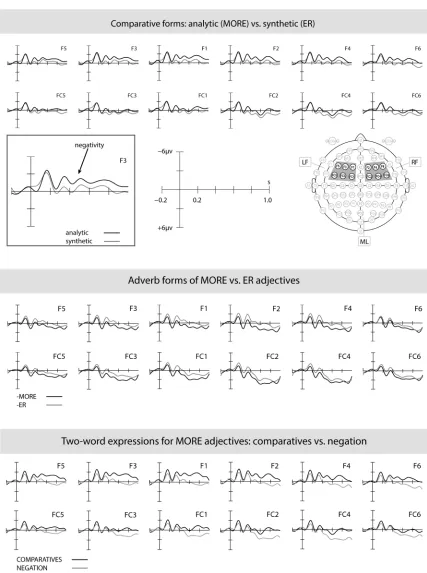
For each participant, mean ERP amplitudes were extracted for each electrode site. After data cleaning and after removing incorrect responses, 80.02% of all trials were included in the sta-tistical analysis. Similar numbers of trials were included for the two comparative conditions and the adverb and negation control conditions. The behavioural responses from the delayed overt production task confirmed our expectation that synthetic comparative forms are pre-ferred for ER-adjectives and analytic comparative forms for MORE-adjectives: 97% of the comparative responses to ER-adjectives were with synthetic–erforms (816/842), and 92.5% of the comparative responses to MORE-adjectives were analyticmoreforms (781/844). For the analysis of the ERP data of the comparative conditions, we only included trials that yielded the expected responses, i.e. ER-adjectives with synthetic forms, and MORE-adjectives with ana-lytic forms. The grand-average ERP waveforms for comparatives, adverbs and negation can be seen inFig 1(top, middle, bottom respectively).
The top panel ofFig 1, which compares the waveforms for the two critical conditions, ana-lytic (more) vs. synthetic (-er) comparatives, indicates a negative-going waveform elicited when silently producing analytic comparatives relative to synthetic ones between approxi-mately 300ms and 800ms. This waveform is most pronounced at right fronto-central sites. The middle panel ofFig 1examines whether the contrast seen in the top panel ofFig 1could be lex-ical in nature, due to the different lemmas involved. To this end, the middle panel ofFig 1
Fig 1. ERP effects for analytic (more) vs. synthetic (-er) comparatives (top panel), -lyadverbs of the different (ER vs. MORE) lemmas (middle panel), and for two-word expressions (MORE+ adjective vs. NEG+adjective) (bottom panel).
the silent production of–lyadverbs of MORE-adjectives, suggesting that the negativity is unlikely to be due to lexical differences between the different lemmas. The bottom panel ofFig 1examines whether the contrast seen in the top panel ofFig 1could result from the fact that analytic comparatives require the production of two-word expressions, unlike synthetic com-paratives which are single words. To this end, the bottom panel ofFig 1contrasts the produc-tion of analytic comparatives with the producproduc-tion of negated forms withnot, both of which are two-word expressions and both involve the same lemmas. The bottom panel ofFig 1displays ERP responses which are similar to the ones seen in the top panel, i.e., a more negative-going waveform for analytic comparatives between approximately 300 and 800ms after the silent production cue. This suggests that the length of response (two word vs. one word) is an unlikely source for the contrast between analytic and synthetic comparatives seen in the top panel ofFig 1.
The statistical analyses confirmed the observations reported above. An ANOVA of the ERP data for the 300 to 800ms time window revealed a significant main effect ofForm(F(2, 36) = 3.96,p= .029) but not of ‘Type’ (p>.45), and more importantly, a significant interaction betweenFormandType(F(2, 36) = 3.58,p= .046). Planned follow-up analyses byForm con-firmed that the negativity for analytic comparatives (relative to synthetic ones) seen in the top panel ofFig 1is reliable (F(1, 18) = 5.55,p= .030), whereas there were no significant differ-ences for the ERP waveforms in the middle panel ofFig 1between-lyadverbs for MORE vs. ER-adjectives (p>.25). Planned follow-up analyses byTyperevealed no reliable differences in brain responses for ER-adjectives between the production of comparative and negated forms (p>.32). For MORE-adjectives, however, results confirmed the negativity seen in the bottom panel ofFig 1for the production of analytic comparatives (relative to negation) in the 300 to 800ms time window (F(1, 18) = 9.38,p= .007).
Analytic (more) and synthetic (-er) adjectives differ on a number of parameters (with the latter being more frequent and shorter than the former, and typically simplex rather than derived); thus, the ERP responses to the production of these two kinds of adjective forms might also be compared indirectly (with a separate neutral form as a control condition for each of them), rather than directly as done in the analyses above. This can help to further rule out potential length, frequency and complexity effects. To address this, we additionally con-ducted a 6 (condition) x 3 (ROI) analysis. This revealed a main effect ofcondition, (F(5, 90) = 3.15,p= .0210), which was followed up with planned post-hoc comparisons. We specifically took the–lyadverb condition as a control for–erforms and the negation condition as a control formoreforms, in both cases comparing the same lemmas, e.g.quietlyvs.quieterandnot cur-rentvs.more current. As expected from the direct comparisons of–erandmoreforms reported above, significant differences between silent production of analytic (more) comparative forms vs. negated forms (F(1, 18) = 9.38,p= .0067) were found, while the planned contrast between synthetic (-er) comparative forms and -lyadverbs did not reach significance (F(1, 18) = 0.09,
p= .77). This contrast confirms the negativity we obtained in our initial analysis for the silent production of analytic (relative to synthetic) comparative forms.
Summarising, we found an enhanced frontal negativity starting 300ms after silently produc-ing analytic (more) comparative forms relative to synthetic (-er) ones. Lexical differences between the adjective lemmas and length differences between the two comparative forms could be ruled out as potential sources for this ERP effect.
Discussion
received considerable attention in the psycholinguistic and neurocognitive literature, particu-larly but not exclusively with respect to how the brain orchestrates inhibition and control of multiple languages in bilinguals. The current study examined competition during the produc-tion of morphologically complex expressions (morphological encoding), by testing analytic vs. synthetic comparative adjective formation in English (e.g.,quiet—quietervs.current–more cur-rent). In terms of their surface forms, synthetic comparative forms (e.g.,quieter) are fully trans-parent, but they are lexically restricted and represent a largely closed class of items. Analytic comparative formation, on the other hand, has been argued to be a default process which applies unless blocked by a lexical feature [+S(ynthetic) C(omparative)] on a listed set of adjec-tives that take synthetic forms [33–34]. The results of the current study indicate how the brain responds to this case of morphological competition. We propose that the enhanced negative ERP for the (silent) production of analytic comparative forms reflects the additional constraint that controls the output of a default process (relative to lexicalized comparative forms).
In the following we will discuss the temporal sequencing, the spatial distribution, and the functional significance of the enhanced negativity obtained in the current study in the light of previous neurocognitive studies on morphological encoding.
As regards thetemporal sequencingof processes involved in language production, brain potential studies of morphologically complex words have led to the identification of morpho-logical encoding as a distinct component within the temporal sequencing of processes involved in language production. Koester and Schiller (2008) [46] examined the production of Dutch compounds in a primed picture-naming task and reported ERP responses to morphological encoding from 350ms onwards after the visual stimulus. This estimated timing of morphologi-cal encoding in speaking is consistent with the results of a meta-analysis of 82 picture-naming experiments [47] which identified morphological encoding as taking place between approxi-mately 250-330ms after the visual stimulus, which is after semantic encoding (~250ms) but before phonological encoding (~330-450ms). In accordance with this timeline, Sahin et al. (2009) [48], reported effects of morphological encoding between 320ms and 450ms after cue onset. Furthermore, Lavric, Pizzagalli, Forstmeier and Rippon (2011) [49] also obtained ERP signals of morphological encoding for the generation of English past-tense forms in a similar time window, from approximately 300ms onwards with increased activity in right frontal and temporal brain areas, particularly for generating regular–ed(relative to irregular) forms. Finally, four ERP studies using the silent-production-plus-delayed-vocalization task [21,22–
24] reported an enhanced frontal morphological encoding negativity between 300 and 450ms post onset for different kinds of morphological phenomena (past tense, plurals, participles), different languages (English, German), and different populations (native and non-native speakers). Our current ERP findings are thus broadly consistent with the timing of morpho-logical encoding processes reported in previous studies and proposed in models of speech production.
is formed by the white-matter fiber bundles descending from the anterior cingulate cortex and the pre-supplementary motor area to Broca’s area. During awake brain surgery, the patient was asked to form morphologically complex words, which elicited many morphological over-applications to forms that normally require lexically stored forms. The authors attributed this performance to the damaged FAT, which is supposed to lead to a deficit in the mechanisms that control the selection of lexicalized forms and rule-based processes during language pro-duction. These studies are part of a growing body of research suggesting that frontal brain areas are linked to cognitive control and error monitoring. The distribution of the negativity observed in the present study (as well as in our earlier ones) fits well with the distribution of previously reported frontal negativities linked to competition/control mechanisms suggesting that the particular case of control mechanism focused on here (seeFig 2) may also be mediated by a frontally distributed brain network.
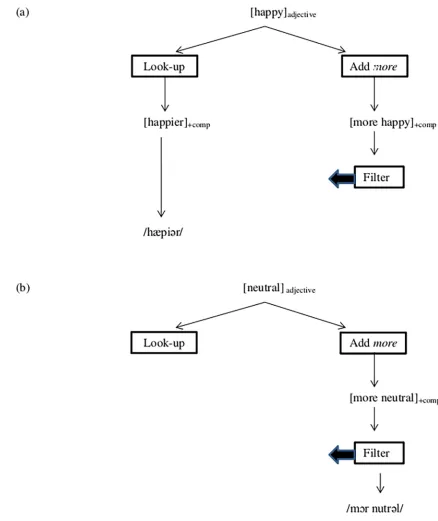
As regards itsfunctional significance, previous studies interpreted the enhanced negativity for the production of complex words as an index of morphological concatenation, viz. the composition of a stem plus an affix [21]. This interpretation straightforwardly accounts for the pattern of results obtained for the English past tense, for which regular forms (that involve affixation) elicited an enhanced negativity as opposed to irregular forms (that are not affixed). Applied to the current study, this account predicts a negativity for–erforms relative to analytic (more) comparatives, as the former (but not the latter) involve affixation. Our results, however, revealed the opposite pattern, namely a negativity for the production of analytic comparatives. Hence, our findings are not compatible with an interpretation of the negativity in terms of affix composition. An alternative functional interpretation builds on the fact that the produc-tion of comparative adjectives involves morpho-lexical competiproduc-tion between analytic and syn-thetic forms of expression. We specifically propose that the negativity reflects a constraint on grammatically-based computational processes, in this casemorecomparative formation. This is illustrated inFig 2.
As illustrated inFig 2A, the output of lexical look-up is unconstrained, which means that once an entry is found (for a synthetic comparative form), it is submitted to the speech output system and articulated, for example, as /hæpiər/ for the adjectivehappy. By contrast, accurate production of an analytic comparative form (illustrated inFig 2B) requires an additional con-trol process to check whether for a given a candidate form (e.g.more neutral) there is no equiv-alent stored form that would block themoreform. We suggest that the elicited negativity we have observed in our ERP results signals this additional control/filter process involved in the production of analytic comparative forms.
We believe that other potential causes for this ERP effect are less likely. Conceptual and/or semantic encoding processes can be ruled out as the source for the enhanced negativity for analytic comparatives (relative to synthetic ones), because the two comparatives do not differ conceptually or in their meanings. Also, different adjective lemmas were involved when ERP responses to analytic versus synthetic forms were compared with each other (e.g.,happyvs.
neutral). However, the adverb control condition in which the same lemmas had to be pro-duced as -lyadverb forms (e.g.,happilyvs.neutrally) did not elicit a negativity for MORE-adjective lemmas (relative to ER-MORE-adjective lemmas) indicating that the enhanced negativity for analytic comparatives cannot be attributed to any lexical differences of the lemmas involved. Furthermore,moreand–ercomparative responses differ in length, with the former (but not the latter) requiring the production of a two-word expression (more neutralvs.happier). We do not think that this contrast is responsible for the ERP differences obtained. If it were, the negativity should have disappeared when we comparedmorecomparatives and negation of the same lemmas, because both conditions require two-word expressions (e.g.,more neutralvs.
the enhanced negativity for analytic comparatives was maintained relative to a control condi-tion with stimuli of the same length (viz. negacondi-tion) the produccondi-tion of which does not require any kind of output control for different means of expression. Given these findings, we main-tain that the negativity for analytic comparative forms is an index of morpho-lexical
[image:12.612.135.573.71.592.2]competition.
Fig 2. A schematic representation of the production of comparative adjectives.
We note that the account proposed here for the negativity obtained for analytic compara-tives also applies to the results of production studies that tested other phenomena of morpho-logical encoding. Recall that Budd et al. (2013) [21] and Festman and Clahsen (2016) [22] obtained this enhanced negativity for the production of regular past tense forms, Jessen et al. (2016) [24] for regular participles in German, and Budd et al. (2015) [23] for regular plurals inside compounds in English. What is common to the phenomena that elicited this negativity is that they involve grammatically-based computational processes that have to be prevented from over-application. These computational processes are not only the familiar cases of affixa-tion but also include periphrastic forms such asmorecomparatives. These processes compete with stored lexical forms which may be unanalyzed wholes, for example suppletive forms, or may have internal structure, as for example irregular -nparticiples of German or–er compara-tives in English. In any case, the proposed functional interpretation of the morphological encoding negativity in terms of competition is not dependent upon the notion of affix (de) composition or morpheme combination during word production, but would also be compati-ble with amorphous or supra-lexical models of morphological processing, e.g. [55] for which both recognition and production crucially involve competition between exponents.
Conclusion
We found that the production of analytic comparative adjective forms (e.g.more neutral) elic-ited an enhanced negativity relative to the production of synthetic comparatives (e.g.happier). The onset latency of this brain response (~300ms) is consistent with previous findings from production studies [47–48] which have identified processes of morphological encoding to occur from this latency onwards. Control conditions ruled out non-morphological properties —in particular lexical and length differences between analytic and synthetic comparatives–as potential sources for this negativity. In previous research using the same silent-production-plus-delayed-vocalization paradigm that was used for the current study, this morphological encoding negativity has also been found for the production of regularly (relative to irregularly) inflected verbs and nouns in English and German. We propose a unified interpretation for the negativity obtained in these and the current study arguing that it reflects an output control mechanism during language production that prevents grammatically-based computational processes from over-applying.
Finally, we note that the ERP literature contains several reports of fronto-central negativi-ties occurring in similar time-windows (~300-800ms) as the morphological encoding negativ-ity, which have been interpreted as signaling conflict monitoring, cognitive control, and similar processes [50–51]. Consequently, we may speculate that the morphological encoding negativity is part of a family of negativities that reflect cognitive control processes more generally.
Supporting information
S1 File. ER-adjectives.
(PDF)
S2 File. MORE-adjectives.
(PDF)
S1 Dataset. Mean ERP amplitudes.
Acknowledgments
We thank Roger Deeble for technical support.
Author Contributions
Conceptualization: Harald Clahsen.
Formal analysis: Silke Paulmann, Mary-Jane Budd.
Funding acquisition: Harald Clahsen, Christopher Barry.
Investigation: Silke Paulmann, Mary-Jane Budd.
Methodology: Harald Clahsen, Silke Paulmann, Mary-Jane Budd.
Project administration: Harald Clahsen, Silke Paulmann, Christopher Barry.
Software: Silke Paulmann, Mary-Jane Budd.
Supervision: Harald Clahsen, Silke Paulmann.
Visualization: Silke Paulmann.
Writing – original draft: Harald Clahsen, Silke Paulmann.
Writing – review & editing: Harald Clahsen, Silke Paulmann, Mary-Jane Budd, Christopher
Barry.
References
1. Janssen DP, Roelofs A, Levelt WJ. Inflectional frames in language production. Lang Cogn Process. 2002; 17(3): 209–236.
2. Aronoff, M. Competition and the lexicon. In: Elia, A, Iacobini, C, Voghera, M, editors. Livelli di Analisi e fenomeni di interfaccia. Atti del XLVII congresso internazionale della societàdi linguistica Italiana. Roma: Bulzoni Editore; 2016. pp. 39–52.
3. Pinker S. Words and rules: the ingredients of language. 1st ed. New York, NY: Basic Books; 1999. 4. Spalek K, Markus F. D, Bo¨lte J. Is lexical selection in spoken word production competitive? Introduction
to the special issue on lexical competition in language production. Language and Cognitive Processes. 2013; 28(5): 597–614.
5. Bu¨rki A. Sadat J., Dubarry A.-S., Alario X. Sequential processing during noun phrase production. Cogni-tion. 2016; 146: 90–99.
6. Hirschfeld G. Jansma B., Bo¨lte J., Zwitserlood P. Interference and facilitation in overt speech production investigated with event-related potentials. Neuroreport. 2008; 19(12): 1227–1230.https://doi.org/10. 1097/WNR.0b013e328309ecd1PMID:18628670
7. Misra M, Guo T, Bobb SC, Kroll JF. When bilinguals choose a single word to speak: Electrophysiologi-cal evidence for inhibition of the native language. J Mem Lang. 2012; 67(1): 224–237.
8. Guo T, Liu H, Misra H, Kroll JF. Local and global inhibition in bilingual word production: fMRI evidence from Chinese-English bilinguals. Neuroimage. 2011; 56(4): 2300–2309.https://doi.org/10.1016/j. neuroimage.2011.03.049PMID:21440072
9. Abutalebi J, Green DW. Neuroimaging of language control in bilinguals: neural adaptation and reserve. Biling. 2016; 19(4): 689–698.
10. Runnqvist E, Strijkers K, Sadat J, Costa A. On the temporal and functional origin of L2 disadvantages in speech production: a critical review. Front Psychol. 2011; 2: 379.https://doi.org/10.3389/fpsyg.2011. 00379PMID:22203812
11. Christoffels IK, Firk C, Schiller NO. Bilingual language control: an event-related brain potential study. Brain Res. 2007; 1147: 192–208.https://doi.org/10.1016/j.brainres.2007.01.137PMID:17391649
13. Verhoef K, Roelofs A, Chwilla DJ. Role of inhibition in language switching: Evidence from event-related brain potentials in overt picture naming. Cognition. 2009; 110(1): 84–99.https://doi.org/10.1016/j. cognition.2008.10.013PMID:19084830
14. Ganushchak LY, Schiller NO. Brain error-monitoring activity is affected by semantic relatedness: An event-related brain potentials study. J Cogn Neurosci. 2008; 20(5): 927–940.https://doi.org/10.1162/ jocn.2008.20514PMID:18201131
15. West R, Alain C. Event-related neural activity associated with the Stroop task. Brain Res Cogn Brain Res. 1999; 8(2): 157–164. PMID:10407204
16. Mu¨ller O, Hagoort P. Access to lexical information in language comprehension: Semantics before syn-tax. J Cogn Neurosci. 2006; 18(1): 84–96.https://doi.org/10.1162/089892906775249997PMID:
16417685
17. Rodriguez-Fornells A, van der Lugt A, Rotte M, Britti B, Heinze HJ, Mu¨nte TF. Second language inter-feres with word production in fluent bilinguals: brain potential and functional imaging evidence. J Cogn Neurosci. 2005; 17(3): 422–433.https://doi.org/10.1162/0898929053279559PMID:15814002
18. Schiller NO. Lexical stress encoding in single word production estimated by event-related brain poten-tials. Brain Res. 2006; 1112(1): 201–212.https://doi.org/10.1016/j.brainres.2006.07.027PMID:
16893534
19. Schmitt BM, Mu¨nte TF, Kutas M. Electrophysiological estimates of the time course of semantic and pho-nological encoding during implicit picture naming. Psychophysiology. 2000; 37: 473–484. PMID:
10934906
20. Elston-Gu¨ttler KE, Paulmann S, Kotz SA. Who’s in control? Proficiency and L1 influence on L2 process-ing. J Cogn Neurosci. 2005; 17(10): 1593–1610.https://doi.org/10.1162/089892905774597245PMID:
16269099
21. Budd MJ, Paulmann S, Barry C, Clahsen H. Brain potentials during language production in children and adults: An ERP study of the English past tense. Brain Lang. 2013; 127(3): 345–355.https://doi.org/10. 1016/j.bandl.2012.12.010PMID:23398779
22. Festman J, Clahsen H. How Germans prepare for the English past tense: silent production of inflected words during EEG. Appl Psycholinguist. 2016; 37: 487–506.
23. Budd MJ, Paulmann S, Barry C, Clahsen H. Producing morphologically complex words: An ERP study with children and adults. Dev Cogn Neurosci. 2015; 12: 51–60.https://doi.org/10.1016/j.dcn.2014.11. 002PMID:25541272
24. Jessen A, Fleischhauer E, Clahsen H. Morphological encoding in German children’s language produc-tion: Evidence from event-related brain potentials. J Child Lang. 2016; 44(2): 427–456.https://doi.org/ 10.1017/S0305000916000118PMID:27018576
25. Giraudo H., & Dal Maso S. The salience of complex words and their parts: Which comes first?. Frontiers in psychology. 2016; 7: 1778.https://doi.org/10.3389/fpsyg.2016.01778PMID:27917133
26. Pinker S, Ullman MT. The past and the future of the past tense. Trends Cogn Sci. 2002; 6(11): 456– 463. PMID:12457895
27. Emonds J. A transformational approach to English syntax: Root, structure-preserving, and local trans-formations. New York: Academic Press; 1976.
28. Barber C. Linguistic change in present-day English. London et al.: Oliver & Boyd; 1964.
29. Frank M. Modern English: A practical reference guide. Englewood Cliffs, NJ: Prentice-Hall; 1972. 30. Hilpert M. The English comparative language structure and language use. English Language and
Lin-guistics. 2008; 12(3): 395–417.
31. LaFave N. The most apt experimental investigation of English comparative and superlative formation. University of Pennsylvania Working Papers in Linguistics. 2015; 21(1): 1–12.
32. Aronoff, M, Lindsay, M. Partial organization in languages: la langue est un système ou` la plupart se tient. Proceedings of the 8th De´cembrettes; 2015. pp. 1–14.
33. Poser WJ. Blocking of phrasal constructions by lexical items. In: Sag IA, Szabolcsi A, editors. Lexical Matter. Stanford: CSLI; 1992. pp. 111–130.
34. Graziano-King J, Cairns HS. Acquisition of English comparative adjectives. J Child Lang. 2005; 32(2): 345–373. PMID:16045254
35. Dunbar E, Wellwood A. Addressing the “two interface” problem: Comparatives and superlatives. Glossa. 2016; 1(1:5): 1–29.
37. Leminen A., Clahsen H. Brain potentials to inflected adjectives: Beyond storage and decomposition. Brain Research. 2014; 1543: 223–234.https://doi.org/10.1016/j.brainres.2013.10.038PMID:
24161829
38. Bosch S., Krause H., Leminen A. The time-course of morphosyntactic and semantic priming in late bilin-guals: A study of German adjectives. Bilingualism: Language and Cognition. 2017; 20(3): 435–456. 39. Boyd J.K. Comparatively speaking: A psycholinguistic study of optionality in grammar. University of
California, San Diego, 2007.
40. Kunter G. Effects of processing complexity in perception and production. The case of English compara-tive alternation. NetWordS. 2015: 32–36.
41. Graziano-King J. English comparatives: a preliminary investigation. Kingsborough Community College, CUNY, 2003.
42. Clahsen H., Temple C. M. Words and rules in children with Williams syndrome. In: Levy Y. & Schaeffer J. (Eds.), Language competence across populations. Erlbaum Press: Hillsdale, NJ, pp. 323–352. 43. Gathercole V. More and more and more about more. Journal of Experimental Child Psychology, 1985;
40(1), 73–104. PMID:4031787
44. Baayen H, Piepenbrock R, van Rijn H. The CELEX lexical database (CD-ROM). Philadelphia, PE: Lin-guistic Data Consortium; 1993.
45. Delorme A, Makeig S. EEGLAB: An open source toolbox for analysis of single-trial EEG dynamics. J Neurosci Methods. 2004; 134(1): 9–21.https://doi.org/10.1016/j.jneumeth.2003.10.009PMID:
15102499
46. Koester D, Schiller NO. Morphological priming in overt language production: Electrophysiological evi-dence from Dutch. Neuroimage. 2008; 42: 1622–1630.https://doi.org/10.1016/j.neuroimage.2008.06. 043PMID:18674626
47. Indefrey P, Levelt WJ. The spatial and temporal signatures of word production components. Cognition. 2004; 92(1–2): 101–144.https://doi.org/10.1016/j.cognition.2002.06.001PMID:15037128
48. Sahin NT, Pinker S, Cash SS, Schomer D, Halgren E. Sequential processing of lexical, grammatical, and phonological information within Broca’s area. Science. 2009; 326(5951): 445–449.https://doi.org/ 10.1126/science.1174481PMID:19833971
49. Lavric A, Pizzagalli D, Forstmeier S, Rippon G. A double-dissociation of English past-tense production revealed by event-related potentials and low-resolution electromagnetic tomography (LORETA). Clin Neurophysiol. 2001; 112: 1833–1849. PMID:11595142
50. Patel SH, Azzam PN. Characterization of N200 and P300: selected studies of the event-related poten-tial. Int J Med Sci. 2005; 2(4), 147–154. PMID:16239953
51. Folstein JR, van Petten C. Influence of cognitive control and mismatch on the N2 component of the ERP: a review. Psychophysiology. 2008; 45(1): 152–170.https://doi.org/10.1111/j.1469-8986.2007. 00602.xPMID:17850238
52. van Veen V, Carter CS. The anterior cingulate as a conflict monitor: fMRI and ERP studies. Physiol Behav. 2002; 77(4–5): 477–482. PMID:12526986
53. Lamm C, Zelazo PD, Lewis M. Neural correlates of cognitive control in childhood and adolescence: Dis-entangling the contributions of age and executive function. Neuropsychologia. 2006; 44: 2139–2148.
https://doi.org/10.1016/j.neuropsychologia.2005.10.013PMID:16310813
54. Sierpowska J, Gabarro´s A, Fernandez-Coello A, CaminsÀ, Castañer S, Juncadella M, et al., A. Mor-phological derivation overflow as a result of disruption of the left frontal aslant white matter tract. Brain Lang. 2015; 142: 54–64.https://doi.org/10.1016/j.bandl.2015.01.005PMID:25658634