R E S E A R C H
Open Access
Convergence and stability of implicit
compensated Euler method for stochastic
differential equations with Poisson random
measure
Minghui Song
1*and Hui Yu
1,2*Correspondence:
1Department of Mathematics,
Harbin Institute of Technology, Harbin, 150001, P.R. China Full list of author information is available at the end of the article
Abstract
In this paper, an implicit compensated Euler method is introduced for stochastic differential equations with Poisson random measure. A convergence theorem is proved to show that the method obtains a strong order 0.5. After exploiting the conditions of exponential mean-square stability of such equations, the implicit compensated Euler method is proved to share the same stability for any step size. Numerical examples indicate the performance of the convergence and stability.
Keywords: stochastic differential equations; Poisson random measure; convergence; exponential mean-square stability
1 Introduction
In finance and economics, in order to obtain the dynamics observed, it is important to model the impact of event-driven uncertainty. Events such as corporate defaults, opera-tional failures, market crashes or central bank announcements lead to the introduction of stochastic differential equations (SDEs) driven by random measure; see [, ] since such equations were initiated by Merton [].
Since only explicit solutions of a small class of SDEs with Poisson random measure can be obtained, one needs, in general, discrete time approximations which can be divided into strong approximations and weak approximations. Strong approximations provide path-wise approximations, while weak approximations are appropriate for problems such as derivative pricing or the evaluation of risk measures and expected utilities.
We give an overview of the existing literature on the strong approximations of SDEs with Poisson random measure. Early, in [], Platen gave a convergence theorem for strong approximations of any given orderγ ∈ {., , ., . . .} and originally introduced the so-called jump-adapted schemes which were based on time discretizations that included all the jump times. Moreover, by using an order . scheme for approximating the diffusion part, Kloeden and Platen (see []) obtained the jump-adapted order . strong scheme, and they also constructed the derivative free or implicit jump-adapted schemes with desired order of strong convergence. In [], for the specific case of pure jump SDEs, the strong or-der of convergence of Taylor schemes was established unor-der weaker conditions than those currently known in the literature. Recently, Bruti-Liberati and Platen [, ] have presented
the drift-implicit schemes which achieve strong orderγ ∈ {., }. Mao [] deals with the convergence of numerical solutions for variable delay differential equations driven by Pois-son random measure. In [], the improved Runge-Kutta methods have been presented to improve the accuracy behavior of problems with small noise for SDEs with Poisson ran-dom measure. Weak approximations can be seen in [, , ].
As for the stability of SDEs with Poisson random measure, only limited results have been presented in currently known literature. Li, Dong and Situ [] have shown that the almost sure asymptotic stability of linear SDEs with Poisson random measure depends on the negative Lyapunov exponential functions. Using Liapunov’s method, Swishchuk and Kazmerchuk [] have presented the stability of a trivial solution of semi-linear stochastic delay differential equations with Markovian switchings and with Poisson bifurcations.
However, to the best of our knowledge, little has been presented about the stability of numerical methods to SDEs with Poisson random measure. The main contribution in our work shows that the implicit compensated Euler method shares exponential mean-square stability for any step sizetwith SDEs with Poisson random measure; that is, the method can preserve exponential mean-square stability without any restrictions on a step size. To some extent, our numerical experiments demonstrate that the stability behavior of the implicit compensated Euler method is not influenced by an increasing step size, while the Euler method and drift-implicit Euler method can only preserve stability for restricted step sizes. Our work is motivated by [–, ]. In [, ], the drift-implicit Euler method of order . was introduced to SDEs with Poisson random measure and its convergence was considered. In [], Euler method was presented to SDEs with Poisson random measure. In [], the stability was analyzed for the compensated split-step backward (CSSBE) method and split-step backward Euler (SSBE) method to SDEs with Poisson process.
Our work is organized as follows. In Section , an implicit compensated Euler method is introduced to SDEs with Poisson random measure. In Section , a convergence theorem of the method is proved by four lemmas under the Lipschitz conditions and the linear growth conditions. In Section , the exponential mean-square stability of such an equation is analyzed. Subsequently, the stability of the implicit compensated Euler method to such an equation is presented in the last theorem under the one-sided Lipschitz conditions. In Section , some numerical experiments show the performance of the convergence and stability. Finally, a concluding remark is given.
1.1 Problem’s setting
Throughout this paper, unless otherwise specified, we use the following notations. Let u∨u=max{u,u}. Let| · |and·,·be the Euclidean norm and the inner product of
vectors inRd,d∈N. IfAis a vector or matrix, its transpose is denoted byAT. IfAis a
matrix, its trace norm is denoted by|A|=trace(ATA). LetL
F(;R
d) denote the family
ofRd-valuedF
-measurable random variablesξ withE|ξ|<∞.C(Rd;Rd) denotes the
family of continuously differentiableRd-valued functions defined onRd.
The followingd-dimensional stochastic differential equation with Poisson random mea-sure is considered in our paper:
dx(t) =ax(t–)dt+bx(t–)dW(t) +
ε
cx(t–),vpφ(dv×dt), t> (.)
The randomness in this equation is generated by the following (see []). An m -dimensional Wiener processW={W(t) = (W(t), . . . ,Wm(t))T}with independent scalar
components is defined on a filtered probability space (W,FW, (FtW)t≥,PW). A Poisson
random measurepφ(ω,dv×dt) is onJ ×ε×[,∞), where ε⊆Rr\ {}, withr∈N,
and its deterministic compensated measure φ(dv)dt=λf(v)dv dt. f(v) is a probabil-ity densprobabil-ity, and we require finite intensprobabil-ity λ=φ(ε) <∞. The Poisson random mea-sure is defined on a filtered probability space (J,FJ, (FJ
t)t≥,PJ). As a consequence,
the process x is defined on a product space (,F, (Ft)t≥,P), where =W ×J,
F =FW × FJ, (F
t)t≥ = (FtW)t≥× (FtJ)t≥, P =PW × PJ and F contains all P
-null sets. The Wiener process and the Poisson random measure are mutually indepen-dent.
The drift coefficienta:Rd→Rd, the diffusion coefficientb:Rd→Rd×mand the jump coefficientc:Rd×ε→Rdare usually assumed to be Borel measurable functions and the
coefficients satisfy the Lipschitz conditions
a(x) –a(y)∨b(x) –b(y)∨
ε
c(x,v) –c(y,v)φ(dv)≤K|x–y| (.)
for everyx,y∈RdandK
> , and the linear growth conditions
a(x)∨b(x)∨
ε
c(x,v)φ(dv)≤K
+|x| (.)
for allx∈RdandK=max{K, |a()|, |b()|,
ε|c(,v)|
φ(dv)}, where a()+b()+
ε
c(,v)φ(dv)≤L, L> .
A unique strong solution of the equation (.) exists under the conditions (.) and (.); see [, ].
1.2 Implicit compensated Euler method
It is convenient to rewrite the equation (.) in terms of the compensated Poisson measure (see [])
pφ(dv×dt) :=pφ(dv×dt) –φ(dv)dt,
as
dx(t) = ax(t–)+
ε
cx(t–),vφ(dv)
dt+bx(t–)dW(t)
+
ε
cx(t–),vpφ(dv×dt), (.)
forx∈Rd.
form-ing
Yn+=Yn+ a(Yn+) +
ε
c(Yn+,v)φ(dv)
t+b(Yn)Wn
+
tn+
tn
ε
c(Yn,v)pφ(dv×dt), (.)
whereWn=W(tn+) –W(tn).
The continuous-time implicit compensated Euler method is then defined by
Y(t) :=Y+
t
aZ(s–)
+
ε
cZ(s–),v
φ(dv)
ds+
t
bZ(s–)
dW(s)
+
t
ε
cZ(s–),v
pφ(dv×ds), (.)
whereZ(t) =Yn,Z(t) =Yn+fort∈[tn,tn+),n= , , . . . .
Actually, as we see in [],pφ={pφ(t) :=pφ(ε×[,t])}is a process that counts the number
of jumps until some given time. The Poisson random measurepφ(dv×dt) generates a
se-quence of pairs{(τi,ξi),i∈ {, , . . . ,pφ(T)}}for a given finite positive constantTifλ<∞.
Here{τi:→R+,i∈ {, , . . . ,pφ(T)}}is a sequence of increasing nonnegative random
variables representing the jump times of a standard Poisson process with intensityλ, and
{ξi:→ε,i∈ {, , . . . ,pφ(T)}}is a sequence of independent identically distributed
ran-dom variables, whereξiis distributed according toφ(dv)/φ(ε). Then (.) can equivalently be of the following form:
Yn+=Yn+ a(Yn+) +
ε
c(Yn+,v)φ(dv)
t+b(Yn)Wn
–
ε
c(Yn,v)φ(dv)t+ pφ(tn+)
i=pφ(tn)+
c(Yn,ξi). (.)
As the special case of (.), that is,c(x,v) =c(x), the method (.) reduces to
Yn+=Yn+
a(Yn+) +λc(Yn+)
t+b(Yn)Wn–λc(Yn)t+c(Yn)pn,
wherepn=pφ(tn+) –pφ(tn) is a Poisson distributed random variable with meanλt.
2 Strong convergence of implicit compensated Euler method
In this section, we present a convergence theorem of the implicit compensated Euler method (.) to the SDE with Poisson random measure (.) over a finite time interval [,T] under the Lipschitz conditions and the linear growth conditions, whereTis a con-stant andt=T/N,N∈N. At the beginning, we give four lemmas.
The first lemma demonstrates the existence of a solution to the implicit compensated Euler method (.).
Lemma . Under the Lipschitz conditions(.),if(√K+
√
λK)t< ,then the equation
for the implicit compensated Euler method(.)can be solved uniquely for Yn+ given Yn,
Proof Writing (.) asYn+=F(Yn+) and then using the Cauchy-Schwarz inequality and
foru,u∈Rd. Hence, the result follows from the classical Banach contraction mapping
theorem.
The second lemma shows that the discrete implicit compensated Euler method (.) of the equation (.) has bounded second moments.
Lemma . Under the linear growth conditions(.),there existst> such that for all
<t<t< /( + K+ λK),
Proof It follows from (.) that
Thus, by taking expectations and using the martingale properties ofdWnandpφ(dv×dt),
we have Schwarz inequality and the linear growth conditions (.), we can obtain
≤
which yields the following result by the discrete-type Gronwall inequality (see []) and nt≤T
So, we have the result (.), where
C=max
The third lemma shows that the continuous-time implicit compensated Euler method (.) has bounded second moments.
Lemma . Under the linear growth conditions(.),there exists a positive constant C
Proof It follows from (.) that
Schwarz inequality, the linear growth conditions (.) and Fubini’s theorem, we have
E sup
Moreover, Doob’s martingale inequality (see []), the linear growth conditions (.) and Fubini’s theorem imply result (.) by taking
The last lemma shows the close relation between the continuous-time implicit compen-sated Euler method (.) and its step functionsZ(t) andZ(t).
Lemma . Under the conditions(.),there exist positive constants Cand C
indepen-dent oft such that for all <t<t,
Now, the Cauchy-Schwarz inequality gives
Moreover, Doob’s martingale inequality (see []) implies
Therefore, by substituting (.), (.), (.) and (.) into (.) and then applying the linear growth conditions (.) and Fubini’s theorem, we can obtain
E sup
Hence from (.), it follows that
E sup
A similar analysis gives the result (.).
Now, let us state the convergence of the implicit compensated Euler method by relying on the lemmas above.
Theorem . Under the Lipschitz conditions(.)and the linear growth conditions(.), the continuous implicit compensated Euler method(.)of the equation(.)satisfies
+ Rdis used. Hence, by the Cauchy-Schwarz inequality and Doob’s martingale inequality, for
any ≤t≤T, we obtain
The result (.) then follows from the continuous Gronwall inequality (see []).
3 Mean-square stability
This section presents new results on the exponential mean-square stability for the equa-tion (.) under the one-sided Lipschitz condiequa-tions in the following.
We assume that there exist constantsμ,μ,μ,μsuch that∀x,y∈Rd
a(x),b(x),
ε
c(x,v)φ(dv)∈CRd;Rd, (.)
x,a(x)≤μ|x|, (.)
x,
ε
c(x,v)φ(dv)
≤μ|x|, (.) b(x)≤μ|x|, (.)
ε
c(x,v)φ(dv)≤μ|x|, (.)
and
a() =b() =c(, ) = . (.)
And so the equation (.) admits the trivial solutionx(t)≡.
Since the numerical method (.) is implicit, the question of existence and uniqueness arises. And we solve this question in the following lemma.
Lemma . Under the conditions(.), (.)and(.),the equation for the implicit com-pensated Euler method(.)has a unique solution,with probability one,for all
(μ+μ)t< . (.)
Proof The required result is a special case of Theorem . in [].
In this paper, we consider the exponential mean-square stability of the trivial solution, which is defined according to [, ].
Definition .(see []) The equation (.) is said to be exponentially stable in the mean square if there is a pair of positive constantsαandαsuch that for any initial datax∈
LF(;Rd),
Ex(t)≤αE|x|e–αt, for allt≥. (.) Definition .(see []) A numerical method applied to the equation (.) is said to be exponentially stable in the mean square, if there is a pair of positive constantsβandβ
such that the numerical approximationsYnsatisfy
E|Yn|≤βE|x|e–β·nt, n∈N, (.)
for initial datax∈LF(;Rd) and a given step sizet> .
Theorem . Under the conditions(.)-(.),ifσ < in(.),then the equation(.)
is exponentially stable in the mean square.More precisely,any analytical solution of the equation(.)withE|x|<∞satisfies
Ex(t)≤E|x|eσt, for all t≥, (.)
where
σ:= (μ+μ) +μ+μ. (.)
Proof Using Ito’s formula (see []) toˆ f(t,x) =|x(t)|, we have
dx(t)= x(t–),ax(t–)+
ε
cx(t–),vφ(dv)
+bx(t–)
dt
+
ε
x(t–) +cx(t–),v–x(t–)–x(t–),cx(t–),vφ(dv)dt
+x(t–),bx(t–)dW(t) +
ε
x(t–) +c
x(t–),v–x(t–)pφ(dv×dt)
for allt≥. Therefore, the conditions (.)-(.) give
dx(t)≤(μ+ μ+μ+μ)x(t–)
dt+x(t–),bx(t–)dW(t)
+
ε
x(t–) +c
x(t–),v–x(t–)pφ(dv×dt).
Hence, we have
Ex(t)≤E|x|e(μ+μ+μ+μ)t,
where the martingale properties ofdW(t) andpφ(dv×dt) are used.
The following lemma shows that the implicit compensated Euler (.) has a unique solu-tion for alltunder the conditionσ< for the mean-square stability of the equation (.).
Lemma . Under the conditions(.)and(.),ifσ< in(.),the implicit
compen-sated Euler method(.)produces a well-defined unique solution.
Proof From the conditions (.) and (.), we getμ≥ andμ≥. Therefore,σ< in
(.) can lead to (μ+μ) < . Hence, for anyt> , we have (μ+μ)t< < . So,
according to Lemma ., the equation for the implicit compensated Euler method (.) has a unique solution, with probability one, for allt> .
Theorem . Under the conditions(.)-(.),ifσ< in(.)and(.),then for any step sizet> the implicit compensated Euler method(.)to the equation(.)is expo-nentially stable in the mean square,namely
E|Yn|≤E|x|eβ·nt, n∈N, (.)
whereβ(t) =σ+O(t),ast→. Proof It follows from (.) that
Yn– a(Yn) +
ε
c(Yn,v)φ(dv)
t
=Yn–+b(Yn–)Wn–+ tn
tn–
ε
c(Yn–,v)pφ(dv×dt) ,
for any step sizet> . Now, taking expectations and applying the martingale properties ofWn–andpφ(dv×dt), we get
E|Yn|≤tE
Yn,a(Yn) +
ε
c(Yn,v)φ(dv)
+E|Yn–|
+tEb(Yn–)
+E tn
tn–
ε
c(Yn–,v)
φ(dv)dt.
Under the conditions (.)-(.), we have
E|Yn|≤(μ+μ)tE|Yn|+ ( +μt+μt)E|Yn–|.
Since the conditions of (.) and (.) in Theorem . give
– (μ+μ)t> ,
and
< +μt+μt – (μ+μ)t
< ,
we get
E|Yn|≤E|x|eβ(t)·nt,
where
β(t) :=
tln
+μt+μt
– (μ+μ)t
=σ+O(t), ast→.
4 Numerical experiments
We consider the following equation:
dx(t) =ax(t–)dt+bx(t–)dW(t) +
ε
cx(t–)vpφ(dv×dt), t> , (.)
withx(), whered=m=r= . The compensated measure of the Poisson random measure pφ(dv×dt) is given byφ(dv)dt=λf(v)dv dt, and
f(v) = √
πvexp – (lnv)
, ≤v<∞,
is the density function of a lognormal random variable. We simulateW(t),pφ(t) andξi
which are from independent sources of randomness, mainly according to [, ]. Here three examples are given as
I: a= –, b= , c= –., λ= , II: a= –, b= , c= –., λ= ,
and
III: a= , b= , c= –., λ= .
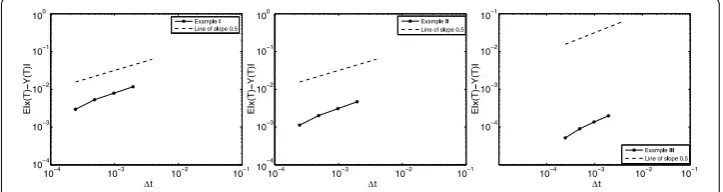
In Figure , the convergence of the implicit compensated Euler method (.) to I, II and III is described. In this numerical test, we focus on the error at the endpointT= , and the endpoint error is denoted asE|x(T) –Y(T)|. The expectation is estimated by averaging M= , sample paths over [, ], and for each path, the implicit compensated method is applied with four different step sizest= pδtfor ≤p≤,δt=T/. The solid line
shows a log-log plot of the expectationE|x(T) –Y(T)|againstt. For reference, a dashed line of slope . is added. We can see that the computational result is consistent with a strong order equal to ..
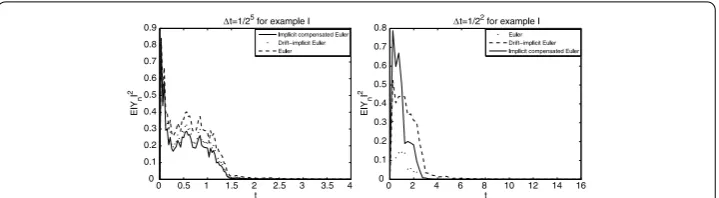
To observe the performance of the stability of the implicit compensated Euler method (.) to (.), we compare the method with the Euler method (see []) and the drift-implicit Euler method (see []) for an increasing step sizetin Figure , Figure , Figure and Fig-ure . Here,E|Yn|denotes the expectation of the numerical approximations. The
expecta-tion is estimated by averagingM= , sample paths, that is to say,ωi: ≤i≤,, E|Yn|= /,
,
i= |Yn(ωi)|. According to Theorem ., I, II and III are
exponen-tially stable in the mean square.
Figure 2 The stability of numerical methods for I about small step sizes withx(0) = 0.1.
Figure 3 The stability of numerical methods for I and II about larger step sizes withx(0) = 0.01.
Figure 4 The stability of numerical methods for I and II about larger step sizes.
From Figure , for a small step sizet= /, the three numerical methods to I are
mean-square stable and behave similarly. Moreover, for a step size t= /, slight difference
appears among the three methods. However, from Figure , for a larger step sizet= , there is observable instability of the Euler method and drift-implicit Euler method while the implicit compensated Euler method remains stable for I. Therefore, our numerical results show that for the parameter values used here, the Euler method and drift-implicit Euler method are stable in the mean square only for restricted step sizes. It is interesting to observe that even for a very large step sizet= , the implicit compensated Euler method is still stable in the mean square for I and II in Figure . And in Figure , pure jump example III is described.
So, we can think that the numerical experiments are consistent with our results in Sec-tion , that is to say, the implicit Euler compensated method performs better stability than current numerical methods of order ..
Competing interests
The authors declare that they have no competing interests.
Authors’ contributions
The authors have equal contributions to each part of this article. All the authors read and approved the final manuscript.
Author details
1Department of Mathematics, Harbin Institute of Technology, Harbin, 150001, P.R. China.2Department of Mathematics,
Heilongjiang Bayi Agricultural University, Daqing, 163319, P.R. China.
Acknowledgements
The financial support from the National Natural Science Foundation of China (No. 11071050) is gratefully acknowledged.
Received: 25 July 2012 Accepted: 6 December 2012 Published: 13 December 2012 References
1. Schönbucher, PJ: In: Credit Derivatives Pricing Models: Models, Pricing and Implementation, pp. 86-103. Wiley, Chichester (2003)
2. Cont, R, Tankov, P: Financial Modelling with Jump Processes. Financ. Math. Ser. Chapman & Hall/CRC, Boca Raton (2004)
3. Merton, RC: Option pricing when underlying stock returns are discontinuous. J. Financ. Econom.2, 125-144 (1976) 4. Platen, E: An approximation method for a class of Itô processes with jump component. Liet. Mat. Rink.22(2), 124-136
(1982)
5. Bruti-Liberati, N, Platen, E: On the strong approximation of jump-diffusion processes. Technical report, Quantitative Finance Research Papers 157, University of Technology, Sydney (2005)
6. Bruti-Liberati, N, Platen, E: Strong approximations of stochastic differential equations with jumps. J. Comput. Appl. Math.205, 982-1001 (2007)
7. Bruti-Liberati, N, Platen, E: Approximation of jump diffusions in finance and economics. Comput. Econ.29, 283-312 (2007)
8. Mao, W: Convergence of numerical solutions for variable delay differential equations driven by Poisson random jump measure. Appl. Math. Comput.212, 409-417 (2009)
9. Buckwar, E, Riedler, MG: Runge-Kutta methods for jump-diffusion differential equations. J. Comput. Appl. Math. (2011). doi:10.1016/j.cam.2011.08.001
10. Liu, XQ, Li, CW: Weak approximations and extrapolations of stochastic differential equations with jumps. SIAM J. Numer. Anal.37(6), 1747-1767 (2000)
11. Mordecki, E, Szepessy, A, Tempone, R, Zouraris, GE: Adaptive weak approximation of diffusions with jumps. SIAM J. Numer. Anal.46(4), 1732-1768 (2008)
12. Li, CW, Dong, Z, Situ, R: Almost sure stability of linear stochastic differential equations with jumps. Probab. Theory Relat. Fields123, 121-155 (2002)
13. Swishchuk, AV, Kazmerchuk, YI: Stability of stochastic differential delay Itô’s equations with Poisson jumps and with Markovian switchings. Application to financial models. Teor. Imovir. Mater. Stat.64, 141-151 (2001)
14. Higham, DJ, Kloeden, PE: Numerical methods for nonlinear stochastic differential equations with jumps. Numer. Math.101(1), 101-119 (2005)
15. Ikeda, N, Watanabe, S: Stochastic Differential Equations and Diffusion Processes, 2nd edn. North-Holland, Amsterdam (1989)
16. Øksendal, B, Sulem, A: Applied Stochastic Control of Jump-Diffusions. Universitext. Springer, Berlin (2005)
17. Mao, XR, Yuan, CG: In: Stochastic Differential Equations with Markovian Switching, pp. 17-200. Imperial College Press, London (2006)
19. Liu, MZ, Cao, WR, Fan, ZC: Convergence and stability of the semi-implicit Euler method for a linear stochastic differential delay equation. J. Comput. Appl. Math.170, 255-268 (2004)
20. Higham, DJ: An algorithmic introduction to numerical simulation of stochastic differential equations. SIAM Rev.43(3), 525-546 (2001)
doi:10.1186/1687-1847-2012-214