R E S E A R C H
Open Access
BOB-RED queue management for IEEE 802.15.4
wireless sensor networks
Mu-Sheng Lin
1*, Jenq-Shiou Leu
1, Wen-Chi Yu
1, Min-Chieh Yu
1and Jean-Lien C Wu
2Abstract
Multimedia services over resource constrained wireless sensor networks (WSNs) face a performance bottleneck issue from the gateway node to the sink node. Therefore, the queue management at the gateway node is crucial for diversified messages conveyed from the front nodes to the sink node. In this article, beacon order-based random early detection (BOB-RED) queue management is proposed. BOB-RED is a dynamic adaptation scheme based on adjusting beacon interval and superframe duration in the IEEE 802.15.4 MAC superframe accompanied with RED queue management scheme to increase the transmission efficiency of multimedia over WSNs. We focus on the performance improvement upon different traffic loads over WSNs. Evaluation metrics include end-to-end delay, packet delivery ratio, and energy consumption in IEEE 802.15.4 beacon enabled mode. Simulation results show that BOB-RED can effectively decrease end-to-end delay and energy consumption compared to the DropTail scheme.
Keywords:wireless sensor networks (WSNs), IEEE 802.15.4, superframe, beacon-enabled, beacon order (BO), super-frame order (SO), queue management, DropTail, random early detection (RED)
1. Introduction
IEEE 802.15.4 standard [1] defines the protocol and interconnection of devices via radio communication in a wireless personal area network (WPAN). The standard uses CSMA/CA medium access mechanism and sup-ports star as well as peer-to-peer topologies. It provides applications such as home entertainment and control, security alarms, industrial monitoring and control, per-sonal mobile healthcare and tele-assist, etc. Two types of device called the full function device (FFD) and the reduced function device (RFD) are used in a LR-WPAN network. FFD is a fully functional device which can be a PAN coordinator, a coordinator, or just a device. RFD is a device with reduced functionality which can only func-tion as an end device. It cannot communicate with any other device in addition to coordinator. We talk about the PAN-coordinator, which acts as a coordinator for the entire WPAN. It is authorized to provide synchroni-zation services in an established network.
Little researches study transmission image or video over IEEE 802.15.4 networks [2-6]. The CMUcam pro-ject provides simple vision capabilities to small embedded systems in the form of an intelligent sensor. The CMUcam3 extends upon this idea by providing a flexible and easy to use open source development envir-onment that complements a low cost hardware platform [7]. It can be used for environment surveillance, robotics, interactive toys, or object recognition and tracking. Traffic loads on multimedia services over resource constrained wireless sensor networks (WSNs) sometimes are huge and bursty. Transmission of image or video data requires careful handling to ensure that end-to-end delay is within acceptable range. So, queue management algorithm on a gateway node should allow temporary bursty traffic and prevent high delay. Up to now, there are many popular queuing management algo-rithms and packet scheduling mechanisms are proposed. As popular known, various scheduling mechanisms such as round-robin (RR), weighted round-robin (WRR), or weighted fair queuing (WFQ) are different from queue managements. Scheduling schemes focus on the sequence and timing of packet transmission, and queue management is obviously about managing queues in * Correspondence: [email protected]
1
Department of Electronic Engineering, National Taiwan University of Science and Technology, Taipei, Taiwan, R.O.C
Full list of author information is available at the end of the article
forwarding devices such as router or relay node. Queue managements can separate into passive queue manage-ment (PQM) and active queue managemanage-ment (AQM). DropTail can be classified as a PQM algorithm since it is basically a simple first in first out (FIFO) mechanism where packets are dropped when queue length exceed buffer length. Random early detection (RED) is the most commonly used queue management algorithm in AQM class [8,9]. Patel et al. [10] proposed comparison between two queuing management system RED and DropTail for avoiding the congestion in high speed packet switched networks. Epiphaniou [11] focuses on three different mechanisms, namely, DropTail (FIFO), RED, and DiffServ, and their effects on realtime voice traffic. Flow RED is an extended version of RED. It behaves just like RED, but maintains per-flow states for all flows in the gateway node. Using this per-flow state, FRED preferentially drops the packets of flows that have queue sizes larger than the average per-flow queue size [12]. Deficit Round Robin is a variant of WFQ disci-pline. It allows WFQ to handle variable packet sizes in a fair manner. It guarantees nearly perfect fairness for flows that have at least one packet in the router buffer. Longest queue drop is used as a packet drop strategy [13]. Ali Ahammed and Banu analyze the performance of AQM algorithms including FRED, BLUE, SFB, and CHOKe. They aim at a thorough evaluation among these algorithms and illustrations of their characteristics by simulation [14]. Le et al. [15] evaluate the perfor-mance of their analytical on M/M/1 queuing model for IEEE 802.15.4 non-beacon-enabled mode at the 2.4 GHz in NS-2 network simulator. Misic and Misic [16] analyze the performance of a personal area network operating under the IEEE Standard 802.15.4 in the beacon-enabled mode, and derive the probability distribution of packet access delay and calculate the throughput. Buratti [17] proposed a mathematical model for the beacon-enabled mode of IEEE 802.15.4. Gao and He [18] proposed an individual beacon order adaptation (IBOA) algorithm for IEEE 802.15.4 networks, which can individually adapt the beacon interval (BI) and duty cycle of each node at the same time to the node’s individual perfor-mance requirements. Jeon et al. [19] proposed a new duty-cycle adaptation algorithm for IEEE 802.15.4 bea-con-enabled networks. They modify the reserved frame control field in the MAC layer header to deliver the end device’s buffer occupancy and queuing delay.
Despite many researches study about the applications of 802.15.4 on industrial and MAC protocol, but little attention in the past has been given to how different queuing management algorithms, such as DropTail and RED, perform in terms of different settings of beacon order (BO), superframe order (SO) parameters on the multimedia service over IEEE 802.15.4 WSNs. As per
our literature search, only a few studies have so far ana-lyzed the impact of BO, SO value on IEEE 802.15.4 operation. But, none article invested RED queue man-agement accompanied with BO, SO value for IEEE 802.15.4 WSNs. Moreover, most current gateway nodes use DropTail as a queue management scheme, which does not guarantee fairness and delay bound. There has been no motivation for realtime applications to use end-to-end congestion avoidance mechanisms for IEEE 802.15.4 WSNs. We study the performance evaluation of different queue management algorithms, such as DropTail, RED on gateway node in this article.
In this study, we focus on the performance improve-ment upon different traffic loads over WSNs. Figure 1 shows a typical multimedia application over WSNs that a front sensor node equipped with a camera sends an emergent message containing the surveillance image to the sink node once it detects an urgent or intrusive event. Different traffic types demand different packet delivery ratios and end-to-end delays. Urgent messages always have a first priority with a minimum end-to-end delay. On the other hand, keep-alive messages carrying small periodic data have a comparatively low priority which can tolerate a longer delay. Hence, a dynamic adaptation scheme based on adjusting BI and frame duration (SD) in the IEEE 802.15.4 MAC super-frame is proposed to increase the transmission efficiency of multimedia over WSNs.
This article presents beacon-order based RED (BOB-RED) queue management for congestion avoidance in IEEE 802.15.4 WSNs. The proposed scheme consists of a virtual threshold function, a dynamic adjusted per-flow drop probability, a dynamic modification of BO and SO strategy that decrease end-to-end delay, energy consumption, and increase throughput when there are different traffic type flows through the gateway node.
A comprehensive simulation for the proposed scheme using the NS-2 network simulator is also pre-sented in this study. Evaluation metrics include end-to-end delay, packet delivery ratio, and energy
consumption using the beacon-enabled and non-bea-con-enabled mode in IEEE 802.15.4 WSNs. Distinct network topologies like star, tree, and chain architec-tures comprising one coordinator and some stationary nodes are considered in the simulation. Simulation results show that a suitable queuing management scheme accompanied with an appropriate setting of BO, SO can effectively achieve a better performance. If the BO value is fixed, a smaller SO value would incur a higher end-to-end delay and a lower packet delivery ratio. If the BO value is equal to the SO value, a larger BO can achieve a higher packet delivery ratio and a lower average end-to-end delay. Besides, the BOB-RED queue management scheme can decrease end-to-end delay compared to the DropTail scheme.
The remainder of the article is structured as follows: in Section 2 we introduce IEEE 802.15.4 MAC super-frame structure and the concepts of RED. In Section 3, we describe the BOB-RED algorithm in detail. In Sec-tion 4, we describe network configuraSec-tion and assump-tions. In Section 5, we present the results of our simulations. Finally, in Section 6, we present our main conclusions and suggest a number of areas for further study.
2. IEEE 802.15.4 MAC superframe structure and RED
2.1 IEEE 802.15.4 MAC superframe structure
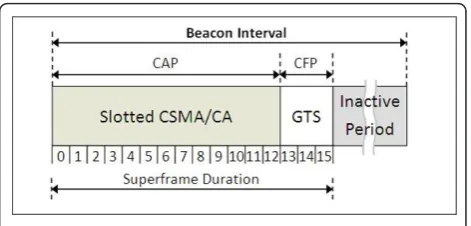
IEEE 802.15.4 MAC protocol supports the enabled and non-enabled modes. In beacon-enabled mode, the access to the channel is managed through a superframe, starting with the beacon packet transmitted by the PAN coordinator. The superframe is subdivided into a contention access period (CAP), con-tention-free period (CFP), and an inactive part. Nodes in CAP use a slotted CSMA/CA to contention for channel and CAP containing a number of GTSs that can be allo-cated by the PAN coordinator to specific nodes. In the non-beacon-enabled mode, there are no regular beacons, but the coordinator may unicast beacons to a soliciting device. Communication among devices in the non-bea-con-enabled mode uses unslotted CSMA/CA for decen-tralized access. This article considers CAP and inactive period only when the beacon-enabled mode is used. Fig-ure 2 shows the IEEE 802.15.4 MAC superframe struc-ture [20].
The structure of this superframe is described by the values of macBeaconOrder (BO) and macSuperframeOr-der (SO). The MAC PIB attribute macBeaconOrmacSuperframeOr-der describes the interval at which the coordinator shall transmit its beacon frames. The superframe order is the variable which is used to determine the length of the SD which is divided into 16 time slots. Similarly, the BI is determined by the variable BO.
Since the time of the SD cannot exceed the time of a BI, the condition for both parameters is 0≤SO≤BO ≤ 14. When BO is greater than SO, it indicates that there is an inactive portion present in the superframe. Also for SO = BO, the BI is same as the SD indicating there is no inactive portion.
The values of macBeaconOrder, BO, and the BI are related as follows:
BI = aBaseSuperframeDuration×2BO
SD = aBaseSuperframeDuration×2SO
•BaseSuperframeDuration = 960 symbols = 15.36
ms, each time slot has a duration of 15.36/16 = 0.96 ms.
•Non-beacon-enabled mode: BO = SO = 15. If BO
= 15, the coordinator will not transmit beacon frames except when requested to do so, such as on receipt of a beacon request command. The value of macSuperframeOrder shall be ignored if BO = 15.
Three topologies are proposed in IEEE 802.15.4 proto-col standard. In a star topology, data transmission can from a device to the coordinator or from the coordina-tor to the device (Figure 3) [1].
Figure 2IEEE 802.15.4 MAC superframe structure.
Following shows part of NS2 trace file in the beacon-enabled mode (BO = SO = 3). Node 0 is the coordinator and node 1 is an FFD that sends constant bit rate (CBR) traffic to node 0. We set the values of BO, SO equal to 3 so the value of BI is 15.36 ms × 23= 122.88 ms. From trace file, we can observe node 0 sends BCN (beacon) every 122.88 ms (1.775232000 - 1.652352000).
s 1.652352000_0_MAC–0 BCN 12 [0 ffffffff 0 0] s 1.775232000_0_MAC–0 BCN 12 [0 ffffffff 0 0] s 1.789120000_1_MAC–0 CM1 17 [0 0 1 0] r 1.789856033_0_MAC–0 CM1 17 [0 0 1 0] s 1.790272000_0_MAC–0 ACK 5 [0 1 0 0] r 1.790624033_1_MAC–0 ACK 5 [0 1 0 0] s 1.898112000_0_MAC–0 BCN 20 [0 ffffffff 0 0]
In the tree topology, data transmission can from a device to the coordinator or from the coordinator to the device. Following shows node 1 sends an association request (CM1) to node 0.
s 1.789120000_1_MAC–0 CM1 17 [0 0 1 0] r 1.789856033_0_MAC–0 CM1 17 [0 0 1 0] s 1.790272000_0_MAC–0 ACK 5 [0 1 0 0] r 1.790624033_1_MAC–0 ACK 5 [0 1 0 0] ...
s 2.282144033_1_MAC–0 CM4 16 [0 0 1 0] r 2.282848067_0_MAC–0 CM4 16 [0 0 1 0] s 2.283072000_0_MAC–0 ACK 5 [0 1 0 0] r 2.283424033_1_MAC–0 ACK 5 [0 1 0 0] s 2.283712000_0_MAC–0 CM2 25 [0 1 0 0] r 2.284704033_1_MAC–0 CM2 25 [0 1 0 0] s 2.284896033_1_MAC–0 ACK 5 [0 0 1 0] r 2.285248067 _0_ MAC–0 ACK 5 [0 0 1 0]
After that node 0 receives the request and sends back an ACK. Connection is established. Then node 1 sends a data request (CM4) and node 0 sends an ACK. Node 0 sends an association response (CM2) and node 1 sends back an ACK [1] (Figure 4).
2.2 Random early detection
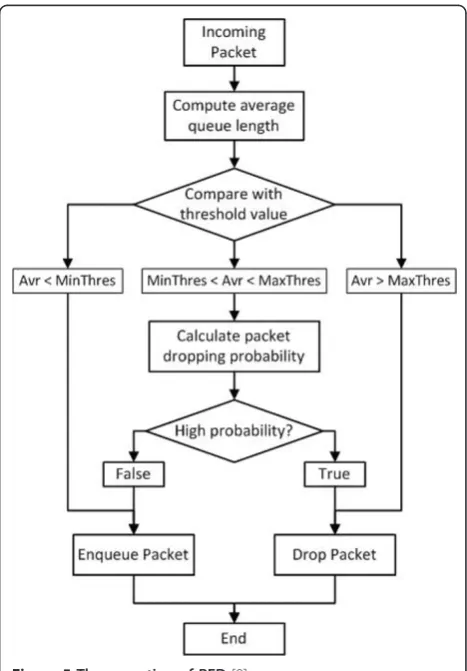
RED, also known as random early discard or random early drop, is an AQM algorithm. The operation of RED queue management is shown in Figure 5.
When packets income, it calculates their current-occupied average queue length (Avr).
It estimates the average queue size as follows.
Avr = (1−wq)×Avr + wq×q
whereqis the instantaneous queue size,wqis the time constant of the low pass filter.
(2) If the Avr is smaller than MinThreshold (Min-Thres), the packet will be kept and sent to the queue waiting for the transmission.
(3) If the Avr is longer than MaxThreshold (MaxThres), all packets will be dropped.
Figure 4Data transmission from coordinator to device.
(4) If the Avr is between MinThres and MaxThres, the initial packet drop probability (Pb) of the packet will be
a linear function of a number between 0 and MaxP
(default value of max. packet drop probability).
Pb= MaxP×(Avr−MinThres)/(MaxThres−MinThres)
The actual probability (Pa) is a function of thePband count of the number of packets enqueued since the last packet was dropped.Pa= Pb/(1 - count ×Pb)
Figure 6 shows the drop probability of RED. RED’s performance is highly dependent on the settings of its control parameters. We choose several control para-meters offered by NS2, which includes qlen, MaxP,
Minth, Maxth and q_w that users may according the
requirements to adjust RED’s performance. However, the impact of the individual parameter on the queue’s performance is dependent on the others too. A set of parameters are listed as below.
1.qlen: queue length.
2.Maxth: maximum threshold for queue, Maxth=
qlen /2.
3. Minth: minimum threshold for queue, Minth =
Maxth/3.
4.MaxP: maximum value for Pb,MaxP= 2 * packe-t_loss_rate. NS-2 default value is 0.1.
5.q_w: queue weight, NS-2 default value is 0.002.
RED is the simplest queue management and compre-hensively used in most routers. Despite RED algorithm is designed to accompany a transport-layer congestion control protocol such as TCP in IP Networks. We try to apply RED mechanism in IEEE 802.15.4 WSNs.
3. BOB-RED algorithm 3.1 Description of BOB-RED
Figure 7 shows the network topology with real-time traffic and non-real-time traffic in multihop IEEE
802.15.4 WSNs. Gateway node collects all the data from relay nodes and sends them to sink. Taking the IBOA [18] and DCA [19] for references, the BOB-RED adapts BO, SO of each gateway node individually to meet the needs of each gateway node working in a WSN. Unlike a unique BO, SO applied to all of the nodes, the BOB-RED assigns BOi, SOi for each neighbor node(i) (iÎ[1,
N], Nis the number of nodes working in the network) which nearby the coordinator.
BOB-RED algorithm can also be applied to large num-ber of sensor nodes because it only runs on coordinator or gateway nodes. Multiple gateway nodes forward pack-ets from end devices hop-by-hop to coordinator. Even though in a large-scale sensor networks, only a few relay nodes which around the coordinator or gateway nodes can transfer data directly to them. Owing to the gateway nodes must be FFDs in IEEE 802.15.4 WSNs, every gate-way node can dynamic adapt the BO, SO values. If we apply BOB-RED algorithm to all gateway nodes, we must consider whether gateway nodes can communicate with the coordinator. Rapidly or continually adapt their BO, SO values may incur the link broken. In addition, large hop counts will increase large loss rate in our simulation. For simplify the complexity, only one gate-way node is implemented in all our simulations.
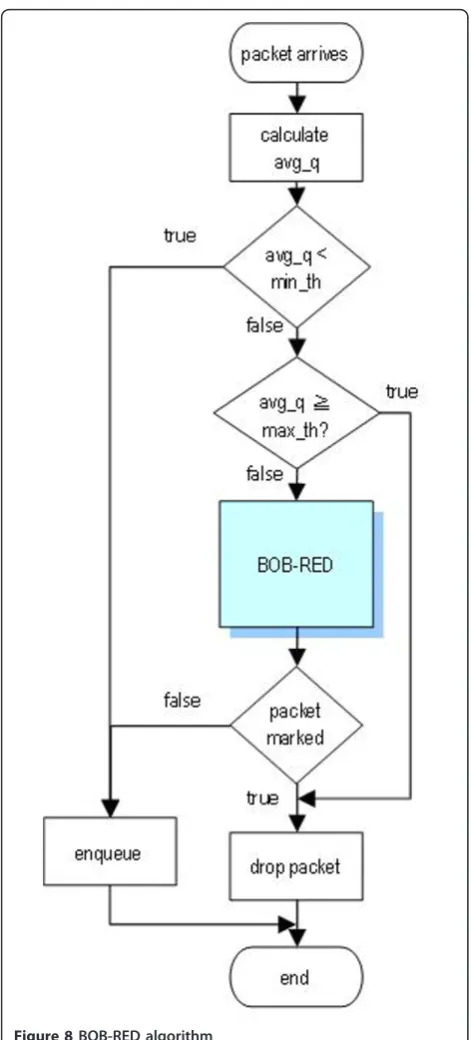
The flowchart of BOB-RED algorithm is shown in Fig-ures 8 and 9.
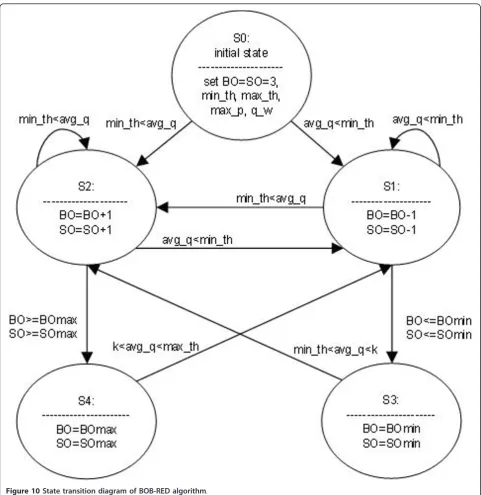
The operation of BOB-RED algorithm is very similar to RED queue management. Figure 10 shows the state transition diagram of BOB-RED. We describe the states of a gateway node as follows:
State 0: The coordinator first sets the initially min_th,
max_th, max_p, q_w, BO and SO values. If we set BO
and SO values as 3, then the coordinator begins to broadcast beacons. The gateway node calculates the average queue lengthavg_q.
State 1: If theavg_qis smaller thanmin_th, thenBO
and SO values decrease 1. If the avg_qis between
min_thand k, the BOB-RED moves to State 2. If the
BO and SO values are less than or equal to the
BOmin, SOmin, the BOB-RED moves to State 3. State 2: If theavg_q is betweenmin_th and k, BO
andSO values increase 1. If the avg_q is less than
min_th, the BOB-RED moves to State 1. If the BO
and SO values are greater than or equal to the
BOmax, SOmax, the BOB-RED moves to State 4. State 3: In this state gateway node operates using
BOmin, SOmin values. If the avg_q is greater than
min_th, the BOB-RED moves to State 2.
State 4: If theavg_qis greatermax_th, all of packets will be dropped. IfBOis still bigger thanBOmin, the
MAC decreasesBO and SO values by 1, and adds
next beacon. If BO, SO values has reached BOmax,
SOmax, the BOB-RED returns to State 1.
Figure 11 shows that the buffer sizeBis divided into four regions by thresholds min_th, k, max_th, where
min_th, k, max_th<B. When packet arrives, the gateway
node computes the average queue length. When the average queue length exceeds a preset thresholdk, the gateway drops or marks each arriving packet with a cer-tain probability, where the exact probability is a function of the average queue length. Pij is the dropping prob-ability, where i and jdenote the number of real-time and non-real-time packets in the buffer, respectively.
The value ofPij can be dynamically calculated based on the number of rear-time and non-real-time packets in the queue, i.e.,
Pij=
wherePloss, rtdenotes the drop probability of real-time packet andPloss, nrtdenotes the drop probability of non-real-time packet, respectively.
Drop probability of real-time packet lists as in Equa-tion 2.
Drop probability of non-real-time packet lists as in Equation 3.
Following shows the pseudocode of BOB-RED algo-rithm.
for each packet arrival (classrt)
calculate the average queue size avg_qrt
if min_th ≦avg_qrt< k
accepted with probability 1
else if k≦avg_qrt< max_th
calculate probability with probability
Ploss,rt=
mark the arriving packet
else if max_th≦avg_qrt
drop the packet
for each packet arrival (classnrt)
calculate the average queue size avg_qnrt
if min_th≦avg_qnrt< k
calculate probability with probability
Ploss,nrt=
mark the arriving packet
else if k≦avg_qnrt< max_th
calculate probability with probability
Pij= (i+j)−k+ 1
B−k+ 1
mark the arriving packet
else if max_th≦avg_nrt
drop the packet
3.2 Queuing model of BOB-RED
It is noted that, in Figure 11, we have both real-time and non-real-time traffic coexistings in the network. The queuing model is specifically designed in each gate-way node.
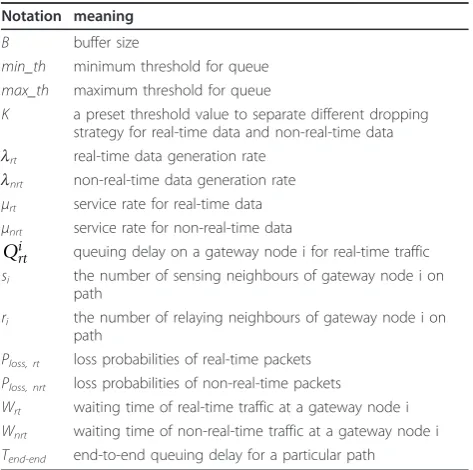
We use Table 2 to summarize most of the notation we will use in the formulation.
The waiting time WrtandWnrtof real-time and non-real-time traffic at a gateway nodei can be calculated according to Little’s formula [21] as follows:
Wrt=
where Pijis the steady-state probability, where iandj denote the number of real-time and non-real-time pack-ets in the buffer, respectively. The loss probabilitiesPloss,
rtandPloss, nrtof real-time and non-real-time packets at a gateway nodei are given as follows.
Ploss,rt=
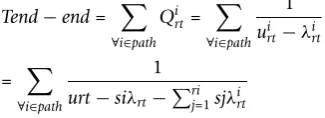
Since we ignore the propagation delay, the end-to-end queuing delay of real-time traffic for a particular path is
Tend−end=
∀i∈path
Qirt=
∀i∈path 1
uirt−λirt
=
∀i∈path
1
urt−siλrt−rij=1sjλirt
(8)
Since the multimedia service is time-constrained. We expect the end-to-end delay along a path under a threshold value.
3.3 The relationship of BO, SO, traffic load against the performance metrics
We use virtual queues for the two different types of traf-fic, real-time traffic and non-real-time traftraf-fic, whose
packets are labeled as different flow number accordingly. On gateway node, there is an agent which determines the order of packets to be transmitted from the queues according to the BOB-RED algorithm. It also checks the type of the incoming packet and sends it to the appro-priate queue according to average queue sizeavg_q, BO,
SO, min_th, max_th, max_pparameters.
Table 3 concludes the relationship of BO, SO, traffic load against the performance metrics of delay, through-put and power consumption from many articles.
From many times of experiments, we find somewhat relationship between qualities of services with all the parameters.
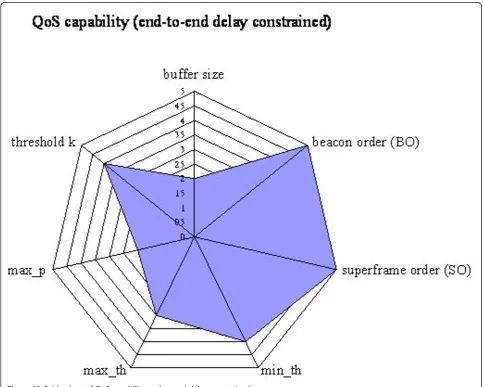
We divide all the factors that affect end-to-end delay into five levels from vary parameters. For example, BO, SO values are from 0 to 15. If we set BO, SO value from 0 to 2, the level in spiderchart is 0.
Figure 10State transition diagram of BOB-RED algorithm.
Figure 12 shows the spiderchart of achieving QoS con-strained in end-to-end delay. From Figure 12, BO and SO obviously affect the end-to-end delay. Buffer size is not helpful to decrease end-to-end delay. Thresholdkis helpful to increase throughputs.
4. Network configuration and assumptions
The solution performance evaluation is carried out under the NS2 simulator [22]. We use the ns2 module developed by Zheng and Lee for IEEE 802.15.4 (NS-2.28) in our simulation. In all simulation, we have con-sidered the followings.
1. The physical layer consists of IEEE 802.15.4 com-pliant radio transmitter (tx) and receiver (rx) that operate in the ISM band at 2.4 GHz, with raw data rate 250 kbps. The modulation technique is Quadra-ture Phase Shift Keying (QPSK).
2. The MAC sub-layer implements the slotted/ unslotted CSMA/CA.
3. The application layer includes three CBR traffic sources with different data rate and one sink in this article.
4. Different scenarios may have different parameter values setting.
5. Burst traffic is generated from the camera that capturing event photo and sending it to sink imme-diately. We dynamically adapt BO, SO value to investigate the performance.
Performance metrics measured in this article are the following.
4.1 Average end-to-end delay
Average end-to-end delay is one of the most important metrics to emergent events. In WSNs, the end-to-end delay is the total time delay to deliver a packet from source to sink node. It is the sum of delays at all links within the end-to-end path. The delay at an intermedi-ate node usually includes the following components: processing delay, queuing delay, transmission delay, pro-pagation delay, and retransmission delay. We mainly consider the average end-to-end delay for all source traffic along a multihop path to sink node. By decreasing the packet retransmission, we can decrease the average end-to-end delay.
4.2 Packet delivery ratio
Packet loss may occur at any stage of a network trans-mission, mainly due to link failures, CSMA/CA channel access mechanism, RED problems. We use packet deliv-ery ratio (PDR) to denote the performance.
PDR = received packets/sent packets
4.3 Energy consumption
The coordinator consumes the energy when it transmits beacon and ACK packet, receives data packet, and lis-tens the channel. Where rxPower is power consumption in receiving a packet, txPower is power consumption in transmitting a packet, sleepPower is power consumption in sleep state, and idlePower is power consumption in idle state. To measure the energy consumption in our scenarios, we use the energy model in NS-2. For acceler-ating the power consumption in our simulation, we modify the default values of the NS2 default value [17]. We only measure the energy consumption on coordina-tor node in beacon-enabled/non-beacon-enabled modes. Table 1 BOB-RED dropping strategy
Packet type
Buffer occupancy Real-time traffic Non-real-time traffic
avg_q < min_th Accepted with probability 1 Accepted with probability 1 min_th≦avg_q < k Accepted with probability 1 Rejected with drop probabilityPloss, nrt k≦avg_q < max_th Rejected with drop probabilityPloss, rt Rejected with probability 1-Pij max_th≦avg_q≦B Rejected with probability 1 Rejected with probability 1
Table 2 Notation table
Notation meaning
B buffer size
min_th minimum threshold for queue max_th maximum threshold for queue
K a preset threshold value to separate different dropping strategy for real-time data and non-real-time data lrt real-time data generation rate
lnrt non-real-time data generation rate
μrt service rate for real-time data
μnrt service rate for non-real-time data
Qi
rt queuing delay on a gateway node i for real-time traffic si the number of sensing neighbours of gateway node i on
path
ri the number of relaying neighbours of gateway node i on path
Ploss, rt loss probabilities of real-time packets Ploss, nrt loss probabilities of non-real-time packets
5. Performance evaluation
There are three scenarios in this study, namely, chain topology, tree topology, and star topology. The simula-tion parameters are summarized in Table 4. Simulasimula-tion duration is set to 60 s of which the first 5 s allow the nodes to associate with the PAN coordinator, and the remaining time is used for sending application traffic.
5.1 Chain topology
Figure 13 illustrates the network topology with two FFD nodes (n1, n2) and one PAN coordinator (node 0). Each sensor node is set 20-m away from the other nodes. Three CBR traffic flows (Cbr1, Cbr2, and Cbr 3) enter node 1 and then be sent with the average data rate (2 packets/s) through the coordinator (node 0) to the sink Table 3 The relationship of BO, SO, traffic load against the performance metrics
BO = SO BO (SO fixed) SO (BO fixed) Delay Throughput Power consumption
↑ ↑ ↑ ↑ ↑ ↑
Small Small Small Low Low Large
Large Large Large High High Small
↓ ↓ ↓ ↓ ↓ ↓
Traffic load (BO = SO) Delay Throughput Power consumption
↑ ↑ ↑ ↑
small Low High Small
Large High Low Large
↓ ↓ ↓ ↓
node (node 2). Each node’s queue size is set to 50 packets.
5.2 Impact of different BO, SO for traffic loads (beacon-enabled mode)
For each configuration, we vary the inter-arrival time of the flows in source node to have different offered loads, assuming a constant packet size. With high offered loads, it causes higher packet loss because of the queue
full. With low offered loads, it causes the increase in the average end-to-end delay.
Table 5 shows the PDR and average end-to-end delay (Avg. delay) using DropTail queue management scheme when SO value is fixed to 0. The PDR values are all zero when BO is greater than 5. Source node cannot transmit data successfully due to long BI and inactive period.
We run the simulation for different values of SO (and BO = SO) as shown in Table 6. When BO equals to SO, less SO value will result in average end-to-end delay increased. When BO value is small, the probability of collision is increased. The bottom of Table 6 shows when BO is fixed, higher SO values have lower average end-to-end delay because of inactive period decreased. Sensor nodes do not change into sleep mode when BO equals to SO.
5.3 Impact of traffic loads (non-beacon-enabled mode)
In this simulation, we send a CBR packet every 5 s for keep-alive traffic, the traffic with data rate 2 packets/s stands for normal traffic, and the traffic which sending 20 packets/s is defined as emergent multimedia traffic load. We set BO, SO value to 15 to evaluate the Table 4 Simulation parameters
NS-2 parameters
Simulation tool NS-2
Radio range 25 m
Data bit rate 250 Kbps
Routing protocol AODV
Scale 50 m × 50 m
Nodes 3, 4, 5 wireless static nodes
Simulation time 60 s
TX power 13.132 mW,
RX power 13.528 mW,
Idle power 712e-7 mW
Sleep power 144e-8 mW
Node’s initial energy 10 J Mean packet size 50 bytes
Traffic type CBR
RED parameters
Minthresh 10
Maxthresh 30
k_th 20
q_weight 0.002
Gentle True
Mark_p 0.1
Packet_loss_rate 0.05
Figure 13Chain topology.
Table 5 PDR and average delay (droptail, 2 pkts/s, SO = 0)
BO PDR (%) Avg. delay (s)
0 100 0.051798
2 100 0.273113
3 100 0.773140
4 1.67 12.413684
performance in the non-beacon-enabled mode. Simula-tion time is 60 s and queue size is 50 packets.
Table 7 shows that all metrics (packet delivery ratio, end-to-end delay, and energy consumption) have not any differences between DropTail and BOB-RED algo-rithm. Due to unslotted CSMA/CA does not use beacon to coordinate devices. Node which acquires the channel can transmit data immediately, so the queue length always is empty. BOB-RED mechanism does not work in the non-beacon-enabled mode. The PDR value is only 39.27% with 20 packets/s traffic load because of the energy of node 0 runs out at 26.808665200 s.
5.4 Tree topology
In the second set of experiments, we study the effect of dynamic adaptation scheme. Figure 14 illustrates the network topology with four nodes defined using NS-2 (n0, n1, n2, n3). Each sensor node is set 20 m away from the other nodes. We assume node 1, node 2 does not affect each other. Simulation parameters are all the same as shown in Table 4.
We run the simulation for different values of BO, SO where BO equals to SO from 0 to 9 with burst traffic. DropTail is the queue management scheme. Node 2 sends CBR traffic to node 0 with 2 packets/s from 10 to 55 seconds. Following node 1 sends burst traffic with 100 packets/s from 25 to 45 s. All nodes are setting the same BO = SO = 3 value in default simulation. Dynamic adaptation scheme changes vary BO, SO values when burst traffic load comes.
Table 8 shows the comparison of default BO, SO value with dynamic adaptation scheme in the average end-to-end delay, PDR, and energy consumption Table 6 Impact of traffic loads (droptail)
BO SO 50 pkts/s Avg. delay (s) 100 pkts/s Avg. delay (s)
0 0 1.424160 1.430937
1 1 0.764768 0.781810
2 2 0.612112 0.621294
3 3 0.539826 0.570217
4 4 0.526245 0.552005
5 5 0.536100 0.559807
6 6 0.535082 0.542379
7 7 0.551991 0.518774
3 0 8.071928 8.064701
3 1 5.832748 5.825045
3 2 1.691801 1.690489
3 3 0.539826 0.570217
Figure 14Tree topology.
Table 7 Droptail vs. BOB-RED with different traffic loads
DropTail BOB-RED
Traffic load (packets/s) PDR (%) Avg. delay (s) Energy PDR (%) Avg. delay (s) Energy
0.2 100 0.022207 9.712956 100 0.022207 9.712956
2 100 0.019916 7.442435 100 0.019916 7.442435
20 39.27 0.018763 0.005730 39.27 0.018763 0.005730
Table 8 Performance of dynamic adaptation scheme
BO = SO
Avg. delay (s)
PDR (%)
Residual energy (node 0 lifetime)
0 0.431532 25.68 Runs out at 35.987584067 s 1 0.256503 26.16 Runs out at 35.430432000 s 2 0.426992 24.63 Runs out at 59.960032000 s 3 0.313196 25.97 Runs out at 33.130784000 s 4 0.615563 25.11 Runs out at 43.386624067 s 5 0.467911 20.66 1.557760 J
6 0.299833 25.78 3.655319 J 7 0.841543 14.97 3.289051 J 8 4.010992 14.16 3.008140 J 9 0.287230 14.16 3.552419 J
metrics. The average end-to-end delay is 0.313196 s and PDR is 0.2597 in default scheme. We observe that when setting BO = SO = 6, PDR is similar with default scheme but average end-to-end delay can effectively decrease in dynamic adaptation scheme. When the simulation ends, coordinator node 0 still remains 3.655319 J power in dynamic adaptation scheme. Con-versely, residual energy of coordinator node 0 runs out at 33.130784000 s in default scheme. Simulation result shows suitably chooses BO, SO value can get longer life-time and less average end to end delay than default set-ting of BO, SO values.
5.5 Star topology
For investigating the effect of our scheme in multihop environment, the modified star topology is used. We design three traffic flows along coordinator to sink node not only one hop to coordinator like standard. The topology of this scenario is shown in Figure 15. Four FFDs (nodes 1 to 4) are placed symmetrically around the PAN coordinator (node 0) with an equal distance of 20 m. The traffics generated by nodes 1, 2, and 3 send
CBR traffics with 50 packets/s along coordinator (node 0) to sink node (node 4). Node 1 sends CBR traffic from 10 to 55 s. Node 2 sends CBR traffic from 25 to 40 s. Node 3 sends CBR traffic from 40 to 55 s. The focus of the experiment is the head of the bottleneck link between n0, n4 and its buffer in particular. Node 0 is the intermediate gateway node with DropTail or BOB-RED queue implemented, with a buffer capacity of 50 packets and a queue fully monitored during the simulation.
5.6 Simulation study in queue management scheme
A similar investigation has been conducted by changing the actual queue mechanism to BOB-RED for all nodes. Figure 16Queue length of coordinator node, traffic load 50 packets/s.
Table 9 Droptail VS. BOB-RED with different traffic loads
DropTail BOB-RED
Traffic load PDR (%) Avg. delay (s) PDR (%) Avg. delay (s)
1 40 0.666688 40 0.666688
50 6.85 7.357023 6.59 3.115317
BOB-RED operation is based on the principle that as the probability of a packet being dropped increases, the pos-sibility of this packet being enqueued decreases. Figure 16 shows the BOB-RED scheme has lower queue length than DropTail. We observe queue length at the gateway node 0 which is closest to the sink node and measuring the end-to-end delay from source node to sink node. By measuring the queue length of coordinator node (n0), we can observe that queue occupy is not heavy. If the traffic load is getting heavier, the amount of packets stay in the queue will increase. BOB-RED can lessen the congestion by early detecting the queue status to drop packet to decrease the retransmission of arriving packets.
5.7 Simulation study in PDR, average end-to-end delay
Simulation results show that light traffic load with BOB-RED can get the same as DropTail in PDR and average end-to-end delay. When traffic load is getting heavier, despite the PDR is slightly lower than DropTail, but BOB-RED can get lower average end-to-end delay than DropTail. Table 9 shows the results.
5.8 Simulation study in energy consumption
Figure 17 shows the energy consumption with different queue management scheme.
The traffic load is 100 packets/s; the total simulation time is 60 s. When the traffic load is light (from 10 to 25 s), the energy consumption of DropTail is the same as BOB-RED. Conversely, both two mechanisms
consume energy rapidly when traffic load is getting hea-vier (from 25 to 40 s). Then, we can observe that resi-dual energy of coordinator node 0 is higher than DropTail if using BOB-RED mechanism. This is because BOB-RED can lessen traffic congestion to decrease the energy consumption. As simulation result shows, using BOB-RED can get better energy consumption than DropTail when traffic load is getting heavier.
6. Conclusions
In this article, we evaluate several queue management algorithms with respect to their abilities of maintaining high resource utilization and low energy consumption in IEEE 802.15.4 beacon-enabled and non-beacon-enabled modes.
We compare the performance of BOB-RED and DropTail on simulation results, using DropTail as the evaluation baseline. The characteristics of different algorithms are also discussed and compared. We evalu-ate the impact of the following parameters on the per-formance of slotted CSMA/CA: (1) the beacon order and the superframe order, (2) queuing management scheme such as RED and DropTail, (3) different traffic loads with dynamic adaptation scheme. Simulation results show that RED queue management scheme accompanied with an appropriate setting of BO, SO can effectively achieve a better performance. Besides, the BOB-RED can decrease end-to-end delay and energy consumption compared to the DropTail scheme.
Despite the vary kinds of experiments have done in this article, how to correctly decide the BOB-RED para-meters and BO, SO values according different kind of traffic loads is still an issue. In our future study, we will observe mobile sink and sensor nodes as possible. How the nodes mobility model and velocity to affect the end-to-end delay, packet delivery ratio, and better energy consumption in multimedia services over IEEE 802.15.4 wireless sensor networks is the direction of study.
Acknowledgements
The authors gratefully acknowledge the support by the National Science Council, Taiwan, under grants 100-2221-E-011-154-.
Author details 1
Department of Electronic Engineering, National Taiwan University of Science and Technology, Taipei, Taiwan, R.O.C2Department of Computer and Communication Engineering, St. John’s University, Taipei, Taiwan, R.O.C
Competing interests
The authors declare that they have no competing interests.
Received: 30 March 2011 Accepted: 21 September 2011 Published: 21 September 2011
References
1. PART 15.4: Wireless Medium Access Control (MAC) and Physical Layer (PHY) Specifications for Low-Rate Wireless Personal Area Networks (LR-WPANs). IEEE Std. P802.15.4a/D5 (2006)
2. KY Wang, SS Lee,et al, Low-MAC FEC Controller for JPEG2000 Image Transmission over IEEE 802.15.4, inWCSET 2009: World Congress on Science, Engineering and Technology, 168–171 (February 2009)
3. KY Wang, SY Lee,et al, Robust JPEG2000 Image Transmission over IEEE 802.15.4, inIEEE International Symposium on Electronic Design, Test and Application, 253–257 (2008).
4. A Zainaldin, I Lambadaris, B Nandy, Video over Wireless Zigbee Networks-Multi-Channel Multi-Radio Approach, inWireless Communications and Mobile Computing Conference, 2008. IWCMC‘08. International, 882–887
(August 2008)
5. S Hengstler, H Aghajan, WiSNAP, A Wireless Image Sensor Network Application Platform, inTRIDENTCOM 2006(March 2006)
6. G Pekhteryev, Z Sahinoglu, P Orlik, G Bhatti, Image Transmission over IEEE 802.15.4 and ZigBee Networks, inIEEE International Symposium on Circuits and Systems (ISCAS).4, 3539–3542 (May 2005)
7. CMUcam project, http://www.cmucam.org/
8. Wikipedia, http://en.wikipedia.org/wiki/Random_early_detection 9. S Floyd, V Jacobson, Random early detection gateways for congestion
avoidance. IEEE/ACM Trans Netw.1(4), 397–413 (1993). doi:10.1109/ 90.251892
10. S Patel, P Gupta, G Singh, Performance measure of Drop tail and RED algorithm, inInternational Conference on Electronic Computer Technology (ICECT), 35–38 (2010)
11. G Epiphaniou, C Maple, P Sant, M Reeve, Affects of queuing mechanisms on RTP traffic: comparative analysis of jitter, end-to-end delay and packet loss, inARES‘10 International Conference on Availability, Reliability, and Security, 33–40 (2010)
12. D Lin, R Morris, Dynamics of random early detection, inProceedings of ACM SIGCOMM 97, Cannes, France, pp. 127–137 (1997)
13. M Shreedhar, G Varghese, Efficient fair queuing using deficit round-robin. IEEE/ACM Trans Netw.4, 375–385 (1996). doi:10.1109/90.502236 14. GF Ali Ahammed, R Banu, Analyzing the performance of active queue
management algorithms. Int J Comput Netw Commun.2(2), 1–19 (2010) 15. NT Le, SW Choi, YM Jang, Approximate queuing analysis for IEEE 802.15.4
sensor network, inSecond International Conference on Ubiquitous and Future Networks (ICUFN), 193–198 (2010)
16. Jelena Mišić, Vojislav MišićB, Access delay for nodes with finite buffers in IEEE 802.15.4 beacon enabled PAN with uplink transmissions. Comput Commun J.28(10), 1152–1166 (2005). doi:10.1016/j.comcom.2004.07.017 17. C Buratti, Performance analysis of IEEE 802.15.4 beacon-enabled mode. IEEE
Trans Veh Technol.59, 2031–2045 (2010)
18. B Gao, C He, An individual beacon order adaptation algorithm for IEEE 802.15.4 networks, inCommunication Systems, 2008. ICCS 2008. 11th IEEE Singapore International Conference on, 12–16 (November 2008)
19. J Jeon, JW Lee, JY Ha, WH Kwon, DCA: duty-cycle adaptation algorithm for IEEE 802.15.4 beacon-enabled networks, inVehicular Technology Conference, VTC2007-Spring.IEEE 65th, pp. 110–113.
20. J Zheng, MJ Lee, Will IEEE 802.15.4 make ubiquitous networking a reality? A discussion on a potential low power, low bit rate standard. IEEE Commun Mag.42(6), 140–146 (2004)
21. L Kleinrock,Queueing Systems, vol. I. (John Wiley, 1976) 22. The Network Simulator - NS-2, http://www.isi.edu/nsnam/ns/
doi:10.1186/1687-1499-2011-107
Cite this article as:Linet al.:BOB-RED queue management for IEEE
802.15.4 wireless sensor networks.EURASIP Journal on Wireless Communications and Networking20112011:107.
Submit your manuscript to a
journal and benefi t from:
7Convenient online submission 7Rigorous peer review
7Immediate publication on acceptance 7Open access: articles freely available online 7High visibility within the fi eld
7Retaining the copyright to your article