
Volume 2010, Article ID 465157,6pages doi:10.1155/2010/465157
Research Article
Space Alignment for Cognitive Transmission in
MIMO Uplink Channels
Ioannis Krikidis
Department of Electrical and Computer Engineering, University of Cyprus, 1678 Nicosia, Cyprus
Correspondence should be addressed to Ioannis Krikidis,[email protected]
Received 5 July 2010; Revised 14 September 2010; Accepted 2 November 2010
Academic Editor: George Karagiannidis
Copyright © 2010 Ioannis Krikidis. This is an open access article distributed under the Creative Commons Attribution License, which permits unrestricted use, distribution, and reproduction in any medium, provided the original work is properly cited.
This paper investigates a new transmission technique for cognitive access in multiple-input multiple-output (MIMO) uplink channels with waterfilling power allocation- (WPA-) based primary transmission. The proposed technique allows a cognitive node to access the common destination simultaneously with the primary node, without affecting the MIMO primary performance. By using an appropriate precoding design, the cognitive node aligns its transmitted signal to the unused primary eigenmodes and ensures an orthogonality between the primary and the cognitive links. In order to overcome the limitation of the conventional WPA at high signal-to-noise ratios, a modified WPA enables the primary node to release some eigenmodes in order to provide a positive cognitive rate for all the cases.
1. Introduction
Cognitive radio (CR) is introduced as an efficient tech-nique in order to use the radio spectrum more efficiently [1]. It is characterized by the capability of the cognitive radios (secondary or unlicensed nodes) to coexist with the spectrum owners (primary or licensed nodes) and share the same frequency band in an opportunistic fashion. The opportunistic access enables the cognitive nodes to use the spectrum when it is idle (spectrum holes) and makes the CR network transparent to the primary network. However, for scenarios with high primary traffic, the number of spectrum holes becomes limited, and thus a positive cognitive data rate cannot be supported.
In order to overcome this limitation of the conventional CR concept, several approaches have been proposed in the literature. In [2], a dirty-paper coding (DPC) approach allows both the primary and the secondary nodes to simultaneously access the channel (interference channel) and protects the primary receiver from interference. However, the DPC design requires a knowledge of the primary signal at the CR as well as a global instantaneous channel knowledge which correspond to a high implementation complexity. On the other hand, in [3] the primary node exchanges its transmission silence with a cooperative (relaying) assistance
from the cognitive node in order to increase both the primary and the cognitive performance. However, this approach requires a cooperation between primary and CR nodes which is not always possible in a “strict” cognitive context where the primary network is not aware of the CR nodes. Another approach incorporates the interference alignment concept [4, 5] with a multiple-input multiple-output (MIMO) waterfilling power allocation (WPA) [6,7] in order to achieve orthogonality between primary and cognitive networks. This approach uses an appropriate precoding technique in order to align the cognitive transmitted signal to the unused eigenmodes of the primary channel. However, the original work in [6,7] focuses on an interference channel (2 Tx-2 Rx) and cannot guarantee a cognitive transmission at high signal-to-noise ratios (SNRs), where the number of the unused eigenmodes is limited.
eigenmodes. In addition, in order to ensure a positive cognitive data rate for high SNRs, a modified WPA that allows the primary node to control its transmitted power for each subchannel is proposed. We show that an appropriate power threshold can release some primary eigenmodes for cognitive transmission without significantly affecting the primary performance. The average achievable rate for both the primary and the secondary networks is evaluated via the-oretical and analytical results. To the best of our knowledge the space alignment design for CR uplink channels as well as the modified WPA scheme are reported in this paper for the first time.
The rest of this paper is organized as follows. InSection 2 we present the system model, and we introduce the main assumptions required for our analysis. In Section 3 we describe the proposed CR space alignment design, and we discuss its achievable rate performance. Numerical results are shown and discussed in Section 4, followed by concluding remarks inSection 5.
Notation. Upper case and lower case bold symbols denote matrices and vectors, respectively. Trace(X) denotes the trace of a matrix X, In denotes the identity matrix of order
n, log(·) denotes the logarithm of base 2, E[·] represents the expectation operator, and the superscript H denotes hermitian transposition operation.
2. System Model
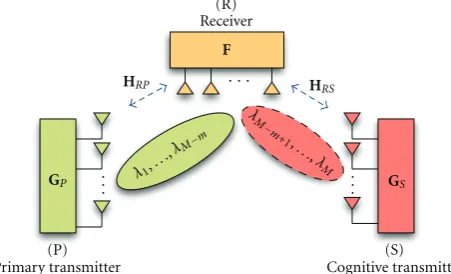
We assume a three-node cognitive topology consisting of one primary nodeP, one secondary (cognitive) nodeS, and a common destination R (e.g., base station) as shown in Figure 1(a similar uplink configuration is assumed in [3]). All the nodes are equipped withM >1 antennas, and both nodes operate in the same frequency band following the rules of the cognitive radio. More specifically, the nodeP(licensed node) exclusively uses the channel and “enjoys” a point-to-point MIMO channel while the node S (unlicensed node) is looking for transmission opportunities and can access the channel subject to the constraint of not affecting the primary link. The common receiver has been optimized (designed) for the primary network and cannot handle Multiple-access interference (MAI) by using advanced interference cancelation schemes. (The goal of most cognitive radio applications is to allow unlicensed nodes to opportunistically use a licensed band. Thus, in many cases, the signaling format of the cognitive nodes may not be known, and thus interference mitigation will generally not be possible.) All the nodes always have data to transmit, and therefore the primary link never becomes idle which results in no-transmission opportunities for the cognitive node. However, an appropriate linear precoding enables the cognitive node to simultaneously access the channel and ensures a positive cognitive rate without affecting the primary network. The received signal atRis given by
y=HRPGPxP+HRSGSxS+n, (1)
· · ·
. . .
. . .
(P) Primary transmitter
(S) Cognitive transmitter (R)
Receiver
HRP HRS
F
GP λ1 GS
,...,λ
M−m
λM
−m +1,
..., λM
Figure1: Cognitive transmission in anM×MMIMO channel via SVD and space alignment.
where xi ∈ CM×1 denotes the transmit vector for the ith
node with i ∈ {P,S}, the matrix Gi ∈ CM×M denotes
the linear precoder used at the ith node (unitary matrix with Trace[GiGHi ] = M), HRi ∈ CM×M is the M ×M
channel matrix for the link i → R, and n ∈ CM×1 indicates an additive white Gaussian noise (AWGN) vector at the receiver with a covariance matrix IM. Both nodes
are subject to a power constraint Trace[Pi] ≤ p0, where
PiE[xHi xi] denotes the covariance matrix of the transmit
vectorxiand indicates the power allocation at each node. The
entries of the channel matricesHRi are independently and
identically distributed (i.i.d.) complex Gaussian circularly symmetric random variables with unit variance (without loss of generality); this means that both channel matrices are almost surely of full rank (i.e., rank[HRi] = M).
In addition, the channel matrices remain constant for the whole transmission and change to an independent realization for the next transmission. At the receiverR, the received signal is linearly processed with the postprocessing matrix F ∈ CM×M which results in the output signal
r=Fy.
As for the channel side information (CSI), we assume that both the primary and the secondary networks have a global knowledge of their channels (a similar assumption is considered in [2, 6, 7]). More specifically, we assume that the instantaneous primary channel HRP is perfectly
3. A Space Alignment Technique for
Cognitive Access
In this section we introduce a space alignment technique that enables the cognitive node to communicate with the common destination R, simultaneously with the primary node, without affecting the MIMO primary network. The performance of the system is determined in terms of the achievable data rate for both the primary and the secondary networks.
3.1. Primary Network. According to the principles of the cognitive radio, the primary network has an exclusive use of the spectrum and ignores the existence of the cognitive network. Given that both the primary node and the common receiver have a knowledge of the instantaneous channelHRP,
the combination of a spatial multiplexing transmission based on the single value decomposition (SVD) of the channel, matrix with a WPA maximizes the primary achievable rate [9, Section 7.1]. The SVD technique allows the primary node to send parallel data streams (without interference between them) along the eigenmodes of the channel and the WPA allocates the power based on the instantaneous strength of the subchannels. More specifically, ifHRP =UΛVHdenotes
the SVD of the matrix HRP, where V,U ∈ CM×M are
(rotation) unitary matrices andΛ ∈CM×M is a rectangular
matrix whose diagonal elementsλ1≥λ2≥ · · · ≥λMare the
ordered singular values of the matrixHRP, the SVD design
requires
GP=V, F=UH (2)
and transforms the initial MIMO channel toMscalar parallel channels defined as
If we ignore the interference-related term (the proposed technique forces this interference to zero), the maximum average achievable primary rate is given as
RP(δ)=E
log detIM+PPΛΛH
, (4)
whereE(·) denotes the expectation operator and the power allocation covariance matrix PP is given by the modified
WPA defined as
a constant, and the noise power is equal to 1. In contrast
to the conventional WPA technique, which corresponds to
δ = 0 and maximizes the achievable rate, the introduced modified waterfilling policy gives the primary node the flexibility to control the power allocated at each eigenmode. More specifically, the system parameter δ depends on the degradation tolerance(maximum degradation level without affecting the required system quality of service (QoS)) that characterizes the system and enables the primary node to release some spatial directions without significantly affecting its performance (e.g., if μ − 1/λ2
k ≈ 0, the release of
the kth spatial channel does not modify the achievable performance).
Parameterδ.From a CR point of view, the maximization of the parameter δ in respect to the primary performance degradation tolerance, gives more opportunities for a sec-ondary transmission (as the parameter δ is increased, the primary eigenmodes are released with a higher probability). Therefore, if 0 < T ≤ 1 denotes the primary performance degradation tolerence (its value depends on the QoS of the application), the optimal δ is expressed by the following optimization problem:
δ∗= max
δ∈[0P0)
δ, (6)
subject to RP(δ)≥TRP(0), (7)
whereRP(0) denotes the maximum achievable primary rate
corresponding toδ = 0. Due to the iterative nature of the WPA [9], the above optimization problem can be solved by using a simple iterative algorithm that continuously increases
δ(with a constant step) until the constraint in (7) is satisfied. Although a further theoretical analysis of δ is beyond the scope of this paper, an interesting remark holds for the high SNR regime. More specifically, given that the WPA converges to a uniform PA scheme at high SNRs, a parameterδwith
p0/m≤δ < p0/(m−1) (wherem=2, 3,. . .,M) ensures the release ofM−m+ 1 primary eigenmodes for all the cases. The parameterδis introduced as a critical system parameter, and its importance is evaluated via simulation results in the next section.
3.2. Primary Network. The proposed technique allows the cognitive node to access the channel simultaneously with the primary node by using the unused primary spatial directions. An appropriate space alignment concentrates the cognitive transmission to the unused primary spatial eigenmodes (with PP(k,k) = 0) and enables a positive cognitive rate
without affecting the primary performance. The proposed space alignment requirement is defined as
UHH
RSGS=PP, (8)
where the matrix PP models the unused primary subspace
(eigenmodes) and is anM×Mdiagonal matrix with entries
Based on (8) and (9), the secondary precoding matrix that aligns the cognitive signal to the available primary subspace is equal to
GS=(HRS)−1UPP. (10)
(The cognitive node perfectly senses the available pri-mary eigenmodes, or a simple pripri-mary signaling feeds the matrixPPto the cognitive node.) The average rate achieved
by the secondary node becomes equal to
RS=max
PS
Elog detIM+HRSGSPSGHSHHRS
the noise variance is equal to 1
=max
wheremis the number of the available primary eigenmodes (e.g., m Mk=1PP(k,k)) and the upper bound in (12)
yields by Jensen’s inequality for the concave function f(x)=
xlog(1 +C/x), whereCis a constant. The above expressions demonstrate that the cognitive transmission is transformed to m symmetric parallel Gaussian channels (without a channel fading degradation), and thus a PA scheme, which symmetrically allocates the available power p0among them subchannels, maximizes the instantaneous achievable rate. In addition, the average number of the unused primary eigenmodes can be written as
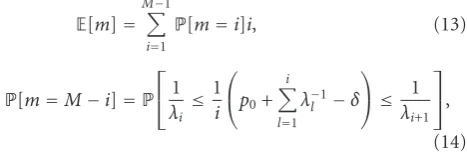
E[m]=
where the above expression is based on the ordered singular values of the matrixHRPas well as the WPA applied on the
primary network. The probability in (14) can be evaluated numerically, and its general closed form is beyond the scope of this paper. (For small values ofMa closed form expression is possible; for example, for M = 2, δ = 0 the joint probability density function of the ordered eigenvalues is
f(λ1,λ2) = (λ1−λ2)2exp(−λ1 −λ2) [10] which results in
dλ1dλ2.) It is worth noting that, due to the channel inversion that is involved in the cognitive precoder matrixGSin (10),
the achievable cognitive rate is independent of the channel HRSand the related fading/shadowing effects.
4. Numerical Results
Computer simulations were carried out in order to evaluate the performance of the proposed scheme. The simulation environment follows the system model of Section 2 and the adopted performance metric is the average data rate expressed in bits per channel use (BPCU).
In Figure 2 we plot the achievable data rate for both the primary (4) and the secondary (11) network versus the SNR (p0) for different numbers of antennas. (The SNR is similar for both the primary and the secondary networks due to the normalized assumed system model and the precoding process at the cognitive node (the primary channel matrix is a unitary matrix and the cognitive link is independent of the channel fading degradation.) A conventional WPA (δ=0) is assumed for the primary link while the primary performance with a uniform power allocation (PP(k,k)= p0/M) is used as a reference curve. The first important observation is that the proposed scheme enables a positive cognitive data rate without any modification at the primary network. More specifically, the cognitive data rate achieves its maximum value at the intermediate SNRs (p0 ≈ 10 dB) where the number of the unused eigenmodes as well as their SNR strength provides the best combination. On the other hand, at low SNRs, although the number of the unused eigenmodes is the maximum one (the primary transmitted power is concentrated to the eigenmode with the maximum singular value), the channel quality results in a poor cognitive per-formance. For high SNRs, the conventional WPA spreads the transmitted power symmetrically along theMeigenmodes of the channel, and therefore the cognitive data rate converges to zero, as no eigenmode is available to convey the cognitive data [9, Section 8.2.2]. In order to validate this remark we can see that the primary performance matches the one achieved by a uniform PA at high SNRs. Furthermore, it can be seen that as the number of antennas increases, the performance is improved for both the primary and the secondary networks. An increase in the number of antennas increases the number of eigenmodes (M) which further increases the number of unused eigenmodes.
Figure 3demonstrates the impact of the PA parameterδ
−10 −5
Primary link with waterfilling PA Primary link with uniform PA Cognitive link
Figure2: Average data rate for both the primary and the secondary networks versus SNR for different numbers of antennas; M = 2, 4, 6, 8 and,δ=0 (conventional WPA).
Primary link with waterfilling PA Primary link with uniform PA Cognitive link
Figure3: Average data rate for both the primary and the secondary networks versus SNR for different numbers of antennas; M = 2, 4, 6, 8, andδ=p0/M.
satisfy the tolerance of the system and is the cost for the cognitive transmission. However, it can be seen that as the number of antennas increases, the number of the released eigenmodes becomes negligible in comparison to M, and thus the performance degradation decreases.
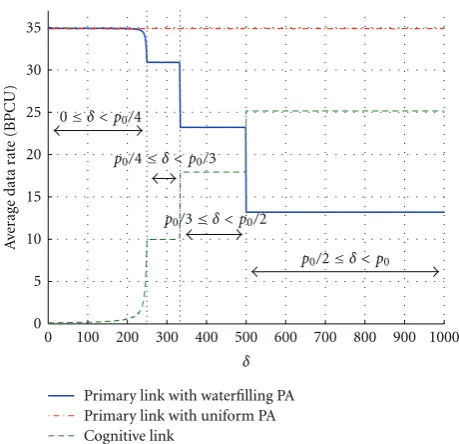
Finally, Figures4 and5 plot the average data rate for both the primary and the secondary nodes ((4) and (11)) versus the power allocation levelδforp0 =10 dB and p0 = 30 dB, respectively, with M = 4 antennas. As it can be
0 1 2 3 4 5 6 7 8 9 10
Primary link with waterfilling PA Primary link with uniform PA Cognitive link
0≤δ < p0/4
p0/4≤δ < p0/3
p0/3≤δ < p0/2
p0/2≤δ < p0
Figure4: Average data rate for both the primary and the secondary networks versus the power allocation levelδ(linear scale);M=4, andp0=10 dB.
Primary link with waterfilling PA Primary link with uniform PA Cognitive link
0≤δ < p0/4
p0/4≤δ < p0/3
p0/3≤δ < p0/2
p0/2≤δ < p0
Figure5: Average data rate for both the primary and the secondary networks versus the power allocation levelδ(linear scale);M=4, andp0=30 dB.
line with the discussion in Section 3.1, and therefore a δ
that takes values in the interval [(p0/m)(p0/(m−1))) (with
m=2, 3, 4) ensures that 5−mspatial directions are used for CR transmission while the remainingm−1 spatial directions are used for primary transmission. On the other hand, at low SNRs and for high values ofm(e.g.,m=4) the parameterδ
does not guarantee a continuous release of the corresponding primary eigenmodes as the WPA levels PP(k,k) strongly
depend on the related single values of the primary channel (δis of the same order with the inverse of the single values). However, asδincreases the WPA levels converge to a uniform PA (δ becomes significantly larger than the inverse of the single values), and therefore the system performance follows our remarks for the high SNR regime.
5. Conclusion
A new cognitive transmission technique for MIMO uplink channels has been proposed. The new technique incorpo-rates space alignment with WPA and results in an orthog-onality between primary and cognitive transmissions. We have shown that a conventional WPA provides an efficient cognitive performance for intermediate SNRs but results in a zero cognitive data rate for high SNRs. A modified WPA that allows the primary node to release some eigenmodes without affecting its required QoS and ensures a positive cognitive data rate for all the cases has been also investigated.
References
[1] S. Haykin, “Cognitive radio: brain-empowered wireless com-munications,”IEEE Journal on Selected Areas in Communica-tions, vol. 23, no. 2, pp. 201–220, 2005.
[2] N. Devroye, P. Mitran, and V. Tarokh, “Achievable rates in cognitive radio channels,”IEEE Transactions on Information Theory, vol. 52, no. 5, pp. 1813–1827, 2006.
[3] T. E. Kourdi and O. Simeone, “An information-theoretic view of spectrum leasing via secondary cooperation,” inProceedings of the IEEE International Conference on Communications, pp. 1–6, Cape Town, South Africa, 2010.
[4] V. R. Cadambe and S. A. Jafar, “Interference alignment and degrees of freedom of theK-user interference channel,”IEEE Transactions on Information Theory, vol. 54, no. 8, pp. 3425– 3441, 2008.
[5] N. Lee and J.-B. Lim, “A novel signaling for communication on MIMOY channel: signal space alignment for network coding,” inProceedings of IEEE International Symposium on Information Theory, pp. 2892–2896, Seoul, Republic of Korea, 2009. [6] S. M. Perlaza, M. Debbah, S. Lasaulce, and J.-M. Chaufray,
“Opportunistic interference alignment in MIMO interference channels,” in Proceedings of the IEEE International Sympo-sium on Personal, Indoor and Mobile Radio Communications (PIMRC ’08), pp. 1–5, Cannes, France, 2008.
[7] S. M. Perlaza, N. Fawaz, S. Lasaulce, and M. Debbah, “From spectrum pooling to space pooling: opportunistic interference alignment in MIMO cognitive networks,”IEEE Transactions on Signal Processing, vol. 58, no. 7, pp. 3728–3741, 2010. [8] K. Gomadam, V. Cadambe, and S. Jafar, “Approaching the
capacity of wireless networks through distributed interference alignment,” inProceedings of the IEEE Global
Telecommunica-tions Conference (GLOBECOM ’08), pp. 1–6, New Orleans, La, USA, 2008.
[9] D. Tse,Fundamentals of Wireless Communication, Cambridge University Press, New York, NY, USA, 2005.
![Real time processing on the road: a guided tour of [iks]'s abstr/cncr setup](data:image/gif;base64,R0lGODlhAQABAIAAAP///wAAACH5BAEAAAAALAAAAAABAAEAAAICRAEAOw==)