The MU-RAY project: Summary of the round-table discussions
F. Beauducel1, A. Bross2, S. Buontempo3, L. D’Auria4, Y. D´eclais5, G. De Lellis3,6, G. Festa6, P. Gasparini6,7, D. Gibert1, K. Hoshina8, G. Iacobucci3, N. Lesparre1, G. Macedonio4, A. Marotta3, J. Marteau5, M. Martini4, G. Miele3,6,
P. Migliozzi3, C. A. Moura3, M. Orazi4, A. Pla-Dalmau2, O. Pisanti3,6, S. Pastor9, R. Peluso4, P. Rubinov2, G. Scarpato4, G. Sekhniaidze3, P. Strolin3,6, H. Taira10, M. Tanaka11,
H. K. M. Tanaka10, A. Tarantola1, T. Uchida12, M. Vassallo3,7, I. Yokoyama13, and A. Zollo6
1Institut de Physique du Globe, Paris, (IPGP), France 2Fermi National Accelerator Laboratory (FNAL), Batavia, IL, USA 3Istituto Nazionale di Fisica Nucleare (INFN), Sezione di Napoli, Italy
4Osservatorio Vesuviano, INGV, (OV), Italy 5Institut de Physique Nucl´eaire de Lyon (IPNL), France
6Universit`a di Napoli “Federico II” (UniNA), Italy
7Consorzio Analisi e Monitoraggio Rischi Ambientali (AMRA), Napoli, Italy 8University of Wisconsin, Madison, USA
9Instituto de F´ısica Corpuscular (CSIC-Universitat de Val`encia), Spain 10Earthquake Research Institute (ERI), University of Tokyo, Japan
11Institute of Particle and Nuclear Studies, KEK, Japan 12Department of Physics, University of Tokyo, Japan 13Usu Volcano Laboratory, Hokkaido University, Japan
(Received December 3, 2008; Revised March 3, 2009; Accepted March 30, 2009; Online published February 22, 2010)
The MU-RAY project has the challenging aim of performing muon radiography of the summit cone of Mt. Vesuvius. The muon telescopes developed for this purpose will be available for the radiography of other volcanoes, in particular Stromboli. The scientific goals, the strategy for their implementation and the baseline detector design are discussed in detail. A tentative time schedule for the project is drawn.
Key words:Muon, radiography, volcanoes.
1.
Introduction
The MUon-RAdiographY (MU-RAY) project aims at performing muon radiographies of the internal structures of volcano edifices with higher sensitivity than so far achieved, by developing and exploiting a new generation of muon “telescopes”. The first challenging aim is to perform the ra-diography of the summit cone of Mt. Vesuvius. The muon telescope will be available for the radiography of other volcanoes, in particular Stromboli. The methodology, es-tablished and successfully applied to several volcanoes in Japan (Tanaka et al., 2005, 2007a–c, 2008; Tanaka and Yokoyama, 2008) relies on the observation of the absorption by the rock of quasi-horizontal muons produced by the de-cay of secondary particles in the cascades originated by the interaction of the primary cosmic radiation with the earth atmosphere. So far, angular resolutions down to 30 mrad were obtained with this method, corresponding to spatial resolutions of 30 meters for a detector positioned at 1 km from the center of the volcano.
Mt. Vesuvius is located 15 km east of the city of Naples. Its morphology is characterized by a volcanic cone (called
Copyright cThe Society of Geomagnetism and Earth, Planetary and Space Sci-ences (SGEPSS); The Seismological Society of Japan; The Volcanological Society of Japan; The Geodetic Society of Japan; The Japanese Society for Planetary Sci-ences; TERRAPUB.
doi:10.5047/eps.2009.03.004
Gran Cono), which reaches 1280 m a.s.l., standing in the caldera of Mt. Somma. Over the years, this volcano went through a series of violent and destructive eruptions. That of AD 79 destroyed Pompeii, Herculaneum and Stabiae. The last period of persistent volcanism of Mt. Vesuvius started after the 1631 Plinian eruption and lasted till 1944. Since that time Mt. Vesuvius has been quiescent and actually only a moderate seismicity and fumaroles testify its activity. The chronology suggests that the longer is the quiescence period the more violent is the renewal of activity. Mt. Vesuvius represents the highest volcanic risk in Europe, since about 600,000 people are living in the “red” zone around it. For this reason, a strong social motivation to this enterprise fosters the scientific interest.
The volcano has been the object, in recent years, of thor-ough geophysical and volcanological studies (Zolloet al., 1996, 2002; Augeret al., 2001). The volcanic activity of Mt. Vesuvius is monitored by a multi-parametric observa-tion system with continuous recording of seismicity, ground deformation and gas emission data that are transmitted to the operating centre of the Vesuvian Observatory, located downtown in Naples. This careful monitoring of Mt. Vesu-vius has the purpose to allow predicting when the next erup-tion will happen, with enough forewarning to be able to safely evacuate the most risky areas. The detailed scien-tific studies performed over the years, allowed to establish
a model for the volcano down to depths of several km with precisions of several hundreds meters. To obtain a more trustful model of the volcano and in particular to gather in-formation on the dynamics of the next eruption, i.e. how next eruption will develop, these results should be comple-mented with those coming from muon radiography, which are much more precise although relative only to the topmost few hundreds meters. As an example, the mass ejection rate during an eruption depends very strongly on the diameter of the lava conduit: the presence of a lava conduit ranging in diameter from 50 m to 100 m would produce an increase by an order of magnitude of the mass ejection rate during an eruption (see the contribution by G. Macedonio to this workshop). Therefore, the knowledge of the lava conduit dimensions and shape with a resolution of the order of 10 m will be beneficial in forecasting the dynamics and the effects of the next eruption.
Given all the above arguments and motivations, the pri-mary goal of the MU-RAY project is the challenging task of high-resolution radiography of Mt. Vesuvius. The mea-surements at Mt. Vesuvius are intended to be thefirst of a series of volcano radiographies around the world, that of Stromboli among them. Therefore, the project aims at col-lecting and focusing the international scientific interests for this new methodology and setting up the standards for a fu-ture generation of high-resolution detectors for muon radio-graphy of volcanoes and other geological structures.
2.
Experimental Conditions and Strategy
Up to now, the topmost internal structure of a volcano edifice was measured by conventional geological methods (seismological, gravimetric and electromagnetic), which provide spatial resolutions of the order of hundreds of me-ters. The detection of variations of the rock density at shal-low depths, like those due to lava conduits or dykes, calls for an improvement of the measurement resolution by one order of magnitude. This task can be achieved by muon radiography. Structures of 10 m in size measured by a de-tector positioned at 1 km correspond to the measurement of 10 mrad angles. In principle, such a precision is easily ob-tained by charged-particle detector technologies as devel-oped in recent years for high-energy physics experiments. However, there are several limiting factors and experimen-tal conditions that should be taken into account when plan-ning the muon radiography of a volcano. Among them, the most relevant are:
- The muon absorption in 1.5–2 km of rock is quite severe; careful measurements are needed to tune a full Monte Carlo simulation.
- The multiple scattering in the rock leads to an angu-lar uncertainty of about 10 mrad on the average and larger for low momenta of the muons emerging from the mountain. The amount of this effect, which de-teriorates the measurement resolution, and its details should be carefully evaluated and accounted for in the design of the detector.
- Volcanic environments are variable and harsh, present-ing quite large temperature excursion. The ideal detec-tor locations are often difficult to reach and sometimes
the help of a helicopter is needed to transport heavy instruments. In normal cases, power lines are not be available.
In the case of Mt. Vesuvius, we should add to the above limiting factors the fact that the deep crater (∼250 m) and the mountain topology allows us to detect only those very energetic muons that were able to cross 2 km of rock. Therefore we expect a very low muonflux, which makes the muon radiography of Mt. Vesuvius a challenging task.
As a consequence of all these considerations, the follow-ing strategy has been set up for MU-RAY.
2.1 Preliminary measurements
Preliminary muon radiographies will be performed at Mt. Vesuvius in 2009. A muon telescope presently taking data in Japan will be used for this purpose. That telescope has an active area of 1 m2 and provides an angular resolution
of 40 mrad if the two planes of scintillating strips are posi-tioned at a distance of 2 m. These measurements will pro-vide experimental data on the cosmic-rayflux through the Mt. Vesuvius edifice, which will be of primary importance in the design of the MU-RAY detector and in the planning of the data taking periods. Given the difficulty of simulat-ing the behaviour of muons through large depths of rock, the measurements will have the important role of tuning the Monte Carlo simulation techniques. Thesefirst mea-surements are also intended to prepare thefield for high-resolution radiographies by experiencing the experimental and technical difficulties.
In the framework of the DIAPHANE project (Gibertet al., 2010), a conceptually similar detector, but of larger angular acceptance and improved spatial resolution, will be built to take data at La Soufriere in Guadalupe.
2.2 Simulation strategy and Monte Carlo validation The simulation of the stochastic behaviour of very high-energy muons traversing large depths of rock is a complex task. A few simulation packages that, among other appli-cations, can be used for this purpose are available. None of them is considered fully reliable by the astro-particle physics community. We will use both GEANT (GEANT4) and FLUKA (Ferrariet al., 2005) tracking programs, which are conceived for a full simulation of the interactions of particles with matter. A digital elevation map (DEM) of Mt. Vesuvius with the precision of 20 m and possibly bet-ter will be used to establish the amount of rock crossed by the muons. In parallel, an effort is going on that aims at applying at muon radiography the code written by some of us (Mieleet al., 2006; Buontempoet al., 2010) to simulate the interaction of neutrinos with the Earth in the framework of the research program of Earth radiography using neutri-nos. The contribution by E. Borrielloet al.at this workshop gives more details on the Monte Carlo simulations.
The tuning andfinal validation of the Monte Carlo simu-lations will be obtained by comparison to the data taken at Mt. Vesuvius during 2009.
2.3 Detector specifications and requirements
helicopter. The mechanical design should be such that the detector can be quickly assembledin situand rugged enough to avoid damages while transporting or assembling it. The detector should require minimal maintenance, have low-power consumption and the least possible impact on the environment. Throughout the course of the data tak-ing periods, expected to last several months, the personnel that controls the experimental area should be required to be on site only for limited time. Given the large amount of rock to be crossed, the muonflux is expected to drop drasti-cally with respect to that measured by muon radiographies in Japan. Therefore, a detector active area of the order of 10 m2or more is expected to be required to allow collection of enough statistics during data taking periods of several months. Finally, data should be immediately transferred to laboratories where the detector calibration and data quality could be checked in real time and the data analysis be per-formed.
2.4 Construction and operation of the MU-RAY tele-scopes
Three high-resolution muon detectors having each an area of 2×2 m2will be built for the challenging goal of the
radiography of Mt. Vesuvius. The design will start soon and will comply with all the arguments listed above. It is fore-seen that the telescopes could be located either close to each other to reduce the exposure time, or they could take data in different locations around the volcano for a 3-dimensional data taking (tomography). These detectors are intended as a standard for a future production that would allow the study of other volcanoes, in particular Stromboli.
3.
Detector Technologies
Several detector technologies were considered. Among them plastic scintillators, nuclear emulsions and Resistive Plate Chambers (RPC) were carefully reviewed. In the case of nuclear emulsions, although they offer a very high reso-lution and have no need for electrical power, they do not allow real-time data acquisition and transfer to laborato-ries for data analysis. In the case of RPCs, the sensitiv-ity to temperature, the need for a gas mixture to be kept carefully under control as well as the large high voltage re-quired would be inconvenient for operation outside of a lab-oratory. Therefore, both nuclear emulsions and RPCs were discarded since they do not fulfill all the experimental re-quirements of the MU-RAY project.
A plastic scintillator muon telescope is a better candi-date to be operated on volcano slopes. This technology, widely used since several decades in Particle Physics, was subject to a continuous development. Nowadays, excellent results are obtained by the combined use of plastic scintilla-tor strips and scintillating wavelength-shifting (WLS)fibers running along the strip. The principle relies on the use of a cheap scintillator, with small photon-absorption length, which produces photons that are transported with high effi -ciency by WLSfibers onto the surface of a photo-multiplier tube (PMT). A plastic-scintillator detector requires a min-imal maintenance, has low power consumption and is rel-atively insensitive to ambient conditions. Detector planes based on plastic scintillators with an area of approximately 50 m2 have been constructed and successfully operated,
with detector total areas of thousands of m2.
Successful muon radiographies of volcanoes were ob-tained by means of plastic scintillator telescopes (Tanakaet al., 2005; Tanaka and Yokoyama, 2008). They were made of 8 to 10 cm wide plastic scintillator strips, covering a to-tal area of approximately 1 m2 and providing angular
res-olutions down to 40 mrad. Each strip was read out by a photomultiplier through a light guide.
The outcome of the discussions was that plastic scintilla-tor strips read out by WLSfibers must be considered as the baseline MU-RAY detector technology.
3.1 The OPERA scintillator strips and readout system
The neutrino oscillation experiment OPERA (http://www.cern.ch/opera) at the Gran Sasso National Laboratory employs on a large-scale plastic scintillator strips readout by optical WLS fibers and multi-anode PMTs for the Target Tracker (Adam et al., 2007), which predicts in real time the location of the event in the nuclear emulsions to guide their analysis. Figure 1 shows the scintillator strips and the readout electronics of the OPERA experiment. Each strip is 2.6 cm wide and about 7 m long. A groove in the strip allocates a WLS optical fiber. The
fiber conveys the optical signal to a multi-anode PMT (Hamamatsu H8804MOD1), which reads the signals of 64 strips. A mechanical module thus consists of 64 strips and their readout. Modules are assembled together, to form planes with approximate size of 7×7 m2. Two planes of
strips, with horizontal and vertical orientation, are grouped together to predict the event location in each plane of emulsion detector. In total, the plastic scintillator strips cover an area of 2,900 m2. On the average, 6 photoelectrons
are detected in the 7 m long scintillator tiles, for normal incident muons.
The readout electronics is based on a 32-channel ASIC. It includes a fast shaper for triggering purposes and a slow shaper for the measurement of the collected charge. Two chips are used to readout each multi-anode PMT, for a total of 1984 chips for the full detector. A detailed description of the ASIC design and performance can be found in ref. (Lucotteet al., 2004). The DAQ board of the OPERA ex-periment (Girerdet al., 2000; PATENT, 2006) is a compact data acquisition system able to read and control the signals generated by a multi-anode PMT. It is controlled by an Eth-ernet network through a LINUX operating system.
Several technical developments stemmed out of the Opera Target Tracker system, of which muon radiography could profit.
Taking into account the pixel effects, two x-y planes made of the 2.6 cm wide Opera-scintillator strips at 1 m dis-tance would provide a spatial resolution of approximately 30 mrad.
3.2 The MINERvA plastic scintillator design
Fig. 1. The plastic scintillator strips (left figure) of the OPERA neutrino experiment and their readout system made by optical wavelength shifting fibres and multianode PMT (right figure).
Fig. 2. Schematic drawing of a section of a plane made by the Minerva scintillation bars. The dots represent the WLS fibers running through the scintillator.
0.25 mm thick TiO2reflective coating (Pla-Dalmau et al., 2005). The strips are readout by embedded WLS fibers glued in a 2.6 mm hole at the centre of the strip. The fibers are Kuraray Y11 S-35 type, 175 ppm of dopant, multi-cladded with a 1.2 mm diameter. They are read from one end and the other end is mirrored. The fibers are coupled to multi-anode Hamamatsu photomultipliers. The geomet-rical assembly of the scintillators, shown in Fig. 2, allows a spatial resolution that is determined by the charge sharing between two adjacent scintillator strips traversed by a par-ticle. Test-beam data did show single hit spatial resolutions below 3 mm; such resolution translates to≈10 mrad for the measurement of twox-yplanes positioned at 0.5 m dis-tance thus significantly improving the spatial resolution ob-tained with rectangular-profile scintillators of similar trans-verse dimensions. An average of approximately 20 photo-electrons are detected in two adjacent scintillators when a normal incident m.i.p. crosses a plane.
3.3 The Silicon Photo-Multiplier option
Silicon Photo-Multipliers (SiPM) are semiconductor photo-detectors operated in limited-Geiger mode (Buzhan et al., 2001, 2003; Sadygovet al., 2003; Golovin et al., 2004). They are operated at∼50 V and the power needed per pixel is∼50μW. They are also called Multi-Pixel Pho-ton Counters (MPPC) since they typically host 1000 pixels in 1 mm2connected in series (see Fig. 3); each pixel gain is∼106 and gives a signal of ∼1 mV for a typical 10–20 ns pulse length. They have sub-nanosecond time resolu-tion. Their quantum efficiency is∼100%, but factors like geometric-sensitive area, probability for photo-detection to initiate a Geiger discharge and recovery time for the pixel, give an overall photon detection efficiency of 30–70%, to be
compared to a typical value of 15% of multi-anode PMTs. The excellent single photo-electron resolution allows rather direct calibration and monitoring. SiPM have been intro-duced in the Particle Physics community since a decade. So far, they were adopted by a few experiments and projects, e.g. the T2K near detector (Gomi et al., 2007) and the CALICE Collaboration for the International Linear Col-lider, which successfully tested a 8,000 channels prototype of the analogue HCAL prototype calorimeter (Repond et al., 2008). Nowadays, SiPM are claimed to be less expen-sive than PMTs.
Since this technology is rather recent, there are several caveats to their use. Although the electronic noise is neg-ligible, the single pixel dark noise (given mostly by ther-mal pairs produced in the semiconductor) is of the order of magnitude of a MHz at room temperature and increases with increasing temperature or bias voltage. The dark noise could obviously be controlled by raising the threshold to a few pixels or by reducing the bias voltage at the expenses of the gain. However, these procedures must be carefully evaluated and tested in the case of the detection of a m.i.p., like in our case, in which a threshold should be set to a few photoelectrons. A more worrisome problem is given by the inter-pixel optical cross talk and the after-pulses, which are related in time to a firing pixel. These effects are measured at room temperature to give an average of approximately 1.25 pixels firing by one initial photo-electron. New gener-ation SiPMs were recently produced, for which the optical cross talk and the after-pulses were reduced to a several per-cent (Piemonteet al., 2007).
Fig. 3. Schematic view of a SiPM.
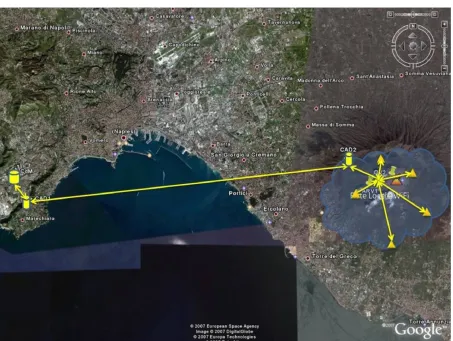
Fig. 4. Map of the Naples gulf area, showing the a schematics of the wireless system of Mt. Vesuvius.
mounting the single channel SiPM directly on the scintilla-tor surface, thus avoiding complex fiber systems; straight-forward single channel calibration, owing to the excellent single pixel resolution; increased ruggedness of the system, which will be an advantage in volcanic environments; re-duction in cost.
3.4 Power and data transmission
Since electrical power lines will not be available on vol-cano slopes, one has to design a detector that requires very
Fig. 5. Schematic drawing showing the strip distribution in the two MU-RAY telescope modules.
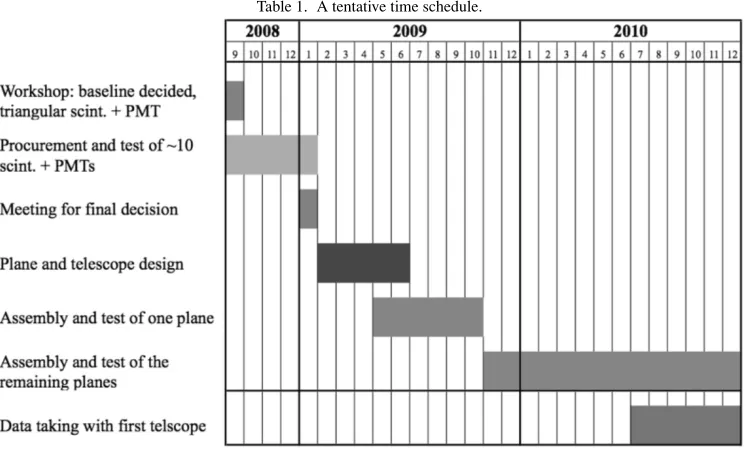
Table 1. A tentative time schedule.
amounts to approximately 200 A h/day. The usage of a two axis solar tracker to increase efficiency has also been con-sidered.
The MU-RAY project data transmission will profit of the Mt. Vesuvius 5 GHz wireless seismic network of the Vesuvian Observatory shown in Fig. 4 (Scarpato et al., 2008). Currently the infrastructure manages a total of 79 channels with a 24-bit at 100 cps sampling (∼190 kbps), but the network has a much greater potential, that will be made available to MU-RAY. Part of the data is collected in local data acquisition centers. Then, the real time signals are centralized at the Monitoring Center of the Vesuvian Observatory. The backbone WiFi link covers about 18 km in line of sight between the site in Naples at about 200 m above sea level and the second one on the Mt. Vesuvius, in the historic building of the Vesuvian Observatory at about 600 m above sea level. Since the distance among the sta-tions and between each station and the data acquisition cen-ter varies from hundreds of mecen-ters to several kilomecen-ters, the data transmission through the wireless network is not expected to limit the choice of the locations of the experi-mental sites.
3.5 Baseline detector design
The use of the MINERvA scintillators and fibers together to the OPERA Target Tracker read-out system was pro-posed as the baseline technology to be adopted for the con-struction of the first MU-RAY telescope. According to the experience of Tanakaet al., the combination of twox-yhits will be enough to measure the direction of a muon. There-fore it is There-foreseen that a MU-RAY telescope, in his minimal version, will be made of two modules (see Fig. 5), each carrying two planes of strips oriented perpendicularly to each other to provide thexandycoordinate of the crossing muon. Each plane will contain 128 two-meter long strips, for a total width of 211.2 cm. Therefore the total number of channels for a complete telescope will be 512, which could be served by eight 64 channel photo-multipliers. The Opera system (64 channels multi-anode PMT, front-end electron-ics and DAQ) is taken as baseline option. It is expected to absorb approximately 8 W for 64 channels, which would amount to a total power consumption of less than 70 W for the entire telescope.
the weight of each half plane to approximately 50 kg. During the workshop it was also foreseen to start an R&D programme to test some of the SiPMs commercially avail-able. Given the limited number of photo-electrons produced in the scintillator by the crossing of a muon, SiPMs with a few hundreds pixels should be enough to guarantee a linear response and avoid saturation effects. Conformity to usage in the volcanic conditions will be established by measure-ments with cosmic rays or at a test beam.
4.
Tentative Time Schedule
A tentative time schedule is shown in Table 1. The tech-nical solutions discussed at the workshop will be studied and tested, with the aim of taking thefinal decisions at the beginning of 2009. One will then proceed with thefinal de-sign, to start assembly and test of thefirst module at mid 2009; if successful, one will continue building the other planes, with the aim of taking data with thefirst telescope in the second half of 2010. The three MU-RAY telescopes should be completed by the end of 2010. The year 2011 will be devoted to data taking.
References
Adam, T.et al., The OPERA experiment Target Tracker,Nucl. Instr. Meth., A577, 523, 2007.
Auger, E., P. Gasparini, J. Virieux, and A. Zollo, Seismic evidence of an extended magmatic sill under Mt. Vesuvius,Science,294, 1510–1513, 2001.
Buontempo, S., L. D’Auria, G. De Lellis, G. Festa, P. Gasparini, G. Ia-cobucci, A. Marotta, M. Martini, G. Miele, P. Migliozzi, O. Pisanti, P. Strolin, M. Vassallo, and A. Zollo, Perspectives for the radiography of Mt. Vesuvius by cosmic ray muons,Earth Planets Space,62, this issue, 131–137, 2010.
Buzhan, P.et al., An advanced study of silicon photomultiplier,ICFA Instrum. Bull.,23, 28, 2001.
Buzhan, P.et al., Silicon photomultiplier and its possible applications,
Nucl. Instr. Meth.,A504, 48, 2003.
Ferrari, A. et al., FLUKA: A multi-particle transport code (Program version 2005), CERN-2005-010, SLAC-R-773, INFN-TC-05-11, Oct 2005, 405 pp, 2005.
GEANT4: a toolkit for the simulation of the passage of particles through matter, http://www.geant4.org/geant4/.
Gibert, D., F. Beauducel, Y. D´eclais, N. Lesparre, J. Marteau, F. Nicollin, and A. Tarantola, Muon tomography: Plans for observations in the Lesser Antilles,Earth Planets Space,62, this issue, 153–165, 2010. Girerd, C., S. Gardien, J. Burch, S. Katsanevas, and J. Marteau, Ethernet
network-based DAQ and smart sensors for the OPERA long-baseline neutrino experiment,Nuclear Science Symposium Conference Record, 2000 IEEE,2, 12/111–12/115, 2000.
Golovin, V.et al., Novel type of avalanche photodetector with Geiger mode operation,Nucl. Instr. Meth.,A518, 560, 2004.
Gomi, S.et al., Development and study of the multi pixeld photon counter,
NIM,A581, 427, 2007.
Lucotte, A.et al., A front-end read out chip for the OPERA scintillator tracker,Nucl. Instr. Meth.,A521, 378, 2004.
Miele, G.et al., The aperture for UHE tau neutrinos of the Auger fluo-rescence detector using a digital elevation map,Phys. Lett. B,634, 137, 2006.
PATENT, Installation de capteurs intelligents pour l’acquisition a haut debit de donnees via le reseau Ethernet, Patent # 04 00468 (delivered
with number # 06/16 dated 2006.04.21), 2006.
Piemonte, C.et al., Development of Silicon Photomultiplies at IRST, talk presented atthe 1st Workshop on Photon Detectors for High En-erg,y Medical and Space Applications, June 13–14, 2007, Perugia, Italy, 2007.
Pla-Dalmau, A., A. D. Bross, and K. L. Mellott, Low-cost extruded plastic scintillator,Nucl. Instr. Meth.,A466, 482–491, 2001.
Pla-Dalmau, A., A. D. Bross, and V. V. Rykalin, Extruding plastic scintil-lator at Fermilab, FERMILAB-CONF-03-318,Proceedings of the 2003 IEEE Nuclear Science Symposium and Medical Imaging Conference, Portland, Oregon, USA October 16–26, 2003.
Pla-Dalmau, A., A. D. Bross, V. V. Rykalin, and B. M. Wood, Extruded plastic scintillator for MINERvA, FERMILAB-CONF-05-506, Pro-ceedings of the 2005 IEEE Nuclear Science Symposium and Medical Imaging Conference, Puerto Rico, October 23–29, 2005.
Repond, J.et al., Design and electronics commissioning of the physics prototype of a Si-W electromagnetic calorimeter for the international linear collider, CALICE Collaboration, JINST 3:P08001, 2008. Sadygov, Z. Ya.et al., Super-sensitive avalanche silicon photodiode with
surface transfer of charge carriers,Nucl. Instr. Meth.,A504, 301, 2003. Scarpato, G.et al., WiFi data transmission system for monitoring volcanic areas: an example application on Mt. Vesuvius, Poster atthe European Geosciences Union General Assembly 2008 (EGU2008), April 13–18, Vienna, Austria, Geophysical Research Abstracts, Vol. 10, EGU2008-A-09461, 2008, EGU General Assembly, 2008.
Tanaka, H. K. M. and I. Yokoyama, Muon radiography and deforma-tion analysis of the lava dome formed by the 1944 erupdeforma-tion of Usu, Hokkaido—Contact between high-energy physics and volcano physics,
Proc. Jpn. Acad.,B84, 107–116, 2008.
Tanaka, H., K. Nagamine, S. N. Nakamura, and K. Ishida, Radiographic measurements of the internal structure of Mt. West Iwate with near hor-izontal cosmic ray muons and future developments,Nucl. Instr. Meth. Phys. Res.,A555, 164–172, 2005.
Tanaka, H. K. M., T. Nakano, S. Takahashi, J. Yoshida, H. Ohshima, T. Maekawa, H. Watanabe, and K. Niwa, Imaging the conduit size of the dome with cosmic ray muons: The structure beneath Showa Shinzan Lava Dome, Japan,Geophys. Res. Lett.,34, L22311, doi:10. 1029/2007GL031389, 2007a.
Tanaka, H. K. M., T. Nakano, S. Takahashi, J. Yoshida, M. Takeo, J. Oikawa, T. Ohminato, Y. Aoki, E. Koyama, H. Tsuji, and K. Niwa, High resolution imaging in the inhomogeneous crust with cosmic ray muon radiography: The density structure below the volcanic craterfloor of Mt. Asama, Japan,Earth Planet. Sci. Lett.,263, 104–113, 2007b. Tanaka, H. K. M., T. Nakano, S. Takahashi, J. Yoshida, and K. Niwa,
De-velopment of an emulsion imaging system for cosmic-ray muon radio-graphy to explore the internal structure of a volcano, Mt. Asama,Nucl. Instr. Meth. Phys. Res.,A575, 489–497, 2007c.
Tanaka, H. K. M., T. Nakano, S. Takahashi, J. Yoshida, M. Takeo, J. Oikawa, T. Ohminato, Y. Aoki, E. Koyama, H. Tsuji, H. Ohshima, T. Maekawa, H. Watanabe, and K. Niwa, Radiographic imaging below a volcanic craterfloor with cosmic-ray muons,Am. J. Sci.,308, 843–850, 2008.
Zollo, A.et al., Seismic evidence for a low-velocity zone in the upper crust beneath Mount Vesuvius,Science,274, 592–594, 1996.
Zollo, A.et al., Bayesian estimation of 2-D P-velocity models from ac-tive seismic arrival time data: imaging of the shallow structure of Mt. Vesuvius (Southern Italy),Geophys. J. Int.,151, 566–582, 2002.