Volume 2010, Article ID 932345,11pages doi:10.1155/2010/932345
Research Article
Trade-Offs between Energy Saving and Reliability in
Low Duty Cycle Wireless Sensor Networks Using a Packet
Splitting Forwarding Technique
Giuseppe Campobello,
1Salvatore Serrano,
1Alessandro Leonardi,
2and Sergio Palazzo
21Dipartimento di Fisica della Materia e Ingegneria Elettronica, Universit`a di Messina, I-98166 Messina, Italy 2Dipartimento di Ingegneria Informatica e delle Telecomunicazioni, Universit`a di Catania, I-95125 Catania, Italy
Correspondence should be addressed to Alessandro Leonardi,[email protected]
Received 1 February 2010; Accepted 13 July 2010
Academic Editor: Roberto Verdone
Copyright © 2010 Giuseppe Campobello et al. This is an open access article distributed under the Creative Commons Attribution License, which permits unrestricted use, distribution, and reproduction in any medium, provided the original work is properly cited.
One of the challenging topics and design constraints in Wireless Sensor Networks (WSNs) is the reduction of energy consumption because, in most application scenarios, replacement of power resources in sensor devices might be unfeasible. In order to minimize the power consumption, some nodes can be put to sleep during idle times and wake up only when needed. Although it seems the best way to limit the consumption of energy, other performance parameters such as network reliability have to be considered. In a recent paper, we introduced a new forwarding algorithm for WSNs based on a simple splitting procedure able to increase the network lifetime. The forwarding technique is based on the Chinese Remainder Theorem and exhibits very good results in terms of energy efficiency and complexity. In this paper, we intend to investigate a trade-offbetween energy efficiency and reliability of the proposed forwarding scheme when duty-cycling techniques are considered too.
1. Introduction
The recent years have witnessed a large diffusion of wireless sensor networks in different application scenarios: agricul-tural fields monitoring, environmental pollution monitor-ing, search and rescue operations in contaminated areas, antimining operations, and so forth. Sensor networks are composed of several low-cost devices with limited processing and storage capabilities, consequently, one of the hot topics in wireless sensor networks is the reduction of energy consumption.
Due to the growing gap between application require-ments and the slow progress in battery capacity, several techniques have been proposed in the literature which put nodes periodically into sleep whenever communications are not needed. Although this is the most effective way to reduce energy consumption, depending on the forwarding technique used, a sleep/wake up scheduling algorithm is sometime required which implies solving critical synchro-nization issues.
In [1], we have presented a forwarding technique based on the Chinese Remainder Theorem (CRT) which splits the original packets into several packets such that each node of the network will forward only small subpackets. The sink, once all subpackets are received correctly, will recombine them reconstructing the original message.
The proposed technique, investigated through analytical models and simulations, shows very good results in terms of energy efficiency and appears particularly suitable for those forwarding nodes that are more solicited than others due to their position into the sensor network. Moreover, we have investigated how the original packet can be also reconstructed even if not all the subpackets are received by the sink, in order to increase the network reliability.
hand, duty-cycling techniques are needed to effectively reduce energy consumption. Therefore, it is important to investigate the performance of the proposed algorithm when duty-cycling techniques are also considered.
In this paper, we show that, with a proper choice of the cycle period, the advantages of the CRT with duty-cycling are the same of those reported in [1], where the nodes are always active. Moreover, we investigate a trade-off between reliability and energy efficiency when the nodes are not perfectly synchronized.
The rest of the paper is organized as follows.Section 2
presents a brief summary of related works already existing in the literature and highlights the distinguished approach of our solution as compared to them.Section 3describes the basic idea with the help of some examples.Section 4resumes the duty-cycle technique adopted in this work. Sections 5
and6describe the initialization and forwarding procedure. In Sections 7 and 8, some analytical results are derived. InSection 9, the performance of the CRT-based forwarding approach is discussed and the analytical model is validated. Finally, inSection 10, some concluding remarks are drawn.
2. Related Works
When using duty-cycle techniques, the active and sleep states of the network nodes should be carefully designed in order to maintain the network connected and guarantee the delivery of the packets.
In the literature, several approaches have been proposed, most of them regarding the MAC layer.
A well-known MAC protocol is S-MAC [2], where, to maintain the synchronization, each node periodically broadcasts its schedule in a control message, so that the neighbors can update this information in their schedule tables. Other approaches are TRAMA [3], which reduces the energy consumption by ensuring that communications are collision free and by placing nodes in sleep mode when they are not communicating; T-MAC [4], which uses an adaptive duty-cycle, where the active part of it is dynamically changed. This reduces the amount of energy wasted on idle listening.
Other approaches regard a cross-layer interaction between MAC and routing, for example, [5, 6]. Both approaches exploit information at routing layer in order to deliver data packets much faster, without sacrificing the energy efficiency achieved by the duty-cycle mechanism.
In most cases the previous approaches require a very tight synchronization which is difficult to achieve in a sensor network composed by simple devices. Moreover, these approaches introduce delivery latency and do not work well when there are frequent changes in the network topologies and in the radio links conditions, causing serious problems related to the network reliability. An interesting example of using a multipath approach together with erasure codes to increase the reliability of a WSN has been proposed in [7]. However, that work suggested the use of disjoint paths. As compared to our proposed forwarding technique, the use of disjoint paths has two main drawbacks. First of all, a route discovery mechanism is needed. Secondly, as the number of
disjoint paths are limited, the number of splits (and therefore the achievable energy reduction factor) is limited too.
Another similar work is [8], where the authors have proposed a protocol called ReInForM (Reliable Information Forwarding using Multiple Paths in Sensor Networks). The main idea investigated in this paper, is the introduction of redundancy in data to increase the probability of data delivery. The redundancy adopted is in the form of multiple copies of the same packet which travel to the destination along multiple paths. However, as shown in [9], multiple paths could remarkably consume more energy than the single shortest path because several copies of the same packet have to be sent. Furthermore, in all the papers mentioned above, the authors do not consider the splitting procedure as a method for reducing energy consumption.
An attempt to guarantee reliability, while minimizing the energy consumption and, at the same time, considering a packet splitting procedure, has been made in [10]. As in [7], the authors use disjoint paths and erasure codes to provide reliability in the network. However, the algorithm proposed is a centralized one based on convex programming which is not suitable for WSNs.
In this paper we show that, by using the CRT-based approach also in a network where nodes alternate between sleep and awake state, both reliability and energy saving can be achieved with a moderate increase in the overall complexity and with very low overhead as compared to the commonly used forwarding techniques.
3. The Forwarding Algorithm Based on
the Chinese Remainder Theorem
The basic idea of the proposed forwarding technique [1] is to split the messages sent by the source node of a wireless sensor network so that the maximum number of bits per packet that a node has to forward is reduced, increasing in this way the network lifetime.
Consider the example inFigure 1. NodesAandBhave to forward a packet to the sinkS. If a normal forwarding scheme is adopted, two cases can be distinguished:AandB select different next-hop nodes (seeFigure 1(a)), this happens with probability 2/3 (case (a)); A and B select the same next-hop node (seeFigure 1(b)), this happens with probability 1/3 (case (b)).
If there arewbits for each packet, the maximum number of bits transmitted by a node belonging to the set{X, Y, Z} iswbits in the case (a), and 2w bits in the case (b). Let us now assume that each node in the set{X, Y, Z}knows that
X Y Z S
w
w w
w
A B
(a)
X Y Z
S
A B
w w
w w
(b)
X Y Z
S
A B
w/3
w/3 w/3 w/3 w/3 w/3
w w
(c)
Figure 1: Forwarding examples: (a) normal forwarding with different next-hops; (b) normal forwarding with the same next-hop; (c) forwarding after splitting.
shown in case (a), and (2−2/3)·1/2 = 2/3 when the splitting procedure is compared to the procedure shown in case (b). Summarizing, an average reduction factor of 4/9 is obtained.
This example shows that by splitting a packet, it is possible to reduce the maximum number of transmitted bits per node, and therefore the energy that a node consumes for the transmission.
The splitting procedure is achieved applying the Chi-nese Remainder Theorem (CRT) which represents a low-complexity approach requiring only a modular division between integers and consequently it can be performed by very simple devices as sensor nodes.
Basically, the CRT can be formulated as follows [11].
GivenNprimespi>1, withi∈ {1· · ·N}, by considering their product M = Πipi, then for any set of given integers
{m1,m2,. . .,mN}there exists a unique integer m < M that solves the system of simultaneous congruences m = mi(mod
pi), and it can be obtained bym=(Ni=1ci·mi)(modM). The coefficientsciare given byci=Qiqi, whereQi=M/pi, andqi is its modular inverse, that is,qisolvesqiQi=1(modpi).
For instance, let us consider the system m = 1(mod 3); m=4(mod5); m=1(mod7).
It is simple to prove thatm =64 solves the system and that it can be obtained through the above equations (in fact we haveM=105;c1=70,c2=21,c3=15, andm=64).
m1
m2 m3
mA
X Y Z
S
A B
Figure2: Example of forwarding after splitting.
As an example of application, consider Figure 2. If X,
Y, andZ receive a messagemA broadcast fromA, each of them, applying the procedure shown above, can transmit a messagemi, withi∈ {1, 2, 3}(called CRT components), to the sink instead ofmA. Furthermore, the sink, knowing pi, withi∈ {1, 2, 3}, and using the CRT approach, will be able to reconstructmA.
In order to apply the previous technique two questions must be answered: how to obtain the prime numbers in a distributed manner, and how to cope with packet loss.
In [1], we have presented a solution to the previous problems. In particular, we have discussed how to choose the set of prime numbers pi > 1, withi ∈ {1· · ·N}, in a distributed manner so that the message can be reconstructed by the sink, even if f CRT components are lost. For sake of completeness an example is reported inSection 6.
Basically, f is the number of admissible failures, that is, the maximum number of CRT components that can be lost (for each packet) without decreasing the network reliability, and is the main design parameter of the proposed algorithm. However, as already stated inSection 1, if duty-cycle techniques are adopted within the proposed CRT-based scheme (or any other splitting techniques) without modifications, the number of packets lost greatly increases. This loss cannot be compensated by increasing f because large values of f reduces the energy efficiency and therefore the network lifetime, that is, a trade-off between energy consumption and reliability exists.
This paper provides a solution to the above problem. As a major result we prove that, under proper conditions, the performance of the proposed CRT-based forwarding algo-rithm are the same with and without duty-cycle techniques. Furthermore, we investigate how energy consumption and reliability are related to the parameter f and other common parameters of duty-cycling techniques. In particular, we show how the parameter f can be properly chosen in order to cope with possible duty-cycle mismatching.
4. Duty-Cycling Parameters
TC
t1 t2
Active state Power saving Active state Active state state Power savingstate
A
B
t1+TTX1 (received) t2
+TTX2 (lost) pDC×TC
Figure3: Duty-cycle parameters.
period (or cycle time) and withpDCthe duty-cycle, that is, the fraction of time when a node is in active state.
Obviously, a low dutycycle is desirable in order to reduce the power consumption and increase the network lifetime.
Duty-cycle techniques impose a proper synchronization scheme to avoid that messages are received while a node is in a power saving state with the effect of increasing the packet loss and reducing the network reliability.
For instance, let us consider Figure 3, where the first time-line represents the clock signal of a generic node A which waits to receive a message, while the second time-line represents the time instants when a generic source nodeB generates a message. Let us assume that the first message, generated at the timet1fromB, and after a transmission time equal to TTX1, is received at the time t1+TTX1. This time instant belongs to an active state for nodeAand therefore the message will be correctly received. On the other hand, the second message, generated at the time instant t2, and requiring a transmission time TTX2, is received during a power saving state ofAand consequently it will be lost.
Throughout the paper we indicate with TAMAX =
maxj{TTXj}the maximum transmission time which includes propagation delay, packet duration, maximum backoff, and time to receive an acknowledge (if an ARQ technique is used). It is worth mentioning thatTAMAXcan be evaluated
taking the specific MAC protocol into account.
For instance, in the case of the IEEE 802.15.4 standard [12], the maximum backofftime is 27.4 ms and assuming a negligible propagation delay (usually less than 1μs), a packet duration of 1.8 ms (i.e., a 56-byte packet at a bitrate of 250 Kbps), and operating without ARQ, it follows that
TAMAX=27.4 + 1.8=29.2 ms.
We show in the next sections how nodes can be synchronized on the basis of the knowledge of the parameters
pDC,TC, and TAMAX. Furthermore, we show how CRT
allows to achieve high reliability even under an imperfect synchronization.
5. Initialization Procedure
An initialization procedure for the proposed CRT-based forwarding technique has been extensively described in [1]. The above mentioned procedure is mainly based on the exchange of Initialization Messages (IMs) and allows to
t0 t0+TC
Node in clusterK (actual sync)
Node in clusterK+ 1 (estimated sync)
+TC
t1=t0+TTX1
t3+TTX3
(n−1)TC IM
Message ith cycle (i+ 1)th cycle (i+n)th cycle
nTC
t3 t2
−TAMAX
Figure4: Duty-cycles synchronization.
organize the network in clusters. The sink is supposed to belong to the cluster 1 and generates a first IM with its own address and a sequence number SN=2. Each node which receives an IM from its neighbors, with a sequence number SN=h, will belong to clusterhand will retransmit the IM with an increased SN value together with its own address and the list of the nodes that will be used as forwarders (which it knows according to the source addresses specified in the received IMs).
On the basis of the received IMs, at the end of the above procedure, each node in the network will know its own next-hops, which other nodes will use it as a next-hop, and into how many parts the received packets can be split. Further details on the initialization procedure are reported in [1].
We show below how nodes can be synchronized using the same IMs seen above.
It is worth mentioning that, using the proposed CRT-based scheme, a perfect synchronization among all the nodes of the network is not needed and we will demonstrate that a synchronization among consecutive clusters is sufficient.
Synchronization of the nodes belonging to cluster 2 is straightforward. In fact, we can consider that all the nodes in cluster 2 (i.e., the nodes that receive the first IM from the sink) start their synchronization signals when receiving the first IM. If the time needed to process the IM is negligible, with respect to the duration of an active state, we can assume that all nodes in cluster 2 are perfectly synchronized.
Now we consider synchronization for successive clusters. We suppose that all nodes knowTCandTAMAXand that the
IMs start being sent in the middle of an active state.
Let us consider that, during the initialization phase, a node in clusterK sends its IM at timet0and that a second node receives this IM at the timet1=t0+TTX1(seeFigure 4). According to our initialization procedure, the latter node belongs to clusterK + 1. Furthermore, we assume that the node configures its clock signal so that the center of one of its active states coincides with the timet2=t1+TC−TAMAX
(as shown inFigure 4).
is only roughly estimated (on the basis of the timet2). Despite this fact, we demonstrate that the previous estimation, under proper conditions derived below, is sufficient.
In fact, let us suppose that in the forwarding phase, for instance, aftern−1 clock cycles, a node in clusterK+1 wishes to send a message to one of the nodes in clusterK, so that it sends the message at the timet3=t2+(n−1)TC. The message will be received by nodes in clusterKat the timet3+TTX3.
Obviously, the message will be properly received ift3+
TTX3belongs to an active state of the node in clusterK, that is, ift0+TTX1−TAMAX+nTC+TTX3∈[t0+nTC−(pDC/2)TC,t0+ nTC+ (pDC/2TC)] which can be rewritten as:
−pDC
2 TC< TTX1−TAMAX+TTX3<
pDC
2 TC. (1)
Considering the definition ofTAMAX, we have max{TTX1, TTX3} ≤TAMAXand the previous condition is satisfied if
TAMAX< pDC
2 TC. (2)
In fact, if the previous condition is respected, we have
TTX1−TAMAX+TTX3 ≤ TTX3 ≤ TAMAX < (pDC/2)TC and TTX1−TAMAX+TTX3>−TAMAX>−(pDC/2)TC.
Simulation results confirm that, if the condition given by (2) is respected, all the messages sent in active states will reach the sink correctly, that is, the loss probability due to the duty-cycle is zero.
It is worth noting that a node in clusterK+ 1 can receive more IMs from different nodes in cluster K. However, if we assume that IMs are processed by nodes belonging to the same cluster in almost the same time, we can use only the first message for synchronization purpose, and possible processing time differences can be easily taken into account by a small increasing ofTAMAX.
InFigure 4, a single message per cycle has been consid-ered. However, multiple transmissions (or retransmissions of the same message) in the same cycle are possible and desirable.
The previous considerations can be easily extended in order to consider M transmissions per cycle, by replacing
TAMAXwithM·TAMAXso that the synchronization condition
becomes
M·TAMAX< pDC
2 TC. (3)
In this case, only the first message is sent in the center of the active state (i.e.,t3inFigure 4) while the other messages follow (in the same cycle).
Obviously, a maximum value of M exists in order to respect (3). Nevertheless, we can choose a low value of pDC to reduce the power consumption, and a large value ofTCto have a large number of transmissions per cycle.
For instance, the IEEE 802.15.4 standard [12] provides a power-saving mechanism by setting two system parameters,
macBeaconOrder (BO)and macSuperFrameOrder (SO), able to achieve low duty-cycle operations. In this case, the
duration of the cycle time is defined as
TC=2BO·15.36 ms, 0≤BO≤14 (4)
while the length of the active period is
TON=2SO·15.36 ms, 0≤SO≤BO. (5)
The duty-cycle is derived as the ratio between the length of an active period, and the length of a cycle time, and can be calculated as
pDC= 1
2(BO−SO). (6)
Consequently, the condition in (3), becomes
SO≥log2
2·M·TAMAX 15.36
(7)
and the desiredpDCcan be achieved by choosing
BO=SO−log2pDC. (8) If we consider a value ofTAMAX=30 ms and the desired
duty cycle ispDC=1/16, we can choose SO=3, BO=7 so thatTC=2 s andTON=123 ms. In this case, the condition in (3) is verified also withM=2.
If we reduce pDC=1/32, we can choose SO=4 and BO =9, in order to haveTC=8 s andTON=245 ms. In this case, the condition in (3) is verified also withM=6.
We remark that, in IEEE 802.15.4 WSNs, the fact that the standard is based on a cluster-tree topology [13] may make easier the integration of the proposed CRT-based forwarding technique. In fact, in this case some information needed for performing the splitting procedure are already in the nodes (each node knows how many children it has) and the different branches of the cluster-tree can be straightforwardly used for sending the CRT components.
6. Forwarding
In this section, we report an example of the proposed forwarding algorithm. Let us consider the network shown in Figure 5 where clusters are obtained according to the initialization procedure already described in the previous section. The figure shows the messages sent by each node when the source nodeHsends a messagemto the sinkS.
According to the initialization procedure, nodeGknows that it is the only next-hop of nodeH and therefore it must forward the packet without performing a splitting procedure. It is worth highlighting that it is not necessary for G to specify the list of the destination addresses {C, D, E, F} in the packet. In fact, in the initialization phase, nodes {C, D, E, F}have already received the IM message IM:[SN =5,G,{C, D, E, F}], and therefore they know that node
G has 4 next-hops and that all of them have to split into
H Cluster 5 G Cluster 4 m1
m1 m2
m2 m3
m3
m4 m4
m
m
C D E F Cluster 3 S Cluster 1
A B Cluster 2
Figure5: Forwarding example.
numbers (as explained below); (2) they select one of the prime numbers, each of them on the basis of their position in the list of addresses{C, D, E, F}specified in the previously mentioned IM; (3) they send the componentsmi=m(mod
pi) (one each), together with a proper mask, to one of the possible next-hops (AorBin the example). The mask is needed to identify the component, i.e., its index i. For instance, it could be the binary representation of the index
ifollowed by the number of components. In particular, in the example we considered, without loss of generality, that only node A is in the coverage range of nodes C and D and only node B is in the coverage range of nodesE and
F.
NodesA andB simply forward the CRT components. Finally, when the sink receives a componentmi, it identifies the number of expected components on the basis of the mask, and therefore it calculates the set of prime numbers, and the coefficients ci needed to reconstruct the original message. Finally, when the sink receives at least N − f
components of the original message, it can reconstruct the message bym=icimi(modM) (whereMis the product of the prime numbers related to the received components).
It is worth noting that nodes {C, D, E, F} can easily obtain the set of prime numbers by considering the smallest consecutive primes that satisfyM>2w. For instance, ifNG= 4,w=40, and f =1, the set{10313,10321,10331,10333}is the set of smallest consecutive primes that guaranteesM = ΠNG
i=1,i /= {j1,...,jf}pi>2wwhatever is the component (in general the set of components{j1,. . .,jf}) that is not received by the sink. Let us observe that, by fixingw,N, and f, the set is unique so that all the nodes obtain the same set in a stand-alone manner. We point out that the values ofwand f can be preprogrammed in the sensor nodes or sent in the IM packets.
7. Energy Reduction Factor
For comparison purposes, we have considered the Shortest Path with Load Balancing (SP), which is very similar to the probabilistic routing. A sensor node having a packet to forward, randomly chooses a neighbor node as next-hop so that the number of hops needed to reach the sink is minimized. Load balancing (i.e., a random choice of the next hop) allows to prolong the network lifetime avoiding that some nodes can be overloaded.
Throughout the paper we consider that an SP packet is composed by K words of w-bits each and that the CRT-based splitting procedure can be applied to each word by considering that the same prime number is used for all the words of the same packet.
As already described in [1], the expected energy reduc-tion factor can be expressed by considering the mean energy consumed by a node in the case of the proposed CRT-based and the SP forwarding technique, that is,ECRT =ncKwCRT· b and ESP = npKw ·b, respectively, where nc and np are the mean number of forwarded packets with the above forwarding schemes,wCRTis the mean number of bits needed to represent the CRT components, and b is the energy needed to transmit a bit. More precisely, the expected energy reduction factor can be defined as follows:
ERF=ESP−ESPECRT =1−ncnwCRT
pw . (9)
It is worth noting that we are considering the average value of the components,wCRT, because in the case of CRT, a node transmits packets which can have components of different length,wi. However, if a large number of packets are considered, the expected total number of bits isnc
i=1Kwi ≈ ncKwCRTand the previous equation is still valid.
In (9), we have not explicitly considered the effect of packet header. However, it is straightforward to prove that when the length of the header is negligible in comparison to the total packet length (or if the CRT is applied to the header too), (9) is still valid.
Equation (9) can be rewritten by considering that nc andnp can be expressed according to the number of sent messagesNmand the mean number of nodes that receive the above messages in the case of CRT and SP schemes, NHcrt
andNHsp, respectively. In fact, the mean number of packets
forwarded by a node isnp=Nm/NHspfor the SP forwarding
algorithm, andnc = NmNCRT/NHcrtfor the proposed
CRT-based forwarding algorithm (if we considerNCRTpackets for each message), so thatnc/np=NCRTNHsp/NHcrt. Accordingly,
the ERF is
ERF=1−NCRTNHsp NHcrt
wCRT
w . (10)
In [1], we have shown that NHcrt and NHsp can be
expressed in terms of the number of possible nodes that can be used as next-hops,NT, and the number of messagesNm.
Accordingly, the ERF is
ERF=1−NCRT 1−(1−1/NT)Nm
1−(1−NCRT/NT)Nm
wCRT
In particular, we proved that the above equation is valid also if the CRT components are forwarded independently and do not follow distinct paths.
BothNT andNm are related to the network, density,ρ. As regardsNT, if we restrict our analysis to the nodes of the second cluster, it can be easily obtained byNT=ρπR2, where Ris the transmission range of the sink. These nodes are the most critical because they represent the sink’s neighbors, and if these nodes run out of energy, the sink remains isolated.
As regards Nm, we consider that a certain number of events Ev, randomly occurs in the sensor network and that for each event, all the nodes that recognize the event, generate a message having the sink node as destination. More precisely, we assume that only nodes inside the circular area of radiusr, with center in the location of the event, will send a message to the sink. For each event, the number of messages generated is in the order ofρπr2, soN
m≈Ev·ρπr2. According to the above relations, considering
NCRTwCRT/w ≈ 1 and using (1 − a/b)c ≈ e−ac/b, it is possible to prove that the ERF falls below a given threshold ERFT when
Ev=R 2
r2log(ERFT). (12)
On the basis of the previous equation, we can state that the number of events that a WSN can handle before that the ERF falls below ERFT is not dependent from the density of the WSN, and that for a desired ERF a large number of events can be handled if the transmission range is large enough in comparison to the event range.
8. Reliability
Basically, the reliability of a WSN can be defined as the probabilityPRthat the sink is able to reconstruct the message. In this section, we introduce an analytical framework which allows to relatePRwith the probability of erasure for a single hop,pe. Moreover, we investigate the relation between
PRand a possible duty-cycle mismatch.
These relationships allows us to obtain the value off (the number of admissible failures) to achieve a targetPR.
It is worth noting that the possibility to obtain different trade-offs between energy saving and reliability by choosing different values of f is one of the main advantages of using the CRT as splitting technique, and that this is not possible with other simple splitting techniques (e.g., simple chunk). Furthermore, considering the limited energy and computation capability of sensor nodes, the very low complexity of the CRT allows it to be more suitable to achieve reliability in WSNs in comparison to other techniques (e.g., FEC techniques based on RS and LT codes) commonly used for other types of wireless networks.
8.1. Reliability and Admissible Failures. Let us assume that, after the splitting procedure starts, each node fails to forward a packet (i.e., a CRT component) due to channel errors or other impairments, with a known probability,pe. Therefore, if L is the number of hops needed to reach the sink,
the probability that a CRT component is not received successfully ispn=1−(1−pe)L.
According to the proposed forwarding algorithm, the sink will not be able to reconstruct the original message if more than f components are not received. If we consider
NCRTcomponents, this happens with probability
PNR=
Therefore, the reliability can be related to both the erasure probability, pe, and the number of failures, f, as follows:
Equation (14) can be read as the cumulative distribution function of a binomially distributed random variable [14]. It is well known that for a large number of trials (i.e., when NCRT increases) the binomial distribution can be approximated by a normal distribution. Therefore, we can coarsely state that by fixing f so that
f =μ+xσ, (15)
which is the cumulative distribution function of the normal variable x. For instance, by choosing f = μ+ 2σ, we can obtain a reliability of about 0.98.
This allows us, knowing pn(i.e.,peandL) andNCRT, to select in a simple manner an appropriate value of f so that the desired value ofPRcan be achieved. Once f is known, it is possible to calculate the appropriate set of primespi> 1, withi∈ {1}so that the splitting procedure can be performed correctly [1].
8.2. Reliability and Duty Cycle. In this subsection, we introduce a model for the reliability in order to take into account possible duty-cycle mismatching. In particular, we evaluate the probabilitypnDCthat a CRT component is not
received successfully due to the fact that condition in (2) is not satisfied.
On the basis of such a probability, the results previously obtained can be extended. In particular, the new reliability can be obtained by (14) consideringpnDCinstead of pn, and the proper value of f to obtain a desired reliability can be evaluated on the basis of (15).
The condition (2) has been obtained starting from
−pDC
2 TC< TTX1−TAMAX+TTX3<
pDC
2 TC, (17) therefore, if we consider the random variablez = TTX1 −
TAMAX+TTX3, then the probability that condition (2) is not
−1/2pDCTC 1/2pDCTC fZ(z)
−TAMAX
1/TAMAX
TAMAX z
Figure6: Probability distribution function ofz=TTX1−TAMAX+
TTX3andpeDC=P(|z| ≥pDC/2TC) (area of the shadow regions).
10 20 30 40 50 60 70 80 0
0.1 0.2 0.3 0.4 0.5 0.6 0.7 0.8 0.9 1
f =0
NCRT
PR
f =1 f =2 f =3
Sim Model
Figure 7: Comparison betweenPR calculated through analytical
model and simulations.
If we consider that TTXj are uniformly distributed between 0 andTAMAX, the random variablezhas a triangular
distribution function over the range [−TAMAX, +TAMAX], and
the probability that condition (2) is not satisfied coincides with the area of the shadow region shown inFigure 6, that is,
peDC=
TAMAX−pDC(TC/2)2 T2
AMAX
. (18)
The above probability is the probability that two succes-sive nodes are not synchronized. Therefore, if we consider that the sink is always in the active state and that there areL hops to reach the sink, we can evaluate the probability that a CRT component is not received successfully as
pnDC=1−
1−peDC
L−1. (19)
Hence, the reliability due to possible duty cycle mis-matching can be obtained using (14) by replacing pnwith
pnDC.
9. Performance Evaluation
In this section, we evaluate the performance of CRT in terms of energy consumption and reliability and validate our analytical model. Let us consider a sensor network where nodes are randomly distributed in a square area of size GridSize [m2], with densityρ[nodes/m2]. Sensor nodes are
assumed to be static, the sink node is located in the center of the square grid in the first cluster (so that its cluster identifier is CLID=1), and each sensor node has a transmission range
equal toR[m]. Clusters have been obtained according to the initialization procedure described inSection 5. Furthermore, to model erasure channels we considered that each node fails to forward a packet or a CRT component with a known probability, pe. Instead, issues like packet retransmissions and memory management are not considered here for sake of simplicity.
We also assume thatEvevents randomly occur in faraway clusters such that CLID ≥ 5. If not already specified, in
the following we consider the condition of synchronization obtained through (2).
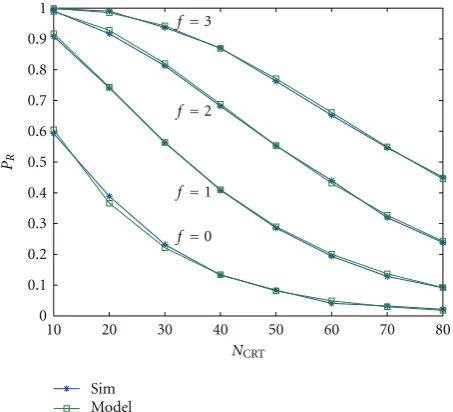
In Figure 7, we assess the accuracy of the proposed model comparing the analytical results obtained through eq. (14) related to the reliability, with those obtained with the simulator.
In particular, we have evaluated the number of packets lost, NPL, when the following values are considered: w ∈ [100, 200], NCRT ∈ [10, 80], ρ = 0.05, R = 60 m, r = 10 m, GridSize=[300 m×300 m], pe = 0.01,L = 5, and
f ∈ {0,. . ., 3}. From the number of packets lost we have obtained thePRasPR=1−NPL/NmwhereNmis the number of messages sent by the sources.
As can be observed, low values of f are sufficient to increase the reliability. For instance, whenNCRT = 20 and
f = 0, we have a reliability value of about 0.36, but it is sufficient to choose f =2 to increase the reliability to 0.92. Moreover, it is possible to observe that the results obtained through the analytical model in (14), and those reported by the simulator are very close to each other, for all the values of
f considered. In particular, simulations show that, when the condition of perfect synchronization in (2) is satisfied, the loss is only due to channel errors.
InFigure 8, we show the reliabilityPRversus the values of f, when pe = 0.01, L = 5, NCRT = 21, Ev = 60, and
r = 10 m. If not already specified, we consider these values of parameters for all the following plots. Analytical results have been obtained according to (15)-(16).
The results obtained confirm the model. In particular, (15)-(16) correctly predict that to achieve a reliability of 0.98 forNCRT =21 andpn=1−0.995 =0.049 it is necessary to
choose f =μ+ 2σ=3.
2 2.5 3 3.5 4 4.5 5 0.9
0.91 0.92 0.93 0.94 0.95 0.96 0.97 0.98 0.99 1
f
PR
Sim Model
Figure8: Analytical and simulation results ofPRversus f whenP
=0.01 andr=10 m.
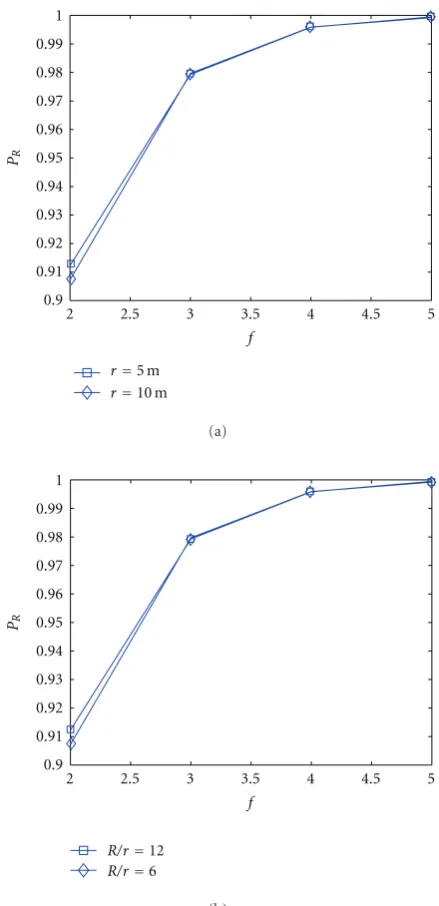
obtained for the transmission range, R. Simulation results shown inFigure 9(b)confirm that the reliability is not related to the ratioR/r.
Instead, the above mentioned ratio greatly impact on the ERF.
In particular, it is possible to observe that, according to (12), when the ratioR/r increases, the ERF increases as well (seeFigure 10(a)), while when the ratioR/ris constant, the ERF remains almost the same (seeFigure 10(b)). Note that the curves inFigure 10(b)are not identical because to obtain the expression in (12), we have considered several approximations:Nm≈Ev·ρπr2,NCRTwCRT≈w, (1−a/b)c≈ e−ac/b.
Previous results show that the parameters ERF,PR,f are related. In particular, when f increases, the ERF decreases andPRincreases. Therefore, it is important to select f so that a desired trade-offbetween reliability and energy reduction can be achieved.
It is worth mentioning that the previous results have also been obtained by simulating also a duty-cycle technique under the synchronization condition given by (2). This allows us to state that performance of the proposed method and its analytical model derived in [1] are valid also if a duty-cycle technique is adopted.
Now, we consider the effect of small duty-cycle matching (i.e., synchronization faults). Duty-cycles mis-matching are possible, for instance, if TAMAX (i.e., the
maximum transmission time) is not perfectly estimated or if small variations happen during the actual network operations.
In Figures11 and12we report the results related to a scenario where we have simulated a perturbation in the value ofTAMAXfor two values ofPDC =1/16 and 1/32, assuming
a cycle time equal to TC =1 s in both cases. Both values of PDC have been calculated taking into account the IEEE 802.15.4 guidelines and are less than 10%. The maximum
2 2.5 3 3.5 4 4.5 5 0.9
0.91 0.92 0.93 0.94 0.95 0.96 0.97 0.98 0.99 1
f
PR
r=5 m r=10 m
(a)
2 2.5 3 3.5 4 4.5 5 0.9
0.91 0.92 0.93 0.94 0.95 0.96 0.97 0.98 0.99 1
f
PR
R/r=12 R/r=6
(b)
Figure9:PRversus f whenr =5 m andr =10 m (a), and for
different values ofR/r(b).
nominal values of TAMAX that can be used to achieve the
synchronization can be calculated according to (2), and are
TAMAX=31.25 ms whenPDC=1/16, andTAMAX=15.63 ms
whenPDC=1/32. We have simulated reliability for two values of TAMAX greater than nominal values. More precisely, we
consideredTAMAX =36 ms whenPDC=1/16, and TAMAX =
17.2 ms whenPDC=1/32, that is, a perturbation of 15% when
PDC=1/16, and 10% in the casePDC=1/32.
2 2.5 3 3.5 4 4.5 5 f
0 5 10 15 20 25 30 35 40 45 50
ERF
R/r=12 R/r=6
(a)
2 2.5 3 3.5 4 4.5 5 f
ERF
0 10 20 30 40 50 60 70 80 90 100
R=72 m,r=6 m R=60 m,r=5 m R=48 m,r=4 m
(b)
Figure10: ERF versus f for different values ofR/r(a) and when
R/r=12 (b).
in both cases. In particular,f =2 (resp. f =3) is sufficient to achievePR=0.98 when the perturbation is 10% (resp. 15%). Moreover, it is possible to observe that, as expected, when
PDC=1/16, the values ofPRare lower than the values ofPR whenPDC=1/32. This happen because, for the same value of
TC, the mismatch on the duty-cycle synchronization in the first case is higher than the second case. Finally,Figure 11
allow us to state that the developed model (i.e., (18)-(19)) is able to accurately predict the effect of a possible duty-cycle mismatching.
The increase in the reliability has as a counter-effect, namely, a decrease in the value of ERF. InFigure 12, we have
0 0.5 1 1.5 2 2.5 3 3.5 4 4.5 5 0.4
0.5 0.6 0.7 0.8 0.9 1
pDC=1/32, TAMAX=0.0172
pDC=1/16,TAMAX=0.036
f
PR
Sim Model
Figure11:PRversusf whenPDC=1/32 andTAMAX=17.2 ms, and
whenPDC=1/16 andTAMAX=36 ms.
0 0.5 1 1.5 2 2.5 3 3.5 4 4.5 5 f
pDC=1/32,TAMAX=0.0172 pDC=1/16,TAMAX=0.036 38
40 42 44 46 48 50 52 54 56
ERF
Figure12: ERF versus f whenPDC=1/32 andTAMAX=17.2 ms,
and whenPDC=1/16 andTAMAX=36 ms.
reported the values of ERF versus the values off. First of all, it is possible to see that ERF decreases when f increases, but its values are always greater than zero for both values ofPDC. This means that with the CRT-based forwarding technique we have an improvement with respect to the shortest path, for all the values of f considered. Secondly, it is possible to observe that the variation of ERF related to different values ofTAMAXis very small.
0 0.5 1 1.5 2 2.5 3 3.5 4 4.5 5 f
0 0.1 0.2 0.3 0.4 0.5 0.6 0.7 0.8 0.9 1
PR
TC=1 s TC=1.05 s TC=1.1 s
TC=1.15 s TC=1.2 s
Figure13:PRversus f whenPDC=1/16 andTAMAX=37.5 ms, for
different values ofTC.
figures, an increase in the redundancy factor f makes the values of PR increase as well in all cases. Moreover, it is possible to observe that, whenTCincreases of small values,
PRincreases significantly. In particular, whenTC=1.2 s, the reliability (without considering channel errors) is 1. This result is in accordance with (2).
Results obtained allow us to assert that, thanks to the CRT approach, we can reduce the energy consumption so prolonging the network lifetime. Moreover, in case of failures due to channel errors or synchronization mismatches, it is possible to find a trade-offbetween the increase in reliability of the network and the energy efficiency.
10. Conclusions
In this paper we have discussed the trade-off conditions between energy consumption and reliability of a novel forwarding technique for WSNs, based on the Chinese Remainder Theorem (CRT).
In particular, first, we have derived an analytical model able to predict the energy efficiency of the method when applied in a sensor network where node use a duty-cycle technique in order to reduce the energy consumption. Then, we have discussed how to select the CRT algorithm parameters in order to obtain a reasonably trade-offbetween energy consumption and reliability.
Finally, through simulations, we have assessed the results obtained analytically, and we have shown that the CRT-based forwarding technique works well also in networks with duty cycle. Moreover, we have shown that possible synchroniza-tion mismatches can be compensated by choosing the CRT parameters accordingly.
References
[1] G. Campobello, A. Leonardi, and S. Palazzo, “A novel reliable and energy-saving forwarding technique for wireless sensor networks,” in Proceedings of the 10th ACM International Symposium on Mobile Ad Hoc Networking and Computing (MobiHoc ’09), pp. 269–278, New Orleans, La, USA, May 2009. [2] W. Ye, J. Heidemann, and D. Estrin, “An energy-efficient MAC protocol for wireless sensor networks,” inProceedings of the 21st Annual Joint Conference of the IEEE Computer and Communications Societies (INFOCOM ’02), pp. 1567–1576, New York, NY, USA, June 2002.
[3] V. Rajendran, K. Obraczka, and J. J. Garcia-Luna-Aceves, “Energy-efficient, collision-free medium access control for wireless sensor networks,”Wireless Networks, vol. 12, no. 1, pp. 63–78, 2006.
[4] T. van Dam and K. Langendoen, “An adaptive energy-efficient MAC protocol for wireless sensor networks,” inProceedings of the 1st International Conference on Embedded Networked Sensor Systems (SenSys ’03), pp. 171–180, Los Angeles, Calif, USA, November 2003.
[5] S. Du, A. K. Saha, and D. B. Johnson, “RMAC: a routing-enhanced duty-cycle MAC protocol for wireless sensor net-works,” in Proceedings of the 26th IEEE International Con-ference on Computer Communications (INFOCOM ’07), pp. 1478–1486, Anchorage, Alaska, USA, May 2007.
[6] Y. Xu, J. Heidemann, and D. Estrin, “Geography-informed energy conservation for ad hoc routing,” inProceedings of the 7th Annual International Conference on Mobile Computing and Networking (MobiCom ’01), pp. 70–84, Rome, Italy, July 2001. [7] S. Dulman, T. Nieberg, J. Wu, and P. Havinga, “Trade-off between traffic overhead and reliability in multipath routing for wireless sensor networks,” inProceedings of the Wireless Communications and Networking Conference (WCNC ’03), New Orleans, La, USA, March 2003.
[8] B. Deb, S. Bhatnagar, and B. Nath, “ReInForM: reliable infor-mation forwarding using multiple paths in sensor networks,” inProceedings of the 28th Annual IEEE Conference on Local Computer Networks (LCN ’03), Bonn, Germany, October 2003. [9] D. Ganesan, R. Govindan, S. Shenker, and D. Estrin, “Highly resilient, energy efficient multipath routing in wireless sensor networks,” Mobile Computing and Communications Review, vol. 1, no. 2, 2002.
[10] P. Djukic and S. Valaee, “Minimum energy reliable ad hoc networks,” inProceedings of the 22nd Biennial Symposium on Communications, Kingston, Canada, June 2004.
[11] J.-H. Hong, C.-H. Wu, and C.-W. Wu, “RSA cryptosystem based on the Chinese remainder theorem,” inProceedings of Asia and South Pacific Design Automation Conference (ASP-DAC ’01), Yokohama, Japan, January 2001.
[12] 802.15.4-2003, “IEEE Standard for Information Technology-Part 15.4: Wireless Medium Access Control (MAC) and Physical Layer (PHY) Specifications for Low-Rate Wireless Personal Area Networks (LR-WPANs),” 2003.
[13] F. Cuomo, E. Cipollone, and A. Abbagnale, “Performance analysis of IEEE 802.15.4 wireless sensor networks: an insight into the topology formation process,”Computer Networks, vol. 53, no. 18, pp. 3057–3075, 2009.