CSEIT411802 | Published - 25 April 2018 | March-April-2018 [ (4 ) 1 : 09-16 ]
National Conference on Recent Advances in Computer Science and IT (NCRACIT)
International Journal of Scientific Research in Computer Science, Engineering and Information Technology
© 2018IJSRCSEIT | Volume 4 | Issue 1 | ISSN : 2456-3307
09
Enabling Technologies for 5G Cellular Networks
Tahir Mohammad Wani
1, Sahil Nazir Pottoo
2, Muneer Ahmad Dar
3, Sameer Ahmad Mir
41,2,3,4Department of Electronics and Communication Engineering BGSB University, Rajouri, Jammu & Kashmir, India
ABSTRACT
The previous four generations of cellular technology have each been a major paradigm shift that has broken backward compatibility. Indeed, 5G will need to be a paradigm shift that includes very high carrier frequencies with massive bandwidths, extreme base station and device densities, and unprecedented numbers of antennas. However, 5G will be highly integrative: tying any new 5G air interface and spectrum together with LTE and Wi-Fi to provide universal high-rate coverage and a seamless user experience. The core network that will support the 5G also has to reach unprecedented levels of flexibility and intelligence, spectrum regulation will need to be rethought and improved, and energy and cost efficiencies will become critical considerations. Heterogeneity will also be a feature that is expected to characterize the emerging wireless world, as mixed usage of cells of diverse sizes and access points with different characteristics and technologies in an operating environment are necessary.
Keywords: LTE, WI-FI, 5G, Heterogeneity
I.
INTRODUCTION
As the long-term evolution (LTE) system embodying 4G has now been deployed and is reaching maturity, where only incremental improvements and small amounts of new spectrum can be expected, it is natural for researchers to ponder, ―what’s next?‖. In just a decade, the amount of IP data handled by wireless networks will have increased by well over a factor of 100: from under 3 exabytes in 2010 to over 190 exabytes by 2018, on pace to exceed 500 exabytes by 2020 [1]. This deluge of data has been driven chiefly by video thus far, but new unforeseen applications can reasonably be expected to materialize by 2020. In addition to the sheer volume of data, the number of devices and the data rates will continue to grow exponentially. The number of devices could reach the tens or even hundreds of billions by the time 5G comes to fruition,
Wi-Fi low-latency experience for network users. The primary technologies and approaches to address the requirements for 5G systems can be classified as follows [4][6][7]:
Densification of existing cellular networks with the massive addition of small cells and a provision for peer-to-peer communication
Simultaneous transmission and reception (e.g., full duplex communication).
Millimeter Wave transmission.
Massive multiple-input multiple-output (massive MIMO) and millimeter-wave (mm-wave communication technologies).
Improved energy efficiency by energy-aware communication and energy harvesting.
Cloud based radio access network (c-RAN).
Virtualization of wireless resources.
The combination of more nodes per unit area and Hz, more Hz, and more bits/s/Hz per node, will compound into many more bits/s per unit area. Other ideas not in the above categories, e.g., interference management through BS cooperation, use of function decomposition and network slicing for improving the current EPC (evolved packet core) may also contribute improvements, but in remainder of this paper, we will like to discuss the above-enlisted points.
II.
ENABLING TECHNOLOGIES FOR 5G
A. Dense Heterogeneous Network
The 5g cellular will be a multi-tier heterogeneous network consisting of macro cells along with a large number of low power nodes power nodes (e.g., small cells, relays, remote radio heads (RRHs), and the provisioning for P2P (such as D2D and M2M) communication. The deployments of heterogeneous nodes in 5G systems will have significantly higher density than today’s conventional single- tier (e.g., macrocell) networks [8] . The heterogeneity of different classes of BSs (e.g., macrocells and small cells) provides flexible coverage areas and improves spectral efficiency. By reducing the size of the cell, the area spectral efficiency is increased through
higher spectrum reuse [13]. Additionally, the coverage can be improved by deploying small cells indoors (such as home, office buildings, public vehicles, etc.). Wireless P2P communication (e.g., D2D/M2M communication among UE and autonomous sensors/actuators) underlying cellular architecture can significantly increase the overall spectrum and energy efficiency of the network. In addition, the network controlled P2P communications in 5G systems will allow other nodes (such as relay or M2M gateway), rather than the macrocell BS, to control the communications among P2P nodes. Given that the inter-tier and intra-tier interferences are well managed, the adoption of multiple tiers in the cellular network architecture will provide better performance in terms of coverage, capacity, spectral efficiency, and power consumption [5].
B. Millimeter Wave
Terrestrial wireless systems have largely restricted their operation to the relatively slim range of microwave frequencies that extends from several hundred MHz to a few GHz and corresponds to wavelengths in the range of a few centimeters up to about a meter. By now though, this spectral band— often called ―beachfront spectrum‖—has become nearly fully occupied, in particular at peak times and in peak markets. Regardless of the efficacy of densification and offloading, much more bandwidth is needed [11][12].
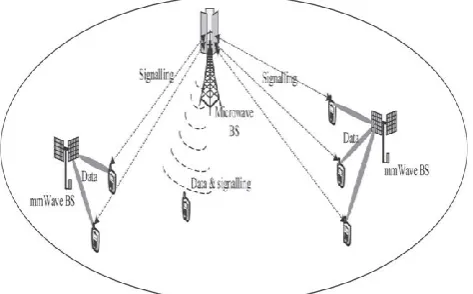
because of rather hostile propagation qualities, including strong pathloss, atmospheric and rain absorption, low diffraction around obstacles and penetration through objects, and, further, because of strong phase noise and exorbitant equipment costs. The dominant perception had therefore been that such frequencies, and in particular the large unlicensed band around 60 GHz, were suitable mainly for very-shortrange transmission. Thus, the focus had been onWiFi (with the WiGiG standard in the 60-GHz band) and on fixed wireless in the 28, 38, 71–76 and 81–86 GHz. However, semiconductors are maturing; their costs and power consumption rapidly falling—largely thanks to the progress of the aforementioned short-range standard—and the other obstacles related to propagation are now considered increasingly surmountable given time and focused effort.
Figure 1: MmWave enabled network with phantom cells.
1) Propagation Issues: Concerning mmWave
propagation for 5G, the main issues under investigation are:
Pathloss: If the electrical size of the antennas (i.e., their size measured by the wavelength λ = c/fc where fc is the carrier frequency) is kept constant, as the frequency increases the antennas shrink and their effective aperture scales with λ2/4π; then, the free-space pathloss between a transmit and a receive antenna grows with f2c. Thus, increasing fc by an order of magnitude, say from 3 to 30 GHz, adds 20 dB of power loss regardless of the transmit-receive
distance. However, if the antenna aperture at one end of the link is kept constant as the frequency increases, then the free-space pathloss remains unchanged. Further, if both the transmit and receive antenna apertures are held constant, then the free-space pathloss actually diminishes with f2c: a power gain that would help counter the higher noise floor associated with broader signal bandwidths.
Blocking: MmWave signals exhibit reduced diffraction and a more specular propagation than their microwave counterparts, and hence they are much more susceptible to blockages. This results in a nearly bimodal channel depending on the presence or absence of Line-of-Sight (LoS) [15][16]. According to recent measurements, as the transmit-receive distance grows the pathloss accrues close to the free-space value of 20 dB/decade under LoS propagation, but drops to 40 dB/decade plus an additional blocking loss of 15–40 dB otherwise [17]. Because of the sensitivity to blockages, a given link can rapidly transition from usable to unusable and, unlike small-scale fading, largesmall-scale obstructions cannot be circumvented with standard smallscale diversity countermeasures. New channel models capturing these effects are much needed, and in fact currently being developed and applied to system-level analysis and simulation studies.
C. Full Duplex Communication
removal of a separate frequency band/time slot for both uplink and downlink transmission. Recent studies [8][9] indicate that FD systems are feasible and can provide significantly higher data rates than the conventional half-duplex (HD) communication systems. FD technology can also solve problems in existing wireless networks, such as hidden terminals, loss of throughput due to congestion, and large end-to-end delays. For instance, FD communication schemes can reduce the latency by simultaneously receiving feedback signals (i.e., channel state information (CSI), ARQ/ACK control signaling, etc.) from the receiver during transmission. FD communication also enables a wireless node such as a BS to perform RF energy transfer (e.g., wireless charging) while receiving uplink transmissions from UE [18].
One possible approach to minimize SI in FD radios is to combine the antenna cancellation, RF interference cancellation, and digital interference cancellation techniques. For instance, let the transmission signal be split between two transmit antennas. For a particular wavelength l, two transmit antennas are placed at d and l/2 + d away from the receive antenna. Hence, by offsetting the two transmitters by half a wavelength, we can let the signals add destructively. As a result, the receiver antenna receives a much weaker signal (e.g., less self-interference) compared with any one of the local transmit signals. After performing the antenna cancellation, the RF interference cancellation and the digital interference cancellation techniques can be employed to further decrease the SI. In the RF interference cancellation technique, a noise canceler chip can remove a known analog interference signal from a received signal. Since the transmitted symbols are already known, a coherent detection mechanism is used in the digital interference cancellation phase to reconstruct the signal. Considering the small transmit power requirements to reduce the effect of SI, low-power networks (e.g., small cell networks (SCNs) and short-range communications such as D2D and M2M communications or multi-hop
relaying) are potential scenarios where FD technology can be practically beneficial .However, in FD systems, interference management becomes significantly more complex due to new interference situations. For a multi-user channel-sharing situation, in addition to intra-cell interference (among the users in a cell), there are inter-cell downlink-to-uplink interference and inter-cell inter-user downlink-to- uplink-to-downlink interference[7][9].
D. Massive MIMO
Stemming from research that blossomed in the late 1990s , MIMO communication was introduced into WiFi systems around 2006 and into 3G cellular shortly thereafter. In essence, MIMO embodies the spatial dimension of the communication that arises once a multiplicity of antennas are available at BSs and mobile devices. If the entries of the channel matrix that ensues exhibit—by virtue of spacing, cross-polarization and/or angular disposition— sufficient statistical independence, multiple spatial dimensions become available for signaling and the spectral efficiency multiplies accordingly [26]. In single-user MIMO (SU-MIMO), the dimensions are limited by the number of antennas that can be accommodated on a mobile device. However, by having each BS communicate with several users concurrently, the multiuser version of MIMO (MU-MIMO) can effectively pull together the antennas at those users and overcome this bottleneck. Then, the signaling dimensions are given by the smallest between the aggregate number of antennas at those users and the number of antennas at the BS. Furthermore, in what is now known as coordinated multipoint (CoMP) transmission/reception, multiple BSs can cooperate and act as a single effective MIMO transceiver thereby turning some of the interference in the system into useful signals; this concept in fact underpins many of the approaches to interference and mobility management mentioned earlier in this section.
per BS sector, and it appeared that, because of form factors and other apparent limitations, such was the extent to which MIMO could be leveraged. Marzetta was instrumental in articulating a vision in which the number of antennas increased by more than an order of magnitude, first in a 2007 presentation with the details formalized in a landmark paper. The proposal was to equip BSs with a number of antennas much larger than the number of active users per time–frequency signaling resource, and given that under reasonable time–frequency selectivities accurate channel estimation can be conducted for at most some tens of users per resource, this condition puts the number of antennas per BS into the hundreds. This bold idea, initially termed ―large-scale antenna systems‖ but now more popularly known as ―massive MIMO,‖ offers enticing benefits [25][26][27]:
Enormous enhancements in spectral efficiency without the need for increased BS densification, with the possibility—as is always the case—of trading some of those enhancements off for power efficiency improvements.
Smoothed out channel response because of the vast spatial diversity ,which brings about the favourable action of the law of large numbers. In essence ,all small scale randomness abates as the number of channel observations grows.
Simple transmit receive structures because of the quasi-orthogonal nature of the channels between each BS and the set of active users sharing the same signaling resourse. For a given number of active users, such orthogonality sharpens as the number of BS antennas grows and simple linear transreceivers, even plain single user beamforming, perform close-to-optimally.
E. Cloud Based Networking
Although this special issue is mainly focused on the air interface, for the sake of completeness we briefly touch on the exciting changes taking place at the network level. In that respect, the most relevant
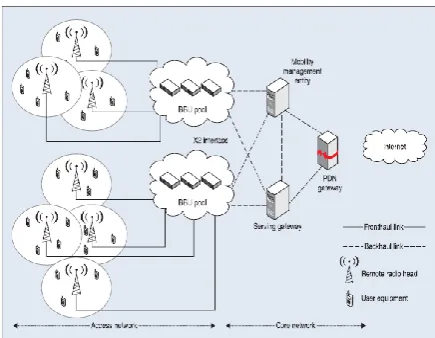
event is the movement of data to the cloud so that it can be accessed from anywhere and via a variety of platforms. This fundamentally redefines the endpoints and the time frame for which network services are provisioned. It requires that the network be much more nimble, flexible and scalable. As such, two technology trends will become paramount in the future: network function virtualization (NFV) and software defined networking (SDN). Together, these trends represent the biggest advance in mobile communication networking in the last 20 years, bound to fundamentally change the way network services are provided. Although the move toward virtualization is thus far taking place only within the core network, this trend might eventually expand toward the edges. In fact, the term cloud-RAN is already being utilized, but for now largely to refer to schemes whereby multiple BSs are allowed to cooperate .If and when the BSs themselves become virtualized—down to the MAC and PHY—this term will be thoroughly justified[21]_[23]. NFV infrastructure will be equivalent to commercial cloud or enterprise cloud. What is expected is that there will be a high degree of reuse of what commercial cloud offers [19].
As virtualization of the communication network gains traction in the industry, an old concept, dating back to the 1990s, will emerge: the provision of user-controlled management in network elements. Advances in computing technology have reached a level where this vision can become a reality, with the ensuring architecture having recently been termed software defined networking (SDN).
2) Software Defined Networking:
SDN is an architectural framework for creating intelligent programmable networks. Specifically, it is defined as an architecture where the control and data planes are decoupled, network intelligence and state are logically centralized, and the underlying network infrastructure is abstracted from the application.
The key ingredients of SDN are an open interface between the entities in the control and data planes, as well as programmability of the network entities by external applications. The main benefits of this architecture are the logical decoupling of the network intelligence to separate software based controllers, exposing the network capabilities through an application program interface, and enabling the application to request and manipulate services provided by the network [20].
Figure 2: An LTE-A system Enhanced with cloud based radio access network.
From a wireless core network point of view, NFV and SDN should be viewed as tools for provisioning the next generation of core networks with many issues still open in terms of scalability, migration from current structures, management and automation, and security.
F. Energy Harvesting
One of the main challenges in 5G networks is to improve the energy efficiency of the battery constrained wireless devices. In the context of prolonging the battery life and improving the overall energy efficiency of the network, harvesting energy from energy sources could be an attractive solution. For instance, the UE can harvest energy from environmental energy sources (e.g., solar and wind energy). However, due to stochastic nature of environmental sources, the available energy levels may vary significantly over time, locations, weather conditions, etc. Therefore, harvesting energy from these sources may not be feasible for reliable and quality-of-service (QoS)- constrained wireless applications [11]. Alternatively, energy can also be harvested from ambient radio signals (e.g., RF energy harvesting). In an RF-powered energy-harvesting network (RF-EHN), the UE can harvest energy from hybrid access point (HAP) using RF signals for their information processing and transmission. RF energy transfer is characterized by low-power and long-distance transfer and thus is suitable for cellular wireless environments (e.g., powering a large number of devices with relatively low energy consumption spreading in a wide area). In addition, the sustainable nature of RF energy sources makes the RF-EHNs a promising approach for future power/energy-constrained 5G wireless networks.
harvesting-enabled UE can harvest energy from RF sources. Depending on the network, the AP and RF energy source can be the same (e.g., acts as HAP). The AP has an energy-harvesting zone and an information transmission zone. Since the operating power of the energy-harvesting component is much higher than that of the information-decoding component, the energy-harvesting zone is smaller than the information transmission zone.
RF energy-harvesting node (which could be UE, low-power femto APs, etc.) consists of the following major components [11]:
A low-power microcontroller to process data from the network application.
A low power RF transceiver for information transmission/reception.
An energy harvester (composed of RF antenna module, an impedence matchim, a voltage multiplier and a capacitor) to collect and convert RF signals into electricity.
In addition, a power management module is used to decide whether the harvested energy should be used immediately or stored for future.
Energy storing element (a battery) is used to reserve the harvested RF energy for future operation.
III.
CONCLUSION
An overview of emerging technologies for 5g cellular networks has been provided in this paper. How mm-Wave and massive-MIMO impacts on the design and development of 5G networks has also been discussed. Future 5G will be a combination of the different enabling technologies. However the biggest challenge will be to integrate all these technologies.
IV.REFERENCES
[1] B. Clerckx, A. Lozano, S. Sesia, C. van Rensburg, and C. B. Papadias, ―3GPP LTE and
LTE-Advanced,‖ EURASIP J. Wireless Commun. Netw., vol. 2009, no. 1, p. 472 124, Sep. 2009.
[2] Cisco, Visual Networking Index, Feb. 2014, white
paper at Cisco.com
[3] Analysys Mason Report S. Hilton,
Machine-to-Machine Device Connections: Worldwide Forecast 2010–2020 2010, Analysys Mason Report
[4] P. Demestichas, A. Georgakopoulos, D. Karvounas,
K. Tsagkaris, V. Stavroulaki, J. Lu, C. Xiong, and J. Yao, ―5G on the horizon: Key challenges for the radio-access network,‖ IEEE Veh. Technol. Mag., vol. 8, no. 3, pp. 47–53, Sept. 2013.
[5] Jeffrey G.Andrews, fellow, IEEE, Stefano Buzzi,
Senior member, IEEE, wan Choi, Senior member IEEE, Stephen v. hanly, member, IEEE, Angel Lozano, Fellow, IEEE, Anthony c.k soong,fellow, IEEE,and jianzhong Charlie Zhang,Senior member, IEEE ― what will 5G be‖?
[6] A. Zakrzewska, S. Ruepp, and M. Berger, ―Towards
converged 5G mobile networks - Challenges and current trends,‖ in Proc. ITU Kaleidoscope Academic Conf., pp. 39–45, Jun. 2014.
[7] S. Talwar, D. Choudhury, K. Dimou, E. Aryafar, B.
Bangerter, and K. Stewart, ―Enabling technologies and architectures for 5G wireless,‖ in Proc. IEEE MTT-S Int. Microwave Symp. (IMS), pp. 1–4, Jun. 2014.
[8] N. Bhushan, J. Li, D. Malladi, R. Gilmore, D.
Brenner, A.
[9] Damnjanovic, R. Sukhavasi, C. Patel, and S.
Geirhofer, ―Network densification: the dominant theme for wireless evolution into 5G,‖ IEEE Commun. Mag., vol. 52, no. 2, pp. 82-89, Feb. 2014. [10] J. Choi, M. Jain, K. Srinivasan, P. Levis, and S. Katti,
―Achieving single channel, full duplex wireless communication,‖ in Proc. Int. Conf. Mobile Computing and Networking, pp. 1–12, 2010. [11] S. Hong, J. Brand, J. Choi, M. Jain, J. Mehlman, S.
Katti, and P. Levis, ―Applications of self-interference cancellation in 5G and beyond,‖ IEEE Commun. Mag., vol. 52, no. 2, pp. 114–121, Feb. 2014.
[13] Connecting America: The National Broadband Plan (Chapter5)2010.[Online].Available:http://download. broadband.gov/plan/ national-broadband-plan.pdf
[14] M. Marcus and B. Pattan, ―Millimeter wave
propagation; Spectrum management implications,‖ IEEE Microw. Mag., vol. 6, no. 2, pp. 54–62, Jun. 2005.
[15] A. Alejos, M. G. Sanchez, and I. Cuinas,
―Measurement and analysis of propagation
mechanisms at 40 GHz: Viability of site shielding forced by obstacles,‖ IEEE Trans. Veh. Technol., vol. 57, no. 6, pp. 3369–3380, Nov. 2008.
[16] Z. Pi and F. Khan, ―An introduction to
millimeter-wave mobile broadband systems,‖ IEEE Commun. Mag., vol. 49, no. 6, pp. 101–107, Jun. 2011.
[17] W. Roh et al., ―Millimeter-wave beamforming as an
enabling technology for 5G cellular
communications: Theoretical feasibility and
prototype results,‖ IEEE Commun. Mag., vol. 52, no. 2, pp. 106–113, Feb. 2014.
[18] S. Rangan, T. Rappaport, and E. Erkip,
―Millimeter-wave cellular wireless networks: Potentials and challenges,‖ Proc. IEEE, vol. 102, no. 3, pp. 366– 385, Mar. 2014.
[19] J. Choi, M. Jain, K. Srinivasan, P. Levis, and S. Katti, ―Achieving single channel, full duplex wireless communication,‖ in Proc. Int. Conf. Mobile Computing and Networking, pp. 1–12, 2010.
[20] C. Liang and F. R. Yu, ―Wireless network
virtualization: a survey, some research issues and challenges,‖ IEEE Commun. Surveys & Tutorials, vol. 17, no. 1, pp. 358–380, 2015.
[21] Ekram Hossoin and Manowar Hasan, ―Cellular 5G:
Key Enabling Technologies and Research
Challenges.
[22] N. Lee, R. W. Heath, Jr., D. Morales-Jimenez, and A. Lozano, ―Base station cooperation with dynamic clustering in super-dense cloud-RAN,‖ in Proc. IEEE GLOBECOM, Dec. 2013, pp. 784–788.
[23] Z. Zhu et al., ―Virtual base station pool: Towards a
wireless network cloud for radio access networks,‖ in Proc. ACM Int. Conf. Comput. Frontiers, 2011, p. 34.
[24] ―Special issue on energy-efficient wireless
communications,‖ IEEE J. Sel. Areas Commun., vol. 29, no. 8, Sep. 2011.
[25] ―Special issue on energy efficiency in
communications,‖ IEEE Commun. Mag., vol. 48, no. 11, Nov. 2010.
[26] E. Telatar, ―Capacity of multi-antenna Gaussian
channels,‖ European Trans. Telecommun., vol. 10, no. 6, pp. 585–595, Nov./Dec. 1999.
[27] F. R. Farrokhi, A. Lozano, G. J. Foschini, and R. A.
Valenzuela, ―Spectral efficiency of FDMA/TDMA wireless systems with transmit and receive antenna arrays,‖ IEEE Trans. Wireless Commun., vol. 1, no. 4, pp. 591– 599, Jan. 2002.
[28] A. Lozano and A. M. Tulino, ―Capacity of