156
Modern Honey Network
Shah Manthan Jigneshkumar
Computer Engineering, Vishwakarma Institute of Information Technology Email: [email protected], [email protected]
Abstract- The concept of honeypot has been around for a while now. But honeypots are yet to be adopted by network security community as a standard majorly due to its complexity. MHN is an open-source project developed by Threatstream which is aimed at overcoming the risk and complexity of honeypots and integration with tools to analyze and productively use the data or intelligence gathered by such honeypots. MHN is easy to deploy, configure and maintain and it provides integration with third-party apps and ability to add our own honeypots, which could go a long way to making honeypots an industry standard.
Index Terms- MHN, Modern Honey Network, Honeypot, Open-source, Threatstream, Cyber Security
1. INTRODUCTION
The concept of honeypot was first introduced by Clifford Stoll in his book ‘The Cuckoo's Egg: Tracking a spy through the maze of computer espionage’ in 1989. In 1990 Bill Cheswick of AT&T Bell Laboratories wrote a paper named ‘An Evening with Berferd: In which a cracker is lured, endured, and studied’. The concept of honeypot has been realized, applied and grown in the late 20th century as evident by the release of the products like ‘Deception Toolkit’ in 1997, ‘CyberCop Sting’ Sin 1998, ‘Snort’, ‘BackOfficer Friendly’ and ‘NetFacade’, in 1998. The formation of the ‘HoneyNet Project’ led by Lance Spitzner in 1999 truly started the developments and formalization of concepts of honeypots.
Today in 2016, it can be concluded that the changes that significantly influenced the advances in honeypot research are adoption of new types of network applications, advances in networking hardware, geographical diversity in internet user population and growth in underground attackers’ communities. Today we have already developed advanced honeypots like ‘BitSaucer’, ‘Honeyware’, ‘Argos’, ‘HoneyBow’, ‘PhoneyBots’ and advanced concepts like ‘Shadow Honeypots’ or ‘Super Honeypots’.
But even after 25 years of private and crowd-sourced research and developments, honeypots have failed to receive industry wide adoption. The lack of adoption by the industry and intelligence community can be easily attributed to the complexity of deployment, configuration and maintenance; and underdeveloped or still-developing technologies related to Big Data, Negative Database, Data Mining, Social Engineering and Data Analytics.
1.1 Objectives / Problem Statement
(1) To create or implement a software solution which is easy to deploy and maintain. (2) To provide tools along with the software
solution to analyze and leverage the data gathered.
(3) To overcome the demerits of honeypots and make honeypots widely acceptable by the industry and security/intelligence community.
2. HONEYPOT
A honeypot is an offensive security measure. Lance Spitzner, the founder of the Honeynet Project defines honeypot as “an information system resource whose value lies in unauthorized or illicit use of that resource”. According to Lance, a honeypot is “a resource whose value is in being probed, attacked or compromised”. Honeypot is a trap set to detect, deflect or in some other manner counteract attempts at unauthorized use of information systems. As such honeypot is a security device that is designed to lure malicious activity towards itself. Capturing such malicious activity allows for studying it to understand the operations and motivation of attackers and the black hat community, and subsequently lead to betterment of security of cyber information resources.
2.1 Classification of honeypots
Honeypots can be classified into various categories based upon different object of classification scheme. Such classification based upon various criteria is given below.
(1) Interaction Level
Interaction level describes if the exposed functionality of a honeypot is limited.
• Low interaction
158 3.1 MHN Architecture
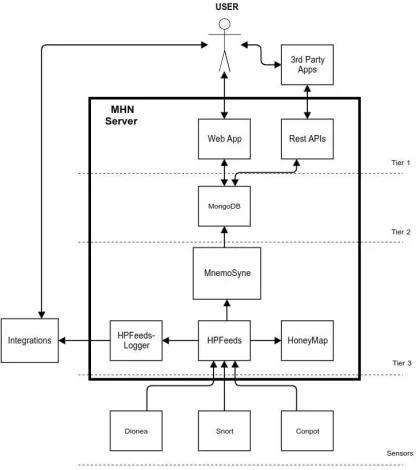
MHN is designed on three-tier architecture. Various sensors and honeypots are placed at the bottom. The tier above the sensors includes HPFeeds, HPFeeds-Logger, HoneyMap and Mnemosyne. The next tier has MongoDB. The top tier includes the Web App and Rest APIs. The architecture is shown in the figure below.
Fig. 1. Architecture of MHN Server
Going from bottom to top, features of each tier are listed below.
(1) Sensors
This layer of architectures involves the sensors which are the data generation points. The purpose of this tier is to make use of multiple sensors deployed in different geographical locations with different configurations and to form a honeynet or a honeypot network. Various sensors that can be deployed easily via MHN include Snort, Suricata, Dionaea, Conpot, Kippo, Amun, Glastopf, Wordpot, ShockPot, p0f and Elastichoney. Along with computer network sensors, MHN also provides the facility to deploy a sensor for Raspberry Pi WSN. On top the already configured sensors listed above, MHN provides the facility to add new sensors very easily.
(2) Tier-3
This layer has HPFeeds at its core. HPFeeds is an open-source tool used to collect data from various sensors deployed at the bottom tier. HPFeeds-logger is used to collate the data collected by HPFeeds and feed
the data to third-party app integrations like Splunk, ArcSight and ELK. HoneyMap is used for real-time visualization of data gathered by HPFeeds. Thus this layer is dedicated to data collection and collation. Mnemosyne is used to index the data into MongoDB.
(3) Tier-2
This tier has MongoDB at its core to store, manage and manipulate data. Mnemosyne is used to index the data into MongoDB. Such this layer consists of data management system
(4) Tier-1
This is the top layer of MHN architecture. This layer involves MHN Web App and Rest APIs which the user directly interacts with. The Rest APIs include CEF and STIX support for direct SIEM integration through our Commercial platform developed by Threatstream called ‘Optic’.
Fig. 2. Architectural Layout of MHN
3.2 Sensors
As mentioned in the MHN architecture, sensors are deployed at the base of MHN server. These sensors are various honeypots, IDS, passive scanners which generate the data about the attack, the attacker and the attack vector. These sensors log every activity in the honeypots and scan them for known malware or virus or worm signatures and detect anomalies. The data generated by these scanners is the raw products that will be collected, collated, indexed, stored and process to provide useful results. Various sensors are available to deploy, pre-configured as a part of MHN Server and Web app. These sensors are listed below.
(1) Dionea
160 HPFeeds plays the very important role as a data
gathering point for MHN Server. HPFeeds lies at the base of MHN Server. HPFeeds can have multiple inputs from different honeypot software which work as a data generation point. HPFeeds has internal connections to HPFeeds-logger, HoneyMap and Mnemosyne.
3.4 Mnemosyne
Mnemosyne is used as a data normalization tool, which connects HPFeeds with MongoDB.
Mnemosyne has three main objectives:
(1) Provide immutable persistence for HPFeeds. (2) Normalization of data to enable sensor
agnostic analysis.
(3) Expose the normalized data through a RESTful API.
Mnemosyne uses following collections:
(1) Counts
This collection was added specifically for MHN. This collection was designed to speed up aggregation queries. It can be described as pre-computed summaries of counts over time-ranges.
(2) Daily_stats
This is a default collection of Mnemosyne which stores daily summaries statistics across various dimensions of data.
(3) Dork
This default collection stores searches, file paths and associated metadata collected from honeypot. This collection specifically relates to web application honeypots. It serves Dorks collected by Glastopf.
(4) File
This is the default collection used to store files and associated metadata collected from various honeypots.
(5) HPFeed
This default collection stores the raw message sent back from a honeypot in the original format (Usually JSON).
(6) Metadata
This collection has been specifically added by MHN. It is used to store metadata around IP addresses. This collection is used as a pre-computed collection of observations around an attacker IP. This collection is mainly used for P0f data.
(7) Session
This default collection is the most important. This collection summarizes honeypot interaction as a normalized 5-tuple record.
(8) URLs
This default collection is used to store URLs and associated metadata collected from various honeypots. These URLs are potentially serving malicious content.
(9) HPFeeds Database
This collection is specifically used by HPFeeds broker.
(10)Auth_key
This collection stores data about HPFeeds users. It gets populated as new users are added to HPFeeds.
3.5 MHN Web Application
MHN Server provides an attractive web application designed by ThreatStream.
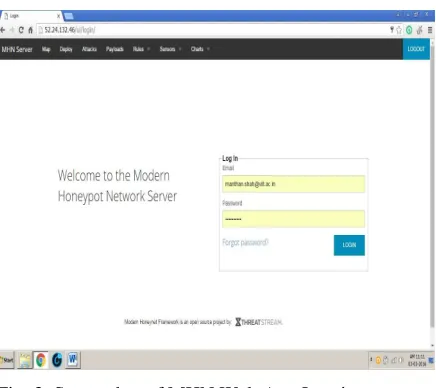
This web app can be used to log in to the MHN Server and do manipulations graphically.
Fig. 3. Screenshot of MHN Web App Log-in
Having logged into the MHN Server, the homepage is shown. This homepage provides a summary. The attack count of past 24 hours is shown along with a list of top attacker IPs, attacked ports, honeypots, sensors and attack signatures.
The web app provides many facilities:
(1) Map
This tab provides a direct integration to HoneyMap in MHN Server. A real-time map of the world is shown. Different honeypots deployed and attacks are also displayed in real-time fashion.
162 and Information Security (IJCNIS Vol.4,
No.10, September 2012)
[3] Seifert, C; Welch, I, Komisarczuk, P. (2006): “Taxonomy of honeypots”, CS Technical Report TR-06-12, School of Mathematics, Statistics and Computer Science, Victoria University of Wellington, New Zealand [4] The honeynet project (http://honeynet.org/)
[5] MHN, Threatstream