Copyright 2012 by Shu-Kai Hsieh, Yu-Yun Chang, and Meng-Xian Shih
Chinese Sentiments on the Clouds:
A Preliminary Experiment on Corpus Processing and Exploration on Cloud Service
Shu-Kai Hsieh, Yu-Yun Chang, Meng-Xian Shih Graduate Institute of Linguistics, National Taiwan University
No. 1, Sec. 4, Roosevelt Road, Taipei, 10617 Taiwan
[email protected], {june06029;simon.xian}@gmail.com
Abstract
This study aims to propose a novel pipeline architecture in building and analyzing large-scaled linguistic data on the cloud-based envi-ronment, an experimental survey on Chinese Polarity Lexicon will be taken as an exam-ple. In this experiment, data are evaluated and tagged by applying crowd sourcing ap-proach using online Google Form. All the data processing and analyzing procedures are com-pleted on-the-fly with free cloud services au-tomatically and dynamically.The paper shows the advantages of using cloud-based environ-ment in collecting and processing linguistic data which can be easily scaled up and effi-ciently computed. In addition, the proposed pipeline architecture also brings out the poten-tials of merging with mashups from the web for representing and exploring corpus data of various types.
1 Introduction
With the emergence of huge amount of web data available in recent years, corpus linguistics as well as other related empirical fields such as the collect-ing and processcollect-ing of language resources, and their evaluation are facing with the greatest challenges ever. The spread of corpus and lexical resources in linguistics has been led to a great level of theo-retical survey and enhanced the empirical founda-tion, not only with respect to sampling and annota-tion, but also with exploratory data analysis. How-ever, more recently there have been long discussions about what the current state of art in corpus linguis-tics fails to do, which can be pinpointed at least in
two respects: (1) the lack of socio-cultural (meta-) information reflected in the data, is incompetent for pragmatic usages and discourse analysis; (2) rather skewed with data in the public domain, heterogene-ity of (individualized) language usages and develop-ment is not able to be traced.
With the advanced technological progress in data availability with storage and computing ability, the issues mentioned can be tackled to a great extent. We take it as the turning point forcorpus-based lin-guistics to transform into a data-intensive and cloud-based linguistics. In light of that, we want to ex-plore the transformation viability in this paper. As a first step, we present a novel pipeline architecture to build Chinese Polarity Lexicon on the cloud en-vironment by taking the data from the web as re-source. Polarity lexicon contains sentiment-bearing words and phrases, encoded with polarities to each word or phrase, usually either assigned as positive or negative. The study of polarity lexicon has attracted much attention in recent years for classifiers to train on the lexical dataset, and is becoming important for applications such as Sentiment Analysis and Opin-ion Mining.
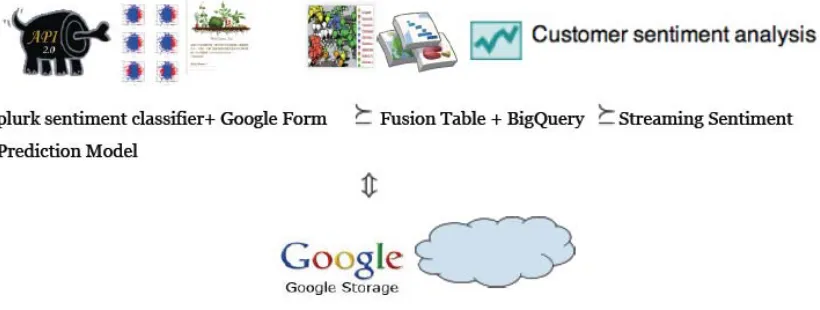
nega-Figure 1: Proposed pipeline framework
Google BigQuery6. Then finally, it was sent forward
to prediction model with stream machine learning.
4.2 Formulate seed-sets from emotion-tagged Plurk Corpus
We have collected a total of 13534 Chinese posts ex-tracted from Plurk corpus. The data have been seg-mented and POS-tagged by importing yahoo! Chi-nese Segmentator and Tagger 7, for which the
ya-hoo! segmentation system is powerful for its lexi-con extension on new emerged words from the social web (e.g. trendy words and code-mixing words). From the previous research (Chen et al., 2010), a Mood classifier had built up by training the target text with the keywords generated from Anctconc us-ing log-likelyhood feature selection method (Kilgar-riff, 2001; Anthony, 2004). Also, a manually clas-sified result was used to evaluate the accuracy of Mood classifier. In this paper, in order to construct the word polarity prediction model more specifi-cally, the Plurk posts are collected and fed on only if the posts have identical resulting results from Mood classifier and manual evaluation.
After the chosen posts are selected and seg-mented, a list of 100 seed words (all seed words are content words, including nouns, adjectives and verbs) are chosen based on the following three cri-teria: the balance in corpus frequency distribution, opinion relevance, and wordnet POS representa-tives. The first criterion is used to create a corpus 6https://developers.google.com/bigquery/ 7http://tw.developer.yahoo.com/cas/
frequency word list, and the 100 seed words are ex-tracted in balance according to the corpus frequency distribution. Then the last two criteria are applied to confirm whether each seed word has opinion expres-sions in meaning and an relevant description from wordnet. The above seed word selecting elements are integrated to ensure the seed words have appar-ent meaning descriptions before adapting to the pre-diction model.
An online survey is created by using Google Form, which we ask the participants to evaluate the 100 seed words with a finer granularity of 5 star rat-ing (scalrat-ing from 1 (Extremely Positive) to 5 (Ex-tremely Negative)). Instead of taking a readily pre-pared corpus as previous studies (which the word polarity corpora are manually tagged by a specific group of people), for example as using the General Inquirer corpus, we let the participants to decide the polarities of each seed word, and then assign differ-ent weights to each seed word based on the overall survey statistical results. Therefore, a list of seed words with polarities is created, which only the seed words given with positive weights are tagged with positive polarity, and reversely, assigned with nega-tive polarity.
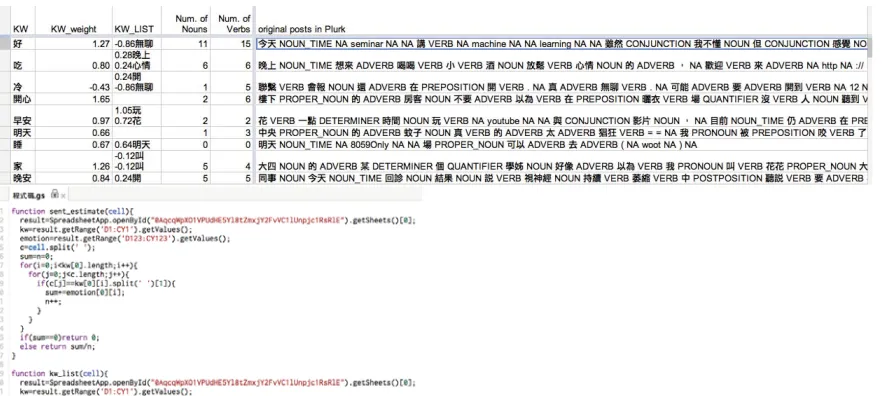
Figure 2: Score form with functions written online
shows a snapshot of this scored form.
4.3 Preprocessing and Exploratory Data Analysis
In order to compute the model training more effi-ciently, we use Google API to write our own func-tions and apply them to the data in Google Form. This is a convenient way for training and analyz-ing the data online without needanalyz-ing to run the whole programs on our own devices. To be even better, once the data is renewed, the programs will run the functions automatically in an instant and no need to execute the programs manually. Through this small experiment of this paper, we hope to provide a prac-tical method for linguists to deal with data in a more skilled and dynamic way.
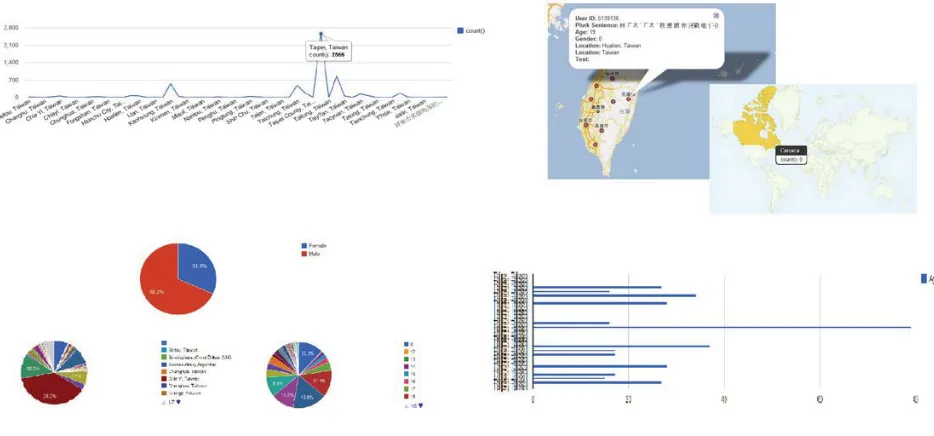
With the data imported into Google Fusion Table, it is convienient to use a variety of Visualize plots as shown in Figure 3. The Visualize function contains table, map, line, bar, pie and other plotting tools to help quickly analyze the data. In addition, it allows us to add some specific conditions while plotting. By applying the line chart, we can quickly find out which city has the greatest Plurk population. Visu-alize function has also implanted the Geocode (ge-ography codes) which takes the location data to tag places on a map or colored up the related regions. Also, once clicking on the tagged places or colored regions, the related meta information will be pre-sented. For investigating data distribution (for
ex-ample gender, location, and age), the pie chart can be used which provides results calculated in percent-ages. On the other hand, for more detailed distribu-tion analysis, bar chart is shown to be better present-ing the statistic results between two variables, such as location and age.
4.4 Prediction Model
The prior polarity lexicons thus constructed are used as training data for cloud-based prediction model in extracting more polar words and determining the overall sentiment of Plurk texts. As the first attempt, we are using the Google-hosted prediction model as a black-box for primer experiment,8 and a
Pre-dictive Model Markup Language (PMML)-based9
adaptiveprediction model is envisioned which
com-bines Chinese wordnet-based sense/sentiment prop-agation approach (by assuming that sentiment and lexical relatedness are linked) with bootstrapped in-dividualized parameters.
4.5 Limitations
With its versatility in processing and exploring cor-pus data, the limitations we encountered with this framework so far lie in two aspects: First, due to the free service provided by Google, the experiment is largely dependent on the services provided by the
8http://lope.linguistics.ntu.edu.tw/
wordpola/iosubscribe.html
Figure 3: Corpus data exploratory analysis using Fusion Table APIs
commercial company, which could be a weak point in terms of stability in the future; and (2) what is also at stake here is indeed the embedded use of other tools and APIs can be a problem due to their compatibility with Google services. However, with the downside mentioned, we believe that much more can be improved with respect to the likelihood of fu-ture convergence for the open collaboration between academic and commercial fields.
5 Conclusion
In conclusion, we showed a novel architecture of language resource construction and evaluation on the cloud computing environment, and illustrated it with the experiment on Chinese Polarity Lexicon. We believe that this approach will open up many possibilities to be explored. This mixed scenario of folksonomy and cloud computing allow us to not only detect how different groups of people recog-nize prior polarities and their weights from the con-textual clues, but also understand further which pa-rameters should be modeled as patterns for polarity detection. The compiled lexicon can be served as a dynamic input for the cloud-based streaming predic-tion model(s) for the maximum performance.
In future work, we will apply the proposed
ar-chitecture to augment the newly released Chinese Wordnet10 by polarity classification of synsets
in-stead of lemma, since the current way is not able to capture the fact that a word with various senses could have different polarities. In addition, although these methods can be applied on Chinese words, word sentiment is in fact a function of the compos-ite characters and the way as how people process an ideogram while encountering a new word. In the future, we will consider running an experiment on Character Sentiment in parallel.
References
L. Anthony. 2004. AntConc: A Learner and Classroom Friendly, Multi-Platform Corpus Analysis Toolkit. In
Proceedings of IWLeL 2004: An Interactive Workshop on Language e-Learning, pages 7–13.
M.-Y. Chen, H.-N. Lin, C.-A. Shih, Y.-C. Hsu, P.-Y. Hsu, and S.-K. Hsieh. 2010. Classifying Mood in Plurks. InThe 22th Conference on Computational Linguistics and Speech Processing. Chi-Nan University, Taiwan. A. Esuli and F. Sebastiani. 2005. Determining the
se-mantic orientation of terms through gloss analysis. In Proceedings of the 14th ACM International Con-ference on Information and Knowledge Management (CIKM05), pages 617–624. Bermen, DE.
V. Hatzivassiloglou and K. R. McKeown. 1997. Predict-ing the semantic orientation of adjectives. In Proceed-ings of the European Chapter of the Association for Computational Linguistics (EACL), pages 174–181. M. Hu and B. Liu. 2004. Mining and summarizing
cus-tomer reviews. In Proceedings of the International Conference on Knowledge Discovery and Data Min-ing (KDD), pages 168–177. ACM.
J. Kamps, M. Marx, R. J. Mokken, and M. de Rijke. 2004. Using WordNet to measure semantic orien-tation of adjectives. In Proceedings of LREC-04, 4th International Conference on Language Resources and Evaluation, volume IV, pages 1115–1118. Lisbon, Portugal.
H. Kanayama and T. Nasukawa. 2006. Fully automatic lexicon expansion for domain-oriented sentiment anal-ysis. InProceedings of the Conference on Empirical Methods in Natural Language Processing (EMNLP), pages 355–363.
A. Kilgarriff. 2001. Comparing corpora. International Journal of Corpus Linguistics, 6(1):97–133.
S.-M. Kim and E. Hovy. 2004. Determining the senti-ment of opinions. InProceedings of the International Conference on Computational Linguistics (COLING). Geneva.
S. Mohammad. 2011. From once upon a time to happily ever after: Tracking emotions in novels and fairytales. InProceedings of the 5th ACL-HLT Workshop on Lan-guage Technology for Cultural Heritage, Social Sci-ences, and Humanities, pages 105–114. Association for Computational Linguistics.
C. E. Osgood, G. J. Suci, and P. H. Tannenbaum. 1957.
The measurement of meaning. Urbana, USA: Univer-sity of Illinois Press.
D. Rao and D. Ravichandran. 2009. Semi-Supervised Polarity Lexicon Induction. InThe 12th Conference of the European Chapter of the Association for Compu-tational Linguistics (EACL-09).
P. J. Stone, D. C. Dunphy, M. S. Smith, and D. M. Ogilvie. 1966. The General Inquirer: A Computer Approach to Content Analysis. MIT Press.
B.-L. Tim. 2009. Linked data. InTED 2009 conference. ”The Great Unveiling” in Long Beach, CA, USA. P. D. Turney and M. L. Littman. 2003. Measuring praise
and criticism: inference of semantic orientation from association. ACM Transactions on Information Sys-tems, 21:315–346.
P. Turney. 2002. Thumbs up or thumbs down? sentiment orientation applied to unsupervised classication of re-views. InProceedings of the Annual Conference of the Association for Computational Linguistics (ACL). J. Wiebe. 2000. Learning subjective adjectives from