Enhancing Root Extractors Using Light Stemmers
Mahmoud El-Defrawy College of Computing and Information Technology
AAST, Alexandria, Egypt [email protected]
Yasser El-Sonbaty College of Computing and Information Technology
AAST, Alexandria, Egypt [email protected]
Nahla A. Belal College of Computing and Information Technology
AAST, Alexandria, Egypt [email protected]
Abstract
The rise of Natural Language Processing (NLP) opened new possibilities for various applications that were not applicable before. A morphological-rich language such as Ara-bic introduces a set of features, such as roots, that would assist the progress of NLP. Many tools were developed to capture the process of root extraction(stemming). Stemmers have improved many NLP tasks without explicit knowledge about its stemming accuracy. In this paper, a study is conducted to evaluate various Arabic stemmers. The study is done as a series of comparisons using a manually annotated dataset, which shows the efficiency of Arabic stemmers, and points out potential improvements to existing stemmers. The pa-per also presents enhanced root extractors by using light stemmers as a preprocessing phase.
1 Introduction
Natural Languages (NLs) are the medium that allow two or more parties to communicate and interact. Linguistics have captured NLs as a set of sophisti-cated rules that describe the usage of a language.
The merger between linguistics and computer sci-ence began to formalize into Natural Language Pro-cessing (NLP) in mid 1950s (Nadkarni et al., 2011). Machine Translation (MT) (Hutchins, 2004) was one of the first tasks of NLP. MT takes one language as an input then predicts the output in another lan-guage. Linguistic complexity limited the develop-ment of MT, and other NLP tasks (Nadkarni et al., 2011).
There exists various NLP tasks. For exam-ple, Text Summarization (Jing and McKeown, 2000)(Nenkova, 2005), Part of Speech Tagging (POST) (Habash et al., 2009), word segmentation (Monroe et al., 2014), sentiment analysis (Oraby et al., 2013b)(Oraby et al., 2013a), and many more tasks. Each task has a specific goal which can be achieved by utilizing another NLP task. For exam-ple, sentiment analysis utilizes stemming algorithms (Oraby et al., 2013a). Many NLP tasks are a part of more complex tasks.
Text plays a central role in NLP and can be found in different forms, such as simple text or extracted rom images (Fathalla et al., 2007), this increases text resources and hence increases the need for more concise text forms.
Stemming analysis is essential for many complex tasks. Stemming is a way of reducing a given word into a concise representation while preserving most of its linguistic features (Ryding, 2005). Arabic language is highly supportive for stemming analy-sis. Arabic language is a derivative language, where words are constructed from basic forms called roots (Ryding, 2005). Stemming for the Arabic language is the process of deriving back the root of a given word. Some stemmers derive multiple roots for a single word, hence, various techniques were used to disambiguate multiple roots. For example, utilizing a words context was used in the technique Context-Based Arabic Stemmer , CBAS, proposed in (El-Defrawy et al., 2015). Arabic stemmers are utilized for many tasks, such as sentiment analysis (Saleh and El-Sonbaty, 2007)(Oraby et al., 2013b)(Oraby et al., 2013a), question answering (Ezzeldin et al.,
157
2.3 Stopwords
Arabic language defines a set of words that have a special meaning, such
ي
ف
(fy, means ”In”) andم
ن
(mn, means ”From”). Such words do not follow root-pattern substitution and commonly have some static forms (Ryding, 2005). It is part of Arabic mor-phology to identify such words and skip it.2.4 Diacritics
Diacritics (Ryding, 2005) are part of Arabic words semantics. It encapsulates a set of invaluable features capturing grammatical, morphological, and phonological information. Diacritics are an-notations on individual letters of a word, but it is optional (Pasha et al., 2014). Most of the Arabic readers depend on their intuition to capture such information. Many Arabic resources do not include Diacritics, such as newspapers and non-linguistic books, which creates another challenge for Stem-ming algorithms.
Stemming is the reverse process of derivational analysis, where for a given word a root needs to be extracted. For Arabic speakers, stemming is fairly simple even with missing information. They are capable of deducing the correct root. But, for computational devices, it is a highly complex pro-cess. Even with a complete representation of Arabic morphology, the missing information of input, such as diacritics, may lead to a set of possible results. The challenges presented above enforce scientists to make different assumptions when constructing stemmers to find an appropriate balance between correct and incorrect results.
3 Related Work
Various stemmers were developed to utilize Arabic morphological features. Each stemmer developed some mechanism to extract these features. In this section, we explore major stemmers, and their tech-niques.
3.1 Khoja Stemmer
Khoja stemmer (Khoja and Garside, 1999) starts by removing diacritics, punctuation, and non-characters of the input word. The word then follows a set of predefined paths, such as a decision tree. The
paths are initially based on the words length then a series of prefixes and suffixes removals are defined. The resulting word gets matched with a set of prede-fined patterns. The matching process is highly com-plex, since it involves an additional set of linguis-tic rules. Finally, the extracted root gets validated against a set roots dictionary, then the process is ter-minated if the root is correct. In case the extracted root is incorrect, the stemmer continues searching for other root possibilities. The process is termi-nated when it reaches the first correct root, or af-ter exhaustive search without finding a root, and it is then marked as an un-stemmed word. The num-ber of used patterns is relatively small, indicating that Khoja stemmer is intensively dependent on pre-fixes and suffixes removal. Khoja stemmer is one of the closest simulations to the manual root extraction. The decisions made by Khoja stemmer are static, where it has a linguistic justification for each deci-sion. But, it does not capture the dynamics of the language and it does not explore all linguistic pos-sibilities. Khoja stemmer turns out to be a powerful tool (AlSughaiyer and AlKharashi, 2004). However, it does not involve other important cases, such as mutation, and the complexity of its decisions makes it challenging to update.
3.2 Sebawi Stemmer
match two or more patterns; Sebawi utilizes the fre-quencies computed from the pattern deduction to as-sociate a score with each possible match based on the conditional probability of prefix, suffix, and de-duced pattern. Finally, the resulting roots are com-pared to an Arabic root dictionary to validate their existence (Darwish, 2002). The deduction of pattern removes the need for manually enumerating them. However, the deduced patterns are different from the linguistic patterns, deduced patterns introduce new patterns not previously used and in many cases de-duced frequencies will not reflect the actual linguis-tic frequencies.
3.3 Light10 Stemmer
Light stemming is a less complex version of stem-ming analysis (AlSughaiyer and AlKharashi, 2004). Light stemmers are more concerned with removing the prefix and suffix of a word (AlSughaiyer and AlKharashi, 2004). Aljlayl and Frieder (2002b) con-struct a light stemmer to show that light stemming has a higher potential than root extraction with re-spect to Information Retrieval (IR). Larkey et al. (2002) conducted a similar study by constructing a set of light stemmers and comparing them with Khoja stemmer. Both types of stemming analysis showed improvement in IR (Larkey et al., 2002). However, the Light10 outperforms various stem-mers in IR and it is widely used in IR (Larkey et al., 2007). Light10 is a fast and straightforward al-gorithm. It starts by removing punctuation, diacrit-ics, and non-Arabic letters. It mainly normalizes the Hamza with all of its variations to
ا
(-lf). Then it starts by removing prefixes according to a set of con-straints.3.4 ISRI Stemmer
ISRI stemmer (Taghva et al., 2005) is another sim-ulation for the linguistic process similar to Khoja stemmer (Khoja and Garside, 1999). It starts by nor-malizing the input word, removing diacritics, and non-related Arabic characters. The key in normal-ization is unifying the different forms of Hamza to
ا
(-lf) which differs from Khoja stemmer (Khoja and Garside, 1999). The normalized word then fol-lows a series of decisions to remove possible pre-fixes that is three, or less characters, and then map it to a group of patterns according to its length. ISRIsearches for possible matches within a groups pat-terns, if there is no match; it starts by removing possible suffixes. The stemming process should be stopped when the remaining length of the input word is three or less characters. Another key difference from Khoja stemmer is that ISRI does not validate roots against any type of dictionaries. ISRI is more oriented towards finding the minimal representation of an input word which can be used for information retrieval. The lack of dictionary has some side ef-fects, such as the extracted roots are not necessarily correct, the root could be a meaningless set of char-acters. Roots would be unreliable for further pro-cessing, specially for linguistic based tasks.
3.5 Tashaphyne Stemmer
Tashaphyne is a light weight Arabic stemmer (Zer-rouki, 2010). It is uses similar approach to ISRI stemmer. Since, it searches for the minimum repre-sentation of an Arabic word (Zerrouki, 2010). But, It is not as greedy as ISRI stemmer. It starts by remov-ing non-related letters in the root extraction process, such as diacritics. It uses two lists of prefixes and suffixes to segment a given word. Tashaphyne pro-vides both a light stem or a root to the input word.
3.6 ElixirFM Morphological Analyzer
3.7 MADAMIRA Morphlogical Analyzer
MADAMIRA (Pasha et al., 2014) is a morpholog-ical analyzer that provides a set of valuable fea-tures including stemming. MADAMIRA (Pasha et al., 2014) is composed of two sub-tools, MADA (Habash et al., 2009) and AMIRA (Diab et al., 2007). MADA annotates the input word with every possible morphological feature, such as diacritics and lemma (Habash et al., 2009). MADA is capa-ble of predicting 19 morphological features by using 14 distinct Support Vector Machine (SVM) and N-gram language model to predicte the other 5 features (Habash et al., 2009). AMIRA (Diab et al., 2007) includes a word Tokenizer, POST, and Base Phrase Chucker (BPC), where some tasks intersect with MADA. AMIRA uses a machine learning approach (SVM) for its predictions. AMIRA analysis is not as deep as MADA with respect to the intersected tasks which makes AMIRA relatively faster (Pasha et al., 2014). The merger extends both tools (Pasha et al., 2014). It is a dynamic tool that provides a set of valuable features to other tasks, such as Ma-chine Translation (MT) and Named Entity Recogni-tion (NER) (Pasha et al., 2014). MADAMIRA pro-vides a light stemming analysis feature where it re-moves prefix and suffix from a word. It is a pow-erful tool that captures underlying data dynamics. However, it is dependent on the data quality and the learning features.
4 Stemmers Evaluation and Enhancement
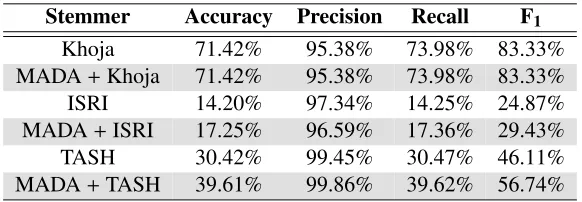
Arabic stemmers have been evaluated using a stan-dard IR test, due to the lack of existing stemmed datasets (Smirnov, 2008). In this section, the stemmers are evaluated using a manually stemmed dataset. In addition, an enhancement for the root extractors discussed in the Related Work section is obtained by using light stemmers as a preprocessing step to root extractors. The results of the enhance-ment are shown in tables 2, 3, and 4.
4.1 Evaluation Dataset
A set of 29 manually annotated documents were used for stemmers evaluation. The dataset is part of International Corpus of Arabic (ICA) (Alansary et al., 2007). ICA is a collection of Arabic documents obtained from various resources such as
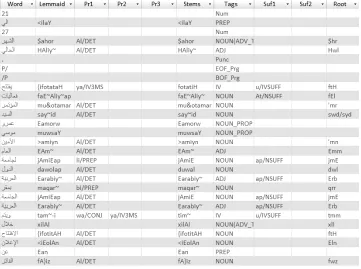
newspa-pers, magazines, and books (Alansary et al., 2007). ICA was collected and annotated to give a complete representation of the Arabic language to be used in Arabic NLP research (Alansary et al., 2007). The 29 documents contain 10,302 tokens. Only 8,941 words are Arabic words, while the remaining are to-kens, such as ”/T” (beginning of a title). Only 6,323 words have associated roots and 3,629 unique word-root pairs of the 10,302 tokens. Every word has a various set of features associated with it for evaluat-ing the discussed stemmers, such as stem and root. This makes the dataset an ideal reference for evalu-ating the introduced stemmers. However, some fea-tures were left blank because the words do not have the associated feature, such as stopwords, as shown in Figure 1. The dataset will be used to conduct a series of comparisons to evaluate Arabic stemmers from various perspectives.
4.2 Evaluation Criteria
Arabic roots and stems provide a valuable set of characteristics that are useful for many computa-tional tasks (Aljlayl and Frieder, 2002a)(Oraby et al., 2013a)(Ezzeldin et al., 2015). Various tasks re-quire different perspectives such as Information Re-trieval would use roots for grouping, and other may use linguistic features of roots.
The linguistic accuracy provides a representative measure for the efficiency of the stemmer in lin-guistic based tasks. Linguistic accuracy is com-puted as the ratio between the number of correctly stemmed words and the number of the input words. On the other hand, roots can be used as a word’s label, which can group linguistically similar words. Another set of measures were used to measure the macro and micro classification capabilities of the roots. The difference between macro and micro is that the size of class if reflected on the micro measure where the the macro measure treats classes equally regardless of class’s size. The following set of equations are used to provide macro and micro classification measurements (Manning et al., 2008):
4.3 Evaluation Results
Figure 1: Evaluation Dataset.
Accuracymacro=
Pn
i=1|Xi∩Yi|
Pn
i=1|Xi∪Yi|
Accuracymicro= 1 n
n
X
i=1
|Xi∩Yi| |Xi∪Yi|
(1)
Precisionmacro=
Pn
i=1|Xi∩Yi|
Pn
i=1|Xi|
Precisionmicro= 1 n
n
X
i=1
|Xi∩Yi| |Xi|
(2)
Recallmacro=
Pn
i=1|Xi∩Yi| Pn
i=1|Yi|
Recallmicro= 1 n
n
X
i=1
|Xi∩Yi| |Yi|
(3)
F1macro=
Pn
i=1|Xi∩Yi| Pn
i=1|Xi|+|Yi|
F1micro= 1 n
n
X
i=1
|Xi∩Yi| |Xi|+|Yi|
(4)
Where:
nis the number of candidate roots.
Xis the set of candidate roots.
Xiis an indvidual candiate root.
And
Y is the set of (semantically) correct roots.
Table 1: Light Stemmer Linguistic Accuracy
Light Stemmer linguistic Accuracy
MADAMIRA (MADA) 91.73%
Light10 47.83%
Table 2: Stemmers Lingustic Accuracy
Stemmer linguistic Accuracy linguistic Coverage
Khoja 72.1% 72.1%
MADA+Khoja 72.1% 72.1%
ISRI 14.2% 14.2%
MADA+ISRI 16.91% 16.91%
Tashaphyne (TASH) 30.3% 30.3%
MADA+TASH 38.23% 38.23%
ElixirFM NA 98.15%
Table 3: Stemmers Macro Classification Statistics
Stemmer Accuracy Precision Recall F1
Khoja 57.53% 57.53% 59.59% 58.55%
MADA+Khoja 57.53% 57.53% 59.59% 58.55%
ISRI 10.43% 10.43% 10.49% 10.46%
MADA+ISRI 15.40% 15.40% 15.60% 15.50%
TASH 25.07% 25.07% 25.15% 25.11%
MADA+TASH 41.79% 41.79% 41.85% 41.82%
Table 4: Stemmers Micro Classification Statistics
Stemmer Accuracy Precision Recall F1
Khoja 71.42% 95.38% 73.98% 83.33%
MADA+Khoja 71.42% 95.38% 73.98% 83.33%
ISRI 14.20% 97.34% 14.25% 24.87%
MADA+ISRI 17.25% 96.59% 17.36% 29.43%
TASH 30.42% 99.45% 30.47% 46.11%
MADA+TASH 39.61% 99.86% 39.62% 56.74%
and MADAMIRA stemmers, while the root extrac-tors stemmers are Khoja, ISRI, and Tashaphyne. The experiments also investigate combining the two types of stemming algorithms, where light stem-ming is used as preprocessing for root extractors. It combines MADAMIRA stemmer with Khoja, ISRI, and Tashaphyne stemmers. Only unique words in the dataset having an associated root feature are used in the test.
Table 1 shows the improvement of the light ming algorithm MADAMIRA over Light10 stem-mer. MADAMIRA gives an accuracy of 91.73% with roughly 44% accuracy improvement over Light10. Using the MADAMIRA light stemmer as a pre-processing phase before root extraction using Khoja, ISRI, and Tashaphanye stemmers improves the accuracy of root extraction.
ISRI, and Tashaphanye stemmers in standalone mode and when preceded by MADAMIRA pre-processing. There is a substantial difference be-tween Khoja stemmer and the other two, ISRI and Tashaphyne, with at least 40% linguistic accuracy gap. This is due to the usage of a roots dictionary by Khoja. But when adding MADAMIRA as a pre-processing phase, there is a noticeable improvement in ISRI and Tashaphanye by roughly 2% and 8%, re-spectively. There is no effect of using MADAMIRA with Khoja, this is due to the robust segmentation of Khoja and the existence of dictionary validation. The ElixirFM morphological trees were not suffi -cient to disambiguate the generated roots. However, it provides a valuable set of features and substantial root converge which can be used for further analy-sis. The usage of MADAMIRA is also reflected on the classification and clustering measures. As no-ticed, the increase of linguistic accuracy increases related measures, namely, classification and cluster-ing. Table 2 also shows the effectiveness of gener-ating possible roots of ElixirFM. However, the syn-tactic strategy for distinguishing words’ senses is not completely effective in producing only one root.
Classification has a distinctive property, that is grouping similar words. By comparing Tables 3 and 4, there is a noticeable increase in clustering mea-sures over classification. This due to the fact that size of classes is being reflected to the micro clas-sification measure where it is ignored with macro classification measure.
The performance of stemming algorithms can be noticeably improved by applying some minor changes, such as normalization processes. For ex-ample, changing the form of Hamaz (
ء
, an Arabic letter). Such changes would not affect only linguis-tic based task but also related non-linguislinguis-tic tasks.5 Conclusion
Stemmers are employed in various tasks, such as information retrieval (IR) (Aljlayl and Frieder, 2002a)(Larkey et al., 2002) and sentiment analysis (Oraby et al., 2013b). Stemmers achieve a notice-able improvement in related NLP tasks (Oraby et al., 2013a). However, the evaluation of stemmers does not explicitly show the stemming efficiency (Smirnov, 2008). In this paper, direct evalaution
was used to study the behaviour of Arabic stem-mers. The paper investigates two types of stemming algorithms, namely, light stemmers and root extrac-tors. The light stemmers studied were MADAMIRA (Pasha et al., 2014) and Light10 (Larkey et al., 2007). And, the root extractors studied were Khoja (Khoja and Garside, 1999), ISRI (Taghva et al., 2005), and Tashaphyne (Zerrouki, 2010). The mea-sures used to compare the stemmers were the lin-guistic accuracy and coverage, in addition to macro and micro classification measures. The results ob-tained show that the increase of linguistic accuracy increases the effectivness in other tasks(Oraby et al., 2013b)(Ezzeldin et al., 2015).
Otakar Smrz, Viktor Bielick´y, Iveta Kourilov´a, Jakub Kr´acmar, Jan Hajic, and Petr Zem´anek. 2008. Prague arabic dependency treebank: A word on the million words. InProceedings of the Workshop on Arabic and Local Languages (LREC 2008), Marrakech, Morocco, pages 16–23.
Otakar Smrˇz. 2007. Elixirfm: implementation of func-tional arabic morphology. InProceedings of the 2007 Workshop on Computational Approaches to Semitic Languages: Common Issues and Resources, pages 1–8. Association for Computational Linguistics. Kazem Taghva, Rania Elkhoury, and Jeffrey S Coombs.
2005. Arabic stemming without a root dictionary. pages 152–157.