Figure 1: Architecture of the NIF4OGGD system
only perform text search over the documents. However, keeping this information and performing advanced extrac-tion methods is one of our steps in a larger research agenda. In case ofCologne, we applied the above mentioned ap-proach which allow us to extract textual data from the doc-uments as well as docdoc-uments’ titles.
4.
Architecture
The NIF4OGGD architecture shown in Figure 1 has three main modules: Conversion of documents to NIF, Enrich-ment and Visualization & Search. The modules provide a flexible solution to integrate multiple web data sources us-ing semantic web standards and NIF.
4.1. Conversion of Documents to NIF
For the conversion to NIF, two resources where established for every document: First, the textual content of a docu-ment was added to a resource of the typenif:Context
with the nif:isString predicate as a literal. The URL of the source document was also included in the metadata to ensure full traceability of the original data. Second, the title string of the document was in turn added to a resource of the type nif:Title with the
nif:anchorOf predicate and linked to the context re-source via nif:referenceContext. Listing 2 pro-vides an example of a NIF conversion of a document pre-sented in Figure 3.
4.2. Enrichment
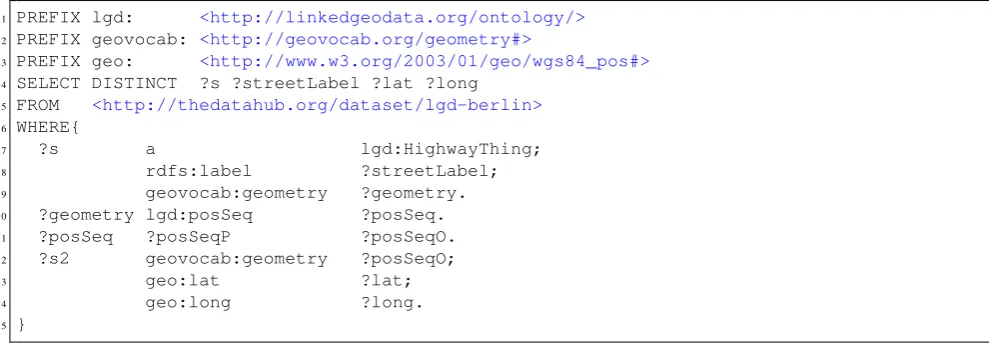
In order to link the geographical and the governmental data, the governmental data is enriched by geodata via Ling-Pipe Exact Dictionary-Based Chunker (i. LingLing-Pipe, 2013). LingPipe relies on the Aho-Corasick string matching algo-rithm (Aho and Corasick, 1975). The output of this extract-ing is stored as standardized NIF files. The collection of LGD locations and government data is additionally stored as a set of documents in aLucene (Hatcher et al., 2004) index.
Furthermore, we built an in-memory dictionary for the data provided by LGD. This dictionary is used for performing an analysis in all NIF files that contain governmental data.
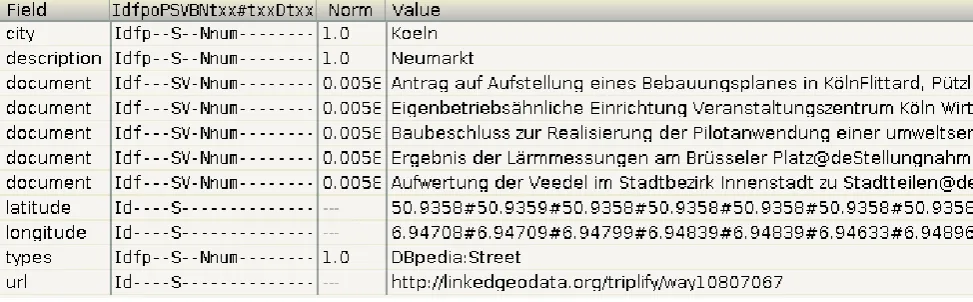
Specifically in the data stored in nif:isString prop-erty, when a location name occurs in a document, all the data are stored in the Lucene document corresponding to that location. Figure 2 shows an example of all fields stored for an indexed document.
4.3. Visualization & Search
Aiming to allow an easy integration of NIF4OGGD into ex-ternal web processes, we implemented RESTful and SOAP web services for the search process. The web service in-terface allows access to query a Lucene index and returns JSON and NIF format.
NIF4OGGD is deployed as a web service and has a very simple user interface for demonstration. The source code is available at our project repository13. The user interface14
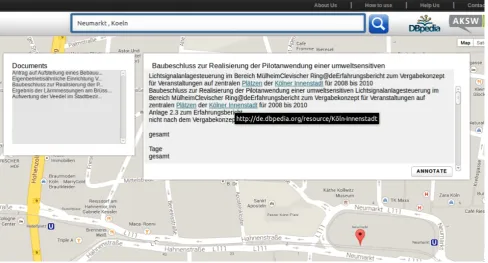
was built using the Google Maps API, allowing to search locations by name. Once the location is selected by the user, the map shows it on a map and displays related government documents stored in the index. It is also possible to annotate the texts using DBpedia Spotlight (Mendes et al., 2011) and use the annotated resources to discover more information in a graph database. Figure 3 shows the NIF4OGGD user interface.
5.
Use Cases
In this section, we outline application scenarios and use cases for our system.
Data Retrieval. An example use case for data retrieval are citizens searching for events in their neighbourhood. NIF4OGGD provides data about what governmental events happen in a specific area. For instance, Figure 3 shows a user query for governmental documents mentioning Neu-markt inCologne. As shown, there are many documents about the search topic, in which the user is free to browse.
Interoperability using NIF. The aligned governmental documents using NIF representation enable searching for the same entity across different authorities’ documents.
NIF’s interoperability capabilities make it easy to query all
13
Figure 2: Lucene index
Listing 2: Example NIF resources
1 <http://offeneskoeln.de/dokumente/3819-2011/#char=0,1596> 2 a nif:Context , nif:RFC5147String ;
3 nif:isString "Baubeschluss zur Realisierung der Pilotanwendung einer umwelt[...]"@de ; 4 nif:sourceUrl <http://offeneskoeln.de/dokumente/3819-2011/> ;
5 nif:sourceUrl <http://ratsinformation.stadt-koeln.de/vo0050.asp?__kvonr=29978> . 6
7 <http://offeneskoeln.de/dokumente/3819-2011/#char=0,40>
8 a nif:Title , nif:RFC5147String ;
9 nif:beginIndex "0"ˆˆxsd:nonNegativeInteger ; 10 nif:endIndex "12"ˆˆxsd:nonNegativeInteger ;
11 nif:referenceContext <http://offeneskoeln.de/dokumente/3819-2011/#char=0,1596> ; 12 nif:anchorOf "Baubeschluss"@de .
occurrences of a certain text segment in all available doc-uments without the need of any additional indexing. Es-pecially, sophisticated SPARQL queries can posed to inter-linked NIF documents, e.g., to find all places across Berlin where demonstrations were declared about some particular political issue.
Listing 3 introduces an example of using NIF to retrieve all documents mentioningBaubeschluss.
Information Aggregation. Using DBpedia Spotlight, NIF4OGGD annotates the governmental documents us-ing the cross-domain dataset ofDBpedia, which provides added value to the data. As an example, in Figure 3 user can use the annotated entities of the presented document to get detailed data aboutK¨olner Innenstadt.
6.
Conclusion and Future Work
NIF4OGGD is a novel language resource providing geo-graphical data that is interlinked with governmental infor-mation. We presented an extraction process for creating this language resource and made it freely available. In addi-tion, our project constitutes a new central sharing point for Open German Governmental Data which is published fol-lowing the 5 Star principles. In the future, we plan to extend our datasets and enrich it with more data from the LOD-cloud. Furthermore, we plan to employ additional NLP-algorithms, e.g., to just show documents with a valid time range, to provide more trustful documents via NIF4OGGD.
7.
References
Alfred V. Aho and Margaret J. Corasick. 1975. Efficient string matching: An aid to bibliographic search. Com-mun. ACM, 18(6):333–340, June.
S¨oren Auer, Chris Bizer, Georgi Kobilarov, Jens Lehmann, Richard Cyganiak, and Zachary Ives. 2008. DBpedia: A nucleus for a web of open data. InProceedings of the 6th International Semantic Web Conference (ISWC), volume 4825 ofLecture Notes in Computer Science, pages 722– 735. Springer.
S¨oren Auer, Jens Lehmann, and Sebastian Hellmann. 2009. LinkedGeoData - adding a spatial dimension to the web of data. InProc. of 8th International Semantic Web Con-ference (ISWC).
Tim Berners-Lee. 2011. Linked data-design issues (2006).
URL http://www.w3.org/DesignIssues/LinkedData.html. Bundesgesetzesblatt. 2013. E-government
gesetz des bundes (2013). URL http://www.bmi.bund.de/SharedDocs/Downloads/ DE/Themen/OED Verwaltung/Informationsgesellschaft/ egovg verkuendung.pdf.
Mordechai Haklay and Patrick Weber. 2008. Open-streetmap: User-generated street maps. Pervasive Com-puting, IEEE, 7(4):12–18.
Erik Hatcher, Otis Gospodnetic, and Michael McCandless. 2004. Lucene in action.
frag-Figure 3: Searching for governmental documents mentioning Neumarkt in Cologne
Listing 3: List of all occurrences of “Baubeschluss” using NIF
1 PREFIX str: <http://nlp2rdf.lod2.eu/schema/string/> 2 SELECT ?document {
3 ?s str:isString ?document.
4 ?textSegment str:referenceContext ?s;
5 str:anchorOf "Baubeschluss". 6 }
ments. InEKAW 2012, Lecture Notes in Computer Sci-ence (LNCS) 7603. Springer.
Sebastian Hellmann, Jens Lehmann, S¨oren Auer, and Mar-tin Br¨ummer. 2013. IntegraMar-ting nlp using linked data. In 12th International Semantic Web Conference, 21-25 October 2013, Sydney, Australia.
Alias i. LingPipe. 2013. Alias-i lingpipe. [Online; ac-cessed 23-October-2013;].
Pablo N Mendes, Max Jakob, Andr´es Garc´ıa-Silva, and Christian Bizer. 2011. Dbpedia spotlight: shedding light on the web of documents. InProceedings of the 7th In-ternational Conference on Semantic Systems, pages 1–8. ACM.
Eric Prud’hommeaux and Andy Seaborne. 2008. Sparql
query language for rdf. Latest version available
as
http://www.w3.org/TR/rdf-sparql-query/, January.
Claus Stadler, Jens Lehmann, Konrad H¨offner, and S¨oren Auer. 2012. Linkedgeodata: A core for a web of spatial open data. Semantic Web Journal, 3(4):333–354. Daniel Steinberg. 2012. libcurl: The multiprotocol file
transfer library.