Figure 1: Tree of syntactic dependencies in the sentence“ELF3 modulates resetting of the circadian clock in Arabidopsis”
along with other linguistic annotations
These rules are highly modular, and can therefore be reused to a large extent across different applications. For example, on the lower levels the syntactic rules will describe com-mon structures such as passive, active or nominalized ex-pressions. An example of a syntactic rule for the passive case is shown below:3
synRel(simple_passive, [H,B,A],
[ dep(subj,H,B),dep(pobj,H,A), dep(prep,A,By), pos(H,’VBN’), lemma(By,[’by’,’through’,’via’]) ]).
Rules at the next level can combine lower-level rules into more powerful structures, which allow the users to abstract away from the syntactic level. For example, a unique query will be needed to match all sentences that describe an inter-action between anagentA and atargetB, regardless of how they are expressed at the surface level. The argu-ments of the query can either be specific entities (e.g. ‘NF-KappaB’) or type restrictions (e.g. protein, cell, disease). As the set of patterns and rules is gradually enriched, so are the possible lexico-syntactic variants that can be captured. An example of a more advanced rule is the one which cap-tures“A triggers the H of B”, where H represent a nomi-nalized verb (activation, regulation, etc.). Similar complex rules have designed, e.g. for“under the control of ”, “in-volved in”,“be able to”etc. Because such rules are built on top of the lower-level rules, they automatically capture the known syntactic variants, such as“The H of B is trig-gered by A”. We refer to relations defined at this level as
domain relationsas they rely on lexical constraints which are typical of a given domain. The user query can happen at each one of the 3 levels. So it is possible to test individual syntactic rules, semantic rules, and domain rules.
If a domain ontology is available, we can extend the inter-pretation of the type restriction to mean not only the objects that directly match the given type, but also those that have a type subsumed by it.
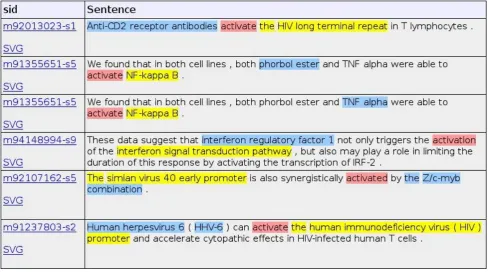
Additionally, the OntoGene Text Mining environment pro-vides facilities for debugging and visualization. For exam-ple, each result bears the name of the rules that generated it. This allows immediate detection of problems and their quick correction. An example is shown in figure 3. We also provide a “visual diff” facility that shows in the same graphical format the matches that have been acquired or lost as a consequence of the addition of a new pattern or rule.
3
A prolog-based syntax is adopted.
4.
Applications
The tools that we describe have been applied to extract se-mantic relations from two distinct corpora: GENIA and ATCR.
GENIA (Kim et al., 2003) is a corpus of 2000 Medline abstracts which have beenmanuallyannotated (by domain experts) for various biological entities according to the GE-NIA Ontology. A detailed description of this application can be found in (Rinaldi et al., 2006).
The ATCR Corpus (Arabidopsis Thaliana Circadian Rhythms) is a corpus of 147 Medline abstracts (up to year 2004), extracted using the keywords: “Arabidopsis Thaliana” and “Circadian Rhythms”. It has been automat-ically annotated using the “Biolab Experiment Assistant (BEA)”TM. This applications is described in (Rinaldi et al.,
2007).
In the case of the GENIA corpus, users can create com-plex queries which make use of the ontological relations, because the entity annotations have been created according to the types defined in the GENIA Ontology4.
Additionally, we have used an approach based on the rules described above as one of the key components within a text mining system aimed at extracting specific protein-protein interactions from biomedical literature. This system was used in our participation to the BioCreative text mining challenge (Krallinger et al., 2007), obtaining competitive results (for details see Rinaldi et al. (2008)).
BioCreAtIvE provides a framework for testing and evalu-ating text mining tools over a number of shared tasks of biological significance. One of them is the protein-protein interaction task, which consists of detecting from articles the main protein interactions reported by the authors.
5.
Evaluation
The applications over the GENIA corpus and the ATRC corpus were evaluated by asking domain experts to use the system and build rules to match the information of inter-est. During this process, they can make use of visual feed-back showing the coverage of each rule. The evaluation was based on a random selection of a limited number of sentences from the corpora, which were then manually as-sessed for the detection of relations and arguments of
inter-4http://www-tsujii.is.s.u-tokyo.ac.jp/
Figure 2: Sample output for the ‘activate’ relation
agent target
Y A P N Y A P N
activate 72 64 5 8 77 54 8 10
bind 36 18 1 8 39 18 1 5
block 3 0 0 0 1 1 0 1
TOTAL 111 82 6 16 117 73 9 16
52% 38% 3% 7% 55% 34% 4% 7%
correct 90% incorrect10% correct 89% incorrect11%
Table 1: Analysis of precision for selected relations over GENIA
est. Table 1 summarizes the values of precision. The col-umn identified by [Y] shows cases where the relation (and the corresponding argument) was considered by the biolo-gist as correct and relevant. The [A] column refers to argu-ment which were only partially correct (but sufficient to un-derstand the nature of the relationship). The other columns consider different types of errors.
In the absence of a gold standard, only approximative recall values can be reported. However, in the case of the ATCR application, we have been able to measure a “worst-case” recall value of 40% , which basically implies that our actual recall is at least as good as this value. On a smaller subset of the corpus we actually measured a recall value of 60% (for details see Rinaldi et al. (2007)).
In the context of the BioCreative competition, the task of detecting protein-protein interactions is additionally com-plicated by the need of locating protein names in the ab-stracts provided by the organizers, and normalizing them to unique identifiers. We developed techniques capable of lo-cating protein names and their variants starting from a set of seed terms obtained from UniProt (UniProt Consortium,
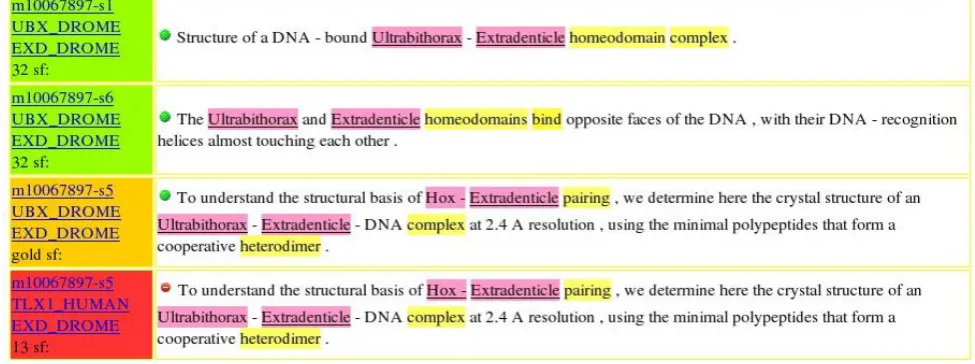
2007). Figure 4 shows an example of automatically anno-tated abstract.
Further, not all potential interactions are requested, but only those that the authors present as their main results. Interac-tions that are mentioned only as ‘background’ information should be ignored. The combination of these requirements makes the task extremely challenging, and no participating system was capable of achieving results above 50%. In our own system, after generating candidate interactions on the basis of co-occurrence of protein names within the same sentence, we have applied the methodology described above as a ‘syntactic filter’ in order to separate syntactically meaningful interactions from accidental ones. These filters proved to be extremely efficient: on the BioCreative train-ing set they allowed us to increase precision from 20% to almost 50% with only a minimal loss in recall. More details can be found in (Rinaldi et al., 2008).
6.
Related Work
Figure 3: Debugging facilities
2004; Ananiadou et al., 2006), with important contributions from the computational linguistics field (Miyao et al., 2006; Pyysalo et al., 2006; Daraselia et al., 2004).
In particular, the task of relation extraction has seen a num-ber of different approaches, which primarily can be clas-sified into three groups according to the amount of NLP involved.
Surface-based approaches (Hakenberg et al., 2007; Ehrler et al., 2007) make use of lexical or PoS patterns without attempting any deeper understanding of the nature of the interaction. The advantage is that such patterns can in many cases be automatically learnt from annotated corpora. Shallow parsing approaches typically detect the main con-stituents of the sentences, without building a complete syn-tactic analysis. An example is (Corney et al., 2004). Approaches based on full parsing attempt to build a com-plete syntactic structure for each sentence in the corpus, which is then used to extract or confirm candidate inter-actions. For example, (Gonzalez et al., 2007) use the Link Grammar parser, (Daraselia et al., 2004) makes use of an LFG parser, specifically adapted to Medline, (Saetre et al., 2007) use an HPSG parser, (Erkan et al., 2007) uses the Stanford dependency parser.
7.
Conclusion
We have developed various techniques that can support the process of relation discovery from biomedical litera-ture. These techniques have been evaluated on a corpus of 2000 medline abstracts and by participation to a compet-itive evaluation for text mining systems. In both cases, the results prove the effectiveness of the proposed approach.
Acknowledgments
This research is partially supported by the Swiss National Science Foundation (grant 100014-118396/1).
8.
References
Sophia Ananiadou, Douglas B Kell, and Junichi Tsujii. 2006. Text mining and its potential applications in sys-tems biology. Trends Biotechnol, 24(12):571–579.
K. Bretonnel Cohen and Lawrence Hunter. 2004. Natu-ral language processing and systems biology. In Werner Dubitzky and Francisco Azuaje, editors,Artificial Intel-ligence Methods and Tools for Systems Biology, pages 147–173. Springer Netherlands.
D. P. A. Corney, B. F. Buxton, W. B. Langdon, and D.T. Jones. 2004. BioRAT: Extracting biological information from full-length papers. Bioinformatics, 20(17):3206– 13.
Nikolai Daraselia, Anton Yuryev, Sergei Egorov, Svetalana Novichkova, Alexander Nikitin, and Ilya Mazo. 2004. Extracting human protein interactions from MEDLINE using a full-sentence parser. Bioinformatics, 20(5):604– 611.
Frederic Ehrler, Julien Gobeill, Imad Tbahriti, and Patrick Ruch. 2007. GeneTeam site report for BioCreAtIvE ii: Customizing a simple toolkit for text mining in molecu-lar biology. In (Krallinger and Hirschman, 2007), pages 199–208.
G¨unes¸ Erkan, Arzucan Ozgur, and Dragomir R. Radev. 2007. Extracting interacting protein pairs and evidence sentences by using dependency parsing and machine learning techniques. In (Krallinger and Hirschman, 2007), pages 287–292.
Graciela Gonzalez, Luis Tari, Anthony Gitter, Robert Lea-man, Shawn Nikkila, Ryan Wendt, Amanda Zeigler, and Chitta Baral. 2007. Integrating knowledge ex-tracted from biomedical literature: normalization and evidence statements for interactions. In (Krallinger and Hirschman, 2007), pages 227–236.
J¨org Hakenberg, Michael Schr¨oder, and Ulf Leser. 2007. Consensus pattern alignment to find proteprotein in-teractions in text. In (Krallinger and Hirschman, 2007), pages 213–216.
Lars Juhl Jensen, Jasmin Saric, and Peer Bork. 2006. Lit-erature mining for the biologist: from information re-trieval to biological discovery.Nature Reviews Genetics, 7:119–129.
depen-Figure 4: Example of an annotated abstract. The terms marked in violet are those identified by the system as protein names, the terms marked in blue are those identified as organism names, while those marked in orange are other classes of terms. Words marked in yellow are indicators for a relation, words marked in green might suggest the presence of a curatable relation. The green dot on the left of a sentence indicates that the system considers that sentence as potentially containing a “curatable” relation.
dencies extracted from biomedical literature. Technical report, IFI, University of Zurich. Technical Report IFI-2006.04.
J.D. Kim, T. Ohta, Y. Tateisi, and J. Tsujii. 2003. GE-NIA corpus - a semantically annotated corpus for bio-textmining. Bioinformatics, 19(1):i180–i182.
M Krallinger and L Hirschman, editors. 2007. Proc. of Second BioCreative Challenge Evaluation Workshop 2007. CNIO, Madrid.
Martin Krallinger and Alfonso Valencia. 2005. Text-mining and information-retrieval services for molecular biology. Genome Biology, 6(7):224.
Martin Krallinger, Florian Leitner, Carlos Rodriguez-Penagos, and Alfonso Valencia. 2007. Overview of the protein-protein interaction annotation extraction task of biocreative ii.Genome Biology.
Y Miyao, T Ohta, K Masuda, Y Tsuruoka, K Yoshida, T Ni-nomiya, and J Tsujii. 2006. Semantic retrieval for the accurate identification of relational concepts in massive textbases. InProceedings of COLING-ACL 2006, Syd-ney, Australia, pages 1017–1024.
Alexander A. Morgan, Zhiyong Lu, Xinglong Wang, Aaron M. Cohen, Juliane Fluck, Patrick Ruch, Anna Di-voli, Katrin Fundel, Robert Leaman, J¨org Hakenberg, Chengjie Sun, Heng hui Liu, Rafael Torres, Michael Krauthammer, William W. Lau, Hongfang Liu, Chun-Nan Hsu, Martijn Schuemie, and Lynette Hirschman. 2007. Overview of biocreative ii gene normalization.
Genome Biology.
Sampo Pyysalo, Tapio Salakoski, Sophie Aubin, and Ade-line Nazarenko. 2006. Lexical adaptation of link gram-mar to the biomedical sublanguage: a comparative evalu-ation of three approaches.BMC Bioinformatics, 7(Suppl 3):S2.
Fabio Rinaldi, Gerold Schneider, Kaarel Kaljurand, Michael Hess, and Martin Romacker. 2006. An Envi-ronment for Relation Mining over Richly Annotated Cor-pora: the case of GENIA. BMC Bioinformatics, 7(Suppl 3):S3.
Fabio Rinaldi, Gerold Schneider, Kaarel Kaljurand, Michael Hess, Christos Andronis, Ourania Konstanti, and Andreas Persidis. 2007. Mining of Functional Re-lations between Genes and Proteins over Biomedical Scientific Literature using a Deep-Linguistic Approach.
Journal of Artificial Intelligence in Medicine, 39:127– 136.
Fabio Rinaldi, Thomas Kappeler, Kaarel Kaljurand, Gerold Schneider, Manfred Klenner, Simon Clematide, Michael Hess, Jean-Marc von Allmen, Pierre Parisot, Martin Ro-macker, and Therese Vachon. 2008. Ontogene in biocre-ative ii. Genome Biology. (to appear).
Rune Saetre, Kazuhiro Yoshida, Akane Yakushiji, Yusuke Miyao, Yuichiro Matsubayashi, and Tomoko Ohta. 2007. AKANE system: Protein-protein interaction pairs in the BioCreAtIvE2 challenge, PPI-IPS subtask. In (Krallinger and Hirschman, 2007), pages 209–212. Gerold Schneider, Fabio Rinaldi, and James Dowdall.
2004. Fast, Deep-Linguistic Statistical Minimalist De-pendency Parsing. In G. Kruijff and D. Duchier, ed-itors, COLING-2004 workshop on Recent Advances in Dependency Grammars, August 2004, Geneva, Switzer-land, pages 33–40.
Burr Settles. 2005. ABNER: an open source tool for auto-matically tagging genes, proteins and other entity names in text. Bioinformatics, 21(14):3191–3192.
Yu Song, Eunju Kim, Gary Geunbae Lee, and Byoung-Kee Yi. 2005. POSBIOTM-NER: a trainable biomed-ical named-entity recognition system. Bioinformatics, 21(11):2794–2796.
Yoshimasa Tsuruoka, John McNaught, Jun’ichi Tsujii, and Sophia Ananiadou. 2007. Learning string similarity measures for gene/protein name dictionary look-up using logistic regression.Bioinformatics, 23(20):2768–2774. UniProt Consortium. 2007. The universal protein resource