The TextPro tool suite
Emanuele Pianta, Christian Girardi, Roberto Zanoli
Fondazione Bruno Kessler38100 Trento, Italy pianta, cgirardi, zanoli{@fbk.eu}
Abstract
We present TextPro, a suite of modular Natural Language Processing (NLP) tools for analysis of Italian and English texts. The suite has been designed so as to integrate and reuse state of the art NLP components developed by researchers at FBK. The current version of the tool suite provides functions ranging from tokenization to chunking and Named Entity Recognition (NER). The system‟s architecture is organized as a pipeline of processors wherein each stage accepts data from an initial input or from an output of a previous stage, executes a specific task, and sends the resulting data to the next stage, or to the output of the pipeline. TextPro performed the best on the task of Italian NER and Italian PoS Tagging at EVALITA 2007. When tested on a number of other standard English benchmarks, TextPro confirms that it performs as state of the art system. Distributions for Linux, Solaris and Windows are available, for both research and commercial purposes. A web-service version of the system is under development.
1.
Introduction
TextPro is a suite of tools oriented towards a number of NLP tasks such as Web page cleaning, tokenization, sentence splitting, morphological analysis, PoS-tagging, lemmatization, multiword recognition, chunking and NER.
The suite has been designed so as to integrate and reuse state of the art NLP components developed by researchers at FBK. These components were developed under different licenses and sometimes optimized for a single operating system or computer architecture. The user of each component had to manage possible interdependencies with other tools, and solve compatibility or portability issues.
TextPro tries to make it more easy. Single tools are still offered as stand-alone programs, but it is now possible to use them in an integrated environment, providing an extensible framework for creating and adding new components, for both research and commercial purposes. The tool suite has been designed in order to meet the following requirements:
Simplicity: The tool suite should be easy to install, configure and use. A wrapper program allows for specifying what kind of analysis are requested, and takes into account possible interdependencies between tasks.
Modularity: Each tool should have a well defined data interface. Removing, adding or substituting a module should be very easy.
Portability: A tool is taken into consideration for integration in TextPro, only if can be ported to the main operating systems, that is at least Linux, Windows, and Solaris
Evaluation: Whenever possible, tools are
evaluated on standard benchmarks.
The TextPro architecture is based on a pipeline of
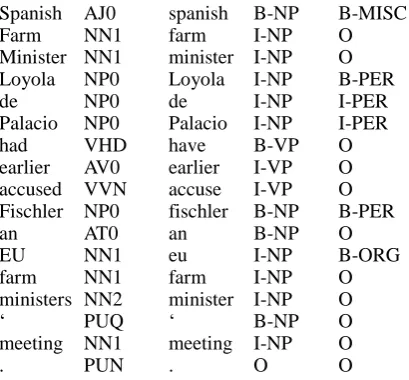
processors: each processor accepts data from an initial input or from the output of a previous processor, executes a specific task, and sends the resulting data to the next stage, or to the output of the pipeline. Pipelines of processors are widely used in building NLP applications, mainly due to their simplicity and flexibility. GATE is one well-known text processing framework following this approach (Cunningham et al., 2002). Although GATE is a well established and widely used system, it is relatively complex to use. This is also due the choice of using XML stand-off annotation as interchange format between processors. For this reason we decided to implement an alternative framework emphasizing simplicity and easiness of use. This explains also our decision to use tables instead of XML stand-off annotation as interchange format: each module adds its specific information on a different column of the table. The use of the IOB labeling format (Ramshaw & Marcus, 1995) allows the system to annotate a span of tokens with some information (in one column) and another partly overlapping span of words with another kind of information (on a different column). For example:
Spanish AJ0 spanish B-NP B-MISC Farm NN1 farm I-NP O Minister NN1 minister I-NP O Loyola NP0 Loyola I-NP B-PER
de NP0 de I-NP I-PER
Palacio NP0 Palacio I-NP I-PER
had VHD have B-VP O
earlier AV0 earlier I-VP O accused VVN accuse I-VP O Fischler NP0 fischler B-NP B-PER
an AT0 an B-NP O
EU NN1 eu I-NP B-ORG
farm NN1 farm I-NP O ministers NN2 minister I-NP O
„ PUQ „ B-NP O
meeting NN1 meeting I-NP O
. PUN . O O
sentence.
2.4
MorphoPro
MorphoPro is a morphological analyzer. It is made up of a development environment, implemented in Prolog, and a run-time version implemented in C++. The development version contains a declarative representation of the knowledge needed to analyze and synthesize Italian and English words. This knowledge is used to produce a list of all forms, which is then compiled in a very compact and efficient Finite State Automata. Such FSA is actually used by the run-time version of MorphoPro to analyze English and Italian words. For each input word, MorphoPro produces all possible morphological analysis. A morphological analysis is a sequence of features separated by “+”. The first two features of any analysis are always the lemma and lexical category, followed by a variable list of other features such as gender, number, etc.
2.5
TagPro
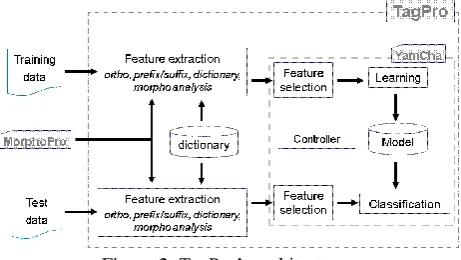
Part of speech tagging is the problem of determining the correct parts of speech of a sequence of words. We used YamCha, to build TagPro (Pianta & Zanoli, 2007), a PoS-tagging system able to exploit a rich set of linguistic features, such as prefixes, suffixes, orthographic information (e.g. capitalization, hyphenation), and the morphological features produced by MorphoPro. Each of these features is extracted for the current word, and for the previous and following words. We refer to these features as static features, as opposed to dynamic features, which are decided dynamically during tagging. For the latter, the system uses the tag of the two tokens preceding the current token.
Figure 2: TagPro‟s architecture
TextPro scored as the best system in the Italian Pos Tagging task at EVALITA 2007, with an accuracy of 98.04%. For English, the system obtains an accuracy of 97.80 when evaluated on the British National Corpus (BNC). Practical annotation time is 1000, 2000 tokens/sec.
2.6
ChunkPro
Text chunking consists of dividing a text in syntactically correlated parts of words and it can be considered as an intermediate step towards full parsing.
For example, the sentence “He reckons the current account deficit will narrow to only # 1.8 billion in September.” can be divided as follows: [NP He ] [VP reckons ] [NP the current account deficit ] [VP will
narrow ] [PP to ] [NP only # 1.8 billion ] [PP in ] [NP September ] .
Figure 3: ChunkPro‟s architecture
Given the word itself and the output of TagPro, ChunkPro groups words into flat constituents of the type: nominal, verbal, adjectival, adverbial. ChunkPro is based on YamCha, which is the system performing the best in the CoNLL-2000 Shared Task with an F1 measure equal to 93.48%.
When tested on the same test corpus, using the part-of-speech annotation given by TagPro, ChunkPro produces an F1 measure of 95.28%. The tool does not work for Italian yet.
2.7
EntityPro
NER is a subtask of Information Extraction which aims at locating and classifying words in text into predefined categories such as persons, organizations, locations, time expressions, etc.
The most frequently applied techniques for this task are based on machine learning: Hidden Markov Models, Maximum Entropy Models, Support Vector Machines (SVMs).
EntityPro (Pianta & Zanoli, 2007) is based on YamCha which exploits SVMs. As argued by T. Joachims (1998), one of the advantages of SVMs is that dimensionality reduction is usually not needed, as they are robust to overfitting and scale up well to high feature dimensions. YamCha allows for handling both static and dynamic features, and for defining a number of parameters such as window-size, parsing-direction (forward/backward) and algorithm of multi-class problems (pair wise/one vs rest).
Figure 4: EntityPro‟s architecture
Tjong Kim Sang, E. De Meulder, F. (2003). Introduction to the CoNLL-2003 Shared Task: Language-Independent Named Entity Recognition. In:
Proceedings of CoNLL-2003, Edmonton, Canada,
2003, pp. 142-147.