An Overview on the various Frameworks available for recharging Wireless Sensor Networks
Thomas Abraham Mr. B N Kiran
Student ( M.Tech CNE-VTU 4th SEM) Lecturer, Dept. of IS and Engg
The National Institute of Engineering, Mysore The National Institute of Engineering, Mysore
Abstract
Wireless Sensor Networks (WSNs) are finding its applications in different environments in our day to day life. However a drawback that our current technology faces is the technical knowledge of how these networks can be kept up and functioning to an efficient level. The power consumption and replenishment of these sensors that are deployed in the environment to be monitored has been a challenging factor since decades. Researches on the improvements in the efficiency in the power consumption of WSNs have been on the spotlight for quite a while. Premature energy depletion and outdated recharging strategies are some of the major areas that require improvement in the WSNs.
In this paper we discuss on the existing technologies and new proposals on the various frameworks that have been designed to improve the efficiency in the recharging of Sensors deployed in WSNs
Keywords-component
Introduction
THERE HAS BEEN A NUMBER OF RESEARCHES ON THE IMPROVEMENTS IN THE EFFICIENCY IN THE POWER CONSUMPTION AND RECHARGING OF WIRELESS SENSOR NETWORKS (WSN) ON THE SPOTLIGHT FOR QUITE A WHILE.PREMATURE ENERGY DEPLETION AND OUTDATED RECHARGING STRATEGIES ARE NOW SOME OF THE MAJOR AREAS THAT REQUIRE IMPROVEMENT IN THE WSNS.
There are several constraints mentioned in [1] that create bottlenecks in the performance during the recharging and transmission of information across the network. Some of the reasons for this is attributed to interferences in the WSNs due to simultaneous transmission over the same channel by the nodes or also could be because of signal being transmitted in a neighboring network that interferes with the WSN signal transmission. Another reason could be Multipath fading. It occurs when the recipient receives the same signal through the line of sight and another replica that is echoed after being reflected by various objects in the environment.
Advances in multichannel time synchronized mesh networks based on 802.15.4 radios address these issues to a large extent thereby optimizing the transmission process at a physical level.
HOWEVER THE IMPROVEMENTS AT A LOGICAL LEVEL WHICH INVOLVES THE STRATEGIES THAT NEEDS TO BE IMPLEMENTED FOR EFFICIENT COMMUNICATION BETWEEN NODES THROUGH DIFFERENT ROUTING METHODOLOGIES IS STILL IN PROGRESS. FEW OF THE MANY BREAKTHROUGHS IN THIS LEVEL SHALL BE DISCUSSED IN THE FOLLOWING SECTIONS.
2. Basic Network Components
Service stations or Base Stations (BS): Locations near sensor networks those are responsible for the distribution and execution of power and maintenance requirements of the WSN.
SenCars: The vehicles used to carry power in charged batteries from the Service stations to the nodes that require recharging.
Nodes: These refer to the sensors that are deployed in an area for monitoring and gathering information from those locations.
Head Node: The node assigned to each sub area that acts as a gateway between the nodes in that area and the nodes of a neighboring area. Usually the node with the highest energy level is selected for this task.
3. Low Energy Adaptive Clustering Hierarchy (LEACH)
called as a round which is made up of cluster setup stage ad steady state storage for the purpose of reducing energy costs [2]. The flow chart in figure 1 details the working of a LEACH Protocol:
Figure 1: Cluster formation of LEACH protocol [2]
The threshold function for node selection in the LEACH protocol is given by the following formula:
(1)
Here k is the number of clusters during each round and N gives the number of nodes in the network. Each node will be Cluster Head once in N/k rounds; N/k also means cluster size. In each cluster, each sensor has equal chance to become the cluster head [2].
Two Level LEACH (TL-LEACH) is an improvement on this model where it has two levels of cluster heads named as primary and secondary [3]. These clusters are randomly rotated so that the energy consumption is evenly distributed amongst the two clusters. This gives an improvement of over 30% of the energy that is consumed during the transfer of data in the network in LEACH.
4. Hybrid Energy Efficient Distributed Clustering (HEED)
HEED is a clustering method which considers the residual energy in the nodes for forming clusters [5]. Here the node with the highest energy is elected as cluster head node. Cases where the highest residual energy is same, the cost for communication between the nodes is considered to select the cluster head. However it has a slight drawback where the energy consumed during round shifting is not considered though the power dissipated in each round is accounted.
5.Energy Efficient Clustering Scheme (EECS)
EECS is typically similar to the LEACH clustering scheme where the network is partitioned into a set of clusters where each cluster contains one cluster head [6]. Interaction between the cluster head and BS happens in a single hop. However unlike LEACH, cluster formation in EECS is executed by dynamic sizing of clusters based on cluster distance from the base station. Thus the problem of energy efficiency in cases where the BS is far from the cluster head is resolved here.
During the network deployment, the BS sends out a message to all nodes at a fixed power level. From this message, each node is able to calculate the distance to the BS by comparing the transmission signal strength with the strength at which the signal is received.
As per the simulation detailed in [6] we can see that EECS is more efficient than the different variations of LEACH and HEED [2][3].
6.Base Station Controlled Dynamic Clustering Protocol (BCDCP)
This is a protocol very much similar to a variant of LEACH-C [7]. It has 2 major stages - Setup and Data Communication. As the name suggests, during the cluster formation process, the base station selects the right candidates from the nodes to be the cluster head. An algorithm is used to split the network into clusters continuously. Messages are aggregated at the cluster heads and sent across to the BS in multiple hops.
An enhanced version of BCDCP called as EEBDCP has been discussed in [7].
7.Threshold sensitive energy-efficient sensor network protocol (TEEN)
8. Adaptive Periodic Threshold sensitive energy-efficient sensor network (APTEEN)
APTEEN is a hybrid protocol for efficient routing that adapts the advantages in both LEACH and TEEN. It utilizes comprehensive information retrieval [9]. Data transmission in APTEEN follows the threshold value of TEEN and the periodic data transmission is done as in LEACH. Such a network enables the user to request past, present and future data from the network in the form of historical, one-time and persistent queries respectively. The threshold value and parameters that include the TDMA schedule count time is transmitted after cluster formation by the CH node to the other network nodes. All nodes communicate the collected data to the CH at the time set by the parameter. But it still has a disadvantage wherein all the nodes of the network are supposed to transmit data in a steady manner.
9.An Advanced Regional Clustering Scheme using Threshold dataset (ARCT)
ARCT is a protocol based on dynamic clustering that acts on the basis of the cluster and proactive network that transmits at a fixed time [10]. In addition it uses threshold just like in TEEN discussed earlier. Thus it can be categorized as a reactive network just like TEEN. ARCT uses two types of clusters— the regional cluster and the normal cluster. These clusters have different ways to collect data. The regional cluster contains data formed through a comparison of the data collected from adjacent nodes, and after that the head node of the regional cluster acts and transmits the collected data. The normal cluster combines with the nodes that failed to participate in the regional cluster. All the nodes that contain this cluster take part in data collection. The nodes that participate in this cluster increase the energy efficiency using a threshold value table when collecting data.
10. Advanced Region Clustering Scheme (ARCS)
11. NDN Based Real time Wireless Recharging Protocol (NETWRAP)
NETWRAP is a recent proposition on improving the routing efficiency of a WSN. It makes use of a new concept called Named Data Networking (NDN) proposed recently for the internet [12]. Here the data being communicated are referred to with their names rather than using the recipient’s address. Communication is initiated from the receiver and has two entities – Interest and Data, involved in its operation [11]. As interest messages are transmitted from one node to the other it creates a Pending interest table in each node it traverses. This helps in back tracking the path the message needs to take when it needs to get back to the receiver with the data. The forward transmission is based on Forward Interest Base states of the fellow nodes.
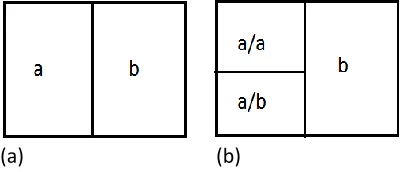
The network is divided into a hierarchical sub areas and energy information is collected in aggregated forms. Each subarea is given a name and the data is then addressed by the area’s name rather than the node address. For instance, say we have a rectangular area divided vertically to two areas ‘a’ and ‘b’ (figure 1). When ‘a’ is divided horizontally, the 2 new sub areas are named ‘a/a’ and ‘a/b’.
(a) (b)
Figure 2: NDN based division and naming of WSN Networks
After proper assignment of names, a head node is selected for each area. This would be usually the one with the maximum energy level in that area. The SenCars send energy requests to the heads in the top level. The heads send lower level energy interests to its child head in that area and so forth till the bottom most child nodes receive the energy interest messages. On receiving an energy level message a node responds with its ID and energy level. Thu the names of the nodes with low energy levels are aggregated and passed on up the hierarchy directing towards the head node of the respective area. So finally, the top most head node gets this information and passes it on to the SenCar.
The advantages of using NDN based protocol are a handful as discussed below:
Firstly, as compared to existing networks, the number of SenCars used in an NDN network is minimized to a great extent. This has a great impact in reducing the cost incurred in charging the nodes.
12. Conclusion
We have discussed the various protocols that have been implemented and proposed so far for improving the life time of WSNs. Some are specific to some applications and others can be used in general. Further researches can be done on finding how the strengths of one protocol can be combined with another and further improve the lifetime of networks they are being applied to. NDN seems to hold a new break through into how WSN can be managed power efficiently. Further research is required in this angle.
13. References
1. Lance Doherthy, Jonathan Simon and Thomas Watteyne, Dust Network Product Group, Linear Techology Corp, Millpitas, CA, Wireless Sensor Network Challenges and Solutions
2. Lalita Yadav et al, Low Energy Adaptive Clustering Hierarchy in Wireless Sensor Network (LEACH), IJCSIT Vol 5(3), 2014 4661-4664, ISSN: 0975-9646
3. V Loscri G Morabito and S. Marano, Two Level Hierarchy for Low Energy Adaptive Clustering Hierarchy, DEIS Department, University of Calabria via P.Bucci, 42/c 87036 Rende, CS, Italy
4. A. Al-zou’bi, Y. Khamayseh, W.Mardini and M.Bani Yassein, Improvement on LEACH Protocol of Wireless Sensor Network (VLEACH)- doi: 10.4156/jdcta.vol3.issue2.yassein
5. Younis, O. and Fahmy, S. (2004). HEED: A Hybrid, Energy-Efficient, Distributed Clustering Approach for Ad Hoc Sensor Networks. IEEE Transactions on Mobile Computing, 2004, 3(4), 660– 669.
6. Mao YE, Chengfa LI, Guihai CHEN, and Jie WU - An Energy Efficient Clustering Scheme in Wireless Sensor Networks. Ad Hoc & Sensor Wireless Networks, Vol. 3, pp. 99-119
7. K. Padmanabhan and P. Kamalakkannan, Energy Enhanced Base Station Controlled Dynamic Clustering Protocol for Wireless Sensor Networks – Journal of Advances in Computer Networks, Vol.1 No.1, March 2013
8. A. Manjeshwar and D. P. Agrawal. TEEN: A Routing Protocol for Enhanced Efficiency in Wireless Sensor Networks.In 1st International Workshop on Parallel and Distributed Computing Issues in Wireless Networks and Mobile Computing, April 2001.
9. Arati Manjeshwar and Dharma P. Agrawal, APTEEN: A Hybrid Protocol for Efficient Routing and Comprehensive Information Retrieval in Wireless Sensor Networks- Center for Distributed and Mobile Computing, ECECS Department,University of Cincinnati, Cincinnati, OH 45221-0030
10. Dongmin Choi, Sangman Moh, and Ilyong Chung, “ARCS: An Energy-Efficient Clustering Scheme for Sensor Network Monitoring Systems,” ISRN Communications and Networking, vol. 2011, Article ID 572572, 10 pages, 2011. doi:10.5402/2011/572572
11. Cong Wang, Ji Li, Fan Ye and Yuanuan Yang,, NETWRAP: An NDN Based Real-Time Wireless Recharging framework for Wireless Sensor Networks, IEEE Transactions on Mobile Computing, Vol 13, No.6, June 2014
12. V. Jacobson, D Smetters, J. Thornton, M. Plass, N.Briggs and R.Baraynard, “Networking Named Content”, Proc. ACM 5th Int’l Conf. Emergency Networking Experiments and Technologies (CoNEXT) 2009.
![Figure 1: Cluster formation of LEACH protocol [2]](https://thumb-us.123doks.com/thumbv2/123dok_us/8607001.1396709/3.612.76.335.85.344/figure-cluster-formation-leach-protocol.webp)