An Optimal Clustering Approach In Web Usage
Mining For Recommendation System
Tripti Saxena , Dr Pratima Gautam
Abstract: Web usage mining is used to identify and understand patterns that are taken from web data. Web usage mining is one of the applications of Data mining procedures to perceive and comprehend the requirements of electronic uses. In other words, the quick development of web-based business has incited the item to be over-burden, where the clients on the web are not ready to successfully choose the items they are presented to. To overcome these issues, web usage mining can be used to generate patterns. Web usage mining is an effective technique for extracting knowledge from unstructured data. In our research work, we are using HMM ranking and Expectation Minimization-Gaussian Mixture Model (EM-GMM) clustering for generating better patterns for the ease of web based services. The research work is performed on MATLAB simulation tool for generating rules for clusters first and second.
Keywords: Web Mining, Web usage mining, Clustering, HMM, Recommender System, Expectation Minimization-Gaussian Mixture Model (EM-GMM).
————————————————————
1.
INTRODUCTION
Web usage mining (WUM) defines as web log mining as well. WUM mines the log data put away out in the web server. Colossal improvement in World Wide Web expands the multifaceted nature for clients to peruse it efficiently. To build the execution of sites better web architecture, web server exercises are moved to according to clients' interests. The ability to know the habits and interests of users supports in the operational approaches of enterprises.Web mining is the use of data mining processes to separate web data from web records, including web archives, hyperlinks between records, logging sites, and so on. Web mining (WM) can also be termed as the integration of the knowledge collected by conventional data mining methods and techniques with knowledge related to the web.Two unique methodologies were taken in at first characterizing Web mining. The initial one was a 'procedure driven view', which terms WM as a series of errands and ‘data-driven view' was other one, in which Web mining is characterized as far as the kinds of Web data which was utilized in the mining procedure.
There are three common category of knowledge which knows how to be found by web mining:
Web activity, server log & tracking the web browser activity.
Web graphs, from connections to pages.
For data found in web content, web pages and
archives.
2.
WEB
USAGE
MINING
With the increasing demand of internet more number of websites is being involved for getting required information and thus more usage of web-based data. The data which is stored in different format types in the web log file. This log record ought to be kept up as this data is in an unsorted way and it is done through preprocessing. WUM centers on finding valuable data. Web log record is consequently produced by the web
server at whatever point client gets to the asset like site page of the site WUM is the way toward pulling back the helpful information from the server logs. It is the utilization of data mining procedures to find fascinating use designs from Web data so as to understand and better serve the prerequisites of the Web-based applications. Web usage data note down the identity of the user and their browsing behavior at a particular Web site. Usage data can be documented in the form of log files. A weblog is a record where the server takes the learning always client asks for websites from a specific Server. Log document might be put in 3 distinct areas for example web servers, web intermediary server, client's browser.
web server log documents
The Log document comes under Web-server focuses
on customer's action, which gets the web-server via web-browser for a website.
Web Proxy Server
It's the middle server (mode of cooperation) that exists between the customer and Web server. With these lines, if the web server receives the customer's demand through the intermediary Server, next records for Log would be data of the proxy-Server & none customer's first. These web proxy servers keep individual Log record for the client's social event.
Customer/User Browsers
These log documents can be created to remain in the customer's browser window. There are several software that a user can download in their browsing window. And, after all its say and the log records are available in the customer's browser window, the sections of Log document are only made by the web-server.
3.
DESCRIPTION
OF
WEB
USAGE
MINING
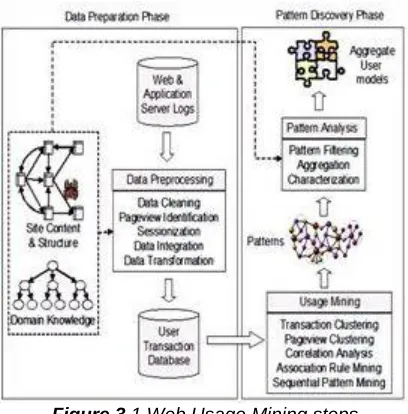
Data mining process used by WUM to finding useful patterns from web usage data. Through log records and site related mining, it can be able to find user access patterns. Figure 3.1 displays the overall process of mining the Web usage with all essential steps. These are data collection, pre-processing, pattern discovery and pattern analysis.
_____________________
Tripti Saxena is currently pursuing PhD in computer science and engineering in AISECT University, Bhopal (MP), PH-9753485817. E-mail:[email protected]
Figure 3.1 Web Usage Mining steps
Weblogs on web server are important data centers for WUM. When the user requests the resources of the web server, then each request is entered in the web log file on the web server. Consequently, clients browsing behavior is entered into the weblog document. Similarly, data is collected from website documents and operational database. The collected data in the weblog record is inadequate and is not suitable for direct mining. Pre-processing is important for transforming data into a suitable structure for pattern search. Pre-processing can give accurate, compact data for data mining, Includes data pre-processing, data cleaning, user identification, customer session recognition, path completion, and data integration [1]. The last step of the WUM process is the Pattern Analysis. Pattern discovery is the most important step of WUM process to extract the set of patterns and next choose the useful pattern and filter out uninteresting patterns by pattern analysis. By using some methods pattern analysis performed. These methods are data and knowledge query (like SQL), OLAP technology and usable analysis. After getting the patterns from queries then extracted pattern are arranged in cube then OLAP activities are carried out on these patterns. When patterns are extracted from pattern set there is need of representing the results, the methods of representation, for example, are used regularly for different properties to separate the coloring pattern or color to tilt the normal pattern or data. To filter the patterns (like specific page, content type page or hyperlinks) used content and structure information. The result of pattern analysis helps in e-commerce in the following ways:
For fulfill the requirement of users according to user’s browsing behavior from the sites, E-commerce web site pattern are improved.
As of personal interest personalize the web sites and for the visitor change the web site specifically.
To detecting the intrusion develop a security system which
can be prohibited user access from online content.
Clients can be maintained by understanding the client's basic requirements with providing customized products, satisfied the clients by the use of tracking behavior in e-commerce..
Analyze the behavior patterns of consumers to effective estimation of advertise.
Web server activity includes server log files. Gives insights regarding document solicitations to a web-Server reaction to those solicitations, Weblogs are kept up by Web-Servers & hold data about clients getting to the webpage.
To know the user’s behavior uses web log files. Weblog files have requests to address web servers and it can be recorded in the sequential request. Web Server logs are basic contented (ASCII) documents, which are autonomous of the server phase.
Web server logs are of following types:
Access Log File: Information about all received requests & client’s Server.
In Access Log Records all the requests proceeds via
Server.
Error Log File: record of inner error. When there is an error, on the page the client is requesting the entry from the web server, which is entered in the Error Log. Mostly, Access & Error Logs are utilized, although agents and Referrer Logs can be enabled on the Server.
Agent Log File: Knowledge regarding user’s browser,
browser edition.
Referrer Log File: it is used to giving information of links and user is forwarded to the website.
Log files maintain various types of information in different web servers. Table 1 represents the some information about web log
IP address of User IP address of User Client's verification
name
Username and password if he server necessitates client verification
The date-time stamp The time spent on each website page when surfing by the site of the client
The HTTP request The HTTP status code returned to the client
The Response status Response status of demanded webpage The size of requested
recourses Requested resource size Reference URL The asset gotten to by the client Client's browser
recognition
Browser wherever client sent a requests to the Web-Server
Visiting Path The way the customer was taken whereas going to the site
Demand type Strategy to be used for posted information is noted
4.
RECOMMENDER
SYSTEM
they have comparable tastes[11]. Such clients fabricate a gathering or an alleged neighborhood. A client gets suggestions to those things that he/she hasn't evaluated previously, yet that was at that point emphatically appraised by clients in his/her neighborhood.Different methodologies of CF are:
User-based methodology: This method was found in
the late 1990s by the University of Minnesota's teacher Jonathan L. It was proposed by Heralkar. In the user-based methodology, clients do primary tasks. If some customers have the same taste then they are involved in a group. Depending on the assessment of things by different clients, an identical gathering is recommended to the customer, with who regularly share the inclination. If community rated an item positively, it would be suggested for the users [12,13].
Item-Based methodology: In 2001, researchers of
University of Minnesota projected this method [14]. Alluding to the way that the essence of clients stays consistent or alter somewhat comparative things fabricate neighborhoods dependent on thanks of clients. A while later the framework produces recommendations with things in the area that a client would incline toward [14] [23]
Hybrid recommendation methodology: For better
outcomes some recommender frameworks
consolidate diverse procedures of
community-oriented methodologies and content-based
techniques.
We have proposed a new method of clustering namely Gausssian Mixture model (GMM) in this paper, which provides a significant improvement in the generation of no. of rules. Fig. 2 displays the role of recommendation system in web usage mining.The remainder of this paper is arranged as follows. Segment V provides preprocessing and point-by-point information of data mining methods that are accessible for use. In Segment VI, the review of the whole proposed framework is talked about pursued by the usage subtleties and result assessment in segment VII. Segment VIII portrays the end alongside future work.
Figure 2 Web Usage Mining based Recommender System
5.
LITERATURE
REVIEW
Cooley et al introduced web usage mining firstly, and it focused on users’ preferences on the Internet to prediction and learning [7]. The whole procedure of WUM is commonly partitioned into two essential assignments: data planning & pattern discovery [2]. The essential data hold by some servers such as Web servers, proxy servers and web customers, which is required for WUM. [9] It has been estimated web log data preprocessing takes 80% time of the data mining. Preprocessing work can be done in two ways: In the primary system, weblogs are mapped to relational databases; subsequently suitable mining calculations are adjusted for more analysis [10]. The other strategy uses an extraordinary preprocessing way to change the log notification to fit clear mining algorithms. Incidentally, the proposed technique in this study uses the first approach to pre-processing data. The data preparation work creates a server session file, where each session contains a sequence of different types of requests made by a user during the same visit [2]. For access web log data different preprocessing function are used. In [11], portrayal web browsing designs of data planning techniques. Various strategies are discussed about finding designs used to be specific Apriori [12], Naesve Bayesian [13], and agglomerative clustering [14] and they are given actual form. The pattern discovery functions include the findings of association rules, sequential patterns, user classification etc. [15]. The use of removed utility designs from web data can be
related to broad scope, for example, optimized
personalization, framework enhancement, webpage
modification, business intelligence search, usage
browser Logs, client profile, Web-Server Logs, enlistment information, customer session or exchanges, behavior, customer inquiries & other type knowledge which is effect of web connection.In [8] A fuzzy rule-based clustering algorithm uses a managed sequence method so that the unsupervised bunch can handle the probe. It naturally attempts to investigate potential groups in data designs and identify them with some interpretable fuzzy rules. Together with these fuzzy rules, classification of data designs can highlight the actual boundaries of the clusters.
6.
PROPOSED
WORK
The Gaussian mixture model (GMM) based clustering are proposed by using enhance the probability function with EM algorithm [5], [6], [7], [8] which gives better results in compare of Fuzzy C-Means (FCM). This proposed method is more suitable to find the arbitrary ellipsoidal shapes clusters with arbitrary number of data points.In GMM-EM clustering use the existing HMM ranking results as a input parameter. [5-8] accommodating GMM-EM to increasing probability function with respect to parameters (components and mixing coefficient of covariances and involved average). The steps of EM clustering have been presented further. µkα) By considering the parameters for the current GMM-EM stage, the means
covariance matrices and combination coefficients (where
k=1,....K) as a result of the previous period of k-means clustering calculate and assess the initial value of log probability..β) E step. Assess the obligations utilizing the present values of parameter
(znk) =
( ) ( )(1)
ϒ) M step. By using current responsibilities again calculate the parameters [5-8]
=
(znk) (2) (znk)( )( )
T (3)
= (4) Where,
(znk)= Nk (5) δ) Assess the log probability
ln p(X| , ) = ln ( , ) (6)
ε) Parameters convergence or log probability tests. On the off chance that the convergence criterion isn't fulfilled, come back to step b.
HIDDEN MARKOV MODEL
HMM depends on Markov series. The Markov model is used to defining the random variable probability and the state's sequence, which is one of the few who can go against prices from some set. These sets can be words, or labels, or images speaking to anything, similar to the climate. A Markov chain makes a solid presumption that on the off chance that we need to anticipate the future in the sequence, the only thing that is important is the present state. The states before the current state have no impact on the future except via the current state. It's as though to anticipate tomorrow's climate you could inspect the present climate yet you weren't permitted to see yesterday's climate.All the more formally, take a series of state factors q1,q2,...,qi . A Markov model encapsulates the Markov suspicion on the probabilities of this arrangement: that Markov presumption while foreseeing the future, the past doesn't make a difference, only the present. Markov supposition:
P(qi = a|q1...qi−1) = P(qi = a|qi−1) (7)
A Markov chain is valuable when we have to process a probability for an arrangement of noticeable events. Much of the time, be that as it may, the events we are keen on are concealed: we don't watch them specifically. For instance we don't regularly watch grammatical feature labels in content. Or maybe, we see words and should induce the labels from the word succession. We call hidden tags because they are not observed. A hidden Markov model (HMM) enables us to discuss both events seen (such as we meet in information) and hidden incidents (such as grammatical form labels) which we consider to be causal factors in our potential model. A HMM is determined by the accompanying parts:
S = s1s2 ...sM is set of M states
M = m11m12 ...mn1 ...mnnis a transition probability matrix M, all mkl speaking to the moving probability from state P k to state l, subjected to mkl = 1 ∀ k
UO = uo1uo2 ...uosis U observations chain, every one drained from a dictionary D = d1, d2,..., di
OP = opi(uot) is observation probabilities chain, additionally called as outflow probability, all communicating the likelihood of a perception ot being produced from a state i
= 1, 2,..., Nis a starting probability dispersion in excess of states. The probability of i that Markov series will start in the state i. some of the states from j have j = 0. These states cannot be considered as start states. Additionally, i = 1.
Proposed Algorithm:
Step:1 Initializethe process Step:2 Apply preprocessing
Step:3 AssessSession and customer identification
Step:4 Apply calculated Knowledge Base and Pattern mining
Step:5 Now rules will be generated using Apriori Algorithm Apply Apriori Algorithm on selected data
JOINING PHASE: Ki is generate by join the Fi-1 with itself
PRUNING PHASE: some (i-1)-item set that e not repeated most of the time, is not considerable as frequent i-item set subset
Ki: Candidate item set with i size Fi: Frequent item set with i size F1 = {Frequent Item};
For ( i = 1; F i != null; i++) do begin Ci+1 = Generated Candidates from Fi ; For every T transactions in DB do
Add the all candidates count in Ci+1 which are enclosed in T
Fi+1 = candidates in Ki+1 with min_supp End for
Returns ∪i F i;
Step:6 Generate PID for all existing product
Step:7 Calculate PID counts for visited URLs and Purchased Products
Step:8 If Counts >Threshold
Step:9 Evaluate Min. Supp Value (MSV) and Min. Conf. Value
(MCV)
Step:10 Now apply EMGMM over the data
Step:11 Calculate PID counts for visited URLs and Purchased Products
Step:12 Form two clusters of the generated URLs and Products
The above pseudocode shows the basic steps of the entire process which highlights the sequence of the techniques applied over the system. The threshold value taken in step 8 is visit =30 and purchase = 03.
Figure 3 Data Flow Diagram of EMGMM
MSV = 0.12 and MCV = 0.2.
7.
RESULT
ANALYSIS
MATLAB uses a wide assortment of potential along with signal and image handling, correspondence, control configurations, test sizing, financial modeling and analysis, computational science and parallel preparation. The current PC framework has standard anti-focus and then-throughput-based stimulants, for example, large enlisting power in the form of normal processing units. The MATLAB programs are definite and expressly communicate information level equality as language gives some unusual state administrators who work specifically on groups. Traditionally, MATLAB is used as a programming language for writing different types of simulations. In areas such as control engineering, image processing and communication, it is widely used for simulation and designing the system. These programs are usually long lasting and developers make significant efforts in trying to reduce their running time.The rules produced in excess of the cluster once mining association rules from this sort of non-value-based data, we may discover hundreds or thousands of rules compared to explicit feature values. We in this manner present a clustered association rule as a rule that
is shaped by consolidating comparative, \adjacent"
association rules to structure a few general rules. Figure 4 and figure 5 shows the rules generated without EMGMM.
Figure 4 visualizing the rules generated without EM-GMM
Figure 5 visualizes continued phase of rules generated without EM-GMM
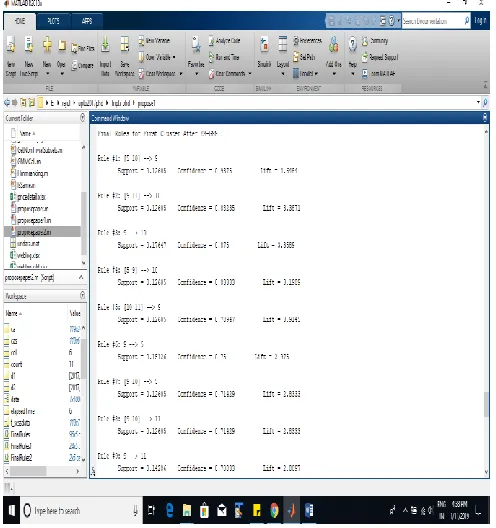
Figure 6 shows the rules generated for first cluster after EMGMM
Figure 7 shows the rules generated for second class after EM-GMM
Final Rules Without EM-GMM :
Rule #1: [8 10] --> 9
Supp = 0.12605 Conf = 1 Lift = 4.9583 Rule #2: [7 8] --> 9
Supp = 0.13445 Conf = 0.941 Lift = 4.666 Rule #3: [5 10] --> 9
Supp = 0.126 Conf = 0.937 Lift = 4.648 Rule #4: [7 10] --> 9
Supp = 0.142 Conf = 0.894 Lift = 4.436 Rule #5: [5 9] --> 7
Supp = 0.134 Conf = 0.888 Lift = 3.777 Rule #6: [8 9] --> 7
Supp = 0.134 Conf = 0.888 Lift = 3.777 Rule #7: [7 11] --> 9
Supp = 0.126 Conf = 0.88235 Lift = 4.375 Rule #8: [9 11] --> 7
Supp = 0.126 Conf = 0.88235 Lift = 3.75 Rule #9: [9 11] --> 10
Supp = 0.126 Conf = 0.88235 Lift = 3.387 Rule #10: 9 --> 10
Supp = 0.17647 Conf = 0.875 Lift = 3.3589 Rule #11: [7 9] --> 10
Supp = 0.14286 Conf = 0.85 Lift = 3.2629 Rule #12: [5 7] --> 9
Supp = 0.13445 Conf = 0.84211 Lift = 4.1754 Rule #13: 9 --> 7
Supp = 0.16807 Conf = 0.83333 Lift = 3.5417 Rule #14: [5 9] --> 10
Supp = 0.12605 Conf = 0.83333 Lift = 3.1989 Rule #15: [8 9] --> 10
Supp = 0.126 Conf = 0.833 Lift = 3.198 Rule #16: 15 --> 14
Supp = 0.15966 Conf = 0.82609 Lift = 3.9322 Rule #17: 22 --> 17
Supp = 0.15126 Conf = 0.81818 Lift = 4.0568 Rule #18: [9 10] --> 7
Supp = 0.14286 Conf = 0.80952 Lift = 3.4405 Rule #19: [7 9] --> 5
Supp = 0.13445 Conf = 0.8 Lift = 3.1733 Rule #20: [7 9] --> 8
Supp = 0.13445 Conf = 0.8 Lift = 4.1391 Rule #21: 40 --> 41
Supp = 0.126 Conf = 0.789 Lift = 4.4737 Rule #22: [10 11] --> 9
Supp = 0.12605 Conf = 0.78947 Lift = 3.9145 Rule #23: 8 --> 9
Supp = 0.15126 Conf = 0.78261 Lift = 3.8804 Rule #24: 16 --> 17
Supp = 0.15126 Conf = 0.78261 Lift = 3.8804 Rule #25: 4 --> 3
Supp = 0.142 Conf = 0.772 Lift = 2.786 Rule #26: 14 --> 15
Supp = 0.159 Conf = 0.76 Lift = 3.93 Rule #27: 26 --> 27
Supp = 0.159 Conf = 0.76 Lift = 3.478 Rule #28: 9 --> 5
Supp = 0.151 Conf = 0.75 Lift = 2.97 Rule #29: 9 --> 8
Supp = 0.151 Conf = 0.75 Lift = 3.880 Rule #30: 17 --> 16
Supp = 0.151 Conf = 0.75 Lift = 3.88 Rule #31: 17 --> 22
Supp = 0.151 Conf = 0.75 Lift = 4.05 Rule #32: [7 9] --> 11
Rule #33: 8 --> 7
Supp = 0.142 Conf = 0.739 Lift = 3.141 Rule #34: 27 --> 26
Supp = 0.159 Conf = 0.730 Lift = 3.478 Rule #35: 6 --> 7
Supp = 0.126 Conf = 0.714 Lift = 3.035 Rule #36: 7 --> 9
Supp = 0.168 Conf = 0.714 Lift = 3.54 Rule #37: 41 --> 40
Supp = 0.126 Conf = 0.714 Lift = 4.47 Rule #38: [9 10] --> 5
Supp = 0.126 Conf = 0.714 Lift = 2.83 Rule #39: [9 10] --> 8
Supp = 0.126 Conf = 0.714 Lift = 3.69 Rule #40: [9 10] --> 11
sup = .126 conf. = .714 LIFT = 2.80 Rule #41: 2 --> 5
sup = .142 conf. = .708 LIFT = 2.83 Rule #42: 9 --> 11
sup = .142 conf. = .708 LIFT = 2.80 Rule #43: 13 --> 17
Supp = 0.142 Conf = 0.708 Lift = 3.51 Rule #44: 17 --> 13
Supp = 0.142 Conf = 0.708 Lift = 3.512 Rule #45: 9 --> [7 10]
Supp = 0.142 Conf = 0.708 Lift = 4.43 Rule #46: 8 --> 5
Supp = 0.134 Conf = 0.695 Lift = 2.75 Rule #47: 8 --> [7 9]
Supp = 0.134 Conf = 0.695 Lift = 4.13 Rule #48: 22 --> 13
Supp = 0.126 Conf = 0.681 Lift = 3.380 Rule #49: 22 --> 16
Supp = 0.126 Conf = 0.681 lift = 3.52 Rule #50: 7 --> 5
sup = 0.159 conf. = .678 LIFT = 2.69 Rule #51: 7 --> 10
sup = .159 conf. = .678 LIFT = 2.60 Rule #52: 10 --> 9
Supp = .176 Conf = 0.677 Lift = 3.35 Rule #53: 9 --> [5 7]
Supp = 0.134 Conf = 0.666 Lift = 4.175 Rule #54: 9 --> [7 8]
Supp = 0.134 Conf = 0.666 Lift = 4.666 Rule #55: 8 --> 10
Supp = 0.126 Conf = 0.652 Lift = 2.50 Rule #56: 16 --> 22
Supp = 0.126 Conf = 0.652 Lift = 3.52 Rule #57: 8 --> [9 10]
Supp = 0.126 Conf = 0.652 Lift = 3.69 Rule #58: 5 --> 7
sup =.159 conf. = .633 LIFT = 3.69 Rule #59: 11 --> 10
sup = .159 conf. = .633 LIFT = 2.43 Rule #60: 2 --> 11
up = .126 conf. = .625 LIFT = 4.479 Rule #61: 13 --> 22
Supp = 0.126 Conf = 0.625 Lift = 3.38 Rule #62: 9 --> [5 10]
Supp = 0.126 Conf = 0.625 Lift = 4.648 Rule #63: 9 --> [7 11]
Supp = 0.126 Conf = 0.625 Lift = 4.375 Rule #64: 9 --> [8 10]
Supp = 0.126 Conf = 0.625 Lift = 4.958 Rule #65: 9 --> [10 11]
Supp = 0.126 Conf = 0.625 Lift = 3.914 Rule #66: 10 --> 7
sup = .159 conf. = .612 LIFT = 3.604 Rule #67: 10 --> 11
sup = 0.159 conf. = .61 LIFT = 4.43 Rule #68: 7 --> 8
Supp = 0.142 Conf = 0.607 Lift = 3.14 Rule #69: 7 --> 11
Supp = 0.142 Conf = 0.607 Lift = 2.40 Rule #70: 7 --> [9 10]
Supp = 0.142 Conf = 0.607 Lift = 3.44 Rule #71: 5 --> 9
Supp = 0.151 Conf = 0.6 Lift = 2.97 Rule #72: 7 --> [5 9]
Supp = 0.134 Conf = 0.571 Lift = 3.77 Rule #73: 7 --> [8 9]
Supp = 0.134 Conf = 0.571 Lift = 3.77 Rule #74: 5 --> 2
sup = .142 conf. = .566 LIFT = 2.80 Rule #75: 5 --> 11
sup = .142 conf. = .566 LIFT = 2.24 Rule #76: 11 --> 5
sup = .142 conf. = .566 LIFT = 3.247 Rule #77: 11 --> 7
sup = .142 conf. = .566 LIFT = 3.40 Rule #78: 11 --> 9
sup = .142 conf. = .566 LIFT = 4.809 Rule #79: 10 --> [7 9]
Supp = 0.142 Conf = 0.548 Lift = 3.262 Rule #80: 7 --> 6
Supp = 0.126 Conf = 0.535 Lift = 3.035 Rule #81: 7 --> [9 11]
Supp = 0.126 Conf = 0.535 Lift = 3.75 Rule #82: 5 --> 8
sup = .134 conf. = .533 LIFT = 3.75 Rule #83: 5 --> 10
sup = .134 conf. = .533 LIFT = 3.047 Rule #84: 5 --> [7 9]
Supp = 0.134 Conf = 0.533 lift = 3.173 Rule #85: 10 --> 5
sup = .134 conf. = .516 LIFT = 3.04 Rule #86: 3 --> 4
supp = .142 conf. = .515 LIFT = 4.78 Rule #87: 11 --> 2
sup = .126 conf. = .501LIFT = 1.479 Rule #88: 5 -->3
sup = .12605 conf. = .521 LIFT = 1.803 Rule #89: 5--> [9 10]
Supp = 0.12605Conf = 0.5lift = 2.8333 Rule #90: 11 --> [7, 9]
Supp = 0.12605Conf = 0.5 Lift = 2.975 Rule #91: 11 -->[9.10]
Rule #92: 10 -->8
Supp = 0.12605Conf = 0.48387 Lift = 2.5035 Rule #93: 10-->[5 9]
Supp = 0.12605Conf = 0.48387 Lift = 3.1989 Rule #94: 10 -->[8 9]
Supp = 0.12605Conf = 0.48387 Lift = 3.1989 Rule #95: 10 -->[9 11]
Supp = 0.12605Conf = 0.48387 Lift = 3.3871 Rule #96: 3 -->5
Supp = 0.12605Conf = 0.45455 Lift = 1.803
Final Rules for First Cluster After EM-GMM : Rule #1: [5 10] --> 9
Supp = 0.12605 Conf = 0.9375 lift = 4.6484 Rule #2: [9 11] -->10
Supp = 0.12605 Conf = 0.88235 lift = 3.3871 Rule #3: 9 --> 10
Supp = 0.17647 Conf = 0.875 lift = 3.3589 Rule #4: [5 9] --> 10
Supp = 0.12605 Conf = 0.83333 lift = 3.1989 Rule #5: [10 11] --> 9
Supp = 0.12605 Conf = 0.78947 lift = 3.9145 Rule #6: 9 -->5
sup= .15126 conf = .75 LIFT = 1.975 Rule #7: [9 10] -->5
sup = .12605 conf. = .71429 LIFT = 1.8333 Rule #8: [9 10] -->11
sup = .12605 conf. = .71429 LIFT = 3.8333 Rule #9: 9 --> 11
sup = .14286 conf. = .70833 LIFT = 4.8097 Rule #10: 10 --> 9
Supp = 0.17647 Conf = 0.67742 lift = 3.3589 Rule #11: 11 -->10
Supp = 0.15966 Conf = 0.63333 lift = 2.4312 Rule #12: 9 -->[5 10]
Supp = 0.12605 Conf = 0.625lift = 4.6484 Rule #13: 9 --> 8
Supp = 0.12605 Conf = 0.625 lift = 3.9145 Rule #14: [7 9] --> 11
sup = .15966 conf. = .6129 LIFT = 1.4312 Rule #15: 5 -->9
sup = .15126 conf. = .601 LIFT = 3.975 Rule #16: 5 -->11
sup = .14286 conf. = .56667 LIFT = 3.2478 Rule #17: 11 -->5
sup = .14286 conf.= .56667 LIFT = 3.2478 Rule #18: 11 -->9
sup = .14286 conf. =0.56667 LIFT = 4.8097 Rule #19: 5 --> 10
sup = .13445 conf. =0.53333 LIFT = 4.0473 Rule #20: 8 --> 5
sup = .13445 conf. = .51613 LIFT = 1.0475 Rule #21: 5 --> [9 10]
sup = .12605 conf. = .502 LIFT = 1.83333 Rule #22: 11 -->[9 10]
sup = .12605 conf. = .512 LIFT = 3.8333 Rule #23: 10 --> [5 9]
Supp = 0.12605 Conf = 0.48387 lift = 3.1989 Rule #24: 10 --> [7 8]
Supp = 0.12605 Conf = 0.48387 lift = 3.3871
Final Rules for Second Cluster After EM - GMM :
Rules #1: 26 --> 27
Supp = 0.15966 Conf = 0.76 Lift = 3.4875 Rule #2: 27 -->26
Supp = 0.15966 Conf = 0.73077 Lift = 3.4785
8.
CONCLUSION
&
FUTURE
SCOPE
as with web-based applications growth, there is a need for understanding web usage data better especially in e-commerce, it is an important interest in analyzing web usage data and applying knowledge for providing the best use for users. Still, WUM arises some hard scientific questions, which should be answered before developing strong equipment. In this research work, we have provided a brief scenario of web usage mining in recommendation system using clustering techniques. This task will develop a structure or a idea which introduces the generation of rules over the clusters. It is a new concept of generating the rules over the clusters. In future we will try to apply some other technique to develop new and more efficient rules and also we will try to perform our research on some other advance simulation tool.
REFERENCES
[1] E. Kim, W. Kim, Y. Lee. Purchase propensity prediction of EC customer by combining multiple classifier based on GA. International Conference on Electronic Commerce 2000 : 274~280.
[2] J. B. Schafer, J. A. Konstan, J. Riedl. E-commerce recommendation applications. Data Mining and Knowledge Discovery,2001(5):115~153.
[3] S. W. Changchien, T. Lu. Mining association rules
procedure to support on-line recommendation by customers and products fragmentation. Expert Systems with Applications, 2001(20): 325~335. [4] B. Sarwar, G. Karypis, J. Konstan, J. Riedl.
Analysis of recommendation algorithms for e-commerce. Proceedings of ACM Ecommerce 2000 Conference, 2001:158~167.
[5] S. Yuan, W. Chang. Mixed-initiative synthesized learning approach for Web-based CRM. Expert Systems with Applications, 2001(20):187~200. [6] R. Kohavi, F. Provost. Applications of data mining
to electronic commerce, Data Mining and Knowledge Discovery, 2001(5):1~2.
[7] J. g. Liu, h. h. Huang. Web Ming for Electronic Business Application, Proceedings of the Fourth
International Conference on Parallel and
Distributed Computing, Applications and
Technologies, Chengdu, China, 2003:872~876. [8] J. Srivastava, R. Cooley, M. Deshpande, P. N.
Tan. Web Usage Mining: Discovery and
Applications of Usage Patterns from Web Data. SIGKDD Explorations,2000, 1(2):1~12
[9] E. Cohen, B. Krishnamurthy, J. Rexford.
Improving end-to-end performance of the web using server volumes and proxy filters. In Proc. ACM SIGCOMM, 1998:241~253.
[11] P. Pirolli, J. Pitkow, R. Rao. Silk from a sow's ear: Extracting usable structures from the Web. In: Proc. 1996 Conference on Human Factors in Computing Systems (CHI-96), Vancouver, British Columbia, Canada, 1996.
[12] L. Catledge, J. Pitkow. Characterizing browsing behaviors on the World Wide Web, Computer
Networks and ISDN Systems
,1995,27(6):1065~1073.
[13] M. S. Chen, J. S. Park, P. S. Yu. Data mining for path traversal patterns in a web environment. In Proceedings of the 16th International Conference
on Distributed Computing Systems,
1996:385~392.
[14] B. Mobasher. Web Usage Mining and
Personalization. Practical Handbook of Internet Computing,2004:14~22
[15] R. Agrawal, R. Srikant. Fast Algorithms for Mining Association Rules. In Proceedings of the 20th International Conference on Very Large Data Bases (VLDB’94), Santiago, Chile, Sept 1994. [16] U. Fayyad, G. Piatetsky-Shapiro, P. Smyth. From
data mining to knowledge discovery: An overview. In Fayyad U., Piatetsky-Shapiro G., Smyth P.,Uthurusamy R, editors, Advances in Konwledge Discovery and Data Mining, AAAI/MIT Press, 1996:1~34
[17] J. E. Pitkow, K. B. Krishna. Webviz: A tool for world-wide web access log analysis. In First International WWW Conference, 1994.
[18] K. Hammond, R. Burke, C. Martin, s. Lytinen. Faq-Finder: A case-Based approach to knowledge navigation. In Working Notes of the AAAI Spring
Sym posium: Information Gathering from
Heterogeneous, ternational Distributed
Environments. AAAI Press, 1995.
[19] T. Joachims, D. Freitag, T. Mitchell. WebWatcher: A Tour Guide for the World Wide Web, Proceedings of IJCAI97, Nagoya, Japan, August 1997:770~775.
[20] D.S.W. Ngu, X. Wu. Sitehelper: A localized agent that helps incremental exploration of the world wide web. In 6th International World Wide Web Conference, Santa Clara, CA, 1997. 710