Article
Comparing Markov Chain Samplers for Molecular
Simulation
Robert D Skeel1,† ID and Youhan Fang2ID
1 Purdue University; [email protected] 2 Purdue University; [email protected]
* Correspondence: [email protected] † Current address: Arizona State University
Abstract: Markov chain Monte Carlo sampling propagators, including numerical integrators for
1
stochastic dynamics, are central to the calculation of thermodynamic quantities and determination of
2
structure for molecular systems. Efficiency is paramount, and to a great extent, this is determined by the
3
integrated autocorrelation time (IAcT). This quantity varies depending on the observable that is being
4
estimated. It is suggested that it is the maximum of the IAcT over all observables that is the relevant
5
metric. Reviewed here is a method for estimating this quantity. For reversible propagators (which are
6
those that satisfy detailed balance), the maximum IAcT is determined by the spectral gap in the forward
7
transfer operator, but for irreversible propagators, the maximum IAcT can be far less than or greater
8
than what might be inferred from the spectral gap. This is consistent with recent theoretical results
9
(not to mention past practical experience) suggesting that irreversible propagators generally perform
10
better if not much better than reversible ones. Typical irreversible propagators involve a parameter
11
controlling the mix of ballistic and diffusive movement. To gain insight into the effect of the damping
12
parameter for Langevin dynamics, its optimal value is obtained here for a multidimensional quadratic
13
potential energy function.
14
Keywords:Markov chain Monte Carlo; stochastic dynamics integrators; decorrelation time; integrated
15
autocorrelation time.
16
1. Summary 17
Thermodynamic and structural properties of a molecular system can be precisely defined as
18
expectations of ensemble-dependent functions of its configurations. The calculation of such expectations
19
is feasible only with the use of Markov chain Monte Carlo (MCMC) methods or approximations thereof.
20
Considered here are sampling propagators that do not compromise the Markov property. Included are
21
unbiased samplers that conditionally accept proposed moves and biased samplers that unconditionally
22
accept such moves, in particular, discretized stochastic dynamics. Many such sampling propagators
23
are proposed in the literature, and, in virtually all cases, experiments are conducted to substantiate
24
claims of superiority. Too often though, a good metric is not used to measure the computational cost of a
25
propagator. The aim of this article is threefold: First, to explore some practicalities related to measuring
26
the efficiency of a propagator. Second, to highlight the superior efficiency of irreversible propagators,
27
namely, those that do not satisfy detailed balance. Third, to provide some insight into the optimal mix of
28
diffusive and ballistic movement for Langevin dynamics.
29
LetρQ(q), q = [q1,q2, . . . ,qν]T, denote the probability density function corresponding to the 30
ensemble of interest. This function is assumed to be known only up to a multiplicative factor. An
31
observable is an expectationE[u(Q)] =R u(q)ρQ(q)dqfor some “preobservable”u(q). This can be 32
estimated by the mean ¯UN = (1/N)∑nN=−01u(Qn), where the random valuesQnare obtained from a 33
Markov chainQ0→Q1→ · · · →QN−1that samples fromρQ(q). Note the use here of upper case to 34
denote random variables.
35
In practice, sampling performance is improved if the configuration variablesqare augmented with auxiliary variablesp, e.g., momenta, yielding phase space variablesz= (q,p). The probablity density is extended toρ(q,p)so that
Z
ρ(q,p)dp=ρQ(q),
and an MCMC scheme is constructed to produce a chainZ0→Z1→ · · · →ZN−1whereZ= (Q,P). 36
The samples from the chain tend to be highly correlated, and this greatly reduces the convergence rate asN→+∞. As explained in Sec.2, the variance of an estimate forE[u(Z)]is
Var[U¯N] =
τ
NVar[u(Z)] +O( 1
N2) (1)
whereτis theintegrated autocorrelation time(IAcT) foru(z). Theeffective sample sizeis thereforeN/τ, and
37
the appropriate metric for evaluating a propagator is the effective sample size divided by the computing
38
time.
39
In a great many practical simulations, the effective sample size is probably close to zero. One
40
can disagree on the significance of such simulations [1]. In any case, for the comparison of sampling
41
algorithms, it is possible to choose molecular systems, restrained if necessary, for which it is feasible to
42
attain a decent effective sample size.
43
Often thespectral gapis cited as the relevant quantity. To understand its role, it is helpful to express
44
ideas in a direct way as in Ref. [2]. As detailed in Sec.2, introduce a forward transfer operatorF to
45
express the ratioρn/ρin terms ofρn−1/ρ, whereρn(z)is the probablity density forZn. LetF0=F − E 46
whereEudenote thefunctionwith constant valueE[u(Z)], Assume that the operatorF0has its spectrum 47
strictly inside the unit circle, as it does in practice. The error in(1/N)∑N−1
n=0 ρn(z)can be shown [1] to be
48
“proportional to”(1− F0)−1and therefore to the reciprocal of the spectral gap|1−λ2|, whereλ2is a 49
nonunit eigenvalue ofF nearest 1.
50
Estimates of the IAcT are obtained by summing the terms of the autocorrelation function, which
51
is constructed from autocovariances of increasing time lags normalized by the (lag zero) covariance.
52
Each term contributes a roughly equal statistical error but a signal that decays as the lag time increases.
53
Therefore, in practice, the terms are weighted by a function called a lag window. The lag window must
54
be tailored to the autocorrelation function, and choosing a suitable lag window is very difficult, as
55
mentioned in Sec.2.1.
56
Reliable estimates of the IAcT are impractical in general. Sec. 3 introduces the concept of quasi-reliability, which aims to enforce a necessary condition for reliable estimates. Informally, the goal is to ensure good coverage of those “parts” of phase space that has been explored, to reduce the possibility of missing an opening to an unexplored part of phase space. More precisely, for an arbitrary subset of phase space, we ask that the proportion of samples in that subset differ from its expectation by no more than some tolerancetol, with, say, 95% confidence. This is shown to be true if the IAcTτfor any preobservableu(z)satisfiesτ≤tol2N. The maximum IAcTτmaxis the greatest eigenvalue of
G=1− E+F0(1− F0)−1+F0†(1− F0†)−1, (2)
where†denotes the adjoint with respect to the inner product
hv,ui= Z
For a reversible propagator, whereF†=F,
τmaxis 1 less than twice the reciprocal of the spectral gap. 57
However, for an irreversible propagator, it can be much smaller, as demonstrated by a simple example in
58
Sec.4.1, or larger as in Sec.5. As a practical algorithm, it is suggested to obtain the maximum IAcT by
59
first discretizing the space of preobservables. Consideration of a quadratic energy potential suggests
60
using a linear combination of phase space variables (and possibly quadratic terms in these variables).
61
The idea of seeking the preobservable that maximizes the IAcT is suggested already in Ref. [3],
62
which considers a set of indicator functions as preobservables and uses the greatest IAcT of these to
63
assess sampling thoroughness. In general, maximizing over a linear combination of preobservables
64
can lead to a much larger result than taking the maximum of them individually, due to correlations
65
that might exist between different preobservables. This does not necessarily apply, however, to those
66
considered in Refs. [1,3].
67
Sec.3.1notes that that typical irreversible propagators, termed “quasi-reversible” here, have a
68
forward transfer operator F = RF¯ where each of ¯F and R is reversible and R2 = 1. For such 69
propagators, the estimation ofτmaxsimplifies somewhat. 70
Theoretical results [4] indicate that adding irreversibility reduces the autocorrelation times of
71
observables. Sec.4gives a couple of very elementary examples illustrating the dramatic increase inτmax 72
if an irreversible propagatorFis replaced by its reversible “counterpart” 12(F+F†). 73
Discretized Langevin dynamics is a particularly effective general-purpose propagator.
74
Unfortunately, one must specify a value for the damping coefficientγ. Sec.5analyzesτmaxfor a quadratic 75
potential and obtains an optimal value for the coefficient, namely, the value(3/8)1/2=0.612· · · times
76
the critical damping coefficent for lowest frequencyω1. This value is such that the lowest frequency 77
mode is moderately underdamped, with higher frequencies increasingly underdamped.
78
2. Preliminaries 79
Assuming thatZ0has probability densityρ(z), the variance of the estimateUNis exactly
Var[UN] =
1
NVar[u(Z)] 1+2
N−1
∑
k=1
1− k
N C(k)
C(0) !
where the autocovariances
C(k) =E[(u(Z0)−E[u(Z0)]) (u(Zk)−E[u(Zk)])].
The limitN→+∞gives Eq, (1) where the integrated autocorrelation time
τ=1+2
+∞
∑
k=1 C(k)
C(0). (3)
As an example of augmenting configuration space, considerρ(q,p)∝exp(−β(V(q)) +12pTM−1p)) where p = [p1,p2, . . . ,pν]T. A good propagator for this is the BAOAB integrator [5] for Langevin
dynamics, whose equations are
dQt=M−1Ptdt, dPt=F(Qt)dt−γPtdt+
s 2γ
β M1/2dWt, (4) where M is a matrix chosen to compress the range of vibrational frequencies, F(q) = −∇V(q),
80
M1/2MT1/2 = M, andWt is a vector of independent standard Wiener processes. Each step of the 81
integrator consists of the following substeps:
82
B: P0n =Pn−1+12∆tF(Qn−1), 83
A: Q0n =Qn−1+12∆tM−1P0n,
O: P00n =exp(−γ∆t)P0n+
p
1−exp(−2γ∆t)β−1/2M1/2Rn,
85
A: Qn =Q0n+12∆tM
−1P00
n,
86
B: Pn =P00n+12∆tF(Qn), 87
whereRnis a vector of independent standard Gaussian random variables. The samples generated from
88
this process are shown [6] to be those from a distribution that differs from the correct one by onlyO(∆t2).
89
The special choiceγ=1/(2∆t)is the Euler-Leimkuhler-Matthews integrator [5] for Brownian dynamics
90
with step sizeδt=∆t2/2. Remarkably, the invariant density of this integrator differs from the correct
91
one by onlyO(δt2). This integrator can be expressed as a Markov chainQ10 →Q02→ · · · →Q0N−1in
92
configuration space, with propagator
93
Qn =Q0n+12
√
2δtβ−1/2M−T 1/2Rn, 94
Q0n+1=Qn+δtM−1F(Qn) +12
√
2δtβ−1/2M1/2−TRn,
95
which is a discretization of Brownian dynamics
dQt=M−1F(Qt)dt+
s 2 βM
−T
1/2dWt. (5)
The desired samples{Qn}are available as part of the process (and, as a theoretical observation, they
96
can be recovered from the Markov chain{Q0n}alone, by eliminatingRnin the two equations above and
97
solving forQn).
98
For any MCMC propagator, the forward transfer operator is defined so that
un=Fun−1
whereun(z) =ρn(z)/ρ(z)andρn(z)is the probability density forZn. In particular,
Fun−1(z) = 1 ρ(z)
Z
ρ(z|z0)un−1(z0)ρ(z0)dz0
whereρ(z|z0)is the transition probablity for the chain. The operatorF has an eigenfunctionϕ1(z)≡1 99
for eigenvalueλ1=1. 100
A reversible propagator is one that satisfies detailed balance, which means that
ρ(z0|z)ρ(z) =ρ(z|z0)ρ(z0).
Detailed balance is equivalent to F† = F, where the adjoint F† is defined by the condition that 101
hFv,ui=hv,F†uifor arbitraryu(z)andv(z). The BAOAB integrator is not reversible as a sampling 102
propagator, except for the special caseγ=1/(2∆t); but a scheme consisting of a fixed number of BAOAB
103
steps followed by a momenta flip is reversible. The unmodified BAOAB integrator is, however, in a class
104
of “quasi-reversible” integrators introduced in Sec.3.1.
105
As a model problem for Brownian dynamics, given by Eq. (5), considerF(q) =−mω2q. Changing variablesQt= (mβ)−1/2Q0tand dropping the prime gives the simple stochastic differential equation
dQt=−ω2Qtdt+
√
2 dWt, (6)
whereW(t)denotes a standard Wiener process. A perfect realization ofQ(t)at discrete points is obtained by the reversible propagator
Qn =exp(−ω2δt)Qn−1+ q
1−exp(−2ω2δt)1
The probablity densityρ(q,t)forQ(t)satisfies the Fokker-Planck equation(∂/∂t)ρ= (∂/∂a)(ω2qρ) + (∂2/∂q2)ρ. Writing ρ(q,t) = u(q,t)ρ(q) gives (∂/∂t)u = −ω2q(∂/∂q)u+ (∂2/∂q2)u. The operator on the right-hand side has eigenfunctions u(q) = Hek(ωq) with eigenvalues −kω2 for k =
0, 1, . . .. The modified version of the Hermite polynomial of degree k is given by Hek(x) =
(−1)kexp(x2/2)(dn/dxn)exp(−x2/2). The forward transfer operator F for the propagator defined by Eq. (7) has these same eigenfunctions and has eigenvaluesλk+1 = exp(−kω2δt)for k = 1, 2, . . .. The spectral gap is 1−exp(−ω2δt). In the multidimensional case with normal mode frequencies 0 < ω1 ≤ ω2 ≤ · · · ≤ ων, the time step δt is some fraction, say 12, of 1/ων2 and the spectral
gap is very nearly 12ω21/ω2ν. To see the applicability to practical numerical integrators, consider the Euler-Leimkuhler-Matthews discretization of Eq. (6):
Q0n= (1−ω2δt)Q0n−1+ (1− 1 2ω
2δt)√2 ω2δt1
ωRn. (8)
Comparing Eqs. (8) and (7) and equating the coefficients of the two terms on their right-hand sides
106
enables Eq. (8) to be written in the form of Eq. (7) with modified values forωandδt. In particular,
107
the modified value of exp(−ω2δt)is 1−ω2δt, so spectral gap is exactlyω2δt. In the multidimensional
108
case, whereω21δt1, the spectral gap for the discrete stochastics isvery nearlythat of the continuous
109
stochastics.
110
2.1. Estimating integrated autocorrelation time
111
Suggested [7] as a covariance estimate is the quantity
CN(k) = 1
N
N−k−1
∑
n=0
(u(zn)−UN)(u(zn+k)−UN),
with justification in Ref. [8, pp. 323–324].
112
The use of all possible termsCN(k)/CN(0)in Eq. (3) to estimate the IAcT does not converge in the
limitN →+∞, so, in practice, alag window w(k)is used to increasingly damp terms as the noise to signal ratio increases:
τ≈1+
N−1
∑
k=1
w(k)CN(k) CN(0).
An interesting algorithm calledacorfor estimating the IAcT is available on the web [9]. Estimating
113
the IAcT can be quite difficult, andacorcan give unsatisfactory results. An attempt to improve it [1] is
114
at best marginally successful. For reversible methods, there are properties of the autocorrelation function
115
that may be useful for improving estimates of it [7].
116
3. Quasi-reliable Estimates of Sampling Thoroughness 117
The idea of quasi-reliability is to require that the sample sizeNbe large enough that, with say 95% confidence, theestimated probability of any subset Ω of phase space differs by no more than tolfrom its correct value. More specifically, for any subset Ω of phase space, an estimate 1Ω,N of
E[1Ω(Z)] =Pr(Z∈Ω)must satisfy
Var[1Ω,N]≤
1 4tol
2.
Because
Var[1Ω,N]≈τΩ
1
NVar[1Ω(Z)]≤ 1 4NτΩ, whereτΩis the IAcT for 1Ω, it is enough that
1 4NτΩ≤
1 4tol
For molecular simulations, this requires that only those conformations or clusters of conformations
118
having a probability greater thantolbe sampled.
119
In practice, molecular systems have many symmetries, which dramatically reduces the amount
120
of sampling needed. For example, water molecules are generally considered interchangeable as are
121
many subsets of atoms on a given molecule, e.g., the 2 hydrogen atoms of any water molecule. More
122
formally, there are permutationsPof the variableszsuch thatρ(Pz) = ρ(z)and thatP−1F P = F 123
where(Pu)(z) =u(Pz). For such symmetriesP, the quasi-reliablity requirement considers only those
124
Ωfor which 1Ω(Pz) =1Ω(z).
125
It is helpful to express the IAcT in terms of the forward transfer operator. It can be shown that
E[v(Z0)u(Zk)] =hFkv,ui.
and, in particular,
126
C(k) = E[u(Q0)u(Qk)]−E[u(Q0)]E[u(Qk)] =hFku,ui − hEu,ui
= (
h(1− E)u,ui, fork=0,
hFk
0u,ui, fork≥1,
(10)
using the fact thatE F0=F0E =0. The integrated autocorrelation time can be rewritten as
τ= C(0
) +2∑+∞
k=1C(k)
C(0) =
h(1− E+2∑+∞
k=1F0k)u,ui
h(1− E)u,ui =
hGu,ui h(1− E)u,ui
where
G=1− E+F0(1− F0)−1+ (F0(1− F0)−1)†,
which is a self-adjoint operator.
127
For a reversible propagator, for whichF and henceF0is self adjoint, an arbitrary preobservableu is in many cases expressible as a linear combination of the eigenfunctionsϕk(z)ofF0, corresponding to eigenvalues 1>λ2≥λ3≥ · · ·>−1. (For a more rigorous treatment, see Ref. [7, Sec. 2].) The IAcT foru is then simply a weighted average, of the values
1+ 2λk 1−λk
= 1+λk 1−λk
with weightshϕk,ui2/(hϕk,ϕkihu,ui). This is maximized foru = ϕ2, since(1+λ2)/(1−λ2)is the 128
largest of these values. Note that, forλ2negative,τcould be much less than 1. Havingτ<1 may appear
129
paradoxical until it is recognized that Eq. (1) is simply an asymptotic approximation forN→+∞.
130
For the simple example withF(q) =−ω2q, the eigenfunctionϕ2(q) =
√
2ωq. The indicator function 1Ωthat is richest inϕ2(q)is the one withΩ= [0,+∞], for which the first weight is 2/π. This means that the IAcT for 1Ωis at least 2/πof the maximum IAcT. For a multimodal distribution, the eigenfunction ϕ2(q)corresponding to the subdominant eigenvalueλ2resembles an indicator function more closely [2] than does√2ωq. Therefore, little is lost and simplicity is gained, if we use the maximun IAcT over all observables satisfying the symmetries instead of just indicator functions:
τmax=supu∈W
hGu,ui
h(1− E)u,ui (11)
where
is our set of preobservables. This can be simplified to
τmax=supu∈W
hGu,ui
hu,ui . (12)
To see this, note that the same supremum is obtained for both objective functions if the functionuis
131
restricted so thatEu=0 and that for such a functionuthe two objective functions are equal.
132
For the simple example of Eq. (8), the IAcT is maximized by u(q) = q. In the case of a
133
multidimensional Gaussian distribution, the maximum occurs for linear combinationaTqofqwherea 134
is the eigenvector of the Hessian ofV(q)corresponding to its smallest eigenvalueω21. For multimodal
135
distributions in 1 dimension, it appears that the maximizing preobservableϕ2(q)is qualitatively similar 136
toqin the sense that it is monotonic [2].
137
As is customary when seeking an unknown function, one considers a finite linear combination u(q) =aTu(q)of basis functionsui ∈Wwhere theaiare chosen to maximimize the IAcT. From Eq. (10),
the autocovariance for suchu(q)is
C(k) =aTCka
where
Ck =
(
h(1− E)u,uTi, fork=0,
hFk
0u,uTi, fork≥1.
(13)
Consequently,
τmax≈max a
aTKa
aTC0a whereK=C0+2
+∞
∑
k=1
Ck, (14)
which is a solution of the generalized eigenvalue problem
1 2(K+K
T)a=C0a
τ. (15)
Without information about the actual distributionρ(z), a general choice for basis functions might
138
be linear polynomials, which are the “subdominant” eigenfunctions for a Gaussian distribution. Simple
139
examples in Ref. [1] (consisting of a mixture of 2 Gaussians, a one-node neural “network”, and logistic
140
regression) demonstrate that the use of linear basis functions can yield an IAcT much greater than
141
that of a preobservable of “interest”. For molecular simulation, it is clear that instead of atomic
142
coordinates, a better choice of a basis function the distance between two atoms, each of which is
143
uniquely distinguishable. In particular, for a protein, one might chooseα-carbons distributed along the
144
backbone chain of a protein. For further suggestions consult Ref. [10], which considers the automatic
145
construction of indicator functions for estimatingτmax, based on the dynamics of the propagator. 146
3.1. Quasi-reversible propagators
147
As stated above, the BAOAB integrator would be reversible if the final B substep were modified to
148
include a momenta flip, i.e.,
149
BR: Pn =−(P00n+12∆tF(Qn)).
150
If the flipped BAOAB integrator is followed by another momenta flip, the result is the original irreversible
151
BAOAB integrator, which intuitively and empirically is a superior sampler. More generally, a sampler
152
might be said to be “quasi-reversible” if its forward transfer operatorF =RF¯ where each of ¯FandR 153
is reversible andR2=1. For a momenta flip, the operatorRis defined by(Ru)(q,p) =u(q,−p). 154
Quasi-reversible propagators are special in that their covariance matrices satisfy a special property if basis functionsuiare chosen so that
andI0 andI00are identity matrices of possibly different dimension. Such basis functions are easy to
155
construct since any functionucan be written as a sum of its “even part” 12(u+Ru)and its “odd part”
156 1
2(u− Ru). In particular, using the fact thatRE =E R, 157
Ck = hFku,uTi − hEu,uTi=hu,(F R¯ )kuTi − hu,EuTi
= hRu,(RF¯)kRuTi − hRu,REuTi=hDu,FkuTDi − hDu,EuTDi=DCkTD.
The matrixCkthus partitions into 4 blocks. The symmetric part ofCkconsists of the two diagonal blocks,
158
and the skew-symmetric part consists of the two off-diagonal blocks. Empirical estimates ofCklack
159
these symmetry properties. The expected symmetries provides twice as many sample for estimating the
160
sampling error in the off-diagonal elements. Additionally, since the IAcT requires only the symmetric
161
part ofCk, it is unnecessary to compute the off-diagonal blocks, and the eigenvalue problem decouples
162
into two smaller problems. Also, it follows that the maximizing linear combination is either a linear
163
combination of the even functions or of the odd functions. For molecular dynamics at least, it seems to
164
be the case that the long time scales are present only in the position coordinates, so only the(1, 1)block
165
might be computed.
166
4. Irreversible Samplers and Their Superiority 167
Uniform sampling—if it could be used—converges likeO(1/N), which is superior to theO(1/√N)
168
convergence of random sampling. It would be desirable to combine them by promoting near-uniform
169
sampling within layers of near-constant energy and using diffusion to move among energy layers.
170
4.1. A very simple example
171
The following very simple example is an analog of Example 2.8 of Ref. [4] and similar to an example of Ref. [11]. Assuming probabilities are represented as row vectors, let F be an nbyn probability transition matrix given by
Fij=
θ, ifi=j,
1−θ, ifi=j+1 modn, 0, otherwise,
where 0 < θ < 1. The stationary probability vector is(1/n)[1, 1, . . . , 1]. The inner product for two row vectorsuT,vTishvT,uTi = vTu, and the adjoint of a transition matrix is its transpose. SinceF
is a circulant matrix, both it and its adjoint have as eigenvectorsuTk = [1,ζk−1, . . . ,(ζk−1)n−1], whereζ denotes thenth root of unity exp(2πi/n). A straightforward, though lengthy, calculation shows that
uTkF0= (θ+ (1−θ)ζk−1)uTk and uTkF0T= (θ+ (1−θ)ζ1−k)uTk,
fork=2, 3, . . . ,n, and
uTkG= θ 1−θu
T
k.
Therefore,
2/|1−λ2|=2/((1−θ)|1−ζ|) =1/((1−θ)sin(π/n)), but
τmax=θ/(1−θ).
Table 1.τmaxis the IAcT forFandτmaxrv is that forFrv= 12(F+F T)
(a)τmax
n\ε 0.1 0.01 0.001
10 90 990 9990
100 900 9900 99900
1000 9000 99000 999000
(b)τmaxrv −τmax
n\ε 0.1 0.01 0.001
10 35 33 33
100 3910 3511 3355
1000 403612 389921 351047
sampling, which is better than uncorrelated random samples. However, as shown in the example that follows, such a dramatic difference between (one less than twice) the reciprocal of the spectral gap and the IAcT does not hold when sampling is inhibited more by energy than by entropy barriers. A reversible propagator can be formed from this simple example by using instead the symmetric part of its propagator:Frv= 1
2(F+FT). This time
uTkF0rv= (θ+1
2(1−θ)(ζ
k−1+
ζ1−k))uTk, fork=2, 3, . . . ,n, and
uTkGrv=
4
(1−θ)(2−ζk−1−ζ1−k)−1
uTk. Therefore
2/|1−λ2|=4/((1−θ)(2−ζ−ζ−1)) =1/((1−θ)sin2(π/n)), and
τmax=1/((1−θ)sin2(π/n))−1. Clearly, the irreversible propagator is much better forn1.
172
4.2. A very simple example with a barrier
173
Consider the 2nby 2ntransition matrix given by
F =
0 1−ε ε
1 0 . .. ...
1 0
ε 0 1−ε
1 0 . .. ...
1 0
.
Ifεwere zero, the eigenvalue 1 would have multiplicity 2, with orthogonal eigenvectors given by the
174
vector of all ones and by fT = [1, 1, . . . , 1,−1,−1, . . . ,−1]. For smallε > 0, it is expected that the
175
eigenvector corresponding to the subdominant eigenvalue would be a perturbation of fT. Indeed, it
176
happens that fTFn= (1−2ε)fT. This also holds for(Fn)T, so the IAcT forFnis 1/ε−1. This suggests
177
a value of aboutn(1/ε−1)for the IAcT ofF, which is corroborated by Table1(a). The excess IAcT
178
due to making the propagator reversible is given by Table1(b). It appears to grow quadratically with
179
n, consistent with the diffusive nature of the propagator. Summing pairs of entries from the two tables
180
shows that the advantage of irreversibility depends on the relative importance of entropy barriers to
181
energy barriers.
5. Optimal Langevin Damping for a Model Problem 183
To analyze the effect of the damping parameterγon the IAcT for Langevin dynamics, given by Eq. (4), consider the standard model problemF(q) = −mω2q. Changing variablesQt = (βm)−1/2Q0t,
Pt=β−1/2m1/2Pt0, and dropping the primes gives
dQt=Ptdt, dPt=−ω2Qtdt−γPtdt+
p
2γdWt.
Assume exact integration with step size∆t.
184
The analysis is rather lengthy, so for the benefit of the reader who wishes to omit it, the discussion
185
and conclusions are given here:
186
1. Reaching precise conclusions is difficult for most of the analysis unless one assumes that∆tis not
187
too large, where “not too large” seems to be satisfied in practice. This assumption underlies the
188
statements that follow.
189
2. The spectral gap is an increasing function ofω, so for a multidimensional quadratic potential
190
energy, the value ofγthat maximizes the spectral gap depends on the lowest frequencyω1. 191
3. The spectral gap is maximized forγ≤2ω, corresponding to an underdamped system, for which
192
the spectral gap isω∆t+O(∆t2).
193
4. The eigenfunctions of the operatorGcan be partitioned into eigenspacesP0k,k=0, 1, . . ., where
194
P0k is a linear combination ofk+1 specific polynomials of degreekin ωqandp. The greatest
195
eigenvalue ofGisτmax=maxkτmax(k) whereτmax(k) is the maximum IAcT overP0k.
196
5. Figure1shows that, for fixed∆tandγ, the valueτmax(k) is an increasing function ofω, at least for
197
k=1, 2, 3, 4. Hence, as for the spectral gap, it is the lowest frequencyω1that dictates the maximum 198
τ.
199
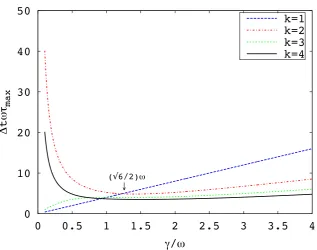
6. Figure2indicates that, for fixed∆tandω, the maximizingτis eitherτmax(1) orτmax(2), depending on the 200
value ofγ. The optimal damping coefficient isγ= (
√
6/2)ω, for whichτmax(1) =τmax(2) =
√
6/(ω∆t).
201
7. The eigenfunction forτmax(1) is the linear polynomialωq. For such a preobservable, it may not seem 202
correct that the IAcT becomes arbitrary close to zero asγgoes to zero. This does not mean, however
203
that the variance goes to 0, because Eq. (1) is an asymptotic result, and the IAcT is a prefactor for
204
the leading order 1/Nterm in the expression for the variance. The next order 1/N2term would
205
dominate ifγwere very small. An order 1/N2error is characteristic of uniform sampling, which
206
would be the consequence of near-Hamiltonian dynamics. Also, linear polynomials are special
207
in that their expectation is independent of total energy, so it matters little that near-Hamiltonian
208
dynamics poorly samples different values of total energy.
209
8. The eigenfunction forτmax(2) is a specific linear combination ofω2q2−1 andp2−1. For quadratic
210
polynomials, the total energy does affect its expected value, which is why it is necessary thatγbe
211
large enough to sample different energies on a reasonable time scale.
212
5.1. The forward transfer operator
213
The forward transfer operator is
Fu=ρ−1e∆tLK(ρu) where
ρ(q,p)∝exp(−1
2p 2−1
2ω 2q2). andLKis the Fokker-Planck operator [12, Eq. (10.1)–(10.3), (10.9)]
LKf =−p ∂ ∂qf+ω
2q ∂ ∂pf+γ
∂
Therefore,
F =e∆tL where
Lf = 1
ρLK(ρf) =−p ∂ ∂qf +ω
2q ∂
∂pf−γp ∂ ∂pf +γ
∂2 ∂p2f. Using the relationLf = 1ρLK(ρf), it is easy to show that the adjoint
L†f =p ∂ ∂qf−ω
2q ∂
∂pf−γp ∂ ∂pf+γ
∂2 ∂p2f. 5.2. Gamma for maximum spectral gap
214
Ref. [12, Ch. 10, Eqs.(1, 2, 3b, 9, 22, 52, 60, 71, 72, 74, 77, 78, 82, 83)] gives the eigenvalues ofLKas
µk,l =−
1
2(k+l)γ− 1
2(k−l)δ, k,l=0, 1, . . . , with eigenfunctions
ψk,l =ρ(q,p)1/2(k!l!δk+l)−1/2(√γ+B −
√
γ−A)k(−
√
γ−B+
√
γ+A)lρ(q,p)1/2, where
γ± = 1
2(γ±δ) and δ= q
γ2−4ω2,
with the radical sign denoting the principal square root, and operatorsA,Bdefined by
Af =−ω−1 ∂ ∂qf+
1
2ωq f, Bf =− ∂ ∂pf +
1 2p f.
The operatorL has eigenfunctionsρ(q,p)−1ψk,l(q,p) and the same eigenvalues; F has these same
215
eigenfunctions and has eigenvalues exp(∆tµk,l).
216
Fork+l=1, one hasµ0,1=−γ−,µ1,0 =−γ+and
ϕ0,1 = (γ−/δ)1/2(−p+γ+q)ρ(q,p), ϕ1,0 = (γ+/δ)1/2(p−γ−q)ρ(q,p).
In the caseγ± = 12γ,F has a double eigenvalueλ2 = λ3 =e−ω∆tbut one eigenfunction ϕ2(q,p) = 217
p−ωqand one generalized eigenfunctionϕ3(q,p) = q, satisfying(F −λ2)ϕ3 = ϕ2. This results in 218
behavior involving a linear combination of e−ωtandte−ωt. 219
The eigenvalue nearest 1 depends on∆t. For small enough∆t, it is exp(−γ−∆t), and the spectral
220
gap isω∆t+O(∆t2)forγ ≤ 2ω andω∆t(2ω/γ)(1+ (1−(2ω/γ)2)1/2)−1+O(∆t2)otherwise. To
221
maximize the spectral gap, chooseγto be no greater than 2ω, corresponding to an underdamped system.
222
5.3. Gamma for maximum IAcT
223
To obtainτmax, one needs eigenelements forG, given by Eq. (2) withF =exp(∆tL). Note that the 224
subspace of polynomials of degree≤kis closed under application ofLandL†. Moreover, this holds 225
separately for subspacePk of odd polynomials of degree≤ kfor kodd and for subspacePk of even
226
polynomials of degree≤kforkeven. And it applies also to operatorsE,F,F†, andG. Hence, the Pkare
227
eigenspaces ofrG. These eigenspaces can be further decomposed as follows. LetP0k=Pkfork<2, and
228
letP0k=Pk∩P⊥k−2fork≥2. The claim is thatP0kis an eigenspace, of dimensionk+1. To confirm this, it
229
G†=GandGv∈
Pk−2. Letube a basis forP0kchosen so there are even functions ofpfollowed by odd
231
functions ofp. In particular,
232
u = [ωq, p]T,
u = [ω2q2−1, ωqp, p2−1]T,
u = [ω3q3−3ωq,(ω2q2−1)p,ωq(p2−1), p3−3p]T,
u = [ω4q4−6ω2q2+3,(ω3q3−3ωq)p,(ω2q2−1)(p2−1),ωq(p3−3p),p4−6p+3]T, fork =1, 2, 3, 4, respectively. The polynomials inωqand inpare modified versionsHek of Hermite
polynomials. We haveLu= Aufor some matrix of constantsA, given by
A=
0 −kω ω −γ . ..
. .. . .. −ω kω −kγ
. (16)
(Cf. Risken (1984), Eqs.(10.96),(10.97) forLK.) We haveEu=0andF0u=Fu=exp(∆tA)u. Therefore, from Eqs. (13) and (14), one has
Ck=hF0ku,uTi=exp(k∆tA)hu,uTi, and
K=coth(−1
2∆tA)hu,u
Ti=coth(−1
2∆tA)C0. For each value ofk,τmaxis the maximum eigenvalue of
1 2
C0−1coth(−1
2∆tA)C0+coth(− 1 2∆tA)
T
. (17)
As explained in Sec.3.1, if the basis functions are re-ordered so that those that are even functions ofp
233
precede those that are odd functions ofp, the eigenvalue problem splits into 2 nearly equal parts.
234
Fork=1,A=XΛX−1whereΛ=diag(−γ−,−γ+)and
X= "
ω ω
γ− γ+
# .
The covariance matrixC0=hu,uTi=diag(1, 1), and matrix (17) is diag(τ+,τ−)where
τ± = 1
δ
±γ±coth(1
2∆tγ−)∓γ∓coth( 1 2∆tγ+)
.
Using the identity coth(x±y) = (sinh 2x∓sinh 2y)/(cosh 2x−cosh 2y), one gets that the eigenvalues of matrix (17) are
τ± = sinh
(12∆tγ)±γsinh(12∆tδ)/δ cosh(12∆tγ)−cosh(12∆tδ) .
The greater ofτ±isτ+, and it is a straightforward exercise to show thatτ+is an decreasing function ofωas along as
In practice, a numerical integrator is used, whose step size is chosen so that∆tL=θwhereθis some fractional value, e.g., 12, and Lis the magnitude of largest eigenvalue of the Jacobian matrix of the right-hand side of the system of (first-order) stochastic differential equations. In particular,
ω∆t=θ ifγ≤2ω; (19)
otherwise, it holds thatω∆t<γ∆t/2. Hence, inequality (18) is more than satisfied. It is more complicated to analyze the behavior of values ofτfork>1, so we exploit the smallness ofω∆tandγ∆tto do an asymptotic analysis. From expression (17), one sees that forP0k, itsτmaxequalsτ
(k)
max+O(∆t)whereτmax(k) is the greatest eigenvalue of
− 1
∆t(C
−1 0 A
−1C
0+A−T). (20)
Fork=1, one hasC0=diag(1, 1)andτmax(1) =2γ/(ω2∆t), corresponding to the eigenfunctionωq. For k=2, one has
A−1= 1 2γω2
−γ2−ω2 2γω −ω2
−γω 0 0
−ω2 0 −ω2
,
C0=diag(2, 1, 2), and the largest eigenvalue for expression (20) is
τmax(2) = 2∆1 t
γ ω2 +
2 γ+
s γ2 ω4 +
4 γ2
! ,
corresponding to an eigenfunction that is some linear combination ofω2q2−1 andp2−1. Againτmax(k) is a decreasing function ofωfor small enough∆t. For generalk, the size of the elements ofAin Eq. (16) increase withω, which suggests that for practical values of∆t, the largest eigenvalue for expression (20) decreases with ω. This can be confirmed numerically. To reduce the number of parameters, write A=−ωB(γ/ω), and rewrite expression (20) as
1 ω∆t(C
−1
0 B(γ/ω)
−1C
0+B(γ/ω)−T). (21)
The valueτmax(k) is the largest eigenvalue of matrix (21), soγ∆tτmax(k) is a function only of the ratioω/γ.
235
Fig.1plots this quantity fork=1, 2, 3, 4, confirming thatτmax(k) is decreasing function ofωfor fixed values
236
ofγand∆t. Therefore, for a multidimensional quadratic potential,τmaxis very likely to be determined 237
by the lowest frequency mode. (This is readily established for the spectral gap for reasonable values of
238
∆t.)
239
Having established that the lowest frequency mode is most likely responsible forτmax, letωdenote
240
the lowest frequencyω1, and consider the optimal choice ofγ. From matrix (21), observe thatω∆tτmax(k) 241
is a function only ofγ/ω. Accordingly, we chooseγ/ωto minimize maxkω∆tτmax(k). However,∆tmay 242
depend onγ, but only ifγ>2ων, according to Eq. (19). Let us initially ignore this possibility and revisit 243
it after determining the optimalγ.
244
Assuming that the maximum ofω∆tτmax(k) is attained fork = 1 ork = 2, there are two possible 245
locations for the bestγ. One is the choiceγ=
√
2ω, for whichω∆tτmax(2) =1+
√
2 andω∆tτmax(1) =2
√
2.
246
The other is the choiceγ= (
√
6/2)ωwhereω∆tτmax(k) =
√
6 for bothk=1 andk=2. The latter is the
247
better choice. This and the assumption that the maximum occurs fork<3 is supported by Fig.2. Since
248
(√6/2)ω1<2ων, we see from Eq. (19) that there is no concern about∆tlimiting the value ofγ. 249
Note that for the optimalγ, the dynamics is underdamped in every mode.
10
110
010
110
210
30
0.5
1
1.5
2
∆
t
γτ
maxω/γ
k=1
k=2
k=3
k=4
Figure 1.γ∆tτmax(k) vs.ω/γfork=1, 2, 3, 4
0
10
20
30
40
50
0
0.5
1
1.5
2
2.5
3
3.5
4
∆
t
ωτ
max
γ
/
ω
k=1
k=2
k=3
k=4
↓
(√6/2)ω
6. Discussion and Conclusions 251
It is asserted in the literature [1,3] that for comparing MCMC propagators and for ensuring
252
reasonably reliable simulation results, it is of great value to estimate the maximum autocorrelation
253
time over all possible observables. Certainly, this would seem desirable for comparing propagators, since
254
it is best to assume as little as possible about the actual observables that are to be estimated from the
255
Markov chain. Also, the longest IAcT would be most reliably estimated, because its accurate estimation
256
would call for a greatest number of samples; moreover, the accuracy of estimates of other IAcTs might
257
be influenced by the longest IAcT. Unfortunately, estimating IAcTs and assessing such estimates is a
258
difficult task, which could benefit greatly from further research.
259
In this article, it is suggested that the maximum IAcT be estimated by considering an arbitrary linear
260
combination of basis functions chosen to capture the lowest frequency motions of the dynamics of the
261
MCMC chain. Also appealing is the approach based on a set of well chosen indicator functions [10].
262
Another quantity for measuring performance of an MCMC propagator is the spectral gap. It
263
is related to equilibration time, but as a predictor of IAcTs, it can be arbritarily too pessimistic or
264
optimistic. This may occur for irreversible propagators applied to energy landscapes where entropy
265
barriers dominate energy barriers.
266
Shorter integrated autocorrelation times are thus a primary consideration in the design of MCMC
267
propagators. To this end, it is advantageous not to insist on reversibility. In particular, the ballistic
268
component of propagators like hybrid Monte Carlo and Langevin dynamics may offer dramatic speedups
269
for overcoming entropy barrriers, though no advantage for energy barriers.
270
Irreversible propagators typically have a parameter that determines the extent of diffusive behavior.
271
For discrete Langevin dynamics applied to a multidimensional quadratic potential, the optimal value
272
corresponds to slightly underdamped dynamics for the lowest frequency mode, with other modes
273
experiencing even lighter dampling. Although this conclusion is not necessarily indicative of the optimal
274
damping for the usual situation, in which there a multiplicity of energy minima, it can be helpful to
275
begin with an understanding of simple situations.
276
Author Contributions:Y.F. performed the analysis for Sec.5.2and the computation for Sec.5.3. R.S. did the analysis
277
for Secs.3.1,4,5.1,5.3and wrote the paper.
278
Conflicts of Interest:The authors declare no conflict of interest.
279
280
1. Fang, Y.; Cao, Y.; Skeel, R. Quasi-Reliable Estimates of Effective Sample Size, 2017. arXiv:1705.03831v2
281
[stat.CO].
282
2. Schütte, C.; Huisinga, W. Biomolecular Conformations as Metastable Sets of Markov Chains. Proceedings of
283
the 38th Annual Allerton Conference on Communication, Control, and Computing, 2000, pp. 1106–1115.
284
3. Lyman, E.; Zuckerman, D.M. On the Structural Convergence of Biomolecular Simulations by Determination
285
of the Effective Sample Size. J. Phys. Chem. B2007,111, 12876–12882.
286
4. Rey-Bellet, L.; Spiliopoulos, K. Irreversible Langevin Samplers and Variance Reduction: a Large Deviations
287
Approach.Nonlinearity2015,28, 2081–2104.
288
5. Leimkuhler, B.; Matthews, C. Rational Construction of Stochastic Numerical Methods for Molecular Sampling.
289
Appl. Math. Res. Express2013, pp. 34–56.
290
6. Leimkuhler, B.; Matthews, C.; Stoltz, G. The Computation of Averages from Equilibrium and Nonequilibrium
291
Langevin Molecular Dynamics. IMA J. Numer. Anal.2016,36, 13–79.
292
7. Geyer, C.J. Practical Markov Chain Monte Carlo. Stat. Sci.1992,7, 473–511.
293
8. Priestly, M.B.Spectral Analysis and Time Series; Academic Press, 1981.
294
9. Goodman, J. Acor, Statistical Analysis of a Time Series, 2009. http://www.math.nyu.edu/faculty/goodman/ 295
software/acor/,https://github.com/dfm/acor.
296
10. Zhang, X.; Bhatt, D.; Zuckerman, D.M. Automated Sampling Assessment for Molecular Simulations Using
297
the Effective Sample Size. J. Chem. Theory Comput.2010,6, 3048–3057.
11. Diaconis, P.; Holmes, S.; Neal, R.M. Analysis of a Nonreversible Markov Chain Sampler. Ann. Appl. Probab. 299
2000,10, 726–752.
300
12. Risken, H.The Fokker-Planck Equation. Methods of Solution and Applications; Vol. 18,Springer Series in Synergetics,
301
Springer, 1984.