A STUDY ON EFFECTIVENESS OF HR PRACTICES AND POLICIES ON JOB SATISFACTION WITH REFERENCE TO TEXTILE INDUSTRIES IN TAMIL NADU, INDIA
C. LOGANATHAN& A. VALARMATHI
Research Scholar, PhD in Management, Karpagam University, Coimbatore, Tamil Nadu, India Director, Vivekananda Institute of Management Studies, Kovilpalayam, Coimbatore, Tamil Nadu, India ABSTRACT
Growth of Indian textile industry is immense and the role of Tamil Nadu is significant in textile industry. This paper discusses various practices of human resources. Human Resource Management is the utilization of human resources which denotes practices like recruitment and selection, training, compensation and performance appraisal. In this study, these HR practices have been explained in relation to Job Satisfaction (N= 100) among the employees of Textile industry. The resultsindicate that employees from textile industry of Tamilnadu, were satisfied with recruitment and training and development HR practices employed within the industry. However, it is also observed that employees are not satisfied with compensation and performance appraisal practices. Recommendations have been provided at the end to improve the satisfaction among employees.
Keywords: Indian Textile Industry, HR Practices, Recruitment, Training, Compensation.
1.1 Introduction to Study
Indian textile industry is the second largest industry in the world next to China. It generates job opportunities for more than 35 million people and contributes 3% to 4% GDP, after agricultural sector. Tamil Nadu is the third largest GDP contributor of Indian economy and it occupies the second position in total employment in India with 9.97%share (Jessica, K.N., 2013).
Bosall and Purcell (2003) define human resource management (HRM) as “a phenomenon that includes anything and everything associated with the management of employment relationships in the firm”. Armstrong (2010) defined HRM as a strategic, integrated and coherent approach to the employment, development and well-being of working conditions of organizations.Human resource management is comprised of functions like people resourcing, managing performance, managing reward, human resource development and employment relations. In this paper the relationship between effectiveness of HR practices and job satisfaction is explored in the context of Tamil Nadu’s textile industry. Job satisfaction is the key ingredient to achieve recognition, compensation, promotion (Kaliski, 2007). Variables of job satisfaction have roles to interplay with various HR practices which are followed in Tamil Nadu’s textile industry.
1.2 Aim and Objectives
1. To determine the association between HR practices and job satisfaction,
International Journal in Management and Social Science (Impact Factor- 4.358)
1.3 Literature Review
1.3.1 HR Practices: Overview
In a fiercely competitive market environment, organizations are required to develop and maintain their competitiveness. In order to achieve this progress, the skills and capabilities of employees need to be tuned according to the requirements of the market. Human Resource Management (HRM) is the most important areas in organizational practice. Schuller (2000) opined that skills, knowledge and competencies are key factors to determine firms’as well as the nation’s prosperity. Full utilization of human resources is possible through ‘psychological contract’ between the individual employee and the organization (Singh, 2005). There are three sets of HR practices for an innovative HR system. These sets are training focused HR practices which put emphasis on skill development and human capital investment, performance based reward oriented HR practices,and team development HR practices for leadership and team based activities (Trehan, Setia, 2014).
There are many factors which determine the HR policies of an organization. For instance, (Author, year) asserts that HRM practices are affected by factors like external factors and internal factors. External factors are economic changes, technological changes, national culture, sector characteristics, regulations, actions of competitors. Internal factors include business strategy, organization’s size, and organizational structure. On the other hand, according to (Author, year), economic changesin the international context have led to changes in HR practices as there is a need to constantly upgrade them as per different cultures.Other factors too play a relevant role in the framing of HR policies of organizations: integration of technology in HR has changedthe context of HR practices; whereasnational culture plays an important role in the development of proper organization structure and methods for HR practices (Tiwari, Saxena, 2012).
Organizations can be classified into manufacturing and service organizations. This sartorial classificationhelps to understand which HR practices will suit best for the organization. Government regulations and the internal environment of organizations have an influence on HR practices. The firm’s strategy and structure are another determining factor to design and implementation of HR practices. Lastly, productive business strategies are linked to human resource practices (Tiwari and Saxena, 2012). There are seven HR practices. They are 1) employment security, 2) selective hiring, 3) self-managed teams and decentralization of decision making, 4) comparatively high compensation contingent on organizational performance, 5) extensive training, 6) reduced status distinctions and barriers, including dress, language, office arrangements and wage differences across levels and 7) extensive sharing of financial and performance information throughout the organization (Vlachos I. P., 2009).
1.3.2 Impact of HR policies & practices on Job Satisfaction
with affective commitment (Absar, 2010).HR practices are recruitment, selection, training and development, compensation, rewards and recognition. Training is related to existing performance and development is related to future performance of the personnel. Training enhances employees’ job specificity and simultaneously job satisfaction is increased. Recognition is one of the motivating forces to highlight employee’s performance. It increases job satisfaction through financial reward or non-financial reward (Javed, 2012). Bogdanova et al (2008) studied that HRM practices intend to develop and allocate human capital for long term goals to boost job satisfaction as well as employees’ performance. In 2012, Majumdar’s study on HRM practices and impact of employee’s satisfaction revealed that most of the employees are dissatisfied to compensation, career growth, training and development, management style, job design and responsibilities. In 2013, Lamba and Chowdhary’s study expressed that HRM practices have significant association with organizational commitment, organizational performance for attaining retention of skilled workers (Jeet, Sayeeduzzafar, 2014).
1.3.3 HR Policies and Practices and their impact on Job Satisfaction
Human Resource Planning: Human resource planning is defined that organization has the right number and types of people at the right time and right place. Effective HR planning can enhance job satisfaction of employees for smoothen their career ladder (Absar, 2010).
Recruitment and Selection: This practice is essential to search for right people with required knowledge, skill and abilities (KSA). Selective hiring is a key practice to ensure profit making. Proper recruitment and selection of employees enhance employee productivity and contribute to reduce turnover (Vlachos I. P., 2009). The main goal of this practice is make congruence between employees and organization, teams and work requirements to create better work environment (Absar, 2010).
Training and Development: Training and development is related to organizational performance. Training programmes increase employee’s skill, productivity and reduce job dissatisfaction. Secondly, training and developing internal resources lower down the cost and risk of selecting, hiring and inducting candidates from external resources (Vlachos I. P., 2009). Adequate knowledge, skills, attitudes of employees boost financial and non-financial performance of organizations, so training and development have a significant influence on job satisfaction (Absar, 2010). .
Performance Appraisal: Performance appraisal is an important practice to measure the effectiveness and efficiency of employees. Performance appraisal is comprised with four phases approach, like, technical, extended, appraisal and maintenance (Aggarwal, Thakur, 2013). Performance management practices are development plans for the future, providing training to managers, measuring the quality of performance appraisals, resolving poor performance, consistency across the organization and feedback. The performance management system ensures that development goal is identified for each personnel and forward-looking action plan is recognized. Managers are able to identify the potential to attain excellent performance and this is possible through achieving performance management cycle. Quality of performance appraisals is measured by introducing coaching for others and employee surveys. Resolution of poor performance is possible through regular and constructive feedback. Consistent effort for performance appraisal includes accountability of top management to endorse performance management system and good evaluation can modify employees’ skills and learned behaviours. (Horwitz R. n.d.).
International Journal in Management and Social Science (Impact Factor- 4.358)
based compensation is also the most important element in organizational incentive systems (Vlachos I. P., 2009). Employees’ loyalty and productivity are dependent on compensation. So it is an important variable in job satisfaction (Absar, 2010).
1.3.4 HR policies and practices followed by Textile industry in India
Textile and apparel industries are vital parts of world economy ranging from employment generation to retailing. Traditional players in the production of this industry are China, India, Pakistan and Vietnam. Indian textile industry accounts for 4% GDP with 45 million textile workers and 11% share of the country’s total exports. Emerging trends of textile industry are technology up gradation fund scheme (TUFS), e-marketing, common effluent treatment plant (CETP), marketing initiatives, scheme for integrated textile parks (SITP), National Textile Corporation (NTC), export promotion, skill development (Reddy E., 2013).In 2007, Parimalam’s study on ‘Knowledge, Attitude and Practices Related to Occupational Health Problems among Garment Workers in Tamilnadu, India’ revealed that out of 216 workers in garment manufacturing industry, 27 workers were employed in cutting, 131 workers were in stitching and 58 were in the finishing department. Absenteeism was the main problem of textile industry which led labour turnover and labour productivity was affected also. There is another factor to influence labour productivity and this is change from high volume to low volume orders. On the other hand, growth of textile industry in Tamilnadu was due to the availability of spinning and weaving mills and specialized workers. The problem of this labour intensive industry was to retain these efficient workers (Shanmugasundaram, Panchanatham, 2011).
Conceptual Framework
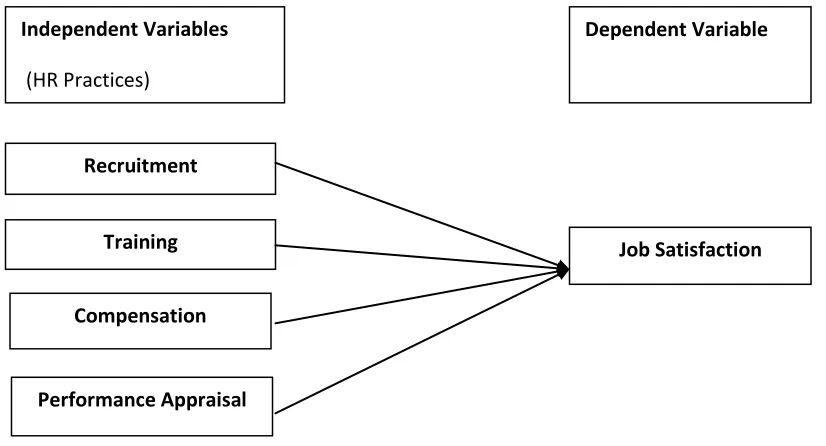
Based on the study of literature survey, the researcher developed conceptual framework for the study which is presented below.
Figure 1: Conceptual Framework for the study Independent Variables
(HR Practices)
Recruitment
Training
Compensation
Performance Appraisal
Dependent Variable
1.4 Research Methodology
Research Design- The paper uses descriptive as well as explanatory research design as it describes employees within their workplace., as in descriptive and at the same time, analyses textile industries’ HR practices.
Data Collection- Primary data was collected from 100 respondents across 10 organizations of Tamilnadu. Each of the participating organizations was approached and explained the aim and objectives of the study. In order to supplement the primary data, researcher also collected secondary data from different sources, for example, journals, books, working papers, thesis, report etc.
Reliability and Validity of Methods- To determine reliability of collected data, Cronbach alpha was tested and SPSS 19.0 was used to give the result of .736 to measure instrument responses.
Data Analysis- The researcher transferred the responses to an excel sheet by coding them and then imported the data to SPSS 19.0. The correlation and regression analysis tests were then tested to examine the proposed hypotheses.
1.5 Results and Discussion
1.5.1 Demographic profile of the Respondents
Table 1 shows the demographic profile of the respondents which includes their age and gender. This table represents that 6% of the employees are from the age group of 18 to 25 years, 18% people are within 26 to 33 years of age, 8% employees are in the age group of 34 to 41 years, 44% employees are within the age group of 42 to 49 years, 14% employees are in 50 to 57 years age and only 10% people are from the age group of 58 to 65 years. In gender demographics, only 38% respondents are male and 62% respondents are female.
Table 1: Descriptive Statistics of Demographic profile (Age, Gender)
Variable Age (In years) Gender
Statistics
18-25 years
26-33 years
34-41 years
42-49 years
50-57 years
58-65 years
Male Female
Percentage 6 18 8 44 14 10 38 62
Table 2: Descriptive Statistics of Demographic profile (Qualification, Experience)
Variable Qualification Experience (In Years)
Statistics
No formal education
Below 10th STD
10th STD
12th STD
Grad./PG < 1 1-3 4-6 > 6
Percent 10 34 31 22 3 1 6 12 81
International Journal in Management and Social Science (Impact Factor- 4.358)
standard, 31% employees and 22% employees’ qualifications are 10th Standard and 12th Standard respectively. Only 3% people are Graduate or Post-Graduate qualification. Perspective of experience, only 1% respondent has experience of less than 1 year, 6% people have experience of 1 to 3 years, and 12% people have experience of 4 to 6 years. Majority 81% respondents have experience of more than 6 years.
1.5.2 Role of HR Practices in Job Satisfaction
Hypothesis 1: Null Hypothesis - Recruitment does not any impact on Job Satisfaction among employees.
Alternative Hypothesis – Recruitment has an impact on Job Satisfaction among employees.
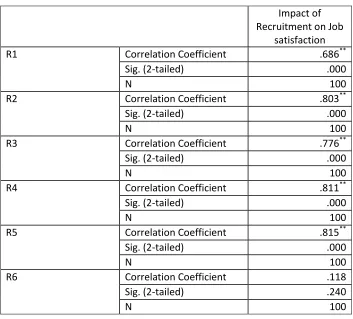
The result shows strong correlation between recruitment practices and its associated factors which means null hypothesis (H10) is rejected and alternative hypothesis (H11) is accepted. The responses gathered from the employees, indicate that there is strong correlation between placement of right person in the right job to impact of job satisfaction (α= .000, p-value= .686), adequate and relevant information (α= .000, p-value= .803), candidates’ selection on merit (α= .000, p-value= .776), internal referencing (α= .000, p-value= .811) (See Appendix II). Therefore, it can be concluded that recruitment practices within the textile industry has an impact on job satisfaction among employees.
Hypothesis 2: Null Hypothesis – Training Practices does not impact to Job Satisfaction among employees.
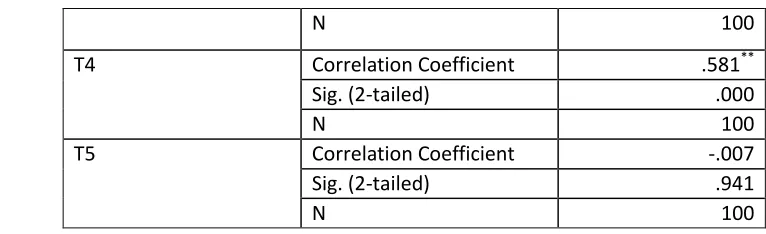
Alternative Hypothesis - Training Practicesimpacts to Job Satisfaction among employees.The above result shows strong correlation of training and its related factor s with job satisfaction. So null hypothesis (H20) is rejected and alternative hypothesis (H21) is accepted. According to responses, it is observed that organization’s training needshave impacted on job satisfaction (α= .000, p-value= .688), training of social skills, problem solving skills of organization (α= .000, p-value= .396), training program’s content (α= .000, p-value= .586) but responses have decreased in terms of employers’ discouragement to seminars and workshops (α= -.007, p-value= .941). However, having correlation with the training related factors to job satisfaction, only one factor is not correlated to job satisfaction. It says that employers don’t encourage employees to participate in various seminars and workshops.
Hypothesis 3: Null Hypothesis - Compensation does not have impact on job satisfaction among employees.
Alternative Hypothesis - Compensation has a great influence on job satisfaction.
Result yields weak correlation between compensation related factors and job satisfaction. Results indicate that dissatisfaction is due to inadequate payment (α= .660, p-value= -.044), employees’ disagreement in terms of pay increments (α= .431, p-value= .080). Negative correlation is seen in competitive pay package (α= .409, p-value= -.084) and rewards linked to pay for performance (α= .793, p-value= -.027). The only factor which reflects satisfaction is that the payments are given to the employees on time (α= .401, p-value= .000). So null hypothesis (H30) is accepted and alternative hypothesis (H31) is rejected.
Hypothesis 4: Null Hypothesis- Performance Appraisal practices do not influence Job Satisfaction.
This above result depicts that factors of performance appraisal have weak correlation to job satisfaction among respondents. It means null hypothesis (H40) is accepted and alternative hypothesis (H41) is rejected. Strong correlation have been observed between performance appraisalpractices which are aimedat enhancement of employees’ skill and job satisfaction (α= .000, p-value= .826). Negative correlation is seen in factors like regular intervals of performance appraisal (α= .030, p-value= -.217) and fair performance appraisal (α= .008, p-value= -.264). So it is not many people were satisfied with the performance appraisal practices within organization.
1.7 Conclusion and Recommendation
International Journal in Management and Social Science (Impact Factor- 4.358)
References:
1 Absar M.M.N., Azim M.T., Balasundaram N. and Akhter S. (2010). Impact of Human Resources Practices on Job satisfaction: Evidence from Manufacturing Firms in Bangladesh. Economic Science Series, Vol. LXII, No 2, pp. 31-42.
2 Aggarwal A. and Thakur G. S. M. (2013). Techniques of performance Appraisal- A Review. International Journal of Engineering and Advanced Technology, Vol. 2(3), pp. 617-621.
3 Chauhan Y. S. and Patel N. K. (2014). Human Resources Management Practices and Job satisfaction: A Study of Hotel Industry. Abhinav National Monthly refereed Journal of Research in Commerce & Management, Vol. 3 (9), pp. 1-6.
4 Horwitz R. (n.d.) Performance Management Practices. Rev. 2. Kwela Leadership & Talent Management.
5 Javed M., Rafiq M., Ahmed M. and Khan M. (2012). Impact of HR Practices on Employee Job satisfaction in Public Sector Organizations of Pakistan. Interdisciplinary Journal of Contemporary research in Business, Vol. 4(1), pp. 348-363.
6 Jeet V. and Sayeeduzzafar (2014). A Study of HRM Practices and its Impact on Employees Job Satisfaction in Private Sector Banks: A Case Study of HDFC Bank. International Journal of Advance Research in Computer Science and Management Studies, Vol. 2(1), pp. 62-68. 7 Khan I., Ghauri T.A. & Akram K. (2012).
Relationship between Job satisfaction and HR Practices, an Empirical Research of Different Sectors of University Teachers in Pakistan.
International Journal of Learning &
Development, Vol. 2(3), pp. 25-33.
8 Parimalam P., Kamalamma N. and Ganguli A. K. (2007). Knowledge, Attitude and Practices Related to Occupational Health Problems among Garment Workers in Tamil Nadu, India.
Journal of Occupational Health, Vol. 49, pp- 528-534.
9 Schuler R. S. and MacMillan I. C. (1984). Gaining Competitive Advantage through Human Resource Management Practices. Human Resource Management, Vol. 23 (3), pp. 241-255.
10 Shanmugasundaram S. and Panchanatham N. (2011). Embracing Manpower for Productivity in Apparel Industry. International Journal of Innovation, Management and Technology, Vol. 2(3), pp. 232-237.
11 Singh A.K. (2005). HRD Practices and Philosophy of Management in Indian Organizations.
Vikalpa, Vol. 30 (2), pp. 71-79.
12 Tandon N. and Reddy E. E. (2013). A Study on Emerging Trends in Textile Industry in India.
AMET International Journal of Management, pp. 81-88.
13 Tiwari P., Saxena K. (2012). Human Resource Management Practices: A Comprehensive Review. Pakistan Business Review, pp. 669-705. 14 Trehan S. and Setia K. (2014). Human Resource Management Practices and Organizational Performance: An Indian Perspective. Global Journal of Finance and Management, Vol. 6 (8), pp. 789-796.
15 Vlachos I.P. (2009). The Effects of Human Resource Practices on Firm Growth.
Appendix I: Quantitative Questionnaire
Section A: Demographic Profile
Please tick √ as applicable. 1. Age:
a. 18-25 [ ] b. 26-33 [ ] c. 34-41 [ ] d. 42-49 [ ] e. 50-57 [ ] f. 58-65 [ ]
2. Gender: Male [ ] Female [ ] 3. Marital Status:
a) Married [ ] b) Unmarried [ ] c) Widow/ Widower [ ] d) Divorced/ Separated [ ]
4. Highest level of education attained: a) No formal education [ ] b) below 10th Standard [ ] c) 10th Standard [ ] d) 12th Standard [ ] e) Graduate/ Post Graduate [ ] 5. Religion:
a) Christianity [ ] b) Hindu [ ] c) Muslim [ ] d) Others [ ] 6. Experience:
a) < 1 year [ ] b) 1-3 years [ ] c) 4-6 years [ ] d) > 6years [ ]
Section B: Impact of HR practices on Job satisfaction
International Journal in Management and Social Science (Impact Factor- 4.358)
HR Practices SA A UD D SD
Our organization places the right person in the right job. (R1)
Adequate and relevant information about the organization and job is provided to the candidate at the time of recruitment. (R2)
Selection of a candidate in our organization is strictly based on his/her merit.(R3)
Internal referencing is followed for efficient applicants.(R4)
The training needs of the employees in our organization are assessed on the basis of their performance appraisal. (T1)
Our organization takes maximum one month to inform about the selection decision. (R5)
Medical examination is a regular practice for new employees. (R6) Training in our organization includes social skills, general problem solving skills and broader knowledge of the organization. (T2)
The contents of the training programs organized are always relevant to the changing needs of our jobs and our business. (T3)
We are assigned challenging jobs to charge our enthusiasm and develop our skills. (T4)
We are encouraged to participate in various seminars and workshops. (T5)
We are being paid adequately for the work we do. (C1)
Pay increments offered by our organization are satisfactory.(C2) Our organization makes all payments due to us in time.(C3)
Our organization follows the policy of matching pay with performance.(C4)
The pay we receive is competitive compared to that ofemployees doing similar work in other organizations.(C5)
The benefits we receive in our organization are similar to whatmost of the other organizations in the industry provide to their employees.(C6)
Rewards and incentives are fairly distributed in our organization. (C7) Rewards in our organization are strictly linked to employee performance.(C8)
Our organization appraises the performance of its employees at regular intervals. (P1)
Performance appraisal in our organization aims at improving employee performance and strengthening our job skills. (P2)
We feel our performance appraisal has been fair and objective (P3) Our performance goals are set at realistic levels. (P4)
Appendix II: Results of Correlation Analysis
Hypothesis 1: Correlation Matrix
Table 1: Impact of Recruitment practices on Job satisfaction
Impact of Recruitment on Job
satisfaction
R1 Correlation Coefficient .686**
Sig. (2-tailed) .000
N 100
R2 Correlation Coefficient .803**
Sig. (2-tailed) .000
N 100
R3 Correlation Coefficient .776**
Sig. (2-tailed) .000
N 100
R4 Correlation Coefficient .811**
Sig. (2-tailed) .000
N 100
R5 Correlation Coefficient .815**
Sig. (2-tailed) .000
N 100
R6 Correlation Coefficient .118
Sig. (2-tailed) .240
N 100
Hypothesis 2: Correlation Matrix
Table 2: Impact of Training practices on Job satisfaction
Impact of Training on Job Satisfaction
T1 Correlation Coefficient .688**
Sig. (2-tailed) .000
N 100
T2 Correlation Coefficient .396**
Sig. (2-tailed) .000
N 100
T3 Correlation Coefficient .586**
International Journal in Management and Social Science (Impact Factor- 4.358)
N 100
T4 Correlation Coefficient .581**
Sig. (2-tailed) .000
N 100
T5 Correlation Coefficient -.007
Sig. (2-tailed) .941
N 100
Hypothesis 3: Correlation Matrix
Table 3: Impact of Compensation practices on Job satisfaction
Impact of Compensation on Job
satisfaction
C1 Correlation Coefficient -.044
Sig. (2-tailed) .660
N 100
C2 Correlation Coefficient .080
Sig. (2-tailed) .431
N 100
C3 Correlation Coefficient .401**
Sig. (2-tailed) .000
N 100
C4 Correlation Coefficient .077
Sig. (2-tailed) .447
N 100
C5 Correlation Coefficient -.084
Sig. (2-tailed) .409
N 100
C6 Correlation Coefficient .033
Sig. (2-tailed) .742
N 100
C7 Correlation Coefficient .046
Sig. (2-tailed) .651
N 100
C8 Correlation Coefficient -.027
Sig. (2-tailed) .793
N 100
Table 4: Impact of Performance appraisal on Job satisfaction
Impact of Performance Appraisal on Job
Satisfaction
P1 Correlation Coefficient -.217*
Sig. (2-tailed) .030
N 100
P2 Correlation Coefficient .826**
Sig. (2-tailed) .000
N 100
P3 Correlation Coefficient -.264**
Sig. (2-tailed) .008
N 100
P4 Correlation Coefficient -.179
Sig. (2-tailed) .075
N 100
P5 Correlation Coefficient -.277**
Sig. (2-tailed) .005