Volume 2008, Article ID 231367,15pages doi:10.1155/2008/231367
Research Article
Note Onset Detection via Nonnegative Factorization of
Magnitude Spectrum
Wenwu Wang,1Yuhui Luo,2, 3Jonathon A. Chambers,4and Saeid Sanei5
1Centre for Vision, Speech and Signal Processing, University of Surrey, Guildford, GU2 7XH, United Kingdom 2Samsung Electronics Research Institute, Communication House, Staines, TW18 4QE, United Kingdom 3Winton Capital Management Ltd., London, W8 6LS, United Kingdom
4Advanced Signal Processing Research Group, Department of Electronic and Electrical Engineering, Loughborough University, Loughborough, Leics LE11 3TU, United Kingdom
5Centre of Digital Signal Processing, CardiffUniversity, Cardiff, CF24 3AA, United Kingdom
Correspondence should be addressed to Wenwu Wang,[email protected]
Received 6 November 2007; Revised 20 February 2008; Accepted 6 May 2008
Recommended by Sergios Theodoridis
A novel approach for onset detection of musical notes from audio signals is presented. In contrast to most commonly used conventional approaches, the proposed method features new detection functions constructed from the linear temporal bases that are obtained from the decomposition of musical spectra using nonnegative matrix factorization (NMF). Three forms of detection function, namely, first-order difference function, psychoacoustically motivated relative difference function, and constant-balanced relative difference function, are considered. As the approach works directly on input data, no prior knowledge or statistical information is therefore required. Practical issues, including the choice of the factorization rank and detection robustness to instruments, are also examined experimentally. Due to the scalability issue with the generated nonnegative matrix, the proposed method is only applied to relatively short, single instrument (or voice) recordings. Numerical examples are provided to show the good performance of the proposed method, including comparisons between the three detection functions.
Copyright © 2008 Wenwu Wang et al. This is an open access article distributed under the Creative Commons Attribution License, which permits unrestricted use, distribution, and reproduction in any medium, provided the original work is properly cited.
1. INTRODUCTION
The aim of onset detection is to locate the starting point of a noticeable change in intensity, pitch or timbre of sound. It plays an important role in a number of music applications, such as automatic transcription, content delivery, synthesis, indexing, editing, information retrieval, classification, music fingerprinting, and low bit-rate audio coding [1, 2]. For example, robust detection of note onsets, note durations, pitch frequencies, and melodies becomes a common require-ment in a pitch to MIDI converter which is an important component of many commercial music consoles and audio signal processing software. A significant portion of music information retrieval research has focused upon the problem of note onset detection from audio signals, which forms a basis of many algorithms for automatic beat tracking [3], rhythm description [4], and temporal segmentation of audio [5]. A recent study reveals that onset detection can also provide useful cues for sound localization in spatial audio
[6]. Although onset detection is conceptually simple, it is a challenging task in audio engineering when performing robust automatic detection using computers. This is due to several major difficulties, that is, identifying changes in different notes with wide range of temporal dynamics, distinguishing vibrato from changes in timbre, detecting fast passages of musical audio, and extracting onsets generated by different instruments. Consequently, onset detection remains an open problem and demands further research effort.
Original signal
Pre-processed signal
Detection function
Note onsets
Preprocessing
Reduction
Peak-picking
(a)
|FFT|
NMF
Temporal profile
Absolute (relative) differentiation
(b)
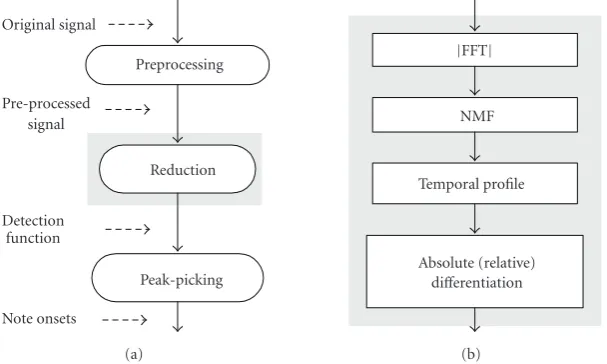
Figure1: Diagram of the onset detection: (a) the general scheme, (b) the proposed reduction strategy, that is, the scheme for deriving the detection functions in this work.
Undoubtedly, the detection function is of great importance to the overall performance of an onset detection algorithm. For the onsets to be easily detected, a good detection function should revealsharppeaks at the locations of those onsets, which would effectively facilitate the subsequent peak-picking process. Therefore, our main attention here is paid to the construction method of detection functions.
Although similar concepts relevant to human perception have been used in most existing approaches to detect onset changes, they are essentially very distinctive with regards to the various types of signal information being employed in the construction of detection functions. These include the intensity change-based methods using temporal features, for example, [7,8]; the timbre change-based methods using spectral features, for example, [9]; model based detection methods using statistical properties, for example, [10], and methods based on phase and pitch information of signals, for example, [11,12], among many others (see, e.g., [1] for a recent review and more references therein).
In this paper, we propose a novel approach for onset detection. This approach is essentially based on the repre-sentation of audio content of the musical passages by a linear basis transform, and the construction of the detection func-tion from the bases learned by nonnegative decomposifunc-tion of the musical spectra. The overall detection scheme is shown in
Figure 1(b). In this scheme, musical magnitude (or power)
spectra of the input data are firstly generated using a discrete Fourier transform (DFT). Then, the nonnegative matrix factorization (NMF) algorithm is applied to find the crucial features in the spectral data. With the transformed data, the individual temporal bases are exploited to reconstruct an overall temporal feature function of the original signal. The detection function is thereby derived by taking the first-order difference (or relative difference) of the feature function whose sudden bursts are converted into narrower peaks for easier detection.
The proposed approach has several promising proper-ties. First of all, the proposed technique is a data-driven
approach, no prior information is needed, as otherwise required for many knowledge-based approaches. Secondly, thanks to the temporal features obtained implicitly from the NMF decomposition, an explicit computation of the signal envelope or energy function, which is required for many existing intensity-based detection approaches, is no longer necessary. Additionally, the NMF-based temporal feature is more robust for both first-order difference and relative difference as compared with direct envelope detection-based approaches (this will be highlighted in the subsequent simulation section).
Note that, due to the scalability issue with the generated nonnegative matrix (see Section 3 for more details), the proposed approach will only be applied to process relatively short recordings in our experiments. Long recordings are therefore not considered in this paper as more computing time is required by the algorithm for handling the increased size of the nonnegative matrix. Additionally, we focus only on single instrument (or voice) recordings, even though the proposed approach can, theoretically, be applicable to multiple instrument (or voice) recordings.
The remainder of this paper is organized as follows. The concept of NMF and the algorithm used in this work are briefly reviewed in Section 2. The method for generating the nonnegative spectral matrix from the input data is presented in Section 3, where the method of how to apply the NMF learning algorithm is also included. The proposed detection functions based on, respectively, the first-order difference, the relative difference, and a constant-balanced relative difference, are described in Section 4. Section 5 is dedicated to the experimental verification of the proposed approach. Finally, conclusions are drawn inSection 6.
2. NONNEGATIVE MATRIX FACTORISATION
×104 14 12 10 8 6 4 2 0
Time in samples −2
0 2
A
m
plitude
G4 A3 E5
(a)
700 600 500 400 300 200 100
Time in frames 500
1000 1500 2000
Fre
q
u
en
cy
(b)
Figure2: The waveform of the original audio signal (a) and the generated nonnegative magnitude spectrum matrix X (b). The onset locations are marked manually with arrows.
matrixX∈R≥0,M×N, the goal of NMF is to find nonnegative matricesW∈R≥0,M×RandH∈R≥0,R×N, such that
X≈WH, (1)
where R is the rank of the factorisation, generally chosen to be smaller than M (or N), or a value which satisfies (M+N)R < MN, which results in the extraction of some latent features whilst reducing some redundancies in the original data. To find the optimal choice of matricesWand H, we should minimize the reconstruction error betweenX andWH. Several error functions have been proposed for this purpose [13–16]. For instance, an appropriate choice is to use the criterion based on the squared Frobenius norm,
W,H=arg min
W,H
X−WH2
F, (2)
whereWandH are the estimated optimal values ofWand H, and·F denotes the Frobenius norm. Alternatively, we can also minimize the error function based on the extended Kullback-Leibler divergence,
W,H=arg min
W,H
M
m=1 N
n=1
Dmn, (3)
where Dmn is the mnth element of the matrix D which is given by
D=XlogX(WH) −X+WH, (4)
whereanddenote the Hadamard (elementwise) product and division, respectively, that is, each entry of the resultant matrix is a product and division of the corresponding entries from two individual matrices, respectively. Although gradient descent and conjugate gradient approaches can
700 600 500 400 300 200 100 0
Time in frames 0.1
0.05
(a)
700 600 500 400 300 200 100 0
Time in frames 0.1
0.05
(b)
700 600 500 400 300 200 100 0
Time in frames 0.1
0.05
(c)
700 600 500 400 300 200 100 0
Time in frames 0.1
0.05
(d)
700 600 500 400 300 200 100 0
Time in frames 0
1
(e)
700 600 500 400 300 200 100 0
Time in frames 0
0.5 1
(f)
Figure 3: Detection results of the signal depicted in Figure 2. Figures3(a)–3(c)are the visualizations of row vectors of the matrix
Ho; (d) denotes the temporal profile of ho(k), that is, (9); (e)
visualizes the detection function (13); and (f) represents the final onset locations.
700 600 500 400 300 200 100 0
Time in frames 0.02
0.04 0.06 0.08
(a)
700 600 500 400 300 200 100 0
Time in frames 0.02
0.04 0.06
(b)
700 600 500 400 300 200 100 0
Time in frames 0.1
0.05
(a)
700 600 500 400 300 200 100 0
Time in frames 0.1
0.05
(b)
700 600 500 400 300 200 100 0
Time in frames 0.1
0.05
(c)
700 600 500 400 300 200 100 0
Time in frames 0.1
0.05
(d)
Figure5: The visualisation of row vectors of the matrixHofor rank R=4.
700 600 500 400 300 200 100 0
Time in frames
R=1
R=2
R=3
R=4
R=5 0.05
0.1 0.15 0.2 0.25
A
m
plitude
Figure6: Temporal profileho(k) changes with variousRvarying
from 1 to 5.
both be applied to minimize these cost functions, we are particularly interested in the multiplicative rules developed by Lee and Seung [14,15]. These rules are easy to implement and also have good convergence performance. Additionally, a step-size parameter which is normally required for gradient algorithms is not necessary in these rules. In compact form,
×1035 2.5
2 1.5 1
0.5 0
Time in samples −5
0 5
A
m
plitude
Figure7: A real piano signal containing twelve onsets is used for showing the effect of the choice ofRon the detection performance.
600 500 400 300 200 100 0
Time in frames
R=4
R=8
R=12
R=16
R=20 0
0.5 1 1.5
A
m
plitude
(a)
600 500 400 300 200 100 0
Time in frames
R=4
R=8
R=12
R=16
R=20 −0.5
0 0.5 1 1.5
A
m
plitude
(b)
Figure8: Detection performance in terms ofho(k) (upper subplot)
andho
r(k) (below subplot) remains relatively constant despite the
variable rankR.
the multiplicative update rules for minimizing criterion (2) can be rewritten as
H←−HWTXWTWH, (5)
W←−WXHTWHHT, (6)
×104 15 10
5 0
Time in samples −10
0 10
(a)
×104 15 10
5 0
Time in samples −10
0 10
(b)
×104 15 10
5 0
Time in samples −10
0 10
(c)
×104 15 10
5 0
Time in samples −10
0 10
(d)
Figure9: Four music audio signals played (or generated) by a (a) guitar, (b) gun, (c) piano, and (d) whistle, respectively, containing the same notes G4, A3, and E5 as those in the violin signal used in
Section 5.1.
3. NONNEGATIVE DECOMPOSITION OF MUSICAL SPECTRA
For the NMF algorithm to be applied, we should first prepare a nonnegative matrix that contains an appropriate representation of the original data to be analyzed. Unlike the image data analyzed in [14], musical audio data cannot be directly used as they contain negative-valued samples. In our problem, the nonnegative matrixX is generated as the magnitude spectra of the input data, similar to [17]. We denote the original audio signal ass(t), wheret is the time instant. Using aT-point windowed DFT, a time-domain signals(t) can be converted into a frequency-domain time-series signal as
S(f,k)= T−1
τ=0
s(kδ+τ)w(τ)e−j2π f τ/T, (7)
wherew(τ) denotes aT-point window function, j =√−1, δis the time shift between the adjacent windows, and f is a frequency index, f =0, 1,. . .,T−1. Clearly, the time index k in S(f,k) is generally not a one-to-one mapping to the time indextins(t). If the whole signal has, for instance,L samples, then the maximum value ofk, that is,K, is given
800 700 600 500 400 300 200 100 0
Time in frames −0.1
0 0.1
(a)
800 700 600 500 400 300 200 100 0
Time in frames 0
0.5 1
(b)
800 700 600 500 400 300 200 100 0
Time in frames −10
0 10
(c)
800 700 600 500 400 300 200 100 0
Time in frames 0
0.5 1
(d)
800 700 600 500 400 300 200 100 0
Time in frames −2
0 2
(e)
800 700 600 500 400 300 200 100 0
Time in frames 0
0.5 1
(f)
Figure 10: Comparison between the detection functions for the guitar signal (seeFigure 9(a)). Plots (a), (c), and (e) are detection functions ho
a(k), hor(k), and hob(k), respectively, and plots (b),
(d), and (f) are the onsets localised correspondingly using these detection functions.
as K = (L−T)/δ, where · is an operator taking the maximum integer no greater than its argument. (In practice, zero-padding may be required to allow the remainingp(0≤
p < δ) samples in the end of the signal to be covered by the analysis window.) LetS(f,k) be the absolute value ofS(f,k), we can then generate the following nonnegative matrix by packingS(f,k) together,
X=
⎛ ⎜ ⎜ ⎜ ⎜ ⎜ ⎝
S(0, 0) S(0, 1) · · · S(0,K−1)
S(1, 0) S(1, 1) · · · S(1,K−1) ..
. ... ... ...
S(T/2, 0) S(T/2, 1) · · · S(T/2,K−1) ⎞ ⎟ ⎟ ⎟ ⎟ ⎟ ⎠, (8)
800 700 600 500 400 300 200 100 0
Time in frames −0.2
0 0.2
(a) 800 700 600 500 400 300 200 100 0
Time in frames 0
0.5 1 (b) 800 700 600 500 400 300 200 100 0
Time in frames −5 0 5 (c) 800 700 600 500 400 300 200 100 0
Time in frames 0
0.5 1 (d) 800 700 600 500 400 300 200 100 0
Time in frames −2 0 2 (e) 800 700 600 500 400 300 200 100 0
Time in frames 0
0.5 1
(f)
Figure 11: Comparison between the detection functions for the gunshot signal (seeFigure 9(b)). Plots (a), (c), and (e) are detection functions ho
a(k), hor(k), and hob(k), respectively, and plots (b),
(d), and (f) are the onsets localised correspondingly using these detection functions. Gunshot signals fluctuate more strongly as compared with violin, guitar, and piano signals. The onset peaks revealed by functionsho
a(k) andhob(k) are not as strong as those
revealed byho r(k).
the frequency axis, and the dimension ofX, that is,M×N, then becomes (T/2 + 1)×K[18]. This non-negative matrix containing the magnitude spectra of the input signal will be used for decomposition. It is worth noting that there is a scalability issue with the generated matrix X, that is, if the signal to be processed is very long, the constructed data matrixX can be very large in dimension. In this work, we focus on relatively short signals for which NMF does not pose a problem in terms of computational loads.
Using the learning rules (5) and (6), X in (8) can be effectively decomposed into the product of two nonnegative matrices, denoted asWo∈R≥0,(T/2+1)×RandHo ∈R≥0,R×K,
800 700 600 500 400 300 200 100 0
Time in frames −0.1
0 0.1
(a) 800 700 600 500 400 300 200 100 0
Time in frames 0
0.5 1 (b) 800 700 600 500 400 300 200 100 0
Time in frames −10 0 10 (c) 800 700 600 500 400 300 200 100 0
Time in frames 0
0.5 1 (d) 800 700 600 500 400 300 200 100 0
Time in frames −2 0 2 (e) 800 700 600 500 400 300 200 100 0
Time in frames 0
0.5 1
(f)
Figure 12: Comparison between the detection functions for the piano signal (seeFigure 9(c)). Plots (a), (c), and (e) are detection functions ho
a(k), hor(k), and hob(k), respectively, and plots (b),
(d), and (f) are the onsets localised correspondingly using these detection functions. The detection functions reveal strong peaks at the onset locations, while remaining relatively flat for the period of note decaying, due to the relatively small variations of dynamics of the piano signal.
800 700 600 500 400 300 200 100 0
Time in frames −0.02
0 0.02
(a)
800 700 600 500 400 300 200 100 0
Time in frames 0
0.5 1
(b)
800 700 600 500 400 300 200 100 0
Time in frames −5
0 5
(c)
800 700 600 500 400 300 200 100 0
Time in frames 0
0.5 1
(d)
800 700 600 500 400 300 200 100 0
Time in frames −0.5
0 0.5
(e)
800 700 600 500 400 300 200 100 0
Time in frames 0
0.5 1
(f)
Figure 13: Comparison between the detection functions for the whistle signal (seeFigure 9(d)). Plots (a), (c), and (e) are detection functionsho
a(k),hor(k), andhob(k), respectively, and plots (b), (d) and
(f) are the onsets localised correspondingly using these detection functions. The attack of the notes of the whistle signal is not as strong as percussive audio, for example, guitar signal. Detection functionsho
a(k) andhob(k) are less accurate thanhor(k) for revealing
the peaks of the onset attack.
×104 10 8
6 4
2 0
Time in samples −10
−5 0 5 10
A
m
plitude
Figure14: A realistic music signal played by a guitar.
600 500 400 300 200 100 0
Time in frames −0.5
0 0.5
(a)
600 500 400 300 200 100 0
Time in frames −2
0 2
(b)
600 500 400 300 200 100 0
Time in frames −2
0 2
(c)
Figure 15: Comparison between the detection functions for the real piano signal (seeFigure 7). Plots (a), (b), and (c) are detection functionsho
a(k),hor(k), andhob(k), respectively, where the detected
onsets using these functions are marked with stars.
the choice ofR, for which, there has been no generic guidance for different application scenarios. However, this issue turns out not to be crucial in our application, as verified in our simulations. It is worth noting that by using the magnitude spectrum, we have actually ignored the phase information, which can be useful for improving the detection performance especially for the algorithms considering spectral features, as examined in [1, 11]. However, as will be clear in the next section, our detection functions are constructed from the temporal basis of the factorization, which has the form of a temporal feature. Therefore, phase information does not have the same impact for the detection functions in this work as those based on spectral features.
4. CONSTRUCTION OF DETECTION FUNCTIONS
By combining all the singlepartstogether, we can reconstruct the following time series:
ho(k)= R
r=1
Hork, (9)
wherek = 0,. . .,K−1, andho(k) provides an alternative approach for the construction of an onset detection function. To enhance the sudden changes in the signal to be detected, we take the first-order difference of ho(k) as a detection function, that is,
ho a(k)=
d dkh
o(k), k=0,. . .,K−1, (10)
250 200
150 100
50 0
Time in frames −5
0 5
(a)
250 200
150 100
50 0
Time in frames −5
0 5
(b)
250 200
150 100
50 0
Time in frames −5
0 5
(c)
Figure16: Comparison between the detection functions for the real guitar signal (seeFigure 14). Plots (a), (b) and (c) are detection functionsho
a(k),hor(k), andhob(k), respectively, where the detected
onsets using these functions are marked with stars.
taking the difference between two consecutive samples of the series. Therefore,ho
a(k)=ho(k)−ho(k−1). In other words, ho
a(k) takes the absolute difference between the neigbouring samples ofho(k) at discrete time instantk, hence it is able to reveal sudden intensity changes in the signal. However, there exists psychoacoustic evidence showing that human hearing is generally more sensitive to the relative than to the absolute intensity changes [19]. Therefore, we can also use a detection function based on the first-order relative difference, that is,
hor(k)=
(d/dk)ho(k)
ho(k) . (11)
Note that, the major difference between ho
r(k) in (11) and the detection function proposed by Klapuri [8] lies in the different strategies taken for the construction of the temporal profile. In [8], it is formed from the energy or amplitude envelope of a group of subband signals obtained from the original signal using a filterbank decomposition.
To consider a tradeoffbetween the performance by the above two functions, we also introduce a constant-balanced detection function,
ho b(k)=
(d/dk)ho(k)
η+ho(k) , (12)
whereηis a positive constant. By adjusting the constantη, we can obtain the desirable performance in the interim that may be achieved by (10) and (11) independently. To see this, we consider two extreme cases. Ifηtakes values approaching to zero, that is, η→0, in other words, η ho(k), we have hob(k) ≈ hro(k). On the other hand, if η ho(k),
800 700 600 500 400 300 200 100 0
Time in frames −0.2
0 0.2
(a)
800 700 600 500 400 300 200 100 0
Time in frames 0
0.5 1
(b)
800 700 600 500 400 300 200 100 0
Time in frames −5
0 5
(c)
800 700 600 500 400 300 200 100 0
Time in frames 0
0.5 1
(d)
800 700 600 500 400 300 200 100 0
Time in frames −2
0 2
(e)
800 700 600 500 400 300 200 100 0
Time in frames 0
0.5 1
(f)
Figure 17: Increasing the threshold used for localisation of the onsets can improve the robustness against the instrumental dynamics. In this example, the threshold is set to 0.6 for onset detection of the gunshot signal (seeFigure 9(b)). Plots (a), (c) and (e) are detection functionsho
a(k),hor(k), andhob(k), respectively, and
plots (b), (d), and (f) are the onsets localised correspondingly using these detection functions. This figure is in contrast to Figure 11, where the threshold is set to 0.3.
we havehob(k) ≈ (1/η)hoa(k), which means hob(k) will have the same profile as that of ho
a(k), with the only difference a scaling factor. All the above three detection functions are examined in our simulations. In fact, η has practical advantage of preventing the denominator in (11) from being zero. Effectively, (12) can also be written as the logarithm,
ho b(k)=
d dklog
η+ho(k), (13)
600 400
200 0
Time in frames −1
0 1 2
(a)
600 400
200 0
Time in frames
0 1 2
(b)
600 400
200 0
Time in frames 0
1 2
(c)
250 200
150 100
50 0
Time in frames −2
0 2 4
(d)
250 200
150 100
50 0
Time in frames 0
1 2
(e)
250 200
150 100
50 0
Time in frames 0
1 2
(f)
Figure18: Adjusting the threshold used for localisation of the onsets can improve the robustness against the instrumental dynamics. In this example, two different values of the threshold, that is, 0.1 (corresponding to subplots (b) and (e)) and 0.3 (corresponding to subplots (c) and (f)) were used for onset detection of the piano and guitar signals, whose detection functionsho
r(k) are plotted in (a) and (d), respectively.
Subplots (b) and (c) show the locations of the onsets detected using the relative difference functions with the threshold set to 0.1 and 0.4, respectively, for the piano signal, and (e) and (f) for the guitar signal.
5. NUMERICAL EXPERIMENTS
5.1. Detection example for a music audio signal
To illustrate the detection method described above, we first apply the proposed approach to the onset detection of a simple audio signal which was played by a violin and contains three consecutive music notes G4, A3, and E5
(see Figure 2(a)), whose note numbers are 55, 45, and 64,
respectively, and whose frequencies are 196.0 Hz, 110.0 Hz, and 329.6 Hz, respectively. (The MIDI specification only defines note number 60 as “Middle C,” and all other notes are relative. The absolute octave number designations can be arbitrarily assigned. Here, we define “Middle C” as C5.) The choice of the simplistic signal, together with some others used in subsequent sections, is dictated by a particular application scenario, where MIDI commands may be used as controlling keys in some advanced music consoles and software packages for hand-free but voice or music
600 400
200 0
Time in frames 0
0.1
(a)
600 400
200 0
Time in frames 0.02
0.04 0.06 0.08 0.1
(e)
600 400
200 0
Time in frames −0.02
0 0.02
(b)
600 400
200 0
Time in frames −0.01
0 0.01 0.02
(f)
600 400
200 0
Time in frames 0
20 40
(c)
600 400
200 0
Time in frames 0
1 2 3
(g)
600 400
200 0
Time in frames −0.2
0 0.2 0.4 0.6
(d)
600 400
200 0
Time in frames −0.2
0 0.2 0.4 0.6
(h)
Figure19: Comparison between the results of the proposed detection method and that based on RMS, where the plots are (a)hRMS(k), (b) hRMS
a (k), (c)hRMSr (k), (d)hRMSb (k), (e)ho(k), (f)hoa(k), (g)hro(k), and (h)hob(k), respectively.
operation. The factorization rankRis set to 3, that is, exactly the same as the total number of the notes in the signal. The matrices W andH were initialized as two matrices whose elements are absolute values of zero mean real i.i.d. Gaussian random variables. The NMF algorithm was running over 100 iterations. In fact, the algorithms only took 11 iterations to converge to a local minimum in this experiment. The generated nonnegative magnitude spectrum matrix X is visualized inFigure 2(b).Figure 3demonstrates the process described in Sections3and4(see alsoFigure 1(b)), where the detection function (13) was applied, and the constant ηis set to 0.01. From Figures3(a)–3(c), it is clear that the NMF algorithm has learned the parts of the original signal, and these three parts represent the individual notes in this
case. By summing up these three parts using (9), the overall temporal profileho(k) of the original signal is reconstructed, as shown inFigure 3(d). After applying (13) to this profile, the detection functionhob(k) reveals apparent peaks on the locations where the notes start to strike, see Figure 3(e). The onset locations can thereby be easily determined by thresholding the local maxima of ho
b(k), see Figure 3(f), which are 630 milliseconds, 3016 milliseconds, and 5574 milliseconds, respectively.
5.2. On choice of factorization rankR
0.5 0.4
0.3 0.2
0.1 0
Thresholds (a)
(b) 40 50 60 70 80 90 100
TP
(a)
0.5 0.4
0.3 0.2
0.1 0
Thresholds (a)
(b) 0 20 40 60 80 100
FP
(b)
0.5 0.4
0.3 0.2
0.1 0
Thresholds (a)
(b) 0 20 40 60 80 100
TP
(c)
0.5 0.4
0.3 0.2
0.1 0
Thresholds (a)
(b) 0 10 20 30 40 50 60
FP
(d)
Figure20: Test results of TP and FP against different thresholds for the two real music signals in Figures7and14. Plot (a) corresponds to the proposed approach, and (b) to the RMS approach. The upper two plots correspond to the test results for the piano signal inFigure 7, while the below two plots correspond to the test results for the guitar signal inFigure 14. In this test, twenty different thresholds between 0.025 and 0.5 were used.
this case. In many practical situations, however, the number of hidden parts is not known a priori. Either a greater or a smaller value ofRthan the real number of the latent parts in the signal to be learned may be used for the factorization. Unfortunately, there is no generic guidance on how to choose optimally the rank R. Here, we show experimentally the effect of R on the performance of our detection method. We use the same experimental setup for the parameters as above, except forR, which we change from 1 to 5. Figures
4 and 5 are the visualizations of matrix Ho with R equal to 2 and 4, respectively.Figure 4(b)indicates that the total parts have not been fully separated, as there are two parts bound together in one row.Figure 5shows that although all parts have been separated as shown in (a) (c) and (d), there is an extra row that may contain the weighted components of all latent parts. Fortunately, these side effects are not
crucial in our application. Figure 6 plots ho(k) changing with variousR. We can see clearly that the profiles are very similar for differentRand only differ from their amplitude, especially the change points of the intensity remain the same for differentR. This implies that variousRstill give the same detection result.
Although a relatively simple signal was used in the above experiment, the observations found here are also valid for realistic music signals, for which we have performed extensive numerical tests. As an example, a segment of such a signal is shown in Figure 7, and ho(k) and ho
r(k) changing with variousRare shown inFigure 8. Although the temporal profiles are obtained using variousRdiffer in their amplitude,ho
25 20
15 10
5 0
FP (a)
(b) (c) 20 40 60 80 100
TP
Figure21: Average results of TP against FP for a dataset containing realistic music signals. Plots (a), (b), and (c) correspond to the proposed approach, the RMS approach, and the method in [20], where 14 different thresholds (shown as marks in each plot) were used.
performance can be achieved even thoughRis not known accurately.
5.3. Robustness to instruments
InSection 5.1, we have shown the good performance of the
proposed approach for the stimulus played by violin. How-ever, the performance may vary for the stimuli played by var-ious instruments, or generated in some other ways.Figure 9
shows four audio signals containing three consecutive music notes G4, A3, and E5, which were played (generated) by a guitar, gun (gunshot), piano, and whistle, respectively. (The choice of the instruments in this experiment is dictated by a specific application scenario, as described inSection 5.1.) Figures10(a),10(c), and10(e)show the detection functions ho
a(k),hor(k), andhob(k) obtained by applying (10), (11), and (13) to the profile of the guitar signal in Figure 9(a), and Figures 10(b), 10(d), and 10(f) show the onset locations determined by thresholding the local maxima ofho
a(k),hor(k), andho
b(k) respectively. Similarly, Figures11,12, and13are the plots of the results of detection functions and the onset locations of the gunshot, piano, and whistle signals in Figures
9(b),9(c), and9(d), respectively. Note that, we use the same threshold as that in Section 5.1for the localisation of the onsets for all these instruments. Clearly, for guitar and piano signals,ho
a(k),hor(k), andhob(k) all provide robust estimates of the note onsets. However, for gunshot and whistle signals, the onsets detected using ho
a(k) and hob(k) appear not only at the correct location, but also at some false positions, while the robustness of the detection functionho
r(k) remains relatively consistent. These experiments indicate that the robustness of the proposed method may vary with the different instruments, due to their various dynamics. For the onsets to be robustly detected, the detection functions
are expected to provide instrument relatively independent performance. In this respect, ho
r(k) provides more robust detection performance against the variations of instrumental dynamics, as compared with those of detection functions ho
a(k) andhob(k).
To show the performance of the proposed method for more realistic signals, we have performed tests based on a commercial dataset containing signals played by different instruments (seeSection 5.6for objective performance mea-surements). As illustrative examples, apart from the signal
in Figure 7, we show another music signal played by a
guitar inFigure 14. The detection functions obtained for the piano (Figure 7) and guitar (Figure 14) signals are plotted in Figures15 and16, respectively, where subplots (a), (b), and (c) show the detection functionsho
a(k),hor(k), andhob(k), respectively. From the detected onsets (marked with stars) in each subplot, we can compare the performance of each detection function. Note that the threshold in the peak-picking stage was set to 0.2 for both tests. The observations made for simplistic music signals are also valid for these realistic signals played with different instruments.
5.4. Effect of thresholding
From the above section, we understand that the perfor-mance of the proposed approach may be affected by the instruments. Apart from using better detection functions, the robustness can also be improved by applying additional constraints, such as removing the false onsets if they fall into a certain distance to a detected onset, as onsets may occur in the order of one after another with a certain period of time between each other. Another effective yet simple way of improving the robustness against the stimuli is to appropriately adjust the threshold used for the localisation of onsets.Figure 17shows that by increasing the threshold from 0.3 to 0.6, most of the false onsets detected in the gunshot signal, that is,Figure 11, have almost been removed, and the detection accuracy is greatly improved for detection func-tionsho
a(k) andhob(k). In Figure 18, applying two different thresholds in the peak-picking stage for the relative detection function ho
Table1: Onset detection results by the proprosed approach as compared with the true values marked manually. The deviations between the estimated and the actual onset time are denoted in brackets.
Onset time (s) G4 A3 E5
Estimated by (10) 0.630 (0.016) 3.016 (0.007) 5.583 (0.023)
Estimated by (11) 0.612 (−0.002) 3.007 (−0.002) 5.556 (−0.004)
Estimated by (13) 0.630 (0.016) 3.016 (0.007) 5.574 (0.014)
Actual 0.614 3.009 5.560
fixed thresholds. However, we have tested many different thresholds with the hope that such evaluations may provide a general guideline for choosing an optimal threshold, and also give useful clues for future development of an adaptive scheme.
5.5. Comparisons with RMS approach
In this section, we compare the proposed approach with the approach based on the direct detection of the signal envelope using the root mean square (RMS), that is,
hRMS(k)= 1
T T−1
τ=0
s[kδ+τ]2, (14)
where δ is the time shift,k denotes the frame index, and T is the frame length. Expression (14) is a variation of the detection function in [7]. For simplicity, the detec-tion funcdetec-tions derived from (14), corresponding to those described by (10), (11), and (13), respectively, inSection 4, are denoted ashRMS
a (k),hRMSr (k), andhRMSb (k), respectively, which are obtained simply by replacingho(k) withhRMS(k). To make an appropriate comparison, the parameters are set to be identical for both approaches, as in Section 5.1. In practical implementation, (11) is approximated by (13) through settingηto be 10−22(a trivial value approximating zero).Figure 19shows the results. From this figure, we can see that, surprisingly, although the temporal profiles look similar for both the RMS and NMF approaches, the derived detection functions are relatively different, especially the behaviours of ho
r(k) and hRMSr (k) are very different. hor(k) tends to be more balanced over the different onsets, while hRMS
r (k) is seriously unbalanced which would make the final step “peak-picking” depicted inFigure 1(a)much more difficult, an optimal threshold is not easy to be accurately predefined as the subsequent onset peaks may easily fall down to the similar levels of noise components. Additionally, by comparing Figures19(a) and19(e), it appears thatho(k) is smoother thanhRMS(k). This is a good property forho(k), as we find from Figures19(b) and 19(f) that the fluctuations in (b) may be too large to apply global thresholding for peak-picking. Since the same window size has been used for generating ho(k) and hRMS(k), it is likely thatho(k) is less sensitive to the choice of window size. Similar properties have also been found for other signals, such as the signals played by piano and guitar (the results are omitted here). Note that the analysis of the constant-balanced detection function described inSection 4is also confirmed byFigure 19.
To show the accuracy of the proposed approach, we list
in Table 1 the estimated locations of the onsets in Figures
19(f)–19(h) as compared with the values marked manually (i.e., the true values). From this table, it is observed that the onsets estimated by the difference function have slight delays from the true values, while the relative difference function provides more accurate estimates (i.e., they are closer to the true values). The constant-balanced detection function offers an intermediate performance that may be useful if there is a dramatic unbalance across the amplitude of the various onset peaks in the relative difference function. The maximum estimation error for the relative difference function is less than 5 milliseconds, which means the detection accuracy is perfect in this case, as the human auditory system is not capable of detecting gaps in sinusoids under 5 milliseconds [19]. Although the difference function appears to be less accurate, considering the window size and overlap are 18 milliseconds and 9 milliseconds in our experiment, respec-tively, the accuracy of the first-order difference function is also acceptable. This is because all the proposed detection functions operate framewise on the spectrum data, and an onset can be considered as correctly detected if it falls within a window size of the predetermined onset position [1,21]. Clearly, in this experiment, all the onsets detected by the three detection functions can be deemed as accurate since they all fall within a 25-millisecond window around the true onset position. However, it is worth noting that a sample-accurate onset detection may be obtained by preselecting just those frames (and their surrounding frames) in which the onsets are detected and by processing these frames in sample-accuracy [22]. We would also like to point out that the proposed approach is especially useful for percussive audio signals, as the consistently informative amplitude changes within the signals have been effectively used for the formulation of the detection functions.
5.6. Objective performance evaluation
positive. In practice, there may exist a few missing notes not being detected at all, which is reflected by the index of TP.
In the first experiment, the two signals in Figures 7
and 14 were used. The thresholds used for peak-picking were increased gradually from 0.025 to 0.5 with a step size 0.025, that is, 20 different thresholds were tested. The proposed approach is compared with the RMS approach as described in Section 5.5. The performance analysis in the previous sections suggests that the relative difference function provides the best results in most cases, we there-fore focus only on this detection function. As shown in
Section 5.2, the performance of the proposed algorithm is
not sensitive to the choice of rankR, we therefore setRto 12 for both signals. Figure 20 shows the result. From this figure, we can see that the proposed approach performs much better especially for the guitar signal; though for the piano signal, the performance difference between the two approaches is trivial. In accordance with the observations made inSection 5.4, an optimal threshold may be found by considering TP and FP simultaneously, that is, maximizing TP while minimizing FP. For example, for the piano signal, 0.2, can be regarded as an approximately optimal threshold for both the proposed approach and the RMS approach.
To evaluate the performance more substantially, apart from the RMS method, we have also considered another approach in the literature [20]. All the approaches were applied to a collection of realistic signals from a commercial dataset, where 21 testing signals with each containing a particular number of notes were tested. The thresholds used for peak-picking were increased gradually from 0.1 to 0.425 with a step size 0.025, that is, 14 different thresholds were tested. Note that, unlike the 20 thresholds used in the previous experiment, we discarded the relatively small (e.g., 0.025) and big (e.g., 0.5) thresholds in these tests as they either give a large number of false detections or miss many correct notes. The average performances based on these test signals are shown inFigure 21, which shows the change of TP versus FP for all 14 tested thresholds. The closer the plot approaches to the top-left corner of the figure, the better performance the approach may have. It is clear from this sense that the proposed approach performs better than the method in [20] and the RMS approach. From this figure, an optimal threshold can also be found if the TP-FP point for this particular threshold approaches the top-left corner. As is well known, music signals are composed of different notes, no matter whether they are complicated or not, from one instrument or multiple instruments. Each note can be regarded as a “part” of the whole signal. This agrees conceptually with the promising property of the NMF technique, that is, decomposing data into a part-based representation. For music signals, it naturally decomposes the data into different musical events, that is, individual parts of the musical signals. This might be the reason why NMF features perform well for the purpose of onset detection.
6. CONCLUSIONS
We have presented a new onset detection approach for musical audio by using nonnegative decomposition of a
magnitude spectrum matrix. Based on the nonnegative basis learned from the factorization, we have constructed three feasible detection functions, in which the relative difference detection function provides the best performance against instrumental dynamics. The proposed technique has also been compared with the RMS envelope-based approach and its advantages have been shown. The numerical examples provided have supported the good performance of the proposed technique for onset detection.
ACKNOWLEDGMENTS
The authors would like to thank the anonymous reviewers for their very helpful comments. Some preliminary results of this work appeared partly in IEEE International Workshop on Machine Learning for Signal Processing, Maynooth, Ireland, September 6–8, 2006.
REFERENCES
[1] J. P. Bello, L. Daudet, S. Abdallah, C. Duxbury, M. Davies, and M. B. Sandler, “A tutorial on onset detection in music signals,”
IEEE Transactions on Speech and Audio Processing, vol. 13, no. 5, pp. 1035–1047, 2005.
[2] A. Lacoste and D. Eck, “A supervised classification algorithm for note onset detection,”EURASIP Journal on Advances in Signal Processing, vol. 2007, Article ID 43745, 13 pages, 2007. [3] M. E. P. Davies and M. D. Plumbley, “Context-dependent beat
tracking of musical audio,”IEEE Transactions on Audio, Speech, and Language Processing, vol. 15, no. 3, pp. 1009–1020, 2007. [4] F. Gouyon and S. Dixon, “A review of automatic rhythm
description systems,”Computer Music Journal, vol. 29, no. 1, pp. 34–54, 2005.
[5] M. A. Bartsch and G. H. Wakefield, “Audio thumbnailing of popular music using chroma-based representations,”IEEE Transactions on Multimedia, vol. 7, no. 1, pp. 96–104, 2005. [6] B. Supper, T. Brookes, and F. Rumsey, “An auditory onset
detection algorithm for improved automatic source local-ization,”IEEE Transactions on Audio, Speech, and Language Processing, vol. 14, no. 3, pp. 1008–1017, 2006.
[7] W. A. Schloss, On the automatic transcription of percus-sive music: from acoustic signal to high-level analysis, Ph.D. Dissertation, Department of Hearing and Speech, Stanford University, Stanford, Calif, USA, 1985.
[8] A. Klapuri, “Sound onset detection by applying psychoacous-tic knowledge,” inProceedings of the IEEE International Con-ference on Acoustics, Speech and Signal Processing (ICASSP ’99), vol. 6, pp. 3089–3092, Phoenix, Ariz, USA, March 1999. [9] P. Masri,Computer modeling of sound for transformation and
synthesis of musical signal, Ph.D. Dissertation, University of Bristol, Bristol, UK, 1996.
[10] S. Abdallah and M. D. Plumbley, “Probability as metadata: event detection in music using ICA as a conditional density model,” inProceedings of the 4th International Symposium on Independent Component Analysis and Blind Signal Separation (ICA ’03), pp. 233–238, Nara, Japan, April 2003.
[11] J. P. Bello and M. Sandler, “Phase-based note onset detec-tion for music signals,” in Proceedings of the IEEE Interna-tional Conference on Acoustics, Speech and Signal Processing (ICASSP ’03), vol. 5, pp. 441–444, Hong Kong, April 2003. [12] C. Roads, Ed., The Music Machine: Selected Readings from
1989.
[13] P. Paatero, “Least squares formulation of robust non-negative factor analysis,”Chemometrics and Intelligent Laboratory Sys-tems, vol. 37, no. 1, pp. 23–35, 1997.
[14] D. D. Lee and H. S. Seung, “Learning the parts of objects by non-negative matrix factorization,”Nature, vol. 401, no. 6755, pp. 788–791, 1999.
[15] D. D. Lee and H. S. Seung, “Algorithms for non-negative matrix factorization,” in Advances in Neural Information Processing Systems 13 (NIPS ’00), MIT Press, Cambridge, Mass, USA, 2001.
[16] P. O. Hoyer, “Non-negative matrix factorization with sparse-ness constraints,”Journal of Machine Learning Research, vol. 5, pp. 1457–1469, 2004.
[17] P. Smaragdis and J. C. Brown, “Non-negative matrix factoriza-tion for polyphonic music transcripfactoriza-tion,” inProceedings of the IEEE Workshop on Applications of Signal Processing to Audio and Acoustics (WASPAA ’03), pp. 177–180, New Paltz, NY, USA, October 2003.
[18] W. Wang, Y. Luo, J. A. Chambers, and S. Sanei, “Non-negative matrix factorization for note onset detection of audio signals,” in Proceedings of the 16th IEEE Signal Processing Society Workshop on Machine Learning for Signal Processing (MLSP ’07), pp. 447–452, Maynooth, Ireland, September 2006.
[19] B. C. J. Moore,An Introduction to the Psychology of Hearing, Academic Press, San Diego, Calif, USA, 5th edition, 2003. [20] D. L. Wang, “Feature-based speech segregation,” in
Com-putational Auditory Scene Analysis: Principles, Algorithms, and Applications, D. L. Wang and G. J. Brown, Eds., IEEE Press/Wiley, New York, NY, USA, 2006.
[21] C. Duxbury, M. Sandler, and M. Davies, “A hybrid approach to musical note onset detection,” in Proceedings of the 5th International Conference on Digital Audio Effects (DAFx ’02), Hamburg, Germany, September 2002.