Research Article
Detection and Parameter Estimation of Multicomponent LFM
Signal Based on the Cubic Phase Function
Yong Wang and Yi-Cheng Jiang
Harbin Institute of Technology, Research Institute of Electronic Engineering Technology, Harbin 150001, China
Correspondence should be addressed to Yong Wang,[email protected]
Received 27 September 2007; Revised 17 January 2008; Accepted 5 March 2008
Recommended by Jar-Ferr Yang
A new algorithm for the detection and parameters estimation of LFM signal is presented in this paper. By the computation of the cubic phase function (CPF) of the signal, it is shown that the CPF is concentrated along the frequency rate law of the signal, and the peak of the CPF yields the estimate of the frequency rate. The initial frequency and amplitude can be obtained by the dechirp technique and fast Fourier transform. And for multicomponent signal, the CLEAN technique combined with the CPF is proposed to detect the weak components submerged by the stronger components. The statistical performance is analyzed and the simulation results are shown simultaneously.
Copyright © 2008 Y. Wang and Y.-C. Jiang. This is an open access article distributed under the Creative Commons Attribution License, which permits unrestricted use, distribution, and reproduction in any medium, provided the original work is properly cited.
1. INTRODUCTION
Linear frequency-modulated (LFM), or chirp, signals are frequently encountered in applications such as radar, sonar, bioengineering, and so forth. The amplitude, initial fre-quency, and chirp rate are the basic parameters which denote the characteristic of the LFM signal, and the estimation of them is an important problem in the signal process-ing community. Several estimation procedures have been proposed, but most are based on the maximum likelihood (ML) principle [1,2]. These methods can be ascribed to a multivariable optimization algorithm and the accuracy of them strongly depends on the grid resolution in the search procedure. The computational burden may be too high to obtain reasonable accuracy. In recent years, many techniques based on the time-frequency analysis have been presented to solve this problem, such as the Wigner-Hough transform [3,4], the Radon-ambiguity transform [5], and the fractional Fourier transform (FrFt) [6], and so forth. These techniques alleviate the computational burden in a way, but still need complex searching and the application of them is limited. Hence, the fast estimation of the parameter of LFM signal with high accuracy is still an urgent problem to us all. In this paper, a new algorithm of detection and parameters estimation of LFM signal is presented, by the computation of the CPF [7] of the signal, it is shown that the CPF is
concentrated along the frequency rate law of the signal, and the estimation of the frequency rate can be obtained by finding the CPF peak. Then the estimation of the initial frequency and amplitude can be implemented by the dechirp technique and fast Fourier transform. The algorithm requires only one-dimensional (1D) maximizations, which lessen the computational burden greatly. And for multicomponent signal, the CLEAN technique combined with the CPF is proposed to detect the weak components submerged by the stronger components, and the combination technique is valuable in practice. The statistical performance is analyzed at last and the simulation results demonstrate the validity of the algorithm proposed.
2. DETECTION AND PARAMETER ESTIMATION OF
LFM SIGNAL BASED ON CPF
The cubic phase function (CPF) was introduced in [8] for the purpose of estimating the instantaneous frequency rate law of a quadratic FM signal. In this paper, a new algorithm for detection and parameter estimation of multicomponent LFM signal based on the CPF is developed in the following.
For a monocomponent LFM signal
s(t)=bejφ(t)=bej(αt+βt2)
20 40 60 80 100 120 Relative time
250 200 150 100 50
R
elati
ve
fr
equency
rat
e
la
w
(a) 2D distribution
100
50
0 0
50
100 Relati
ve time 0
20 40 60
A
m
plitude
Relative frequency rate law
(b) 3D distribution Figure1: The CPT of a LFM signal.
where φ(t) is the signal phase, b is amplitude, α is initial frequency, andβis chirp rate. The CPF is defined as
CP(t,u)=
+∞
0 s(t+τ)s(t−τ)e −juτ2
dτ. (2)
By substituting (1) in (2), we obtain
CP(t,u)=b2e2j(αt+βt2) +∞
0 e
j(2β−u)τ2
dτ. (3)
Using the identity
+∞
−∞e −jmt2
dt=
π me
−j(π/4), m >0, (4)
we obtain
CP(t,u)= ⎧ ⎪ ⎪ ⎪ ⎨ ⎪ ⎪ ⎪ ⎩
∞ u=2β b2
2 π
|u−2β| u /=2β.
(5)
It is not hard to see that CP(t,u) peaks along the curve u = 2β, so the chirp rate β can be estimated. Then the parameters α and b can be estimated by dechirping and finding the Fourier transform peak. For a discrete signal in the additive noise
x(n)=s(n) +v(n), |n| ≤ N−1
2 , (6)
where v(n) is complex white Gaussian noise of zero mean and power ofσ2. The discrete CPF is defined as
CP(n,u)=
(N−1)/2
m=0
x(n+m)x(n−m)e−jum2
. (7)
The two-dimensional (2D) distribution and three-dimensional (3D) distribution of the CPF for a LFM signal are shown in Figures1(a)and1(b), respectively. We can see fromFigure 1(a)that the CPF is concentrated along the curve u=2β, and we can obtain the estimation of chirp rateβat arbitrary time, but fromFigure 1(b), we can see that when n=0, the CPF gets its maximum value, hence, the estimation ofβcan be obtained by finding the peak of CP(0,u). Then the estimation ofαandbcan be obtained by the following two expressions:
α=arg max
α
(N−1)/2
n=−(N−1)/2
s(n)e−j(αn+βn2)
, (8)
b=1
N
(N−1)/2
n=−(N−1)/2
s(n)e−j(αn+ βn2). (9)
The CPF, like the ambiguity function, is bilinear. It, there-fore, produces “cross-terms” when multiple components are present. So, the influence of cross-terms should be studied.
Theorem 1. For multicomponent LFM signal, there exist the “cross-terms” in the CPF, but this will not influence the detection and parameter estimation of the “autoterms.”
Proof. For simplicity, we discuss here the two components case, which are modeled as
s(t)=s1(t) +s2(t)=b1ej(α1t+β1t 2)
+b2ej(α2t+β2t 2)
s(t+τ)s(t−τ)
=b2
1e2j(α1t+β1t 2)
e2jβ1τ2+b2
2e2j(α2t+β2t 2)
e2jβ2τ2
+b1b2ej(α1+α2)t+j(β1+β2)t 2
ej(β1+β2)τ2+j(α1−α2)τ+2j(β1−β2)tτ
+b1b2ej(α1+α2)t+j(β1+β2)t 2
ej(β1+β2)τ2−j(α1−α2)τ−2j(β1−β2)tτ.
(11)
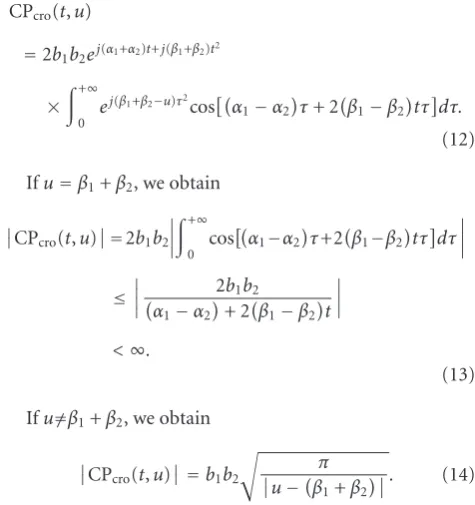
The CPF of the “autoterms” has the form of (5), peaks along the curveu=2β1andu=2β2, respectively. Now let
us compute the CPF of the “cross-terms”
CPcro(t,u)
=2b1b2ej(α1+α2)t+j(β1+β2)t 2
×
+∞
0 e
j(β1+β2−u)τ2cosα
1−α2
τ+ 2β1−β2
tτdτ.
(12)
Ifu=β1+β2, we obtain CPcro(t,u)=2b1b2+∞
0 cos
α1−α2
τ+2β1−β2
tτdτ
≤ 2b1b2 α1−α2
+ 2β1−β2
t
<∞.
(13)
Ifu /=β1+β2, we obtain
CPcro(t,u)=b1b2 π u−β1+β2.
(14)
We can see from (13) and (14) that, the CPF of the “cross-terms” is bounded, while the CPF of the “autoterms” is infinite whenu = 2β1 or u = 2β2. So, the existence of
the “cross-terms” does not influence the detection of the “autoterms.”
Remark 1. The phase information of the LFM signal is neglected in this paper, because in most situations, the characteristics of LFM signal are determined by the chirp rate and initial frequency.
Remark 2. For an LFM signal with finite length, the maxi-mum value of its CPF is finite, and the result ofTheorem 1 is ideal. For a signal in practice, the conclusion above is still valid.
Remark 3. The CPF algorithm is suitable for the LFM signal with the constant amplitude, initial frequency, and chirp rate, which can be illustrated by the definition of the CPF.
Remark 4. The estimate of the chirp rateβcan be obtained by finding the peak of CP(n,u) in (7) whenn = 0, which
the Wigner-Hough transform and the fractional Fourier transform (FrFt) would require O(N2) operations when
estimating the parameters of an LFM signal.
For multicomponent signal, the CLEAN technique [9] combined with the CPF is proposed to detect the weak components submerged by the stronger components, just as follows:
Step 1. Let k = 1, where k is the number of signal components,s(t) is the original signal.
Step 2. Compute the CPF ofs(t) according to (2), and get its absolute value|CP(t,u)|.
Step 3. Finding the peak of |CP(t,u)|, it is concentrated along the curve u = 2βk, then the estimated values
{bk,αk,βk}of thekth LFM component are obtained
accord-ing to (8) and (9).
Step 4. Construct the reference signalsr1(t)=exp(−jβkt2),
then multiply it withs(t), we obtains1(t)=s(t)sr1(t). Now
thekth LFM component has been dechirped to a sinusoidal signal, while the other components are still LFM signals.
Step 5. Design a filter with narrow bandwidth around αk,
then the kth component of s1(t) is filtered out and this
operation has little influence on other components.
Step 6. Multiply the residual signal withsr2(t)=exp(jβkt2),
and the other components can be calibrated to the original form. So, the residual signal without thekth LFM component can be obtained.
Step 7. Letk=k+ 1, repeat Steps2–6until the energy of the residual signal is less than a threshold.
Figure 2is an example to show the validity of the method above. There are two LFM components with length 255, the CPF on the plane (t,u) is shown inFigure 2(a), and the CPF of the signal that has restrained the first component is shown in Figure 2(b). We can see that, on the parameter plane, the weak components will be submerged by the stronger components, and we can improve the dependability of signal detection by the CLEAN technique.
3. STATISTICAL PERFORMANCE
3.1. Signal-to-noise ratio
In the presence of signal s(n) without noise, the value CPs(n,u) has a peak at the coordinates (0, 2β); forx(n) = s(n) +v(n), the value CPs+v(n,u) becomes a random variable
and there exists a variance var{CPs+v(0, 2β)}. The output
SNR is defined as
SNRout=
CPs(0, 2β)2
varCPs+v(0, 2β)
200
100
0 0
100
200 Relati
ve time 0
500 1000 1500
A
m
plitude
Relative frequency rate law
(a) The CPF on (t,u) plane
200
100
0 0
100
200 Relati
ve time 0
500 1000 1500
A
m
plitude
Relative frequency rate law
(b) The CPF of the signal that has restrained the first component Figure2: The signal separation based on CLEAN technique.
The expected value of CPs+v(0, 2β) is
ECPs+v(0, 2β)
=
(N−1)/2
m=0
Es(m)s(−m)e−2jβm2
=1
2(N+ 1)b
2.
(16)
The second-order moment of CPs+v(0, 2β) is
ECPs+v(0, 2β)2
=
(N−1)/2
m=0
(N−1)/2
k=0
Es(m) +v(m)s(−m) +v(−m)
·s∗(k) +v∗(k)s∗(−k) +v∗(−k)e−2jβ(m2−k2)
=
(N−1)/2
m=0
(N−1)/2
k=0
s(m)s(−m)s∗(k)s∗(−k)
+Ev(m)v∗(k)s(−m)s∗(−k) +Ev(m)v∗(−k)s(−m)s∗(k)
+Ev(−m)v∗(k)s(m)s∗(−k) +Ev(−m)v∗(−k)s(m)s∗(k) +Ev(m)v∗(k)Ev(−m)v∗(−k)
+Ev(m)v∗(−k)Ev(−m)v∗(k)e−2jβ(m2−k2).
(17)
By computing each term in (17), we obtain
ECPs+v(0, 2β)2
=
N+ 1 2
2
b4+(N+3)b2σ2+N+ 3
2 σ
4.
(18)
By combining (16) and (18), we obtain the variance
varCPs+v(0, 2β)
=N+ 3b2σ2+N+ 3
2 σ
4. (19)
Hence, we can express the output SNR as a function of the input SNR,
SNRout≈
(N/2)SNR2 in
2SNRin+ 1
, (20)
where SNRin=b2/σ2is the input SNR.
We can see from (20) that at high input SNR (SNRin
1), the expression (20) can be approximated by SNRout =
NSNRin/4. Conversely, at low SNR (SNRin1), the
expres-sion (20) can be approximated by SNRout =NSNR2in/2, the
output SNR could be even worse than the input SNR. We can define the threshold of the algorithm as the interception point between the two limiting behaviors corresponding to the two cases of high and low SNR, obtaining the SNR threshold value equal to SNRin = 1/2, about−3 dB. It is a
constant and the length of signal does not influence the SNR.
Remark 5. Other transformations, such as the fractional Fourier transform and the Wigner-Hough transform, the threshold value is 1/N, this is advantageous because the threshold value can be lowered by increasing the number of samples [10]. While the threshold of the CPF applied to LFM signals is a constant, it is disadvantageous. The similar transformations include the polynomial-phase transform [11].
3.2. Accuracy
E(δβ)2≈ 90
N5
1 SNR
1 + 1 2SNR
. (21)
Theorem 3. The MSE ofαis expressed by E(δα)2≈ 6
N3SNR. (22)
Theorem 4. The MSE ofbis expressed by
E(δb)2≈ σ2
2N. (23)
Lemma 1([13]). For largeN, the Cramer-Rao lower bounds ofβ,α, andbare expressed as
CRLB β≈ 90
SNR·N5,
CRLBα≈ 6
SNR·N3,
CRLBb≈ σ2
2N.
(24)
If we normalize the variances by the corresponding Cramer-Rao lower bounds, we obtain the efficiencies
εβ≈1 +
1
2SNR, εα=εb≈1. (25) Remark 6. The efficiencies of the Wigner-Hough transform (WHT) is [10]
εβ=εα≈1 +
2 NSNR+O
1 N2
, εb≈1. (26)
Compared with the CPF algorithm, the estimate accuracy of the chirp rate βis higher than the CPF algorithm, and the estimate accuracy of the initial frequency α and the amplitude b is the same as the CPF algorithm. But the implementation of the WHT requires 2D maximizations.
Remark 7. The efficiencies of the fractional Fourier trans-form (Frft) is [6]
εβ=εα≈1 +
3 2N+ 1+O
1 N2
, εb≈1. (27)
Compared with the CPF algorithm, the estimate accuracy of the chirp rate βis higher than the CPF algorithm, and the estimate accuracy of the initial frequency α and the amplitude b is the same as the CPF algorithm. But the implementation of the Frft still requires 2D maximizations.
4. SIMULATIONS
In this section, the Monte Carlo simulations are provided to support the theoretical results. In the experiment, the signal contains two components, the length of it is 255, and the parameters of each component are:b1 =1,α1 =π/8,β1 =
0.005, andb2=0.2,α2=π/4, andβ2=0.002. The sampling
interval is 1, the value of the input SNR varies from−4 dB to 11 dB with an interval of 1 dB, we run 200 Monte Carlo simulations, the measured MSEs (dB) of each parameter and the theoretical MSEs (dB) just as (21)–(23) are shown in Figures3and4.
0 5 10
SNR (dB)
−120
−100
−80
−60
MSE(
β
)
(a)
0 5 10
SNR (dB)
−80
−60
−40
−20
MSE(
α
)
(b)
0 5 10
SNR (dB)
−40
−30
−20
−10
MSE(
b
)
(c)
Figure3: MSEs of parameter estimates of the first component. (Full lines are the theoretical MSEs, and circles indicate measured MSEs).
As shown in Figure 3, for the first component, when the SNR is higher than−2 dB, the measured MSEs and the theoretical MSEs are well matched. If the SNR is lower than
0 5 10 SNR (dB)
−120
−100
−80
−60
MSE(
β
)
(a)
0 5 10
SNR (dB)
−80
−60
−40
−20
MSE(
α
)
(b)
0 5 10
SNR (dB)
−40
−30
−20
−10
MSE(
b
)
(c)
Figure4: MSEs of parameter estimates of the second component. (Full lines are the theoretical MSEs, and circles indicate measured MSEs).
and the theoretical MSEs, this is because the approximations implied in the theoretical analyses are no longer valid at low SNRs. For the second component, we can see fromFigure 4
that, after filtering out the first component by the CLEAN technique, the measured MSEs are close to the theoretical MSEs when the SNR is higher than −2 dB, but compared with Figure 3, the accuracy decreases in a way, and there are some irregular variations of the measured MSEs, this is because of the weakness of the second component compared with the noise at low SNRs, and the influence of the first component exists simultaneously.
5. CONCLUSION
The detection and parameters estimation of multicompo-nent LFM signal can be realized by the CPF. The principle of detection and parameters estimation of single LFM signal is presented. For multicomponent LFM signal, the CLEAN technique combined with the CPF is proposed to detect the weak components submerged by the stronger components. The statistical performance is analyzed in this paper and the simulation results demonstrate the validity of the algorithm proposed.
REFERENCES
[1] T. J. Abatzoglou, “Fast maximum likelihood joint estimation of frequency and frequency rate,” IEEE Transactions on Aerospace and Electronic Systems, vol. 22, no. 6, pp. 708–715, 1986.
[2] R. M. Liang and K. S. Arun, “Parameter estimation for superimposed chirp signals,” inProceedings of the IEEE Inter-national Conference on Acoustics, Speech, and Signal Processing (ICASSP ’92), vol. 5, pp. 273–276, San Francisco, Calif, USA, March 1992.
[3] I. Raveh and D. Mendlovic, “New properties of the Radon transform of the cross Wigner/ambiguity distribution func-tion,”IEEE Transactions on Signal Processing, vol. 47, no. 7, pp. 2077–2080, 1999.
[4] Y. Sun and P. Willett, “Hough transform for long chirp detection,” IEEE Transactions on Aerospace and Electronic Systems, vol. 38, no. 2, pp. 553–569, 2002.
[5] M. Wang, A. K. Chan, and C. K. Chui, “Linear frequency-modulated signal detection using Radon-ambiguity trans-form,”IEEE Transactions on Signal Processing, vol. 46, no. 3, pp. 571–586, 1998.
[6] L. Qi, R. Tao, S. Zhou, and Y. Wang, “Detection and parameter estimation of multicomponent LFM signal based on the fractional Fourier transform,”Science in China Series F, vol. 47, no. 2, pp. 184–198, 2004.
[7] P. O’Shea, “A new technique for instantaneous frequency rate estimation,”IEEE Signal Processing Letters, vol. 9, no. 8, pp. 251–252, 2002.
[8] P. O’Shea, “A fast algorithm for estimating the parameters of a quadratic FM signal,”IEEE Transactions on Signal Processing, vol. 52, no. 2, pp. 385–393, 2004.
[9] J. Tsao and B. D. Steinberg, “Reduction of sidelobe and speckle artifacts in microwave imaging: the CLEAN technique,”IEEE Transactions on Antennas and Propagation, vol. 36, no. 4, pp. 543–556, 1988.
polynomial-phase signals,”IEEE Transactions on Information Theory, vol. 37, no. 2, pp. 422–430, 1991.
[12] S. Peleg and B. Porat, “Linear FM signal parameter estima-tion from discrete-time observaestima-tions,”IEEE Transactions on Aerospace and Electronic Systems, vol. 27, no. 4, pp. 607–616, 1991.