Language Influences Number Processing – a Quadrilingual Study
Korbinian Moeller1, Samuel Shaki2, Silke M. Göbel3, & Hans-Christoph Nuerk4,1 1 Knowledge Media Research Center, Tuebingen, Germany
2 Ariel University Center of Samaria, Ariel, Israel 3 University of York, York, United Kingdom 4 Eberhard Karls University, Tuebingen, Germany
3000 words in text body (incl. Abstract)
Please send correspondence to: Dr. Korbinian Moeller
Knowledge Media Research Center Schleichstrasse 6
72076 Tübingen Tel: 07071/979350 Fax: 07071/979100
ABSTRACT
Reading/writing direction or number word formation influence performance even in basic numerical tasks such as magnitude comparison. However, so far the interaction of these language properties has not been evaluated systematically. In this study we tested English, German, Hebrew, and Arab participants realizing a natural 2 x 2 design of (i) reading/writing direction (left-to-right vs. right-to-left) and (ii) number word formation (non-inverted vs. (non-inverted, i.e., forty seven vs. seven-and-forty). Symbolic number magnitude comparison was specifically influenced by the interaction of reading/writing direction and number word formation: participants from cultures where reading direction and the order of tens and units in number words are incongruent (i.e., German and Hebrew participants) exhibited more pronounced unit interference in place-value integration. A within-group comparison indicated that this effect was not due to differences in education. Thus, basic cultural differences in numerical cognition were driven by natural language variables and their specific combination.
INTRODUCTION
In this quadrilingual cross-cultural study, we examined the impact of reading/writing direction and the formation of number words on performance in a number comparison task. We used a 2 x 2 design involving Arabic-, English-, German-, and Hebrew-speaking participants realizing an orthogonal quasi-experimental manipulation of the two factors. These factors were chosen, because both have been observed to influence number processing when investigated in isolation.
First, it is assumed that numbers are represented in ascending order along a so-called mental number line (e.g., Restle, 1970; Dehaene, Bossini, & Gireaux, 1993; but see Santens & Gevers, 2008 for a differing view). Interestingly, the orientation of the mental number line seems to depend on the dominant reading/writing direction. In cultures reading/writing from left-to-right numbers increase in size along the mental number line accordingly (e.g., Dehaene et al., 1993). In contrast, in cultures with right-to-left reading/writing a less clear or even reversed right-to-left orientation has been observed (e.g., Shaki, Fischer, & Petrusic, 2009; Shaki, Fischer, & Göbel, 2012). Importantly, however, influences of reading/writing direction on number processing have so far been investigated primarily for effects with single-digit numbers (e.g., spatial-numerical associations such as the SNARC effect, Dehaene et al., 1993, indicating faster responses to small numbers by the left hand and to larger numbers by the right hand in left-to-right reading cultures). Yet, it has not been examined whether reading/writing direction also influences place-value integration of tens and units in two-digit number processing.
separate comparisons of tens and units yield incompatible (e.g., 47_62, 4>6 but 7<2) rather than compatible decision biases (e.g., 52_67, 5>6 and 2>7) reaction times are prolonged because the units interfere with the processing of the decision-relevant tens (e.g., Nuerk, Weger, & Willmes, 2001). Interestingly, such unit interference was more pronounced in languages with inversion in which the order of tens and units is incongruent between verbal and digital notation (e.g., Nuerk, Weger, & Willmes, 2005; Pixner, Kaufmann, Moeller, Hermanova, & Nuerk, 2011a). Additionally, inversion influences are not limited to magnitude comparison but were also reported for a variety of both verbal and non-verbal numerical tasks such as transcoding (Pixner et al., 2011b; Zuber, Pixner, Moeller, & Nuerk, 2009), number line estimation (Helmreich, Zuber, Pixner, Kaufmann, Nuerk, & Moeller, 2011), and even addition (Brysbaert, Fias, & Noël, 1998; Göbel et al., 2014; see Nuerk, Moeller, Klein, Willmes, & Fischer, 2011, for an overview). However, so far, influences of number word inversion were only investigated in left-to-right reading/writing languages.
directionality of reading/writing and inversion (i.e., German and Hebrew participants, see Figure 1). The main effects of inversion (e.g., Nuerk et al., 2005) and reading direction (Shaki et al., 2009) reported so far may thus only reflect specific sections of the postulated interaction. Note that neither reading direction nor inversion was task-relevant in our study as we studied symbolic number comparison using the same stimulus set of Arabic digits throughout. Interestingly, while text is generally read from right-to-left in Arabic and Hebrew, multi-digit Arabic numbers are nevertheless read from left-to-right because the place-value system is not reversed (i.e., "47" is written as 47, not ). Thus, we only presented Arabic two-digit numbers to participants that are processed following the same place-value coding in all four language groups. Expected differences should be driven by differing reading/writing direction and inversion properties of number words. It is important to note that our hypothesis specifically addresses unit interference as indicated by the unit-decade compatibility effect and not overall differences between the languages per se.
MATERIALS AND METHODS
47
siebenundvierzig
(seven-and-forty)
47
forty seven
English
German
Left-to-right
reading
No Number Name Inversion Number Name Inversion
47
47
Right-to-left
reading
Hebrew
Arabic
ʲ ʡʹ ʥ
ʭʩʲʡʸ ʠ
˴ϥϭ˵ό˴Α˸έ˴ϭ Δ˴ό˸Α˴γ
Participants and Design: 24 English-speaking (7 males, mean age 23.1 years), 18 Arabic-speaking (13 males, mean age 24.4 years), 24 German-speaking (8 males, mean age 23.6 years), and 30 Hebrew-speaking participants (5 males, mean age 22.7 years) were tested in the UK, Palestine, Germany, and Israel, respectively. All participants were native speakers of the respective language, had received the majority of their mathematics education in their native language and were assessed in their native language.
Task and Stimuli: All participants completed the same two-digit number magnitude comparison task consisting of 360 two-digit number pairs of which the larger number had to be chosen. The stimulus set consisted of 240 between-decade pairs (e.g., 47_62) and 120 within-decade filler pairs (e.g., 46_49) presented above and below a fixation point until response. The Arrow-down key of a standard keyboard had to be pressed by the left index finger when the lower number was the larger one and the Arrow-up key with the right index finger when the upper number was the larger one. Between-decade pairs were taken from Nuerk et al. (2001) and comprised 120 unit-decade compatible and 120 incompatible number pairs. Stimuli order was randomized for each participant individually.
Analyses: Error rates were low and did not differ significantly between language groups (English: M=4.4%, SD=3.2%; Arabic: M=3.2%, SD=2.8%; German: M=3.6%,
SD=2.2%; Hebrew: M=2.5%, SD=2.3%). Analyses focused on RT (reaction time from display onset to response) of correct responses. RTs deviating from an individual’s mean by more than ±3SD were discarded from further analyses (MEnglish=1.1%, MGerman=1.0%, MHebrew=1.2% and MArabic=0.8% of trials). Importantly, there were no reliable differences between the groups in the percentage of trials excluded by the trimming procedure [F(3, 92)=1.36, p=.26, all pairwise comparisons p>.31].
RESULTS
Compatibility effects in the four language groups
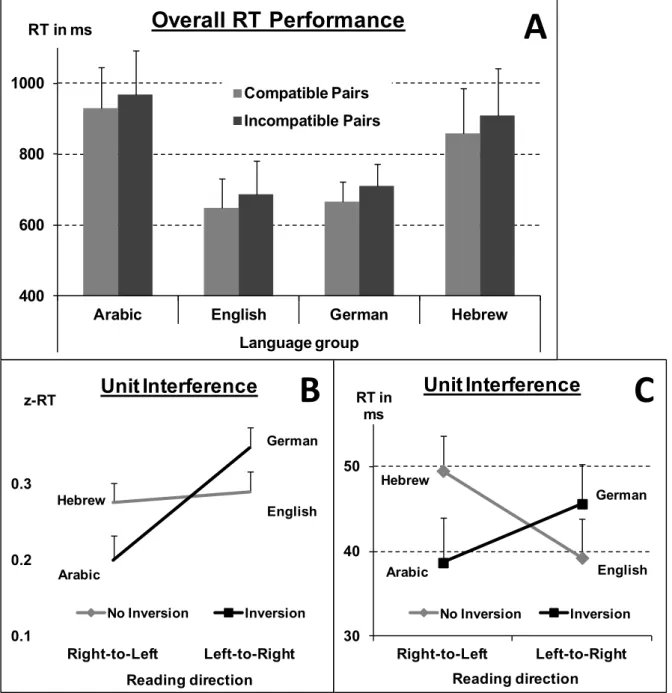
In each group the majority of participants showed the expected compatibility effect with faster responses to compatible than incompatible number pairs (English: 23 out of 24 participants, Arab: 16/18, German: 24/24, Hebrew: 28/30). Additionally, the t-tests indicated that the compatibility effect was significant for each language group [all: ts > 7.43, all
ps<.001; MEnglish=39ms; MArabic=39ms; MGerman=46ms; MHebrew=49ms, see Figure 2].
DISCUSSION
The current study investigated influences of reading/writing direction and the formation of number words on basic numerical cognition employing a quadrilingual (i.e., Arabic, English, German, and Hebrew) 2x2 design realizing an orthogonal variation of these two factors. Unit decade integration was differentially affected in the four language groups depending on the
Figure 2: Panel A gives mean raw RT (with error bars indication SD) separated for unit-decade compatible and incompatible number pairs and the four language groups. Panel B and C depicts the disordinal interaction of reading/writing direction and inversion observed for unit interference (computed as zRT incompatible - zRT compatible, Panel B, Panel C for raw RT): unit interference is most pronounced when reading/writing direction and number word inversion are incongruent (i.e., for Hebrew and German). Error bars indicate 1 standard error of the mean.
Hebrew English Arabic German 30 40 50 Right-to-Left Left-to-Right RT in ms Reading direction
Unit Interference
No Inversion Inversion Hebrew English Arabic German 0.1 0.2 0.3 Right-to-Left Left-to-Right z-RT Reading direction
Unit Interference
No Inversion Inversion
B
C
400 600 800 1000
Arabic English German Hebrew
Language group
RT in ms
Overall RT Performance
Compatible Pairs Incompatible Pairs
respective number words (see Figure 1) this provides an account for the observed interaction of reading/writing direction and number word inversion. One might speculate that it is orthography which links phonology and reading/writing direction (cf. van Orden, 1987; Ferrand & Grainger, 1992), however, future research is needed to evaluate the exact level of the observed interaction. Nevertheless, the combination of the factors phonology and reading/writing direction is important as the mere activation of number word phonology can only account for inversion effects observed for left-to-right reading/writing languages (e.g., Helmreich et al., 2011; Pixner et al., 2011). But only the respective reading/writing direction defines the spatial bias (left-to-right vs. right-to-left) of the verbal representation (cf. Nazir, Ben-Boutayab, Decoppet, Deutsch, & Frost, 2004 for comparable evidence from reading research) and provides a theoretical framework accounting for our results of the current study: Influences of this spatial bias in co-activated number words and its congruency with the symbolic digital-Arabic representation (i.e., inversion) in the assessed languages (as modulated by reading/writing direction) were critical for decreasing or increasing unit interference. The unit-decade compatibility effect was significantly larger in those cases where the directionality of reading/writing direction and inversion (i.e., the congruency between verbal number words and Arabic digital notation) interfered: in German (reading from left-to-right but naming the units before the tens in number words) and Hebrew (reading from right-to-left but naming the tens before the units in number words).
present results strongly suggest that languages with more transparent number words and yet another dominant reading direction should not only be studied with regard to one particular factor in isolation.
The compatibility effect was also reliably smaller for right-to-left reading participants. This finding may be associated with opposing reading directions for words and multi-digit numbers - a specificity of to-left reading cultures. While text is generally read from right-to-left in these cultures multi-digit Arabic numbers need to be read from left-to-right because the place-value coding system is not reversed (i.e., "47" is written as 47 and not ). Therefore, through the necessary switch from right-to-left to left-to-right reading for multi-digit numbers in text passages the tens digit may be considered more prominently by participants from right-to-left reading cultures because it reflects the point from which processing of the respective two-digit Arabic number has to start. As a consequence unit interference may then be reduced.
influenced our results. Nevertheless, it has to be acknowledged that the evidence so far comes from studies on participants reading/writing from left-to-right. Thus, further studies involving right-to-left reading/writing participants would be desirable to substantiate our findings and evaluate possible interactions of multi-digit number processing and general cognitive and also perceptual (e.g., Kazandijan & Chokron, 2009) variables in cultures reading/writing from right-to-left.
Footnotes
REFERENCES
Ansari, D. (2008) Effects of development and enculturation on number representation in the brain. Nature Reviews Neuroscience, 9, 278-91.
Brysbaert, M., Fias, W. & Noël, M.P. (1998). The Whorfian hypothesis and numerical cognition: Is “twenty-four” processed in the same way as “four-and-twenty”?
Cognition, 66, 51-77.
Dehaene, S., & Cohen, L., 1997. Cerebral pathways for calculation: double dissociation between rote verbal and quantitative knowledge of arithmetic. Cortex 33, 219-250. Dehaene, S., Dupoux, E., & Mehler, J. (1990). Is numerical comparison digital? Analogical
and symbolic effects in two-digit number comparison. Journal of Experimental Psychology: Human Perception and Performance, 16, 626-641.
Dehaene S., Bossini S., & Giraux P. (1993). The mental representation of parity and numerical magnitude. Journal of Experimental Psychology: General, 122, 371-396. Ferrand, L., & Grainger, J. (1992). Phonology and orthography in visual word recognition:
evidence from masked non-word priming. Quarterly Journal of Experimental Psychology A, 45, 353-372.
Fischer, M. H. (2012). A hierarchical view of grounded, embodied and situated numerical cognition. Cognitive Processing, 13, 161-164.
Fischer, M. H., & Brugger, P. (2011). When digits help digits: Spatial-numerical associations point to finger counting as prime example of embodied cognition. Frontiers in Psychology, 2: 260.
Göbel, S., Moeller, K., Pixner, S., Kaufmann, L., & Nuerk, H.-C. (2014). Language affects symbolic arithmetic in children: the case of number word inversion. Journal of Experimental Child Psychology119, 17-25.
Ito, Y., & Hatta, T. (2004). Spatial structure of quantitative representation of numbers: Evidence from the SNARC effect. Memory & Cognition, 32, 662–673.
Kazandijan, S., & Chokron, S. (2009). Paying attention to reading direction. Nature Reviews Neuroscience, 9, 965.
Klein, E., Moeller, K., Kettl, D., Zauner, H., Wood, G., Willmes, K., Haider, C., Gassner, A., & Nuerk, H.-C. (2013). Object-based neglect in number processing. Behavioral and Brain Functions.
Macizo, P., & Herrera, A. (2010). Two-digit number comparison: Decade-unit and unit-decade produce the same compatibility effect with number words. Canadian Journal of Experimental Psychology, 64, 17-24.
Macizo, P., Herrera, A., Román, P. E., & Martín, M. C. (2011a). The processing of two-digit numbers in bilinguals. British Journal of Psychology, 102, 464-477.
Macizo, P., Herrera, A., Román, P., & Martín, M. C. (2011b) Proficiency in a second language influences the processing of number words. Journal of Cognitive Psychology, 23, 915-921.
Moeller, K., Pixner, S., Zuber, J., Kaufmann, L., & Nuerk, H.-C. (2011). Early place-value understanding as a precursor for later arithmetic performance – a longitudinal study on numerical development. Research in Developmental Disabilities, 32, 1837-1851. Nazir, T. A., Ben-Boutayab, N., Decoppet, N., Deutsch, A., & Frost, R. (2004). Reading
habits, perceptual learning, and recognition of printed words. Brain and Language, 88, 294-311.
Nuerk, H.-C., Weger, U., & Willmes, K. (2001). Decade breaks in the mental number line? Putting tens and units back into different bins. Cognition, 82, B25-B33.
Nuerk, H.-C., Weger, U., & Willmes, K. (2005). Language effects in magnitude comparison: Small, but not irrelevant. Brain and Language, 92, 262-277.
Nuerk, H.-C., Moeller, K., Klein, E., Willmes, K., & Fischer, M. H. (2011). Extending the mental number line - A review of multi-digit number processing. Zeitschrift für Psychologie / Journal of Psychology, 219, 3-22.
OECD (2010). PISA 2009 Results. What Students Know and Can Do. Student Performance in Reading, Mathematics and Science. Volume I. Paris: OECD.
Pixner, S., Kaufmann, L., Moeller, K., Hermanova, V., & Nuerk, H.-C. (2011). Whorf reloaded: Language effects on non-verbal number processing in 1st grade - a trilingual study. Journal of Experimental Child Psychology, 108, 371-382.
Restle, F. (1970). Speed of adding and comparing numbers. Journal of Experimental Psychology, 83, 274-278.
Roelofs, A. (1997). The WEAVER model of word-form recognition in speech production.
Cognition, 64, 249-284.
Santens, S. & Gevers, W. (2008). The SNARC effect does not imply a mental number line.
Cognition, 108, 263-270.
Shaki, S., & Fischer, M. H. (2012). Multiple spatial mappings in numerical cognition. Journal of Experimental Psychology: Human Perception and Performance, 38, 804-809. Shaki, S., Fischer, M.H. & Göbel, S.M. (2012). Direction counts: A comparative study of
spatially directional counting biases in cultures with different reading directions.
Journal of Experimental Child Psychology, 112, 275-281.
Shaki, S., Fischer M. H., & Petrusic W. M. (2009). Reading habits for both words and numbers contribute to the SNARC effect. Psychonomic Bulletin & Review, 16, 328-31.
Van Orden, G. C. (1987). A ROWS is a ROSE: Spelling, sound, and reading. Memory & Cognition, 15, 181-198.
Zorzi, M., Bonato, M., Treccani, B., Scalambrin, G., Marenzi, R., & Priftis, K. (2012) Neglect impairs explicit processing of the mental number line. Frontiers in Human Neuroscience. 6: 125.