Holographic Information Systems
Thesis by
George Panotopoulos
In Partial Fulfillment of the Requirements for the Degree of
Doctor of Philosophy
California Institute of Technology Pasadena, California
2003
photorefractive iron-doped lithium niobate crystals. Journal of Applied Physics, 2002. 92(2): pp. 793-796, Copyright 2002, American Istitute of Physics
Copyright 2003 George Panotopoulos
I would like to start, as the unwritten rules of acknowledgment writing dictate, by thanking Professor Demetri Psaltis, who held the position of my academic advisor during my five years at Caltech. The opportunity he gave me to work among his group of extremely gifted students, as well as the oral and written presentation skills I acquired through my interaction with him, are greatly appreciated. I would also like to thank Prof. Dr. Karsten Buse. I first met Karsten while he was a postdoc in the Psaltis group, and I was a first year graduate student. Since then we had many opportunities to collaborate, culminating to my joining his group at the Uni-versity of Bonn for two months, which was among the most enjoyable and produc-tive periods I had while working on my thesis. During this time, I grew to appreciate the strict quality standards he applies to his scientific work, and I was inspired by his unwavering devotion to the well being of his students. While at Caltech I had the opportunity to interact with several other faculty members. Professors Perona, Abu-Mostafa, Tanguay, and Koch were kind enough to share their knowledge and insight, helping me gain better understanding of their respective fields, and contrib-uting significantly to my scientific growth. For that I thank them. Last, but not least, I would like to express my gratitude to Professor Hercules Avramopoulos, who supervised my undergraduate thesis at NTUA, and first introduced me to experi-mental optics. He has since been a good friend and mentor, whose good advice I can always rely on.
change. Zhiwen Liu for his friendship, and for dispensing his extraordinary intuition so unassumingly. For my contemporaries, many thanks to Jose Mumbru, for his friendship and dry humor that helped us both through the OPGA project, and Yun-ping Yang, for looking after my figure. From the next generations of students, I would like to thank Hung-Te Hsieh for our excellent collaboration on the strong gratings project, for his careful review of the relevant chapters of this thesis, and of course for his remarkable cooking skills. Martin Centurion for his friendship and indulgence of my use of Spanish, Zhenyu Li, and Hua Long. I would also like to thank for their friendship a number of people who were members of the Psaltis group at various points in time: Benjamin Schupp, Irena Maravic, Todd Meyrath, Dirk Walther, Ingo Nee, Vijay Gupta, George Maltezos and Manos Fitrakis. Regarding the other members of the Psaltis group, many thanks to Yayun Liu for being the most fervent fan of my Hollywood career, and for supporting my delu-sions of grandeur, and to Lucinda Acosta, for taking care of administrative matters, but more importantly, for the motherly good care she takes of students. Special thanks to all the members of the Buse group in Bonn, for their help and friendship during my stay, and especially to Marc Luennemann, for being a model host and a very dear friend.
On a more personal level I would like to thank all my friends for their love and sup-port, with a special mention to my NTUA classmates, who help me feel as if I never left every time I go back home. Special thanks to George and Polly for recreating a family feeling and co-hosting a number of parties in the Garibaldi street house, and to my other housemates, Faidonas and Alexandra. I would also like to thank Carla for her love, and for being there for me, during this very dark and frustrating period of my life.
The goal of this work is to investigate the use of holographic techniques for infor-mation processing and transmission systems. Until recently inforinfor-mation has been processed and transmitted mainly electronically. With the advent of optical fiber communications the monopoly of electronics has receded in the telecommunica-tions field, but the domain of information processing is still dominated by electronic processors.
This thesis follows a top-down approach to the design of processors that integrate both electronic and optical components. It begins with the design considerations of a compact, rapidly reconfigurable opto-electronic processor, which possesses an optical bus in addition to the traditional electronic bus. The optical bus takes advan-tage of the massive parallelism that is afforded by optics and can be coupled to a holographic digital memory, allowing rapid reconfiguration of the device. The capa-bility of rapid reconfiguration gives rise to a new computational paradigm, where the reprogramming of the device can become part of the computation. We suggest additional applications of this processor, namely as a smart reading head for large scale holographic disk memories. Finally we present novel algorithms that were developed specifically to take advantage of the additional capabilities of our pro-cessor.
CHAPTER 1 Introduction. . . .1
1.1 Holography for information systems . . . .1
1.2 Optically programmable gate arrays . . . .2
1.3 Strong volume gratings . . . .3
1.4 Materials . . . .3
1.5 References . . . .4
CHAPTER 2 Optically programmable gate array. . . .6
2.1 Introduction . . . .6
2.2 Elements of the OPGA . . . .8
2.3 The OGPA chip . . . .10
2.3.1 The APS array . . . .12
2.3.2 The reconfigurable logic . . . .14
2.3.3 Performance characterization of the APS array . . . .15
2.4 The OPGA demo. . . .22
2.5 Discussion . . . .27
2.6 References . . . .28
CHAPTER 3 Applications for the OPGA. . . .31
3.1 Introduction . . . .31
3.2 Real-time video processing . . . .32
3.3 Cursive digit classification . . . .34
3.3.1 Introduction . . . .34
3.3.2 Divide and conquer classification algorithm. . . .35
3.3.3 Algorithm performance . . . .37
3.3.4 Modeling of algorithm performance . . . .39
3.3.5 Discussion . . . .44
3.4 Fast queries in large-scale non-indexed holographic databases . . . .44
3.4.1 Introduction . . . .44
3.4.2 The constellation model. . . .45
3.4.3 The application . . . .48
3.5 Other applications . . . .49
3.6 Discussion . . . .50
3.7 References . . . .51
CHAPTER 4 Strong volume gratings in the reflection geometry. . . .53
4.1 Introduction . . . .53
4.2 Waves in two-dimensional periodic media . . . .55
4.2.1 Introduction . . . .55
4.2.2 Modes in periodic media . . . .55
4.2.4 Photonic band gap. . . .60
4.2.5 Band gap width . . . .62
4.3 Reflection geometry using coupled-mode analysis . . . .63
4.3.1 Introduction . . . .63
4.3.2 Coupled mode equations in free space . . . .64
4.3.3 Mode coupling in anisotropic media . . . .68
4.3.3.1 Introduction . . . .68
4.3.3.2 Grating parallel to the c-axis . . . .69
4.3.3.3 Grating off the c-axis . . . .72
4.3.4 Solution of coupled-mode equations . . . .75
4.3.5 Bragg detuning of strong volume gratings in reflection geometry . . . .76
4.3.5.1 Introduction . . . .76
4.3.5.2 Wavelength detuning . . . .78
4.3.5.3 Filter bandwidth vs. photonic band gap width . . . .79
4.3.5.4 Angular and wavelength detuning . . . .80
4.3.5.5 Experiments . . . .86
4.3.6 Thermal detuning of strong volume gratings in reflection geometry . . . .90
4.3.6.1 Introduction . . . .90
4.3.6.2 Effect of temperature on center wavelength . . . .90
4.3.6.3 Angular compensation of thermal filter center drift. . . .92
4.3.6.4 Experiments . . . .92
4.4 Discussion . . . .95
4.5 References . . . .96
CHAPTER 5 Strong volume gratings in the 90o geometry. . . .98
5.1 Introduction . . . .98
5.2 Coupled mode equations in the 90o geometry . . . .99
5.2.1 Introduction . . . .99
5.2.2 Derivation of coupled mode equations . . . .100
5.2.3 Analytical solution of the coupled mode equations in the Bragg match case . . . . .103
5.3 Diffraction efficiency in the 90o geometry . . . .104
5.3.1 Theory . . . .104
5.3.2 Experiments. . . .107
5.4 Wavelength detuning of strong gratings in the 90o geometry . . . .112
5.4.1 Introduction . . . .112
5.4.2 Numerical solution of the coupled mode equations . . . .112
5.4.2.1 Algorithm . . . .112
5.4.2.2 Numerical stability considerations . . . .114
5.4.3 Simulation results . . . .114
5.5 Impulse response of 90o volume holograms . . . .116
5.5.1 Introduction . . . .116
5.5.2 Use of FFT with continuous time and frequency . . . .117
5.5.3 Numerical stability considerations . . . .119
5.5.4 Simulation results . . . .120
6.1 Introduction . . . .125
6.2 Absorption Mechanisms in LiNbO3:Fe . . . .126
6.3 Theoretical considerations . . . .127
6.4 Experimental methods. . . .128
6.4.1 Experimental setup . . . .128
6.4.2 Reflection correction . . . .128
6.5 Experimental results . . . .130
6.5.1 Temperature dependence of absorption . . . .130
6.5.2 Model validation. . . .132
6.5.3 Polarization dependence . . . .135
6.5.4 Absorption increase in the near infrared . . . .136
6.6 Discussion . . . .136
6.7 References . . . .138
CHAPTER 7 Measurement of quadratic electro-optic coefficient . . . .140
7.1 Introduction . . . .140
7.2 Measurement of the linear electro-optic coefficient. . . .141
7.2.1 Introduction . . . .141
7.2.2 Theory . . . .142
7.2.3 Experimental methods and results . . . .144
7.3 Measurement of the quadratic electro-optic coefficient. . . .145
7.3.1 Introduction . . . .145
7.3.2 Theory . . . .146
7.3.3 Phase locker setup . . . .148
7.3.4 Harmonic limited measurement setup . . . .149
7.3.5 Quadratic electro-optic measurement setup . . . .151
7.3.6 Experimental methods and results . . . .153
7.4 Discussion . . . .153
List of Figures
CHAPTER 1 Introduction...1
CHAPTER 2 Optically programmable gate array...6
Figure 2-1. Compact OPGA module. The addressing devices access different pages stored in the holographic memory element. The information contained in these pages is imaged on the surface of the chip. There photodetectors collect the information, which is then used to reconfigure the programmable logic that is also implemented on the chip. ...9 Figure 2-2. Optically Reconfigurable Look-Up Table. The information received by the
photodetector array is stored in the latches. The input defines through a decoder which latch value will be output, thus implementing the LUT. ...10 Figure 2-3. Photograph of the OPGA chip. (a) 64 × 64 Active Pixel Sensor Array. (b)
Reconfigurable logic...11 Figure 2-4. Schematic diagrams of Passive and Active Pixels. For the Passive Pixel the
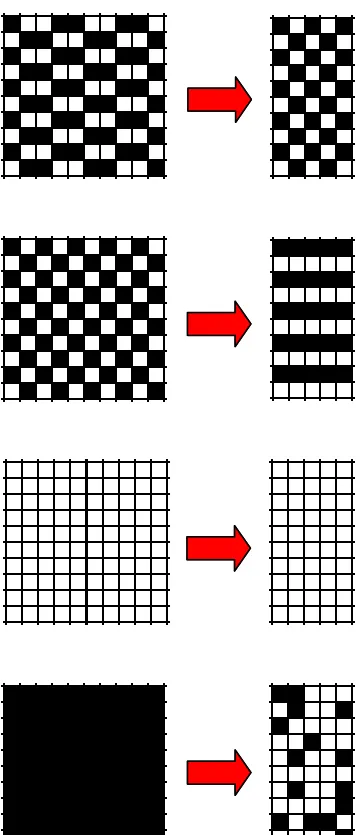
charge of the floating diffusion is output directly. For the Active Pixel it is amplified in-situ before being output. ...12 Figure 2-5. Examples of differential encoding. The left column corresponds to the data
projected on the APS array, with white squares corresponding to illuminated pixels and black ones to dark pixels. The right column corresponds to the data that is read out, with black corresponding to 1 and white corresponding to 0. The last two examples illustrate the response of the array to nondifferential inputs. ...13 Figure 2-6. Schematic diagram of the differential APS pair. The two pixels are amplified
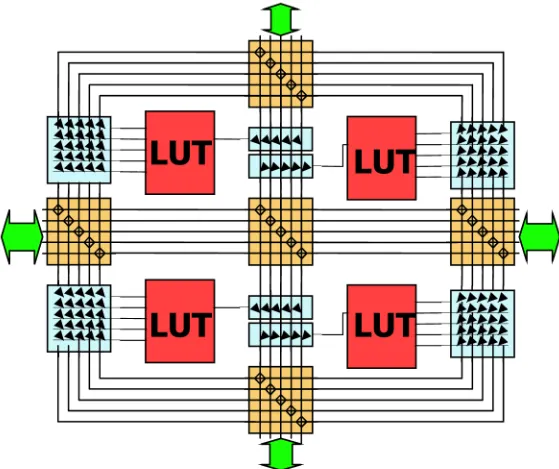
independently, and then driven through a comparator. The outcome of the comparison is stored in a latch, and accessed during readout. ...14 Figure 2-7. Schematic diagram of the reconfigurable logic. It is composed from four 5-bit
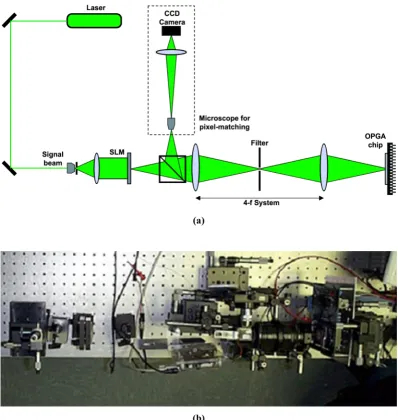
input, 1-bit output LUT’s, five interconnection matrixes and four I/O ports.14 Figure 2-8. Pixel matching experimental setup. (a) Schematic diagram. (b) Detail of the
experimental setup. ...16 Figure 2-9. Images used for pixel matching. (a) Image of pixels. (b) Image of illumination
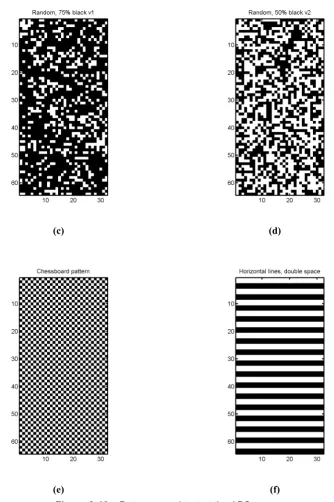
pattern. (c) Superposition of pixels and illumination pattern...17 Figure 2-10. Patterns used to test the APS array...18 Figure 2-11. Probability of readout error vs. illuminating intensity (arbitrary units) for
three random patterns. ...20 Figure 2-12. Probability of readout error vs. illuminating intensity (arbitrary units) for two
random patterns, both having 50% black pixels...21 Figure 2-13. Probability of readout error vs. illuminating intensity (arbitrary units) for one
random and two structured patterns, all three having 50% black pixels. ...22 Figure 2-14. Schematic diagram of OGPA demo setup. ...23 Figure 2-15. Functionality of the reconfiguration templates contained in the first data page.
Thick lines denote the connections implemented in this reconfiguration. ..24 Figure 2-16. (a) APS readout of the first data page. (b) Detail of the hologram containing
the first data page...24 Figure 2-17. Output of the OGPA chip undergoing reconfiguration. The time required
to switch between the two output sets an upper bound for the reconfiguration Pe
Pe
Pe
Figure 2-18. Functionality of the reconfiguration templates contained in the second data page. Thick lines denote the connections implemented in this reconfiguration.
...26 Figure 2-19. (a) APS readout of the second data page. (b) Detail of the hologram
containing the second data page. ...26 Figure 2-20. Output of the OGPA chip undergoing reconfiguration...27
CHAPTER 3 Applications for the OPGA...31
Figure 3-1. Schematic diagram of Real-Time Video Processing application using OGPA’s. ... ...33 Figure 3-2. Simple neural network consisting of one hidden layer with two nodes. ...34 Figure 3-3. Probability of correct classification vs. the number of output classes for the
Neural Network of Figure 3-2. ...35 Figure 3-4. Decision tree for the divide and conquer classification algorithm. ...36 Figure 3-5. Mapping of the divide and conquer classification algorithm on the OPGA device.
... ...37 Figure 3-6. Three-layer, balanced, binary decision tree...39 Figure 3-7. Probability of n reconfigurations for a binary, three-layer decision tree. ...41 Figure 3-8. Performance of the Divide and Conquer classification algorithm as a function of
the performance of the individual NN’s. (a) Probability of correct classification vs. P1 and P2, given P3=0.9. (b) Average number of reconfigurations vs. P1
and P2, given P3=0.9. (c) Probability of correct classification vs. P1 and P2, given P3=0.5. (d) Average number of reconfigurations vs. P1 and P2, given P3=0.9.... . ...42 Figure 3-9. Probability of n reconfigurations for a ternary, three-layer decision tree...43 Figure 3-10. Different uses of the optical and electronic buses of the OPGA. (a) For
applications that require fast reconfiguration the optical bus is used to input the reconfiguration data. (b) When the same reconfiguration is used to process large amounts of data it makes sense to use the optical bus to input that data. In both cases the outcome is output through the electronic bus.46 Figure 3-11. Constellations composed of face features. The human observer can
immediately assess that cases (a) and (b) correspond to human faces, while cases (c) and (d) do not. ...47 Figure 3-12. Schematic diagram of the system that performs queries in large, non-indexed
holographic databases using the Constellation Model algorithm. In this case OPGA’s are used as smart heads that detect features in images stored in the database. ...48 Figure 3-13. OPGA’s act as smart heads that read out the data from the holographic disk database....
. ...49 Figure 3-14. Extension of the OGPA chip used as a detector for a 4-D holographic imaging system.
... ...50
CHAPTER 4 Strong volume gratings in the reflection geometry...53
Figure 4-1. Holographic element with strong reflection gratings, used to implement intra-chip interconnects. VCSEL’s are denoted by red and photodetectors by green... . ...54 Figure 4-2. Simple mode-coupling geometry. The grating vector is parallel to the z-axis.
Both the incident and diffracted beam wavevectors form an angle with the K
grating vector. The polarization vectors shown correspond to in-plane, or extraordinary polarization...70 Figure 4-3. The k-sphere diagram for the reflection geometry. ...78 Figure 4-4. Diffraction efficiency DE of a strong reflection volume grating vs. wavelength
detuning . The parameters for this plot are =0, nm,
, and cm. The dashed vertical lines denote the extent of the stop-band. ...79 Figure 4-5. Dependence of the filter center of a fixed grating on the incidence angle .The
parameters for this plot are and nm. ...81
Figure 4-6. Dependence of the bandwidth of a fixed grating on the incidence angle . The solid line corresponds to the exact solution of Equation 4-90, and the dashed line to the approximate solution, given by Equation 4-91. The results do not agree, therefore the approximate solution is not valid. The parameters for this
plot are , nm, and . ...83
Figure 4-7. Dependence of the bandwidth of a fixed grating on the incidence angle , based on the exact solution of Equation 4-90. The parameters for this plot are
, nm, and . ...83 Figure 4-8. Dependence of the bandwidth on the incidence angle . The solid line
corresponds to a fixed grating, and the dashed line to different gratings, each having the same center for the given incidence angle. The bandwidth is smaller for the fixed grating. The parameters for this plot are ,
nm, and . ...85
Figure 4-9. Dependence of the bandwidth on the incidence angle , for different gratings, each having the same center for the given incidence angle. The solid line corresponds to a fixed external angle , and the dashed line to a fixed internal angle . The results for the two cases are similar. The parameters for this plot
are , nm, and . ...86
Figure 4-10. k-sphere diagram illustrating recording from the top. The dashed sphere corresponds to the shorter recording wavelength. The solid sphere corresponds to the longer readout wavelength. ...87 Figure 4-11. Recording curve of a strong grating, using an active stabilization system...88 Figure 4-12. Filter shapes of strong volume reflection gratings, for different values of
incidence angle. Increasing incidence angles result in shorter filter centers.89 Figure 4-13. Filter center vs. incidence angle. The dots are experimental results, and the solid line a fit using Equation 4-98. ...89 Figure 4-14. Effect of temperature on the filter center of strong volume reflection gratings.
The solid curve takes into account both thermal dispersion and thermal expansion. The dashed curve only takes into account thermal expansion. We can conclude that the two effects act in the same direction, and that they are comparable. 91
Figure 4-15. Angles required for the compensation of thermal detuning vs. temperature. Circles indicate experimental data points. The solid line is the fit curve, obtained using Equation 4-106. ...93 Figure 4-16. Deviation of the filter center obtained using angular compensation of thermal
detuning, from the target filter center vs. temperature. ...93
∆λ θ λ = 1550
∆n = 2.5×10⁻⁴ L = 2
θ0 = 0 λ0 = 1550
θ0 = 0 λ0 = 1550 ∆n = 2.5×10⁻⁴
θ0 = 0 λ0 = 1550 ∆n = 2.5×10⁻⁴
θ0 = 0
λ0 = 1550 ∆n = 2.5×10⁻⁴
θ0 = 0 λ0 = 1550 ∆n = 2.5×10⁻⁴
Figure 418. Experimentally measured bandwidths, corresponding to the 3, 5, 10, and -20 dB levels, for filters whose thermal detuning has been compensated using rotation, vs. temperature. The tendency of the bandwidth to decrease as the temperature increases is due, mainly, to the fact that the grating we used for our experiments was not fixed, and as a result it was getting erased as we increased the temperature. ...95
CHAPTER 5 Strong volume gratings in the 90o geometry...98
Figure 5-1. Grating, incident beam, and diffracted beam for the 90o geometry. Lx and Ly
denote the dimensions of the crystal along each axis. A1 and A2 are the
complex amplitudes of the incident and diffracted wave respectively. ...101 Figure 5-2. Color-coded plots of the field amplitude in the Bragg-matched case: (a) Incident
beam. (b) Diffracted beam. Note that the color code is different for the two plots. .. ...105 Figure 5-3. Intensity profile of the diffracted beam along the output boundary, for various
values of refractive index modulation . As increases, the grating becomes stronger, and more energy is diffracted from the area closer to the input boundary...106 Figure 5-4. Diffraction efficiency of a strong grating in 90o geometry vs. 107
Figure 5-5. Schematic diagram of the experimental setup used to monitor the evolution of grating strength vs. recording time, for strong volume gratings in the 90o geometry.. . ...108 Figure 5-6. Diffracted beam profiles collected during the recording of a strong volume
grating in the 90o geometry: (a) t=45 min, (b) t=120 min, (c) t=195 min, (d) t=285 min. As recording time increases the grating becomes stronger, and more energy is diffracted from the area closer to the input boundary. ...109 Figure 5-7. Intensity profile of the diffracted beam along the output boundary. Different
curves correspond to different points in time during recording. As recording time increases the grating becomes stronger, and more energy is diffracted from the area closer to the input boundary. Note that we exclude 1 mm on each side of the crystal to avoid edge effects. ...110 Figure 5-8. Fitting results of Equation 5-32 to experimentally measured intensity profiles110 Figure 5-9. Refractive index modulation (fit parameter to Equation 5-32) vs. recording time. The connecting line is a guide for the eye... 111 Figure 5-10. Refractive index modulation (fit parameter to Equation 5-32) vs. recording
time. The error bars indicate the 95% confidence intervals. The connecting line is a guide for the eye. ... 111 Figure 5-11. Color-coded plots of field amplitude for the incident beam , and the
diffracted beam , for various values of detuning : (a) for
nm. (b) for nm. (c) for nm. (d) for
nm. (e) for nm. (f) for nm. Note that the color code is different for each plot. ...115 Figure 5-12. Diffraction efficiency DEp vs. wavelength, for various values of refractive index
modulation . Higher values of result in larger bandwidth. ...116
∆n ∆n
v = 2κ LxLy
∆n
∆n
A1
A2 ∆λ A1 ∆λ = 0
A2 ∆λ = 0 A1 ∆λ = 0.01 A2 ∆λ = 0.01
A1 ∆λ = 0.1 A2 ∆λ = 0.1
Figure 5-13. Color-coded plot of the output field intensity vs. time t and distance from the input face of the crystal y...121 Figure 5-14. Impulse response vs. time for specific points of the output face of the crystal:
(a) y=0 cm. (b) y=0.2004 cm. (c) y=0.4008 cm. (d) y=0.6012 cm. The dashed
vertical lines correspond to and ...122
CHAPTER 6 Effect of temperature on absorption in LiNbO3:Fe...125
Figure 6-1. Absorption mechanisms in LiNbO3:Fe. Two possible transitions are shown,
and ...127 Figure 6-2. Reflection correction for calculation of the absorption coefficient from optical
density data...130 Figure 6-3. Absorption coefficient vs. photon energy E with varying crystal temperature.
Ordinary light polarization is used. ...131 Figure 6-4. Absorption coefficient change between 30 oC and 150 oC (dotted line) and
fitting curve (solid line). Ordinary light polarization is used. ...131 Figure 6-5. Absorption width (fit parameters to Equation 6-2) for different light
polarization states and photon energy levels. (a) Extraordinary light polarization, high photon energy. (b) Ordinary light polarization, high photon energy. (c) Ordinary light polarization, low photon energy. Error bars indicate 95% confidence intervals and the connecting lines are guides to the eye.133 Figure 6-6. Residual fitting norm vs. number of fitting parameters. (a) Considerable drop
from three to four parameters. (b) Moderate drop for increases of the number of parameters beyond four. ...134 Figure 6-7. Absorption coefficient at 780 nm vs. temperature for ordinary light polarization...
. ...136
CHAPTER 7 Measurement of quadratic electro-optic coefficient...140
Figure 7-1. Schematic diagram of the experimental setup used for the measurement of the linear electro-optic coefficient of a crystal. ...142 Figure 7-2. This plot demonstrates graphically how the same small phase perturbation can
lead to intensity perturbations of different frequencies, depending on the center phase. ...147 Figure 7-3. Schematic diagram of the experimental setup intended to measure the
quadratic electro-optic coefficient of a crystal. ...149 Figure 7-4. Schematic diagram of the experimental setup used for the measurement of the
quadratic electro-optic coefficient of a crystal. ...151 Figure 7-5. Output of the Lock-In Amplifier vs. the product of applied voltages on the
crystal. The circles represent data points and the solid line a linear fit. ...154
t ync
c
---= t ync
c
--- Lxnc c ---+ =
Fe2+→Fe3+ e-+ Fe2+→(Fe2+)∗
α α
∆α σ
CHAPTER 1 Introduction...1
CHAPTER 2 Optically programmable gate array...6
Table 2-1. Patterns used to test the APS array. ...20
CHAPTER 3 Applications for the OPGA...31
Table 3-1. Performance comparison of the four algorithms used to classify cursive digits.38 Table 3-2. Comparison of analytical and simulated values for performance measures of the binary, three-layer decision tree. ...40
Table 3-3. Comparison of analytical and simulated values for performance measures of the ternary, three-layer decision tree...43
CHAPTER 4 Strong volume gratings in the reflection geometry...53
Table 4-1. Parameter values and 95% Confidence Intervals (CI) resulting from the fitting of the angular filter tuning data to Equation 4-98. ...90
CHAPTER 5 Strong volume gratings in the 90o geometry...98
CHAPTER 6 Effect of temperature on absorption in LiNbO3:Fe...125
Table 6-1. Fitted values and 95% confidence intervals for the parameters C and E0 of Equation 6-2...132
Table 6-2. Equations used to fit the experimental data for model validation. ...133
1
Introduction
1.1 Holography for information systems
In this thesis we investigate the use of holography in the context of information pro-cessing. Information can be encoded on light beams, by modifying their temporal or spatial properties. Holograms can be used to manipulate the properties of those light beams, effectively processing the information they bear. In this section we will discuss, in the most general terms, what kind of processing can be implemented using holographic elements.
single reference plane wave is coupled to multiple gratings in order to reconstruct the highly structured information page [1-3]. These memories can be interfaced to optoelectronic circuits, thus enhancing key aspects of their performance [1-4,1-5]. Due to their large number of periods, holographic gratings exhibit significant selec-tivity to angular and wavelength detuning. It is, therefore, possible for strong volume holograms to act as filters that isolate and redirect specific spatial and spectral information. Such gratings can be used to implement tunable intercon-nects for a chip, act as wavelength filters [1-6,1-7] or demultiplexers [1-8] for Wave-length Division Multiplexing (WDM) fiber communications systems, or be used to perform spatially and spectrally selective imaging [1-9,1-10].
In this thesis we will focus on the investigation of two of these possible uses. The first is the use of holograms as memory elements, and their combination with opto-electronic circuits. The second is the use of strong holographic volume gratings as filtering elements for WDM optical communications. In the next sections of this chapter we present an outline of the thesis.
1.2 Optically programmable gate arrays
We will begin in Chapter 2 by detailing the design, implementation, and testing of a compact, rapidly reconfigurable, optoelectronic processor. We will go through ini-tial design considerations and briefly mention all the constituent components, spending more time on the testing and integration of the silicon circuit that com-bines photodetectors with logic circuits. We will then detail experiments to imple-ment and test the integration of these devices, culminating in the demonstration of holographic reconfiguration of our processor.
Introduction
as smart head that are able to retrieve classes of objects from large, non indexed holographic databases.
1.3 Strong volume gratings
As mentioned in Section 1.1, strong volume gratings can be used to implement tun-able interconnects as well as filters of WDM fiber communication systems. In Chapter 4 we will investigate the behavior of strong gratings, in the reflection geometry. We will start with a general treatment of waves in two-dimensional peri-odic media. Then we will focus on the reflection geometry, and investigate some of the finer aspects of the coupled mode theory, with applications to polarization dependence, angular, wavelength, and thermal detuning. Finishing with the reflec-tion geometry we present experimental results confirming our theories.
We will then proceed to the 90-degree geometry, in Chapter 5. We will extend the coupled mode formalism to two dimensions, and present theoretical and experi-mental results regarding diffraction efficiency. Next, we will discuss wavelength detuning, and develop a numerical solution for the coupled-mode equations in that case. We will conclude the chapter with a numerical calculation of the impulse response of strong volume gratings in the 90-degree geometry.
1.4 Materials
Our ability to record gratings in photorefractive materials is due to the electro-optic effect, which allows electric fields induced by charge redistribution to be mani-fested as a modulation of the refractive index. Though the presence of grating is due, for all practical purposes, to the linear electro-optic effect, it is of interest to investigate the magnitude of the quadratic electro-optic effect. In Chapter 7 we will begin by reviewing an experimental setup used to measure the linear electro-optic coefficients. We will then proceed to describe the limitations that prevent the use of such a setup for the measurement of the quadratic electro-optic coefficients, highlighting the challenges presented. Finally, we will present the design of a mea-surement system capable of measuring the quadratic electro-optic coefficients, even in the presence of much stronger linear electro-optic coefficients, as well as results for the case of manganese-doped lithium niobate (LiNbO3:Mn).
1.5 References
[1-1] A. Yariv and P. Yeh, Optical Waves in Crystals. 1984, New York: John Wiley & Sons.
[1-2] H. Kogelnik, Coupled Wave Theory for Thick Hologram Gratings. Bell System Technical Journal, 1969. 48(9): pp. 2909-2947.
[1-3] H. J. Coufal, G. Sincerbox, and D. Psaltis, eds. Topics in Applied Physics: Holo-graphic Memories. 1999, Springer: Berlin, New York, Tokyo.
[1-4] J. Mumbru, G. Zhou, S. Ay, X. An, G. Panotopoulos, F. Mok, and D. Psaltis. Opti-cally reconfigurable processors. in Euro-American Workshop on Optoelectronic Information Processing. 1999: SPIE.
[1-5] J. Mumbru, G. Panotopoulos, D. Psaltis, X. An, F. Mok, S. Ay, S. Barna, and E. Fossum. Optically programmable gate array. in Proc. SPIE of Optics in Computing. 2000.
Introduction
[1-7] J. Hukriede, I. Nee, D. Kip, and E. Kratzig, Thermally fixed reflection gratings for infrared light in LiNbO3:Ti:Fe channel waveguides. Optics Letters, 1998. 23(17): pp. 1405-1407.
[1-8] S. Breer, H. Vogt, I. Nee, and K. Buse, Low-crosstalk WDM by Bragg diffraction from thermally fixed reflection holograms in lithium niobate. Electronics Letters, 1998. 34(25): pp. 2419-2421.
[1-9] G. Barbastathis, M. Balberg., and D.J. Brady, Confocal microscopy with a volume holographic filter. Optics Letters, 1999. 24(12): pp. 811-813.
2
Optically programmable
gate array
2.1 Introduction
Neverthe-Optically programmable gate array
less, it is considerably harder to force light to interact with matter than it is to force electrons to do so.
On the other hand, again due to the lack of charge, photons have the very advan-tageous property of not interacting with each other. This inherently reduces the crosstalk of optical communications, and allows unprecedented degrees of paral-lelism in on-chip interconnects, hardly conceivable in the case of purely electronic circuits. Furthermore, the decrease of device size in VLSI circuits is not followed by a similar decrease in interconnect dimensions. As devices shrink and operating fre-quencies increase the need for more efficient, less real-estate-consuming intercon-nection solutions will become pressing. We believe that optical interconnects will provide an elegant solution to this problem [2-1].
In this chapter, we propose the use of photonics to implement data transfer, on a chip scale. More specifically, we discuss the design, fabrication, and characteriza-tion of a compact, rapidly reconfigurable optoelectronic processor [2-3, 2-4], which relies on the interfacing of a silicon optoelectronic circuit with a holographic optical memory [2-5, 2-6]. The device we propose is an extension of a Field Programma-ble Gate Array (FPGA) [2-7], a widely used class of reconfiguraProgramma-ble digital circuits. The main idea behind FPGA’s is that any Boolean function can be implemented by proper combination of elementary Boolean functions (e.g., all Boolean functions can be implemented using NAND gates). FPGA circuits contain two components: • Reconfigurable look-up tables (LUT’s).
• Reconfigurable interconnects.
of programming of microprocessors, are widely used in demanding Digital Signal Processing (DSP) applications [2-8, 2-9].
The enhancement of FPGA’s with optical interfaces has been discussed in litera-ture, mainly in terms of high-bandwidth I/O 10] and interchip interconnects [2-11]. The device we propose, namely the Optically Programmable Gate Array (OGPA), addresses one of the main limitations of FPGA’s: Their long reconfigura-tion time. FPGA’s have only one set of inputs/outputs (I/O), they communicate electronically through the pins of the chip. Since most of these I/O resources are used for the transfer of data that is processed by the device, very few I/O ports are available for its reconfiguration. As a result the reconfiguration of an FPGA can last several milliseconds, and in practice FPGA’s are programmed before the data pro-cessing begins and do not alter their functionality during operation.
By contrast, the OPGA has an additional set of inputs, namely a set of photodetec-tors on the surface of the chip. These inputs are linked to a holographic memory that contains the reconfiguration data necessary to program the logic functionality of the device. The inherent 2-D aspect of holographic memories, combined with fast access, allows OPGA’s to be reprogrammed in a matter of microseconds, thus providing a new computational paradigm, where the reconfiguration of the device can be part of the computation.
In this chapter we discuss the design and implementation of the OGPA device. We present the elements of the device and some of the trade-offs involved. Then we focus on the chip that combines the reconfigurable logic and detectors, discuss the methods used to characterize it and the corresponding results. Finally, we intro-duce a demo setup that showcases the successful reconfiguration of an electronic circuit, using a holographic memory.
2.2 Elements of the OPGA
Optically programmable gate array
• A holographic memory element, where the reconfiguration templates are stored.
• An addressing device, used to access information in the holographic memory, and transfer it to the silicon circuit.
The processing element of the OGPA is located on the silicon circuit, and is imple-mented by configuring properly the logic blocks and interconnects. The information required to configure the processing element is stored in the holographic memory element. When we want to change the functionality of the processing element we use an addressing device to select a specific reconfiguration data page from the memory, and transfer it on the surface of the chip. There, the photodetectors receive this information, which is then routed to the reconfigurable elements. The information is used to change the parameters of these elements, leading to the implementation of a new functionality.
The holographic memory element can be made using several different materials, such as polymers (Aprilis [2-12], DuPont [2-13]), or photorefractive crystals (LiNbO3:Fe), and the information can be recorded using a number of different mul-tiplexing techniques, such as reflection geometry [2-14], transmission geometry, 90o geometry [2-15], shift multiplexing [2-16], and peristrophic multiplexing [2-17]. In selecting the holographic material and multiplexing technique, we need to address the competing needs for memory capacity and efficient reconstruction of Figure 2-1. Compact OPGA module. The addressing devices access different pages stored in
the holographic memory element. The information contained in these pages is imaged on the surface of the chip. There photodetectors collect the information, which is then used to reconfigure
The addressing devices are crucial in determining the minimum reconfiguration time, in the sense that they should enable us to access rapidly different memory pages, and have enough power, so that the information that is reconstructed on the surface of the chip can be integrated by the photodetectors in a short time. Devices that fulfill these requirements are arrays of Vertical Cavity Surface Emitting Lasers (VCSEL’s) [2-19], and Micro-electro-mechanical (MEM’s) arrays combined with laser diodes.
2.3 The OGPA chip
The OPGA chip consists of two main elements: a photodetector array and recon-figurable logic. Since the reconfiguration data is to be transferred from the memory to the photodetectors, and then to be used to reconfigure the LUT’s and intercon-nects, it would make sense to place the reconfigurable logic elements and the pho-todetectors used to reconfigure them in close proximity. Such an optically
reconfigurable LUT is shown in Figure 2-2. Optical information collected by the Active Pixel Sensor (APS) array is transferred to an array of 16 latches. A four-bit
Figure 2-2. Optically Reconfigurable Look-Up Table. The information received by the photodetector array is stored in the latches. The input defines through a decoder which latch value
will be output, thus implementing the LUT.
Optically programmable gate array
decoder receives an input and presents the contents of the corresponding latch at the output. By selecting the values stored in the latches we can implement any 4-bit input, 1-4-bit output Boolean function.
Combining the photodetectors and reconfigurable logic elements has obvious advantages, in terms of minimizing the wiring required for configuration-data trans-fer. On the other hand, such a design results in bigger pixels with smaller fill-factor, putting a strain on the power requirements of the laser source, and the diffraction efficiency requirements of the holographic memory.
We designed and fabricated a prototype OPGA chip in collaboration with Photobit Inc. The chip was fabricated using a 0.35 micron, CMOS technology. It is shown in Figure 2-3, where the two main elements, the photodetector array and the recon-figurable logic, are easily distinguishable. In this prototype chip we chose to
imple-ment the photodetector array and the logic at different locations, mainly in order to facilitate testing. The trade-offs between the two possible designs should be
sidered in future implementations. In the following sections we describe in detail these two elements.
2.3.1 The APS array
The photodetector array was implemented as a 64 × 64 active pixel sensor differ-ential array [2-20, 2-21]. Each pixel of this array is an active pixel, the difference
between a passive pixel and an active pixel being that in an active pixel the charge generated by the photodiode is actively amplified before being red-out (see Figure 2-4). As a result, active pixels achieve significantly better signal-to-noise (SNR) ratios than their passive counterparts.
The array also employs differential encoding, so that every pair of pixels encodes only one bit, i.e., a pixel combination of dark-bright corresponds to 1 and a combi-nation of bright-dark corresponds to 0. This encoding is a rudimentary error correct-ing code, used to counter the fact that the intensity across large reconstructed holographic data pages is not constant. The pixel combinations dark-dark and bright-bright are not permitted, and result to a random flickering value and a zero value respectively. Examples illustrating the concept of differential encoding are shown in Figure 2-5. The differential encoding is implemented by driving the output voltages of the two pixels of a pixel pair through a comparator, as shown in Figure 2-4. Schematic diagrams of Passive and Active Pixels. For the Passive Pixel the charge of the floating diffusion is output directly. For the Active Pixel it is amplified in-situ before being
output. VDD
Reset
Read Floating
Diffusion Pixel Output
VDD VDD
Reset
Read Floating Diffusion
Pixel Output
Passive Pixel
Active Pixel
VDD
Reset
Read Floating
Diffusion Pixel Output VDD
Reset
Read Floating
Diffusion Pixel Output
VDD VDD
Reset
Read Floating Diffusion
Pixel Output
VDD VDD
Reset
Read Floating Diffusion
Pixel Output
Optically programmable gate array
Figure 2-6. The nonpermitted states result from the fact that the corresponding inputs drive the comparator out of its normal operation region. The different behav-ior for different nonpermitted states stems from the asymmetric design of the com-parator.
The APS array can be read row-wise, and rows can be accessed in random order. When a row is being read out, the corresponding pixel values are compared pair-Figure 2-5. Examples of differential encoding. The left column corresponds to the data projected on the APS array, with white squares corresponding to illuminated pixels and black ones to dark pixels. The right column corresponds to the data that is read out, with black corresponding to 1 and
wise, and the resulting outcomes are stored at the output latches of the array. Due to differential encoding, the 64 × 64 APS array produces 64 lines of 32 bits.
2.3.2 The reconfigurable logic
The reconfigurable logic, illustrated in Figure 2-7, consists of the following: Figure 2-6. Schematic diagram of the differential APS pair. The two pixels are amplified independently, and then driven through a comparator. The outcome of the comparison is stored in
a latch, and accessed during readout.
Figure 2-7. Schematic diagram of the reconfigurable logic. It is composed from four 5-bit input, 1-bit output LUT’s, five interconnection matrixes and four I/O ports.
A
A
+
-D D Q
CMP
Reset Reset
Reset
WR RD
SEL i
Pixel Bus
Latch
Bus OutputBus
Left Pixel
Optically programmable gate array
• Four 5-bit input, 1-bit output LUT’s. • Five interconnection matrixes. • Four I/O ports.
• A five-line bus is used to transmit data to and from the different elements. Each input of each LUT can be connected to any bus line, and the same holds for its output. Therefore the reconfiguration of a LUT block requires 25 = 32 bits for the LUT itself, 5 × 5 bits for the reconfiguration of the input connections, and 5 bits for the reconfiguration of the output connections, bringing the total to 62 bits. As a result two lines of the APS array are necessary to reconfigure any LUT block. Each of the five interconnection matrixes connects four segments of the 5-line bus. The corresponding lines of the four segments can be connected in 6 different ways, therefore 5×6 bits are required for the reconfiguration of an interconnection matrix, corresponding to a single line of the APS array.
The I/O ports are implemented using tri-state buffers, so that they can be set to operate in input-only, output-only, or input-output mode.
The reconfiguration of the entire logic requires 4×2 + 5×1 = 13 lines of the APS array. Since each data page consists of 64 lines, it contains enough information for four complete reconfigurations of the logic.
2.3.3 Performance characterization of the APS array
In the case of the APS array, the use of such a technique was rendered impossible due to the differential encoding used. Due to that, the output of the array flickers randomly when it is not pixel matched, and only stabilizes when we are very close to pixel match. In order to circumvent this hurdle we designed the optical setup shown in Figure 2-8.
In this setup the light of a HeNe laser is collimated and spatially modulated using the SLM. It is then imaged on the surface of the chip using a 4-f system, formed by
(a)
(b)
Optically programmable gate array
two low-aberration Nikon lenses. The chip and board are mounted on a combina-tion of translacombina-tion and rotacombina-tion stages allowing five degrees of freedom (three trans-lational and two rotational). The surface of the chip acts as a partial reflector, so the illuminating pattern is reflected back through the 4-f system. A beam-splitter, placed between the SLM and the first lens, splits the reflected light, part of which is imaged on a CCD camera through a microscope objective. A pair of LED’s illu-minates the surface of the chip independently, so that the image of the chip is superimposed to the image of the illuminating pattern on the CCD. Using the rota-tion and translarota-tion controls of the chip mount we are able to align the APS pixels and the illuminating pattern, thus achieving pixel-matching between the two, as shown in Figure 2-9.
The next step is to vary the intensity of known illuminating patterns using a variable attenuator, and measure the number of errors on the APS output. We used both random and structured patterns, shown in Figure 2-10. More information about the patterns can be found in Table 2-1. The probability of error is plotted vs. inten-sity (arbitrary units) in Figure 2-11, for three different random patterns. The three patterns are generated using the same distribution of random numbers by chang-ing a threshold. Very low intensities lead essentially to the dark-dark combination Figure 2-9. Images used for pixel matching. (a) Image of pixels. (b) Image of illumination pattern.
(c) Superposition of pixels and illumination pattern.
(a) (b)
Optically programmable gate array
(c) (d)
(e) (f)
being displayed on the APS array, and as a result we get quasi-random flickering, leading to a of about 50% for all patterns. At the other end of the spectrum,
when the displayed pattern intensity is very high, we have the bright-bright pixel combination, which leads to an all-white output (white is equivalent to 0). As a result, the for each pattern is close to its percentage of black (or 1) pixels. In the middle of these two extremes we have a region where the drops and even reaches zero. This region is interrupted by a bump, whose height seems to be inde-Figure 2-11. Probability of readout error vs. illuminating intensity (arbitrary units) for three
random patterns.
Pattern Description % Black pixels Figure
25 Random pattern 25 Figure 2-10 (a)
501 Random pattern 50 Figure 2-10 (b)
75 Random pattern 75 Figure 2-10 (c)
503 Random pattern 50 Figure 2-10 (d)
chs Chessboard pattern 50 Figure 2-10 (e)
hlds Alternating 2-pixel witch black and white lines 50 Figure 2-10 (f)
Table 2-1. Patterns used to test the APS array. Pe
Pe
Pe
Optically programmable gate array
pendent of the percentage of dark pixels in the pattern. The actual intensity per pixel corresponding to the minimum BER (75 arbitrary units) is 0.37 pW.
In Figure 2-12, we compare the for two different random patterns, both having
50% black pixels. Their behavior is in good agreement. In order to gain some insight as to the origin of the bump we compare the of a random pattern with 50% black pixels, a chessboard pattern, and a pattern consisting of two-pixel thick horizontal lines. Note that all patterns have 50% black pixels. The results, shown in Figure 2-13, indicate that the frequency of change from black to white and vice-versa along the vertical direction is related to the in the middle intensity range. Indeed, the horizontal lines pattern has the lowest such frequency, followed by the random pattern, and then the chessboard pattern, which has the highest such fre-quency possible. This behavior is an indication that the errors in the middle inten-sity range are due to limitations of the latches, which are unable to switch states rapidly enough.
Figure 2-12. Probability of readout error vs. illuminating intensity (arbitrary units) for two random patterns, both having 50% black pixels.
Pe
Pe
Pe
In conclusion, the latches are a target area for future improvements of the APS array. Nevertheless, the current design allows error-free readout of the information displayed on the APS in a specific intensity range. This enabled us to incorporate the chip to a holographic memory system, in order to demonstrate the reconfigura-tion of an electronic circuit, using a holographic memory, as described in the next section.
2.4 The OPGA demo
In this section we discuss the implementation of a system allowing the reconfigu-ration of the OPGA chip using data stored in a holographic memory. The main advantage of this design over the one using an SLM as the reconfiguration tem-plate source, is the considerably lower switching time of holographic memories. The schematic diagram of the setup is shown in Figure 2-14. It is very similar to the setup used to test the APS array with a few modifications and additions, namely a piece of DuPont photopolymer was mounted on a rotational stage, and placed between the SLM and the beam-splitter. The configuration data was recorded on the DuPont photopolymer [2-12] using peristrophic multiplexing [2-17]. The choice Figure 2-13. Probability of readout error vs. illuminating intensity (arbitrary units) for one
Optically programmable gate array
of this material dictated the change of the laser source, which in this case was an Ar-ion laser, producing cw light at wavelength =514 nm. Part of the raw beam of the laser was tapped-off, collimated, and used as the reference beam for the recording of the reconfiguration information.
We recorded two different data pages, each of them containing two reconfiguration templates. The first reconfiguration, contained in the first data page, receives an input at the left I/O port of the logic block and routes it to the upper I/O port. The second reconfiguration of the first data page receives an input again from the left I/O port and routes it to the right I/O port. The functionality of the two reconfigura-tions is illustrated in Figure 2-15. We reconstructed the first data page. The corre-sponding APS readout is shown in Figure 2-16, along with a detail of the actual hologram.
We can program the electronic board that provides the bias and timing signals to the OPGA to input a counter to the left I/O port. Then, by monitoring the output of the upper and right ports with an oscilloscope (see Figure 2-17), we can confirm the successful configuration of the device. The time it takes for the counter output to switch from the upper to the right I/O is an upper bound for the reconfiguration
Figure 2-14. Schematic diagram of OGPA demo setup.
time , and is measured to be 127 µs. The fact that we only perform a partial reconfiguration of the device does not affect this estimate. Since the limiting effect
(a) (b)
Figure 2-15. Functionality of the reconfiguration templates contained in the first data page. Thick lines denote the connections implemented in this reconfiguration.
(a)
(b)
Figure 2-16. (a) APS readout of the first data page. (b) Detail of the hologram containing the first data page.
Optically programmable gate array
is the photodetector integration, and not the transfer of the reconfiguration data to the logic, the time would be about the same for a full reconfiguration.
The functionality of the two reconfigurations contained in the second data page is illustrated in Figure 2-18. The first one separates the lines of the bus into two groups, odd (1, 3) and even (0, 2, 4). The odd lines are routed to the upper I/O port, while the even lines are routed to the right I/O port. The second reconfiguration of the second data page broadcasts all five bus lines to both I/O ports. By rotating the holographic material, we can reconstruct that second data page. The correspond-ing APS readout and a detail of the data page hologram are shown in Figure 2-19, while the oscilloscope output is shown in Figure 2-20, confirming the successful configuration of the device.
Figure 2-17. Output of the OGPA chip undergoing reconfiguration. The time required to switch between the two output sets an upper bound for the reconfiguration time we can achieve
In conclusion, we demonstrated the successful reconfiguration of the OPGA chip using holographic data, contained in a peristrophically multiplexed database. The
(a) (b)
Figure 2-18. Functionality of the reconfiguration templates contained in the second data page. Thick lines denote the connections implemented in this reconfiguration.
(a)
(b)
Optically programmable gate array
extension to larger APS arrays, more reconfigurable logic blocks, and holographic reconfiguration databases with more data pages should be straightforward.
2.5 Discussion
In this chapter we discussed the integration of a holographic memory and a silicon circuit combining photodetectors and reconfigurable logic elements, to build the OGPA device. We presented briefly the elements of the device, and focused on the silicon circuit. We characterized the APS array and reconfigurable logic of a demo unit that was fabricated. Finally, we built a setup where we interfaced a holographic memory to the circuit, and demonstrated successful reconfiguration, using optically reconstructed data.
From the characterization of the APS array we conclude that our design can achieve error-free reconstruction for a range of incident intensities. This error-free intensity range is limited, among other things, by the output latches, a point that should be addressed in future implementations. The differential encoding scheme has a good performance, but its complexity exceeds the benefits, therefore it should be dropped. This is especially true if we use MEMS as the addressing
device, since in that case we have enough power to produce reconstruction of the holographic data with high SNR.
From the OPGA demonstration setup we obtained a reconfiguration time µs, limited by the integration time of the detectors. A clear direction for future research is to investigate how much further this time can be reduced. Our design should be, in principle, scalable, both in terms of data pages, and in terms of pixels per data page. The implementation of larger holographic databases should be straightforward, therefore, future research should focus on the imple-mentation of larger, distributed pixel sensor arrays.
2.6 References
[2-1] D. A. B. Miller, Rationale and challenges for optical interconnects to electronic chips. Proceedings of the IEEE, 2000. 88(6): pp. 728-749.
[2-2] E. Towe, ed. Heterogeneous optoelectronics integration. 2000, SPIE: Bellingham.
[2-3] J. Mumbru, G. Zhou, S. Ay, X. An, G. Panotopoulos, F. Mok, and D. Psaltis. Opti-cally reconfigurable processors. in Euro-American Workshop on Optoelectronic Information Processing. 1999: SPIE.
[2-4] J. Mumbru, G. Panotopoulos, D. Psaltis, X. An, F. Mok, S. Ay, S. Barna, and E. Fossum. Optically programmable gate array. in Proc. SPIE of Optics in Computing. 2000.
[2-5] D. Psaltis and F. Mok, Holographic memories. Scientific American, 1995. 273(5): pp. 70-76.
[2-6] D. Psaltis and G. W. Burr, Holographic data storage. Computer, 1998. 31(2): p. 52.
[2-7] S. D. Brown, R. J. Francis, J. Rose, and Z. G. Vranesic, Field-programmable gate arrays. 1992, Norwell: Kluwer Academic Publishers.
[2-8] P. Stogiannos, A. Dollas, and V. Digalakis, A configurable logic based architecture for real-time continuous speech recognition using hidden Markov models. Journal of VLSI Signal Processing Systems for Signal Image and Video Technology, 2000. 24(2-3): pp. 223-240.
Optically programmable gate array
[2-9] A. Benedetti and P. Perona, A system for real-time 2-D feature detection based on field programmable gate arrays. Integrated Computer-Aided Engineering, 2000. 7(3): pp. 181-191.
[2-10] T. H. Szymanski, M. Saint-Laurent, V. Tyan, A. Au, and B. Supmonchai, Field-programmable logic devices with optical input-output. Applied Optics, 2000. 39(5): pp. 721-732.
[2-11] J. Van Campenhout, H. Van Marck, J. Depreitere, and J. Dambre, Optoelectronic FPGA's. IEEE Journal of Selected Topics in Quantum Electronics, 1999. 5(2): pp. 306-315.
[2-12] K. Curtis and D. Psaltis, Characterization of the Dupont photopolymer for 3-dimensional holographic storage. Applied Optics, 1994. 33(23): pp. 5396-5399.
[2-13] R. M. Shelby, D. A. Waldman, and R. T. Ingwall, Distortions in pixel-matched holographic data storage due to lateral dimensional change of photopolymer stor-age media. Optics Letters, 2000. 25(10): pp. 713-715.
[2-14] K. Curtis, C. Gu, and D. Psaltis, Crosstalk in wavelength-multiplexed holographic memories. Optics Letters, 1993. 18(12): pp. 1001-1003.
[2-15] G. W. Burr, F. H. Mok, and D. Psaltis, Angle and space multiplexed holographic storage using the 90-degrees geometry. Optics Communications, 1995. 117(1-2): pp. 49-55.
[2-16] G. Barbastathis, M. Levene, and D. Psaltis, Shift multiplexing with spherical refer-ence waves. Applied Optics, 1996. 35(14): pp. 2403-2417.
[2-17] K. Curtis, A. Pu, and D. Psaltis, Method for holographic storage using peristrophic multiplexing. Optics Letters, 1994. 19(13): pp. 993-994.
[2-18] F. H. Mok, G. W. Burr, and D. Psaltis, System metric for holographic memory sys-tems. Optics Letters, 1996. 21(12): pp. 896-898.
[2-20] E. R. Fossum, CMOS image sensors: Electronic camera-on-a-chip. IEEE Transac-tions on Electron Devices, 1997. 44(10): pp. 1689-1698.
3
Applications for the
OPGA
3.1 Introduction
The OPGA device that we presented in Chapter 2 is a reconfigurable optoelec-tronic processor, characterized by its very low reconfiguration time. The ability to change the functionality of the processor in a time scale similar to that of the actual computation, gives rise to a new computational paradigm, where the reconfigura-tion becomes part of the computareconfigura-tion.
those lines will be presented in Section 3.2, where we will show how the OPGA can be used for real-time image processing.
Taking the “multiplexing in time” approach a step further, we can think of applica-tions where the next configuration is decided based on the outcome of the current computation, as opposed to going through a predefined sequence of configura-tions. Such an application is the classification of cursive digits, discussed in Section 3.3. The hardware presented in the previous chapter uses a read-only holographic memory. In a device with a read-write memory, we could even think of applications, where configurations are developed based on the outcome of compu-tations, thus we have a circuit that can learn and adapt to an evolving environment. Though the OPGA chip was designed as part of a compact reconfigurable proces-sor, we can use it as a component of a number of different systems. One such system is proposed in Section 3.4, where we use the OPGA chip as a smart head to read out and perform queries on large holographic databases. In Section 3.5 we discuss briefly a number of other interesting applications that are not fully devel-oped in this work.
3.2 Real-time video processing
Applications for the OPGA
the capabilities of the OPGA, brings the total processing time to 330 µs per frame, allowing the application of 100 convolution kernels per frame in real time.
By way of contrast, the reconfiguration time of an FPGA is in the order of ms, making it impossible for this device to apply more than one convolution per frame. Therefore a system consisting of FPGA’s with the same processing power would have 100 FPGA’s, with the associated costs. This comparison suggest an intuitive way to think about the operation of the OGPA in this application: It can be thought of as a device that multiplexes several FPGA’s in time. The convolutions that we want to carry out could be performed in parallel by a hundred different processors. Instead, we use a single processor, which successively implements each of those hundred required processors. At this point we should stress the fact that, in this particular application, each reconfiguration is independent of the results of the computation performed by the previous configuration. In the next section we will discuss an application where the opposite is true.
3.3 Cursive digit classification
3.3.1 Introduction
In this section we discuss an algorithm for cursive digit classification that requires rapid reconfiguration, similar to that offered by the OGPA device. Any pattern clas-sification problem is solved, in its most abstract form, by defining subspaces in a multidimensional space [3-2]. To make this statement more concrete, imagine that we have 8×8 pixel images of handwritten digits. These images lie in a 64-dimen-sional space. Classifying the digits as 0, 1, 2, etc., is equivalent to defining 10 hypersurfaces, each surrounding the occurrences of the corresponding class. The complexity of the classification lies in the requirement to specify these hypersur-faces.
This complexity becomes evident if we try to perform the classification using limited computational resources, such as the Neural Network (NN) shown in Figure 3-2,
which has one hidden layer with two nodes. We train the network using the back propagation with momentum algorithm [3-3, 3-4]. Our database consists of training set of 3823 digits and a test set of 1797 digits. In Figure 3-3 we plot the correct clas-sification performance of the NN vs. the number of classes it attempts to classify in. Note that when there is one output class (essentially we ask the question: “Is this digit X?”), the probability of obtaining the correct answer is almost 100%. This
Applications for the OPGA
probability drops fast as we increase the number of output classes, and when we reach 10 classes, it’s almost 10%, meaning we are equally well off assigning each input sample to a random class. The algorithm we present in this section provides a method to tackle the full classification problem, using such limited computational resources.
3.3.2 Divide and conquer classification algorithm
A way to simplify the full classification task is to break it down to simpler tasks, so that the final result is reached by navigating through a decision tree. This principle is illustrated in Figure 3-4, where, going back to our example, instead of directly classifying each digit to one of ten classes, we can initially classify it to one of the following three sets: {1,2,3,8}, {0,5,9}, and {4,6,7}1. Since we only have three output classes, the probability of correct classification is substantial. Once we have decided in which class the digit belongs, we can proceed to clarify which digit it is. Again, this is a fairly simple question, and we can expect to receive the correct Figure 3-3. Probability of correct classification vs. the number of output classes for the Neural
Network of Figure 3-2.
1. These sets were selected as to maximize the correlation of the digits within each set.
0 2 4 6 8 10 12
-0.2 0 0.2 0.4 0.6 0.8 1 1.2
Number of output units
Probabili ty o f Corre ct Cla ssif ica ti on
0 2 4 6 8 10 12
-0.2 0 0.2 0.4 0.6 0.8 1 1.2
Number of output units
answer with high probability. Finally, once we have reached the conclusion that this is most likely digit X, we can use a NN with a single output to verify this hypothesis. The graph in Figure 3-3 indicates that this is a virtually error-free decision, resulting in high accuracy for the complete algorithm.
In order to better illustrate the algorithm and understand how it maps to the OGPA device, let’s walk through a specific example (see Figure 3-5): We initialize the OPGA device to implement the NN that distinguishes between the three sets {1,2,3,8}, {0,5,9}, and {4,6,7}. Assume that the digit 2 is presented to input, and that the NN correctly classifies it into the first set. Based on this outcome, the next reconfiguration will program the OPGA to implement the NN that distinguishes between digits 1,2,3, and 8. The same input is presented to this network, and let us assume, for the sake of argument, that in this case the NN erroneously con-cludes that this is the digit 3. This outcome will dictate the next reconfiguration, namely a single output NN that classifies its input as either the digit 3 on not. Since such a NN has very low probability of error, more likely than not it will detect the mistake of the previous layer. The OPGA device is reconfigured to its previous functionality, and the second most likely outcome is selected, say, that the input is the digit 2. We will have one last reconfiguration to the NN that classifies the input as the digit 2 or not, and again, most likely, this will confirm that the input is indeed the digit 2 and the final outcome will be presented at the output.
Applications for the OPGA
3.3.3 Algorithm performance
To determine the performance of the algorithm we define three metrics:
• The probability of n reconfigurations , defining the probability that the algorithm will produce an output after n reconfigurations, regardless of the cor-rectness of that output.
• The probability of correct classification , defining the probability that the algorithm will classify the input correctly.
• The probability that the algorithm will end without classifying the input . The first metric, , relates to the speed of the algorithm. Ideally we would like the algorithm to produce an output after as few reconfigurations as possible. The second metric, , defines the success rate of the algorithm, and the third
Figure 3-5. Mapping of the divide and conquer classification algorithm on the OPGA device.
P(rec=n)
Pcorr
PnoClass
P(rec=n)
metric, which can be incorporated to the probability of error, quantifies the worse case scenario, where we have to navigate the whole decision tree without reaching any conclusions.
In order to determine the merits of our algorithm, we compared it with three other algorithms, which are outlined here:
• Fully Parallel Classification (FPC): This algorithm would be implemented by having ten FPGA’s running in parallel, each implementing a NN with a single output. The input is be presented to all NN’s in parallel and the highest output determines the class.
• Sequential Classification (SC): To implement this algorithm we would use an OGPA to successively implement the single output NN’s corresponding to digits 0, 1, 2, etc. The output of each successive implementation is compared to a threshold. Once the threshold is exceeded we classify the digit in the corre-sponding class and abort.
• Exhaustive Sequential Classification (ESC): This algorithm is a sequential ver-sion of the Fully Parallel one. An OPGA implements successively the single output NN’s. Their outputs are buffered and once we go through all ten of them they are compared, and the highest output determines the class.
Table 3-1 summarizes the results from the comparison of these three algorithms to
the divide and conquer (DAC) algorithm. Regarding the probability of correct clas-Parameter
Algorithm
Fully Parallel (FPC)
Divide and Conquer (DAC)
Sequential (SC)
Exhaustive Sequential (ESC)
Correct classification probabil-ity for the training set
0.98378 0.97253 0.97332 0.98378
Correct classification probabil-ity for the test set
0.93656 0.91096 0.89705 0.93656
Average number of reconfigu-rations for the training set
1 3.5124 5.3421 10
Average number of reconfigu-rations for the test set
1 3.9104 5.0534 10
Required memory 10 14 10 10
Required computational resources
10 1 1 1
Applications for the OPGA
sification for the test set, we notice that the FPC and ESC share the best perfor-mance, as expected, followed by the DAC and the SC algorithms. Regarding the average number of reconfigurations for the test set, the FPC has the least, the DAC comes second, and the SC and ESC algorithms follow. The FPC has the best per-formance, both in terms of speed and accuracy. Nevertheless this