/
The
Connection Machine System
*Lisp Release Notes
Version 5.2
October 1989These release notes do not replace those for Version 5.1
First printing, October 1989
The information in this document is subject to change without notice and should not be construed as a commitmentby Thinking Machines Corporation. Thinking Machines Corporation reserves the right to make changes to any products described herein to improve functioning or design. Although the information in this document has been reviewed and is believed to be reliable, Thinking Machines Corporation does not assume responsibility or liability for any errors that may appear in this document. Thinking Machines Corporation does not assume any liability arising from the application or use of any information or product described herein.
Connection Machine is a registered trademark of Thinking Machines Corporation. CM-l. CM-2. CM, and DataVault are trademarks of Thinking Machines Corporation. Paris. "'Lisp. and CM Fortran are trademarks of Thinking Machines Corporation. VAX. UL1RIX. and V AXBI are trademarks of Digital Equipment Corporation. Symbolics, Symbolics 3600, and Genera are trademarks of Symbolics, Inc. Sun and Sun-4 are trademarks of Sun Microsystems, Inc.
UNlX is a trademark of AT&T Bell Laboratories CommonLoops is a trademark of Xerox Corporation.
Copyright E 1989 by Thinking Machines Corporation. All rights reserved.
Thinking Machines Corporation 245 First Street
Contents
List of Tables ... v
About These Release Notes ... vii
Customer Support . . . .. xi
1 About Version 5.2 ... 1
1.1 Summary of Enhancements ... 1
2 Porting Code to Version 5.2 ... 2
2.1 Lucid Common Lisp Versions ... 2
2.1.1 Lucid Common Lisp Version 2.5 on VAX Front Ends . . . 3
3 *Lisp Language Version 5.2 ... . . . 4
3.1 Reimplemented pref!! ... 4
3.2 Structure pvar Pretty Printing ... 4
3.3 *Lisp Language Restrictions Update ... ,... 7
3.3.1 Known Errors Corrected... ... .... ... ... 7
3.4 Known Errors and Restrictions ... 8
Inltlal~oldboot-geometry-def-falls ... 8
star-pset-or-pref-struct-bug ... 9
4 *Lisp Compiler Version 5.2 ... 12
4.1 *Lisp Code Walker ...•..•... 12
4.1.1 Increased Compilation Scope.. ... 12
4.1.1.1 Enhancement of Code Compilation. ... 13
4.1.1.2 Enabling the Code Walker .. .. .. .. .. .. .. .. . .. .. .. ... 13
4.1.1.3 Simpler Code Now Compiles: An Example •... 13
4.1.1.4 Minor Feature - Automatic Declaration of Loop Indices. 14 4.2 Changes to Compilation of*all and pref!! .•...•...•...•... 15
iv *Usp Release Notes
4.3 Declaration Ilint . . . .. 15
declaration-hint .•••.••.•..••.••.•...•.•••...•... 15
4.4 *Lisp Compiler Restrictions Update ...•...•... 17
4.4.1 Known Errors Corrected ...•... 17
4.4.2 Known Errors and Restrictions ... ...•... 17
ash-bang-bang-oompller-restrlctlon ••.•••.•..••••••..•... 17
compller-restrlctlons-mlssed-ln-5.1-doc .•....•.••.•.•..•. 18
5 *Lisp Simulator Version 5.2 .. . . 20
5.1 *Lisp Simulator Restrictions Update ... 20
5.1.1 Known Errors Corrected ... 20
5.1.2 Known Errors and Restrictions. . . .. 20
coerce-bang-bang-array-slm-bug • . . • • . . • . . . • • • • • • . . . • . .. 21
star-pset-vold-wlth-array-or-struct-slm-bug .•..••..•.•.•. 22
6 *Lisp Library Version 5.2 ... . . . 23
6.1 Accessing
the
*Lisp Library. . .. . . .. . . .. . . .. . . . .. . . .. • . . .. 236.2 *Lisp Library Contents. . . • . . . .. 23
Tables
1 Correspondence of *Lisp and Lucid Common Lisp Versions ... 3
About These Release Notes
Objectives
The *Usp Release Notes Version 5.2 are published to inform *Lisp programmers about all new and
changed *Lisp features introduced with the Connection Machine System Software Version 5.2
Intended Audience
The reader is assumed to have a working knowledge of Common Lisp, as described in Common Lisp: The Language, and of *Lisp, as described in the *Lisp documentation for Versions 5.0 and 5.1. The
reader is also assumed to have a general understanding of the Connection Machine system.
Revision Information
These release notes are new with *Lisp Version 5.2. They do not replace *Lisp Release Notes Version 5.1, nor do they replace any other manual in the *Lisp documentation for Versions 5.0 or 5.1.
Organization of These Release Notes
1 About Version 5.2
Identifies *Lisp and Version 5.2.
2 Porting Code to Version 5.2,
Explains what to do to ensure that 5.1 *Lisp code runs under 5.2.
3 *Lisp Language Version 5.2
Describes language features that are new and enhanced in Version 5.2.
4 *Lisp Compiler Version 5.2
Describes compiler features that are new and enhanced in Version 5.2.
5 *Lisp Interpreter Version 5.2
Describes interpreter features that are new and enhanced in Version 5.2.
6 *Lisp Simulator Version 5.2
Describes simulator features that are new and enhanced in Version 5.2. ,
viii *Lisp Release Notes
7 "'Lisp Library 5.2
Describes library of *Lisp source code, new as of Version 5.2.
Related Manuals
• *LispReleaseNotes, Version 5.0
The Version 5.0 release notes provide a succinct overview of the many new features intra-ducedin Version 5.0 and of the changes made to *Lisp between the release of Version 4.3 and the release of Version 5.0. These are essential reading.
• *LispReleaseNotes, Version 5.1
The Version 5.1 release notes provide a succinct overview of the many new features intro-duced in Version 5.1 and of the changes made to *Lisp between the release of Version 5.0 and the release of Version 5.1. These are essential reading.
• Supplement to the *Lisp Reference Manual. Version 5.0
This manual updates the *Lisp Reference Manual, adding descriptions of all features new
with the release of *Lisp Version 5.0.
• *Lisp Compiler Guide, Version5.0
This manual describes the current implementation of the *Lisp compiler.
• Connection Machine Front-End Subsystems
The manuals in this volume should beread before the *LispReference Manual. It explains the
configuration of the Connection Machine system and how to access the Connection Machine from a front-end computer.
• Connection Machine Parallel Instruction Set
The *Lisp Reference Manual explains how to call Paris from *Lisp. Users who wish to do so should also refer to the Paris manual.
• Common Lisp: The Language. by Guy L. Steele Jr. Burlington, Mass.: Digital Press, 1984.
About These Release Notes ix
Notation Conventions
The notation conventions used in these release notes are the same as those used in all current *Lisp documentation.
Convention
boldface
italics
typewriter
Meaning
*Lisp language elements, such as keywords, operators, and function names, when they appear embedded in text.
Customer Support
Thinking Machines Customer Support encourages customers to report errors in Connection Machine operation and to suggest improvements in our products.
When reporting an error, please provide as much information as possible to help us identify and correct the problem. A code example that failed to execute, a session transcript, the record of a backtrace, or other such information can greatly reduce the time it takes Thinking Machines to respond to the report. To contact Thinking Machines Customer Support:
U.S. Mail:
Internet
Electronic Mail:
Usenet
Electronic Mail:
Telepbone:
For Symbolics users only:
Thinking Machines Corporation Customer Support
245 First Street
Cambridge, Massachusetts 02142-1214
ameslthinklcustomer-support
(617) 876-1111
The Symbolics Lisp machine, when connected to the Internet network, provides a special mail facility for automatic reporting of Connection Machine system errors. When such an error occurs, simply press Ctrl-M to create a report. In the mail window that appears, the To: field should be addressed as fol-lows:
Please supplement the automatic report with any further pertinent information.
1 About Version 5.2
The *Lisp language is a parallel extension of Common Lisp for programming the Connection Machine system. Programs using *Lisp typically include both Common Lisp and *Lisp con-structs.
Version 5.2 is an incremental *Lisp release. All Version 5.2 CM System Software compo-nents, including *Lisp, now support two new CM hardware options: double-precision floa-ting-point accelerators and larger processor memories. In addition, *Lisp Version 5.2 pro-vides enhanced compilation and corrects a number of implementation errors.
1.1
Summary of Enhancements
The following categories of *Lisp enhancements distinguish *Lisp Version 5.2 from pre-vious versions.
• Double-Precision Floating-Point Accelerators Supported. Previously, the Con-nection Machine model CM-2 included one 32-bit floating-point accelerator (fpu) for every 32 physical processors. Now, these may be replaced by 64-bit fpu's. *Lisp Version 5.2 supports this optional hardware upgrade. See the Paris Release Notes,
Version 5.2, for a discussion of the perfonnance impact of 64-bit fpu's.
• Larger Processor Memories Supported. Whereas CM-2 configurations previous-ly included 64K bits of memory per physical processor, an optional hardware up-grade to 256K bits of memory per physical processor is now available. *Lisp Version 5.2 supports this hardware option. See the Paris Release Notes, Version 5.2, for a
discussion of the perfonnance impact of larger memories.
• *Lisp Compiler Code Walker. The *Lisp compiler has been significantly en-hanced by the addition of a code walker.
• *Graphics. A *Lisp interface to the CM Graphic Programming tools is now avail-able.
• *Lisp Library. A library of new, experimental *Lisp features is now available.
2 *Lisp Release Notes
• Reimplemented pref!!. The pram macro has been reimplemented to provide more robust execution.
• Structure pvar Pretty Printing. A new debugging aid, ppp-struct, has been added
to "'Lisp. This feature pretty-prints structure pvars.
2 Porting Code to Version 5.2
"'Lisp code written under Version 5.1 runs under Version 5.2 unchanged with the follOwing exceptions:
• Lucid Common Lisp Version 2.5 is required for VAX front ends.
• The porting instructions described in the *Lisp Release Notes Version 5.1 apply to Version 5.2 also.
• Obsolete functions (those documented as such) are not guaranteed to work under Version 5.2.
2.1
Lucid Common Lisp Versions
"'Lisp currently requires different versions of Lucid Common Lisp on VAX and on Sun-4 front ends.
Version 5.2 3
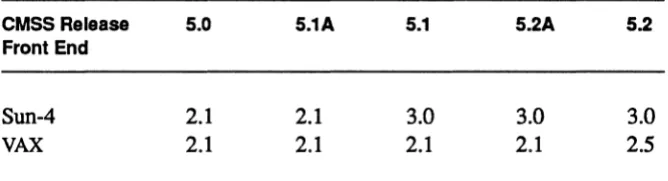
The following chart shows which Lucid versions are required by *Lisp versions 5.x.:
Table 1. Correspondence of *Lisp and Lucid Common Lisp Versions
CMSS Release 5.0 5.1A 5.1 5.2A 5.2
Front End
Sun-4 2.1 2.1 3.0 3.0 3.0
VAX 2.1 2.1 2.1 2.1 2.5
In each case, the version correspondence applies equally to the *Lisp interpreter, compiler, and simulator.
*Lisp programmers are strongly advised to obtain Lucid Common Lisp documentation ap-propriate to their front-end environment.
2.1.1 Lucid Common Lisp Version 2.5 on VAX Front Ends
The release notes for Lucid Common Lisp Version 2.5 completely detail how Version 2.5 dif-fers from Version 2.1. The Lucid changes that most affect *Lisp programs are noted below.
(1) Use of the change-rnemory-management function discouraged
The change-rnemory-management function is not recommended by Lucid for Ver-sion 2.5. If it is nonetheless used, the :growth-Jimlt keyword value should be much less than previously recommended by Thinking Machines Corporation. Failing to
reduce the :growth-lImlt value before using change-rnemory-management causes problems with the garbage collection mechanism.
Here is an acceptable change-rnemory-management call used by some Thinking Machines Corporation developers in their IIsp-lnlt.llsp files:
(change-memory-management :expand 64
f+sun :growth-limit f+sun 768 )
(2) Foreign function interface changed
4 *Lisp Release Notes
(3) Lucid ephemeral garbage collector
In previous Lucid releases, garbage collection occurred frequently and took signifi-cant amounts of time. Lucid Common Lisp Version 2.5 includes an ephemeral gar-bage collector. Consequently, full garbage collection is neither as frequent nor as no-ticeable.
3 *Lisp Language Version 5.2
Version 5.2 of the *Lisp language is substantially the same as Version 5.1. Changes that dis-tinguish 5.2 from its predecessor are described below.
3.1
Reimplemented pref!!
The praf!! macro has been reimplemented to ensure that it does not cause an out-of-memory condition if the optional collision-mode argument is set to :many-colllsions.
3.2
Structure pvar Pretty Printing
Version 5.2 5
ppp-struct
[Function]
Prints the contents of the supplied structure pvar in a readable fonnat.
Arguments---ppp-struct pvar per-line &key :start :end :prlnt-array
:stream :wldth :tltle
pvar per-line :start :end :prlnt-array :stream :width :tltle
Structure pvar. Pvar to print in readable fonnat. Positive integer. Number of values to display per line.
Send address of processor at which to start printing. Defaults to O. Send address of processor at which to stop printing. Defaults to *number-of-processors-Jlmlt* .
Boolean. Detennines whether arrays are printed out in full. De-faults to t.
Stream object or t. If supplied, output is written to the specified stream. Defaults to t, sending output to *standard-output*.
Integer. Width, in characters, of each value displayed. Defaults to 8 characters.
String ornll. Text to display as title line, ornll forno title. Defaults to name ofpvar's structure type.
Returned Value
-nil Evaluated for side-effect
Side Effects
-The contents of pvar from processor start up to processor end is written to stream in a
6 *Lisp Release Notes
Description
-This function is new with *Lisp Version 5.2.
The function pp~truct attempts to print out the structure pvar pvar in readable fonnat, with processor values for each slot being shown left to right, one line per slot. The num-ber of values displayed per line is detennined by per-line.
The keyword arguments :start, :end, :prlnt-array, and :stream control the amoUnt, for-mat, and destination of the output exactly as with ppp.
The argument :wldth detennines the printed width of each slot value, and defaults to 8 characters.
The argument :title defaults to t, which specifies that the title printed out is the name of the *defstruct of which pvar is an instance. If :tItle is nil, no title is printed out If it is a string, then that string is used as the title.
Examples---(*defstruct person
(ssn 0 :type (unsigned-byte 32» (age 0 :type (unsigned-byte 16» (height 0.0 :type single-float) (weight 0.0 :type single-float)
)
(ppp-struct a-person 8 :end 16 :width 10)
*DEFSTRUCT PERSON
SSN: 219101296 545417079 833166928 508389095 945762998 685245194 687147484 442455228
AGE: 43 76 9 96 63
31 59 82
HEIGHT: 0.7566829 6.0384245 6.8458276 2.9526687 6.920122 2.5360777 0.65423644 0.16378379
Version 5.2 7
SSN: 604959766 822929695 445946453 856011938 68420622 724449217 967664808 640359065
AGE: 27 28 88 68 98
66 61 31
HEIGHT: 2.01059 5.2301087 6.1360407 1.8808416 6.919573 5.686286 5.1784062 4.504147
WEIGHT: 82.76129 200.76877 165.2837 48.37853 154.9278 84.00104 16.700924 232.88974
NIL
Notes---Not implemented in F16 simulator
The ppp-struct operation is not implemented in the simulator version F16, which corresponds to *Lisp Version 5.2.
3.3
*Lisp Language Restrictions Update
Most previously reported *Lisp language implementation errors and restrictions have been corrected for the release of *Lisp Version 5.2. The known outstanding bugs and restrictions are reported again in these release notes. All past issues of Programming in *Lisp In Parallel
may therefore be discarded.
3.3.1
Known Errors Corrected
The following implementation errors reported in In Parallel Vol.
n,
No.1, August 1989, are fixed in *Lisp Version 5.2:grld-from-vp-cube-adr-bug IIst-of-active-processors-bug ppp-css-truncates-proc-addresses pvar-prlnt-functlons-Ignored ranklng-zero-breaks
8 *Lisp Release Notes
3.4
Known Errors and Restrictions
All known unintentional language restrictions for Version 5.2 *Lisp operation are reported here in alphabetical order by bug report ID. Ifnew bugs are discovered, they will be reported during the coming months in the In Parallel software bulletin, Vol.
m.
10 Inltlal-coldboot-geometry-def-falls
Environment
*Lisp (interpreter and compiler) Version 5.1, Sun OS 4.0
Description
The first *coJd-boot operation fails if it specifies an initial-geometry-definition
form. Subsequent calls to *coJd-boot do not fail.
Reproduce By > (cm:attach)
;;; Loading source file "/cm/configuration/configura-tion.lisp"
16384
> (in-package '*lisp) *<Package "*LISP" 1A2542E>
> (*cold-boot :initial-geometry-definition
(create-geometry :dimensions ' (1024 1024) :on-chip-bits ' (0 4)
:off-chip-bits ' (10 0»)
»Error: The symbol CMI::*ALL-GEOMETRIES* has no global val-ue.
SYMBOL-VALUE:
Required arg 0 (S): CMI::*ALL-GEOMETRIES* :C 0: Try evaluating CMI::*ALL-GEOMETRIES* again :A 1: Abort to Lisp Top Level
-> :a
Version 5.2
> (*cold-boot) 16384
(128 128)
> (*cold-boot :initial-geometry-definition (create-geometry :dimensions ' (1024 1024)
:on-chip-bits ' (0 4) :off-chip-bits ' (10 0»)
16384
(1024 1024) >
Notice that the second call to *cold-boot succeeded.
Workaround
There are two workarounds:
1. Don't use this method of specifying the VP set.
9
2. Invoke *cold-boot twice at the beginning of a session: first, without the in-itial-geometry-dejinition specified; and then again, with the initial-geome-try-dejinition specified.
Status
Outstanding.
10 star-pset-or-pref-struct-bug
Environment
*Lisp (interpreter compiler) Version 5.1; any hardware configuration.
Description
10 *Lisp Release Notes
Specifically. if any pvar argument to either function is a structure pvar with a varia-ble-length slot whose size depends on the size of the current VP set, then execution will enter the debugger.
Reproduce By
In the following example, slot a of the bugbug parallel structure varies in size based on the value of *current-send-address-Iength* and therefore causes an error.
;; -*- Mode: LISP; Syntax: Common-Lisp; Base: 10; Pack-age: *LISP
-*-(in-package '*lisp)
(*defstruct bugbug (a 0 :type fixnum
:cm-type (field-pvar *current-send-address-length*» (b 0 :type (unsigned-byte 32»
)
(def-vp-set fred (list *minimum-size-for-vp-set*»
(def-vp-set wilma (list (* 2 *minimum-size-for-vp-set*»)
(defun bug ()
(*with-vp-set fred (*let (dest)
(declare (type (pvar bugbug) dest» (*with-vp-set wilma
(*let (source)
(declare (type (pvar bugbug) source» (*when «!! (self-address!!)
(!! (the fixnum *minimum-size-for-vp-set*») (*pset :no-collisions source dest (self-address!!)
»»»)
(*warm-boot) NIL
(bug)
Error: Trying to acess off of the end of field 65536. The passed field has a length of 41, and the length passed to this instruction is 42.
CM:MOVE-ALWAYS
Version 5.2
Arg 1 (CMI::SQURCE): 65536 Arg 2 (LENGTH): 42
s-A, Return to Breakpoint ZMACS in Editor Typeout Window 13
s-B: Editor Top Level
s-C: Restart process Zmacs Windows 6
Workaround
11
Do not use varying length slots in *defstruct fonns when defining parallel structures that will be passed across VP sets.
Status
12 *Lisp Release Notes
4 *Lisp Compiler Version 5.2
Version 5.2 of the "'Lisp compiler offers substantial improvements over Version 5.1. The fol-lowing changes distinguish 5.2 from 5.1:
• There is now a code walker for the "'Lisp compiler.
• The "'all construct now generates Paris -always instructions.
• The praf!! macro, when called with a non-simple source expression, compiles if the ~set argument is either unspecified or given as "'current-vp-set"'.
These enhancements are further described below, along with a hint about providing correct declarations.
4.1
*Lisp Code Walker
In Version 5.2, the "'Lisp compiler has been significantly enhanced by the addition of a code walker. The "'Lisp code walker is an extension of the CommonLoops code walker developed at Xerox Palo Alto Research Center. CommonLoops, including its codewalker, is generously made available by Xerox Corporation to the Common Lisp community for the preparation of derivative works.
The code walker can be enabled and disabled by the user and is disabled by default.
4.1.1 Increased Compilation Scope
The code walker is an extension of the "'Lisp compiler that "walks" through all the individual forms of a piece of "'Lisp code. It records all declarations it encounters and compiles each "'Lisp form it finds.
The code walker allows the "'Lisp compiler to:
• Find declarations it would otherwise ignore.
Version 52 13
4.1.1.1 Enhancement of Code Compilation.
As of Version 5.2, the "'Lisp compiler has these new capabilities when the code walker is en-abled:
• "'Lisp declarations are recognized in all locations where Common Lisp allows decla-ration forms. In particular, the "'Lisp compiler can now recognize declarations with-in defun, let, and let* forms without the need to use the *Iocally construct.
• All properly declared "'Lisp forms are compiled, not only those within the scope of a "'Lisp macro operator such as *set.
4.1.1.2 Enabling the Code Walker
The code walker can be enabled and disabled by the user. It is disabled by default. To enable the code walker, do either of the following:
1. Type
(compiler-options :class :all)
to display a menu of compiler options. At the bottom of the menu is an item that en-ables/disables the code walker
2. Set the variable slc::*usa-code-walker* to t. For example,
(setq slc::*use-code-walker* t)
enables the code walker for all "'Lisp code that is compiled. Setting slc::*use-code-walker* to nil disables the code walker.
4.1.1.3 Simpler Code Now Complies: An Example
Previously, if one wanted to write a function that "'compiled, one would need to write it like
this:
(defun sum-of-squares!! (x y)
(*locally ;;; *locally to declare arguments x and y (declare (type single-float-pvar x y»
(*let (result) ;;; declaration of result within *let form (declare (type single-float-pvar result»
14 *Lisp Release Notes
With the code walker enabled, the "'Lisp compiler now recognizes declarations in all the places Common Lisp pennits declarations-without the need for *Iocally. In particular, the *Lisp compiler now recognizes declarations within defun, let, and let* forms. A list of all spe-cial forms within which Common Lisp pennits declarations may be found in Common Lisp the Language, pp. 153-54.
Thus, one can now write the sum-of-squares definition as
(defun sum-of-squares!! (x y)
(declare (type single-float-pvar x y» (*let (result)
(declare (type single-float-pvar result» (*set result (+!! (*!! x x) (*!! y y») result) )
In addition, the "'Lisp compiler now "'compiles all properly declared "'Lisp fonns, not just those within the scope of a "'Lisp macro operator such as *set. Because of this change, the
sum-of-squares definition may be condensed even further, producing
(defun sum-of-squares!! (x y)
(declare (type single-float-pvar x y»
(+!! (*!! x x) (*!! y y») I ; ; *let and local variable result " , are no longer needed
which "'compiles into Paris code just as well as the original function definition.
4.1.1.4 Minor Feature - Automatic Declaration of Loop Indices
A minor additional feature of the code walker is that it automatically declares iteration vari-ables as integers, eliminating the need for separate declaration of these varivari-ables. For exam-ple,
(dotimes (j 100)
( * set x ( * !! x (!! j»»
Version 5.2 15
4.2
Changes to Compilation of *all and prefl!
As of the release of Version 5.1, the *Lisp compiler generates unconditional (-always) Paris instructions from *all fOImS if the *Lisp compiler option variable *use-always-Instructlon* is set to t. Previously, the *use-always-Instructlon* variable controlled only whether the *Lisp compiler used unconditional instructions for temporary stack operations.
As of the release of Version 5.1, the *Lisp compiler can compile a pref!! fOIm that specifies a non-simple pvar-expression source argument, if the :vp-set keyword argument is either un-specified or given as *current-vp-set*. (Note: This was originally reported in In Parallel Vol. II, No.1, August 1989, under the ID star-all-now-compiles-to-always.
4.3
Declaration Hint
The following hint is reprinted from In Parallel Vol. II, No.1, August 1989.
10 declaratlon-hlnt
Environment
*Lisp Version 5.1, 5.2; any hardware configuration.
Description
Never declare the result of a *Lisp function that the *Lisp compiler is documented to handle. At best such a declaration is superfluous and makes the code less readable. At worst, such a declaration confuses the *Lisp compiler and results in inefficient compiler output.
Reproduce By
For example, suppose we declare the result of a load-byte!! expression, thus:
(*set (the (field-pvar 16) u16)
16 *Lisp Release Notes
The *Lisp compiler renders this as:
(let* «slc::stack-field (cm:allocate-stack-field 0»
(*lisp-i::*temp-pvar-list* *lisp-i::*temp-pvar-list*» ;; Move (coerce) source to destination - *set.
(cm:move (pvar-location u16)
(pvar-location (load-byte!! x (!! 0) (!! 16») 16) (cm:deallocate-upto-stack-field slc::stack-field)
nil)
Notice that although the *Lisp compiler normally compiles load-byte!! forms, this
load-byte!! function is not compiled.
In this example, the *Lisp compiler must know the type ofx in order to compile the
load-byte!!.
Workaround
If, instead, we write:
(*set (the (field-pvar 16) u16)
(load-byte!! (the (field-pvar 32) x) (!! 0) (!! 16»)
The *Lisp compiler generates the following:
(progn ;; Load
constant size byte out of middle of a pvar -load-byte! ! .
(cm:move (pvar-location u16) (pvar-location x) 16)
nil)
This is clearly more efficient.
Forms that the *Lisp compiler does not recognize are exceptions to this rule. Declar-ing the type of an expression that the *Lisp compiler cannot compile is reasonable.
Status
Version 5.2 17
4.4
*Lisp Compiler Restrictions Update
Most previously reponed "'Lisp compiler implementation errors and restrictions have been corrected for the release of "'Lisp Version 5.2. The known outstanding bugs and restrictions are reponed again in these release notes. All past issues of Programming in "'Lisp In Parallel
may therefore be discarded.
4.4.1 Known Errors Corrected
The following compiler implementation errors reported in In Parallel Vol. II, No.1, August 1989, are fixed in "'Lisp Version 5.2:
dsf-compller-bug
reduce-and-spread-hlgh-safety-err star-pset-var-Ien~est
4.4.2 Known Errors and Restrictions
All known unintentional compiler restrictions for Version 5.2 "'Lisp operation are reponed here in alphabetical order by bug repon ID. Ifnew bugs are discovered, they will be reponed during the coming months in the In Parallel software bulletin, Vol.
m.
10 ash-bang-bang-com pller-restrlctlon
Environment
"'Lisp compiler Version 5.1; any hardware configuration.
Description
The "'Lisp compiler requires specification of the length of the count-pvar argument to the ash!! function. In declarations, do not use non-specific types, such as flxnum.
Instead, use more specific types.
Reproduce By
18 *Lisp Release Notes
(ash!! y (!! (the (unsigned-byte 4) n»)
However, only after issuing a warning and only after assuming that a more specific declaration was given, will the "'Lisp compiler compile the call below.
(ash!! y (!! (the fixnum n»)
A call such as the one above signals the following warning:
Warning: While compiling (!! (THE FIXNUM N»: Ash!! returns a result that depends on the size of the count argument. Using your declaration, this expression would take up to 2147483679 bits of stack space.
This warning is signaled because a fixnum declaration assumes a 32-byte argument; shifting a pvar by 32 bytes yields a pvar that is at least 32 bytes long, which is too large to represent. The "'Lisp compiler assumes a reasonable declaration and com-piles the expression. Nonetheless, the programmer should change the code to avoid such warnings.
Workaround
To avoid the warning, change the declaration of the count-pvar variable to
some-thing smaller, such as (slgned-byte 5). Again: Do not use flxnum.
Status
This is a permanent compiler restriction.
10 compller-restrlctlons-mlssed-ln-5.1-c1oc
Documentation Error
Version 5.2 19
Description
On page 34 of the *Lisp Release Notes for Version 5.1, the following additional
*Lisp compiler restrictions should have been noted:
dpb!! shares the compiler restrictions placed on deposlt-byte!!. Specifically, the
val-ue and into-valval-ue arguments must be unsigned-byte pvars of definite length. The po-sition and size arguments must be textually of the fonn (!! x), where x must be an inte-ger or a symbol that evaluates to an inteinte-ger.
Idb!! shares the compiler restrictions placed on load-byte!!. Specifically, the size-pvar argument must be a constant such as (!! x), where x must be an integer or a sym-bol that evaluates to an integer.
Status
20 *Lisp Release Notes
5 *Lisp Simulator Version 5.2
Version F16 of the *Lisp simulator corresponds to *Lisp Version 5.1.
5.1
*Lisp Simulator Restrictions Update
Most previously reported *Lisp simulator implementation errors and restrictions have been corrected for the release of *Lisp Version 5.2. The known outstanding bugs and restrictions are reported again in these release notes. All past issues of Programming in *Lisp In Parallel
may therefore be discarded.
5.1.1 Known Errors Corrected
The following simulator implementation errors reported in In Parallel Vol.
n,
No.1, August 1989, are fixed in *Lisp Version 5.2:amap-bang-bang-sim-restrictlons dlvide-bang-bang-sim-bug lucld-lnterpreted-the-slrn-bug mlsslng-star-clefuns
rank-bang-bang-slm-bug star-pset-clest-unlnltlatlzed slar-setf-of-pref-sim-bug vector-funs-slrn-bug
5.1.2 Known Errors and Restrictions
Version 5.2 21
10 coerce-bang-bang-array-slm-bug
Environment
*Lisp simulator Version F16, which corresponds to CM System Software Version 5.1; any hardware configuration.
Description
In the simulator, the coerce!! function does not work when applied to array pvars.
Reproduce By
(coerce!! (!! # (1 1 1) , (vector-pvar single-float
3»
Workaround
Compose amap!! with a single-argument type conversion function such as float!! or
complex!!. For example, the line of code above may be rewritten as:
(amap!! 'float!! (!! #(111»)
Status
Outstanding.
10 star-pset-vold-wlth-array-or-struct-slm-bug
Environment
*Lisp simulator version F16, which corresponds to CM System Software Version 5.1; any hardware configuration.
Description
22
Reproduce By
> (*defvar foo) FOO
*Lisp Release Notes
> (*proclaim ' (type (vector-pvar single-float 3) bar» NIL
> (*defvar bar (!! #(1.0 1.0 1.0») BAR
> (*pset :no-collisions bar foo (self-address! !» »Error: You cannot *PSET a pvar of type
(PVAR (ARRAY (DEFINED-FLOAT 23 8) (3») into a pvar of type (PVAR *)
Workaround
Derme the destination pvar as an array or structure pvar instead of as a void pvar.
Status
Version 5.2 23
6 *Lisp Library Version 5.2
As of Version 5.2, a new set of *Lisp functions and macros is available in the fonn of an on-line software library. Please note that all code included in the library is experimental. Users are welcome to make use of the library code at their own risk, with the understanding that some or all of these functions and macros may not be supported in future releases.
6.1
Accessing the *Lisp Library
The *Lisp library code is available in the di~ctory /cm/starlisp/library/f5201/*
On-line documentation for the library functions and macros is available in the me
/cm/starlisp/library/f5201/documentation.text
Ask your systems administrator to help you locate these files at your site.
All functions in the library are defined to autoload on demand. When anyone function in a given interface file is autoloaded, the rest of the functions in that interface file are also auto-loaded.
6.2
*Lisp Library Contents
The following interface files are included in the *Lisp library directory for Version 5.2: • AREF32-SHARED
• FFI'
• MATRIX-MULTIPLY • FAST-RNG
Lookup table interface
CMSSL Fast Fourier Transfonn interface CMSSL matrix multiplication interface Fast random number generator
• ROW-AND-COLUMN-MAJOR Row/column major address interface • LET-ALIAS
• COLLECTED-MACROS
24 *Lisp Release Notes
New and possibly incompatible interfaces for the CMSSL matrix multiplication and FFr rou-tines will become available with the next version of the CMSSL.