R E S E A R C H
Open Access
A general solution to the continuous-time
estimation problem under widely linear
processing
Ana María Martínez-Rodríguez, Jesús Navarro-Moreno, Rosa María Fernández-Alcalá
*and Juan Carlos Ruiz-Molina
Abstract
A general problem of continuous-time linear mean-square estimation of a signal under widely linear processing is studied. The main characteristic of the estimator provided is the generality of its formulation which is applicable to a broad variety of situations, including finite or infinite intervals, different types of noises (additive and/or
multiplicative, white or colored, noiseless observation data, etc.), capable of solving three estimation problems (smoothing, filtering or prediction), and estimating functionals of the signal of interest (derivatives, integrals, etc.). Its feasibility from a practical standpoint and a better performance with respect to the conventional estimator obtained from strictly linear processing is also illustrated.
Keywords:Continuous-time processing, Linear mean-square estimation problem, Widely linear processing
1 Introduction
In most engineering systems, the state variables repre-sent some physical quantity that is inherently continu-ous in time (ground-motion parameters, atmospheric or oceanographic flow, and turbulence, etc.). Thus, the for-mulation of realistic models to represent a signal pro-cessing problem is one of the major challenges facing engineers and mathematicians today. Given that in many problems the incoming information is constituted by continuous-time series, the use of a continuous-time model will be a more realistic description of the under-lying phenomena we are trying to model. For example, [1] gives techniques of continuous-time linear system identification, and [2] illustrates the use of stochastic differential equations for modeling dynamical phenom-ena (see also the references therein). Continuous-time processing is especially suitable when data are recorded continuously, as an approximation for discrete-time sampled systems when the sampling rate is high [3] and when data are sampled irregularly [4]. It is also neces-sary with applications that require high-frequency signal processing and/or very fast initial convergence rates. Analog realizations also result in a smaller integrated
circuit, lower power dissipation, and freedom from clocking and aliasing effects [5,6]. In such cases, the continuous-time solution becomes an adequate alterna-tive to the discrete one since it allows real-time proces-sing and alleviates the overload problem assuring more reliable overall operation of the system [7]. Moreover, the analytical tools developed in the continuous-time case might bring new insights to the analysis which are not possible in their discrete-time counterparts. In parti-cular, [8] illustrates this fact in the problem of sorting continuous-time signals, [9] in the problem of nonfragile H∞ filtering for a class of continuous-time fuzzy sys-tems, and [10] in the study of the behavior of the con-tinuous-time spectrogram.
The estimation problem is a topic of great interest in the statistical signal processing community. This pro-blem has traditionally been solved by using a conven-tional or strictly linear (SL) processing. For instance, [11,12] deal with classical estimation problems (e.g., the Kalman-Bucy filter) under a real formalism, [13] tackles similar problems in the complex field, and [14] uses fac-torizable kernels for solving such problems. The main characteristic of the SL treatment is that it takes into account only the autocorrelation of the complex-valued observation process, ignoring its complementary func-tion. That is, the only information considered for the * Correspondence: [email protected]
Department of Statistics and Operations Research, University of Jaén, 23071 Jaén, Spain
building of the estimator is that supplied by the observa-tion process, while the informaobserva-tion provided by its con-jugate is ignored. Cambanis [15] provided the more general solution to the problem of continuous-time lin-ear mean-square (MS) estimation of a complex-valued signal on the basis of noisy complex-valued observations under a SL processing. In fact, Cambanis’s approach is valid for any type of second-order signals and observa-tion intervals, and it is not necessary to impose condi-tions such as stationarity, Gaussianity or continuity on the involved processes, nor restrictions of finite intervals.
Recently, it has been proved that the treatment of the linear MS estimation problem through widely linear (WL) processing, which takes into account both the observation process and its conjugate, leads to estima-tors with better performance than the SL ones in the sense that they show lower error variance. Specifically, and from a discrete-time perspective, the WL regression problem was tackled in [16], the prediction problem in a complex autoregressive modeling setting was addressed in [17,18] and later extended to autoregressive moving average prediction in [19]. Also, an augmented1 affine projection algorithm based on the full second-order statistical information has been newly devised in [20]. Among the wide range of applications of WL pro-cessing is the analysis of communication systems [21], ICA models [22], quaternion domain [23], adaptive fil-ters [24-26], etc.
The study of continuous-time estimation problems is also interesting because it provides precise information on some structural properties of the system under study [8,9]. For instance, an explicit expression of the MS error associated with the optimal estimator can be derived in this approach (e.g., see [12,13]). Notice that
this well-known result is independent of the number of available observations. In addition, the continuous-time solution becomes an excellent alternative to the discrete one when the number of available data is large. Dis-crete-time solutions involve the explicit calculation of matrix inverses whose dimensions depend on the num-ber of observations (see, e.g., [16]). In practice, the pro-cess would be cumbersome or even prohibitive if this number were large (as occurs, e.g., in a major earth-quake where the workload of the system increases suddenly).
The WL estimation problem under a continuous-time formulation was initially dealt with in [27,28] and [29]. More precisely, the particular problem of estimating a complex signal in additive complex white noise is solved in [27] or [28] through an improper version of the Kar-hunen-Loève expansion. A general result comparing the performance of WL and SL processing is also presented in which it is shown that the performance gain, mea-sured by MS error, can be as large as 2. Finally, [29] provides an extension of the previous problem to the case in which the additive noise is made up of the sum of a colored component plus a white one. The
handi-caps of both solutions are: i) they are limited to MS
continuous signals, ii)the signals must be defined on finite intervals,iii)the model for the observation process involves additive noise (white noise in the case of [27]
and [28]), and iv) they are only devoted to solving a
smoothing problem.
In this paper, we address a more general estimation pro-blem than those solved in [27-29]. For that, we consider the general formulation of the estimation problem given in [15], and we solve it by using WL processing. The gen-erality of this formulation allows the solution of a wide range of problems, including general second-order
0 1 2 3 4 5 6 7 8 9 10
1 1.02 1.04 1.06 1.08 1.1 1.12 1.14 1.16 1.18 1.2
(a)σ
I(σ)
0 1 2 3 4 5 6 7 8 9 10
0 0.1 0.2 0.3 0.4 0.5 0.6 0.7 0.8 0.9 1
(b)σ
L(σ)
processes, infinite observation intervals, additive and/or multiplicative noise, noiseless observations, estimation of functionals of the signal, etc. It also brings under a single framework three different kinds of estimation problems: prediction, filtering, and smoothing. Hence, all the above handicaps are avoided with the proposed solution. Specifi-cally, we present two forms of the WL estimator depend-ing on the nature, either proper or improper, of the observation process. Then, we state conditions to express such an estimator in closed form. Closed form expressions for the estimator are convenient from a computational point of view [11,12,15]. Three numerical examples show that the proposed solution is feasible and demonstrate the aforementioned generality. The first one compares the performance of the WL estimator in relation to the SL one by considering an observation process defined on an infinite interval and with multiplicative noise. The second concerns the problem of estimating a signal in nonwhite noise and illustrates its application with discrete data. Lastly, the third example considers the earthquake ground-motion representation problem and illustrates a possible real application.
The rest of this paper is organized as follows. In Section 2, we review the SL solution proposed in [15]. Section 3 presents the main results. We derive the new estimator and its associated MS error. Moreover, we prove the better performance of this in relation to the SL estimator, and we give conditions to obtain a closed form of the WL estima-tor. The results obtained in this section are first stated and then proved rigorously in an Appendix. This section also includes a brief description of how the technique can be implemented in practice. Finally, Section 4 contains three numerical examples illustrating the application of the sug-gested estimator, and a performance comparison between WL and SL estimation is carried out.
Throughout this paper, all the processes involved are complex, measurable and of second-order. Next, we introduce the basic notation. The real part of a complex number will be denoted byR{·}, the complex conjugate by (·)*, the conjugate transpose by (·)H
and the orthogon-ality of two complex-valued random variables, say aand b, by a⊥b. Also, a.s. stands for almost surely and a.e. for almost everywhere.
2 Strictly Linear Estimation
A core problem in signal processing theory is the esti-mation of a signal from the inforesti-mation supplied by another signal. A very general formulation of this pro-blem was provided by Cambanis in [15]. Specifically, let Fand Gbe two functionals and {s(t), tÎ S} be a ran-dom signal, whereSis any interval of the real line.
Sup-pose that s(t) is not observed directly and that we
observe the process
x(t) =F(s(τ),τ ∈S,t), t∈T
whereT is any interval of the real line. Based on the observations {x(t), tÎ T}, the aim is to estimate a func-tional ofs(t)
ξ(t) =G(s(τ),τ ∈S,t), t∈S S’being any interval of the real line.
As noted above, this formulation is very general and contains as particular cases a great number of classical estimation problems, such as estimation of signals in additive and/or multiplicative noise, estimation of sig-nals observed through random channels, random chan-nel identification, etc. [15]. It can also be adapted to treat filtering, prediction, and smoothing problems.
In order to proceed with the building of the Camba-nis estimator, the second-order statistics of the pro-cesses involved are needed. Let rx(t, τ) and rξ(t, τ) be
the respective autocorrelation functions of x(t) and
ξ(t). Let cx(t, τ) =E[x(t)x(τ)] denote the complementary
autocorrelation function of x(t). Moreover, we denote
the cross-correlation functions of ξ(t) with x(t) and x* (t) by r1(t, τ) = E[ξ(t)x*(τ)] and r2(t, τ) = E[ξ(t)x(τ)], respectively.
The weakness of the hypotheses imposed on the pro-cesses and the possibility of considering infinite intervals force us to construct measures other than Lebesgue measure. To avoid an excess of mathematical formalism, we do not follow the Cambanis exposition literally. Changing the measure is equivalent to searching for a functionF(t) such that
T
rx(t,t)F(t)dt<∞ (1)
This functionF(t) can be selected by a trial-and-error method or by using the procedure given in [30], and in addition, it does not have to be unique. This freedom of choice is to be exploited appropriately in every particu-lar case under consideration. For example, ifT= [Ti, Tf]
andx(t) is MS continuous, then we can selectF(t) = 1. Some practical examples can be consulted in [31].
Condition (1) guarantees the existence of the eigen-values and eigenfunctions, {lk} and {jk(t)}, respectively,
of rx(t, τ). Next, we need an orthogonal basis of
ran-dom variables built from the observation process and the Hilbert space spanned by it. The elements of such a basis take the form εk=
Tx(t)φk∗(t)F(t)dt a.s., and
let H(εk) be the Hilbert space spanned by the random
variables {εk}. By using SL processing, the estimator
ˆ
ξSL(t)proposed in [15] is calculated by projecting the
process ξ(t) onto H(εk). As a consequence, ξˆSL(t)is
ˆ
ξSL(t) = ∞
k=1
bk(t)εk, t∈S
with bk(t) = λ1k
Tρ1(t,τ)φk(τ)F(τ)dτ. Moreover, its
associated MS error is
PSL(t) =E[|ξ(t)− ˆξSL(t)|2] =rξ(t,t)− ∞
k=1
λkbk(t)bk∗(t), t∈S.
3 Widely Linear Estimation
In general, complex-valued random processes are improper [24], and then the appropriate processing is the WL processing. In this section, we provide a new estimator,ξˆWL(t), by using WL processing and calculate
its corresponding MS error,PWL(t) =E[|ξ(t)− ˆξWL(t)|2].
To this end, we consider, together with the information supplied by the observation process, x(t), the informa-tion provided by its conjugate, x*(t). Both processes are stacked in a vector giving rise to the augmented obser-vation process, x(t) = [x(t), x*(t)]’, whose autocorrelation function is denoted byrx(t,τ) = E[x(t)xH
(τ)]. Notice that
ˆ
ξWL(t)receives the name of WL estimator because it
depends linearly not only on x(t) but alsox*(t) in con-trast with the conventional estimator.
In order to find an explicit form of the estimator and its error, we have to distinguish two possibilities in rela-tion to the nature ofx(t): proper or improper. If x(t) is proper, i.e.,cx(t,τ) = 0, then the expression for the esti-mator is
ˆ
ξWL(t) =ξˆSL(t) + ∞
k=1
¯
bk(t)εk∗, t∈S (2)
where b¯k(t) = λ1k
Tρ2(t,τ)φk∗(τ)F(τ)dτ, and with
associated MS error
PWL(t) =PSL(t)− ∞
k=1
λkb¯k(t)b¯∗k(t), t∈S (3)
Expressions (2) and (3) are derived in Theorem 1 in
the “Appendix”. These expressions extend to the SL
ones since ifr2(t,τ) = 0, thenξˆWL(t) =ξˆSL(t)andPWL(t)
=PSL(t).
On the other hand, in the improper case (cx(t,τ)≠0),
and unlike the proper case, it is not as quick to calculate an explicit and easily implemented expression ofξˆWL(t).
The main difference between both cases is that now the members of the set{εk} ∪ {ε∗k}are not orthogonal. In
fact, we have
E[εkεl] =
T
T
cx(t,τ)φk∗(t)φl∗(τ)F(t)F(τ)dtdτ= 0, k=l
Thus, the goal will be to calculate an orthogonal basis in the Hilbert space generated by {εk} and{ε∗k},H(εk,εk∗),
which avoids this serious problem. This objective is attained in Lemma 1 in the“Appendix”by means of the eigenvalues, {ak}, and the corresponding eigenfunctions,
k(t), ofrx(t, τ). Following a similar reasoning to [28], it
can be shown that the eigenfunctionsk(t) have the
par-ticular structure given by ϕk(t) = [fk(t),fk∗(t)]and are
orthonormal in the sense of (10). The elements of this new set are real random variables of the form
wk=
T
ϕH
k(t)x(t)F(t)dt a.s. = 2R ⎧ ⎨ ⎩
T
x(t)fk∗(t)F(t)dt
⎫ ⎬
⎭ a.s. (4)
verifying that E[wnwm] = anδnm. By using this new set
of variables, we can obtain the WL estimator explicitly
ˆ
ξWL(t) = ∞
k=1
ψk(t)wk, t∈S (5)
where ψk(t) =αk1(
Tρ1(t,τ)fk(τ)F(τ)dτ+
Tρ2(t,τ)fk∗(τ)F(τ)dτ),
and its corresponding MS error is
PWL(t) =rξ(t,t)−
∞
k=1
αkψk(t)ψk∗(t), t∈S (6)
Theorem 2 in the“Appendix”proves these assertions. From a practical standpoint, it would be interesting to get a closed form forξˆWL(t). For that, it is necessary to
restrict the kind of processes considered so far. Theo-rem 3 in the “Appendix” gives conditions in order to express the estimator in the following way
ˆ
ξWL(t) =
T
h1(t,τ)x(τ)F(τ)dτ+
T
h2(t,τ)x∗(τ)F(τ)dτ a.s. (7)
for some square integrable functions h1(t, ·) andh2(t, ·). Expression (7) is computationally more amenable than (2) or (5). The key question is whether the condi-tions of Theorem 3 are fulfilled. An example of the lat-ter is the classical problem of estimating an improper complex-valued random signal in colored noise with an additive white part addressed in [29]. Specifically, the observation process considered is
x(t) =s(t) +nc(t) +v(t), Ti≤t≤Tf <∞
wheres(t) is an improper complex-valued MS
contin-uous random signal, the colored noise component, nc, is
a complex-valued MS continuous stochastic process uncorrelated withv(t), andv(t) is a complex white noise uncorrelated with the signals(t). Note that the formula-tion of the estimaformula-tion problem treated in [29] is much more restrictive than that studied in the present paper.
still complex. In this case,ξˆWL(t)is real too. However,
there is no reason for the SL estimator to be real, which is not convenient when we estimate a real functional. Moreover, ifx(t) is proper, thenξˆWL(t) = 2R{ˆξSL(t)}and
its associated MS error is
PWL(t) =rξ(t,t)−2
∞
k=1
λkbk(t)b∗k(t), t∈S
which provides a decrease in the error that is twice as great as the SL estimator.
Notice also that the Hilbert space approach we have followed to derive the WL estimators allows us to give an alternative proof of the well-known fact that WL estimation outperforms SL estimation. The estimator
ˆ
ξWL(t)is really obtained by projecting the functionalξ(t)
onto the Hilbert space H(εk,ε∗k). Observe that H(εk)⊆H(εk,εk∗)and then trivially by the projection
theorem of the Hilbert spaces2 [[12], Proposition VII. C.1], we have PWL(t)≤PSL(t), fortÎ S’, and hence, the WL estimator outperforms the SL one as regards its MS error.
3.1 Practical Implementation of the Estimator
We enumerate the necessary steps in implementing the estimation technique proposed for the estimator (5). Nevertheless, some comments are made on how the algorithm can be adapted to obtain (2). Moreover, the role played by (7) becomes clear at the end of the proce-dure. The steps are the following:
1) Determine the augmented statistics of the processes involved. In some practical applications, the second-order structure is initially known. In fact, it may be derived from experimental measurements or mathemati-cal models. For instance, the information-bearing signal in the communications problem is purposely designed to have desired statistical properties [32]. Other exam-ples can be consulted in [33,34].
2) Select a functionF(t) such that condition (1) holds. As noted above, this functionF(t) can be selected by a trial-and-error method or by using the procedure given in [30]. Notice that this function is not unique and, in general, there are many specifications possible.
3) Obtain the eigenvalues {ak} and eigenfunctions {k
(t)} associated withrx(t,τ). In general, determination of eigenvalues and eigenfunctions, except for a few cases, is a problem that is very involved, if not impossible. How-ever, we can avoid the calculation of true eigenvalues and eigenfunctions by means of the Rayleigh-Ritz (RR) method, which is a procedure for numerically solving operator equations involving only elementary calculus and simple linear algebra (see [31,35] for a detailed study about the practical application of the RR method).
4) Truncate expressions (5) and (6) at n terms and
substitute, if necessary, the true eigenvalues and eigen-functions by the RR ones. This truncated version of the estimator, which is in fact a suboptimum estimator, can be calculated via the expression (7) with
h1(t,τ) = n
k=1
ψk(t)fk∗(τ) and h2(t,τ) = n
k=1
ψk(t)fk(τ)
and where both functions satisfy the conditions of Theorem 3.
Thus, we have replaced the computation of 2n
inte-grals in the truncated version of (5) (orn integrals in the finite series obtained from (2)) by the computation of two integrals in (7), and hence, it entails a reduction in the error of approximation for a given precision.
Note that both the precision and the amount of com-putation required in applying this method depend heav-ily on the number n. An easy criterion3 for determining an adequate level of truncation nwithout an unneces-sary excess of computation can be the following: select nin such a way thatnk=1αkrepresents at least 95% of
the total variance of the process,
∞
k=1αk= 2
Trx(t,t)F(t)dt (see the proof of Lemma 1
in the“Appendix”).
5) Finally, from a discrete set of observations, x1, ..., xN, we can compute the integrals in (7) by means of
T
h1(t,τ)x(τ)F(τ)dτ ≈ n
k=1
g1(t,k)xk
T
h2(t,τ)x∗(τ)F(τ)dτ ≈ n
k=1
g2(t,k)x∗k
where the weightsg1(t, k) and g2(t, k) are obtained via a suitable method that performs numerical integration with integrands constituted for discrete points. For example, using the Gill-Miller quadrature method [36] implemented by subroutine d01gaf from the NAG
Tool-box for MAT-LAB or the trapezoidal rule (trapz
func-tion in MATLAB).
The only changes for implementing the estimator (2) are in steps 1 and 3, where we have to use rx(t, τ) and
their associated eigenvalues and eigenfunctions, {lk} and
{jk(t)}, instead.
4 Numerical Examples
Three examples illustrate the implementation of the proposed solution and show its capability to solve very general estimation problems. Example 1 shows a situa-tion where true eigenvalues and eigenfuncsitua-tions are avail-able and aims at comparing the performance of WL processing in relation to SL processing. Example 2
eigenexpansion and also illustrates its implementation with discrete data. Finally, Example 3 considers an appli-cation in seismic signal processing in which the ground-motion velocity is estimated from seismic ground accel-eration data.
4.1 Example 1
Assume that a real waveform s(t) is transmitted over a
channel that rotates it by some random phase θ and
adds a noisen(t). Unlike [28] and [29], we consider infi-nite observation intervals and a multiplicative quadratic noise in the observations. More precisely, s(t) is defined
on the real line, S = ℝ, with zero-mean and
rs(t,τ) = e−(t−τ)
2
. Thus, the observation process is given by
x(t) = ejθs(t)n2(t), t∈T=R (8)
where j =√−1 and the noise n(t) is a zero-mean
Gaussian process withrn(t,τ) = 3-1/2p1/4(t)p1/4(τ), where
p(t) =
2πe−2t2
(this type of process is studied in
[34]). Three different probabilistic distributions forθare taken: a uniform distribution on (-s, s), a zero-mean normal with variances, and a Laplace distribution with zero-mean and variance s. Several choices of swill be used to show how the advantages of WL processing vary with the level of improperness of the observations.
Finally, mutual independence of θ, s(t) and n(t) is
assumed. The objective is to estimate ˙s(t),t∈[0, 1], where˙s(t)denotes the MS derivative ofs(t).
We first notice that−∞∞ rx(t,t)dt<∞, where F(t) = 1
has been selected by a trial-and-error method and thus, condition (1) is verified. This example is one of the par-ticular cases where calculation of true eigenvalues and eigenfunctions is possible. In fact,rx(t,τ) has eigenvalues
(1 +E[e2jθ]λ¯
k and(1−E[e2jθ])λ¯k with respective
asso-ciated eigenfunctions [φk(t)
√
2,φk(t)
√
2] and
[jφk(t)
√
2,−jφk(t)
√
2], k = 0, ..., and
where λ¯k=
2 2+√3
1 2+√3
k
, φk(t) = 2kk!1333/4e−( √
3−1)t2
Hk2√3t
and Hk(t) = (−1)ket
2∂k
∂tke−t
2
are the Hermite polyno-mials. Moreover, we can check that the associated MS errors are the following:
PSL(t) = 2−E[ejθ]2 ∞
k=0
l2
k(t) ¯
λk
and PWL(t) = 2−
2E[ejθ]2
1 +E[e2jθ]
∞
k=0
l2
k(t) ¯
λk
withlk(t) = 3−1/2
T∂∂trs(t,τ)p1/2(τ)φk(τ)dτ.
We use the measure
I= 1
0 PSL(t)dt
1
0 PWL(t)dt
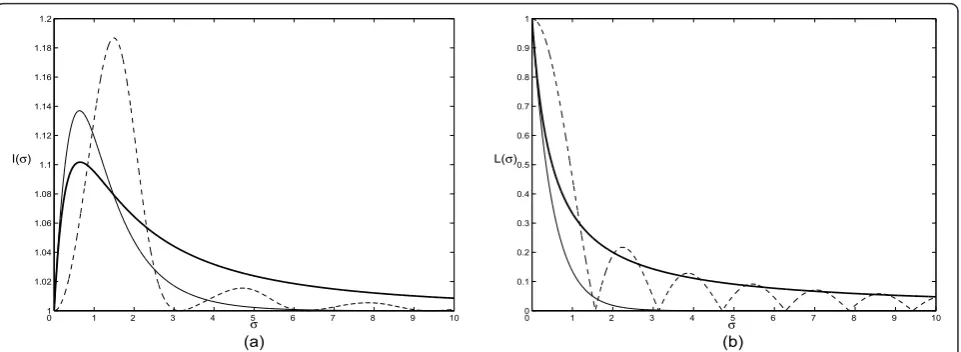
which is closely related to the performance measure considered in [29], to compare the performance of WL processing in relation to SL processing. For that, we have truncated the series inPSL(t) and PWL(t) atn= 10 terms (this approximate expansion explains 99.86% of the total variance of the process). The performance of
both the SL and the WL estimators forn= 10 does not
really vary substantially from the case of n >10. Figure 1a depicts the measureI in function ofsfor the three probabilistic distributions considered for θ. It turns out that the advantages of WL processing decrease in both cases asstends toward zero and asstends toward infi-nity. However, this occurs for different reasons. Another performance measure which helps in the interpretation is
L= |cx(t,s)|
|rx(t,s)|
which, for this example, takes the value L=|E[e2jθ]|. Figure 1b shows the index Las a function of sfor the three probabilistic distributions considered forθ. On the
one hand, as stends toward zero, then the index L
tends to one since in that limit the observation process
becomes a real signal4. On the other hand, when s
increases, then Ltends toward zero sincex(t) becomes a proper signal. The faster convergence to zero in the normal case and the slower one for the Laplace distribu-tion are also observed.
4.2 Example 2
We study a generalization of the classical communica-tion example addressed in [28] and [29]. Assume that a real waveform s1(t) is transmitted over a channel that
rotates it by a standard normal phase θ1 and adds a
nonwhite noisen(t). More precisely, s1(t) is defined on
the interval [0, 1], with zero-mean and
rs1(t,τ) = min{t,τ}. Thus, the observation process is
x(t) = ejθ1s1(t) +n(t), t∈[0, 1]
where the nonwhite noisen(t) is obtained from a
lin-ear time-invariant system of the form
n(t) = ejθ21
0
rs1(t,τ)s2(τ)dτ, with θ2 being a zero-mean
We first notice that01rx(t,t)dt<∞, where F(t) = 1
has been selected since the processes involved are con-tinuous and thus, condition (1) is verified. Now, to apply the RR method, we choose the Fourier basis of complex exponentials on [0, 1],{exp{2πjk}}∞k=−∞. Fol-lowing the recommendations in step 5 of Section 3.1, we compute the integrals in (7) via the subroutines
d01gafandtrapz (there were no significative
differ-ences between both methods).
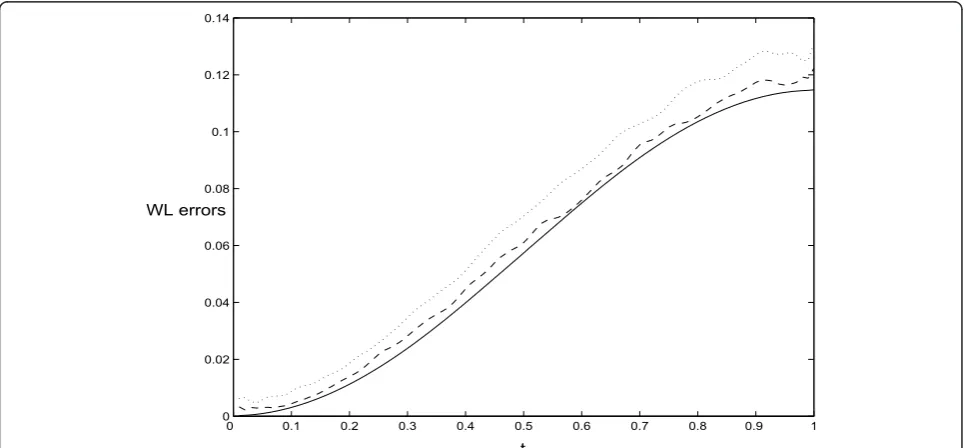
Figure 2 depicts the MS errorPWL(t) together with the MS errors of the WL estimator obtained from the RR
method with n= 25 and n= 50 terms in step 5 of the
algorithm, which have been generated by Monte Carlo simulation (a total of 10,000 simulations were per-formed). We can see that the method may yield a
suffi-ciently accurate solution with a short number n of
terms while reducing the complexity of the problem
sig-nificantly. Note that a truncated expansion at n= 25
terms explains 88.77% of the total variance of the pro-cess and the expansion withn= 50 terms 95.81%.
4.3 Example 3
The seismic ground acceleration can be represented by a uniformly modulated nonstationary process [33]. The modulated nonstationary process is obtained in the fol-lowing way
s(t) =a(t)z(t)
wherea(t) is a time modulating function that could be a complex function, andz(t) is a stationary process with
zero-mean and known second-order moments. In gen-eral, the so-called exponential modulating function is adopted [38,39]. A common choice forz(t) is the stan-dard Ornstein-Uhlenbeck process with a particular ver-sion of the exponential modulating function given bya (t) = e-t[[33], p. 38]. Thus, the seismic ground accelera-tion can be modeled as a stochastic signal {s(t), tÎ S= ℝ+
} withrs(t,τ) = e-(t+τ)e-|t-τ|. Consider the observation
process
x(t) = ejθs(t), t∈T=R+
whereθ is a standard normal phase independent ofs
(t). Now, the objective is to estimate the seismic ground velocity at instantt≥2, i.e.,ξ(t) =01s(τ)dτ, withtÎ S’ = [2,∞). A justification for considering infinite intervals on the basis of the stationarity property of z(t) can be found in [40].
By using a trial-and-error method, we selectF(t) = e-t and then, (1) holds. For the case of infinite intervals, T =ℝ+, the true eigenvalues and eigenfunctions of rx(t, τ)
are not known. We approximate them by means of the RR method. The RR eigenvalues and eigenfunctions of
rx(t,τ) are(1 ± e−2)λ¯kand[φ˜k(t)
√
2,φ˜k(t)
√
2]and
[jφ˜k(t)
√
2,−jφ˜k(t)
√
2], where λ˜kand φ˜k(t)are the
RR eigenvalues and eigenfunctions, respectively, of rx(t,
τ) obtained from the following trigonometric basis
{1,√2 cos(2πe−t),√2 sin(2πe−t),√2 cos(4πe−t),√2 sin(4πe−t), . . .}
0 0.1 0.2 0.3 0.4 0.5 0.6 0.7 0.8 0.9 1
0 0.02 0.04 0.06 0.08 0.1 0.12 0.14
t WL errors
Figure 2MS errors of the WL estimator (5)(solid line)and the estimator calculated in step 5 withn= 25 terms(dotted line)and with
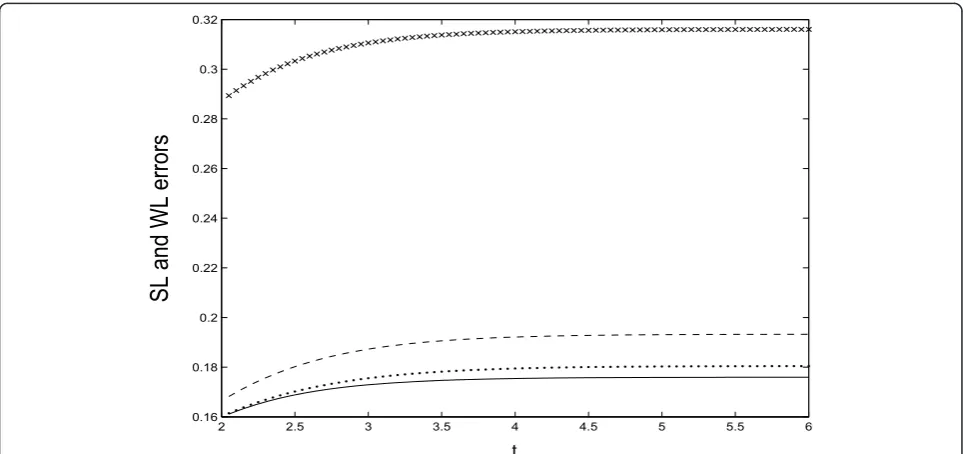
In Figure 3, we compare the MS error of the SL
esti-mator calculated withn = 10 terms with the MS errors
of the WL estimator withn= 2, 4 and, 10 terms (which account for 57.60, 82.30 and 93.88% of the total variance of x(t), respectively). We have limited the estimation interval to [2, 6] because of the observed stabilization of the MS errors for t≥ 4. Apart from the better perfor-mance of the WL estimator with respect to the SL esti-mator (as was to be expected), the rapid convergence of the RR estimators is also confirmed.
5 Concluding Remarks
A new WL estimator has been given for solving general continuous-time estimation problems. The formulation considered can be adapted in order to include as parti-cular cases a great number of estimation problems of interest. The proposed estimator becomes a way that avoids explicit calculation of matrix inverses altogether and can be applied provided that the second-order char-acteristics of the processes involved are known. Such knowledge is usual in some practical problems in fields as diverse as seismic signal processing, signal detection, finite element analysis, etc. An alternative procedure is the stochastic gradient-based iterative solution called augmented complex least mean-square algorithm (see, e. g., [24]) in which the second-order statistics are esti-mated from data. However, if we wish to take advantage of the knowledge of the second-order characteristics and the number of observation data is very large, then the continuous-time solution is a recommended option.
Appendix
This“Appendix” is written following a rigorous mathe-matical formalism parallel to [15] or [30]. Condition (1) is indeed more restrictive than the one imposed in the
works of Cambanis. Specifically, suppose μa measure
on(T,B(T))(B(T)is thes-algebra of Lebesgue measur-able subsets of T) which is equivalent to the Lebesgue measure and verifies
T
rx(t,t)dμ(t)<∞ (9)
The existence of μ satisfying (9) is proved in [30]. Cambanis also shows that (9) allows us to select a func-tionF(t) such that dμ(t)/dt=F(t) and (1) holds.
Theorem 1If x(t)is proper, then
ˆ
ξWL(t) =ξˆSL(t) + ∞
k=1
¯
bk(t)εk∗, t∈S
with b¯k(t) =λ1k
Tρ2(t,τ)φk∗(τ)dμ(τ). Moreover, its
associated MS error is
PWL(t) =PSL(t)− ∞
k=1
λkb¯k(t)b¯∗k(t), t∈S
Proof: Firstly, notice that if x(t) is proper, then the members of the set of random variables{εk} ∪ {εk∗}are
orthogonal. Thus, the estimator ξˆWL(t)is obtained by
projecting the functional ξ(t) onto the Hilbert space
2 2.5 3 3.5 4 4.5 5 5.5 6
0.16 0.18 0.2 0.22 0.24 0.26 0.28 0.3 0.32
t
S
L and WL errors
Figure 3MS errors for the SL estimator withn= 10 terms(crossed line)and for the WL estimator withn= 2 terms(dashed line), with
generated by {εk} and{εk∗}, H(εk,εk∗). Hence, the
estima-tor can be expressed in the form
ˆ
ξWL(t) =∞k=1bk(t)εk+∞k=1b¯k(t)ε∗k, where the
coeffi-cientsbk(t) andb¯k(t)are determined via the projection
theorem of the Hilbert spaces. This result assures that ξ(t)− ˆξWL(t)⊥{εk} ∪ {εk∗}; that is, E[ξ(t)ε∗k] =E[ξˆWL(t)ε∗k]
and E[ξ(t)εk] =E[ξˆWL(t)εk], for all k. Since E[ξˆWL(t)εk∗] =λkbk(t), E[ξˆWL(t)εk∗] =λkbk(t), E[ξ(t)εk] =
Tρ2(t,τ)φk∗(τ)dμ(τ), and
E[ξˆWL(t)εk] =λkb¯k(t), then the first part of the result
follows.
On the other hand, the corresponding MS error is
PWL(t) =E[|ξ(t)− ˆξWL(t)|2] =rξ(t,t)−
∞
k=1
λkbk(t)b∗k(t)−
∞
k=1
λkbk¯(t)¯b∗k(t)
■
We need the following Lemma before proving Theo-rem 2.
Lemma 1
H(wk) =H(εk,εk∗)
Proof:From (9), we get thatrx(t,τ) is the kernel of an
integral operator of L2(μ ×μ) intoL2(μ×μ), which is linear, self-adjoint, nonnegative-definite, and compact. Let {ak} be their eigenvalues and {k(t)} the
correspond-ing eigenfunctions. The eigenfunctions
ϕk(t) = [fk(t),fk∗(t)]are orthonormal in the following
sense
T
ϕH
n(t)ϕm(t)dμ(t) = 2R
⎧ ⎨ ⎩
T
fn∗(t)fm(t)dμ(t)
⎫ ⎬
⎭=δnm (10)
Thus, the real random variables given by (4) are trivi-ally orthogonal, i.e.,E[wnwm] =anδnm.
First, we prove that H(wk)⊆H(εk,εk∗). LetH(εk∗)be
the Hilbert space spanned by the random variables{εk∗}.
From Theorem 6 of [30], we have
T
x(t)fk∗(t)dμ(t) a.s.∈H(εk) and
T
x∗(t)fk(t)dμ(t) a.s.∈H(ε∗k)
and hence it is trivial thatwk⊆H(εk,εk∗).
Now, we demonstrate that H(εk,εk∗)⊆H(wk). For
that, we begin to check that εkÎ H(wk). By projectingx
(t) ontoH(wk), we obtain that x(t) = y(t) + v(t) with
y(t) =∞k=1fk(t)wk and y(t) is perpendicular to v(t).
Thus, we have thatrx(t,τ) =ry(t,τ) + rv(t, τ) wherery(t,
τ) =E[y(t)y*(τ)] andrv(t, τ) =E[v(t)v*(τ)]. By the
mono-tone convergence theorem and (10), we get that
Trx(t,t)dμ(t) = 1 2
∞
k=1αk+
Trv(t,t)dμ(t).
On the other hand,
Trx(t,t)dμ(t) = 1 2Tr(rx) =
1 2
∞
k=1αk, where Tr(rx) is the
trace of the integral operator onL2(μ×μ) with kernelrx
(t, τ).
Thus,
T
rv(t,t)dμ(t) = 0 (11)
and hence
rx(t,τ) =ry(t,τ) a.e. [Leb×Leb] onT×T (12)
Now, we consider the integralηk=
Ty(t)φk∗(t)dμ(t)a.
s. From (12), we have
T
T
ry(t,τ)φk∗(t)φk(τ)dμ(t)dμ(τ) =λk
and then hk ÎH(wk). Moreover, it follows thatE[|εk
-hk|2] = 0 and thenεk=hkÎH(wk).
Similarly, it can be proved thatεk∗∈H(wk). ■
Theorem 2If x(t)is improper, then
ˆ
ξWL(t) ∞
k=1
ψk(t)wk, t∈S
where ψk(t) =αk1(
Tρ1(t,τ)fk(τ)dμ(τ) +
Tρ2(t,τ)fk∗(τ)dμ(τ)).
Moreover, its corresponding MS error is
PWL(t) =rξ(t,t)−
∞
k=1
αkψk(t)ψk∗(t), t∈S
Proof: Following a reasoning similar to that of proof of Theorem 1 and taking Lemma 1 into account, the result
is immediate. ■
In the next result, we provide conditions in order to hold (7).
Theorem 3The WL estimator can be expressed in the following closed form
ˆ
ξWL(t) =
T
h1(t,τ)x(τ)dμ(τ) +
T
h2(t,τ)x∗(τ)dμ(τ) a.s. (13)
for some h1(t, ·),h2(t, ·)Î L2(μ)if and only if for some h1(t, ·),h2(t, ·)Î L2(μ)it is satisfied that
ρ1(t,τ) =
T
h1(t,u)rx(u,τ)dμ(u) +
T
h2(t,u)c∗x(u,τ)dμ(u)
ρ2(t,τ) =
T
h1(t,u)cx(u,τ)dμ(u) +
T
h2(t,u)r∗x(u,τ)dμ(u)
(14)
for tÎS’, a.e.τ~ [Leb]. Proof:From (11), we have
x(t),x∗(t)∈H(wk) for almost allt∈T[Leb] (15)
Suppose that ξˆWL(t)satisfies (13). It follows from ξ(t)− ˆξWL(t)⊥H(wk) and (15) that E[ξ(t)x∗(τ)] =E[ξˆWL(t)x∗(τ)]and E[ξ(t)x(τ)] =E[ξˆWL(t)x(τ)],
Reciprocally, suppose that (14) holds. Define the pro-cess
η(t) =
T
h1(t,τ)x(τ)dμ(τ) +
T
h2(t,τ)x∗(τ)dμ(τ) a.s.
Theorem 6 of [30] guarantees that h(t) Î H(wk).
Moreover, from (14), we obtain thatξ(t) - h(t)⊥x(τ) and ξ(t) - h(t)⊥x*(t) for almost all τÎ T[Leb]. Hence, from the projection theorem of the Hilbert spaces
ˆ
ξWL(t) =η(t)a.s. ■
6 Competing interests
The authors declare that they have no competing interests.
Note
1
Using augmented statistics means incorporating in the analysis the information supplied by the complex conju-gate of the signal and examining properties of both the correlation and complementary correlation functions.
2
This result is an extension of the more familiar orthogonality principle for finite-dimensional vector space (see, e.g., [12,13]).
3
It should be remarked that this criterion only takes
into account the information provided by x(t) and the
removed coefficients could be very informative about ξ(t).
4
Notice that the complex nature of x(t) in (8) stems from the term ejθ. Hence, ass® 0, then the variance ofθvanishes and it becomes a degenerate random vari-able that only takes the value 0 with probability 1.
Acknowledgements
This work was supported in part by Project MTM2007-66791 of the Plan Nacional de I+D+I, Ministerio de Educación y Ciencia, Spain. This project is financed jointly by the FEDER.
Received: 22 November 2010 Accepted: 28 November 2011 Published: 28 November 2011
References
1. D Marelli, M Fu, A continuous-time linear system identification method for slowly sampled data. IEEE Trans Signal Process.58(5), 2521–2533 (2010) 2. L Murray, A Storkey, Particle smoothing in continuous time: a fast approach
via density estimation. IEEE Trans Signal Process.59(3), 1017–1026 (2011) 3. L Guo, B Pasik-Duncan, Adaptive ontinuous-linear quadratic Gaussian
control. IEEE Trans Autom Control44(9), 1653–1662 (1999). doi:10.1109/ 9.788532
4. M Mossberg, High-accuracy instrumental variable identification of continuous-time autoregressive processes from irregularly sampled noisy data. IEEE Trans Signal Process.56(8), 4087–4091 (2008)
5. W Edmonson, JC Palacios, CA Lai, H Latchman, A global optimization method for continuous-time adaptive recursive filters. IEEE Signal Process Lett.6(8), 199–201 (1999). doi:10.1109/97.774864
6. B Schell, Y Tsividis, Analysis and simulation of continuous-time digital signal processors. Signal Process.89(10), 2013–2026 (2009). doi:10.1016/j. sigpro.2009.04.005
7. AV Savkin, IR Petersen, SOR Moheimanic, Model validation and state estimation for uncertain continuous-time systems with missing
discrete-continuous data. Comput Electr Eng.25, 29–43 (1999). doi:10.1016/S0045-7906(98)00024-X
8. P Ferreira, Sorting continuous-time signals and the analog median filter. IEEE Signal Process Lett.7(10), 281–283 (2000). doi:10.1109/97.870681 9. X Chang, G Yang, NonfragileH∞filtering of continuous-time fuzzy systems.
IEEE Trans Signal Process.59(4), 1528–1538 (2011)
10. JPS Bizarro, On the behavior of the continuous-time spectrogram for arbitrarily narrow windows. IEEE Trans Signal Process.55(5), 1793–1802 (2007)
11. HL Van Trees,Detection, Estimation, and Modulation Theory. Part I(Wiley, New York, 1968)
12. HV Poor,An Introduction to Signal Detection and Estimation, 2nd edn. (Springer, New York, 1994)
13. T Kailath, AH Sayed, B Hassibi,Linear Estimation(Prentice Hall, New Jersey, 2000)
14. RM Fernández-Alcalá, J Navarro-Moreno, JC Ruiz-Molina, A solution to the linear estimation problem with correlated signal and observation noise. Signal Process.84, 1973–1977 (2004). doi:10.1016/j.sigpro.2004.06.017 15. S Cambanis, A general approach to linear mean-square estimation
problems. IEEE Trans Inf TheoryIT-19(1), 110–114 (1973)
16. B Picinbono, P Chevalier, Widely linear estimation with complex data. IEEE Trans Signal Process.43(8), 2030–2033 (1995). doi:10.1109/78.403373 17. B Picinbono, P Bondon, Second-order statistics of complex signals. IEEE
Trans Signal Process.45(2), 411–420 (1997). doi:10.1109/78.554305 18. P Rubin-Delanchy, AT Walden, Kinematics of complex-valued time series.
IEEE Trans Signal Process.56(9), 4189–4198 (2008)
19. J Navarro-Moreno, ARMA prediction of widely linear systems by using the innovations algorithm. IEEE Trans Signal Process.56(7), 3061–3068 (2008) 20. Y Xia, CC Took, DP Mandic, An augmented affine projection algorithm for
the filtering of noncircular complex signals. Signal Process.90(6), 1788–1799 (2010). doi:10.1016/j.sigpro.2009.11.026
21. H Gerstacker, R Schober, RA Lampe, Receivers with widely linear processing for frequency-selective channels. IEEE Trans Commun.51(9), 1512–1523 (2003). doi:10.1109/TCOMM.2003.816992
22. J Eriksson, V Koivunen, Complex random vectors and ICA models: identifiability, uniqueness, and separability. IEEE Trans Inf Theory.52(3), 1017–1029 (2006)
23. J Vía, D Ramírez, I Santamaría, Properness and widely linear processing of quaternion random vectors. IEEE Trans Inf Theory.56(7), 3502–3515 (2010) 24. DP Mandic, VSL Goh,Complex Valued Nonlinear Adaptive Filters.
Noncircularity, Widely Linear and Neural Models(Wiley, New York, 2009) 25. T Adali, S Haykin,Adaptive Signal Processing: Next Generation Solutions
(Wiley-IEEE Press, 2010)
26. CC Took, DP Mandic, A quaternion widely linear adaptive filter. IEEE Trans Signal Process.58(8), 4427–4431 (2010)
27. PJ Schreier, LL Scharf,Statistical Signal Processing of Complex-Valued Data (Cambridge University Press, Cambridge, 2010)
28. PJ Schreier, LL Scharf, TM Clifford, Detection and estimation of improper complex random signals. IEEE Trans Inf Theory51(1), 306–312 (2005). doi:10.1109/TIT.2004.839538
29. J Navarro-Moreno, MD Estudillo, RM Fernández-Alcalá, JC Ruiz-Molina, Estimation of improper complex random signals in colored noise by using the Hilbert space theory. IEEE Trans Inf Theory.55(6), 2859–2867 (2009) 30. S Cambanis, Representation of stochastic processes of second-order and
linear operations. J Math Appl, (41), 603–620 (1973)
31. J Navarro-Moreno, JC Ruiz-Molina, RM Fernández-Alcalá, Approximate series representations of linear operations on second-order stochastic processes: application to simulation. IEEE Trans Inf Theory52(4), 1789–1794 (2006) 32. WA Gardner, LE Franks, An alternative approach to linear least squares
estimation of continuous random processes, in5th Annual Princeton Conferene Information Sciences and Systems(1971)
33. RG Ghanem, PD Spanos,Stochastic Finite Elements: A Spectral Approach (Springer, New York, 1991)
34. CE Rasmussen, CKI Williams, Gaussian Processes for Machine Learning, (The MIT Press, 2006) http://www.gaussianprocess.org/gpml/
35. A Oya, J Navarro-Moreno, JC Ruiz-Molina, A numerical solution for multichannel detection. IEEE Trans Commun.57(6), 1734–1742 (2009) 36. PE Gill, GF Miller, An algorithm for the integration of unequally spaced data.
Comput J, (15), 80–83 (1972)
38. SC Liu, Evolutionary power spectral density of strong-motion earthquakes. Bull Seismol Soc Am.60(3), 891–900 (1970)
39. SS Wang, HP Hong, Quantiles of critical separation distance for non-stationary seismic excitations. Eng Struct.28, 985–991 (2006). doi:10.1016/j. engstruct.2005.11.003
40. A Zerva, V Zervas, Spatial variation of seismic ground motions: an overview. Appl Mech Rev.55(3), 271–297 (2002). doi:10.1115/1.1458013
doi:10.1186/1687-6180-2011-119
Cite this article as:Martínez-Rodríguezet al.:A general solution to the continuous-time estimation problem under widely linear processing. EURASIP Journal on Advances in Signal Processing20112011:119.
Submit your manuscript to a
journal and benefi t from:
7Convenient online submission 7Rigorous peer review
7Immediate publication on acceptance 7Open access: articles freely available online 7High visibility within the fi eld
7Retaining the copyright to your article