R E S E A R C H
Open Access
State bounding estimation for a linear
continuous-time singular system
with time-varying delay
Jianying Xiao
1*and Fang Xu
1*Correspondence:
1School of Sciences, Southwest Petroleum University, Chengdu, China
Abstract
This paper investigates the problem of a state bounding estimation for a linear continuous-time singular system with time-varying delay. By employing the maximal Lyapunov–Krasovskii functional and applying the new free-matrix-based integral inequality, some proper conditions are derived in terms of LMIs and a bounding estimation lemma and set are obtained for the studied singular system.
Keywords: State bounding estimation; Time delays; Singular system
1 Introduction
During the past years, state bounding estimation has been widely applied in control sys-tems with actuator saturation, peak-to-peak gain minimization, and parameter estimation (see [1–5]). A state bounding estimation is meant to get the corresponding state bounding set which is limited by the inside and outside of the initial conditions. State bounding esti-mation is so important that it has aroused much attention in control research. Meanwhile, there have been several kinds of correlative applications of a state bounding estimation, such as reachable set estimation and design actuator saturation for control systems (see [1–53]).
Specially, by applying the S-procedure, an ellipsoid reachable set bounding was derived for linear systems without time delays in [19]. However, time delays cannot always be avoided in practice and they often cause the system’s instability and poor performance. Recently, many researchers have studied many kinds of dynamic systems with time de-lays (see [3,6–25]). Thus, some researchers naturally have devoted efforts to investigating the corresponding state bounding estimation for the dynamic systems with time delays. In [7], a delay-dependent criterion for an ellipsoid reachable bounding set was derived by Fridman and Shaked, applying a Lyapunov–Krasovskii functional. Later, in [11], a better ellipsoid reachable bounding set was proposed by Kim using a Lyapunov–Krasovskii func-tional with just one nonconvex scalar. Some new criteria for reachable bounding sets were established by employing the maximal Lyapunov–Krasovskii functional in [14].
On the other hand, singular systems have been more intensively studied than state-space ones because they can present a better description of the behavior for some systems. There have been many singular systems in lots of practical systems, such as circuit systems, air-craft modeling, chemical processes and economic systems. Leaving alone their practical
performance, singular systems are worth investigating for their theoretical importance and have drawn many researchers’ attention in recent years because their basis is different from state-space systems. However, many researchers have successfully extended the ba-sic theory of state-space systems to the singular systems. Recently, there have been several contributions on the state bounding estimation for nonlinear singular systems by applying different methods (see [11–19]). Particulary, Feng and Lam in [17] obtained the reachable set estimation for singular systems with time delays by using a Lyapunov–Krasovskii func-tional but not the maximal Lyapunov–Krasovskii funcfunc-tional.
In this paper, we extend the state bounding estimation to a singular system with time-varying delay. By employing the maximal Lyapunov–Krasovskii functional and apply-ing the new free-matrix-based integral inequality, some proper conditions are derived in terms of LMIs and a new bounding estimation lemma and set are obtained for the studied singular system.
Notations: Throughout this paper,Rndenotesn-dimensional Euclidean space andRm×n
is the set ofm×nreal matrices. [·,·] represents an interval. The superscripts ‘–1’ and ‘T’ stand for the inverse and transpose of a matrix, respectively. · refers to the Euclidean vector norm.∗denotes the symmetric block in a symmetric matrix.Sym(P) is defined as P+PT. For a real number, use the notation+=max{, 0}, which means+=0,,> 0,≤0. Matrix dimensions, if not explicitly stated, are assumed to be compatible for algebraic operations.
2 Problem statement and preliminaries
Consider the following linear continuous-time singular system with time-varying delay:
Ex(t) =˙ Ax(t) +Dxt–d(t)+Bu(t),
x(t) =φ(t), t∈[–dM, 0],
(1)
where x(t)∈Rn is the state vector; the matrices E, A, Dand Bare constant matrices
with appropriate dimensions andrank(E) =n1; d(t) is the time-varying delay satisfying
0≤dm ≤d(t)≤dM, d(t) <˙ d,d> 0;u(t)∈Rm stands for a disturbance which satisfies
uT(t)u(t)≤u2≤ x
t2, whereuis a real constant;φ(t) is the initial condition and
contin-uously differentiable on [–dM, 0]. We denoteφ=maxt∈[–dM,0]φ.
Remark1 The initial condition for the studied system in [17] must be zero. However, the initial condition in this paper either may be equal to zero or not equal to zero. It is obvious that our discussed system is more general than the one in [17].
To discuss the state bounding problem for a linear continuous-time singular system with time-varying delay, the next definitions are necessary.
Definition 2.1 If the singular system (1) is satisfied with one of the next conditions, re-spectively, the system (1) is said to be regular, impulse free, stable and admissible:
(1) The singular system in (1) is said to be regular if the matrix pair(E,A)is regular. (2) The singular system in (1) is said to be impulse free if the matrix pair(E,A)is
(3) The singular system in (1) is said to be stable, if for anyδ> 0, there exists a scalar
ε(δ) > 0, such that, for any compatible initial conditionx0satisfyingx0 ≤ε(δ), the
solutionx(t)of (1) satisfiesx(t) ≤δfort≥0; furthermore,x(t)→0, whent→ ∞. (4) The singular system in (1) is said to be admissible if it is regular, impulse free and
stable.
Definition 2.2 For a given α > 0, system (1) with u(t) = 0 (t ≥0) is said to be α -exponentially stable if there exists a positive constantρsuch that every solutionx(t,φ) of (1) satisfies the following inequality:
x(t,φ)≤ρφe–αt, ∀t≥0. (2)
Forγ > 0, let the ballB(γ) be defined byB(γ) ={x∈Rn:x ≤γ}. By adopting the
concept of ball convergence in [16], we have the following definition.
Definition 2.3 For a givenγ > 0, the system (1) is said to be globally exponentially con-vergent within the ballB(γ) if there exist a constantα> 0 and a non-decreasing function K(·) such that the following inequality holds:
x(K,φ)≤γ +Kφe–αt, ∀t≥0. (3)
The main objective of this paper is to obtain delay-dependent conditions for the state bounding problem of singular system (1). First, the conditions are investigated for the existence of two balls, namely,B(γ1) andB(γ2) with the radiiγ1,γ2explicitly dependent
on the upper boundu2of the disturbance such that: (i) for all initial conditions inB(γ 1),
the corresponding state trajectories of the systems are bounded inside the ballB(γ2) all
the time, and (ii) for all the initial conditions that are outsideB(γ1), the corresponding
state trajectories of the systems converge exponentially (with a convergence rateα) within
B(γ2). Then the conditions are derived for the reachable set bounding of (1) with zero
initial condition and theα-exponential stability of (1) without any disturbance. In the following, some necessary lemmas are introduced.
Lemma 2.1([18]) Let x be a differentiable function: [a,b]→Rn.For symmetric matrices
Q∈Rn×n,Y
1∈R3n×3n,Y3∈R3n×3nand any matrices Y2∈R3n×3n,M1∈R3n×n,M2∈R3n×n
satisfying
Ψ =
⎡ ⎢ ⎣
Y1 Y2 M1
∗ Y3 M2
∗ ∗ Q
⎤ ⎥ ⎦≥0,
the following integral inequality holds:
–
b
a
˙
xT(s)Qx(s)ds˙ ≤TΩ, (4)
where
=
xT(a),xT(b), 1 b–a
b
a
˙
xT(s)ds
T
Ω=
(b–a)
Y1+
1 3Y3
+Sym{M1Π1+M2Π2},
Π1=e1–e2, Π2= 2e3–e1–e2,
e1= [I, 0, 0], e2= [0,I, 0], e3= [0, 0,I].
Lemma 2.2([17]) Let0≤τm<τM, 0 <λ< 1,Q≥0,x(t)be a continuous vector-valued
function on[τm,τM].Ifx(t) ≤λx(t–τ(t))+Q,t≥0,thenx(t) ≤sup–τM≤t≤0x+
Q 1–λ.
Lemma 2.3([17]) If system(1)is regular and impulse free,there exist two nonsingular matrices M and N such that
MEN=
In1 0 0 0
, MAN=
ˆ
A1 0
0 I
.
Let
ˆ
x(t) =N–1x(t) =
ˆ
x1(t)
ˆ
x2(t)
,
wherexˆ1(t)∈Rn1 andxˆ2(t)∈Rn–n1.Denote
MAτN=
ˆ
D11 Dˆ12
ˆ
D21 Dˆ22
, MB=
ˆ
B1
ˆ
B2
.
Then system(1)is a restricted system,equivalent to the following one:
˙ˆ
x1(t) =Aˆ1xˆ1(t) +Dˆ11xˆ1
t–τ(t)+Dˆ12xˆ2
t–τ(t)+Bˆ1u(t),
0 =xˆ2(t) +Dˆ21xˆ1
t–τ(t)+Dˆ22xˆ2
t–τ(t)+Bˆ2u(t).
(5)
Lemma 2.4 Assume that there exist a functional V(xt)and positive scalarsλ1,λ2,α,β∈
(0, 1)such that
(1) λ1x(t) 2
≤V(xt)≤λ2xt2, t≥0, (6)
(2) V(x˙ t) +αV(xt)≤βuT(t)u(t), (7)
where xtrepresents the state trajectory{x(t+θ) :θ∈C[–dM, 0]}.Then every solution x(t,φ)
of(1)satisfies
x(t,φ)2≤βu
2
αλ1
+
λ2 λ1
φ2–βu
2
αλ1 +
e–αt, ∀t≥0. (8)
Proof Notice
˙
V(xt) +αV(xt)≤βuT(t)u(t). (9)
By multiplying both sides of the inequality in (7) witheαt, we have
eαtV˙(xt) +αeαtV(xt) =
d dt
eαtV(xt)
Then, by performing the integral of (10) from 0 toT> 0, it is not difficult to obtain
eαtV(x
T) –V(x0) = T
0
βeαtuT(t)u(t)dt≤ T
0
βeαtu2dt=β αu
2eαT– 1. (11)
By simple computation, it is easy to get
V(xT)≤e–αtV(x0) β αu
2eαT– 1e–αT=β αu
2+
V(x0) – β αu
2
e–αT. (12)
Finally, for allt≥0, replacingTwithtin (12), we get
V(xt)≤ β αu
2+
V(x0) – β αu
2
e–αt. (13)
Taking (6) into account, we derive
x(t,φ)2≤βu
2
αλ1
+
λ2 λ1
φ2–βu
2
αλ1 +
e–αt. (14)
The proof is thus completed.
Remark2 Lemma2.4in this paper provides a basic tool for the problem of state bounding not only containing the state convergence within a ball but also including the reachable set bounding for a continuous-time singular system with bounded disturbance input. It is obvious that Lemma2.4in this paper can be regarded as an expansion of Lemma 3 in [17]. Particularly, takingβ= α
u2 andV(x0), it is easy to see that Lemma2.4is reduced to
Lemma 3 in [17], which was proved to be more useful for the reachable set estimation of singular systems with bounded disturbances. Note that Lemma2.4in this paper can also be applied to the case where there is no disturbance in system (1). In this case, the studied problem is reduced to the α-exponential stability analysis for a singular system with interval time-varying delay.
3 Main results
According to Lemma2.3, we consider the following system’s state bounding estimation:
˙ˆ
x1(t) =Aˆ1xˆ1(t) +Dˆ11xˆ1
t–τ(t)+Dˆ12xˆ2
t–τ(t)+Bˆ1u(t),
0 =xˆ2(t) +Dˆ21xˆ1
t–τ(t)+Dˆ22xˆ2
t–τ(t)+Bˆ2u(t).
(15)
Assumption 1 The matrix pair (E,D) is regular and ˆD22< 1.
Theorem 3.1 Under Assumption1,the singular system(1)is bounded by the ellipsoid
B(ε) =
x∈Rn|xTPˆˆjx≤ βu2
α
ˆ
Pj=
S–TPjS–1
n1×n1,Pˆˆj=T
–T
ηPˆj 0
0 (1–η2)βu2 2α
T–1
if there exist positive Rn×nmatrices P
j,Q1,Q2,Q3,X1,X2,G1,G2,G3,G4,G5,G6,G7,G8,
any R3n×3nsymmetric matrices
Y1=
such that the following matrix inequalities hold:
Proof Given a family of matricesPj> 0,Q1> 0,Q2> 0,Q3> 0,X1> 0,X2> 0, the pointwise
maximum Lyapunov–Krasovskii functional is defined as
Vmax=max
V1,j(x) +V2(xt) +V3(xt) +V4(xt)
=maxVj(x)
=V1,max(x) +V2(xt) +V3(xt) +V4(xt), j= 1, 2, . . . ,N, (19)
where
V1,j(x) =xT(t)ETPjEx(t),
V1,max(x) =maxV1,j(x),
V2(xt) = t
t–dm
eαθ–txT(θ)Q 1x(θ)dθ
+
t
t–dM
eαθ–txT(θ)Q2x(θ)dθ+ t
t–d(t)
eαθ–txT(θ)Q3x(θ)ds,
V3(xt) = (dM–dm) –dm
–dM
t
t+s
eαθ–tx˙T(θ)ETX
1Ex(˙ θ)ds dθ,
V4(xt) =dm 0
–dm
t
t+s
eαθ–tx˙T(θ)ETX
2Ex(˙ θ)ds dθ.
From Lemma2.4, we have
λ1x(t) 2
≤Vmax≤λ2xt2, t≥0, (20)
where
λ1= min 1≤j≤Nλ
ETPjE
,
λ2= max 1≤j≤Nλ
ETPjE
+ max
1≤j≤Nλ(Q1)dm+1max≤j≤Nλ(Q2)dM+1max≤j≤Nλ(Q3)dM
+max
1≤j≤Nλ
ETX1E
(dM–dm)3+ max 1≤j≤Nλ
ETX2E
d2m.
In order to better express the idea of our proof, define a setMmax(x) :={j∈ {1, 2, . . . ,K}: Vj(x) =Vmax(x)} for anyx= 0. Therefore,Vj(x) <Vmax(x), ifj=Mmax(x). Without loss of generality, we assume that the first nellipsoids intersect atx. In that case, Mmax= {1, 2, . . . ,n}. Thus one obtains for allk∈ {1, 2, . . . ,K},xT(Pk–Pj)x≤0,∀j≤n.
Letηj={x∈Rn:Vj(x)≥Vk(x),∀k=j}. Observe thatxis differentiable ifx∈ηj\Vk=jηk,
whilexis nondifferentiable ifx∈nj=1ηj\ K
j=m+1ηj.
Since the derivative of a convex function at a differential point can be regarded as a special case of a directional derivative for the same convex function at a nondifferentiable point, we combine these two situations and only illustrate the proof for the situation of a nondifferentiable point in the following discussion. Therefore,
Vmax=xT(t)ETPjEx(t) +V2(xt) +V3(xt) +V4(xt), j∈Mmax(x), (21)
Calculating the derivative ofVmax, we have
∇˙xV1,max(x) = 2x˙T(t)ET(PjE+E0u)x(t)
= 2Ex(t)˙ TPjEx(t) + 2
Ex(t)˙ TPjE0ux(t), (23)
˙
V2(xt) = –αV2+xT(t)(Q1+Q2+Q3)x(t) –e–αdmxT(t–dm)Q1x(t–dm)
–e–αdMxT(t–d
M)Q2x(t–dM)
–1 –τ˙(t)e–αd(t)xTt–d(t)Q 3x
t–d(t)
≤–αV2+xT(t)(Q1+Q2+Q3)x(t) –e–αdmxT(t–dm)Q1x(t–dm)
–e–αdMxT(t–d
M)Q2x(t–dM)
– (1 –μ)e–αd(t)xTt–d(t)Q3x
t–d(t), (24)
˙
V3(xt) = –αV3+ (dM–dm)2x˙T(t)ETX1Ex(t)˙
– (dM–dm) t–dm
t–dM
eα(θ–t)x˙T(θ)ETX
1Ex(˙ θ)dθ
≤–αV3+ (dM–dm)2x˙T(t)ETX1Ex(t)˙
– (dM–dm)e–αdM t–dm
t–dM
˙
xT(θ)ETX1Ex(˙ θ)dθ, (25)
˙
V4(xt) = –αV4+d2mx˙T(t)ETX2Ex(t) –˙ dm t
t–dm
eα(θ–t)x˙T(θ)ETX2Ex(˙ θ)dθ
≤–αV4+d2mx˙T(t)ETX2Ex(t) –˙ dme–αdm t
t–dm
˙
xT(θ)ETX2Ex(˙ θ)dθ. (26)
By employing Lemma2.1, there exist matricesY1,Y2,Y3,Z1,Z2,Z3∈R3n×3n, and any
matricesN1,N2,M1,M2∈R3n×nsatisfying
Ω1= ⎡ ⎢ ⎣
Y1 Y2 M1
∗ Y3 M2
∗ ∗ ETX
1E ⎤ ⎥
⎦≥0, Ω2= ⎡ ⎢ ⎣
Z1 Z2 N1
∗ Z3 N2
∗ ∗ ETX
2E ⎤ ⎥ ⎦≥0
such thatdm<d(t) <dM. We have
˙
V3(xt)≤–αV3+ (dM–dm)2x˙T(t)ETX1Ex(t)˙
– (dM–dm)e–αdM t–d(t)
t–dM
˙
xT(θ)ETX1Ex(˙ θ)dθ
– (dM–dm)e–αdM t–dm
t–d(t)
˙
xT(θ)ETX1Ex(˙ θ)dθ
≤–αV3+ (dM–dm)2x˙T(t)ETX1Ex(t)˙
+ (dM–dm)e–αdM
xT(t–dm),xT
t–d(t), 1 d(t) –dm
t–dm
t–d(t)
xT(θ)dθ
×d(t) –dm
Y1+
1 3Y3
×
Introducing the free weighting matrixG, we have
2ξT(t)GT–Ex˙i(t) +Ax(t) +Dx
According to Lemma2.4, we have
where
γ2=
βu2 αλ1
, λ1= min 1≤j≤Nλ
ETP jE
,
λ2= max 1≤j≤Nλ
ETPjE
+ max
1≤j≤Nλ(Q1)dm+1max≤j≤Nλ(Q2)dM+1max≤j≤Nλ(Q3)dM
+max
1≤j≤Nλ
ETX1E
(dM–dm)3+ max 1≤j≤Nλ
ETX2E
d2m.
Remark3 Defineγ1=λλ12γ2. It is obvious thatλ1andλ2are positive constants due to the
conditions from Theorem 1. DenoteB1:=B(γ1),B2:=B(γ2), thenB1⊂B2. According to
the above inequality, it is easy for us to obtain two cases as regards the state trajectory of the singular system (1). On the one hand, for any initial condition which belongs toB1, the
corresponding state trajectory is bounded within the ballB2. On the other hand, for any
initial condition which is outsideB1, asttends to infinity, the corresponding trajectory
converges exponentially within the ballB2.
When takingφ(t) = 0, the singular system (1) is translated into the form
Ex˙i(t) =Ax(t) +Dx
t–d(t)+Bu(t),
x(t) = 0 t∈[–dM, 0].
(33)
It is obvious that the new system (33) is just a special case of the system (1). The reach-able set estimation for system (33) has been mainly studied by employing the common Lyapunov–Krasovskii functional in [17]. The corresponding bounding ellipsoids have also been derived. In this paper, we apply the maximal Lyapunov–Krasovskii functional to pro-vide a non-ellipsoidal reachable set estimation for the system (1).
Define the reachable set of (1) as follows:
Rx=
x(t)∈Rn|x(t),u(t) satisfy (1) anduT(t)u(t)≤u2,t≥0. (34)
From (34), it is easy to see that the reachable set of a system is regarded as a bounded set of all reachable states starting from the origin by input disturbances with constrained peak value. Since recently, the most interesting problem of estimation and control for dynamical systems has been to find an estimation of the bounds of the reachable sets. Therefore, many researchers have devoted efforts to investigating such conditions for deriving an ellipsoid or a non-ellipsoid which bounds the reachable set of the system.
LetQbe a symmetric positive definite matrix and a scalarr≥0, the ellipsoid is defined as follows:
ε(Q,r) =x∈Rn,xTQx≤r. (35)
By employing the Lyapunov–Krasovskii functional in (19), from Lemma2.4, we obtain
V(xt)≤ βu2
α
1 –e–αt<βu2
α , ∀t≥0. (36)
Note thatV(xt)≥xT(t)ETPjEx(t). Therefore, we are ready to getxT(t)ETPjEx(t)≤βu
2
α .
of system (1) under zero initial condition. The reachable set is bounded by the ellipsoid Thus, the following inequality holds:
xˆ1(t)≤1 (37)
On the other hand, from Assumption1, it follows from Lemma2.3that
xˆ2(t)=Dˆ21xˆ1
˜
X=
e–αdmX
2 0
0 0
, P˜j=
PjE+E0U 0
G1 G7
,
˜
Q=
Q1+Q2+Q3+αETPjE 0
0 d2
mX2+ (dM–dm)2X1
.
From (41)–(42), we get
symA˜TP˜j
–E˜TZ˜E˜< 0. (43)
Becauserank(E) =˜ rank(E) =n1≤n, there exist nonsingular matricesS˜andT˜ such that
¯
E=S˜E˜T˜ =
I 0 0 0
.
Denote
¯
A=S˜A˜T˜ =
A11 A12
A21 A22
, P¯=S˜–TP˜N˜ =
P11 P12
P21 P22
.
Taking (43) into account, we haveP12= 0 andP11> 0. Then pre-multiplying and
post-multiplying (43) byT˜T andT, respectively, it is easy to obtainsym(AT
22P22) < 0 showing
thatA22is nonsingular. Thus, the pair (E,˜ A) is regular and impulse free. In addition, by˜
simple computation, it is easy to certify thatdet(sE–A) =det(sE˜–A) and˜ deg(det(sE–A)) = deg(det(sE˜–A)). Finally, it is obvious that the system (1) is regular and impulse free.˜
4 Numerical examples
In this section, a numerical simulation example will be presented to demonstrate the ef-fectiveness of our obtained results.
Example1 Consider the two dimensional system (1) with
E=
–0.6 1.1
, A=
–2 0 0 –0.7
, B=
–1 0 –1 –1
,
u(t) =
cos(t) sin(t)
, D= 0.
We have given
P1=
0.4597 0.0270 0.0270 0.3100
, P2=
0.8599 0.7400 –0.7400 2.1083
.
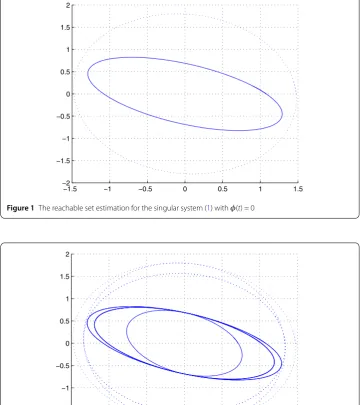
Figures1 and2describe the reachable set estimation for the singular system (1) with
Figure 1The reachable set estimation for the singular system (1) withφ(t) = 0
Figure 2The reachable set estimation for the singular system (1) withφ(t) = 0
5 Conclusions
The problem of a state bounding estimation of a continuous-time singular system with time delays has been investigated in this paper. Some proper conditions have been estab-lished to guarantee the state bounding set for the singular system with time delays by using the maximal Lyapunov–Krasovskii functional and employing the new free-matrix-based integral inequality. The above methods can be extended to our future studies, such as of fractional-order systems and memristor-based neural networks.
Acknowledgements
Funding
This work was supported by Young scholars development fund of swpu (No. 200331010060).
Competing interests
The authors declare that they have no competing interests.
Authors’ contributions
All authors contributed equally to the writing of this paper. All authors read and approved the manuscript.
Publisher’s Note
Springer Nature remains neutral with regard to jurisdictional claims in published maps and institutional affiliations.
Received: 10 May 2018 Accepted: 14 March 2019
References
1. Liu, G., Xu, S., Wei, Y., Qi, Z., Zhang, Z.: New insight into reachable set estimation for uncertain singular time-delay systems. Appl. Math. Comput.320, 769–780 (2018)
2. Liu, G., Xu, S., Park, J.H., Zhang, G.: Reliable exponential H filtering for singular Markovian jump systems with time-varying delays and sensor failures. Int. J. Robust Nonlinear Control28, 4230–4245 (2018)
3. Liu, G., Wei, Y., Ma, Q., Lu, J., Chu, Y.: Robust non-fragile guaranteed cost control for singular Markovian jump time-delay systems. Trans. Inst. Meas. Control40, 2141–2150 (2018)
4. Liu, G., Ma, Q., Lu, J.: Mixed H-infinity and passive filtering for a class of singular systems with interval time-varying delays. Optim. Control Appl. Methods39, 377–392 (2018)
5. Liu, G., Qi, Z., Xu, S.: alpha-dissipativity filtering for singular Markovian jump systems with distributed delays. Signal Process.134, 149–157 (2017)
6. Fridman, E., Pila, A., Shaked, U.: Regional stabilization and H control of time-delay systems with saturating actuators. Int. J. Robust Nonlinear Control13, 885–907 (2003)
7. Fridman, E., Shaked, U.: On reachable sets for linear systems with delay and bounded peak inputs. Automatica39, 2005–2010 (2003)
8. He, Y., Wang, Q., Lin, C., Wu, M.: Delay-range-dependent stability for systems with time-varying delay. Automatica43, 371–376 (2007)
9. Park, J.H., Park, C.H., Kwon, O.M., Lee, S.M.: A new stability criterion for bidirectional associative memory neural networks of neutral-type. Appl. Math. Comput.199, 716–722 (2008)
10. Fridman, E., Shaked, U., Liu, K.: New conditions for delay-derivative-dependent stability. Automatica45, 2723–2727 (2009)
11. Kim, J.H.: Improved ellipsoidal bound of reachable sets for time-delayed linear systems with disturbances. Automatica44, 2940–2943 (2008)
12. Kwon, O., Lee, S., Park, J.: On the reachable set bounding of uncertain dynamic systems with time-varying delays and disturbances. Inf. Sci.181, 3735–3748 (2011)
13. Nam, P., Pathirana, P.: Further result on reachable set bounding for linear uncertain polytopic systems with interval time-varying delays. Automatica47, 1838–1841 (2011)
14. Zuo, Z., Ho, D.W.C., Wang, Y.: Fault tolerant control for singular systems with actuator saturation and nonlinear perturbation. Automatica46, 569–576 (2010)
15. Zuo, Z., Ho, D.W.C., Wang, Y.: Reachable set bounding for delayed systems with polytopic uncertainties: the maximal Lyapunov–Krasovskii functional approach. Automatica46, 949–952 (2010)
16. Oucheriah, S.: Robust exponential convergence of a class of linear delayed systems with bounded controllers and disturbances. Automatica42, 1863–1867 (2006)
17. Feng, Z.G., Lam, J.: On reachable set estimation of singular systems. Automatica52, 146–153 (2015) 18. Zeng, H.B., He, Y., Wu, M., She, J.H.: Free-matrix-based integral inequality for stability analysis of systems with
time-varying delay. IEEE Trans. Autom. Control60, 2768–2772 (2015)
19. de Oliveira, M.C., Skelton, R.E.: Stability tests for constrained linear systems. In: Perspectives in Robust Control, pp. 241–257. Springer, Berlin (2001)
20. Xiao, J.Y., Zhong, S.M.: Extended dissipative conditions for memristive neural networks with multiple time delays. Appl. Math. Comput.323, 145–163 (2018)
21. Elsgolts, L.E., Norkin, S.B.: Introduction to the Theory of the Differential Equations with Deviating Argument. Academic Press, New York (1973)
22. Khusainov, D.Ya., Shatyrko, A.V.: Absolute stability of multi-delay regulation systems. J. Autom. Inf. Sci.27(3–4), 33–42 (1995)
23. Shatyrko, A.V., Khusainov, D.Ya.: Investigation of absolute stability of nonlinear systems of special kind with aftereffect by Lyapunov functions method. J. Autom. Inf. Sci.43(7), 61–75 (2011)
24. Shatyrko, A., Khusainov, D.: On the Interval Stability of Weak-Nonlinear Control Systems with Aftereffect. Sci. World J.
https://doi.org/10.1155/2016/6490826
25. Zeng, D., Zhang, R., Liu, Y., Zhong, S.: Sampled-data synchronization of chaotic Lur’e systems via input-delay-dependent-free-matrix zero equality approach. Appl. Math. Comput.315, 34–46 (2017) 26. Zhang, R., Zeng, D., Zhong, S., Shi, K., Cui, J.: New approach on designing stochastic sampled-data controller for
exponential synchronization of chaotic Lur’e systems. Nonlinear Anal. Hybrid Syst.29, 303–321 (2018)
27. Wang, X., Liu, X., She, K., Zhong, S.: Pinning impulsive synchronization of complex dynamical networks with various time-varying delay sizes. Nonlinear Anal. Hybrid Syst.26, 307–318 (2017)
28. Wang, X., Liu, X., She, K., Zhong, S., Shi, L.: Delay-dependent impulsive distributed synchronization of stochastic complex dynamical networks with time-varying delays. IEEE Trans. Syst. Man Cybern. (2018).
29. Shan, Y., Zhong, S., Cui, J., Hou, L., Li, Y.: Improved criteria of delay-dependent stability for discrete-time neural networks with leakage delay. Neurocomputing266, 409–419 (2017)
30. Shan, Y., She, K., Zhong, S., Zhong, Q., Shi, K., Zhao, C.: Exponential stability and extended dissipativity criteria for generalized discrete-time neural networks with additive time-varying delays. Appl. Math. Comput.333, 145–168 (2018)
31. Chen, H., Zhang, Z., Wang, H.: Robust H state-feedback control for linear system. Proc. R. Soc. A473, 20160934 (2017) 32. Chen, H., Zhong, S., Liu, X., Li, Y., Shi, K.: Improved results on nonlinear perturbed T-S fuzzy system with mixed delays.
J. Franklin Inst.354, 2032–2052 (2017)
33. Xie, W., Zhu, H., Zhong, S., Zhang, D., Shi, K., Cheng, J.: Extended dissipative estimator design for uncertain switched delayed neural networks via a novel triple integral inequality. Appl. Math. Comput.335, 82–102 (2018)
34. Xie, W., Zhu, H., Zhong, S., Cheng, J., Shi, K.: Extended dissipative resilient estimator design for discrete-time switched neural networks with unreliable links. Nonlinear Anal. Hybrid Syst.32, 19–36 (2019)
35. Cheng, J.: Ahn, C.K., Karimi, H.R., Cao, J., Qi, W.: An event-based asynchronous approach to Markov jump systems with hidden mode detections and missing measurements. IEEE Trans. Syst. Man Cybern. Syst. (2018).
https://doi.org/10.1109/TSMC.2018.2866906
36. Cheng, J., Chang, X.H., Park, J.H., Li, H., Wang, H.: Fuzzy-model-basedH∞control for discrete-time switched systems with quantized feedback and unreliable links. Inf. Sci.436-437, 181–196 (2018)
37. Wang, B., Zhang, D., Cheng, J., Park, J.H.: Fuzzy model-based nonfragile control of switched discrete-time systems. Nonlinear Dyn.93(4), 2461–2471 (2018)
38. Shi, K., Tang, Y., Zhong, S., Yin, C., Huang, X., Wang, W.: Nonfragile asynchronous control for uncertain chaotic Lurie network systems with Bernoulli stochastic process. Int. J. Robust Nonlinear Control28(5), 1693–1714 (2018) 39. Wang, J., Shi, K., Huang, Q., Zhong, S., Zhang, D.: Stochastic switched sampled-data control for synchronization of
delayed chaotic neural networks with packet dropout. Appl. Math. Comput.335, 211–230 (2018)
40. Shi, K., Wang, J., Zhong, S., Zhang, X., Zhong, S., Liu, Y., Cheng, J.: New reliable nonuniform sampling control for uncertain chaotic neural networks under Markov switching topologies. Appl. Math. Comput.347, 169–193 (2019) 41. Xiao, J., Zhong, S., Li, Y., Xu, F.: Relaxed exponential passivity criteria for memristor-based neural networks with leakage
and time-varying delays. Int. J. Mach. Learn. Cybern.8, 1875–1886 (2017)
42. Xiao, J., Zhong, S., Xu, F.: Design disturbance attenuating controller for memristive recurrent neural networks with mixed time-varying delays. Adv. Differ. Equ. (2018).https://doi.org/10.1186/s13662-018-1641-8
43. Yang, H., Wang, X., Zhong, S., Shu, L.: Synchronization of nonlinear complex dynamical systems via delayed impulsive distributed control. Appl. Math. Comput.320, 75–85 (2018)
44. Wang, X., She, K., Zhong, S.: Finite-time lag synchronization of master-slave complex dynamical networks with unknown signal propagation delays. J. Franklin Inst.354(12), 4913–4929 (2017)
45. Zhang, R., Zeng, D., Park, J.H., Liu, Y., Zhong, S.: Quantized sampled-data control for synchronization of inertial neural networks with heterogeneous time-varying delays. IEEE Trans. Neural Netw. Learn. Syst.29(12), 6385–6395 (2018) 46. Xiao, J., Li, Y., Zhong, S., Xu, F.: Extended dissipative state estimation for memristive neural networks with time-varying
delay. ISA Trans.64, 113–128 (2016)
47. Xiao, J.Y., Zhong, S.M., Li, Y.T., Xu, F.: Finite-time Mittag-Leffler synchronization of fractional-order memristive BAM neural networks with time delays. Neurocomputing219, 431–439 (2017)
48. Zhang, R., Liu, X., Zeng, D., Zhong, S., Shi, K.: A novel approach to stability and stabilization of fuzzy sampled-data Markovian chaotic systems. Fuzzy Sets Syst.344, 108–128 (2018)
49. Zhang, R., Zeng, D., Zhong, S.: Novel master-slave synchronization criteria of chaotic Lur’e systems with time delays using sampled-data control. J. Franklin Inst.354(12), 4930–4954 (2017)
50. Xiao, J.Y., Zhong, S.M., Li, Y.T.: New passivity criteria for memristive uncertain neural networks with leakage and time-varying delays. ISA Trans.59, 133–148 (2015)
51. Xiao, J.Y., Zhong, S.M., Li, Y.T.: Relaxed dissipativity criteria for memristive neural networks with leakage and time-varying delays. Neurocomputing171, 707–718 (2016)
52. Xiao, J.Y., Zhong, S.M., Li, Y.T.: Improved passivity criteria for memristive neural networks with interval multiple time-varying delays. Neurocomputing171, 1414–1430 (2016)