The Integration of Tangible and Intangible Cultural heritage values for the Sustainable
development of the cultural capital of Kerala: Thrissur, India
AR.JOSNA RAPHAEL P. Associate Professor in Architecture,
Government Engineering College, Trichur Kerala ,India
Presently pursuing Doctoral programme at NIT,Calicut,India
DR.A.K.KASTHURBA,Associate Professor in Architecture,NIT,Calicut,India
ABSTRACT
The aim of this work is to analysis the relationship between tangible and intangible heritage of a historic
urban core of Cultural Capital of Kerala. This investigation has also made it possible to recognize
intangible cultural heritage, which was ignored for a long time for the future development of the city
and also as heritage to be protected and safeguarded. This paper sets out to explain the interrelation
between the intangible and tangible heritage of the space and the distribution of religious, social and
cultural aspects in the spatial context within Thrissur, a South Indian temple city. The research has been
fostered by questions: (1) How to understand and quantify the intangible heritage of traditional urban
cores in Indian cities? (2) How the intangible and tangible heritage can be understood by the social
aspects in terms of user preferences? (3)How the tangible heritage gets defined by the intangible ? The
strong influence of various factors like religious, cultural, historic etc is analyzed to trace the
development of architecture in Trichur. The analysis shows the integration of tangible and intangible
heritage of the traditional urban core and the need for using this as a base for the sustainable
development of the city for the user.
Key words: Culture, Intangible Heritage, Tangible Heritage
1. Background
In the Indian context, one finds that there is a lack of systematic studies to investigate the built
environments with respect to the intangible heritage and the user preferences. This organically evolved
parts of cities that are urban cores in the contemporary developing Indian cities, if analysed in terms of
intangible cultural heritage along with tangible , will help to understand its spatial structure as a result of
the culture specific user preferences in the Indian context.. This may help to evolve a humane approach
to deal the emerging built environments in developing cities of India with objectivity. Only traditional
understand the embedded human aspects in terms of user preferences about built heritage. If the
complete cities are considered, the planned portions are also included and this would obscure the very
purpose of the study
2. Introduction
Trichur highly acclaimed as the Cultural Capital of Kerala, God’s own country well known for its temples,
festivals and other religious events. The land has a singular, diversified physical configuration . The town
is situated on a rising ground with Vadakkunathan Temple complex at its summit. Trichur , the granary
of agrarian resources attracted many traders from different places and thus the area evolved as a
commercial centre. That further led to the development of several settlements in and around Trichur.
The myth of Parasurama doing the penance to bring Shiva to Kerala is taken as symbolic of the
migration of Brahmins cult from the north region. Historically, this is dated to first centaury A.D.
However this was a region of early proto Dravidian culture. The architectural vestiges of the
co-existence of different communities covering a time span of about 5000 years can be seen in Trichur.
The area is found to be the cradle of rich heritage, culture and history. The formation of the city urban
core has a great influence of vaastuvidya principles in its planning and zoning. The view points are the
development layers of the City, the cultural and religious nodes, the paths and its formations over the
years ,its close nit relation to the culture and religion, Its transformation till date without changing its
cultural significance, the built forms and urban blocks which goes hand in hand with culture and religion.
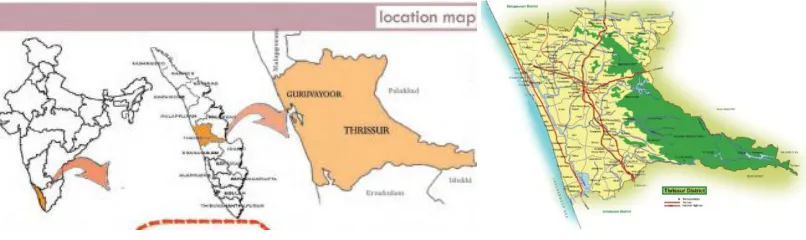
Fig. 1:Location map
Trichur City has a radial pattern with the central temple and streets radiating from it. Trichur Pooram
which has found place in the list of national festivals and world tourism calendar plays the greater role in
modeling the pattern of the urban core. TRICHUR POORAM The most important cultural event of Kerala,
the main procession path of which takes place in the Swaraj round . The round has got a densely lined
that retains the urban core with its ancient traditional character in its planning as well as architecture.
As a reflection of the cultural significant of Trichur majority of the buildings are with balcony so as to
participate in the cultural events. Even now the buildings tend to keep the same grammar in its
architecture.
Unlike other cities and towns of Kerala where urban artifacts deteriorate and is ultimately destroyed
through attack by natural and human agents ,Trichur town is distinctively different from the point of
view of rich cultural values it pocess.The traditional design sensibility cannot be viewed in other towns in
Kerala as much of it has been lost in the process of urbanization. But in Trichur it is in the midst of urban
chaos that we can find so much that we have managed to unconsciously retain: all credits to the cultural
background of the town
The study is divided based on the festivals ,the intangible heritage, the built heritage and socio cultural
conditions. The aim of the study is to understand and quantify the intangible heritage and justify its
existence through the built environments of urban cores in Thrissur. By studying the central urban cores,
within the city, that have been influenced by the presence of religion, culture, trade in varying degrees,
the study aims to highlight the effect of culture on the organisation of space within the city and thus to
provide an understanding of the indigenous pattern of settlements in Thrissur
3.Intangible Cultural Heritage of Thrissur
The main cultural heritage features found in Thrissur and their brief description is listed below
1 THRISSUR POORAM Celebrated every year, in the month of Medam. Thrissur town host the 36 hours long pooram.
Main features of the pooram festival are Ezhunnellippuprogramme, Elanjitharamelam, Madathilvaravu, Kudamattom, spectacular fireworks.etc.
2 MACHATT MAMANKAM A five-day festival celebrated at the MachattuThiruvanikavu temple. The main procession is on the concluding day in which richly
decoratedkuthirakolams are brought to the temple by the Devotees as offerings
3 KOODALMANIKYAM ULSAVAM
The Annual Festival of the Temple held for 11 days in April-May .it starts one day after the famous ThrissurPooram
5 OLLUR PALLI PERUNNAL The most important festival of Ollur church falling on October 23 &24 of each year. The festival was started in 1837
6 PULIKALI A colorful recreational art form which liberally makes use of forms and symbols of nature that finds expression in its bright, bold body painting and high-energy dance movements. A quirky procession of vibrantly painted men in the guise of tigers and panthers romp the Swaraj Road
7 AARATTUPUZHA POORAM The Pooram is known as Devamela as it is a conglomeration of gods, given its massive attendance of deities from neighborhood shrines. deities of various temples from different parts of Thrissur District attend the Pooram and is considered as the oldest temple festival.
8 KODUNGALLUR BHARANI FESTIVAL
The Bharani festival at the KodungallurBhagavati temple is one of the grandest in Kerala. It normally falls between the months of March and April. Kozhikkallumoodal, KavuTheendal, ChandanapotiCharthal.etc. are the important rituals carried out .
9 GURUVAYUR TEMPLE FESTIVAL
The festivities lasts for ten days, celebrated in the month of kumba( feb-mar). Religiously, it is the restoration of divine Chaithanya
10 PUTHENPALLI PERUNNAL The most important festival of Puthan Palli is falling on November last Sunday of each year. The festival was started in 1926
11 BUON NATALE Buon Natale’, a Christmas procession by the Thrissur Archdiocese of the Syro-Malabar Church, entered the Guinness World Records for having the largest number of people dressed up as Santa Claus (Father Christmas).
Table 1: Main Intangible cultural heritage of thrissur
4.Tangible Cultural Heritage of Thrissur
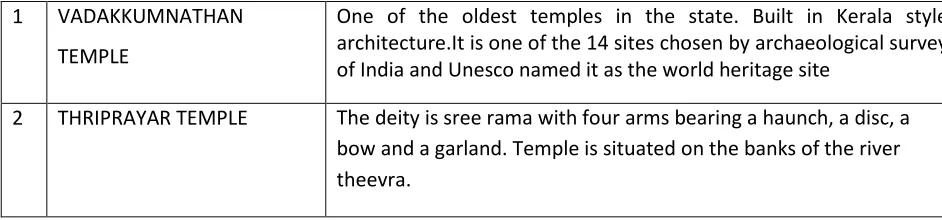
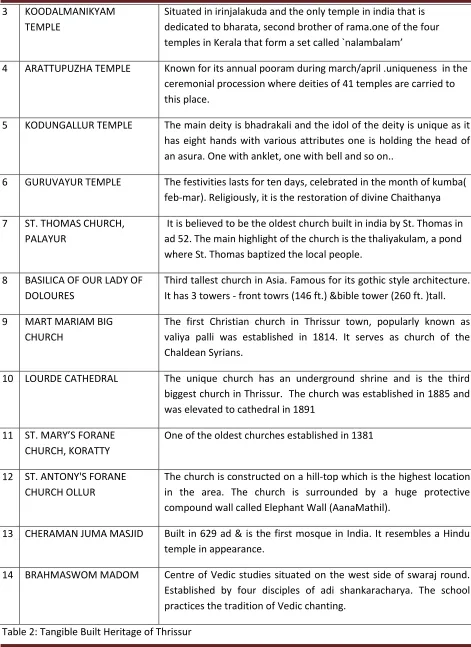
The main tangible heritage found in Thrissur and their brief description is listed below
1 VADAKKUMNATHAN
TEMPLE
One of the oldest temples in the state. Built in Kerala style architecture.It is one of the 14 sites chosen by archaeological survey of India and Unesco named it as the world heritage site
3 KOODALMANIKYAM TEMPLE
Situated in irinjalakuda and the only temple in india that is dedicated to bharata, second brother of rama.one of the four temples in Kerala that form a set called `nalambalam’
4 ARATTUPUZHA TEMPLE Known for its annual pooram during march/april .uniqueness in the ceremonial procession where deities of 41 temples are carried to this place.
5 KODUNGALLUR TEMPLE The main deity is bhadrakali and the idol of the deity is unique as it has eight hands with various attributes one is holding the head of an asura. One with anklet, one with bell and so on..
6 GURUVAYUR TEMPLE The festivities lasts for ten days, celebrated in the month of kumba( feb-mar). Religiously, it is the restoration of divine Chaithanya
7 ST. THOMAS CHURCH, PALAYUR
It is believed to be the oldest church built in india by St. Thomas in ad 52. The main highlight of the church is the thaliyakulam, a pond where St. Thomas baptized the local people.
8 BASILICA OF OUR LADY OF DOLOURES
Third tallest church in Asia. Famous for its gothic style architecture. It has 3 towers - front towrs (146 ft.) &bible tower (260 ft. )tall.
9 MART MARIAM BIG CHURCH
The first Christian church in Thrissur town, popularly known as valiya palli was established in 1814. It serves as church of the Chaldean Syrians.
10 LOURDE CATHEDRAL The unique church has an underground shrine and is the third biggest church in Thrissur. The church was established in 1885 and was elevated to cathedral in 1891
11 ST. MARY’S FORANE CHURCH, KORATTY
One of the oldest churches established in 1381
12 ST. ANTONY'S FORANE CHURCH OLLUR
The church is constructed on a hill-top which is the highest location in the area. The church is surrounded by a huge protective compound wall called Elephant Wall (AanaMathil).
13 CHERAMAN JUMA MASJID Built in 629 ad & is the first mosque in India. It resembles a Hindu temple in appearance.
14 BRAHMASWOM MADOM Centre of Vedic studies situated on the west side of swaraj round. Established by four disciples of adi shankaracharya. The school practices the tradition of Vedic chanting.
5.Samples and procedures
To get the information about what the perceived value of the Local People in Thrissur regarding the
Tangible and intangible Heritage of Thrissur. A Questionnaire survey was conducted. Sample size was
100.The Likert scale was used in this study to get the perceived value which ask people to indicate on a
survey how much they agree or disagree, approve or disapprove, believe to be true or false. Likert scales
were developed in 1932 as the familiar 5 point bipolar response format. When responding to a Likert
questionnaire item, respondents specify their level of agreement or disagreement on a symmetric
agree-disagree scale for a series of statements. A likert scale consists of 5 categories:5-very
important,4-important,3-nuetral,2-unimportant,1-very unimportant . Thus, the range captures the intensity of their
feelings for a given item. Likert scaling assumes that distances on each item are equal. Importantly, "All
items are assumed to be replications of each other or in other words items are considered to be parallel
instruments" In this analysis the score 4-5 was kept as important and 1-2 was kept as unimportant.
CULTURAL FEATURES Gender Number of responses
Not important Neutral important
1 THRISSUR POORAM M 1 1 59
F 3 36
2 MACHATT MAMANKAM M 61
F 39
3 KOODALMANIKYAM ULSAVAM M 61
F 39
4 UTHRALIKKAVU POORAM M 1 60
F 39
5 OLLUR PALLI PERUNNAL M 61
F 39
6 PULIKALI M 7 10 37
F 14 1 31
7 AARATTUPUZHA POORAM M 11 50
F 5 34
F 39
9 GURUVAYUR TEMPLE FESTIVAL M 0 38
F 1 61
10 PUTHENPALLI PERUNNAL M 39
F 61
11 BON NATALE M 1 10 37
F 3 1 48
Table 3:Perceived value of the local residents regarding the cultural Heritage according to gender based on 100 responses( 61 males ,39 females) during Jan2013 –Dec 2013(M=male,F=female)
TANGIBLE FEATURES Gender Number of responses
Not important Neutral important
1 VADAKKUMNATHAN TEMPLE M 61
F 39
2 THRIPRAYAR TEMPLE M 6 2 53
F 2 1 36
3 KOODALMANIKYAM TEMPLE M 61
F 1 38
4 ARATTUPUZHA TEMPLE M 1 61
F 38
5 KODUNGALLUR TEMPLE M 61
F 39
6 GURUVAYUR TEMPLE M 1 60
F 1 38
F 39
8 BASILICA OF OUR LADY OF DOLOURES M 61
F 39
9 MART MARIAM BIG CHURCH M 0 61
F 1 38
10 LOURDE CATHEDRAL M 39
F 61
11 ST. MARY’S FORANE CHURCH, KORATTY
M 1 60
F 1 38
12 ST. ANTONY'S FORANE CHURCH OLLUR
M 1 2 58
F 0 1 38
13 CHERAMAN JUMA MASJID M 1 60
F 3 1 35
14 BRAHMASWOM MADOM M 1 60
F 1 38
Table 4:Perceived value of the local residents regarding the built Heritage according to gender based on 100 responses( 61 males ,39 females) during Jan2013 –Dec 2013(M=male=female)
6.How the Intangible and tangible cultural heritage are valuable to the local community of Thrissur ;Quantitative analysis
The Intangible cultural Heritage value(Likert scale)
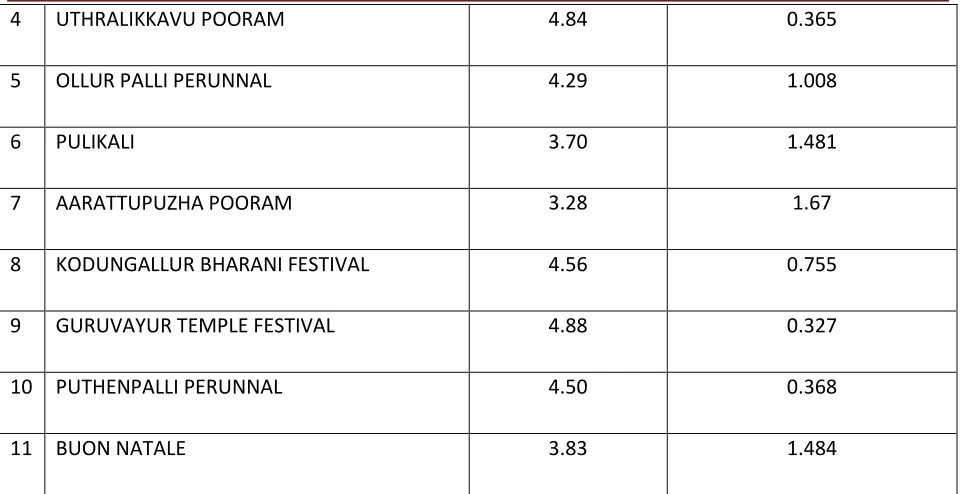
INTANGIBLE CULTURAL HERITAGE MEAN STANDARD DEVIATION
1 THRISSUR POORAM 4.93 0.256
2 MACHATT MAMANKAM 4.98 0.507
4 UTHRALIKKAVU POORAM 4.84 0.365
5 OLLUR PALLI PERUNNAL 4.29 1.008
6 PULIKALI 3.70 1.481
7 AARATTUPUZHA POORAM 3.28 1.67
8 KODUNGALLUR BHARANI FESTIVAL 4.56 0.755
9 GURUVAYUR TEMPLE FESTIVAL 4.88 0.327
10 PUTHENPALLI PERUNNAL 4.50 0.368
11 BUON NATALE 3.83 1.484
Table 5:Average value perception of Intangible cultural heritage
The local residence placed great importance on features related to religion, festivals including activities
related to their religion and culture Pulikali, Aarattupuzha pooram, Buon natale were ranked relatively
low this may be due to the influence of modernization.Thrissur Pooram however seems to be
considered as most important than the rest of the Festivals
The Tangible Built Heritage value(Likert scale)
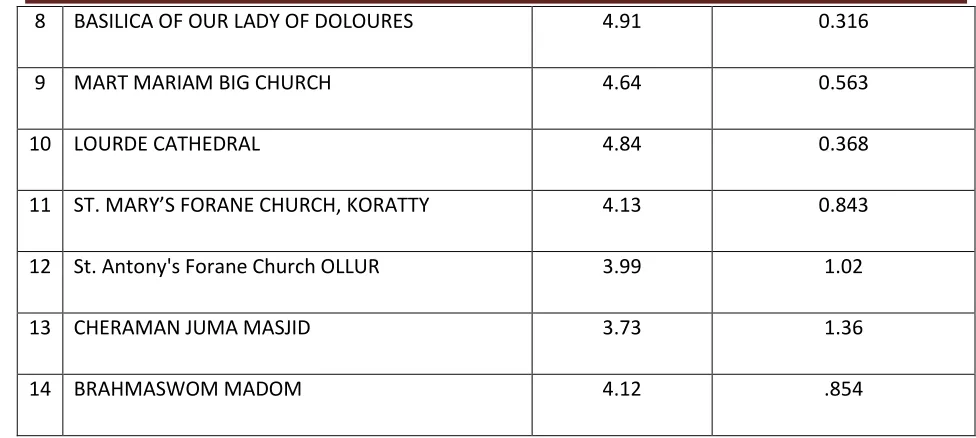
TANGIBLE CULTURAL HERITAGE MEAN STANDARD .DEVIATION
1 VADAKKUMNATHAN TEMPLE 4.94 0.278
2 THRIPRAYAR TEMPLE 3.83 1.13
3 KOODALMANIKYAM TEMPLE 4.84 0.368
4 ARATTUPUZHA TEMPLE 4.8 0.419
5 KODUNGALLUR TEMPLE 4.88 0.398
6 GURUVAYUR TEMPLE 4.03 0.971
8 BASILICA OF OUR LADY OF DOLOURES 4.91 0.316
9 MART MARIAM BIG CHURCH 4.64 0.563
10 LOURDE CATHEDRAL 4.84 0.368
11 ST. MARY’S FORANE CHURCH, KORATTY 4.13 0.843
12 St. Antony's Forane Church OLLUR 3.99 1.02
13 CHERAMAN JUMA MASJID 3.73 1.36
14 BRAHMASWOM MADOM 4.12 .854
Table 6:Average value perception of Tangible cultural heritage
The local residence placed great importance on almost all the tangible built heritage with almost the
same importance
7. Concluding remarks
The research has tried to establish the in depth relationship between the cultural values and the built
environments of traditional urban cores of cultural capital of Kerala. From this research, an effort is
made to make explicit the inevitable definition of the tangible heritage by the intangibles in traditional
Indian built environments, so as to evolve a humane approach towards spatial design of emerging built
environments .Thus, for a sustainable development, integration of tangible and intangible heritage in
traditional urban cores, in terms of their spatial configurations and user preferences are inevitable.It is
not necessary to emulate the past but to contribute positively to the evolution of contemporary Indian
built environments; one can explore the configuration understanding the reasons behind it and
integrate the cultural human aspects for the future sustainability of the cities. Thus, this approach which
is based on understanding and integrating the cultural preferences to study/ conserve/ redevelop
existing built environments or design totally new built environments in case of developing cities of India;
References
[1] Karimi Kayvan.(1997)’The Spatial Logic of Organic cities in Iran and the United Kingdom’, Space Syntax First International Symposium Proceedings, London ,Volume I.
[2] Akagawa N,Sirisrisak T.(2005) ‘Intangible heritage in Urban planning process ,case study: Chao Pharya Riverscape,Thailand’, 8th International conference of the Asian planning Schools Association Proceedings, Tokyo.
[3] Aplin G.(2002) Heritage: Identification, Conservation and management Singapore, London: Oxford University Press.
[4] Garcia I,Giuliani F& Wiesenfield E.(2000)’Definition of Community as a bearer of intangible cultural heritage’, Journal of Community Phycology, Vol.27,pp.727-740.
[5] Hall C.M &McArthur S,(2008) Integrated Heritage Management: Principles and Practice, London : The Stationary Offices.
[6] Richard H,(2008)Heritage conservation Districts :Moving Towards comprehensive approach towards defining sense of place and Character , Retrieved from Pro Quest Digital dissertations.
[7] Rose Ch. E,(2008)Culture: Assessing the relationship among cultural heritage, organizational culture, and organization’s environment :A comparative exploratory investigation of the united states of Canada , Retrieved from Pro Quest Digital dissertations.
[8] UNESCO (2007) Intangible Heritage :Social practices ,rituals and festival events, (online),Available:http:/www.unesco.org.culture/ich/index.php.